Vue normale

  • ✇Euromaidan Press
  • Ukraine’s new Tu-95 killer is a $48,000 copy of a drone China refused to sell
    Ukraine's state security service has its own special attack drone The MICH 2000 is a highly evolved copy of a Chinese drone China refused to sell There are at least eight versions of the 2,000-km drone, from $48,000 On 16 July, one-way attack drones from the Ukrainian state security service—the vaunted SBU—motored 800 km to strike Engels-2 air base in western Russia. At the time, there were reportedly five bombers on the ground at the base: four Tupolev Tu-22M
     

Ukraine’s new Tu-95 killer is a $48,000 copy of a drone China refused to sell

Par : David Axe
13 août 2026 à 13:01

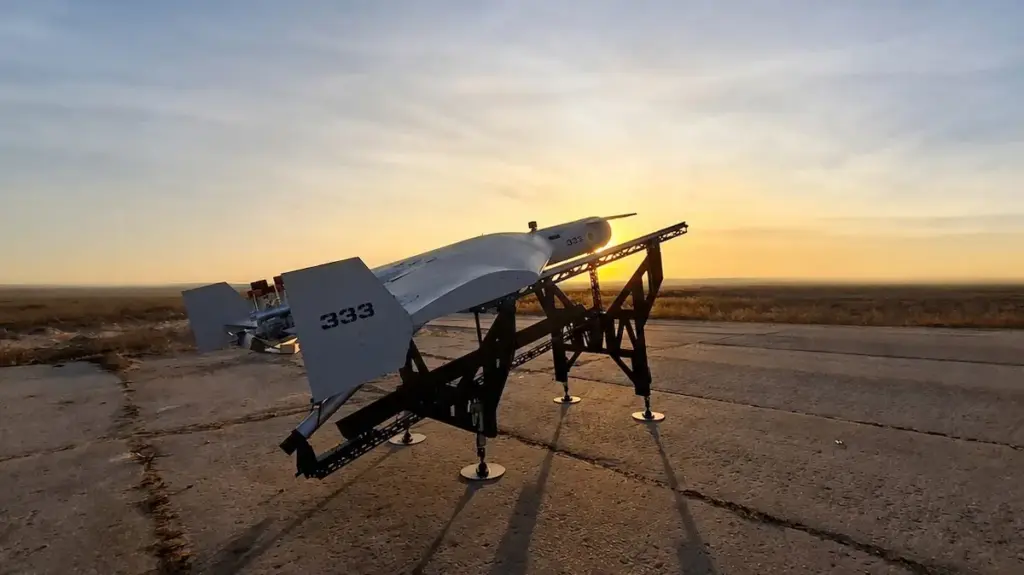
The MICH 2000 drone can fly up to 2,000 km and carry a warhead weighing up to 60kg. Photo courtesy of the manufacturer

  • Ukraine's state security service has its own special attack drone
  • The MICH 2000 is a highly evolved copy of a Chinese drone China refused to sell
  • There are at least eight versions of the 2,000-km drone, from $48,000

On 16 July, one-way attack drones from the Ukrainian state security service—the vaunted SBU—motored 800 km to strike Engels-2 air base in western Russia. At the time, there were reportedly five bombers on the ground at the base: four Tupolev Tu-22Ms and a single Tupolev Tu-95.

The drones struck the four-engine, propeller-driven Tu-95. "According to preliminary data, the plane suffered critical damage," the SBU claimed. "It completely tore off the tail part." That particular aircraft, the SBU added, had been used systematically to launch massed missile strikes on Ukraine. Satellite imagery later confirmed the bomber's destruction.
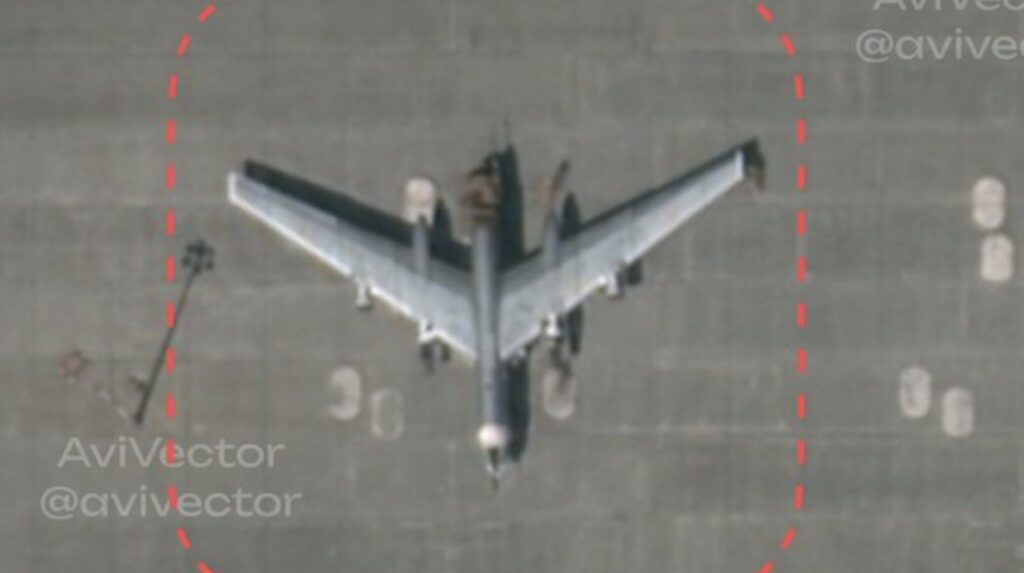
The destroyed Tu-95.
The destroyed Tu-95. Satellite imagery via AviVector.

Nearly a month later, we finally know which drone type the SBU flung at Engels-2 and its parked bombers. They were MICH 2000s—Ukrainian aircraft that began as copies of the Chinese ZTK-150, built after Beijing stopped selling. Ukrainian website Oboronka, which visited the factory, broke the news. "Today, the Mich' is no longer just a Chinese plane, but a drone that is exclusively used by the SBU Special Operations Center 'Alpha.'"

According to Oboronka, whose report was agreed in advance with the manufacturer and the SBU, the MICH 2000 flies as far as 2,000 km with a warhead weighing 25 to 60 kg. "The list of targets hit by this drone is updated every week," Oboronka noted. They include Russian ports, military and industrial sites around Moscow and Engels-2.

The Engels-2 raid might be the most immediately impactful. After the 16 July raid, the Russians may be down to 43 Tu-95s, only a dozen of which are usually active at any given time.

The mysterious Shahed like Ukrainian drone that has been repeatedly spotted during strikes deep inside Russia finally has a name: MICH 2000.

Until now, almost nothing was publicly known about it. The drone is used exclusively by the SBU’s Alpha unit, can fly up to 2,000 km and… https://t.co/yUHIXEjvLl pic.twitter.com/HT59LiigrI

— Special Kherson Cat 🐈🇺🇦 (@bayraktar_1love) August 12, 2026

The plane that came from China

The MICH 2000 started as someone else's drone. In the summer of 2023, Beijing restricted exports of the civilian aircraft Ukrainian units had been buying and converting into deep-strike munitions. At the end of that year, a team of Ukrainian developers flew to China to buy some anyway.

At the factory, they found dozens of ZTK-150s coming off the line—Shahed lookalikes distinguished mainly by a pair of forward canards. The Chinese intermediaries floated selling the production technology outright, and Ukrainian commanders liked the idea. But when the team came back ready to buy, the factory's management refused.

The intermediaries wanted the deal anyway. They offered to assemble the drones somewhere without export restrictions—and to train Ukrainian pilots. The team took the training. "We came there to teach pilots to fly Chinese drones," one member told Oboronka. "And in parallel with the training we photographed everything that was there. Everything from the production process to the arrangement of the shelves and cabinets." They flew home with trained pilots and eight Chinese drones.

Two years later, the Ukrainian version costs $48,000 in its basic configuration. The Chinese original costs $50,000. And according to the manufacturer, almost nothing of the Chinese drone survives in the MICH 2000 now except its outline.

Whittling down the bomber fleet

Ukrainian drones are slowly chipping away at the Tu-95 fleet. A 2022 drone raid badly damaged one of the lumbering turboprop bombers at Engels-2, potentially leaving no more than 51 intact Tu-95s in the Russian air force inventory at the time. Smuggling tiny explosive drones across Russia in trucks on 1 June, 2025, the SBU hit at least seven more Tu-95s as well as four Tu-22Ms, among other aircraft.

The 16 July raid is the more recent Ukrainian effort to shrink the Russian bomber force, but it surely won't be the last. The Russians' roughly 120 bombers—Tu-95s, Tu-22Ms and Tupolev Tu-160s—launch the cruise missiles that routinely blast Ukrainian cities and power plants.

Struggling to intercept all Russian deep strike munitions in the target zone, in part owing to a deepening shortage of the best air defense missiles, Ukrainian forces increasingly aim to prevent the Russian munitions from even launching—by smashing munitions factories or, yes, destroying irreplaceable bombers. Of the three Russian bomber types, just one—the Tu-160—is still in production, albeit at a rate of barely just one every year or two.
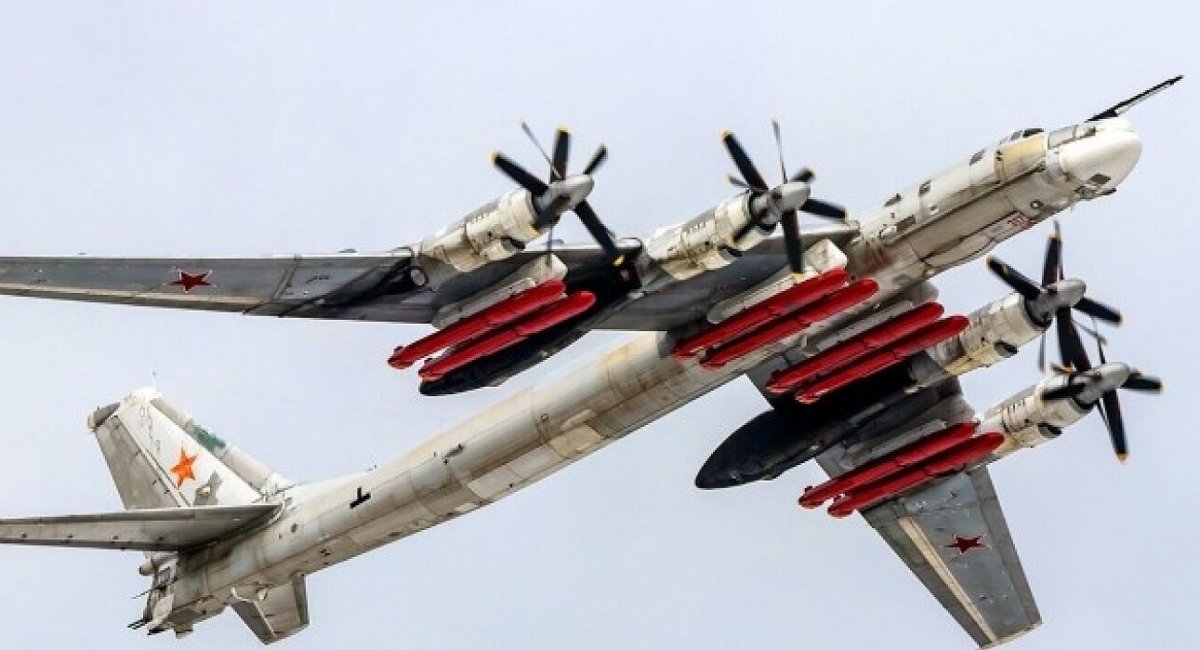
Russian strategic bomber TU-95 carrying Kh-101 missiles. Source: Defense Express
Explore further

Ukraine kills bomber inside Russia. Soviet Union stopped building them decades ago — so this one is gone for good

Expect more MICH 2000 raids. The type's anonymous builder churns out 6,000 MICH 2000s a year but aims to boost output to 10,000 a year. And the firm customizes the drones to suit particular missions.

According to Oboronka, there are eight main versions. "Fighters can choose what kind of communication they need: analog, digital or Starlink. They can choose the warhead, the size of the fuel tank, the possibility of additional guidance." The navigation system can be made more jam-proof by adding additional jam-resistant controlled reception pattern antennas.
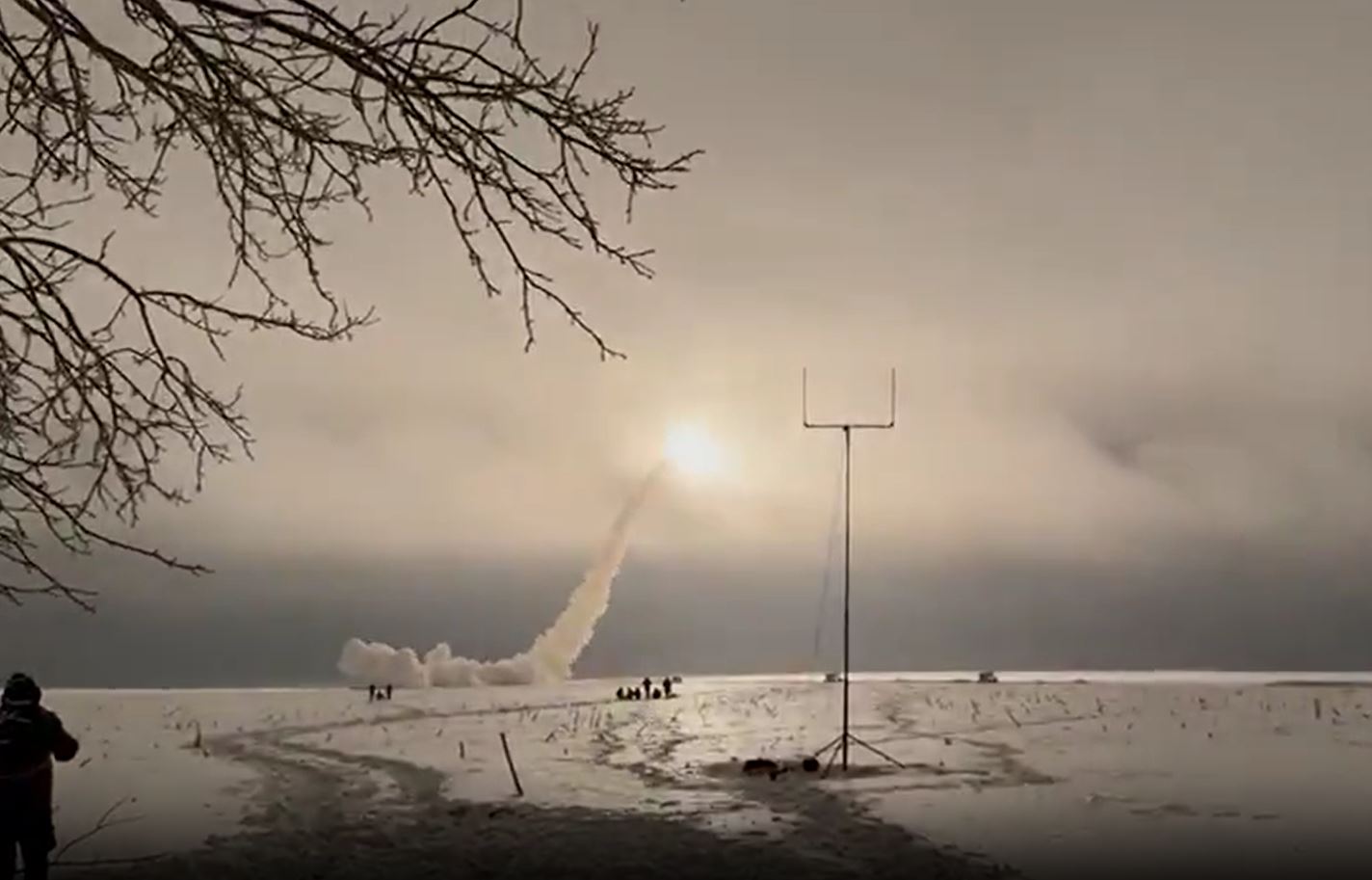
flamingo vs oreshnik ukraine's genstaff now details damage russia's launch site · post fp-5 cruise missile targeting kapustin yar test range ukraine confirmed ballistic infrastructure previous strikes astrakhan oblast intermediate-range
Explore further

Russia has figured out how to stop Ukraine’s most powerful missile

Drone strikes by MICH 2000s and other drone types aren't the only ways Ukrainian forces are trying to blunt Russian attacks on Ukrainian cities and power plants. Ukrainian drone teams are also trying to take out the last five warships in the battered Russian Black Sea Fleet that can fire Kalibr cruise missiles.

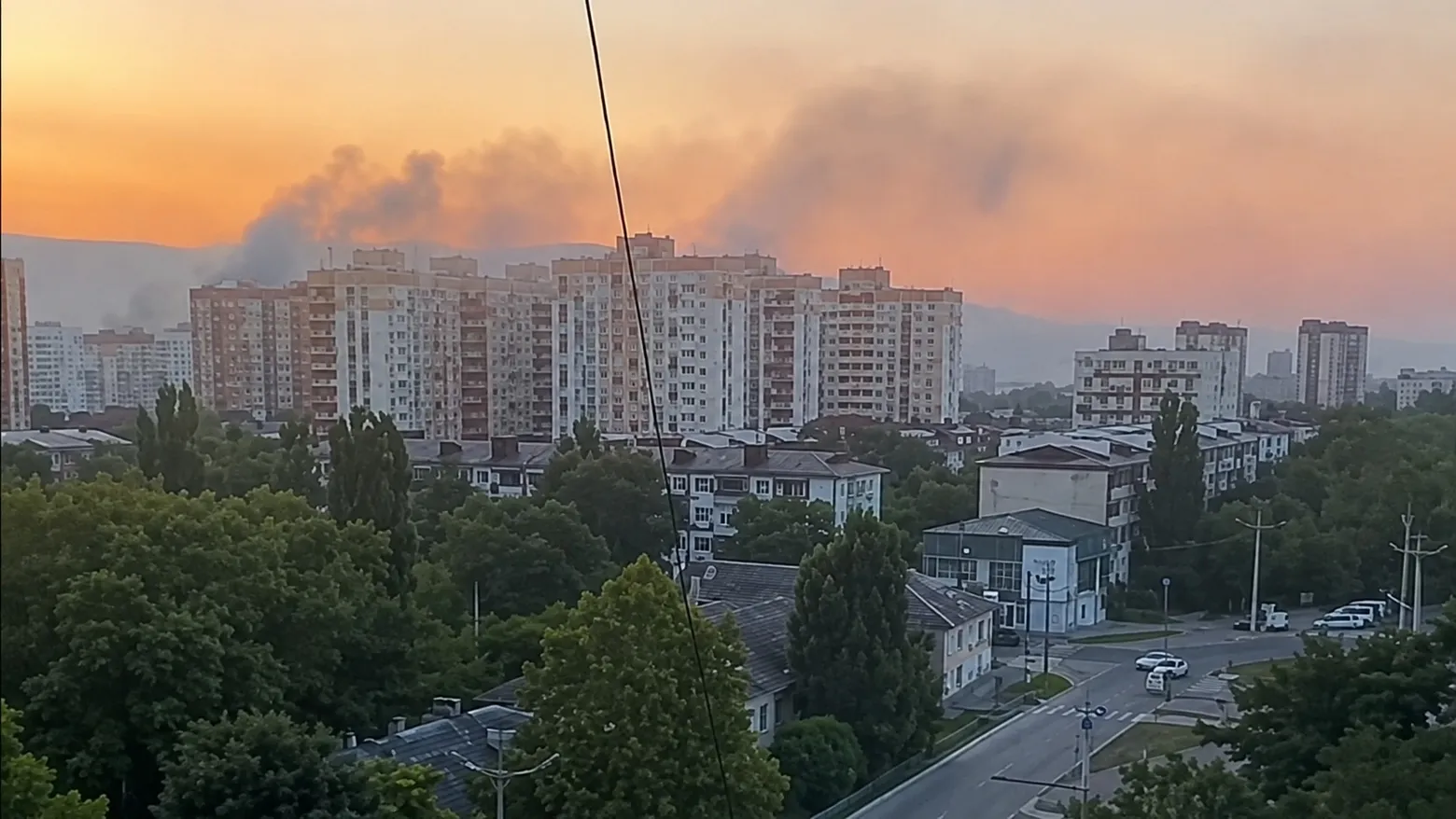
On 11 August, drones struck at least three of the ships in the port of Novorossiysk in southern Russia. The frigates Admiral Essen and Admiral Makarov and the corvette Bykov all suffered visible damage.
  • ✇Euromaidan Press
  • Blackout and a blinded radar: Ukraine hits Russian military infrastructure across Crimea and beyond
    Ukraine’s Defense Forces struck a Russian Nebo-U long-range radar in occupied Sevastopol and several other military targets in Russia and occupied Ukrainian territories during a series of overnight attacks on 13 August, the General Staff of Ukraine’s Armed Forces reported. The strikes are part of Ukraine’s broader “Middle-Strike” campaign, which targets Russian military infrastructure beyond the immediate front line. Nebo-U radar hit in Sevastopol The most signifi
     

Blackout and a blinded radar: Ukraine hits Russian military infrastructure across Crimea and beyond

13 août 2026 à 12:06

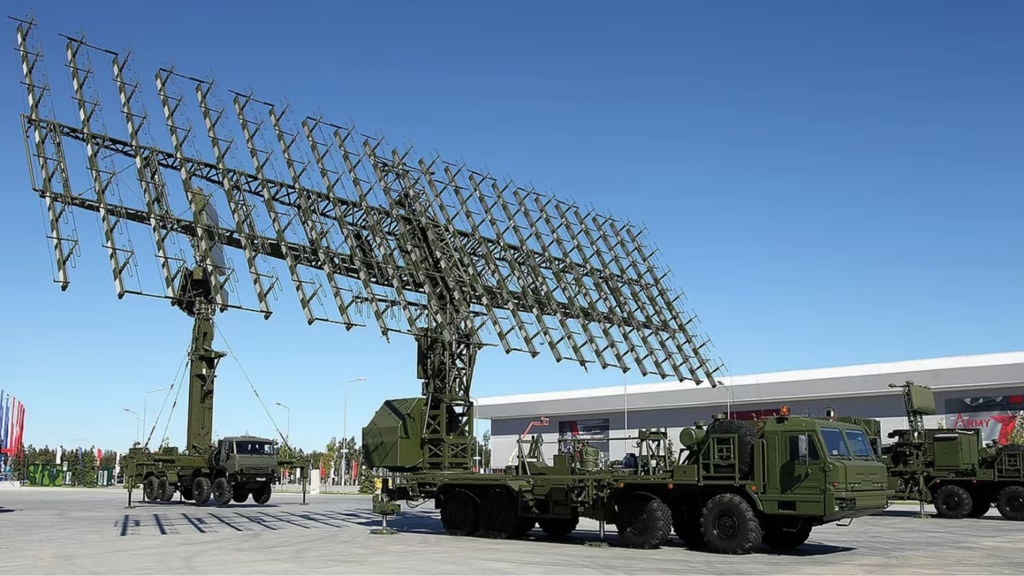
Russian Nebo-U radar station. Photo: Russian media

Ukraine’s Defense Forces struck a Russian Nebo-U long-range radar in occupied Sevastopol and several other military targets in Russia and occupied Ukrainian territories during a series of overnight attacks on 13 August, the General Staff of Ukraine’s Armed Forces reported.

The strikes are part of Ukraine’s broader “Middle-Strike” campaign, which targets Russian military infrastructure beyond the immediate front line.

Nebo-U radar hit in Sevastopol

The most significant overnight target was a Russian Nebo-U radar station in Sevastopol, occupied Crimea.

The Nebo-U is a Russian long-range, three-coordinate radar operating in the meter wavelength range. It is designed to detect and track airborne targets, including aircraft, cruise missiles, and ballistic missiles.

The General Staff said disabling the radar weakens Russia’s ability to detect and track incoming aircraft, cruise missiles, and ballistic missiles, potentially making it harder for Russian forces to detect future Ukrainian strikes and giving Ukrainian weapons a better chance of reaching their targets.

The Nebo-U is estimated to cost around $100 million, making it a high-value Russian surveillance system.

The radar strike supposedly came during a broader Ukrainian drone attack on Sevastopol that also damaged energy infrastructure, according to Russian occupation authorities. The attack caused a citywide blackout before power was later restored through a temporary setup. Ukrainian drones also reportedly targeted the Balaklava power plant, one of Crimea’s two main power stations.

Earlier strikes hit Crimean military infrastructure

The General Staff also reported strikes on Russian military infrastructure in occupied Crimea on 12 August, including a control tower at the Saky airfield.

Ukrainian forces also struck a communications relay near Chornomorske used to control Russian Geran and Gerbera strike drones, according to the General Staff. It said the strikes weaken Russia’s ability to operate the military airfield and control its attack drones.

Russian logistics and supply sites targeted

Ukrainian forces also struck a Russian drone control center near Myrne in occupied Zaporizhzhia Oblast, a fuel and lubricants depot near Dovzhansk in occupied Luhansk Oblast, and an ammunition depot near Novyi Hai in occupied Zaporizhzhia Oblast.

Another strike hit a Russian logistics and equipment depot near Kalanchak in occupied Kherson Oblast.

The General Staff said these strikes disrupt Russian logistics and reduce the military’s ability to accumulate and use ammunition, equipment, and personnel.

Strike reported inside Russia

Ukraine also reported striking a Russian personnel concentration area near Butyrky in Russia’s Belgorod Oblast.

The General Staff did not provide details on the weapons used, the scale of damage, or possible casualties at the individual sites.

The latest report is part of Ukraine’s continued campaign to strike Russian military infrastructure beyond the battlefield. The “Middle-Strike” concept focuses on targets that support Russia’s ability to conduct and sustain combat operations, including command, logistics, air defense, and other military facilities.

The General Staff said Ukrainian forces continue to carry out strikes against key Russian military targets.

  • ✇Euromaidan Press
  • Is a fifth or well over half of Wildberries gone—or can both counts be right?
    Since mid-July, Ukrainian drones have burned their way through the warehouses of Wildberries, Russia’s answer to Amazon, and how much of it is gone has become a question with too many answers.Estimates in circulation range from a fifth of the company’s network to well over half, and they clash because each counts something different. Only by sorting out what each figure measures can you see what the campaign has actually done—and what it has done is heavier, where it co
     

Is a fifth or well over half of Wildberries gone—or can both counts be right?

13 août 2026 à 11:38

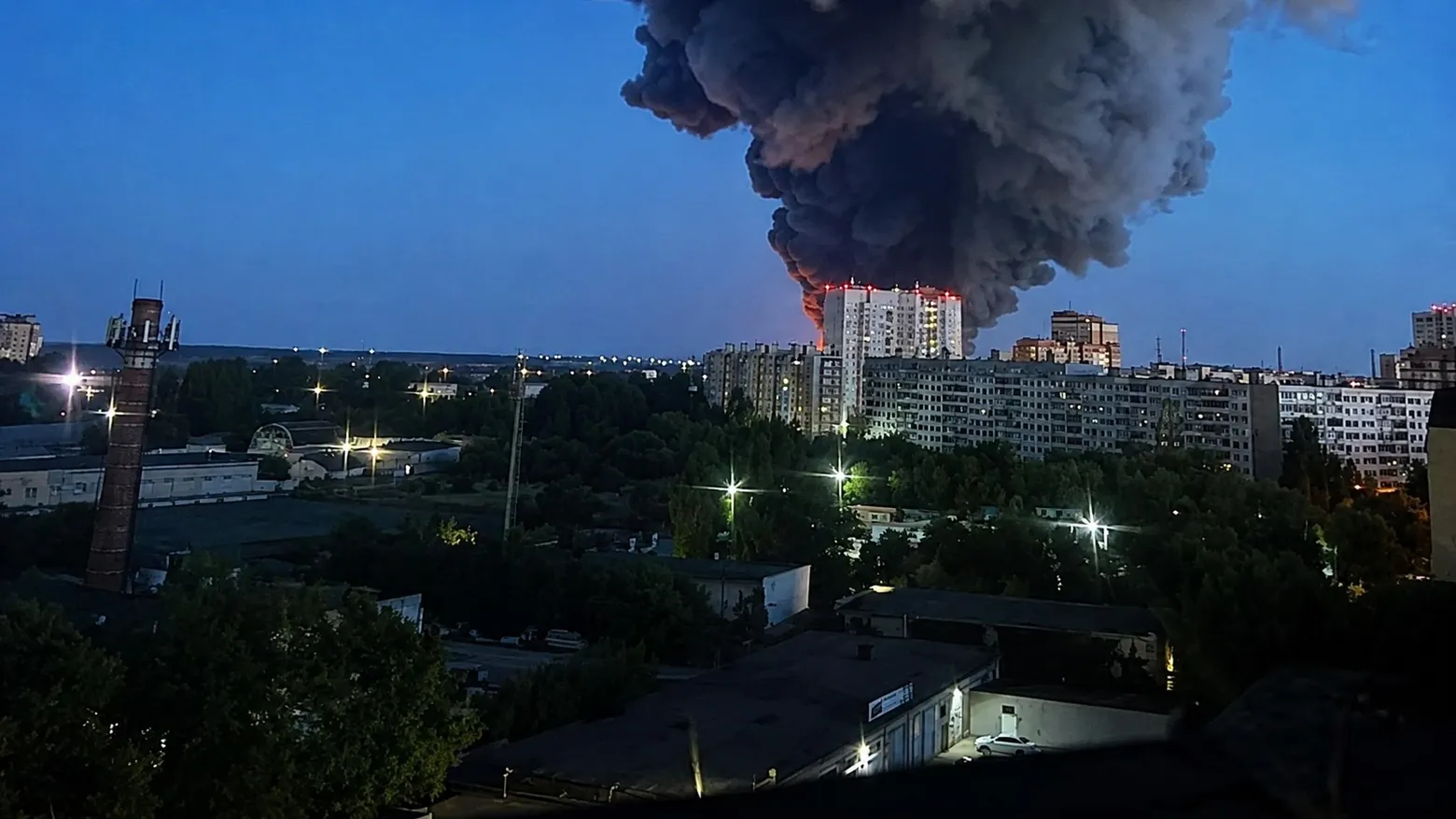
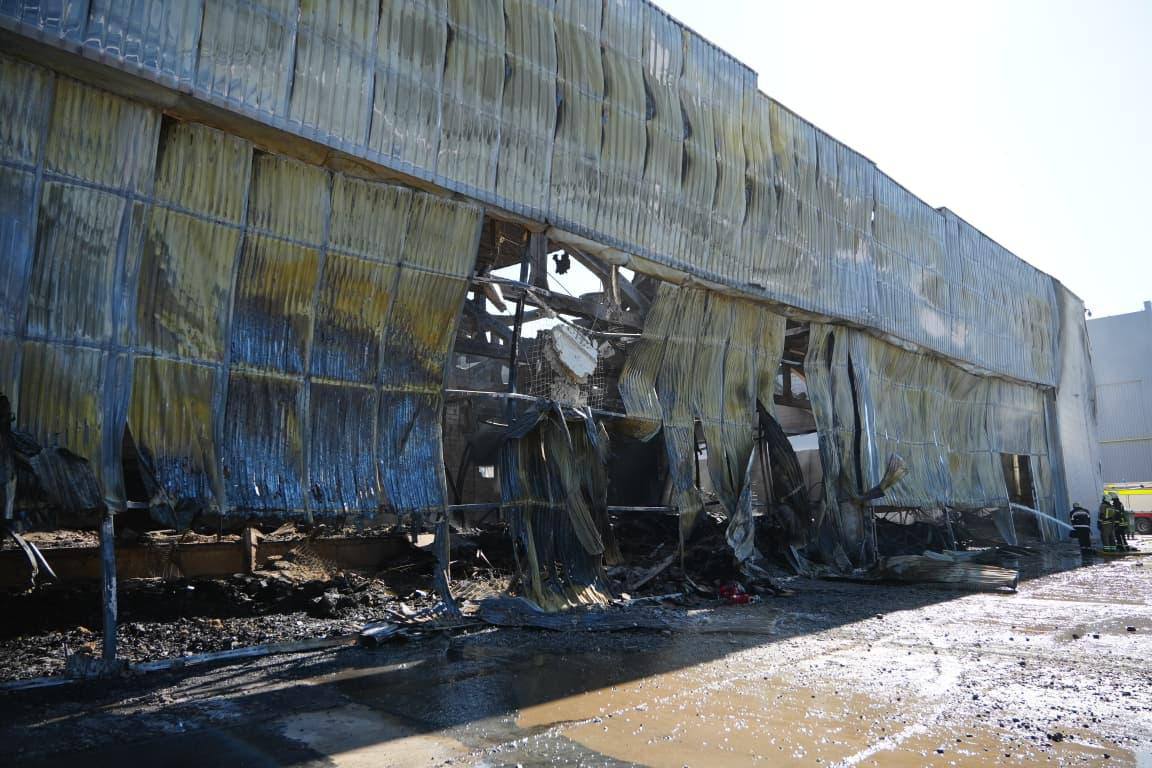
logistics centre in Bashkortostan, Russia,

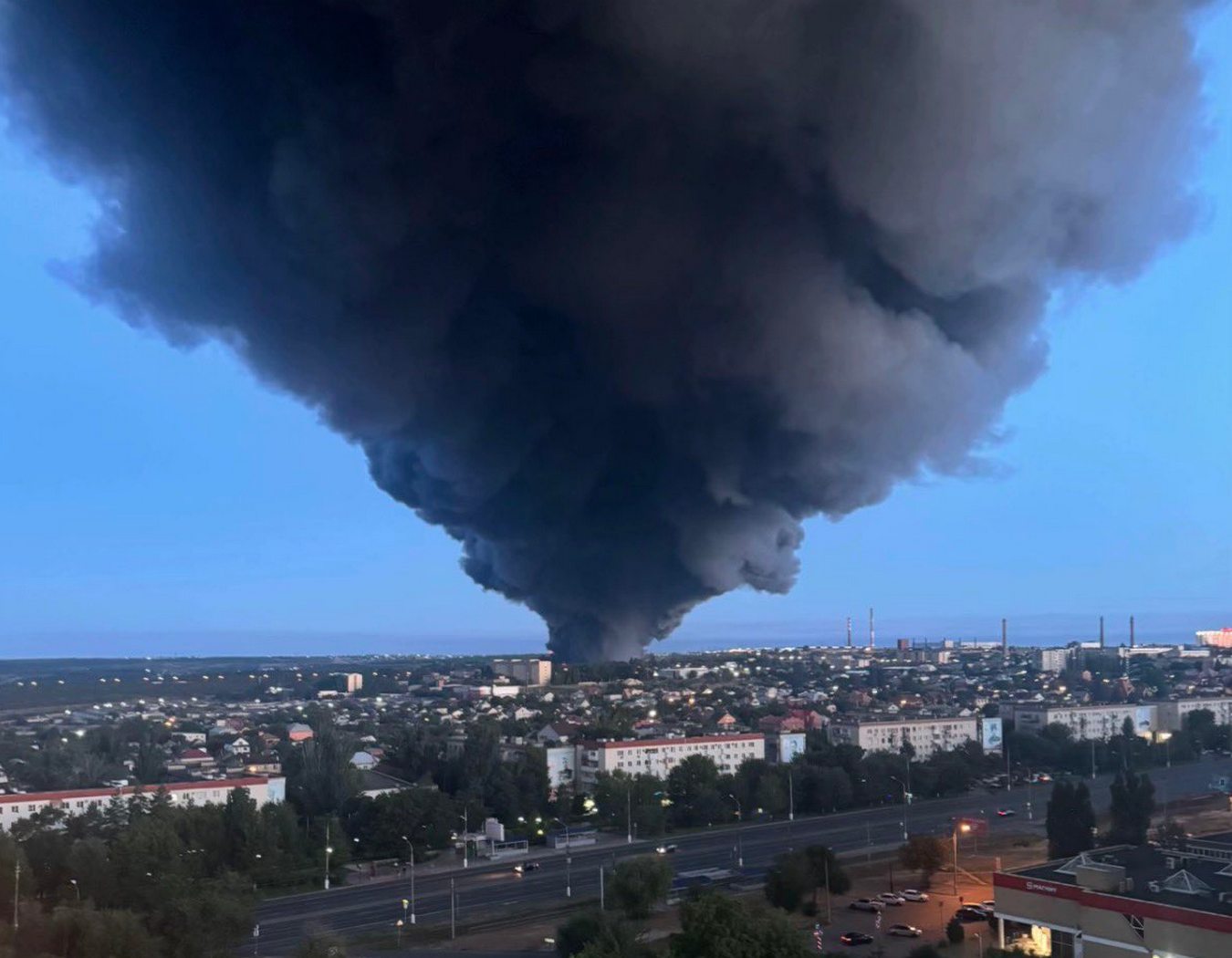
Since mid-July, Ukrainian drones have burned their way through the warehouses of Wildberries, Russia’s answer to Amazon, and how much of it is gone has become a question with too many answers.

Estimates in circulation range from a fifth of the company’s network to well over half, and they clash because each counts something different.

Only by sorting out what each figure measures can you see what the campaign has actually done—and what it has done is heavier, where it counts, than the modest numbers suggest.

Ukraine has concentrated its drones on a couple of dozen hubs that move most of the goods, while the hundreds of small depots that pad the total remain mostly untouched.

Wildberries’ network is scattered across hundreds of small sorting points that would hardly be missed if one burned.

Wildberries is no marginal target. Nearly half of everything Russians buy online runs through it, a marketplace as woven into daily life there as Amazon is in the West. And Kyiv is not burning it for the sneakers.

Estonian military intelligence reports that Wildberries, though not a military firm, supplies the Russian armed forces with kit bought straight off the platform—body armor and drone parts—a case Ukraine makes too. Wildberries denies it.

Yet once the strikes began, the company pulled its “SVO” tag, the label that had gathered those goods in one place, while the goods stayed on sale under other categories; it also barred warehouse workers from carrying camera phones.

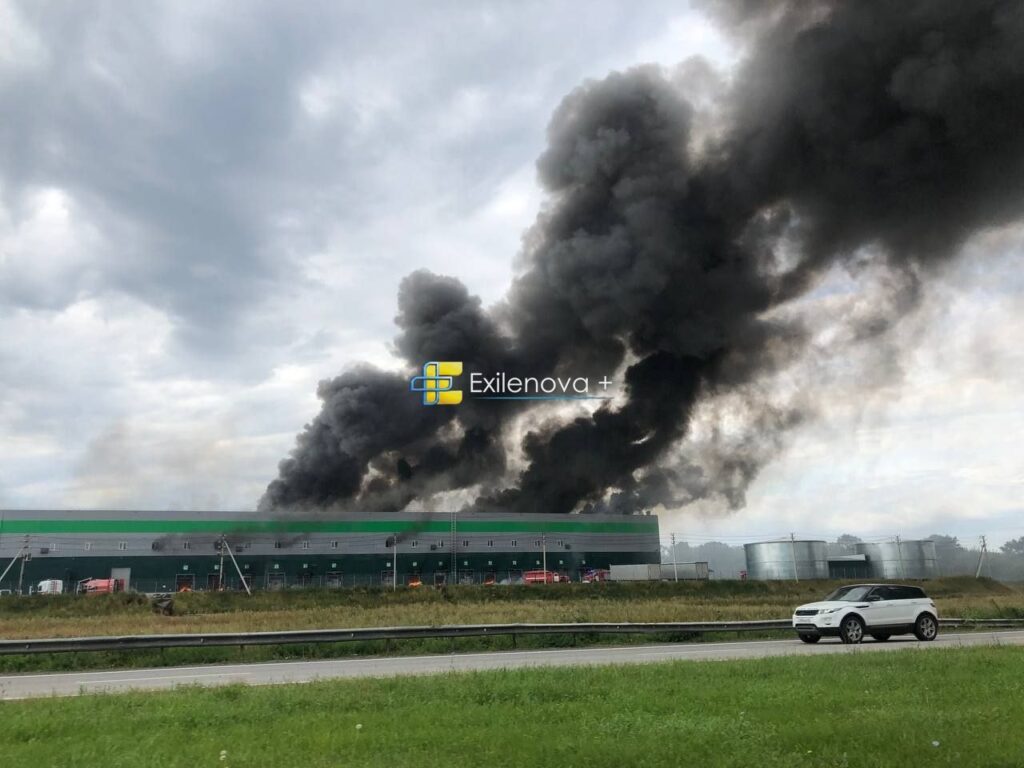
drones hit volgograd kept flying 1100 km tatarstan · post large fire black smoke over russia after ukrainian drone strike wildberries logistics center 31 2026 exilenova+ ukraine news reports
Explore further

Russia’s largest retailer is taking cameras away from its own workers month after eight of its warehouses burned

Count the hubs, and the damage jumps

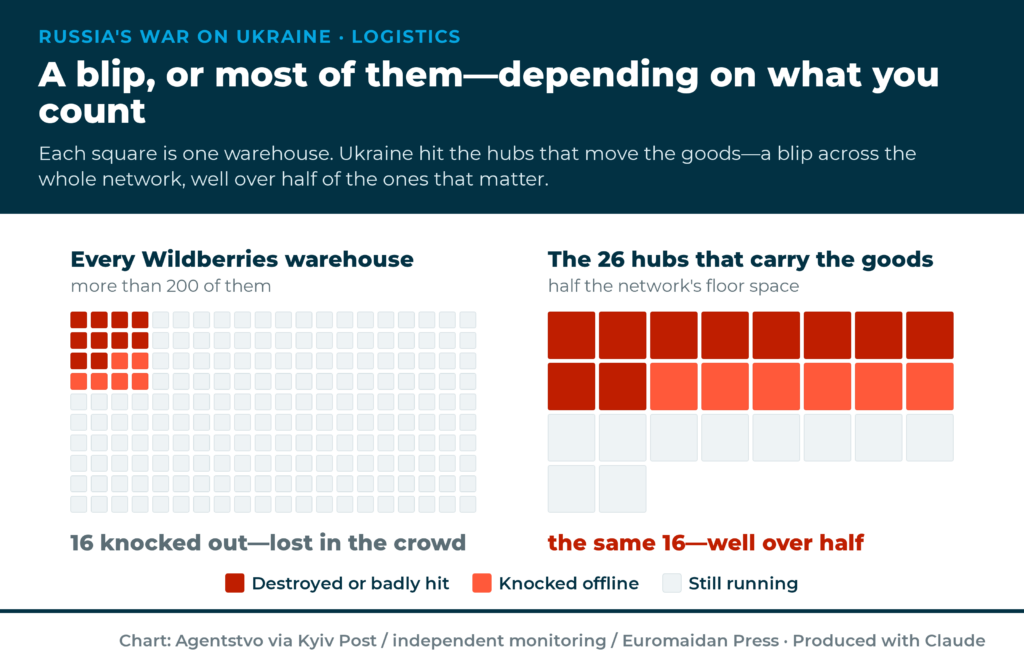
The clash comes down to the word “network.” Most of Wildberries’ floor space is scattered across small sorting points that would hardly be missed if one burned. Set the damage against all of it, and the loss—about a fifth—looks minor.

But the parcels move through these two dozen hubs that hold more than half the company’s space, and those are the ones Ukraine has hit: more than a third are damaged, and by another count, well over half are out of action. It is the same campaign counted in two ways, and only the second shows its aim.

The gap between a building’s size and its damage is easy to miss, and the biggest hub shows how. Koledino, outside Moscow, covers more than 200,000 square meters, and that number keeps getting logged as a loss.

It shouldn’t be. When a drone came down there on 28 July, the fire took a neighboring warehouse—a separate operator that stocks shelves for chains like Lenta and Auchan—while the Wildberries hub kept working.

depending on how to count, ukraine has taken out either a fifth or well over half wildberries warehouses
Ukraine has concentrated its drone strikes on the major hubs that move most of Russia's goods. Measured against all 200-plus Wildberries warehouses, the damage looks like a blip; measured against the largest hubs, it takes out well over half. Chart: Agentstvo via Kyiv Post / independent monitoring / Euromaidan Press · Produced with Claude

Damage reaches beyond the warehouses

The Wildberries strikes are one arm of a declared campaign. On 25 June, Zelenskyy announced a 40-day operation to pressure Russia to end the war.

The warehouse strikes began on 18 July near Moscow and have since spread across a dozen regions, reaching as far as Yekaterinburg in the Urals.

The cost runs beyond floor space. At least eight people have been killed in the strikes so far—warehouse staff and residents caught near the hubs when the drones came down. And the pressure is pushing the company outward: Wildberries is scouting for storage in Kazakhstan, hunting warehouse space beyond the reach of Ukrainian drones.

drones hit volgograd kept flying 1100 km tatarstan · post large fire sends up black smoke over russia after ukrainian drone strike wildberries logistics center 31 2026 x/@bayraktar_1love bayraktar_1love hoivgso
Explore further

Ukraine’s strikes gave Kazakhstan leverage over Russian retail giant Wildberries

The fires have become a line in Russia’s budget. The Kremlin is weighing state loans to keep Wildberries upright—at a point when the federal deficit had, halfway through 2026, already outrun the shortfall the Treasury set aside for the entire year.

Oil and gas revenue, the Kremlin’s main source of war funding, keeps falling short. Russia appears unwilling to let a company this central fail. Paying to save it, hub by burned hub, is the bill Ukraine is now handing Moscow.

Two Kalibr-carrying frigates, a missile ship, a patrol vessel: Ukraine hit four Russian warships in one night at Novorossiysk

12 août 2026 à 16:38

'Admiral Makarov' in 2020

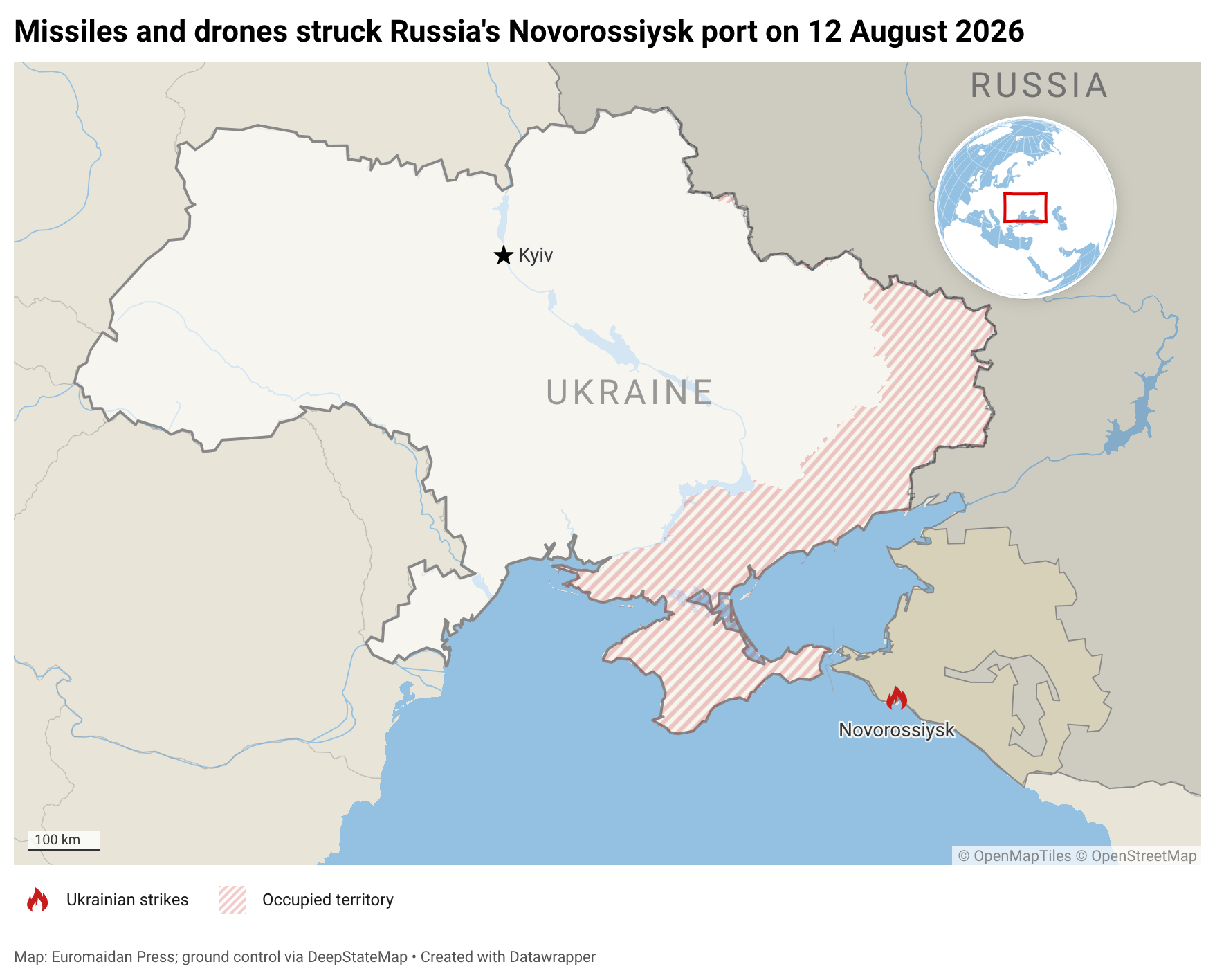
Ukraine reached the port where Russia's Black Sea Fleet took shelter and hit four of its warships. On the night of 12 August 2026, in a joint operation, Ukraine's Defense Forces struck the naval base at Novorossiysk in Russia's Krasnodar Krai, the General Staff reported.

Novorossiysk became Russia's main Black Sea naval base after Ukrainian strikes and sea drones drove the fleet out of occupied Sevastopol in Crimea, so reaching its warships there strikes at the refuge that was supposed to be safe.

The ships that were hit

The four vessels are among the fleet's more capable surface combatants. The two Project 11356 frigates, Admiral Makarov and Admiral Essen, are among the newest and most important surface ships Russia has kept in the Black Sea, both capable of launching Kalibr cruise missiles at Ukraine.

The Buyan-M is another Kalibr shooter. The Project 21631 small missile ship carries the same cruise missiles Russia fires at Ukrainian cities, and the Vasily Bykov is a patrol ship of the class Ukraine has struck before, so the strike damaged both major missile-carrying combatants and a patrol vessel in one night.

The overall damage at the base is still being assessed.

The fleet has no safe harbor left

The strike extends a campaign that has steadily pushed Russia's fleet eastward and out of action. Ukraine drove the Black Sea Fleet from Sevastopol without a navy of its own, using drones and missiles, forcing Russia to pull its ships back to Novorossiysk, farther from Ukraine but not out of reach.

This means that Russia holds no waters it can use and now no harbor where its ships are safe. Ukraine's Defense Forces said they consistently reduce Russia's capacity to continue its armed aggression, and damaging four warships at their fallback base is the naval form of that pressure.

  • ✇Euromaidan Press
  • Russia has figured out how to stop Ukraine’s most powerful missile
    Russia has found a way to defeat Ukraine's Flamingo cruise missiles Russian air force A-50U radar planes see the missiles coming One mapper counts 10 of the last 11 Flamingos shot down Russia has been shooting down most of Ukraine's best long-range cruise missiles as fast as Ukraine can launch them. Just one or two of the $500,000 Fire Point FP-5 Flamingo missiles have hit their targets in recent weeks. That means Russian air defenses are working for now.
     

Russia has figured out how to stop Ukraine’s most powerful missile

Par : David Axe
12 août 2026 à 16:29

flamingo vs oreshnik ukraine's genstaff now details damage russia's launch site · post fp-5 cruise missile targeting kapustin yar test range ukraine confirmed ballistic infrastructure previous strikes astrakhan oblast intermediate-range

  • Russia has found a way to defeat Ukraine's Flamingo cruise missiles
  • Russian air force A-50U radar planes see the missiles coming
  • One mapper counts 10 of the last 11 Flamingos shot down

Russia has been shooting down most of Ukraine's best long-range cruise missiles as fast as Ukraine can launch them. Just one or two of the $500,000 Fire Point FP-5 Flamingo missiles have hit their targets in recent weeks.

That means Russian air defenses are working for now. Whether they'll continue to work is the critical question for Ukrainian strike planners.

Under the cover of darkness on 6 August, the Ukrainian army's 19th Missile Brigade launched at least three of the six-ton, jet-propelled Flamingos toward Tyumen Oblast in western Siberia. The missiles traveled around 2,500 km before disappearing, according to mapper AMK Mapping.

The apparent shoot-downs capped a difficult week for Ukraine's deep strike campaign. AMK Mapping claimed the Russians shot down 10 of 11 launched Flamingos since 1 July. That count is one mapper's, based on open-source tracking, and no official Ukrainian or Russian figures exist to check it against.

Approximate flight route of the 5 Ukrainian FP-5 Flamingo cruise missiles.

They disappeared over Tyumen Oblast, likely after being shot down once again by Russian air defence.

Once again, the missiles followed the path of major rivers at low altitude in order to complicate… https://t.co/8xbymN3dap pic.twitter.com/Rc17wrQI1X

— AMK Mapping 🇳🇿 (@AMK_Mapping_) August 6, 2026
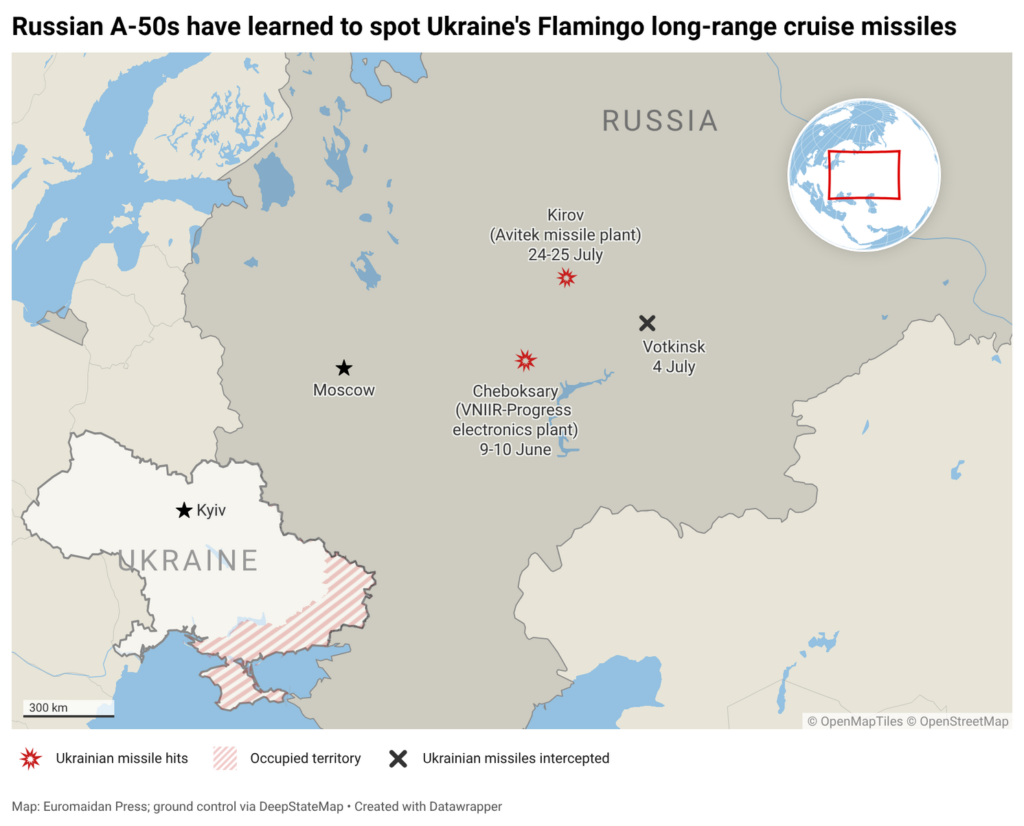
The mapper may be off by one. Between 24 and 25 July, at least one Flamingo struck the Vyatka Machine-Building Enterprise Avitek missile plant in Kirov Oblast 1,300 km from the border with Ukraine. Michael Bohnert, an analyst with the RAND think tank in California, concluded that two Flamingos hit the plant, causing visible damage.

A map of locations where Ukraine has struck with long-range Flamingo missiles and where they were intercepted
Map: Euromaidan Press

It was a potentially powerful blow. Among other things, Avitek produces parts for the Tor medium-range surface-to-air missile system. Slowing Tor production "will have the most impact," Bohnert explained. And the Ukrainian system that a Tor slowdown might benefit the most is ... the Flamingo.

After all, the Tor is one of the air defense systems the Russians could use to shoot down Flamingos. "Any slow-down in the production of these could greatly improve the prospects of FP-5 performance over time," Bohnert noted.

Ukrainian Firepoint FP-5 Flamingo missiles just smashed the Avitek plant in Kirov, Russia (July 24 and 25) — and the biggest hit is to SA-15 Tor production.

Here are the facts and why it matters

On July 24th and 25th, Ukrainian Firepoint FP-5 Flamingo Missiles hot the Vyatka… pic.twitter.com/Ii8VsJCumi

— Michael Bohnert (@mbohnert) July 26, 2026

Aerial defenses

At present, however, it seems that the Flamingo's biggest problem is in the air, not on the ground. Russia is shooting down most of the incoming FP-5s because it has eyes in the sky.

The Russian air force's fleet of lumbering Beriev A-50U radar early-warning planes now has one mission and one mission only: the A-50Us with their fuselage-mounted radars patrol over the likeliest flight paths for Flamingos motoring into the Russian interior to strike strategic industries.

The A-50Us are effective in the role. As recently as June, more Flamingos were getting through Russian defenses. Between 9 and 10 June, the 19th Missile Brigade launched five Flamingos at the VNIIR-Progress electronics plant in Cheboksary, in western Russia, 960 km from the Ukraine border.

Two missiles struck the plant, punching right through anti-drone protections and inflicting major blast and fire damage with their 1,150-kg warheads, the biggest on any Ukrainian deep strike munition.

Russia adapted fast. On 4 July, an A-50U helped missile batteries on the ground spot and shoot down five FP-5s flying toward Votkinsk, 1,360 km from Ukraine. From its perch thousands of feet in the air, the A-50U has a much longer detection range against low targets than any radar on the ground can manage.

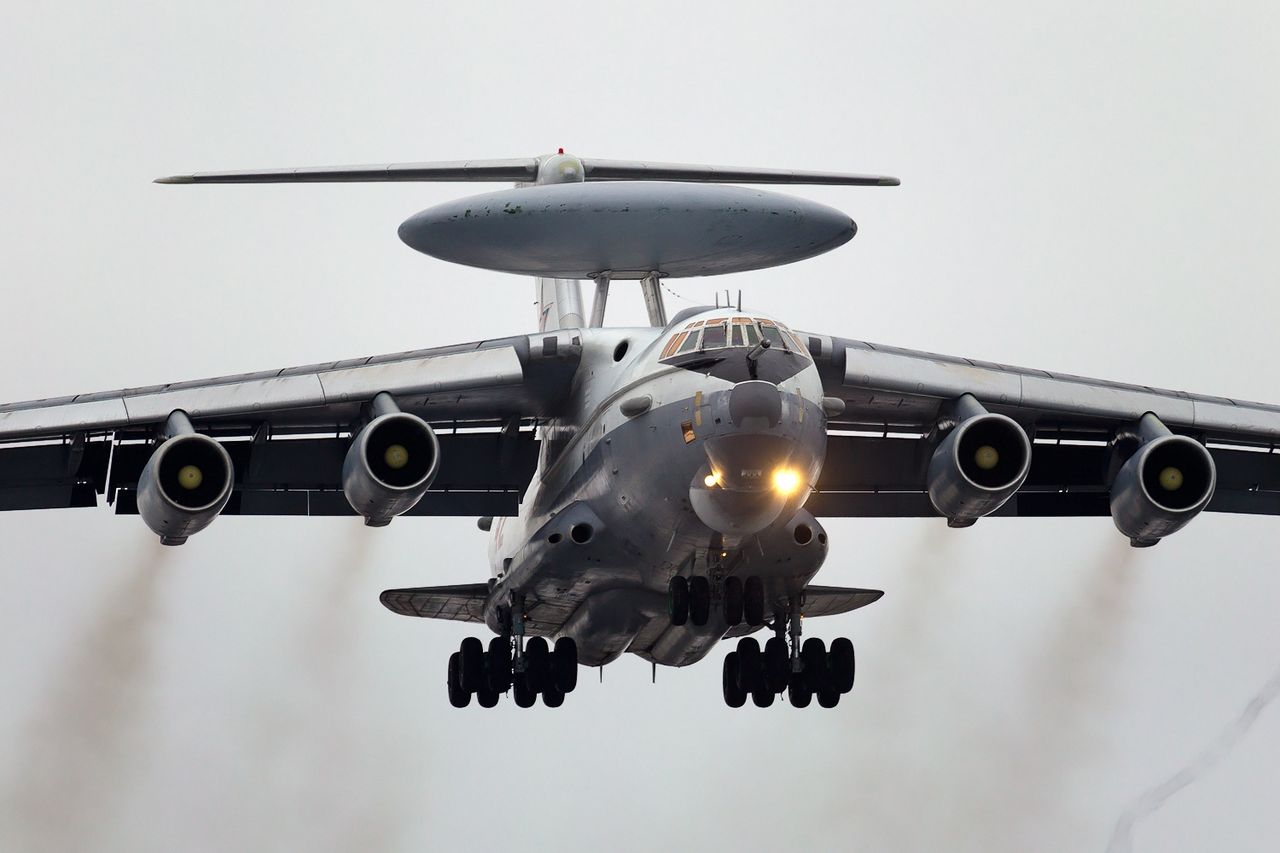
A Russian A-50U.
Explore further

To catch Ukraine’s cruise missiles, Russia is risking the scarce A-50 radar planes it has no way to rebuild

Targeting A-50Us on the ground and in the air in a series of drone and missile ambushes, the Ukrainians have destroyed two A-50Us and damaged at least two others, reducing the fleet to no more than five. Russia has no way to build replacements. But those five planes are now fully committed to the anti-Flamingo fight.

On 7 July, the Russians reportedly launched four of the irreplaceable planes at the same time in order to coordinate the Flamingo shoot-downs. Now, almost all Flamingos go down in flames before they reach their targets.

Ukraine isn't powerless. Fire Point has been working hard to improve the Flamingo and make it harder to shoot down. Perhaps most importantly, it seems the company tweaked the missile's altimeter in order to help it fly lower. The lower a missile flies, the better chance it has of hiding among the radar clutter created by surrounding terrain.

But if a lower-flying Flamingo is harder to shoot down, the improvement hasn't yet registered in the statistics. For now, Russia has figured out how to take out almost all of Ukraine's heaviest deep-strike missiles.

A Russian A-50U.
Explore further

Russia is running out of its best eyes in the sky

  • ✇Euromaidan Press
  • Russia steers its long-range drones from ground towers—Kyiv says it hit one in occupied Crimea
    Ukraine struck a Russian drone-control relay station and two other military targets in occupied Crimea and the occupied south overnight on 12 August, its General Staff said. Explosions rolled across the peninsula through the night, Sevastopol declared repeated air-raid alerts, and towns across occupied Crimea lost power, according to Ukrainian monitoring channels and Russian occupation authorities.  Russia launches its attack drones at Ukraine from sites inside Russia a
     

Russia steers its long-range drones from ground towers—Kyiv says it hit one in occupied Crimea

12 août 2026 à 12:14

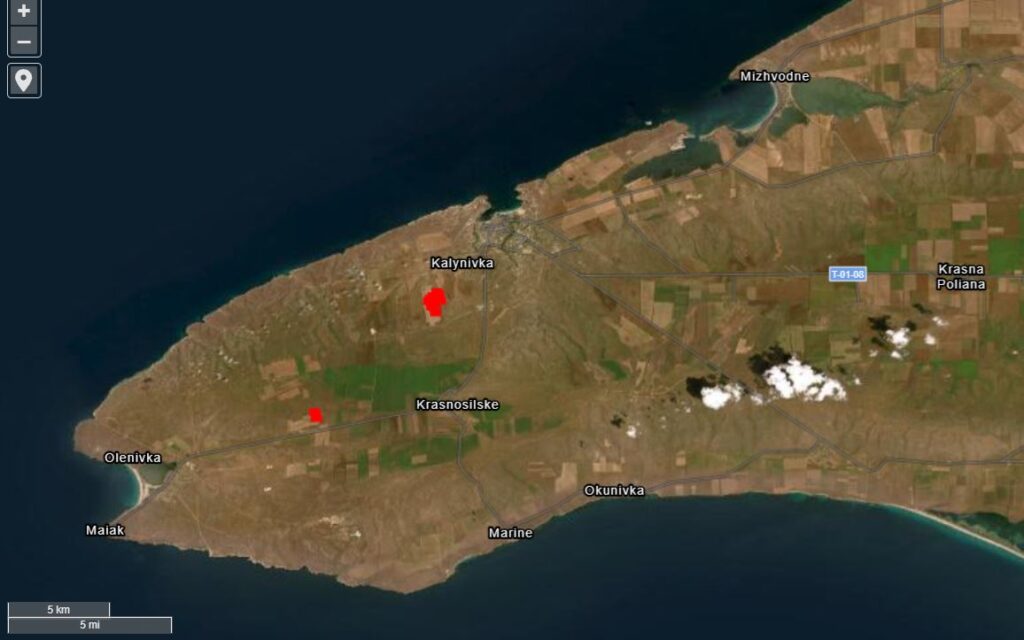
russia steers its long-range drones ground towers—kyiv says hit one occupied crimea · post nasa firms satellite data shows fire about 6 km east olenivka chornomorske raion 12 2026 ukraine

Ukraine struck a Russian drone-control relay station and two other military targets in occupied Crimea and the occupied south overnight on 12 August, its General Staff said. Explosions rolled across the peninsula through the night, Sevastopol declared repeated air-raid alerts, and towns across occupied Crimea lost power, according to Ukrainian monitoring channels and Russian occupation authorities. 

Russia launches its attack drones at Ukraine from sites inside Russia and across occupied territory every day, and relay stations let it steer those drones over long distances. Occupied Crimea is the logistical spine of Russia's hold on southern Ukraine, the funnel through which fuel, ammunition, and reinforcements reach the front, and its fixed airfields, power plants, and control stations sit within reach of Ukraine's growing long-range arsenal.

What the General Staff says was hit

Ukraine's Defense Forces struck three targets overnight, the General Staff reported. The first was a ground relay station used to control Geran and Gerbera attack drones near Olenivka in occupied Crimea. The others were a Russian repair unit near Mariupol in Donetsk Oblast and a staging point for an enemy drone unit near Marivka in Luhansk Oblast.

Hitting these sites weakens Russia's ability to command its attack drones, keep its military vehicles running, and sustain its units, the General Staff said. 

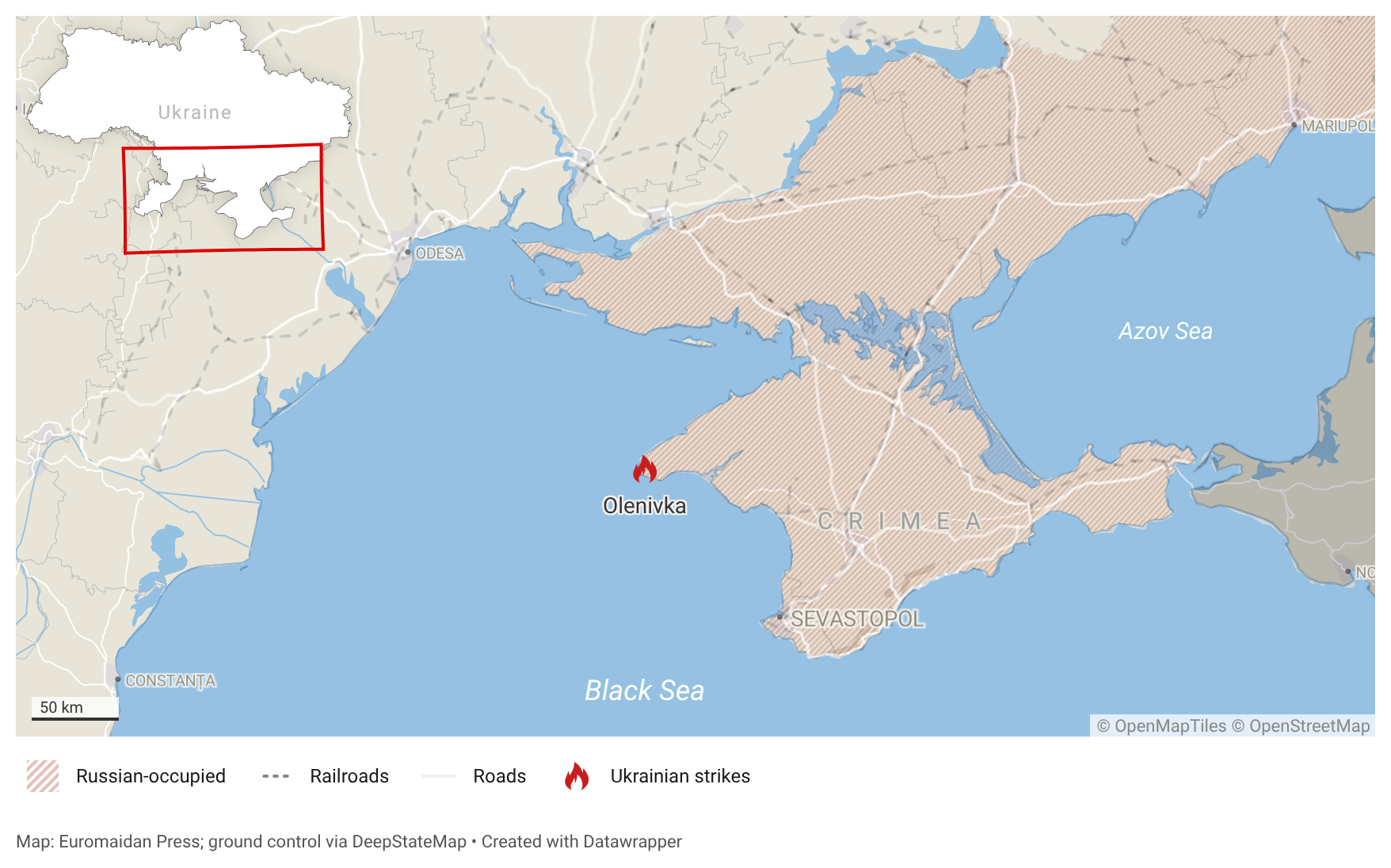
Occupied Crimea has three villages named Olenivka, and the General Staff did not say which one it meant. The likeliest is in the Yevpatoria district, at the tip of the Tarkhankut peninsula—Crimea's westernmost cape and its closest point across the Black Sea to mainland Ukraine's Odesa Oblast, a frequent target of Russian drones launched from the peninsula.

Euromaidan Press could not independently verify the strikes and damage.

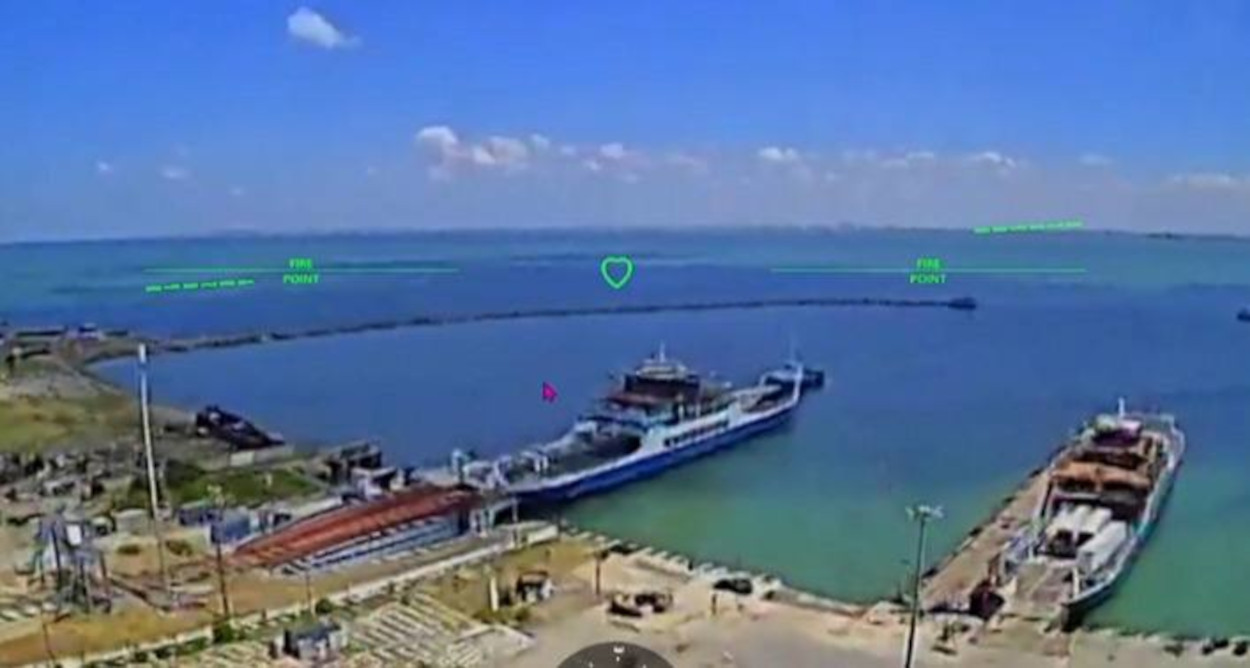
A photo shared by Robert “Madyar” Brovdi shows the Russian ferry “Maria” before it was struck in Ukrainian drone operations, with the damaged “Panagia” ferry visible to the right. Photo: Robert "Madyar" Brovdi
Explore further

Ukraine’s Crimea campaign could strike seven times more targets with faster funding, Brovdi says

Russia flies these drones through a chain of ground repeaters, often mounted on mobile-operator towers or similar tall structures, boost the control signal so operators inside Russia can steer Geran and Gerbera drones over Ukraine from hundreds of kilometers away. Kyiv has dismantled similar relay networks before, including one Russia had built on towers and rooftops in Belarus.

Explosions and blackouts across occupied Crimea

Sevastopol declared three air-raid alerts, and the Russian-installed governor Mikhail Razvozhaev claimed Russian forces downed more than 30 drones, with the heaviest activity over the Balaklava district and no one hurt.

The Ukrainian monitoring channel Krymsky Veter reported explosions in Feodosia and Kerch, and drones close to the Kacha and Belbek airfields. Residents reported air-defense activity near major cities.

The channel said explosions sounded near the Balaklava thermal power plant, a mobile gas-turbine station, and a substation in Sevastopol. Power cut out across parts of occupied Crimea, leaving Sevastopol, Simferopol, and several more cities and districts without electricity.

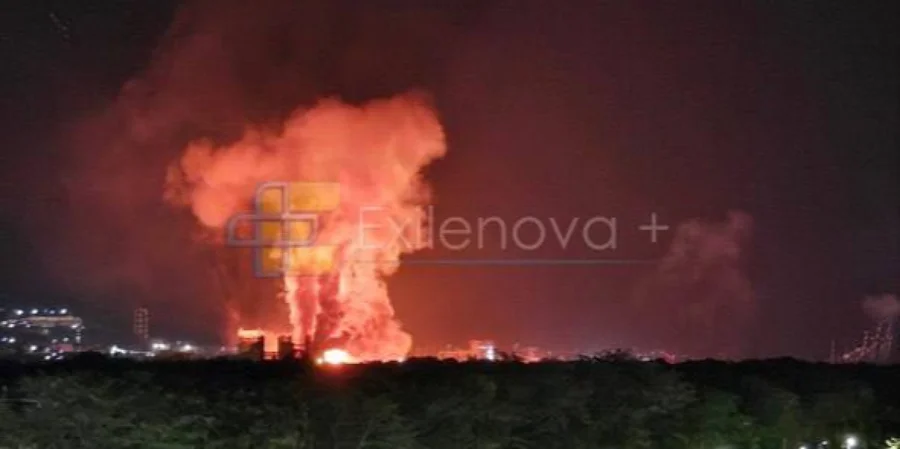
sea drones jet neptune missiles hit one russian port single night · post fire burns novorossiysk early hours 12 2026 пожежа у новоросійську ніч проти серпня фото exilenova+ ukraine news
Explore further

Sea drones, jet drones, and Neptune missiles hit one Russian port in a single night

After the attack, Krymsky Veter's monitoring group reported two large fires near Sevastopol, citing satellite data. One sat by a road junction near the village of Pervomaiske under Balaklava, where a bridge crosses the railway. The other burned near one of the local beaches. The group also logged an already-extinguished fire in the Inzhyr tract that had been reported the day before.

The same night, Ukraine also struck Russia's naval base at Novorossiysk, the fleet's main Black Sea base since late 2023.

Part of the campaign to isolate Crimea

The overnight strikes fit Ukraine's months-long effort to cut occupied Crimea off from the forces and supplies that sustain it. Ukrainian drones have severed road and rail links to the peninsula, left it rationing fuel under rolling blackouts, and pushed the campaign onto the sea by hunting the tankers that supply it. 

  • ✇Euromaidan Press
  • Sea drones, jet drones, and Neptune missiles hit one Russian port in a single night
    On 12 August 2026, Ukraine targeted Russia's main Black Sea naval base and oil terminal at Novorossiysk overnight. Fires broke out at the port's oil and fleet facilities, two of Russia's largest grain terminals stopped work, and debris damaged homes across the city, according to Ukrainian monitoring channels and local Russian authorities. Ukrainian President Volodymyr Zelenskyy confirmed the operation hours later. Russia's southern coast is where much of the war is paid
     

Sea drones, jet drones, and Neptune missiles hit one Russian port in a single night

12 août 2026 à 06:57

sea drones jet neptune missiles hit one russian port single night · post fire burns novorossiysk early hours 12 2026 пожежа у новоросійську ніч проти серпня фото exilenova+ ukraine news

On 12 August 2026, Ukraine targeted Russia's main Black Sea naval base and oil terminal at Novorossiysk overnight. Fires broke out at the port's oil and fleet facilities, two of Russia's largest grain terminals stopped work, and debris damaged homes across the city, according to Ukrainian monitoring channels and local Russian authorities. Ukrainian President Volodymyr Zelenskyy confirmed the operation hours later.

Russia's southern coast is where much of the war is paid for, the loading point for the oil revenue and grain exports that keep the invasion running, and it now sits within reach of Kyiv's long-range weapons.

Kyiv calls it a "unique operation" on the fleet's last big base

Zelenskyy said Ukraine's Defense Forces hit the Novorossiysk naval base overnight on 12 August. The port city is situated more than 350 kilometers from the front line on Russia's eastern Black Sea coast. The Ukrainian president described the assault as a unique operation against the last main outpost of Russia's Black Sea Fleet.

"Our Palianytsia jet drones, Neptune missiles, and naval uncrewed systems precisely struck the designated targets," he said, adding that hits were confirmed on air-defense positions, piers, and seaport infrastructure.

Fires at the Sheskharis oil terminal and the naval harbor

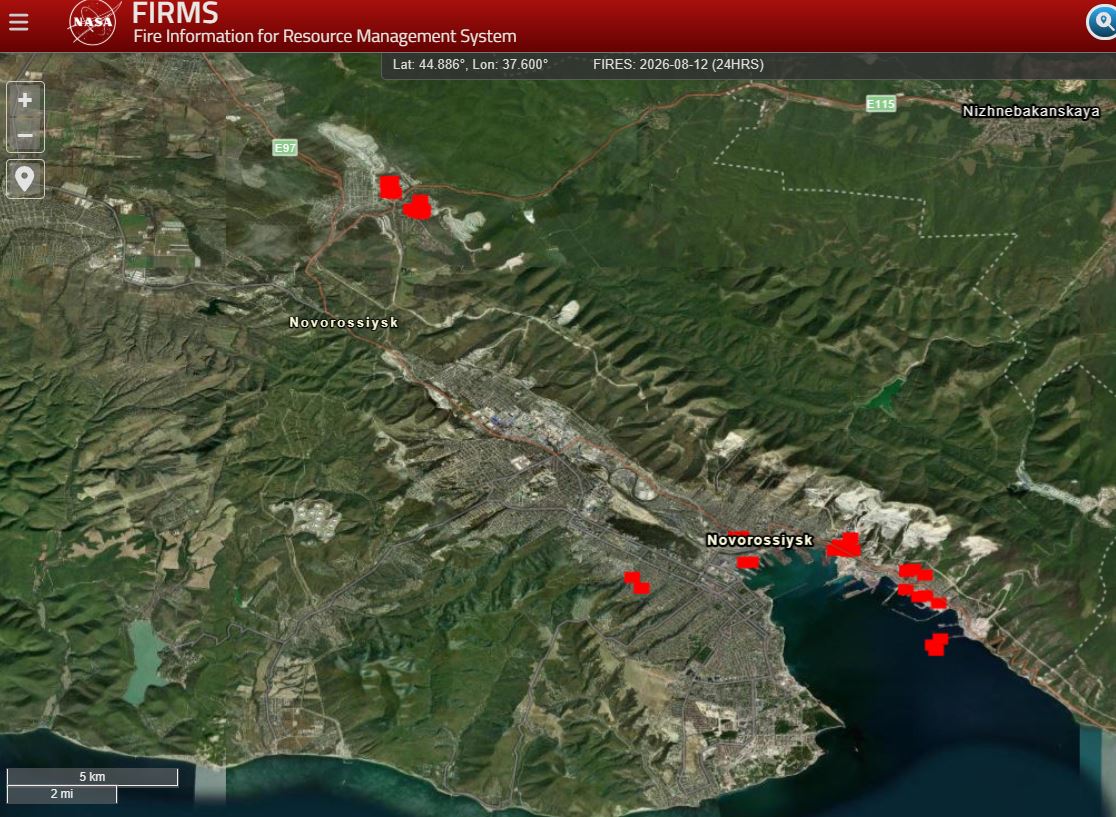
Ukrainian drones hit the oil terminal and the naval base, the Ukrainian defense outlet Militarnyi reported. Its analysis of NASA satellite fire data placed blazes at the Sheskharis complex, where crude loads onto tankers, and near the naval base and fuel-storage tanks.

sea drones jet neptune missiles hit one russian port single night · post nasa firms shows fires detected around novorossiysk 12 2026 ukraine news ukrainian reports
A NASA FIRMS map shows fires detected in and around Novorossiysk on 12 August 2026. Map: NASA FIRMS

Sheskharis is the endpoint of Transneft's main pipelines and a key export point for Russian crude on the Black Sea. Novorossiysk ships 600,000 to 700,000 barrels of oil a day.

The Ukrainian monitoring channel Krymsky Veter said fires broke out near the Sheskharis pier and the military harbor where Black Sea Fleet ships and submarines dock. Russia moved vessels to Novorossiysk after Ukrainian strikes pushed the fleet out of occupied Crimea.

Two grain terminals stop at the world's top wheat exporter

Novorossiysk's two largest grain-handling terminals halted work after the strikes, Reuters reported, citing four industry sources. The world's top wheat seller, Russia sends most of its exports out through Black Sea ports.

The Novorossiysk grain terminal, which can move 8.5 million tons a year, halted work as owner Demetra Holding assessed the damage. NKHP, a terminal handling 7.1 million tons a year, also stopped, its main owner OZK said, adding that no one was hurt. The Ukrainian monitoring Telegram channel Exilenova+ described NKHP, Russia's largest deepwater grain terminal, as one of the sites hit.

novorossiysk

The strikes extend Ukraine's effort to deny Russia the grain and oil revenue that funds the war, a mirror of Russia's own summer campaign against Ukraine's ports: as Moscow strikes Odesa's terminals to choke Ukrainian exports, Kyiv works to shut Russia's own.

A few more videos from Novorossiysk this morning pic.twitter.com/r4zASGtZNc

— Exilenova+ (@Exilenova_plus) August 12, 2026

Russia says its own drone debris damaged homes and killed two

Krasnodar Krai Governor Veniamin Kondratyev claimed several hundred drones attacked the region overnight and that falling debris struck 21 residential buildings and four enterprises in Novorossiysk. He claimed two people were killed, including an eight-year-old child, and 13 wounded across the krai, with about 90 residents moved to temporary shelters.

sea drones jet neptune missiles hit one russian port single night · post smoke rises over novorossiysk after ukrainian strike black 12 2026 video exilenova+ удар по новоросійську серпня року
Smoke rises over Novorossiysk after a Ukrainian strike on the Russian Black Sea port, 12 August 2026. Screenshot from a video: Exilenova+

Novorossiysk Mayor Andrei Kravchenko claimed debris hit six residential buildings, a commercial building, and a construction site, and that there were casualties.

The Russian news Telegram channel Astra reported that a café burned on Sukhumskoye Shosse, across the road from the entrance to the Novorossiysk naval base. Astra also found that a strike damaged School No. 15 near the fleet's ship berths.

Part of a widening summer campaign

The strike fits a broader Ukrainian effort this summer to carry the war onto Russian soil and drain the Kremlin's ability to fight. A day earlier, Ukrainian drones set a Wildberries logistics complex ablaze near Voronezh and hit an oil refinery in Orsk. Overnight on 10 August, drones struck a petrochemical plant in Tobolsk and a refinery in Tatarstan.

Ukraine’s drone strike shut Russia’s biggest LPG plant as fuel rationing returned in 16 regions

12 août 2026 à 05:12

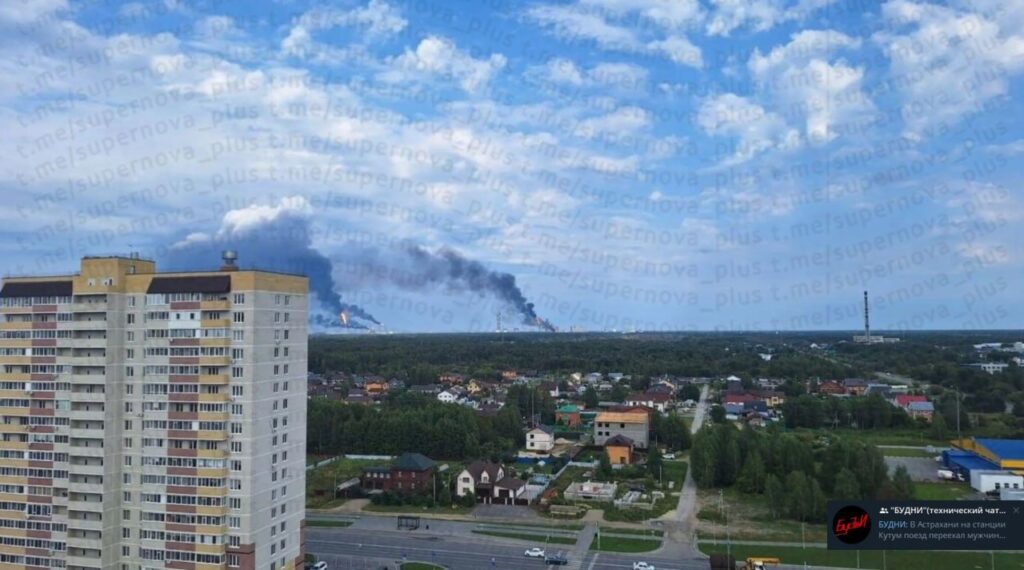
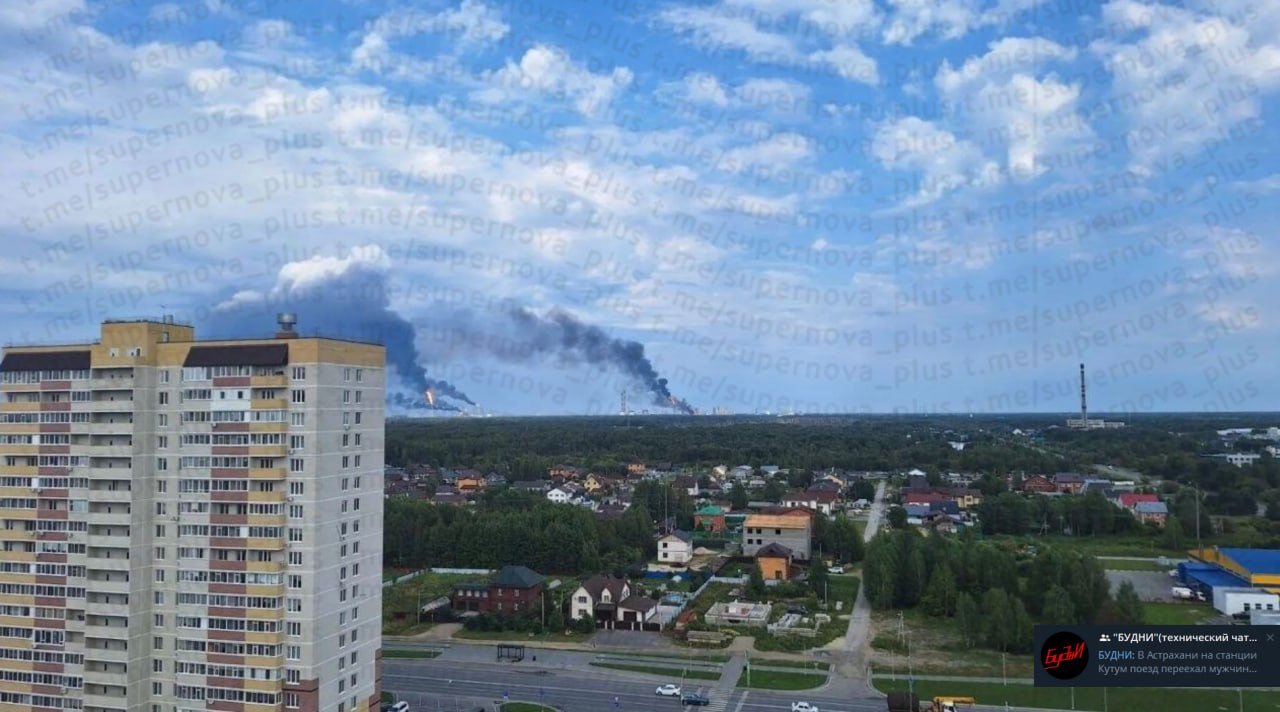
The ZapSibNeftekhim complex in Tobolsk, Tyumen Oblast, is burning. Source: Supernova

A Ukrainian drone strike shut the plant that produces 40% of Russia’s liquefied petroleum gas on 10 August, and the country’s fuel crisis snapped back across at least 16 regions within days.

The shutdown of the Sibur ZapSibNefteKhim complex in Tobolsk, western Siberia, removes about six million metric tons of annual LPG capacity from a fuel system that was already under strain.

The ZapSibNeftekhim complex in Tobolsk, Tyumen Oblast, is burning. Source: Supernova
Explore further

“This is money of his accomplices burning”: Russian partisans and Ukraine hit Siberian plant tied to Putin’s inner circle


Gasoline restrictions had begun easing across Russia at the end of July, when Ukrainian drones temporarily shifted to other targets. When the strikes resumed in early August, fuel rationing returned immediately, the independent Russian outlet 7×7 reported.

Three industry sources told Reuters on Tuesday that the complex stopped operations indefinitely “while the extent of the damage and its consequences are being assessed.”

No LPG volumes were offered from the Tobolsk delivery point on Russia’s commodity exchange—a point that earlier this year handled about 4,000 metric tons of propane-butane mix per day. Sibur declined to comment.

The shutdown of the Sibur ZapSibNefteKhim complex in western Siberia, removes six million metric tons of annual LPG capacity from a fuel system already under strain.

zapsibneftekhim and tobolsk-polymer in tobolsk
The ZapSibNefteKhim and Tobolsk-Polymer industrial sites in Tobolsk, western Siberia, seen in February 2023. A Ukrainian drone strike shut ZapSibNefteKhim indefinitely on 10 August 2026, taking 40% of Russia’s LPG production offline. Photo: Vyacheslav Bukharov/Wikimedia Commons, CC BY-SA 4.0.

A strike on one unit stopped the entire plant

Tyumen Oblast Governor Aleksandr Moor confirmed a fire at an industrial site following a drone attack but did not identify the facility.

Ukraine’s Special Operations Forces Deep Strike units, working with the Russian insurgent movement Chornaya Iskra (Black Spark), claimed the strike. The plant sits more than 2,200 kilometers from the front line.

Militarnyi’s OSINT analysis identified the specific target as the complex’s central gas fractionation unit—the plant’s entry point, where raw hydrocarbons are separated into usable products before anything else in the production chain can run. About half of ZapSibNefteKhim’s output feeds Sibur’s own petrochemical complex in Tobolsk; the rest goes to market.

Sibur held contracts to supply feedstock to defense-industry enterprises, including the Kamenskiy Kombinat, which produces solid rocket fuel and motors for the Grad, Smerch, and Uragan rocket systems.

Sibur also supplied the Perm Gunpowder Plant, which makes charges for multiple-launch rocket systems, air-defense complexes, and cruise missile boosters, Militarnyi also reported. The Sverdlov Plant and Biysk Oleum Plant, both explosives manufacturers, were also Sibur clients.

sochi mayor andrei proshuning with city officials
Sochi Mayor Andrei Proshunin meets with city officials as fuel remains available at only 38 of the resort’s 58 gas stations. Photo: Andrei Proshunin/Telegram

Fuel rationing returned within days

Across at least 16 regions, the fuel restrictions that had briefly eased in July are back, 7×7 reported.

In Sochi—Russia’s most famous beach resort—Mayor Andrei Proshunin said on Telegram that fuel was available at only 38 of the city’s 58 gas stations. Deputy Mayor Vyacheslav Bauer told residents and tourists to use public transport or stop driving, the Moscow Times reported.

In Bashkortostan, authorities banned gasoline sales in canisters, leaving at least one resident unable to fuel his lawnmower—as he complained to regional head Radiy Khabirov during a televised address, a Bashkortostan outlet reported. Production at the Ufa petrochemical complex is unaffected by the drone strikes, Khabirov said.

Still, the shortage persists for a different reason: every time a drone-alert protocol is activated, fuel tankers halt en route to gas stations, regional official Elena Prochakovsky explained at a briefing reported by Prufy. Three districts remain in a fuel “red zone,” and 19 of 26 gas stations in Sterlitamak are operating.

Lipetsk Oblast Governor Igor Artamonov told residents not to expect improvement for one to two weeks, Lipetsk outlet Ploshchad reported. “If you can leave 10 liters unfilled, the person arriving on empty will thank you,” he said.

Russia’s fuel system was already breaking

The Tobolsk shutdown lands on an already fractured system. By mid-July, fuel rationing had spread to more than half of Russia’s regions. Ukraine’s drone campaign had struck Russian refineries 194 times in the first half of 2026 alone—eleven times the previous year’s pace—knocking nearly half the country’s refining capacity offline, Ukraine’s General Staff reported on 4 July.

Repair timelines keep slipping because sanctions block the spare parts Russian plants need. To plug the gap, Russia has banned gasoline exports, permitted lower-grade fuel, and begun importing gasoline from India and Morocco, refined from its own crude—shipping it 14,000 kilometers home because its refineries cannot meet domestic demand.

The Tobolsk shutdown removes more LPG output than any single strike of the war. Russia was already rationing fuel in more than half its regions before this strike.

  • ✇Euromaidan Press
  • Russia’s Odesa strikes halve Ukraine’s grain export forecast
    Ukraine’s Agriculture Ministry has cut its forecast for agricultural exports in 2026–2027 by 54% as Russian attacks disrupt shipping through Odesa’s ports, Bloomberg reported. The ministry now expects 29.6 million tons of agricultural exports, down from 64.4 million. Its wheat export forecast fell by 53%, from 17.6 million tons to 8.3 million tons. Ukraine grows far more grain than it consumes, exporting 65%–70% of its agricultural output. Bloomberg said the sector
     

Russia’s Odesa strikes halve Ukraine’s grain export forecast

11 août 2026 à 13:47

Grain pours from a combine harvester into a trailer during harvest in Ukraine.

Ukraine’s Agriculture Ministry has cut its forecast for agricultural exports in 2026–2027 by 54% as Russian attacks disrupt shipping through Odesa’s ports, Bloomberg reported.

The ministry now expects 29.6 million tons of agricultural exports, down from 64.4 million. Its wheat export forecast fell by 53%, from 17.6 million tons to 8.3 million tons.

Ukraine grows far more grain than it consumes, exporting 65%–70% of its agricultural output. Bloomberg said the sector generated more than half of Ukraine’s export revenue last year. But Russia’s summer attacks have stalled the sea corridor as the harvest arrives, driving some wheat prices below production costs. Land and river routes cannot match the Black Sea shipping capacity, while sales through neighboring EU states remain politically contested. That leaves farmers with less money for the next sowing and further reduces Ukraine’s export income.

Ukraine has about 59 million tons of grain storage. That storage could be full by early November, leaving the country 11 million tons short of space by the end of fall 2026. 

Wheat sells below cost as the silos fill up

Ukraine’s export bottleneck is already hitting its farmers. Port prices fell by another 12-15% in one week, while some farmers sold wheat below production cost. When ships stop, traders either stop buying or pass the higher cost of alternative routes on to producers. That leaves farmers with less cash for fall sowing.

To ease the pressure, the government has approved subsidized loans for agricultural producers. President Volodymyr Zelenskyy said Kyiv would expand storage. Ukraine's Agriculture Ministry has also asked the European Commission for €220 million to help cover interest for small and medium-sized farms.

Ukraine and Moldova are discussing a rail route to Romania’s Constanța port. According to the report, grain was already being redirected through Romania, Slovakia, and Hungary, but these routes cannot replace Odesa’s capacity.

Now the ports and the ships are Russia's targets

The export bottleneck is only part of the problem. Russia’s bombardment also threatens the ports, civilian ships, and crews needed to keep the corridor operating. 

The port of Odesa normally handles about 90% of Ukraine’s grain shipments. Russia intensified attacks on terminals and civilian ships in July 2026 as the harvest reached the coast.

On 19 July, three Russian missiles struck the foreign-flagged Golden Leo as it left Odesa carrying corn, killing 10 people, including a Ukrainian sea pilot. Three days later, no vessel passed through the corridor.

Alternative routes offer little relief, as record-low Danube levels were restricting river traffic. Poland continues to bar Ukrainian grain from its domestic market. Those constraints leave more of the harvest inside Ukraine and farmers with less money to plant the next crop.

  • ✇Euromaidan Press
  • A wiring maker for Volkswagen and Škoda takes a Russian hit in Zhytomyr Oblast
    A Russian overnight strike heavily damaged a German-owned car-parts plant in Zhytomyr Oblast, forcing it to halt production, the company said. No workers were hurt, but the destruction was extensive. One of the region's major employers now has no restart date. Russia increasingly hits the factories and warehouses of foreign companies that kept producing in Ukraine through the war, not only Ukrainian factories, energy facilities, infrastructure, and homes. Each strik
     

A wiring maker for Volkswagen and Škoda takes a Russian hit in Zhytomyr Oblast

9 août 2026 à 12:19

wiring maker volkswagen škoda takes russian hit zhytomyr oblast · post fire engulfs kromberg & schubert plant after strike overnight 9 2026 bunechko 5458835242480244866 ukraine news ukrainian reports

Russian overnight strike heavily damaged a German-owned car-parts plant in Zhytomyr Oblast, forcing it to halt production, the company said. No workers were hurt, but the destruction was extensive. One of the region's major employers now has no restart date.

Russia increasingly hits the factories and warehouses of foreign companies that kept producing in Ukraine through the war, not only Ukrainian factories, energy facilities, infrastructure, and homes. Each strike on a foreign-owned factory chips away at the jobs and outside investment propping up Ukraine's wartime economy, adding to a burden the country's partners are scrambling to offset.

A German plant knocked offline

Russia struck Zhytomyr Oblast overnight into 9 August and hit the Kromberg & Schubert plant, which reported the attack on Facebook. Its production lines and infrastructure took heavy damage. 

"The most important thing for us is that no employees were hurt in the attack," the statement said. 

With the damage so severe, the plant suspended operations for an indefinite period. A restart depends on a technical assessment and the full scope of repairs, the company added.

Kromberg & Schubert is a civilian manufacturer with 100% German investment. It has run in the Zhytomyr region for 11 years and employs about 3,500 people. The plant makes the wiring harnesses that thread through cars, supplying European automakers.

wiring maker volkswagen škoda takes russian hit zhytomyr oblast · post kromberg & schubert plant ablaze after strike overnight 9 2026 bunechko 5458835242480244867 ukraine news ukrainian reports
The Kromberg & Schubert plant ablaze after the Russian strike in Zhytomyr Oblast, overnight on 9 August 2026. Photo: Vitalii Bunechko

Vitalii Bunechko, head of the Zhytomyr Oblast Military Administration, called it one of the region's budget-forming enterprises. He said the administration and local authorities are working to help the strategic investor and keep the plant running.

wiring maker volkswagen škoda takes russian hit zhytomyr oblast · post burned-out kromberg & schubert plant after strike 9 2026 bunechko 5458835242480244865 ukraine news ukrainian reports
The burned-out Kromberg & Schubert plant after the Russian strike in Zhytomyr Oblast, 9 August 2026. Photo: Vitalii Bunechko

Part of a wider overnight assault

Bunechko reported that Russia had launched a massive strike on the oblast overnight. The attack also damaged civilian infrastructure, he said. State Emergency Service crews contained the fires, and investigators began work at the site. 

Russia has repeatedly struck Zhytomyr Oblast during the war, stepping up its drone strikes on northwestern Ukraine, often exploiting Belarusian territory.

Russia plans to make upcoming winter unsurvivable for Ukrainian civilians: Moscow is hitting Ukraine’s gas extraction sites to make heating impossible in cold

9 août 2026 à 11:20

Blaze at Ukrainian gas facility following Russian strike, 3 October, 2025

Russia is trying to knock out Ukraine's gas production before the cold comes. Russia carried out massive strikes on the assets of the Naftogaz Group in eastern, western, and central Ukraine, the company reported.

The strikes target Ukraine's ability to produce the gas it needs for winter. The Russians aim to inflict maximum damage on Ukrainian production and other critical infrastructure to make preparation for the heating season impossible, acting Naftogaz chairman Serhii Fedorenko said, calling the intensity of attacks on oil-and-gas infrastructure sharply higher in recent days.

The strikes hit extraction across the country

Russia targeted the sites where Ukraine pulls gas from the ground. On the night of 9 August, the extraction assets of Ukrnafta and a company drilling site came under massive attack, with Russian forces using dozens of strike drones against the extraction infrastructure.

The damage stopped production. There is substantial destruction at the site; part of the equipment has been put out of commission, and the asset's operation has been halted. However, safety measures meant that workers at the attacked facilities were unhurt.

Fuel stations and production sites were also hit

The campaign extended to Naftogaz's retail and production network. On 7 and 8 August, seven UKRNAFTA filling complexes in Dnipropetrovsk, Zaporizhzhia, and Mykolaiv oblasts came under drone attack, and a worker at one station was injured and is in hospital receiving care.

Central Ukraine was struck, too. On 8 August, Russia attacked Naftogaz production facilities in the central part of the country with jet-powered drones, and the facility suffered serious destruction, though staff were in shelter at the time of the strike.

The target is the heating season

The strikes match the warning from First Deputy Prime Minister and Energy Minister Denys Shmyhal, who has said Russia's aim this winter is to destroy the systems Ukrainians need to survive the cold, from power to water, Politico reported. Damaging gas production now, months before winter, is meant to leave Ukraine unable to heat itself when temperatures drop, turning the coming season into another front against civilians in Russia's war.

  • ✇Euromaidan Press
  • Third one down: Ukraine keeps destroying Russia’s $1.8 million Starlink jammers
    Satellite imagery has confirmed that Ukraine's Defense Forces destroyed a Russian electronic-warfare system built to jam Starlink at Gelendzhik in southern Russia, the Ukrainian defense outlet Militarnyi reported. Ukrainian drones hit the machine on the grounds of a Russian border-guard base during their sweep of the Black Sea coast. It is one more of these costly jammers Russia has lost, even as Ukraine's long-range drones cannot use Starlink over Russia. Ukraine's
     

Third one down: Ukraine keeps destroying Russia’s $1.8 million Starlink jammers

9 août 2026 à 07:59

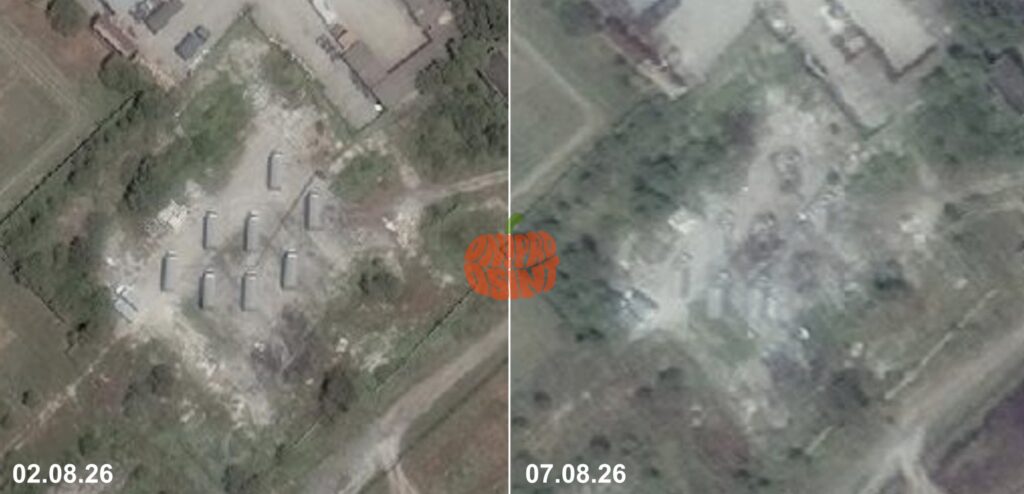
third one down ukraine keeps destroying russia's $18 million starlink jammers · post satellite images russian volna kupol garant starlink-jamming site gelendzhik krasnodar krai russia 2 (left) 7 2026 (right)

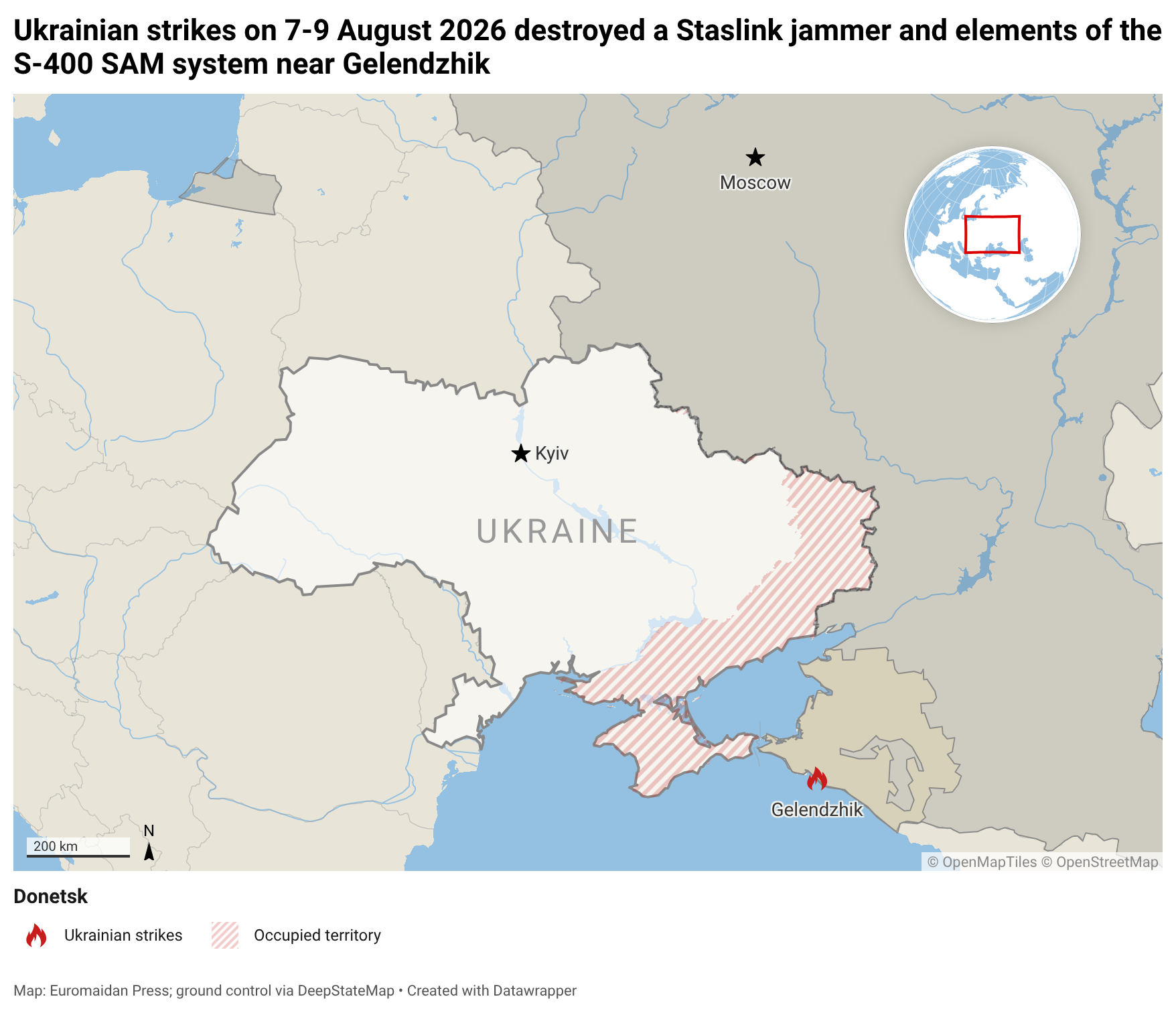
Satellite imagery has confirmed that Ukraine's Defense Forces destroyed a Russian electronic-warfare system built to jam Starlink at Gelendzhik in southern Russia, the Ukrainian defense outlet Militarnyi reported. Ukrainian drones hit the machine on the grounds of a Russian border-guard base during their sweep of the Black Sea coast. It is one more of these costly jammers Russia has lost, even as Ukraine's long-range drones cannot use Starlink over Russia.

Ukraine's deep strikes, targeting oil production, e-commerce, and military production, now reach hundreds to thousands of kilometers into Russia. At the same time, Ukrainian drone crews increasingly aim at the air-defense batteries, radars, and jammers in the occupied territory and the adjacent Russian regions — the hardware Moscow relies on to keep those drones out. Such attacks make subsequent Ukrainian strikes more successful.

Satellites caught the before and after

Satellite images published by the OSINT community Dnipro Osint show the site cleared at Gelendzhik, in Russia's Krasnodar Krai. The Volna Kupol Garant complex is gone. Researchers called it the third destruction of this jammer recorded in open sources. The strike landed on the grounds of military unit 2156, the Novorossiysk border detachment of Russia's FSB Border Service.

Ukrainian drones likely hit it alongside a 7 August strike on cargo ships near Novorossiysk and Gelendzhik. Geolocated photos from residents point to a repeat strike on the base on 8 August.

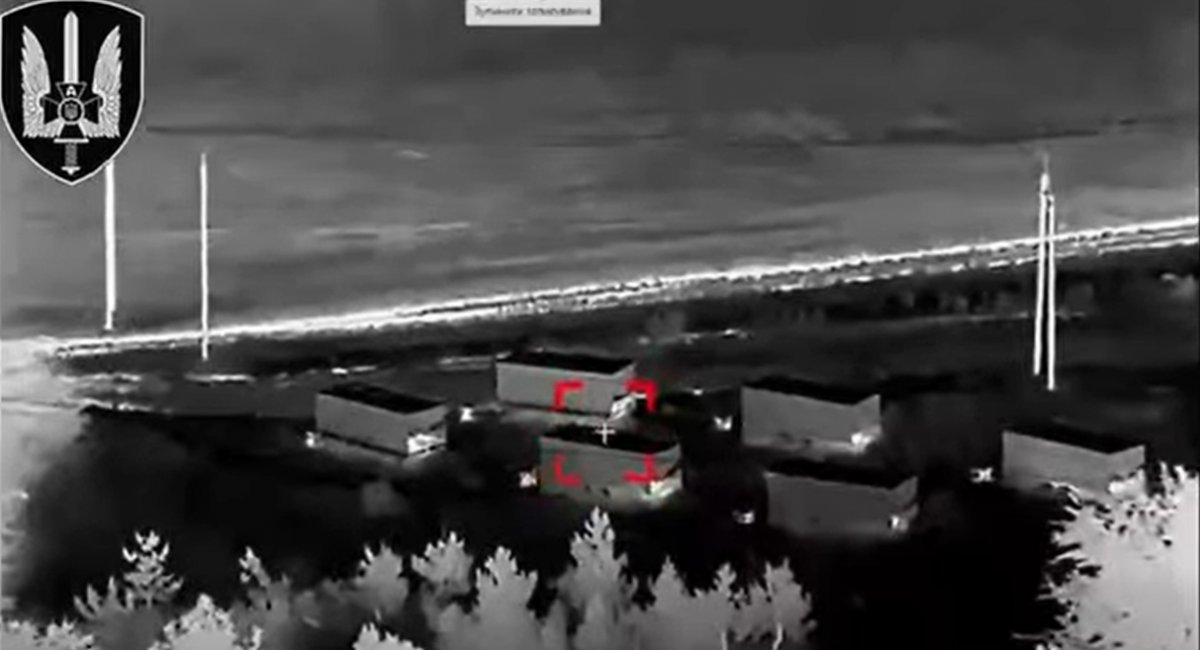
A Volna Kupol Garant system burns.
Explore further

Ukraine’s newest drones don’t need Starlink. Russia spends $1.5 million to jam it anyway.

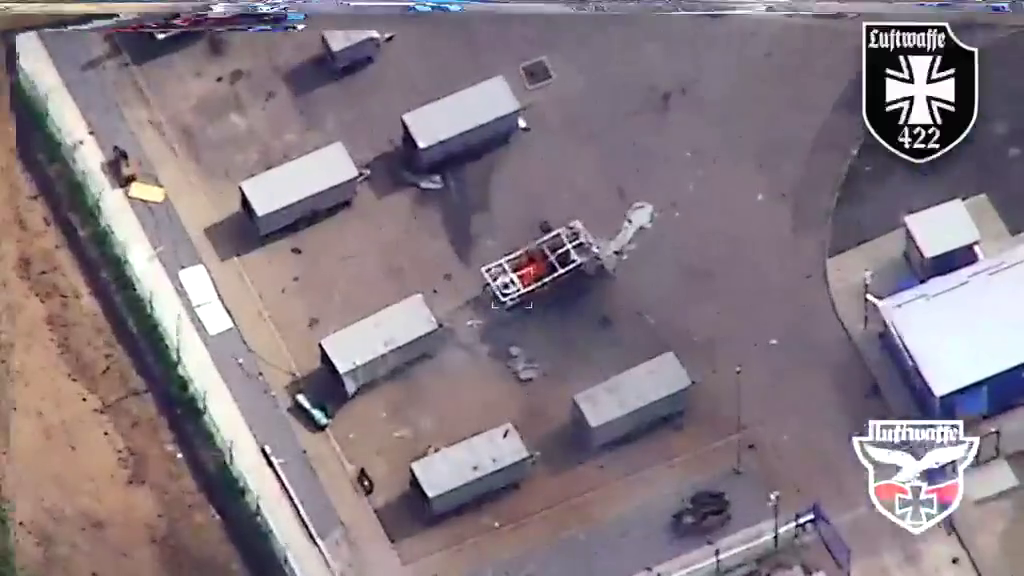
The Volna Kupol Garant is built from trailers carrying satellite antennas. It tracks a passing Starlink satellite and beams a strong signal that scrambles the terminals below across up to 20 km². Starlink is the SpaceX satellite-internet network that Ukrainian drones rely on to reach their operators. Each unit costs about $1.8 million. A same-named firm registered in occupied Simferopol builds it. The developer also makes the Volna 3M jammer that Russia has fitted to Mi-8AMTSh helicopters to block drone satellite navigation.

Ukraine has knocked out these jammers before. The 422nd Unmanned Systems Regiment, the Security Service of Ukraine's (SBU) Alpha special-operations center, and other Ukrainian units have struck such systems, including in occupied Crimea. The complex's weakness is its own power: beaming enough energy to reach a satellite makes it loud and easy to find. 

Russian Volna Kupol Garant system, meant to jam Starlink signals in a 20-kilometer area, shortly before being struck by a Ukrainian attack drone. (Video Still: 422nd Separate Unmanned Systems Battalion "Luftwaffe")
Explore further

Russians deploy massive $1.5M Starlink jammers, Ukrainians are blowing them up

And deep inside Russia, there is little Ukrainian Starlink to jam — SpaceX geofences the network to Ukrainian territory, and Elon Musk has refused Kyiv's push to use it for strikes into Russia so far.

The wider hunt

Ukraine's drone crews have spent 2026 tearing into Russia's air defenses and rear. The same run of Black Sea strikes that wrecked this jammer also burned a Russian S-400 air-defense system on the Gelendzhik coast. 

  • ✇Euromaidan Press
  • Russia’s morning strike on a Kharkiv high-rise kills two men and wounds 21
    Russian forces struck a residential high-rise in Kharkiv's Saltivka district on the morning of 9 August 2026, killing two people and injuring more than 20 others, according to city and oblast officials. The strike collapsed several upper floors and trapped residents inside. Firefighters carried people down from the top stories while a second strike hit a neighboring building. Russia hits Ukrainian cities and their apartment blocks night after night, pairing cheap attack
     

Russia’s morning strike on a Kharkiv high-rise kills two men and wounds 21

9 août 2026 à 03:53

russia's morning strike kharkiv high-rise kills two men wounds 21 · post firefighters work damaged after russian kharkiv's saltivka district 9 2026 2 syniehubov 5458525575338203373 ukraine news ukrainian reports

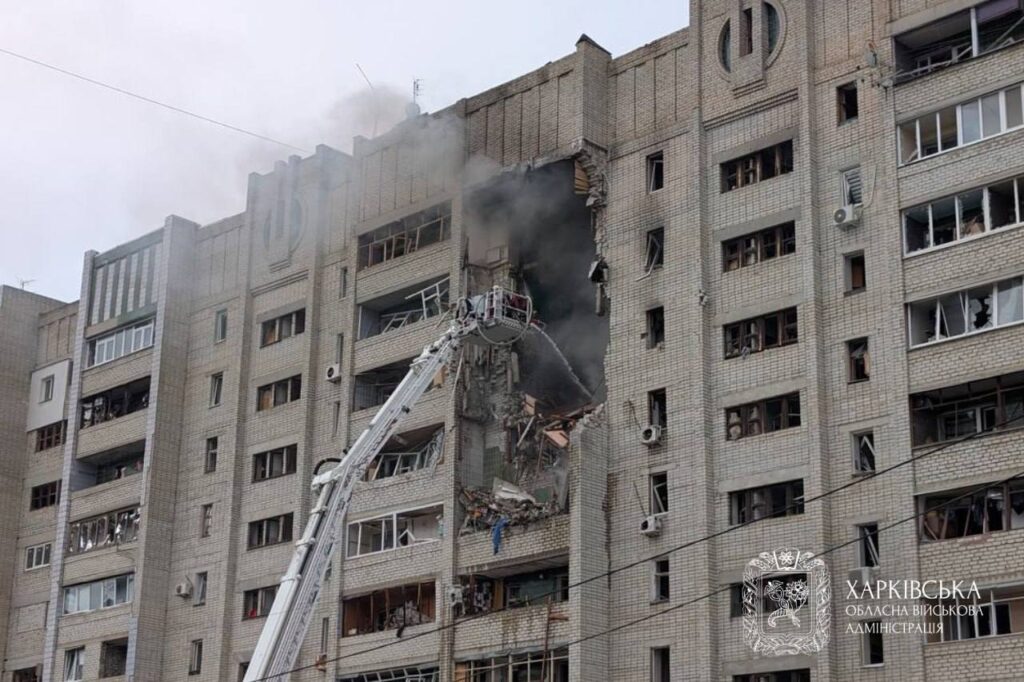
Russian forces struck a residential high-rise in Kharkiv's Saltivka district on the morning of 9 August 2026, killing two people and injuring more than 20 others, according to city and oblast officials. The strike collapsed several upper floors and trapped residents inside. Firefighters carried people down from the top stories while a second strike hit a neighboring building.

Russia hits Ukrainian cities and their apartment blocks night after night, pairing cheap attack drones with a growing volume of cruise missiles that thinning air defenses struggle to stop. Kharkiv, Ukraine's second-largest city, is situated in northeastern Ukraine, with its outskirts roughly 25-30 km from the Russian border, resulting in regular Russian attacks on locals.

A missile through the upper floors

Kharkiv Mayor Ihor Terekhov reported the strike on Saltivka shortly after 07:00. He said Russia had hit a multi-apartment residential building. Minutes later he confirmed the blast destroyed floors 7 through 10, with wounded people inside.

Oleh Syniehubov, head of the Kharkiv Oblast Military Administration, first described a Russian drone strike that killed two. His administration later clarified that a missile hit the high-rise, and that Russia also struck an office building nearby.

Residents were trapped behind the collapse, and crews began a rescue operation. Firefighters brought seven people down from the upper floors, the State Emergency Service reported. The destroyed ceilings sat between the seventh and tenth floors.

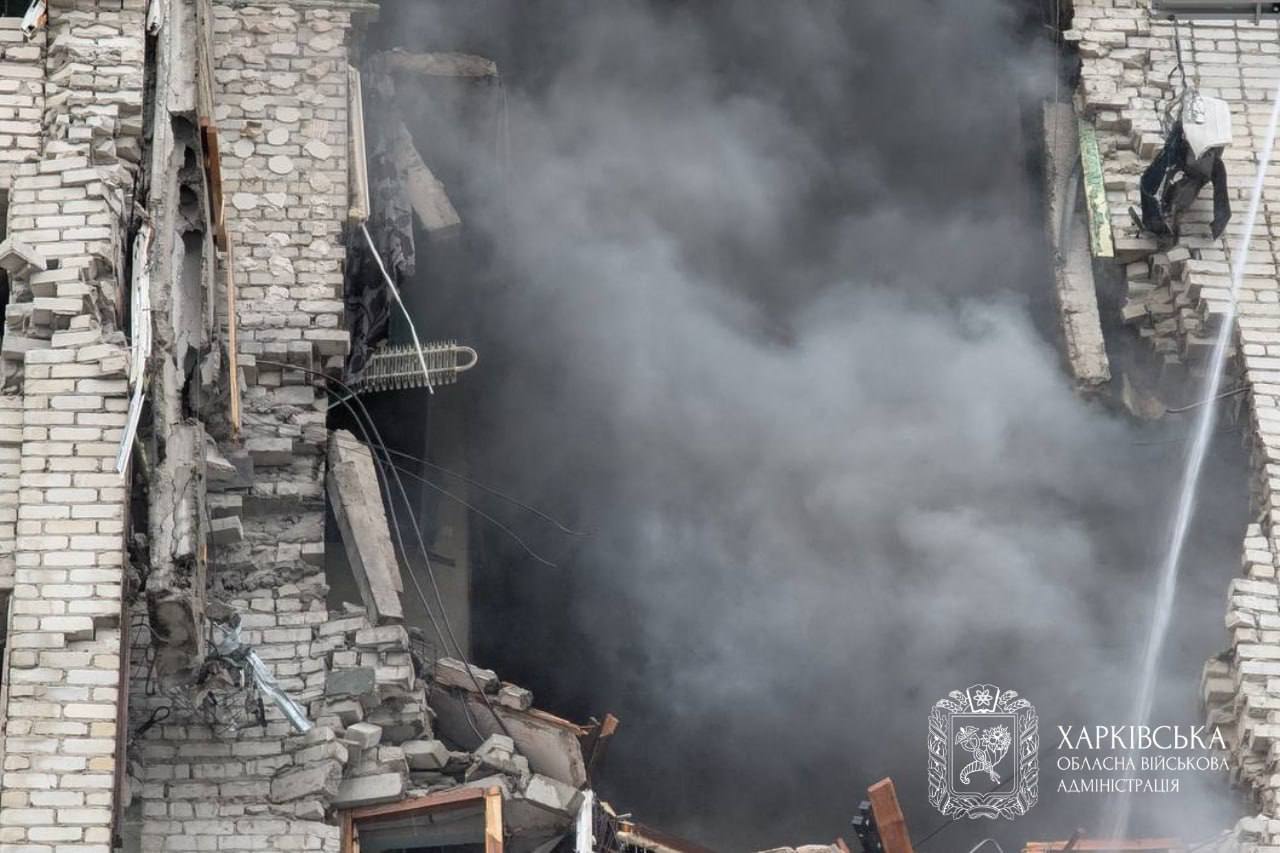
russia's morning strike kharkiv high-rise kills two men wounds 21 · post destroyed upper floors apartment building struck russia kharkiv's saltivka district 9 2026 1 syniehubov 5458525575338203375 ukraine news ukrainian
The destroyed upper floors of the apartment building struck by Russia in Kharkiv's Saltivka district, 9 August 2026. Photo: Kharkiv Oblast Military Administration

As the rescue got underway, Russia struck again. Terekhov said a neighboring high-rise was hit, writing that Russia "is deliberately striking residential buildings" and urging people to shelter. A third impact followed in one of the district's parks.

russia's morning strike kharkiv high-rise kills two men wounds 21 · post rescuers medics carry injured woman site russian kharkiv's saltivka district 9 2026 3 dsns 5458755953088993681 ukraine news ukrainian
Rescuers and medics carry an injured woman from the site of the Russian strike in Kharkiv's Saltivka district, 9 August 2026. Photo: State Emergency Service of Ukraine

Russia regularly employs the double-tap tactic — striking a site, then hitting it again once rescuers arrive — to maximize casualties among first responders.

Two dead, 21 wounded, a boy of five among them

Terekhov counted a dozen wounded at first, then confirmed two people killed at the site. Syniehubov gave the fuller account: two men, aged 50 and 66, killed, and at least 21 people injured.

Among the wounded was a five-year-old boy. 11 people suffered blast injuries and two had carbon monoxide poisoning. Another eight, including a child, had acute stress reactions, and medics hospitalized four.

By late morning, Syniehubov said crews were still clearing the collapsed floors to be sure no one remained underneath. Specialists would then judge whether the building could still be used.

Russians killed two more civilians in Kharkiv this morning

The aerial attack targeted an apartment block, also injuring 21 other people.

📹 TG/DSNS pic.twitter.com/gN9IgRUayP

— Euromaidan Press (@EuromaidanPress) August 9, 2026

A day of strikes across the oblast

Over the past 24 hours, Russia struck Kharkiv and 12 settlements across the oblast, killing three people and wounding or shocking 25, the regional administration said.

In Izium, shelling injured eight people. Russia killed a 68-year-old man in Kivsharivka, near Kupiansk, and wounded a 47-year-old woman in Mykhailivka. In Lozova, a 60-year-old woman was hurt, and a transit evacuation point there took in 227 more people.

❌