Self-proclaimed President of Belarus, Aleksandr Lukashenko, has stated that Venezuelan President Nicolás Maduro could visit Belarus if he were forced to leave office.
President Volodymyr Zelensky expressed gratitude to the Netherlands for financial support, which will reach EUR 3.5 billion next year, as well as for the provision of weapons, air defense systems, and contributions to the PURL initiative.
President Volodymyr Zelensky said that Russians lose about 30,000 people killed every month, but Russian leader Vladimir Putin does not care because he believes only in power and money.
The Moldovan authorities will return to state ownership the assets of Lukoil located on the premises of Chișinău International Airport within 20 days, due to the company’s failure to meet the requirements for selling its assets.
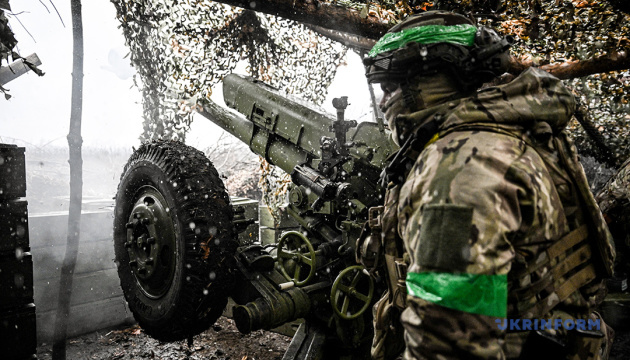
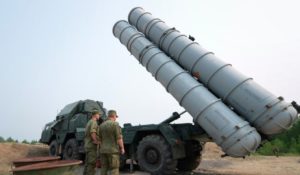
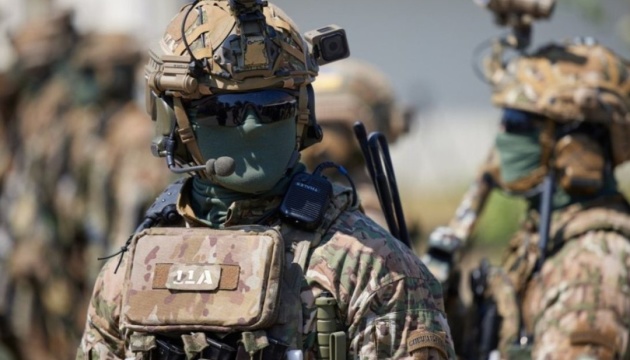
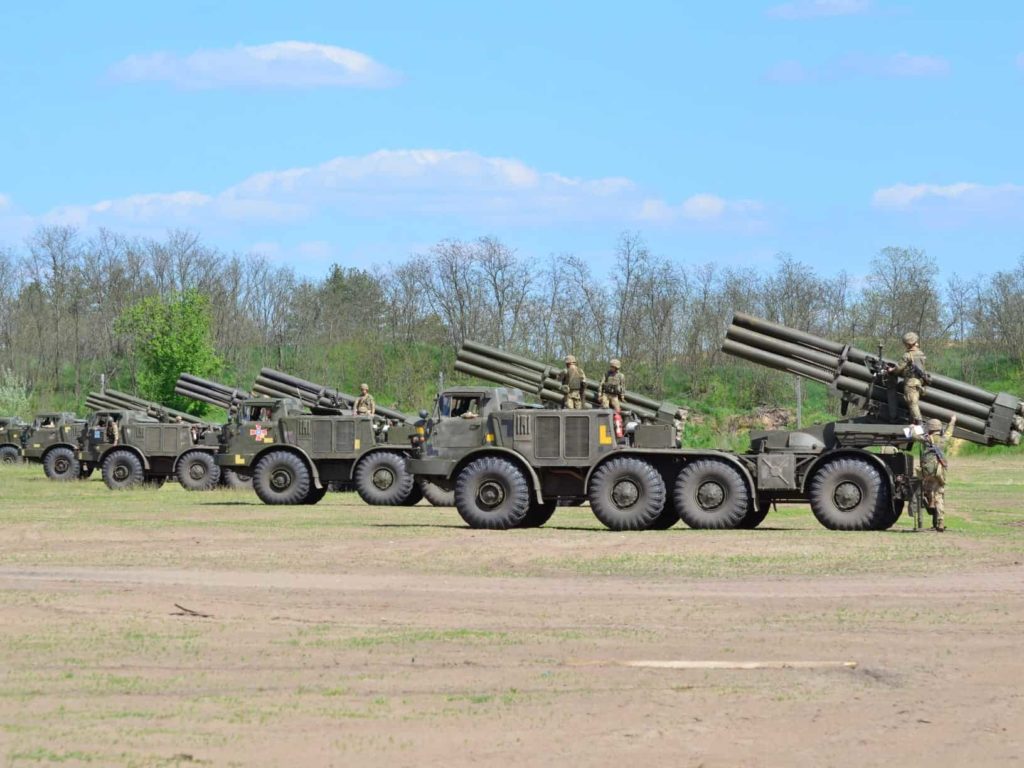
The Ukrainian Special Operations Forces have reported that they destroyed heavy Russian weapons without direct confrontation. The soldiers hit a BM-27 “Uragan” MLRS and Russian troops in Donetsk Oblast.
The BM-27 “Uragan” is one of the most dangerous systems in the Russian arsenal, per PSDInfo. Its 9P140 combat vehicle can launch a full complement of rockets in 8.8 seconds, covering entire city blocks, troop concentrations, fuel depots, command posts, and infrastructure.
Russia uses these systems to terrorize frontline towns and carry out mass artillery strikes. Their destruction is a battlefield success and a life-saving action for civilians.
Under the cloak of night on 16 December, Ukrainian Special Operations Forces went seeking the center of Russian firepower in Donetsk Oblast
In Blahodatne, Ukrainian drones found the BM-27 “Uragan” multiple rocket launcher along with its crew SSO pic.twitter.com/t4c4d9Uuo6
The Ukrainian operation was carried out with FP-2 strike drones in the village of Blahodatne.
Separately, near Pokrovsk, a location with a concentration of occupiers' troops was hit.
Asymmetric warfare as a response to Russian terror
"Special operations forces continue to employ asymmetric actions to undermine the offensive capabilities of the Russian army," the Ukrainian soldiers say.
This is critical for the defense of Donetsk and the entire country, as every destroyed MLRS is one less weapon of mass destruction in enemy hands.
"Special operations forces continue to employ asymmetric actions to undermine the offensive capabilities of the Russian army," the Ukrainian soldiers say.
Today, the biggest news comes from the Pokrovsk direction.
Here, the Russian forces are looking for a way to outflank the Ukrainian resistance in northern Pokrovsk after suffering terrible losses for weeks.
However, the Ukrainian defenders are prepared and on the lookout for any approaching Russians, ready to destroy them with swarms of drones.
Russia seeks to bypass costly Pokrovsk assaults
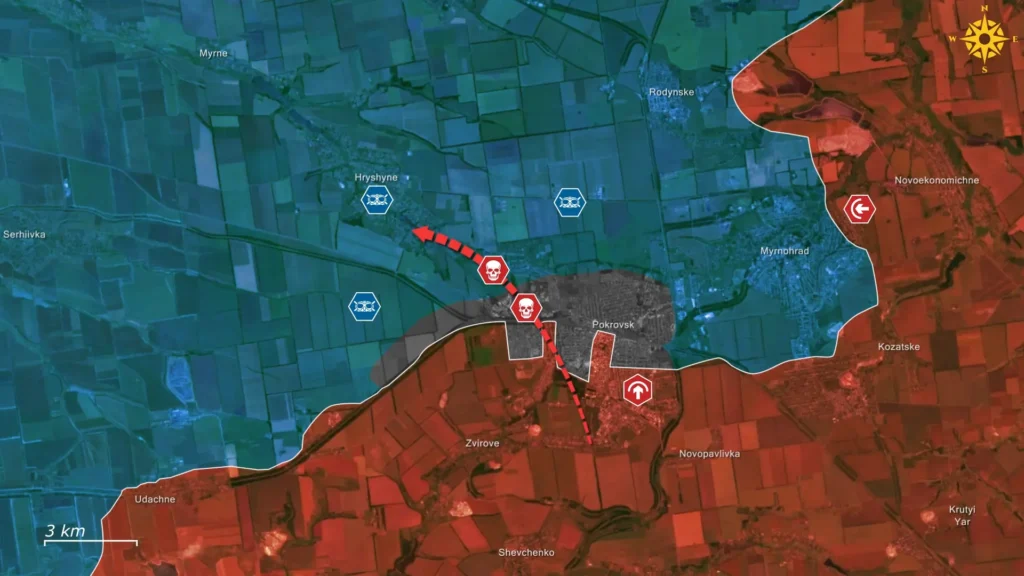
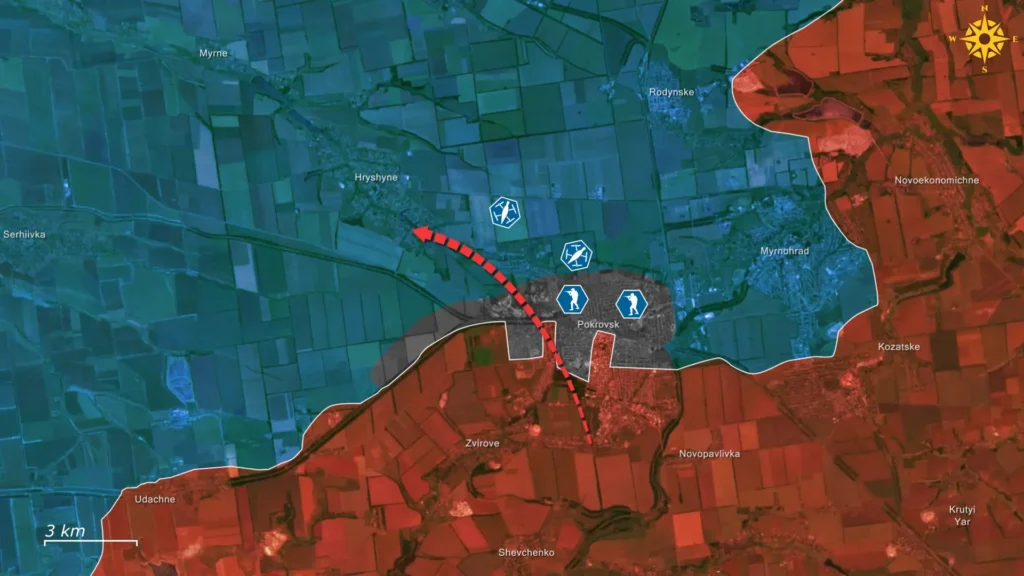
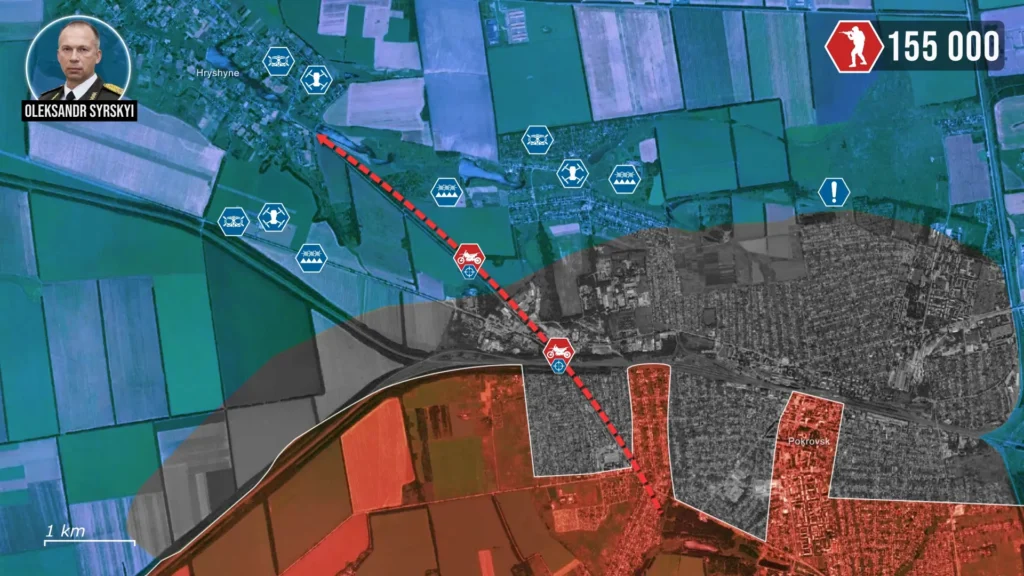
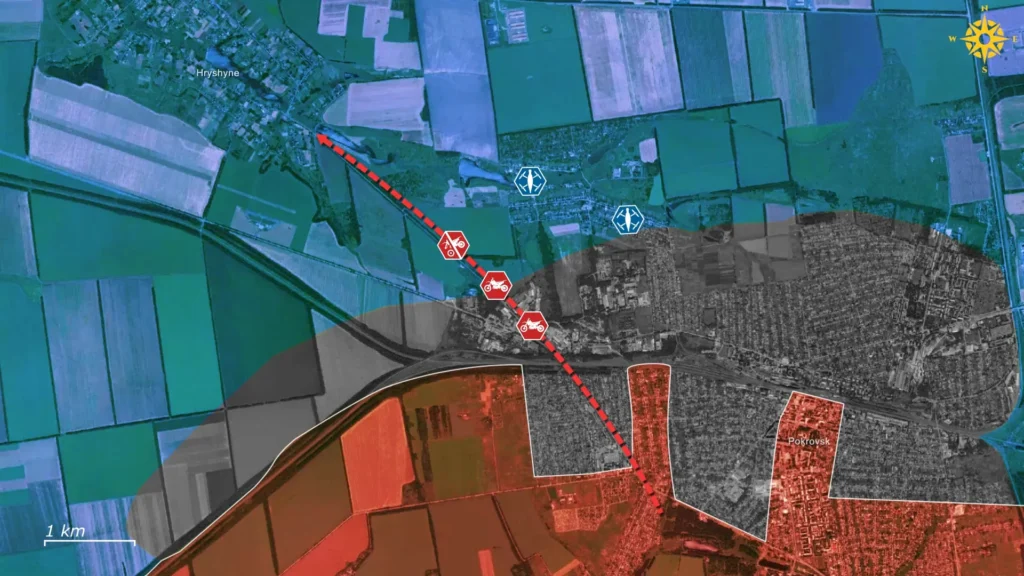
The Ukrainians have successfully prevented enemy penetrations north of the railway line, so the Russians want to attack the western flank and advance towards Hryshyne. The Russian objective is to isolate northern Pokrovsk and endanger its supply routes, thereby intensifying the pressure.
Such a disruption could compel the remaining Ukrainian forces to withdraw, as their positions would become unsustainable in an already hard situation. By forcing a Ukrainian pullback to more favorable terrain, the Russian command would avoid direct assaults and house-to-house close-quarter engagements that would otherwise inflict substantial casualties on their units.
Fast vehicles, short distance - but no concealment
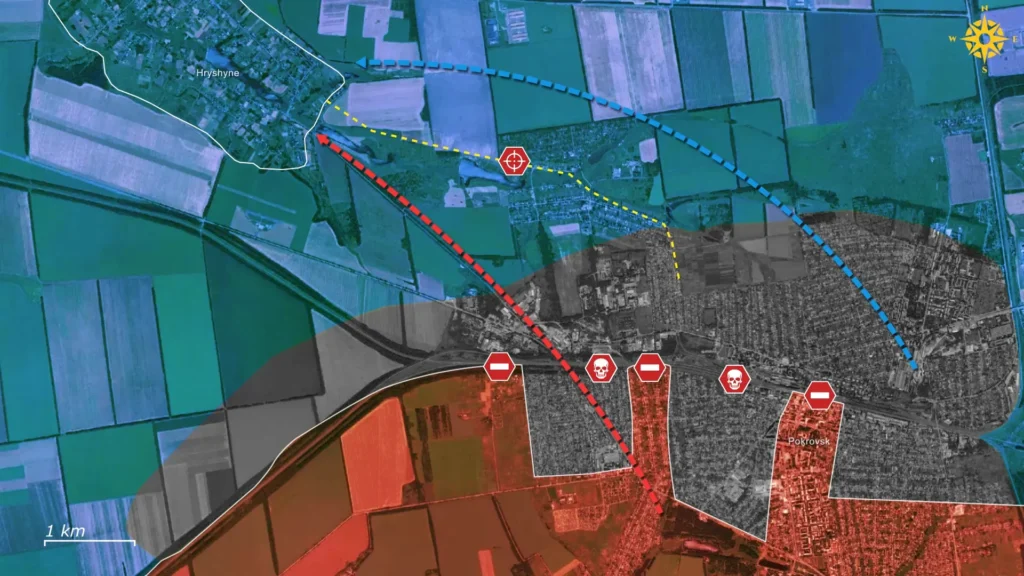
Russia's approach to attack Hryshyne bases on the element of surprise and the deployment of quick-moving motorcycles and buggies to mount a lightning assault and drop off infantry inside the village, as it is only 3.5 kilometers away from the Russian-controlled part of Pokrovsk.
To achieve this, Russia aims to exploit its consolidation of gains in southern Pokrovsk, which serves as a staging ground for its forces, and the buildings provide partial protection from Ukrainian drones.
Another factor is the local road, which is in relatively good condition, leading directly to Hryshyne from Pokrovsk, which allows the Russians to try to push quickly towards the settlement and surprise the Ukrainians.
Unfortunately for the Russians, some of Ukraine's most capable drone units are deployed in this sector, conducting tight surveillance of the area because they expect a Russian attack. The Ukrainian command can also utilize the extensive defensive fortifications, which were built behind Pokrovsk, with the purpose of stopping exactly this type of assault.
Winter visibility and overstretched defenders
The beginning of the winter season is an obstacle for the Russian efforts, because despite the presence of tree lines along the roads, they currently provide no concealment, and with the onset of snowfall, even smaller vehicles such as buggies and motorcycles become significantly easier for drone operators to detect.
At the same time, Ukraine's forces are also not in an ideal position, simultaneously defending the western and northern parts of Pokrovsk and the northern flank of the wider urban agglomeration. This creates a substantial operational burden that increases the risk of missing Russian assault groups, leaving Ukrainian units overstretched.
According to Ukrainian Commander-in-Chief Syrski, the Russians still possess enough manpower in this sector after accumulating approximately 155,000 troops, which gives them a substantial advantage over the Ukrainians, despite the heavy losses.
Geolocated footage shows attack intercepted early
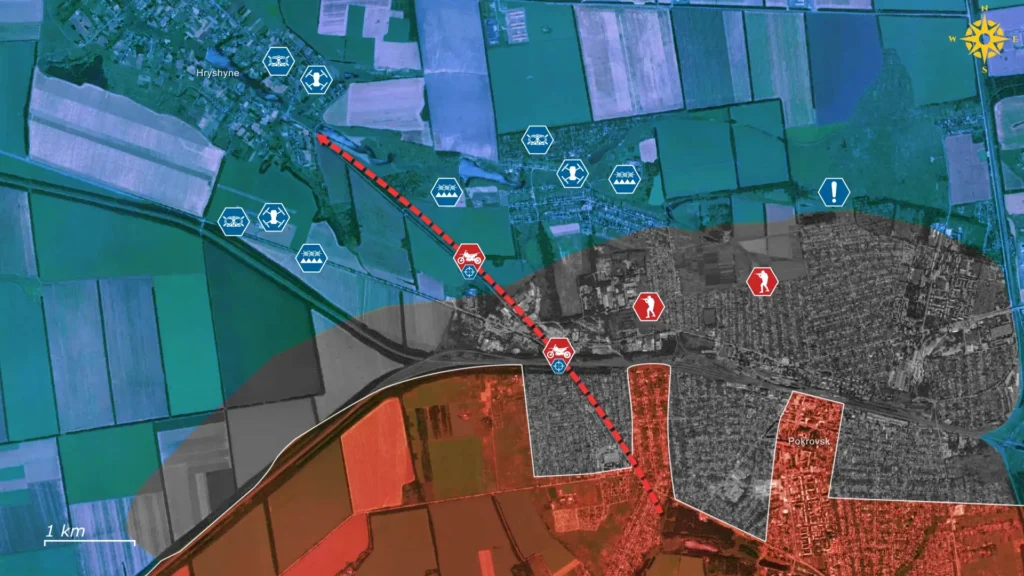
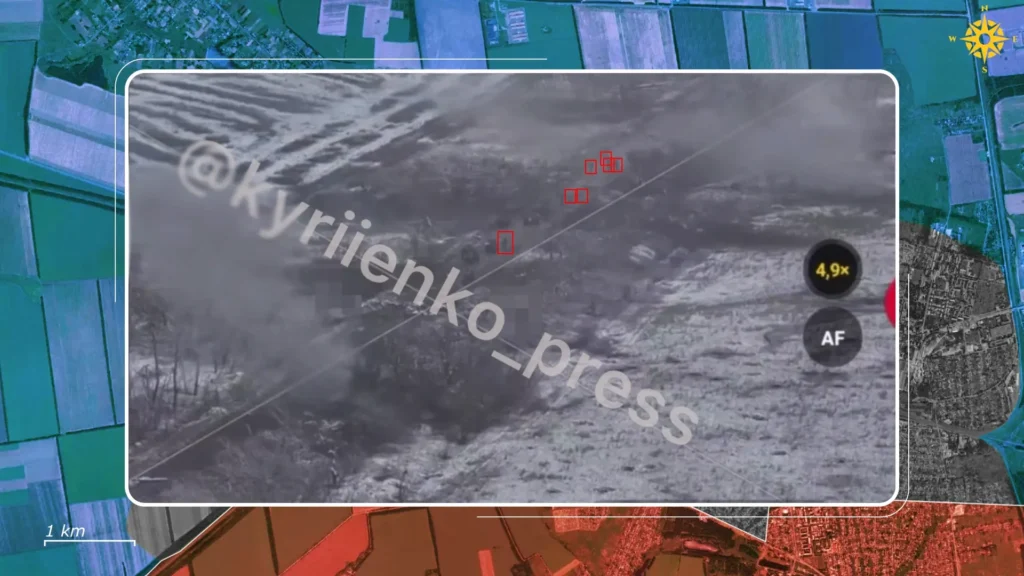
Geolocated footage from Ukrainian drone operators captures the sequence of the Russian attack and how early the advancing forces were detected. Despite the vehicles' speed and maneuverability, the column was halted roughly one kilometer after departing Pokrovsk, where the lead vehicle was immediately targeted.
Additional footage shows the aftermath, with all vehicles burning simultaneously, clear evidence that multiple strikes were delivered at once. Since drone attacks do not always achieve a kill on the first attempt, the number of destroyed vehicles indicates that dozens of Ukrainian drones were already positioned to intercept the assault, preventing any Russian unit from reaching Hryshene.
Failed assault costs Russia 10 vehicles, 40 soldiers
Another video shows surviving Russian soldiers attempting to continue their advance, but in their panic, they failed to disperse, allowing a single FPV drone to neutralize them. In total, the failed Russian push resulted in the destruction of 10 vehicles and the loss of 40 soldiers, eliminating their attempt to execute an outflanking maneuver.
Overall, Russia's new approach of attacking the western flank towards Hryshyne by surprise resulted in even more losses, as the Russian command disregarded the high activity of the Ukrainian drone units, which monitor and punish every movement.
Ukrainian drone operators proved their effectiveness again and demonstrated how important they are for holding the line in and around Pokrovsk. These developments may compel Russian forces to adjust their tactics or turn their attention to another part of the frontline around the embattled town.
In our regular frontline report, we pair up with the military blogger Reporting from Ukraine to keep you informed about what is happening on the battlefield in the Russo-Ukrainian war.
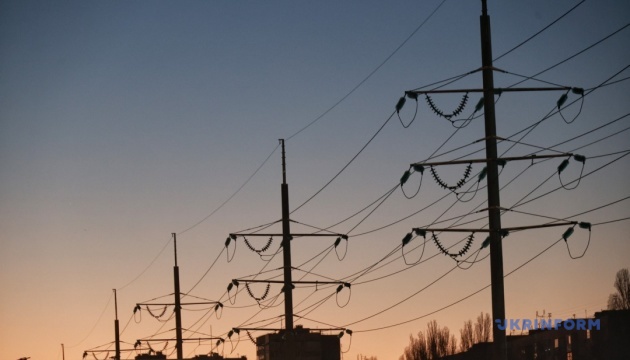
Russian strikes on Ukraine do not stop for a single day amid peace talks. The Kremlin is using massive attacks on energy infrastructure as a direct lever of pressure on Kyiv, says Ukrainian President Volodymyr Zelenskyy.
He emphasizes that there is now virtually no power plant in Ukraine that has not been hit by Russian missile or drone attacks. He adds that air defense is now Ukraine's diplomatic leverage.
Russia’s large-scale strikes could completely disable electricity transmission systems from the west of Ukraine, effectively splitting the country in two and causing a massive blackout in the east, The Washington Post reports. This aligns with the Kremlin’s strategy to destroy Ukraine, according to The Economist.
“For many months, the primary target of Russian drones and missiles has been our energy sector. In fact, there is currently not a single intact power plant left in Ukraine,” Zelenskyy says.
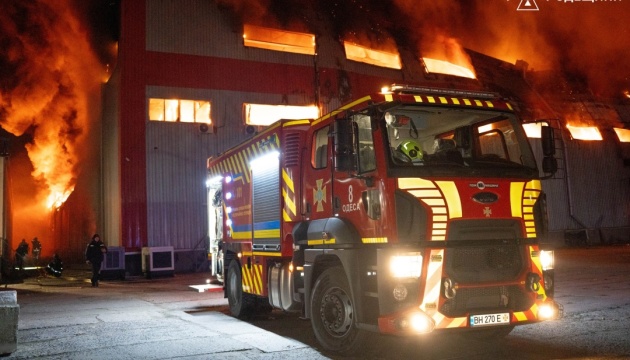
The consequences of this strategy are already felt daily: in Kyiv, electricity outages last up to nine hours a day, while in Odesa, residents have been without power for a fourth consecutive day following the latest strike.
Air defense becomes a key diplomatic leverage
The president directly linked Ukraine’s defensive capabilities to its negotiating position.
“The ability to shoot down Russian missiles and drones is our additional leverage in negotiations is our additional leverage in diplomacy,” Zelenskyy stressed.
According to him, Putin uses the brutality of the strikes as a tool of pressure, attempting to impose his terms through fear, darkness, and cold.
Despite extensive destruction, Ukraine continues to restore electricity supplies as quickly as possible after each attack.
Frozen Russian assets and partner support remain critical
Amid relentless attacks, Ukraine critically depends on continued support from its allies. Zelenskyy also highlighted the issue of frozen Russian assets in the EU.
“These funds must fully and effectively work to protect against Russian aggression. This is fair. This is reasonable. And this must be achievable,” the Ukrainian president said.
He also announced that Berlin is preparing to open one of the first offices focused on arms exports and joint defense manufacturing projects with Germany, Ukraine’s largest trading partner in Europe.
Against the backdrop of diplomatic statements, the reality remains unchanged: Russian strikes continue every day.
That is why air defense, energy resilience, and international support are not only matters of survival, but also key to Ukraine’s ability to engage the aggressor from a position of strength.
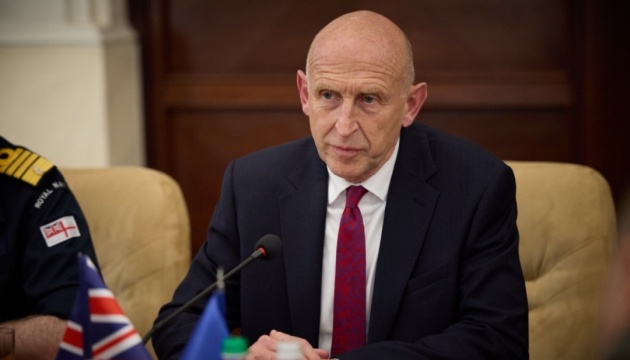
The United Kingdom has decided to provide GBP 600 million worth of air defense capabilities to Ukraine to help protect Ukrainians over the winter months.
The UK government is providing funding to the country's troops to ensure preparedness for future deployment in Ukraine after the peace is established as part of security guarantees to the country.
With sufficient funding, Ukrainian arms manufacturers — including the defense company Fire Point, which produces the long-range Flamingo missiles — are capable of scaling up production. However, partners need to place greater trust in young Ukrainian companies that currently have the most relevant experience in this field.
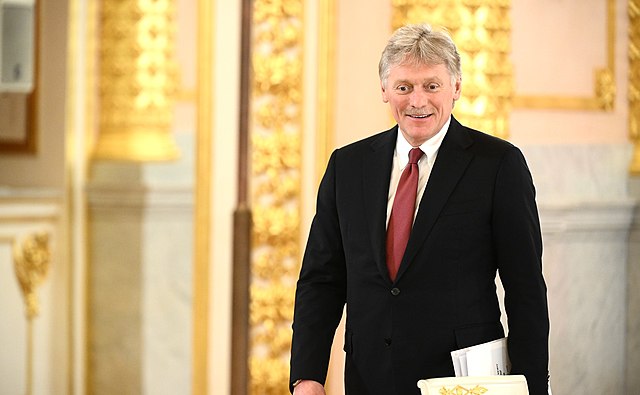
Russia has turned down a proposal for a Christmas ceasefire, with Kremlin spokesman Dmitry Peskov stating that Moscow seeks "not a truce that would give Kyiv a respite and an opportunity to prepare for the continuation of the war, but a full-fledged peace," according to Russian news agency Interfax.
The Russian representative emphasized that Moscow's position "is well known both in the United States and in Ukraine" and stressed that Russia wants to achieve its objectives.
"The question now is whether we are moving toward what President Trump calls a deal, or not," Peskov claimed. "If the Ukrainians have and begin to be dominated by a desire to replace moving toward a deal with immediate unviable solutions, then we are hardly ready to participate in this."
The rejection comes after German Federal Chancellor Friedrich Merz proposed that Russia arrange a Christmas truce. He expressed hope that Russian authorities "have remnants of humanity and can leave people alone for a few days."
Ukrainian President Volodymyr Zelenskyy had previously said ated that both Ukraine and the United States supported the idea of a truce during Christmas and New Year holidays.
"Friedrich has indeed proposed such an idea. He announced it today both publicly and during our conversations. The United States of America supports this idea. As President, I certainly support it as well," Zelenskyy told journalists, responding to a question about the German chancellor's proposal. "I believe that an energy ceasefire is also fine, and we will support any ceasefire. Overall, we support both Europe and the United States in steps aimed at ending the war."
However, Zelenskyy said that "many things, of course, depend on Russia's political will in this regard," while also emphasizing that "much also depends on our work on the documents."
Ukrainian President Volodymyr Zelenskyy said that if Moscow refuses to accept the terms for ending hostilities worked out through negotiations with the US and Europe, it's time for Trump to move to serious pressure on Russia.
Speaking to media after negotiations in Berlin on 15 December, Zelenskyy outlined the diplomatic timeline ahead. "Today or tomorrow, we will finalize our documents. After that, I believe the United States will, in the coming days, hold consultations with the Russians, and then hold consultations with the President of the United States. After that, our teams will meet. I think our negotiating teams will meet in the United States in the near future – possibly even over the weekend. And then, after that meeting, we will see how things stand. We will consider a meeting at the leaders' level, in any event with the President of the United States."
Zelenskyy was asked what he thinks will happen when Ukraine, the US, and Europe finalize agreements and the Kremlin rejects them.
"If Putin rejects everything, we will end up with exactly what we are experiencing on our plane right now – turbulence. We are indeed experiencing it now," Zelenskyy said. "But it is not that severe compared to the war, of course, and compared to what happens if Putin destroys any diplomatic opportunities and willingness – on our side, on the European side, and on the American side."
He continued that in such a scenario, he considers it logical for the US to shift to hard pressure on Russia and expand assistance to Ukraine.
"I believe the United States will apply sanctions pressure and provide us with more weapons if he rejects everything. I think that would be a fair request from us to the Americans. Because, in my view, the logic is this: if the United States is ready to provide security guarantees to Ukraine and to apply strong guarantees if Putin violates the agreement, then tell me honestly – how is that different from a situation in which Putin does not want to end the war?" Zelenskyy said.
"I believe it would be a fair request from me as President, and from some European leaders as well: then give us at least part of those guarantees so that we can repel Putin – air defense, and long-range capabilities," he concluded.
During the briefing, Zelenskyy said that following the negotiations, five documents are to be formalized – some related to security guarantees, others to reconstruction. According to him, there has been "serious progress" on the security guarantees issue.
The president also emphasized that Ukraine will not agree to legal or de facto recognition of the occupied Donbas as Russian territory.
According to US media sources, Washington believes it has resolved "90% of the disagreements" between Ukraine and Russia.
Details of the negotiation framework
Zelenskyy also provided details about the Berlin talks, the first meeting in this format with the US team including Steve Witkoff, Jared Kushner, and General Keith Grynkewich. "The path is certainly not easy, because the war is complicated, and the path will be too. That does not mean it will be long. The Americans want a swift resolution; we care about maintaining quality even at this pace. If speed and quality coincide, we are fully on board," he said.
The negotiations involve five documents covering security guarantees and reconstruction. The security guarantees must be legally binding and approved by US Congress, including an Article 5 equivalent mirroring NATO's collective defense provision. Reconstruction documents address internally displaced persons who lost housing, with costs estimated at 70-80 billion dollars, as well as compensation for families of fallen soldiers and infrastructure repairs.
"Regarding security guarantees, it is important that our military has discussed all the details – I mean, the US-Ukrainian team. And I believe we are very close to strong security guarantees. Certainly, we are people of war, and during war, we trust facts. So, theoretically, we can see good elements on paper today, but the facts – again, I emphasize and return to this – are the votes in the US Congress," he said.
Zelenskyy noted progress on the most difficult points of the 20-point framework agreement and said Europe was successfully brought into the process alongside the US. Together with European leaders, they spoke with President Trump about these steps, with another leader-level meeting expected once documents are finalized.
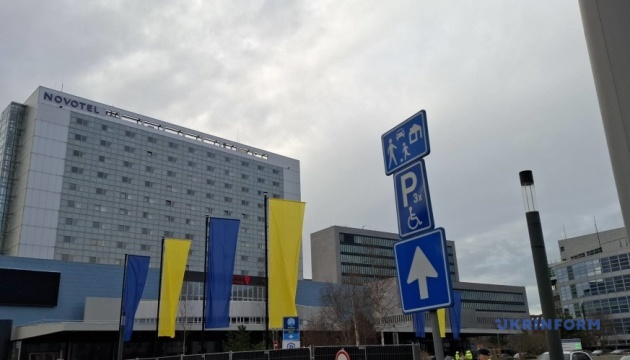
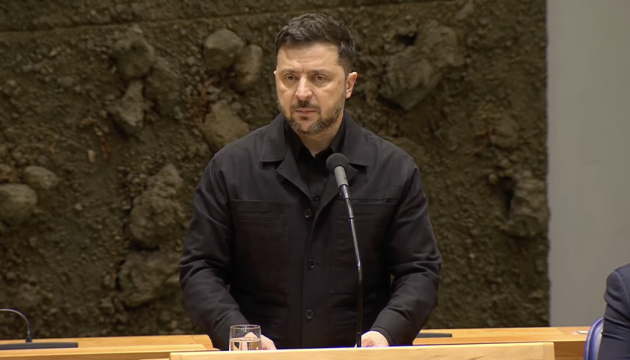
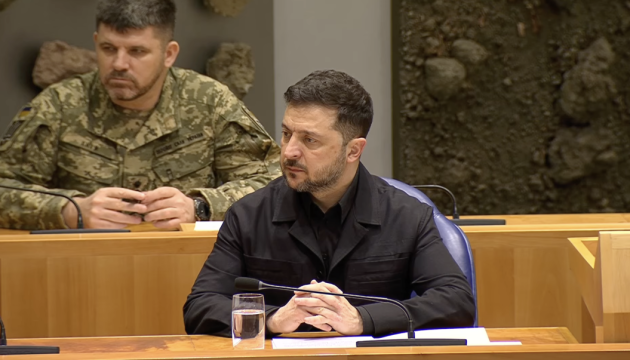
Ukrainian President Volodymyr Zelenskyy landed in the Netherlands on the night of 16 December, the Presidential Office informed journalists.
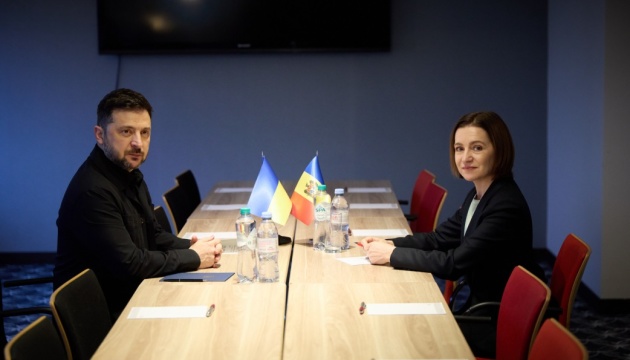
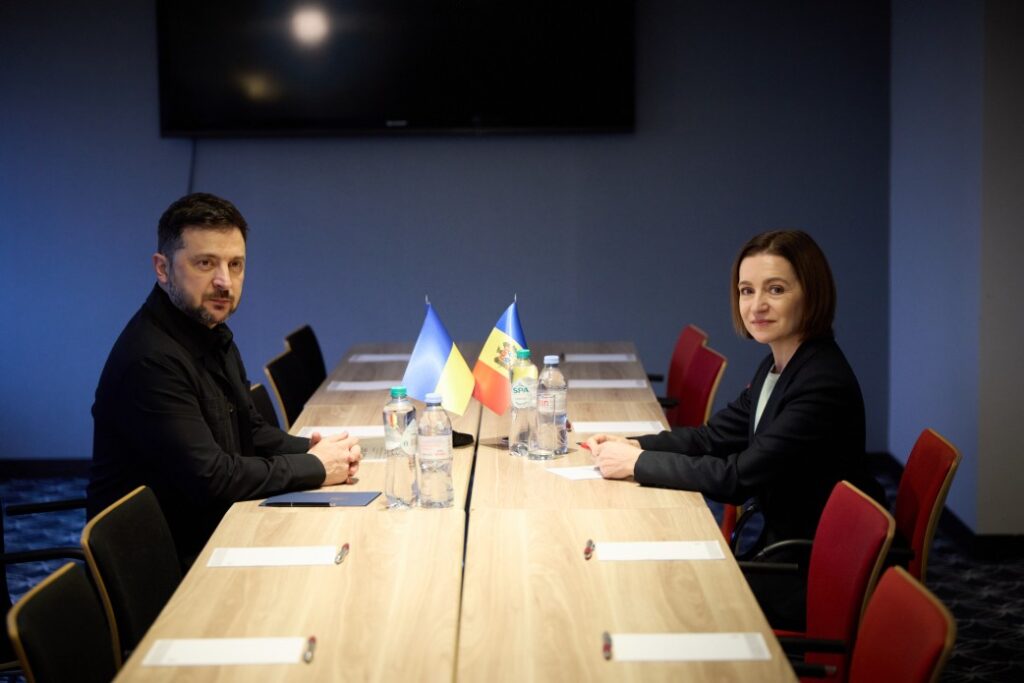
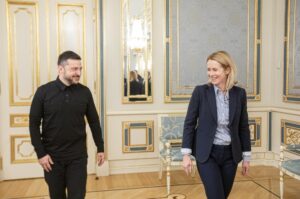
The visit began with a meeting with Moldovan President Maia Sandu in The Hague. Zelenskyy thanked Moldova for its support and readiness to develop cooperation, according to the Presidential Office. The leaders discussed possible areas of partnership and agreed on follow-up contacts.
Zelenskyy briefed Sandu on the progress of negotiations with American and European partners aimed at achieving a dignified peace, guaranteeing security, and rebuilding Ukraine after the war ends.
The two presidents also discussed continuing pressure on Russia and countering all possible manifestations of Russian threats.
Special attention was paid to the shared path to European Union membership. Zelenskyy emphasized that further progress of Ukraine and Moldova must be simultaneous and closely coordinated.
Following the bilateral meeting, Zelenskyy will address both chambers of the Dutch parliament — the House of Representatives and the Senate.
The president will participate in a high-level Diplomatic Conference. Before that, a brief four-way meeting is scheduled with Dutch Prime Minister Dick Schoof, Moldovan President Maia Sandu, and Council of Europe Secretary General Alain Berset.
Separate bilateral talks between Zelenskyy and Schoof will take place in a one-on-one format, after which the leaders will speak with the press. The Dutch government also announced this meeting.
The visit program includes an audience with King Willem-Alexander of the Netherlands, a meeting with Foreign Minister David van Weel and Defense Minister Ruben Brekelmans, and a visit to the Aardenburg Military Rehabilitation Center (MRC Aardenburg).
Prime Minister Schoof will speak at an international ministerial conference dedicated to the Founding Treaty for the International Claims Commission for Ukraine.
On 8 December, the Council of Europe Office in Ukraine reported that on 16 December, leaders and senior politicians from Europe and partner countries will gather in The Hague to launch a new convention establishing this commission.
The International Claims Commission will become the second part of the compensation mechanism for Russia's war aggression against Ukraine. It will build on the already existing Register of Damage for Ukraine. The Claims Commission will be created within the Council of Europe framework. States outside the European continent will also be able to join.
Twelve European leaders committed to "strongly support Ukraine's accession to the European Union" in a joint statement released 15 December following emergency talks in Berlin, while pledging to deploy a multinational military force inside Ukraine and use €210 billion in frozen Russian assets for reconstruction.
The statement represents the most concrete European security package for Ukraine since Russia's 2022 invasion. It comes as EU leaders prepare for a summit on 18-19 December to decide on converting frozen Russian central bank assets into loans for Kyiv—a mechanism the statement explicitly referenced by noting that "Russian sovereign assets in the European Union have been immobilized."
Key commitments from the Berlin statement:
Strong support for Ukraine's EU membership
European-led multinational force operating inside Ukraine
US-led ceasefire monitoring mechanism
800,000-strong Ukrainian military maintained post-war
Legally binding defense commitments against future attacks
Frozen Russian assets tied to war reparations
Which European leaders signed the Berlin statement?
The statement carries signatures from:
European Council President António Costa
Chancellor Friedrich Merz (Germany)
President Emmanuel Macron (France)
President Alexander Stubb (Finland)
Prime Minister Keir Starmer (UK)
Prime Minister Giorgia Meloni (Italy)
Prime Minister Donald Tusk (Poland)
Prime Minister Ulf Kristersson (Sweden)
Prime Minister Mette Frederiksen (Denmark)
Prime Minister Dick Schoof (Netherlands)
Prime Minister Jonas Gahr Støre (Norway)
European Commission President Ursula von der Leyen
The statement remains "open for other countries to join"—acknowledging that not all 27 EU members signed. Hungary's Viktor Orbán and Slovakia's Robert Fico, both of whom have threatened to veto EU support for Ukraine, were absent from the list.
European troops to deploy inside Ukraine
The statement's most significant military commitment: a "European-led 'multinational force Ukraine' made up from contributions from willing nations within the framework of the Coalition of the Willing and supported by the US."
This force would operate inside Ukrainian territory with a broad mandate to "assist in the regeneration of Ukraine's forces, in securing Ukraine's skies, and in supporting safer seas."
The explicit mention of air and naval security suggests European personnel could help operate or support air defense systems and Black Sea operations—roles marking a substantial escalation of Western military involvement in Ukraine.
Leaders also committed to maintaining Ukraine's armed forces at "a peacetime level of 800,000 to be able to deter conflict and defend Ukraine's territory," which would make the Ukrainian military one of Europe's largest standing forces.
US-led ceasefire monitoring mechanism explained
Washington would lead the mechanism ensuring any peace deal holds. The statement outlined "a US led ceasefire monitoring and verification mechanism with international participation to provide early warning of any future attack and attribute and respond to any breaches."
The arrangement includes "a deconfliction mechanism to work on mutual deescalatory actions that can be taken to benefit all parties"—language suggesting direct US-Russia communication channels to prevent incidents from escalating.
What happens if Russia violates a ceasefire:
Legally binding commitment to respond
Measures "may include armed force"
Intelligence and logistical assistance
Economic and diplomatic actions
Frozen Russian assets and Ukraine reparations
The Berlin statement directly tied Russia's €210 billion in frozen assets to future compensation, declaring that leaders would "invest in the future prosperity of Ukraine, including making major resources available for recovery and reconstruction... taking into account the need for Russia to compensate Ukraine for the damage caused."
The EU permanently froze Russian central bank assets last week, eliminating the six-month renewal cycle that had left funds vulnerable to Hungarian vetoes. The 18-19 December summit will determine whether those assets can back a reparations loan that Ukraine would only repay if Moscow compensates Kyiv for war damages.
Ukraine EU membership path confirmed
Leaders pledged to "strongly support Ukraine's accession to the European Union"—the clearest endorsement since Hungary began blocking formal accession negotiations in early 2025.
The statement emphasized that "decisions on territory are for the people of Ukraine, once robust security guarantees are effectively in place," and that leaders would "support President Zelenskyy to consult his people if needed."
What Europe demands from Russia
The statement called on Moscow "to show willingness to work towards a lasting peace by agreeing to President Trump's peace plan and to demonstrate their commitment to end the fighting by agreeing to a ceasefire."
Leaders welcomed "significant progress on President Trump's efforts to secure a just and lasting peace in Ukraine" and committed to "continue to increase pressure on Russia to bring Moscow to negotiate in earnest."
They were clear: "Nothing is agreed until everything is agreed."
In the Pokrovsk sector, Russian forces show the greatest activity on the western outskirts of the city. In particular, the enemy is attempting to break through toward Hryshyne, northwest of Pokrovsk. Russians are also increasing pressure on the southeastern areas of Myrnohrad.
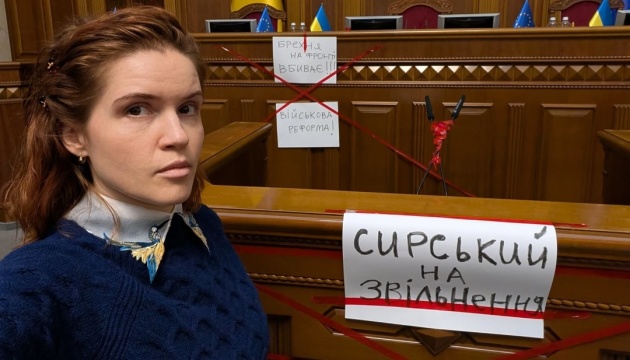
Member of Parliament Mariana Bezuhla has blocked the rostrum of the Verkhovna Rada of Ukraine, demanding military reform and the dismissal of Commander-in-Chief of the Armed Forces of Ukraine Oleksandr Syrskyi.
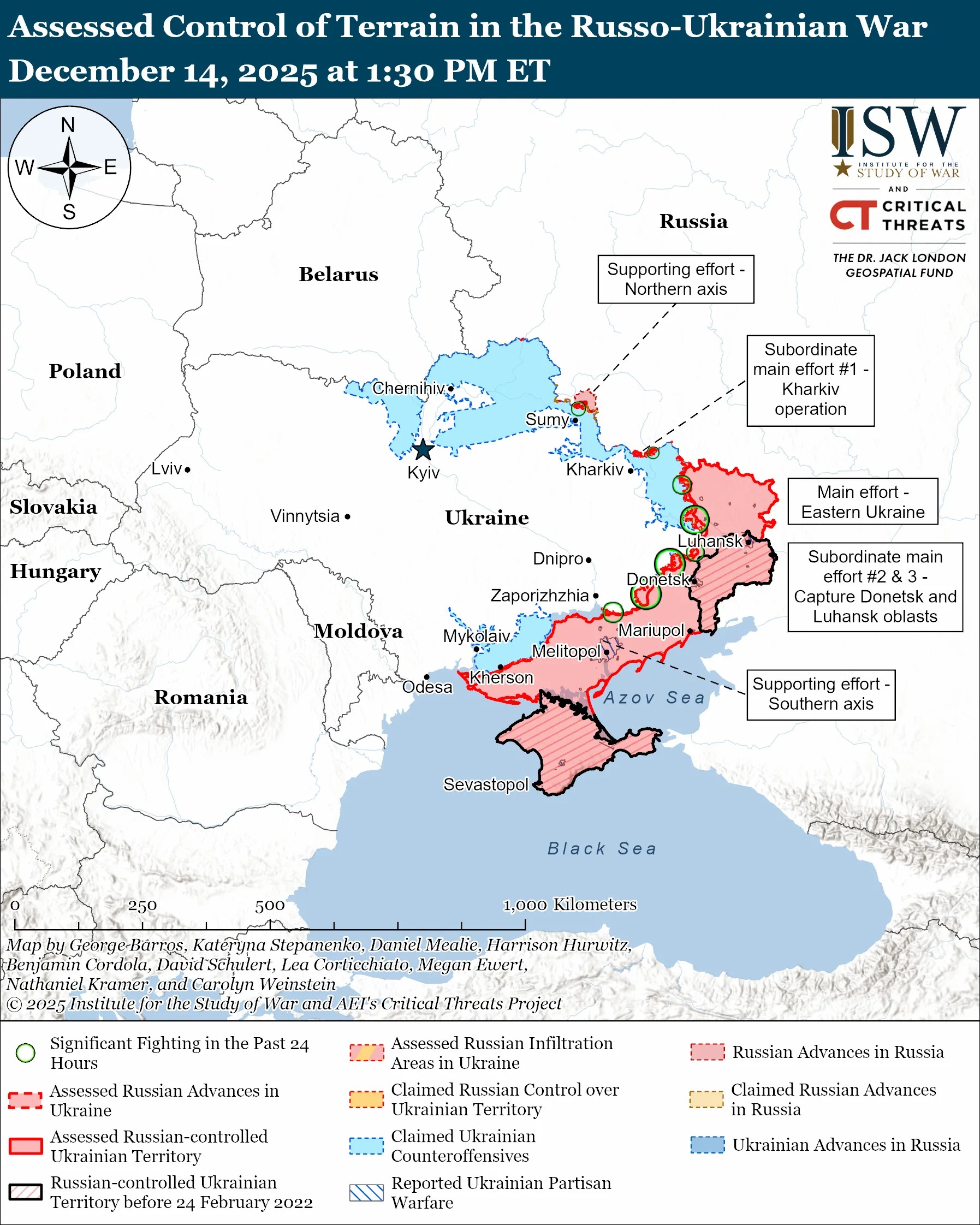
Ukrainian forces continue counterattacking in and around Kupiansk, Kharkiv Oblast, where Russian troops face logistical complications and loss of drone coverage, according to the Institute for the Study of War (ISW). Kyiv’s units have entered northern Kupiansk, blocked Russian infiltration attempts, and liberated nearby settlements, while Russian sources admit growing difficulties.
Ukrainian forces have recently managed to encircle Russian troops inside Kupiansk, a city in Kharkiv Oblast that has remained one of the most active frontline sectors this year. Russian forces advanced toward the city through the summer and autumn, infiltrating parts of Kupiansk by early August, while the Russian military command later portrayed these incursions as significant gains. Kupiansk is a key logistics hub in northeastern Ukraine, and Ukrainian troops launched a coordinated counteroffensive in the area in September 2025 to halt the advance and reclaim lost ground.
Ukrainian troops push forward and cut off Russian movements
ISW says in its 15 December report that Colonel Viktor Trehubov, spokesperson for Ukraine’s Joint Forces Group, noted on 15 December that Ukrainian forces continue clearing operations within Kupiansk and are avoiding urban combat. He reported that Russian forces are using unmanned aerial vehicles to supply a group of around 100 to 200 personnel remaining in the city.
Trehubov implied that UAVs cannot cover all areas and have limited payload capacity, and said drones sometimes drop supplies in ways that expose Russian positions to Ukrainian forces.
A non-commissioned officer of a Ukrainian brigade operating in the Kupiansk direction said Ukrainian troops have liberated several settlements and nearby forest areas, and that elements of his brigade are active in northern Kupiansk. He said Russian forces continue infiltration attempts using a gas pipeline, but Ukrainian forces have blocked the pipeline and now keep all possible exit points under fire control.
Explore further
ISW: Russia’s army can’t sustain multi-pronged offensives due to manpower and equipment strain
Russian bloggers report worsening conditions
ISW reported that Russian ultranationalist milbloggers continue to acknowledge the deteriorating battlefield situation for Russian forces in Kupiansk. One claimed that Russian troops hold some positions in northern and central parts of the city, while the rest is either a contested “gray zone” or under Ukrainian control.
Another milblogger wrote that conditions in western Kupiansk are “rapidly worsening” and said elements of the 68th Motorized Rifle Division of the 6th Combined Arms Army are “desperately fighting.” He also acknowledged that Ukrainian forces have advanced in Kupiansk and in Myrove, immediately northwest of the city.
According to ISW, the same source admitted that “Russian forces no longer have manpower superiority in the area” and said that Ukrainian interdiction efforts are hindering Russian operations. He added that Ukrainian advances have forced Russian drone operators to retreat across the Oskil River to the east (left) bank.
Explore further
ISW: Ukrainian troops continue advancing within and near Kupiansk
ISW contradicts Russian claims with geolocated evidence
“Geolocated footage published on December 14 and 15 indicates that Russian forces likely do not hold positions within Petropavlivka (east of Kupiansk), contrary to Russian claims of advances in the area,” ISW stated.
ISW also assessed that the Kremlin is continuing to promote a narrative of Russian gains in and near Kupiansk “for a cognitive warfare effort designed to portray the Ukrainian lines as on the verge of collapse.” According to ISW, “the Ukrainian counterattacks in the Kupiansk direction continue to demonstrate that.”
Türkiye's Ministry of Defense announced the interception and destruction of an unidentified unmanned aerial vehicle over the Black Sea after it approached Turkish airspace.
The aerial target was detected approaching Turkish airspace from the Black Sea and brought under control through standard air monitoring procedures, according to an official press release from the defense ministry.
F-16 fighters operating under NATO and Turkish national command were deployed to ensure airspace security. During identification procedures, the target was determined to be "an unmanned aerial vehicle that was out of control," the ministry said.
The drone was engaged and destroyed in a safe zone away from populated areas to prevent possible negative consequences, the ministry reported. Neither the type of aircraft nor its national origin was disclosed.
This incident follows a previous case on 1 October, when Turkish naval sappers conducted a controlled detonation of a Ukrainian Magura v5 drone recovered from the sea. Combat drones have washed ashore in Türkiye multiple times in 2024, including a combat maritime drone built on a jet ski base that waves carried from the Black Sea.
As digital assets move from niche investment tools to core components of modern financial services, institutional crypto custody has become a crucial foundation for companies building payment, treasury, and cross-border solutions. Fintechs now handle stablecoins, tokenized deposits, and on-chain settlements daily, and each of these workflows depends on a secure and compliant way to manage private keys.
In practice, that means the custody layer isn’t just a “vault” anymore. It’s the backbone that determines how safely digital assets can be stored, moved, audited, and integrated into existing financial systems. When a fintech processes thousands of transactions an hour or connects with banking partners, even a small operational flaw in the custody stack can create regulatory risks or downtime. That’s why institutions increasingly treat custody as critical infrastructure, not a technical afterthought.
Why security shapes institutional-grade digital asset operations
For fintechs stepping into the digital asset economy, security can make or break operational trust. Handling client balances or settlement flows requires infrastructure that protects private keys without slowing down transaction throughput. In high-volume environments, firms typically combine offline controls for long-term reserves with low-latency access for day-to-day transfers, creating a balance between resilience and usability that retail wallets often can’t match.
Here’s what a modern setup usually includes:
Multi-layer key protection combining MPC, HSMs, and role-based approvals to eliminate single points of failure
Segregated accounts that prevent asset commingling and support clear audit trails
Real-time monitoring of transaction flows and threats across all connected chains.
This mix protects assets while ensuring fintech teams can scale without compromising performance. In a world where one compromised key can freeze operations, security becomes a business requirement, not a technical preference.
How compliance and integration enable scalable fintech growth
Regulators worldwide are raising expectations for how institutional crypto custody should operate, and fintechs must meet these standards from day one. That includes AML screening, data residency rules, and transparent reporting frameworks. With compliance built into the custody layer, firms can maintain audit-ready operations without slowing down product development.
The second pillar that matters just as much is integration. Fintechs need custody that plugs directly into payment engines, settlement rails, and accounting systems. API-first infrastructure allows companies to automate withdrawals, reconcile balances instantly, and support multi-chain flows — all without rebuilding their existing tech stack.
For fast-growing businesses, this combination of compliance and integration unlocks the ability to launch new markets, add new chains, and manage larger volumes without operational friction.
Institutional crypto custody gives fintechs the stability they need to operate in a regulated, fast-moving digital asset landscape. With the right focus on security, compliance, and seamless integration, fintech companies can build products that are trustworthy, scalable, and ready for global expansion.
After meetings with American and European officials in Berlin on 15 December, Ukrainian President Volodymyr Zelenskyy confirmed that Russia still demands full control of eastern Ukraine's Donbas in its so-called peace plan. He said Ukraine will not surrender any of its internationally recognized territory and rejected any compromise on the Donbas.
The Donbas is a historic name for a coal basin and is colloquially used to denote either both Luhansk and Donetsk oblasts, or sometimes just Donetsk Oblast. In recent years of the ongoing Russo-Ukrainian war, Moscow has focused on capturing the entire Donbas region, sending its most numerous ground armies into repeated attacks that have brought only incremental gains at the cost of heavy personnel and equipment losses, yet it has still failed to capture the region in its entirety.
Zelenskyy: Russia still wants Donbas — Ukraine won’t give it up
Speaking at a 15 December online press conference attended by Euromaidan Press, Zelenskyy said Moscow still demands the entire Donbas in negotiations.
“Their position has not changed,” he said. “We do not want to give up our Donbas.”
He made clear that Ukraine will not recognize Russian control over any part of the region, either legally or in practice.
"Neither de jure nor de facto will we recognize Donbas – its temporarily occupied part – as Russian. Absolutely. Nevertheless, we are discussing the territorial issue. You know it is one of the key issues. At this point, there is no consensus on it yet," the President said.
Zelenskyy also addressed American suggestions to create a “free economic zone” in the area, saying that "a “free economic zone” does not mean under the control of the Russian Federation." He stressed that this issue remains one of the most sensitive points in the talks and no consensus has been reached.
Explore further
Trump offers Ukraine “security guarantees” that are designed to fail
Zelenskyy previously told Bloomberg that the territorial issue — specifically Russia’s demand for the Donbas — remains the main unresolved point in talks. On 19 November, media reported that US envoy Steve Witkoff had presented a 28-point peace plan to Trump, allegedly developed with Russian representative Kirill Dmitriev. The plan called for Ukraine to withdraw from Donetsk Oblast and drop its NATO ambitions. Some of those provisions have since been removed, shortening the plan to 20 points.
No compromise on territory, but security talks advance
While territorial discussions remain stuck, Zelenskyy said there has been real progress in other areas, especially on security guarantees. He reiterated the US Congress is expected to vote on legally binding commitments that would require a response if Russia violates any future peace deal or ceasefire. The proposed mechanism would mirror NATO’s Article 5, providing a collective response to aggression.
Explore further
75% of Ukrainians oppose “peace plan,” which includes withdrawal of troops from Donbas
The Ukrainian President said detailed talks have also covered Ukraine’s long-term defense needs, including the size of its army, required weapons and training, and sustainable funding. He welcomed growing cooperation between the US and Europe, noting that the broader Coalition of the Willing — now called Europe+ — includes Canada and other non-EU partners.
Russia’s response will shape the next steps
Zelenskyy warned that if Russian President Vladimir Putin rejects the proposals, Ukraine will request more weapons and tougher sanctions from the US. He said this would be a fair reaction to a complete refusal by Moscow to engage in a peaceful resolution.
He added that around 90% of the draft peace documents have been agreed. The next phase includes consultations between the US and Russia, further talks in the United States, and potentially a summit with US President Donald Trump.
Asked about holding a referendum on the final peace agreement, Zelenskyy said no such plans exist for now. He noted that any vote would require a ceasefire and a secure environment, and that Ukraine is focused on easing the burden on civilians already suffering from war.
On 15 December, the Ukrainian Ministry of Defense announced the winners of the NATO Innovation Challenge “Medical Assistance in Accessible and Vulnerable Combat Spaces”. The competition awarded innovations that help provide care to the wounded in zones under total surveillance and at risk from drones.
The jury included NATO and Ukrainian experts from the medical battalion “Hospitallers” and the “Come Back Alive” foundation.
Victory for portable dialysis device
First place went to a Canadianportabledialysis unit for field use, which effectively replaces the function of the kidney.
It requires only 2–4 liters of water per cycle, compared to 200–500 liters for standard devices, and is compact enough to be carried in a backpack.
American solutions for autonomous medicine
Second place was awarded to MiniFuser, a device for controlled intravenous drug delivery without constant medical supervision, requiring no electricity or special conditions.
Third place went to an automatic system that reads patient data and transmits it securely, eliminating the need for Wi-Fi or Bluetooth, thereby enabling safe and reliable monitoring.
Prospects for frontline testing
Winners of the challenge will have the opportunity to refine their solutions and test them in combat conditions. If successful, these technologies could be scaled for broader use by the armed forces.
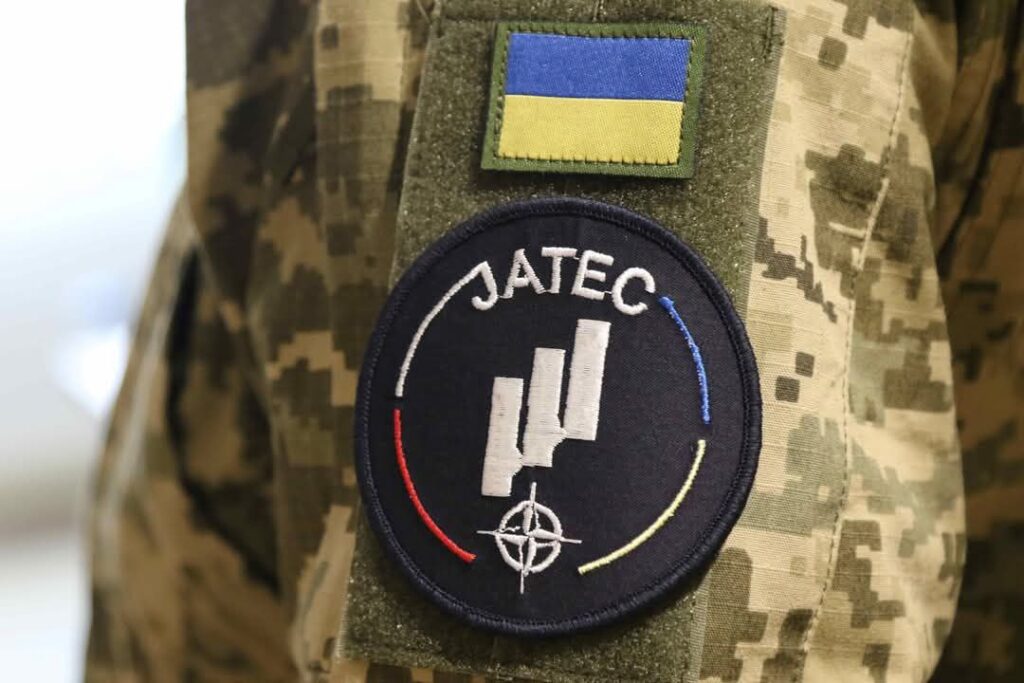
The competition was organized by the NATO-Ukraine Joint Analysis, Training, and Education Center (JATEC) and the NATO Allied Command Transformation.
Earlier, combat medic Volodymyr Ryzhenko, call sign “Druh Sprite”, from the 12th Special Forces Brigade Azov, was named“Best European Medic of the Year” in the Military Medicine category.
In winter 2025, Druh Sprite made headlines after he saved a wounded comrade under enemy fire by performing an emergency blood transfusion using donor blood delivered by drone.
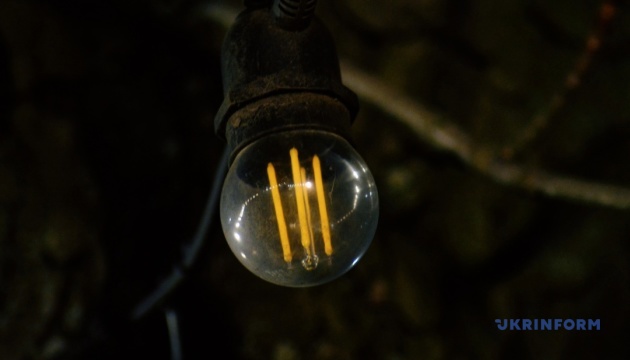
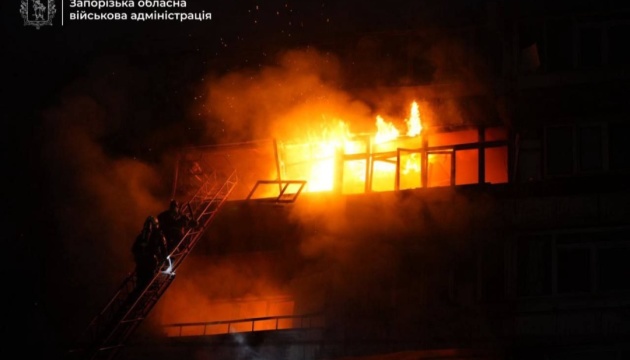
As of the morning of December 16, the government-controlled part of the Donetsk region has been left completely without electricity as a result of Russian shelling.
Russia is unlikely to agree to any peace deal or security guarantees for Ukraine that would not ensure Moscow's full control over Ukraine in the future.
Ukraine's operation to strike a Russian submarine in the port of Novorossiysk was quite complex and multi-layered. This is already the second enemy submarine destroyed by Ukrainian forces.
When Belarus released 123 political prisoners on 13 December—including Nobel Peace Prize laureate Ales Bialiatski—the price wasn’t measured in diplomatic concessions or policy changes. No, it was something much more tangible: potash, a potassium-rich mineral that makes crops grow.
Lithuania’s Foreign Ministry immediately stated that the EU would not follow, citing Belarus’s “combined hybrid attack” and ongoing support for Russia’s war against Ukraine. But the deal reveals an uncomfortable truth about global agriculture: potassium is irreplaceable, and Belarus controls a huge share of the world’s supply.
Explore further
Lithuania exposes Belarusian false flag scheme to frame Vilnius for hybrid attacks
The irreplaceable nutrient
Potassium is one of three essential nutrients for plant growth, alongside nitrogen and phosphorus. Unlike nitrogen fertilizers, which can be synthesized from natural gas, potassium must be mined from underground salt deposits concentrated in very few places.
Belarus holds approximately 23% of global potash reserves and, before sanctions, produced roughly 20% of the world’s supply, according to US Geological Survey data. There is no synthetic alternative.
“No substitutes exist for potassium as an essential plant nutrient and as an essential nutritional requirement for animals and humans,” the USGS states.
This geological lottery made Belaruskali part of what the US Treasury called “Lukashenka’s Wallets”—companies providing funds to the regime through a patronage network of monopolies, tax breaks, and favorable contracts.
Treasury explicitly described Belaruskali as “a major source of tax revenue and foreign currency for the Lukashenka regime” when imposing sanctions in August 2021.
Why the US blinked—and the EU didn’t
The United States imports roughly 85% of its potash from Canada alone—an extreme dependency unmatched by any other major importer, according to US Census Bureau data cited by Argus. Before sanctions, Belarus supplied an average of 635,000 tons annually to the American market.
The Trump administration’s decision to lift sanctions comes just days after threatening severe tariffs on Canadian fertilizer.
Having Belarus as an alternative strengthens Washington’s negotiating position in the ongoing tariff dispute with Ottawa. Potash was added to the US critical minerals list in 2025, signaling a strategic push to diversify supply sources.
The EU faces different calculations. European sanctions remain in place, and Lithuania—which lost billions in transit fees when it banned Belarusian potash shipments through Klaipėda port in February 2022—explicitly rejected any softening.
“None of the reasons why the EU began imposing sanctions on Belarus has disappeared,” the Lithuanian Foreign Ministry said. Opposition leader Sviatlana Tsikhanouskaya described EU sanctions as “far more painful” for Minsk than US restrictions — suggesting Lukashenka’s real prize would be European relief, not American.
Catastrophic price spike
The war Belarus helped launch punished Ukrainian farmers with fertilizer costs that peaked at two to three times normal ratios relative to crop prices in 2024, according to UkrAgroConsult.
The traditional benchmark—one ton of nitrogen fertilizer costing no more than 2.5 tons of wheat—was shattered, with potash and other inputs following similar spikes. Many farmers couldn’t afford adequate fertilization.
Only two of Ukraine’s major chemical plants—Cherkasy Azot and RivneAzot—remained operational after Russia’s invasion.
Global potash prices spiked to $1,000 per ton in mid-2022 before falling to below $300 today. But the damage was done: reduced fertilizer application during wartime affects yields for seasons to come, at a moment when Ukraine’s grain exports are critical to global food security.
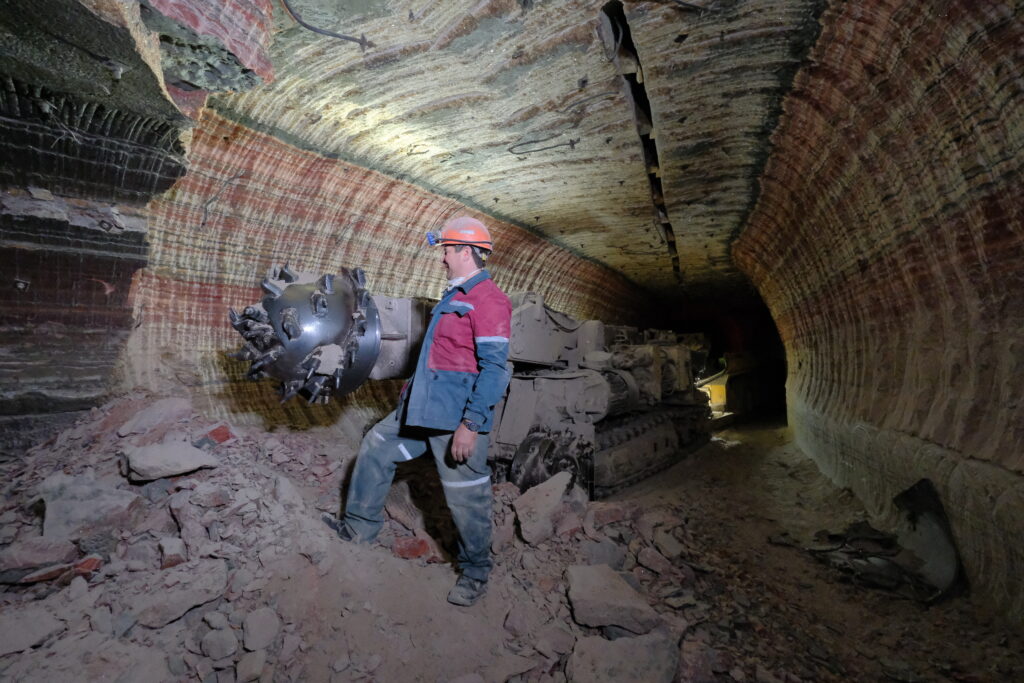
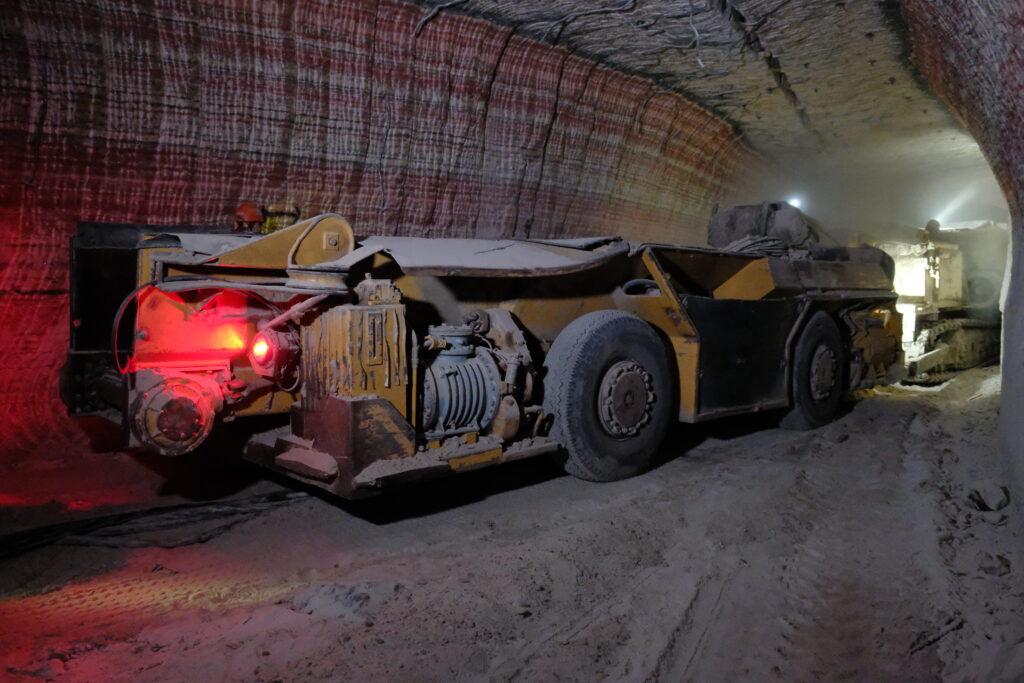
Deep underground, a mining machine extracts potash—an irreplaceable crop nutrient that gives Belarus outsized leverage in global markets and world politics. Photo: belaruskali.by
Sanctions bit, but Belarus adapted
Western sanctions initially devastated Belarusian potash exports. When Lithuania cut off Klaipėda, Belarus’s global market share collapsed from 20% to just 9%, according to the Centre for Eastern Studies in Warsaw.
But Belarus found workarounds.
Shipments were rerouted through Russian ports. Belaruskali engaged in aggressive dumping, offering prices up to 50% below market value. By 2025, Belarus was on track to export over 12 million tons—actually exceeding pre-sanction levels, Argus reported.
The recovery came at a cost: longer transit routes, higher fees to Russia (which treats Belarus as a competitor), and exclusion from the US and EU markets. US sanctions relief reopens the American market, making global trade significantly easier.
Meanwhile, Belarus continues supporting Russia’s war effort, hosting Russian troops, missiles, and tactical nuclear weapons. Over 1,100 political prisoners remain in Belarusian jails.
Ukrainian President Volodymyr Zelenskyy and about 30 other countries are expected to approve plans to create a compensation body for damages caused by the Russian invasion
The Special Operations Forces (SOF) of the Ukrainian Armed Forces have released footage showing the destruction of a group of Russian invaders near Pokrovsk.
Ukrainian President Volodymyr Zelensky has said that, for now, there is no talk of holding a referendum in addressing the territorial issue, specifically Donbas.
The total combat losses of Russian troops from February 24, 2022, to December 16, 2025, in the war against Ukraine amount to approximately 1,190,620 people, including 1,150 people over the past day.
President Volodymyr Zelensky said that an effective coalition of willing parties, plus security guarantees approved by the US Congress, will form the basis of Ukraine's future security structure.
President Volodymyr Zelensky stated that several rounds of negotiations took place in Berlin, during which five documents related to ending the war were discussed. Some of them are security guarantees, while others concern post-war reconstruction.
 Connexion


SSO pic.twitter.com/t4c4d9Uuo6