President Volodymyr Zelensky signed a decree on June 27 imposing sanctions on 52 Russian citizens as well as an additional 34 Russian companies and one Chinese entity involved in the production of Shahed-type drones and chip manufacturing machinery.Ukraine introduced new restrictions as Russia has escalated drone attacks against Ukrainian cities over the past weeks, launching upwards of 400-500 unmanned aerial vehicles (UAVs) per night.Individuals and legal entities subject to Ukrainian sanction
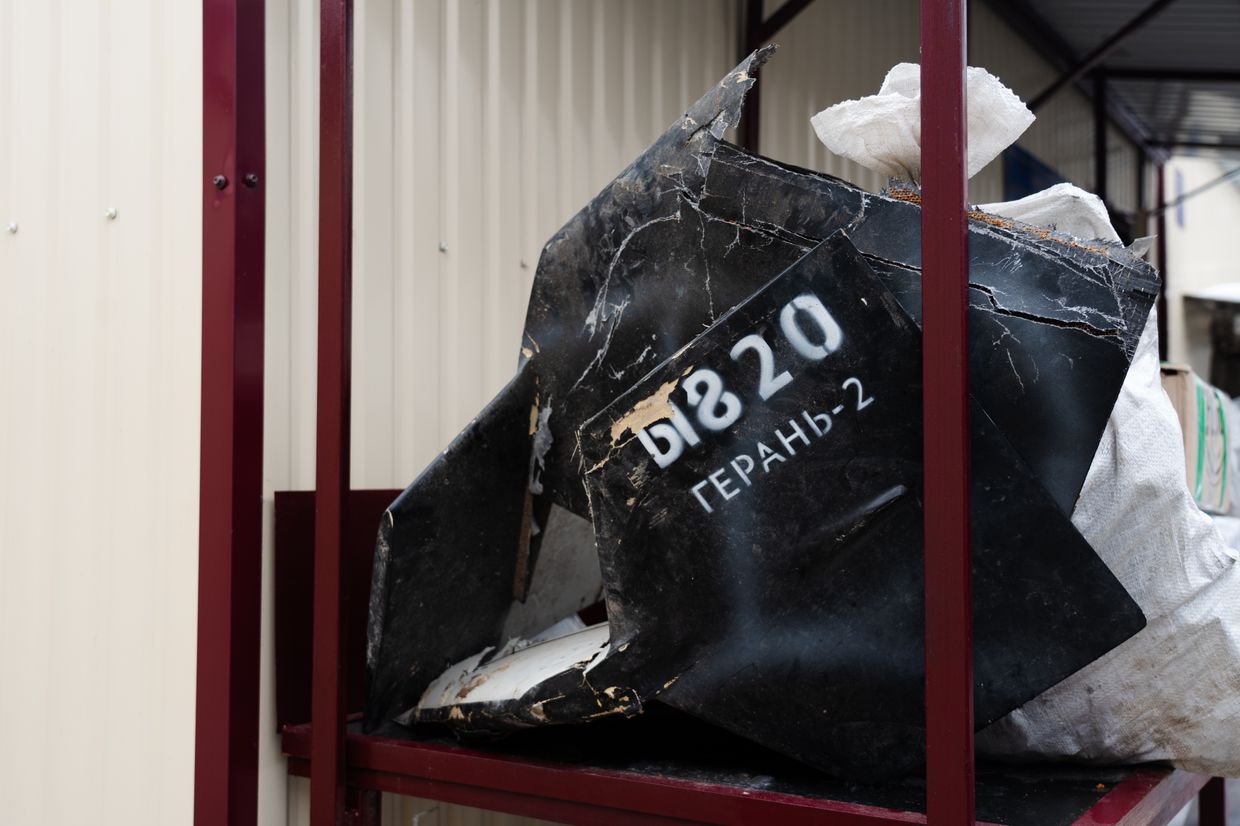
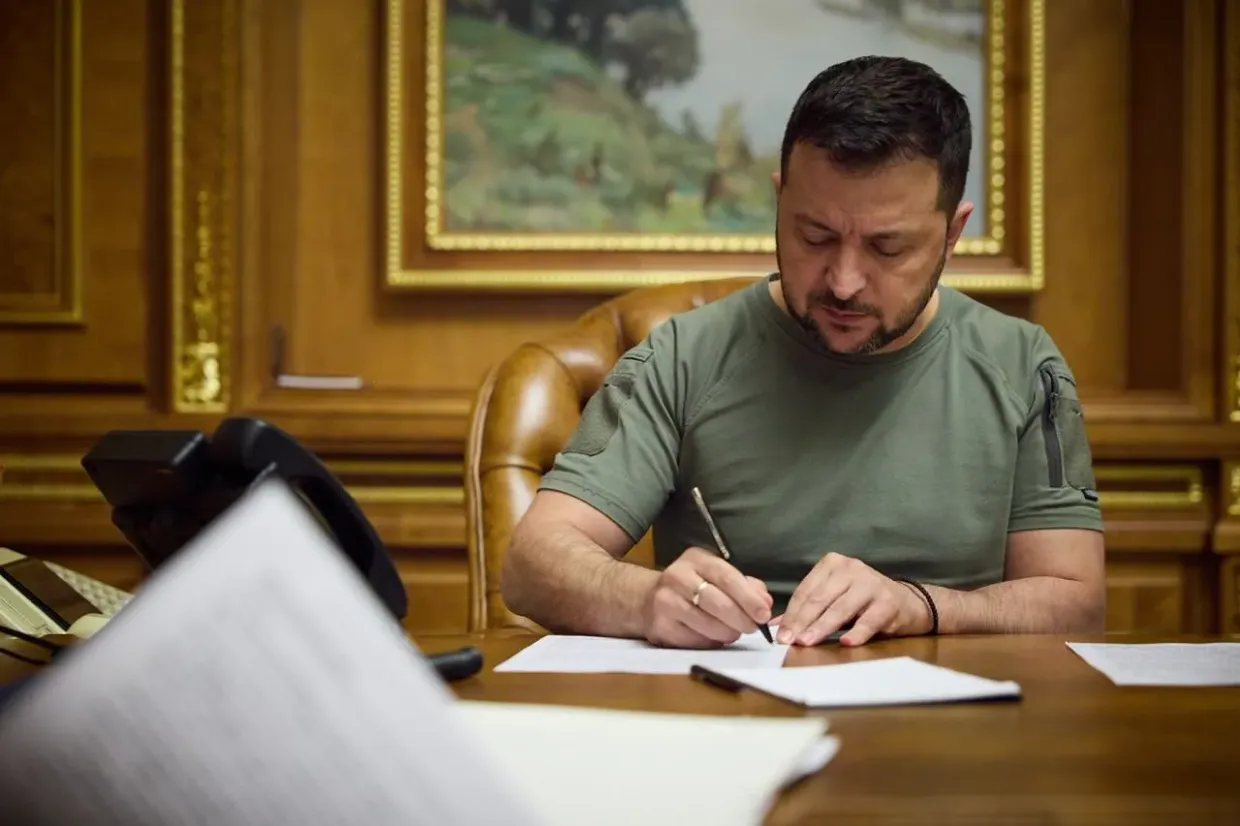
President Volodymyr Zelensky signed a decree on June 27 imposing sanctions on 52 Russian citizens as well as an additional 34 Russian companies and one Chinese entity involved in the production of Shahed-type drones and chip manufacturing machinery.
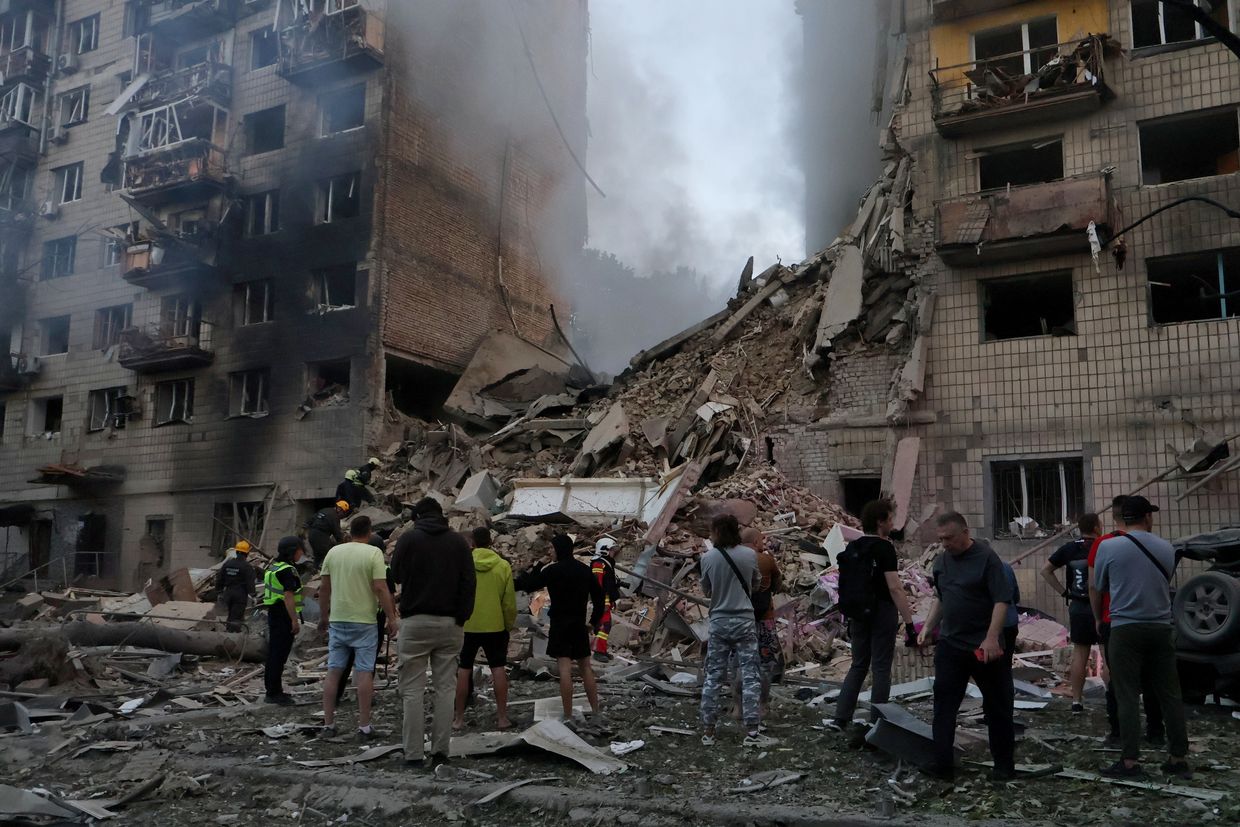
Ukraine introduced new restrictions as Russia has escalated drone attacks against Ukrainian cities over the past weeks, launching upwards of 400-500 unmanned aerial vehicles (UAVs) per night.
Individuals and legal entities subject to Ukrainian sanctions cannot do business and trade in Ukraine, cannot withdraw their capital from the country. In the meantime, their assets are blocked, as well as their access to public and defense procurement, and entry into the territory of Ukraine, among other restrictions.
Andrii Yermak, head of the Presidential Office, said on Telegram that the sanction primarily enterprises and individuals collaborating with a Shahed manufacturing facility located in the town of Yelbuga in Russia's Tatarstan.
Russia has launched thousands of cheap but effective Iranian-designed Shahed drones against Ukraine since the fall of 2022. Originally designed in Iran, Russia has since produced its own Shahed-type drones on Russian territory.
Drones have become one of the defining tools of the full-scale war, used extensively by both Ukraine and Russia for surveillance, long-range strikes, and tactical battlefield advantage.
Earlier in the day, Zelensky signeda decree to coordinate sanctions against Russia with international partners, particularly the European Union and the Group of Seven (G7).
Editor's note: The story was updated with Slovak Prime Minister Robert Fico's statement voiced during the EU summit. EU ambassadors have failed to approve the 18th package of sanctions against Russia due to opposition from Hungary and Slovakia, an unnamed EU official told the Kyiv Independent on June 27.After the 17th package of sanctions against Russia took effect on May 20, Ukraine's allies announced the following day that another round of restrictions was already in the works. Meanwhile, offi
Editor's note: The story was updated with Slovak Prime Minister Robert Fico's statement voiced during the EU summit.
EU ambassadors have failed to approve the 18th package of sanctions against Russia due to opposition from Hungary and Slovakia, an unnamed EU official told the Kyiv Independent on June 27.
After the 17th package of sanctions against Russia took effect on May 20, Ukraine's allies announced the following day that another round of restrictions was already in the works. Meanwhile, officials in Hungary and Slovakia protested against the approval of new restrictions against Russia.
Unlike Hungarian Prime Minister Viktor Orban, who has consistently opposed sanctions against Russia, Slovakia has not previously attempted to block EU sanctions.
"No agreement was reached. Ambassadors will return to this issue after two reservations are removed," the source told Suspilne in a reference to the position of Slovakia and Hungary.
Slovakia has requested that the adoption of the 18th package of EU sanctions against Russia be postponed until a decision is made on the consequences for the member states from RePowerEU, the European Commission's initiative to end dependence on Russian fossil fuels by 2030 in response to Russia's invasion of Ukraine.
Slovak Prime Minister Robert Fico voiced this proposal during the EU summit, the Slovak Foreign Ministry told Suspilne.
The ambassadors also agreed to extend sectoral sanctions against Russia for six months. These sanctions encompass a broad array of economic areas, including restrictions on trade, finance, technology and dual-use goods, industry, transport, and luxury goods.
In June, the European Commission presented the 18th package of sanctions, which includes new restrictions against the Russian energy and banking sectors and transactions related to the Nord Stream gas pipeline project.
Ukraine's European allies are tightening sanctions against Russia as Moscow refuses to accept a ceasefire. Despite Russia's refusal, no new U.S. sanctions have been imposed so far.
President Volodymyr Zelensky signed a decree on June 27 to coordinate sanctions against Russia with international partners, particularly the European Union and the Group of Seven (G7), the President's Office said on its website.A day earlier, EU member states' leaders gave their political consent to extend the sanctions previously imposed on Russia for its war against Ukraine. The EU Committee of Permanent Representatives (CORPER) also extended sectoral sanctions against Russia for another six m
President Volodymyr Zelensky signed a decree on June 27 to coordinate sanctions against Russia with international partners, particularly the European Union and the Group of Seven (G7), the President's Office said on its website.
A day earlier, EU member states' leaders gave their political consent to extend the sanctions previously imposed on Russia for its war against Ukraine.
The EU Committee of Permanent Representatives (CORPER) also extended sectoral sanctions against Russia for another six months on June 26, European Pravda reported, citing a diplomatic source. The sanctions include restrictions against entire sectors or industries of the Russian economy or areas of operation of Russian businesses.
Meanwhile, the participants did not approve the new 18th package of sanctions, which targeted Russia's energy and banking sectors, due to Slovakia's veto.
Zelensky's June 27 decree implements a decision by Ukraine's National Security and Defense Council's (NSDC) to synchronize the sanctions against Russia with the EU and G7.
According to the document, sanctions approved by partner states must be submitted to the NSDC for consideration and approval no later than the 15th day after the partner state's decision comes into force.
The Cabinet of Ministers, the Security Service of Ukraine (SBU), and the National Bank of Ukraine must also ensure the implementation of sanctions approved by international partners in Ukraine.
After the 17th package of sanctions against Russia took effect on May 20, Ukraine's allies announced the following day that another round of restrictions was already in the works.
The push for tighter sanctions comes as Russia continues to reject ceasefire proposals and presses forward with military operations.
European firms continue to ship critical weapons components to Russia, President Volodymyr Zelensky told the European Council on June 26 in a plea for tougher EU sanctions against Moscow. "Some European companies are still sending critical components to Russia. These end up in missiles and other weapons used to kill us, kill Ukrainians," Zelensky said in a video address to the European Council summit in Brussels. Ukraine is in the process of identifying these materials and will pass along eviden
European firms continue to ship critical weapons components to Russia, President Volodymyr Zelensky told the European Council on June 26 in a plea for tougher EU sanctions against Moscow.
"Some European companies are still sending critical components to Russia. These end up in missiles and other weapons used to kill us, kill Ukrainians," Zelensky said in a video address to the European Council summit in Brussels.
Ukraine is in the process of identifying these materials and will pass along evidence to EU officials, he said.
Zelensky's remarks were part of a broader appeal for the EU to expand and strengthen economic penalties on Russia. While the bloc reached an agreement in Brussels to extend current sectoral sanctions for another six months, it is still debating its proposed 18th package of sanctions against Russia.
Zelensky urged the EU to pass "a truly strong" 18th package, targeting "Russia's oil trade, its shadow tanker fleet, Russian banks and other financial instruments, and the supply chains that bring equipment or parts for making weapons."
The sanctions should not only penalize Russia's so-called "shadow fleet" vessels, but also the tankers' captains and the ports Russia uses to export oil, Zelensky said.
The president also reiterated his call to drop the current oil price cap to $30 per barrel.
"Russia's military ambitions grow when its oil revenues are high," he said.
Several European countries still rely heavily on Russian oil and gas, Zelensky pointed out. Ukraine understands the complexities of this situation and treads carefully in order to respect its partnership with the EU.
"Yet, sadly, we don't always feel this same understanding in return when it comes to Ukraine's needs," Zelensky said.
"It feels especially strange to hear such strong criticism — even political pressure from some leaders — while our respect for EU rules allows oil to keep flowing."
While Zelensky did not specify any particular EU leaders, Slovak Prime Minister Robert Fico in June threatened to veto the 18th sanctions package, citing concerns over Slovakia's reliance on Russia's energy imports. Fico has emerged as one of the EU's strongest supporters of Russia, alongside Hungarian Prime Minister Viktor Orban.
Orban took aim against Kyiv at the Brussels summit by blocking a unanimous statement of support for Ukraine's accession to the EU. All 26 other member states supported the statement, while Hungary was the sole opponent.
In his address to the Council, Zelensky urged the EU to send a clear signal of support for Ukraine's European path. Ukraine has fulfilled its obligations in the accession process, the president argued, and deserves recognition of its progress.
"Any delay by Europe at this point could create a global precedent and a reason to doubt Europe's words and commitments," he said.
Editor's Note: This is a developing story and is being updated. The European Union on June 26 reached an agreement to extend sanctions against Russia for another six months, an undisclosed EU official told the Kyiv Independent. Polish Prime Minister Donald Tusk confirmed the agreement shortly afterwards in a joint press conference alongside European Commission President Ursula von der Leyen and European Council President Antonio Costa at the EU summit in Brussels. The EU made the decision on Jun
Editor's Note: This is a developing story and is being updated.
The European Union on June 26 reached an agreement to extend sanctions against Russia for another six months, an undisclosed EU official told the Kyiv Independent.
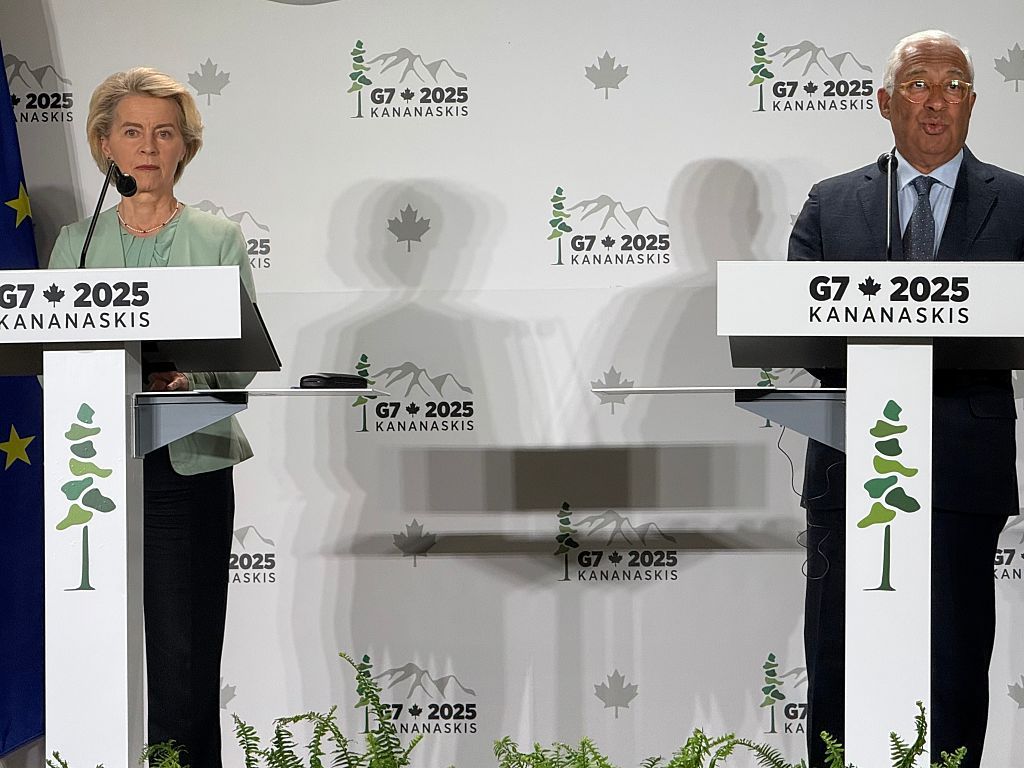
Polish Prime Minister Donald Tusk confirmed the agreement shortly afterwards in a joint press conference alongside European Commission President Ursula von der Leyen and European Council President Antonio Costa at the EU summit in Brussels.
The EU made the decision on June 26 to extend its current sanctions against Russia for six more months, Tusk said.
"We still have a decision about the 18th sanctions package ahead of us," he added.
The EU votes to renew its sectoral sanctions against Russia every six months in January and July. Sanctions encompass a broad array of economic areas, including restrictions on trade, finance, technology and dual-use goods, industry, transport, and luxury goods.
The latest agreement comes amid fears that Hungary, one of the bloc's most Kremlin-friendly member states, would attempt to block the extension. Hungary has repeatedly threatened to use its veto power to obstruct the sanctions process.
The European bloc first adopted sanctions related to Russian aggression on July 31, 2014, after Moscow occupied Crimea and invaded Ukraine's eastern Donbas region. The EU has significantly scaled up its sanctions measures in the wake of the full-scale invasion, adopting 17 major sanctions packages since February 2022.
The EU on June 10 unveiled its 18th package of sanctions against Russia, expanding current measures to include new restrictions on energy, banking, oil, and other sectors. The initial proposal included banning transactions involving the Nord Stream 1 and Nord Stream 2 pipelines and reducing the oil price cap from $60 to $45 per barrel.
Soon after the package was announced, however, the EU reportedly postponed the effort to reduce the oil price cap.
The 18th round of sanctions is currently under debate. Slovak Prime Minister Robert Fico, another Moscow-friendly European leader, has threatened to veto the package. Slovakia has not previously attempted to block EU sanctions against Russia.
United States Secretary of State Marco Rubio surprised NATO allies this week with conflicting messages on Russia sanctions, delivering a tougher stance in private than in his public remarks, Politico reported on June 25.Rubio met with NATO foreign ministers on June 25 during a private dinner at the alliance's annual summit. According to sources who spoke with Politico, Rubio acknowledged that Russia was the main obstacle preventing peace talks to end the war in Ukraine.He reportedly said the U.S
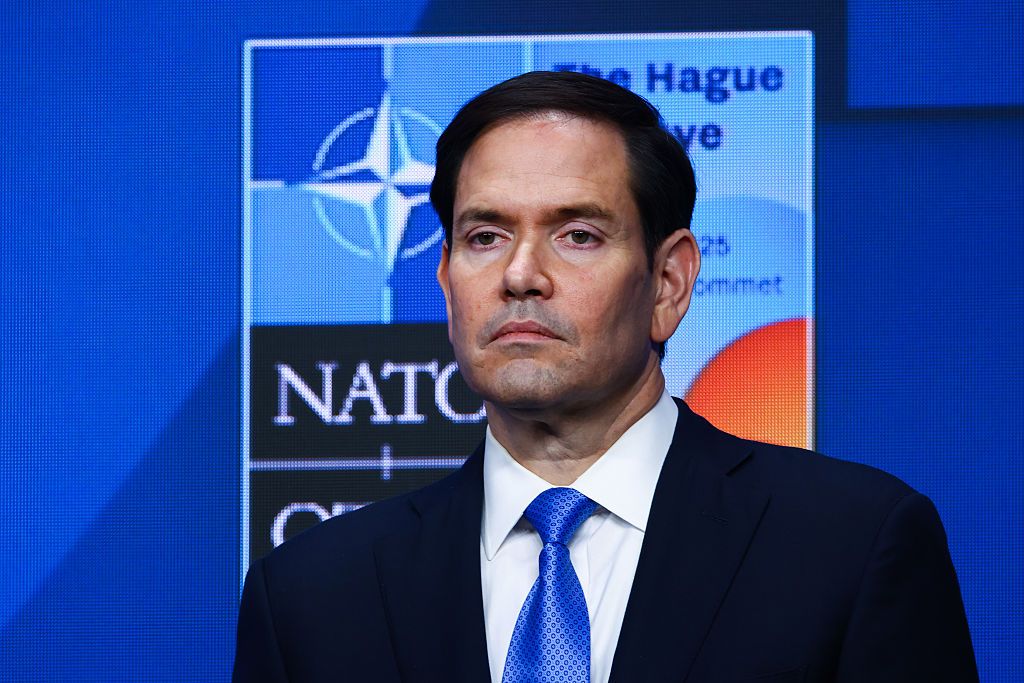
United States Secretary of State Marco Rubio surprised NATO allies this week with conflicting messages on Russia sanctions, delivering a tougher stance in private than in his public remarks, Politico reported on June 25.
Rubio met with NATO foreign ministers on June 25 during a private dinner at the alliance's annual summit. According to sources who spoke with Politico, Rubio acknowledged that Russia was the main obstacle preventing peace talks to end the war in Ukraine.
He reportedly said the U.S. Senate would likely consider new sanctions legislation after completing work on President Donald Trump's spending bill.
However, just hours later, Rubio softened his position on Russia during an exclusive interview with Politico, calling for a more cautious approach.
"If we did what everybody here wants us to do, and that is come in and crush them with more sanctions, we probably lose our ability to talk to them about the ceasefire and then who's talking to them?" Rubio said.
He also added that Trump would know the "time and place" to change course.
When asked about the apparent shift in tone, a senior U.S. official insisted Rubio's messaging has remained consistent in conversations with allies.
"The secretary has been very consistent in meeting and calls with his counterparts on three key point," the official said.
"One is that the president believes strongly that the only way this war ends is through negotiations; second, as soon as the U.S. imposes new sanctions on Russia the opportunity for the U.S. to be involved in those negotiations closes; and third, that the Senate, in America anyway, is an independent body that at some point is going to move on those sanctions,."
At the NATO dinner, Rubio reportedly faced criticism from Polish Foreign Minister Radoslaw Sikorski, who claimed that Russian President Vladimir Putin was disrespecting Trump by violating the ceasefire.
It has been more than 100 days since Ukraine agreed to a U.S.-backed complete ceasefire, while Russia continues to reject it.
Sikorski also reportedly denounced Moscow's repeated attacks on Kyiv and other Ukrainian cities, which have intensified in recent weeks, saying such strikes "should not come for free" — implying that the U.S. and Europe should do more to support Ukraine.
Meanwhile, Rubio has delivered different messages in public and behind closed doors. Despite the shifting rhetoric, Baltic and Nordic countries reportedly view him as a pragmatic ally within the Trump administration — one who has a realistic understanding of the threats posed by Russia and China, according to a second European official cited by POLITICO.
President Volodymyr Zelensky on June 20 said sanctions are "urgently" needed on more Russian defense companies in order to stall the mass-production of the Oreshnik intermediate-range ballistic missile (IRBM).Speaking at a press briefing attended by the Kyiv Independent, Zelensky said a "large number" of companies were involved in the manufacture of Oreshnik which Russia has launched at Ukraine once, and used the threat of more launches to intimidate Kyiv and its Western allies.Russia first laun
President Volodymyr Zelensky on June 20 said sanctions are "urgently" needed on more Russian defense companies in order to stall the mass-production of the Oreshnik intermediate-range ballistic missile (IRBM).
Speaking at a press briefing attended by the Kyiv Independent, Zelensky said a "large number" of companies were involved in the manufacture of Oreshnik which Russia has launched at Ukraine once, and used the threat of more launches to intimidate Kyiv and its Western allies.
Russia first launched the experimental Oreshnik missile in an attack against Dnipro on Nov. 21. Putin claimed the strike was a response to Ukraine's use of U.S. and British long-range missiles to attack Russian territory.
While little is known about the missile, defense experts say it is likely not an entirely new development, but rather an upgraded version of Russia's RS-26 missile. The RS-26, also known as the Rubezh, was first produced in 2011.
While Putin has announced plans for mass production of the Oreshnik, a U.S. official previously told The Kyiv Independent that Russia likely possesses only a small number of these experimental missiles.
Zelensky said 39 Russian defense companies were involved in its production, 21 of which are not currently under sanctions.
"And this means that they receive parts and components for the Oreshnik, and they need it, because without these parts there will be no Oreshnik," he said.
Highlighting apparent difficulties Russia was already having in mass-producing the missile, Zelensky said it is "absolutely incomprehensible why sanctions should not be imposed urgently."
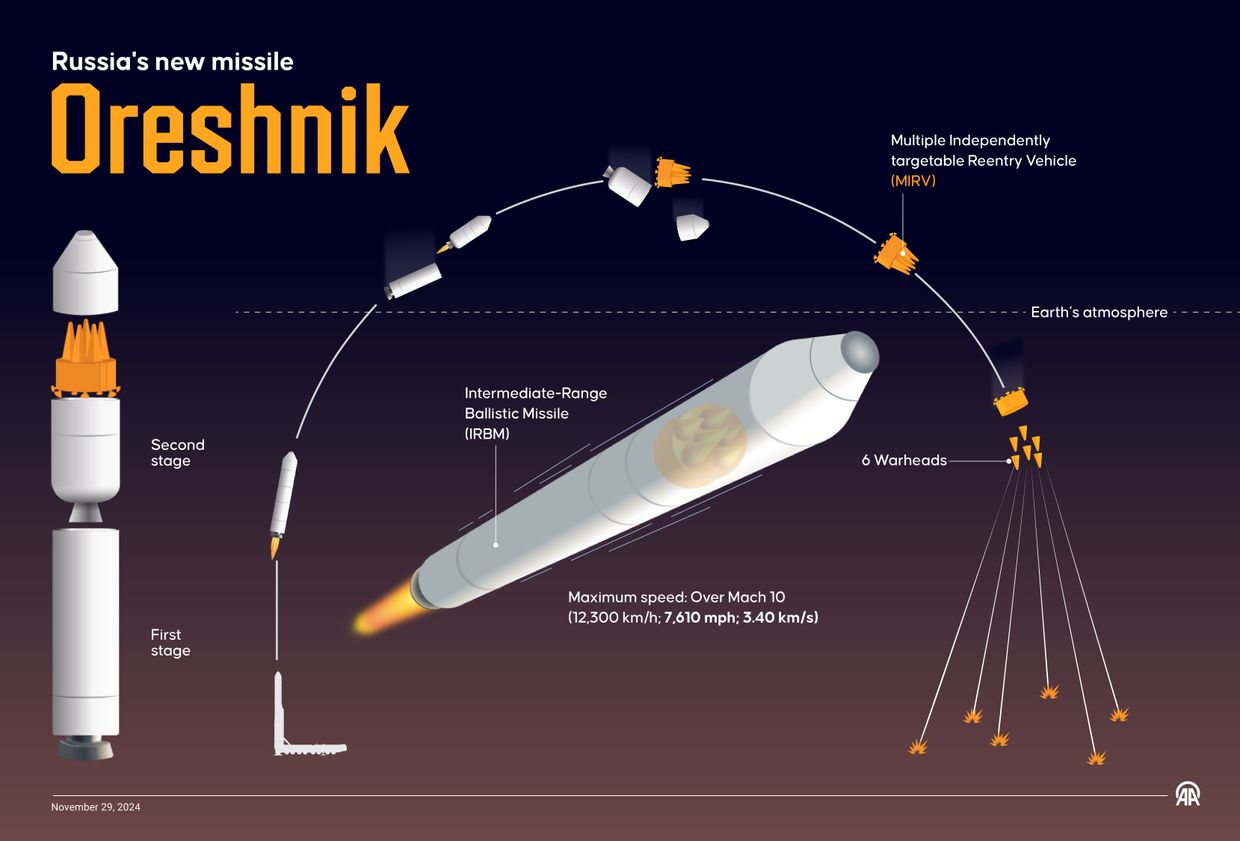
An infographic titled "Russia's new missile Orehsnik" created in Ankara, Turkiye on November 29, 2024. (Omar Zaghloul/Anadolu via Getty Images)
The Financial Times (FT) reported on Dec. 27. that the upgrades were developed using advanced manufacturing equipment from Western companies, despite sanctions.
Two key Russian weapons engineering institutes — Moscow Institute for Thermal Technology (MITT) and Sozvezdie — were named by Ukrainian intelligence as developers of the Oreshnik.
According to the FT, they posted job listings in 2024 that specified expertise in operating German and Japanese metalworking systems.
The listings cited Fanuc (Japan), Siemens, and Haidenhein (both Germany) control systems for high-precision computer numerical control machines essential for missile production.
Despite sanctions slowing the flow of such equipment, FT analysis found that at least $3 million worth of Heidenhain components were shipped into Russia in 2024, with some buyers closely tied to military production.
The European Union has postponed a move to lower the existing price cap on Russian oil, after concerns that the Iran-Israel conflict could lead to higher prices, Politico reported on June 20, citing unnamed diplomatic sources.The price cap, introduced in December 2022 as a measure to limit the Kremlin's ability to finance its war against Ukraine, prohibits Western companies from shipping, insuring, or otherwise servicing Russian oil sold above $60 per barrel.Ukraine has been calling on Western p
The European Union has postponed a move to lower the existing price cap on Russian oil, after concerns that the Iran-Israel conflict could lead to higher prices, Politico reported on June 20, citing unnamed diplomatic sources.
The price cap, introduced in December 2022 as a measure to limit the Kremlin's ability to finance its war against Ukraine, prohibits Western companies from shipping, insuring, or otherwise servicing Russian oil sold above $60 per barrel.
Ukraine has been calling on Western partners to lower the price cap on Russian oil from $60 to $30 per barrel. Meanwhile, two diplomats told Politico that the escalation of the conflict between Iran and Israel would make it impossible to impose new restrictions.
"The idea of lowering the price cap is probably not going to fly because of the international situation in the Middle East and the volatility," said one diplomat on the condition of anonymity.
The issue of reducing the price cap on Russian oil was discussed during the Group of Seven (G7) summit, which was held June 15-17 in Canada. However, the participants failed to reach a consensus.
"At the G7 meeting this week, it was agreed by all the countries they would prefer not to take the decision right now," the diplomat added. "The prices were quite close to the cap; but now the prices are going up and down, the situation is too volatile for the moment."
European Commission President Ursula von der Leyen said during the G7 summit that the existing measures on Russian oil exports "had little effect," while noting that oil prices had risen in recent days, so "the cap in place does serve its function. "
Global oil prices spiked on June 13, after Israeli strikes on Iran triggered a long-range war between the two countries that has continued for over a week.
Brent and Nymex crude prices surged more than 10% before stabilizing around 7.5% higher, with Brent at $74.50 a barrel and Nymex at $73.20 as of June 20, the BBC reported.
The spike threatens to undermine Western efforts to restrict the wartime revenue of the Russian state, which depend heavily on oil exports.
EU High Representative Kaja Kallas previously urged the European Union to pursue lowering the oil price cap on Russian oil, even without U.S. support, warning that Middle East tensions could otherwise drive prices up and boost Russia's revenues.
President Volodymyr Zelensky signed a decree on June 20, imposing sanctions on 56 individuals and 55 Russian, Chinese, and Belarusian companies involved in the production of Russian drones and sanctions circumvention.Ukraine introduced new restrictions as Russia has escalated drone attacks against Ukrainian cities over the past weeks, launching record 400-500 unmanned aerial vehicles (UAVs) per night.Individuals and legal entities subject to Ukrainian sanctions cannot do business and trade in Uk
President Volodymyr Zelensky signed a decree on June 20, imposing sanctions on 56 individuals and 55 Russian, Chinese, and Belarusian companies involved in the production of Russian drones and sanctions circumvention.
Ukraine introduced new restrictions as Russia has escalated drone attacks against Ukrainian cities over the past weeks, launching record 400-500 unmanned aerial vehicles (UAVs) per night.
Individuals and legal entities subject to Ukrainian sanctions cannot do business and trade in Ukraine, cannot withdraw their capital from the country. In the meantime, their assets are blocked, as well as their access to public and defense procurement, and entry into the territory of Ukraine, among other restrictions.
The new package of sanctions targets individuals and entities involved in the development and production of Russian drones such as Geran, Orlan-10, SuperCam, and first-person-view (FPV) drones, according to a decree published on the Presidential Office's website.
The Belarusian Precision Electromechanics Plant and six Chinese enterprises located in Hong Kong and in the provinces of Shandong and Shenzhen are among the sanctioned entities.
The sanctions list includes equipment suppliers to Alabuga Machinery, a Russian manufacturer of machine tools and gears, and individuals who import components for the sanctioned Kronshtadt JSC, a drone producer that developed Banderol UAVs with jet engines.
Russia has repeatedly targeted Ukrainian cities with waves of attack drones, often striking energy infrastructure and residential buildings overnight. Ukraine's defense forces use a mix of electronic warfare, air defense systems, and drone-on-drone interception to repel the assaults.
Drones have become one of the defining tools of the full-scale war, used extensively by both Ukraine and Russia for surveillance, long-range strikes, and tactical battlefield advantage.
The U.S. Senate is postponing action on a bipartisan Russia sanctions bill until at least July, as other legislative and foreign policy priorities dominate the agenda, Semafor reported on June 18. Senators Lindsey Graham (R-S.C.) and Richard Blumenthal (D-Conn.) have been working on a revised version of their bill that would impose secondary sanctions on Russian trading partners, while shielding Ukraine’s allies from penalties and making technical adjustments. But momentum has stalled as Republi
The U.S. Senate is postponing action on a bipartisan Russia sanctions bill until at least July, as other legislative and foreign policy priorities dominate the agenda, Semafor reported on June 18.
Senators Lindsey Graham (R-S.C.) and Richard Blumenthal (D-Conn.) have been working on a revised version of their bill that would impose secondary sanctions on Russian trading partners, while shielding Ukraine’s allies from penalties and making technical adjustments. But momentum has stalled as Republicans push President Donald Trump’s sweeping tax and spending bill, and the escalating conflict between Iran and Israel demands urgent attention.
Senate Majority Leader John Thune (R-S.D.) acknowledged on June 18 that a "July timeframe" was now more realistic for the sanctions bill. "We’re very open to moving, we’re trying to work with the administration from a timing standpoint," Thune said, according to Semafor. Graham added that the Senate is "going to have to wait a bit," citing shifting global developments. "Things are changing now with Iran… that doesn’t mean I’ve forgotten about Russia or Ukraine. Not at all. Iran is center stage, but sooner rather than later," he said.
Trump has not yet signaled support for the legislation, which remains a critical obstacle.
While sanctions enjoy broader Republican backing than direct military aid to Ukraine, GOP lawmakers are hesitant to move forward without Trump’s approval. The U.S. president left the G7 summit in Canada early, skipping a planned meeting with President Volodymyr Zelensky, as attention shifted to a potential U.S. response to Iran’s nuclear ambitions. "All the focus is on Israel and Iran right now," said Sen. Tommy Tuberville (R-Ala.), though he noted that he is "all for putting sanctions" on Russia.
Graham and Blumenthal had hoped to secure passage of the bill ahead of the G7 summit after visiting Ukraine earlier this year. Blumenthal said he and Graham were "making tremendous progress" with the administration, but acknowledged that other priorities were pushing the legislation off the floor.
Supporters of the sanctions argue the bill would give Trump more leverage in negotiations with Russian President Vladimir Putin. "We want to strengthen our hand in the negotiation," said Sen. John Hoeven (R-N.D.). "We want to help effectuate an outcome in Ukraine, so we’re trying to use it in a way that actually helps get something done." The legislation would authorize secondary sanctions on countries that continue to purchase Russian energy or conduct other major trade with Moscow.
Despite uncertainty around timing, both Graham and Blumenthal continue to refine the bill to ensure broader support, including a carveout for Ukraine’s allies and changes to accommodate the global banking system. "There is no evidence that Putin is going to slow down," Graham told Semafor. "We need to change the approach. I think the sanctions will give the president leverage."
The European Union and its allies are ready to toughen sanctions on Russia, French President Emmanuel Macron said on the sidelines of the Group of Seven (G7) summit on June 17."With President (Volodymyr) Zelensky at the G7. We stand in solidarity with the Ukrainian people after last night’s massive Russian strikes," Macron said in a post to social media."We are determined to increase pressure on Russia to accept the immediate and unconditional ceasefire that Ukraine is ready for," he added.Macro
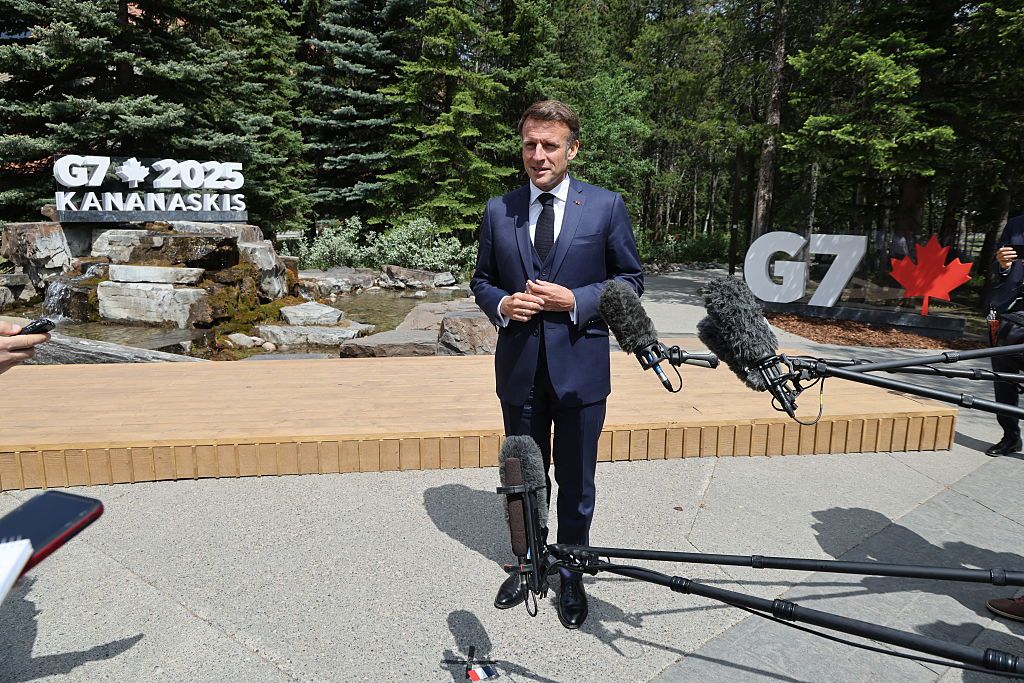
The European Union and its allies are ready to toughen sanctions on Russia, French President Emmanuel Macron said on the sidelines of the Group of Seven (G7) summit on June 17.
"With President (Volodymyr) Zelensky at the G7. We stand in solidarity with the Ukrainian people after last night’s massive Russian strikes," Macron said in a post to social media.
"We are determined to increase pressure on Russia to accept the immediate and unconditional ceasefire that Ukraine is ready for," he added.
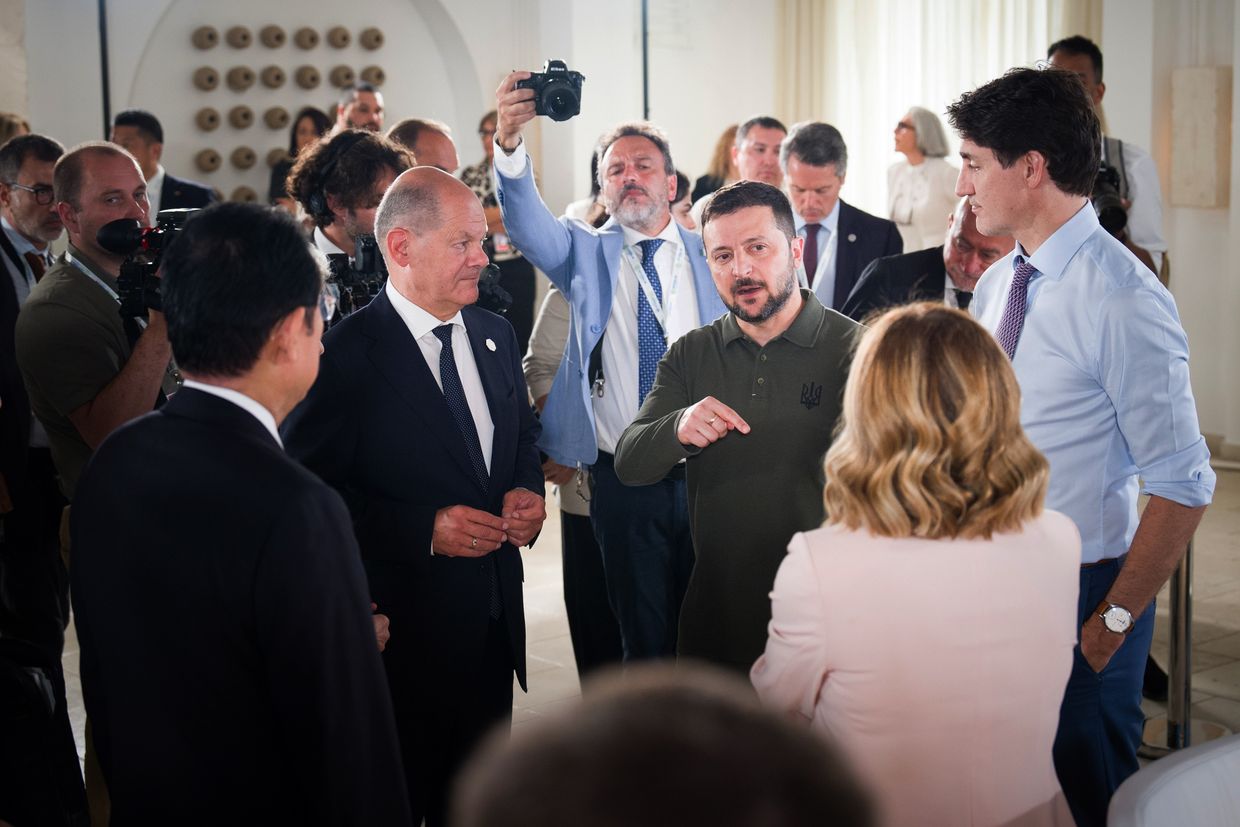
Macron attended the G7 summit in Kananaskis, Canada, from June 15-17. Global leaders discussed a wide range of topics, including Russia's war against Ukraine.
As the G7 leaders met in Canada, Russia launched one of its worst drone and missile attacks on Kyiv since it began its full-scale war against Ukraine in February 2022, killing 16 people and injuring at least 134.
"The common position that is emerging is to say, 'We need to strengthen sanctions,'" CBC News reported, citing Macron.
Europe is proposing much tougher sanctions than the U.S. has imposed on Russia, Macron said, adding that the EU is in "very close co-ordination" with Canada, Japan, and the U.K.
Several countries, including Canada and the U.K., introduced additional sanctions on Russia as the G7 summit was ongoing.
Canada introduced a new military aid package for Ukraine in addition to its sanctions against Russia.
"In our view, this has changed the situation because it will allow us to bring Russia back to the negotiating table, as (U.S.) President (Donald) Trump has been demanding," Macron said, according to CBC News.
Zelensky attended the summit and met with various leaders, including Macron and Canadian Prime Minister Mark Carney.
Zelensky left the summit early, citing Russia's attack on Kyiv. The nearly nine-hour-long attack saw Moscow's forces launch large numbers of drones and missiles at Ukraine's capital.
Foreign Minister Andrii Sybiha condemned the attack, calling it a "massive and brutal strike" timed deliberately to coincide with the G7 summit.
Zelensky described the drone and missile assault as "one of the most horrifying attacks on Kyiv."
President Volodymyr Zelensky arrived at the G7 Leaders' Summit in Canada on June 17 ahead of the final day of the G7 Leaders' summit, according to a Kyiv Independent journalist on the ground.Zelensky was greeted by Canadian Prime Minister Mark Carney in Kananaskis, Alberta, where the summit is being held. "We need more from our allies... We are ready for peace negotiations... But for this, we need pressure," the Ukrainian president said. The Ukrainian president was expected to meet U.S. Presiden
President Volodymyr Zelensky arrived at the G7 Leaders' Summit in Canada on June 17 ahead of the final day of the G7 Leaders' summit, according to a Kyiv Independent journalist on the ground.
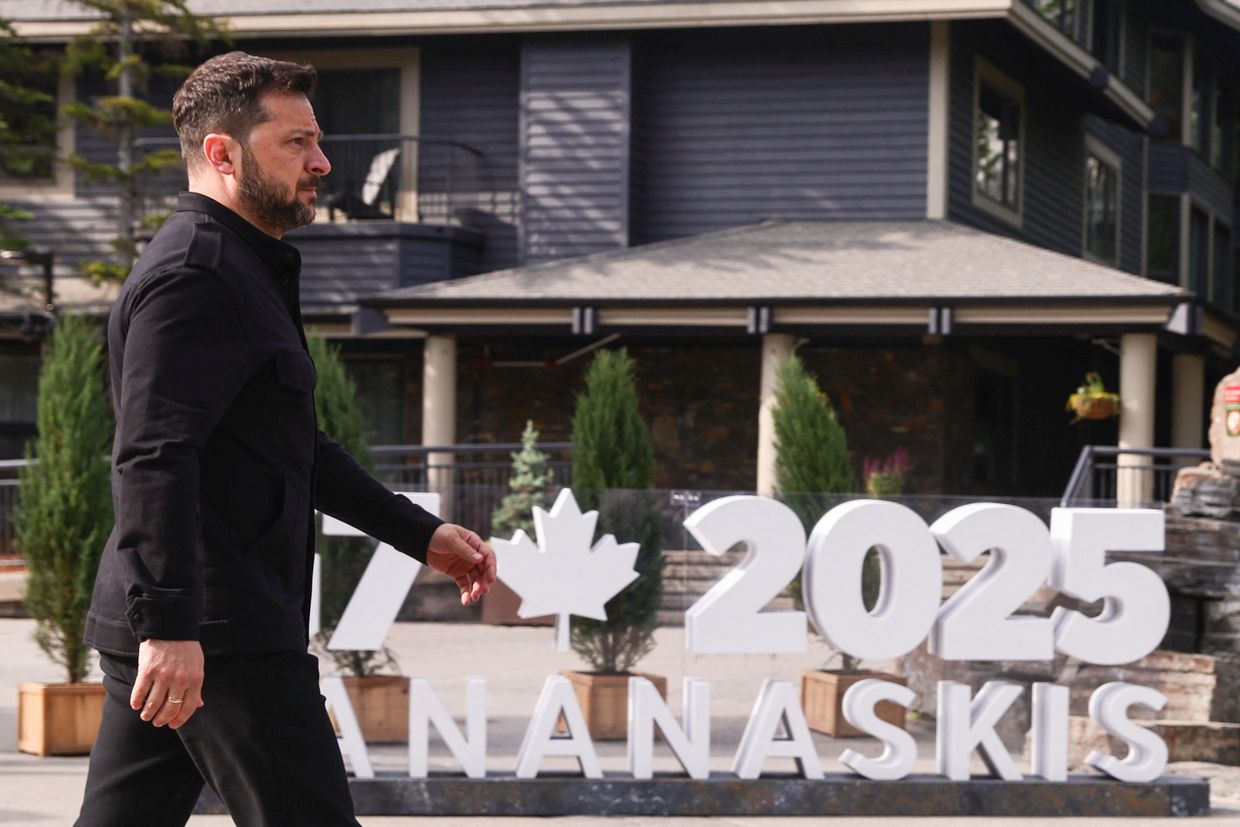
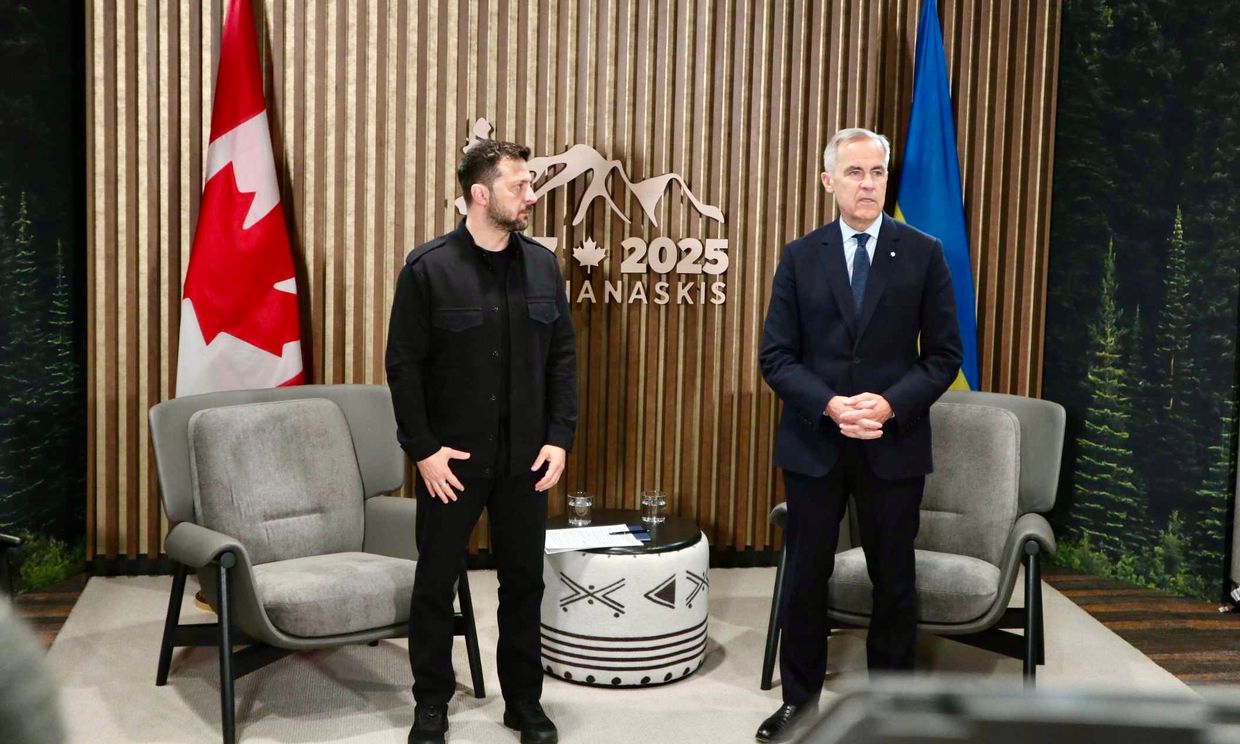
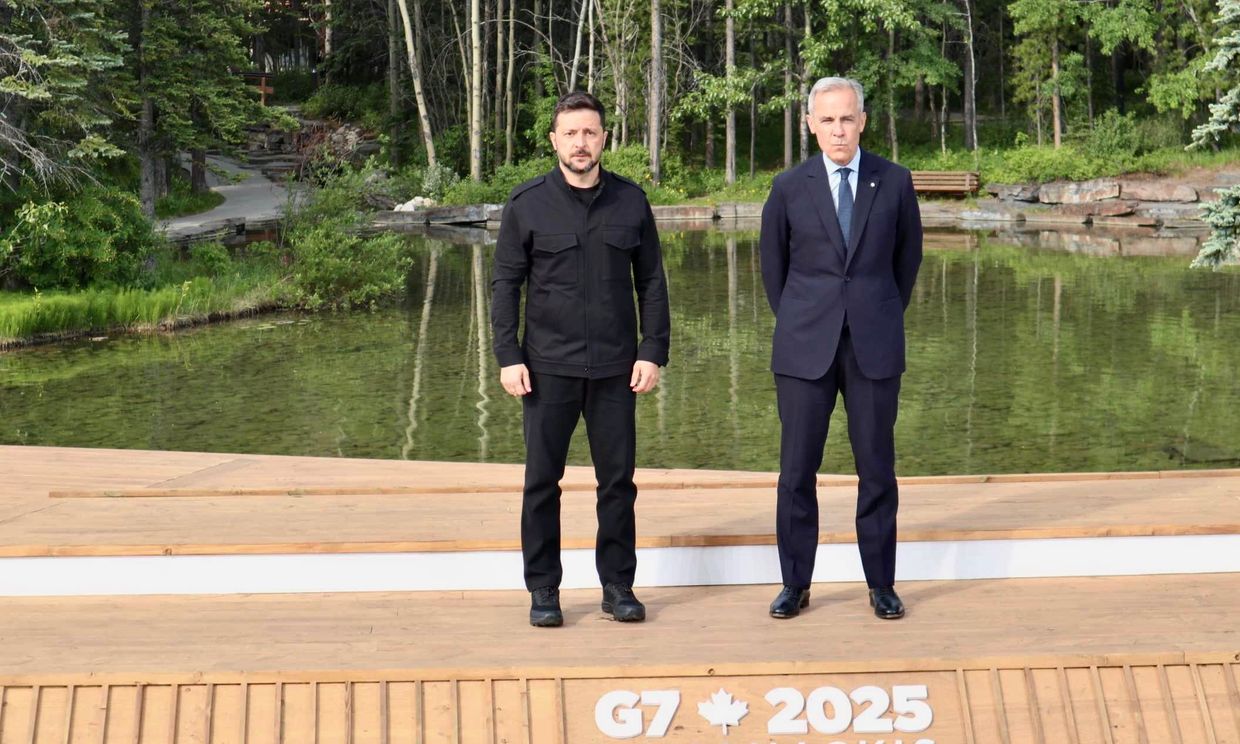
Zelensky was greeted by Canadian Prime Minister Mark Carney in Kananaskis, Alberta, where the summit is being held.
"We need more from our allies... We are ready for peace negotiations... But for this, we need pressure," the Ukrainian president said.
The Ukrainian president was expected to meet U.S. President Donald Trump at the summit. However, it is not clear if the meeting will take place because Trump left the summit early due to escalating tensions in the Middle East.
White House spokesperson Caroline Leavitt confirmed Trump's early departure from the summit, citing the ongoing escalation between Israel and Iran.
The Israeli military launched a large-scale attack on Iran's nuclear and military infrastructure on June 13, which was followed by retaliatory ballistic missile strikes from Tehran. Israel has since struck key defense targets in Tehran, including the headquarters of Iran's Defense Ministry.
Zelensky was to hold his third in-person meeting with Trump, which may signal the future of Trump and Zelensky's relationship, as well as offer insight into the United States' commitment to supporting Ukraine.
In February, Zelensky and Trump held their first meeting, which escalated into a heated argument, with Trump and Vice President JD Vance lambasting the Ukrainian leader over what they described as "a lack of gratitude for U.S. support."
The second meeting between Trump and Zelensky in the Vatican in April led to the U.S. president reiterating calls for a ceasefire in Ukraine and even threatening to impose sanctions on Russia.
In the month since their last in-person meeting, tensions between Trump and Zelensky have risen again. Despite issuing several threats, Trump has not followed through on implementing additional economic pressure on Moscow.
Canadian Prime Minister Mark Carney welcomes President Volodymyr Zelensky during the Group of Seven (G7) Summit in Kananaskis, Alberta, Canada on June 17, 2025. (Dmytro Basmat / The Kyiv Independent)
Canadian Prime Minister Mark Carney welcomes President Volodymyr Zelensky during the Group of Seven (G7) Summit in Kananaskis, Alberta, Canada on June 17, 2025. (Dmytro Basmat / The Kyiv Independent)
Ahead of the summit, European leaders urged G7 nations to impose harsher sanctions on Moscow in order to secure a ceasefire in the war against Ukraine.
"To achieve peace through strength, we must put more pressure on Russia to secure a real ceasefire, to bring Russia to the negotiating table, and to end this war. Sanctions are critical to that end," European Commission President Ursula von der Leyen said on June 15 at a press briefing attended by a Kyiv Independent journalist.
Zelensky is still expected to attend the scheduled meetings with other G7 leaders.
Zelensky said in a closed-door meeting attended by the Kyiv Independent on June 13 that his priority is to speak with Trump about sanctions against Russia, peace talks, weapons purchases, and U.S.-Ukraine economic cooperation.
"There are steps forward we can take — but we need the political will of the U.S. president, if he wants," Zelensky said on June 13.
Amid increased anxiety around Trump's commitment to ending the war, U.S. Defense Secretary Pete Hegseth recently announced that the Pentagon would reduce funding allocated for military assistance to Ukraine in its 2026 defense budget.
Canada, which holds the G7 presidency in 2025, invited Zelensky to participate in summit, marking the Ukrainian president’s fourth G7 meeting since the outbreak of the full-scale invasion in 2022.
An uninsured Russian Aframax-class tanker has been illegally conducting ship-to-ship oil transfers in international waters near Greece and Cyprus since July 2024, Ukraine's military intelligence (HUR) reported on June 16.According to the agency, the vessel, operating without Western insurance, is part of Russia's expanding shadow fleet used to bypass G7 and EU sanctions on Russian oil exports. HUR said such transfers "pose an environmental threat, allow the aggressor to conceal the origin of oil
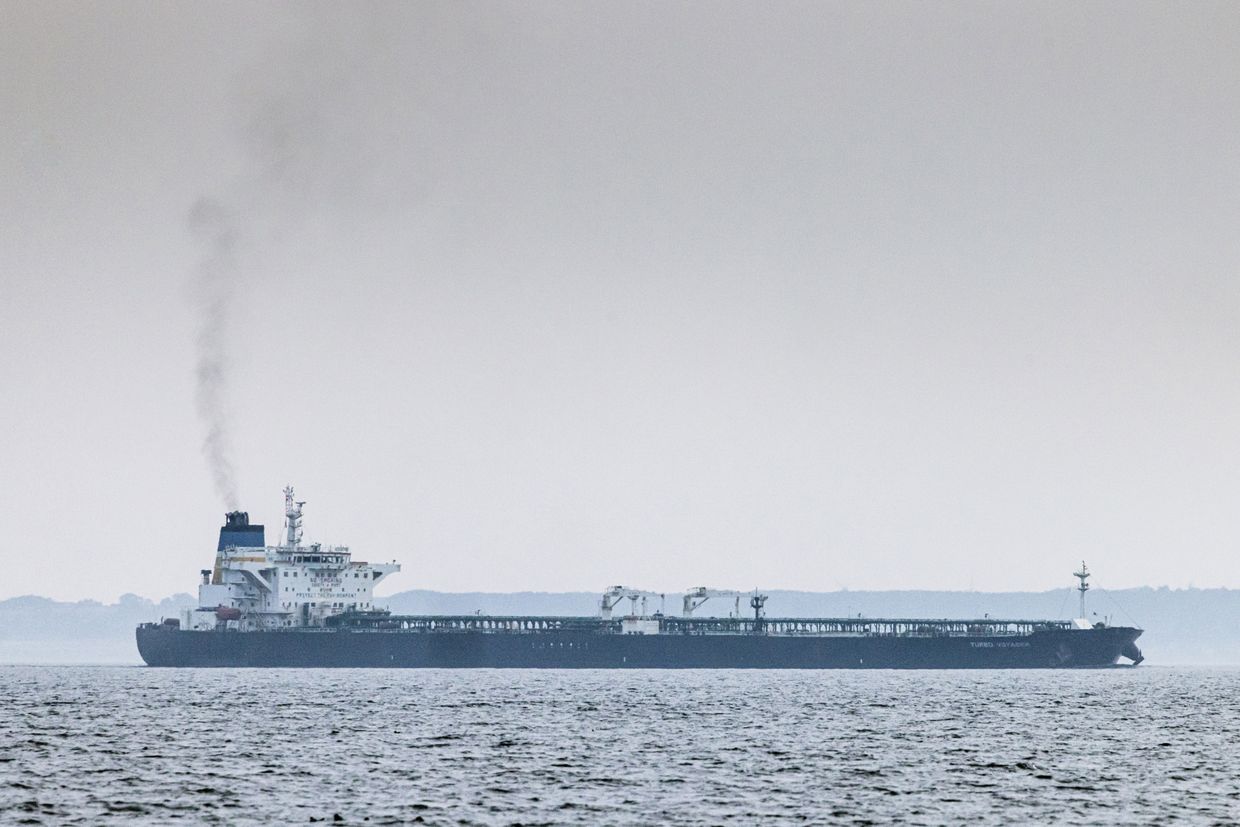
An uninsured Russian Aframax-class tanker has been illegally conducting ship-to-ship oil transfers in international waters near Greece and Cyprus since July 2024, Ukraine's military intelligence (HUR) reported on June 16.
According to the agency, the vessel, operating without Western insurance, is part of Russia's expanding shadow fleet used to bypass G7 and EU sanctions on Russian oil exports.
HUR said such transfers "pose an environmental threat, allow the aggressor to conceal the origin of oil, evade international control, and ensure its supply to third countries in circumvention of sanctions."
Ukraine has identified the tanker as IMO 9247443 and listed it on the War&Sanctions platform, along with 159 other tankers allegedly belonging to Russia's shadow fleet and 55 captains involved in sanction-busting operations.
Despite price caps and Western restrictions, Russia continues to profit from oil and gas exports, which remain a vital revenue source. According to HUR estimates, roughly one-third of those profits are expected to fund Russia's war against Ukraine in 2025.
In May, the EU approved its 17th sanctions package, targeting nearly 200 shadow fleet vessels. The U.S. Treasury had earlier sanctioned over 180 tankers, which together accounted for nearly half of Russia's offshore oil shipments.
While the Biden administration ramped up pressure on Russia's oil trade early in 2024, U.S. President Donald Trump has since declined to impose new sanctions, despite Moscow's continued refusal to agree to a ceasefire.
The Group of Seven (G7) nations need to impose harsher sanctions on Moscow in order to secure a ceasefire in the war against Ukraine, European Commission President Ursula von der Leyen and European Council President Antonio Costa said at the start of the G7 summit in Canada.The G7 Leaders Summit kicked off on June 15 in Kananaskis, Canada, with official talks held June 16-17. While Ukraine hopes to win economic support and unified pressure against Russia, the rapidly escalating conflict between
The Group of Seven (G7) nations need to impose harsher sanctions on Moscow in order to secure a ceasefire in the war against Ukraine, European Commission President Ursula von der Leyen and European Council President Antonio Costa said at the start of the G7 summit in Canada.
The G7 Leaders Summit kicked off on June 15 in Kananaskis, Canada, with official talks held June 16-17. While Ukraine hopes to win economic support and unified pressure against Russia, the rapidly escalating conflict between Israel and Iran may dominate this year's conference.
"To achieve peaceful strength we must put more pressure on Russia to secure a real ceasefire, to bring Russia to the negotiating table, and to end this war. Sanctions are critical to that end," von der Leyen said at a press briefing on June 15 attended by a Kyiv Independent journalist.
Economic sanctions have been an effective intervention since the start of Russia's full-scale invasion, von der Leyen said. She noted that combined G7 and European Union sanctions have decreased Russian oil and gas revenues by nearly 80% since February 2022.
"(T)he sanctions are working, and we will do more," she said.
Von der Leyen urged the G7 to adapt the economic restrictions proposed in the EU's 18th sanctions package, announced on June 10. The new measures target Russia's energy and banking sectors and propose a further reduction in the oil price cap, bringing the cap down from $60 to $45 per barrel.
"I will invite all G7 partners to join us in this endeavor," she said.
Costa echoed the call for sanctions and the necessity of economic pressure in order to achieve a ceasefire. Europe is committed to "increasing additional sanctions to cripple (Russia's) ability to wage war and pressing for an unconditional ceasefire," he said.
Europe's call for unity may meet with resistance from the United States, which has assumed a dramatically different posture towards Ukraine and Russia since President Donald Trump took office in January. Trump has not imposed any new sanctions against Russia, even Moscow blatantly obstructs peace efforts and escalates mass strikes against Ukrainian cities.
The U.S. also reportedly opposes lowering the G7 oil price cap — a measure first introduced in December 2022 that prohibits Western companies from shipping, insuring, or otherwise servicing Russian oil sold above $60 per barrel.
The price cap debate has become more urgent as oil prices, which had fallen below the $60 cap in recent months, surged following Israel's recent strikes against Iran.
Despite U.S. resistance, the EU and the United Kingdom — backed by other European G7 countries and Canada — have said they are prepared to move forward with the proposal, even without Washington's endorsement.
President Volodymyr Zelensky, on the other hand, has said the EU sanctions and proposed price cap drop don't go far enough. Zelensky on June 11 said the EU's 18th round of sanctions "could be stronger" and proposed further slashing the oil price cap to $30 per barrel.
"A ceiling of $45 per barrel of oil is better than $60, that's clear, that's true. But real peace will come with a ceiling of $30," he said. "That's the level that will really change the mindset in Moscow."
Zelensky and Trump are expected to meet on the sidelines of the G7 summit on June 17. The meeting will mark their third in-person encounter since Trump took office.
Russia is exploiting automatic medical exemptions in EU sanctions regulations to import dual-use goods for its military, Lithuania's Deputy Foreign Minister Gabija Grigaite-Daugirde told Bloomberg on June 12.According to Grigaite-Daugirde, Lithuanian customs authorities blocked 28,854 goods in 2024 that were allegedly destined for Russia and Belarus "under the guise of medical exemption."Many of the flagged shipments contained parts for motor vehicles, refrigerators, copiers, and microelectronic
Russia is exploiting automatic medical exemptions in EU sanctions regulations to import dual-use goods for its military, Lithuania's Deputy Foreign Minister Gabija Grigaite-Daugirde told Bloomberg on June 12.
According to Grigaite-Daugirde, Lithuanian customs authorities blocked 28,854 goods in 2024 that were allegedly destined for Russia and Belarus "under the guise of medical exemption."
Many of the flagged shipments contained parts for motor vehicles, refrigerators, copiers, and microelectronics — all of which can have military applications.
"We have witnessed parts for motor vehicles, refrigerators, copying machines, and other types of microelectronics being exported directly to Russia, claiming that these are bound for medical use," she said.
Under current EU rules, medical exemptions are automatically granted, leaving customs authorities to investigate the shipments retroactively. Lithuania has called for reforms allowing exporters to apply for exemptions before shipments are approved.
"Leaving automatic exemptions from sanctions for medical goods is like closing a door but leaving a keyhole," Grigaite-Daugirde said. "Russia definitely finds a way to pass."
As Moscow shifts to a wartime economy and seeks Western-made technology for its arms production, its efforts to circumvent sanctions have grown "desperate," she added.
Lithuania, a key EU and NATO member bordering both Belarus and Russia's heavily militarized Kaliningrad exclave, has taken a hardline stance on enforcement and regularly pushes for tougher sanctions within the bloc.

 Connexion
 The Kyiv IndependentKateryna Hodunova