Vue normale

  • ✇Euromaidan Press
  • 1.2 million weapons in a year: Inside Ukraine’s Amazon-for-arms that ships to the frontline in 24 hours
    Ukraine's weapons marketplace DOT-Chain Defense has compressed delivery times from months to weeks after one year of operation, the country's Defense Ministry reported. For the fastest product categories—electronic warfare gear, ground robots, interceptor drones—orders now reach units within 24 hours. Ukraine's war against Russia's invasion has pushed Kyiv to rebuild military procurement from the ground up, trading slow bureaucratic pipelines for digital platforms where
     

1.2 million weapons in a year: Inside Ukraine’s Amazon-for-arms that ships to the frontline in 24 hours

18 août 2026 à 15:46

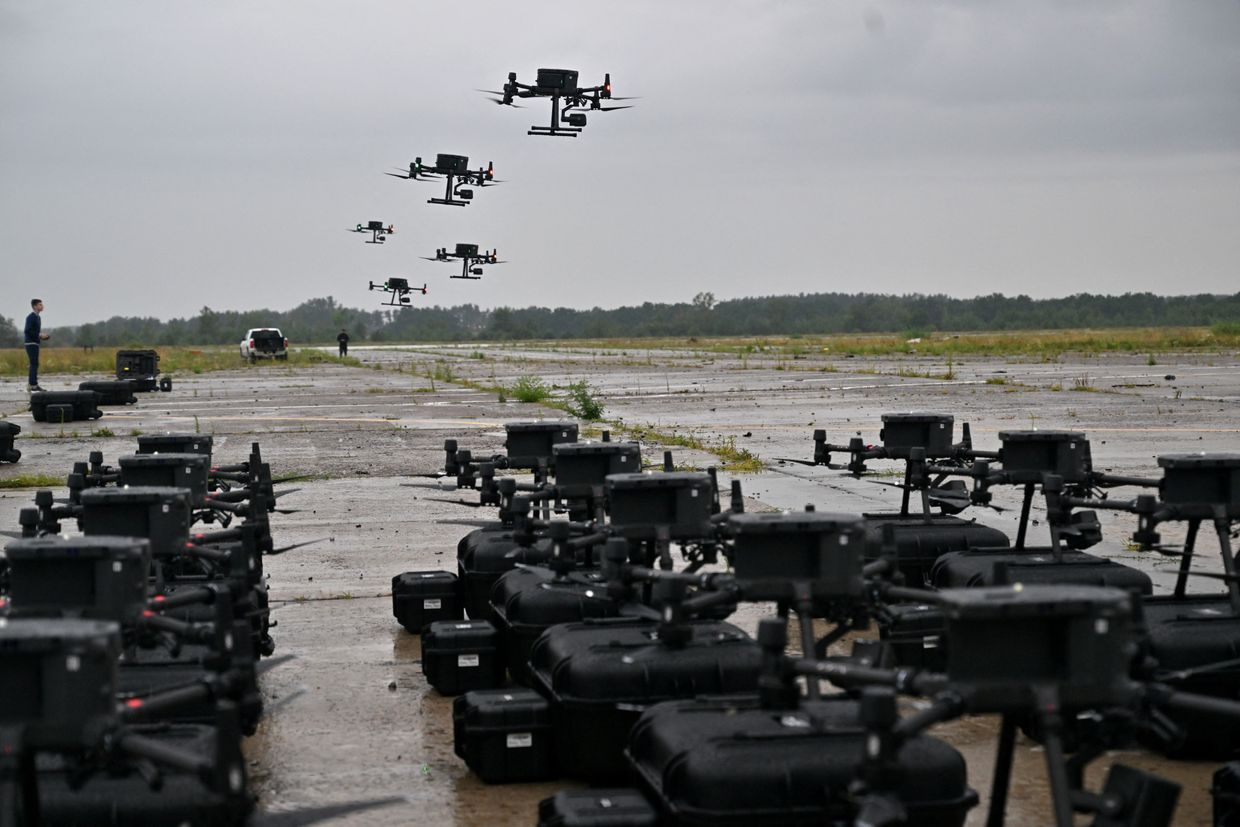
A Ukrainian drone operator.

Ukraine's weapons marketplace DOT-Chain Defense has compressed delivery times from months to weeks after one year of operation, the country's Defense Ministry reported. For the fastest product categories—electronic warfare gear, ground robots, interceptor drones—orders now reach units within 24 hours.

Ukraine's war against Russia's invasion has pushed Kyiv to rebuild military procurement from the ground up, trading slow bureaucratic pipelines for digital platforms where frontline units pick and receive their own weapons faster than Western militaries have managed. Domestic manufacturers now make 90% of newly authorized systems.

Fastest deliveries measured in hours

The Defense Ministry and the Defense Procurement Agency DOT have jointly driven the acceleration, according to the ministry's statement.

"Delivery times for drones and other systems have shrunk from months to a matter of weeks, and often to days," the ministry said.

Beyond that general compression, several categories saw delivery within a single day. Electronic warfare systems, ground robotic platforms, reconnaissance and bomber drones, interceptor drones, and FPV drones on both fiber-optic and radio control all reached units within 24 hours. Ammunition for unmanned systems arrived within six days.
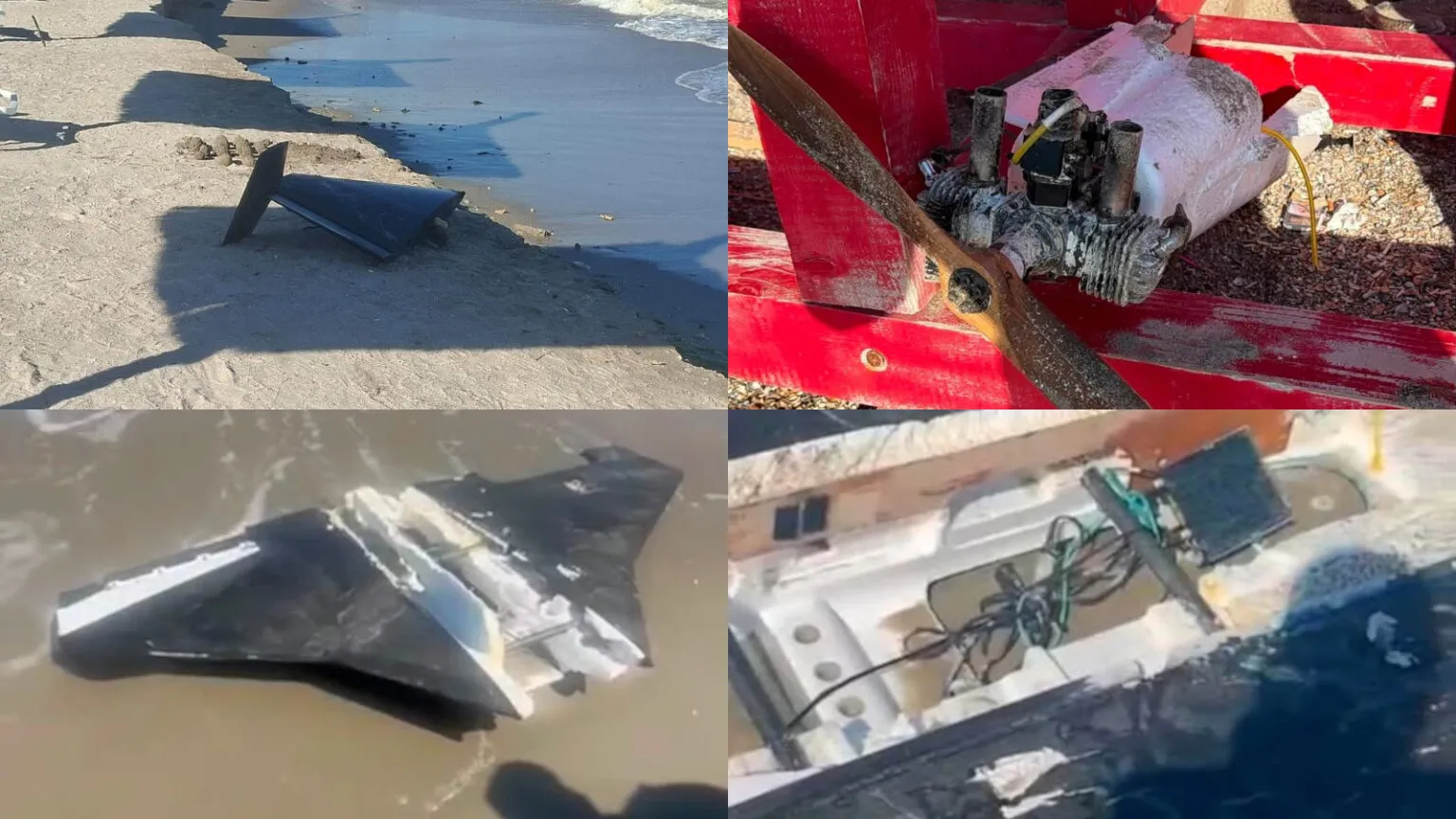
Four-image collage showing drone wreckage found on Romania’s coast and in nearby waters, including wing fragments, an engine and propeller, and exposed electronics.
Explore further

Russian drone attacks on Ukraine’s Danube ports hit recent high, Romania says

Over the first year, the platform shipped more than 1.2 million drones and other systems. Units now choose from 1,181 products made by 300 domestic manufacturers.

How the marketplace works

DOT-Chain Defense supplements centralized state supply rather than replacing it, the ministry noted. Combat units use allocated funds to browse and order the equipment they need for their section of the front. The marketplace handles contracts, payments, and delivery.

The platform's drone constructor tool lets units customize drone configurations before ordering. A dedicated training course on using the marketplace recently launched inside the Army+ mobile app.

ukraine timed its huliaipole operation around weather — worked here's why won't happen again soon · post ukrainian soldier 92nd assault battalion machine gun 2026 armed forces infantry frontline operations
Explore further

US copies Ukraine: Washington launches Amazon-backed UAVs marketplace, inspired by Kyiv’s Brave1 Market and DOT-Chain Defense

Broader procurement picture

The one-year milestone caps a period of rapid scaling across Ukraine's defense procurement. The country contracted about $8 billion worth of drones in the first half of 2026—double the same period last year, according to the Defense Ministry.

More than 400 combat units now shop for weapons through the marketplace's companion Brave1 Market program using points earned for confirmed battlefield activity. Washington modeled its own Unmanned Aircraft Systems Marketplace on the Ukrainian original earlier this year.
The Ukrainian company behind MAUL — a robot that hits 70 km/h and survives flipping over — moves toward investment from an $81M US firm

17 août 2026 à 15:45

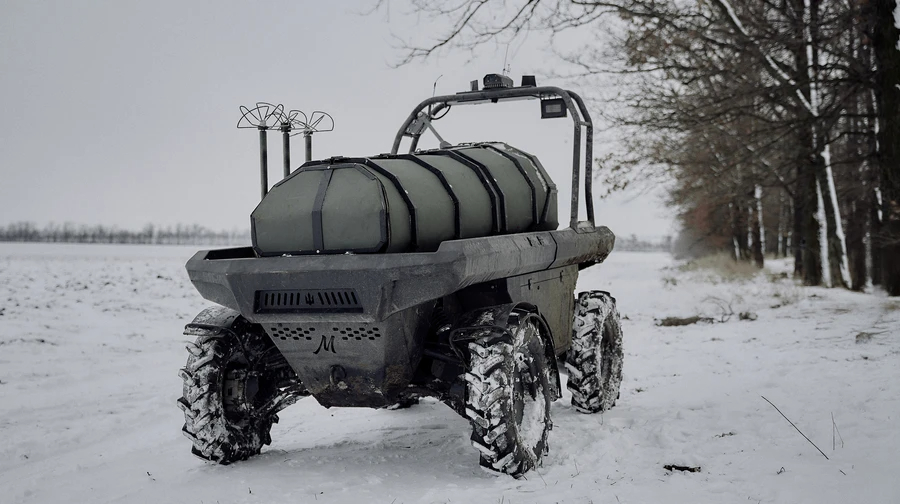
The MAUL unmanned ground vehicle. Source: AIDronesUA

Ukrainian company AIDronesUA and US-based Empery Digital Inc. have signed a document creating the conditions for strategic investment, according to Defender Media. AIDronesUA develops the MAUL unmanned ground vehicle, a casualty evacuation, logistics, and ammunition-delivery platform that was previously presented at the Eurosatory 2026 defense exhibition in Paris.

MAUL is built on an all-terrain vehicle equipped with an internal combustion engine, which offers a significant advantage over electric motors by enabling higher speeds. The drone can travel at up to 70 km/h when a reliable communications link is available. Its engine also allows it to operate in cold weather without the limitations associated with batteries, ArmyInform reports.

MAUL is equipped with four different types of communication links, which can back each other up. The UGV can continue moving even after overturning. Ukrainian military personnel have reported instances in which a vehicle flipped over, returned to its wheels, and continued moving.

Final agreement has not yet been signed

The parties emphasize that, at this stage, this is not a finalized investment agreement. The companies will conduct a feasibility study, financial modeling, and due diligence to assess the potential for future cooperation.

Empery Digital Inc., with which negotiations are underway, has a market capitalization of more than $81 million. The company is involved in the production of electric vehicles and also operates in the digital assets sector, including cryptocurrency.

Access to the US investment market

As part of the due diligence process, Empery Digital plans to assess AIDronesUA's technologies, operations, production requirements, financial needs, regulatory considerations, supply chains, and opportunities for international expansion.

A final agreement can be concluded only after the necessary approvals are obtained, negotiations are finalized, and the relevant documents are signed.

Potential cooperation with the US company could give AIDronesUA access to US investment, international manufacturing expertise, and global markets. The company is also considering integrating Ukrainian-developed technologies into international manufacturing and supply chains.

Ukraine’s ground robots ran nearly 17,000 missions in June. Every one depended on holding signal, problem this new antenna targets

16 août 2026 à 12:14

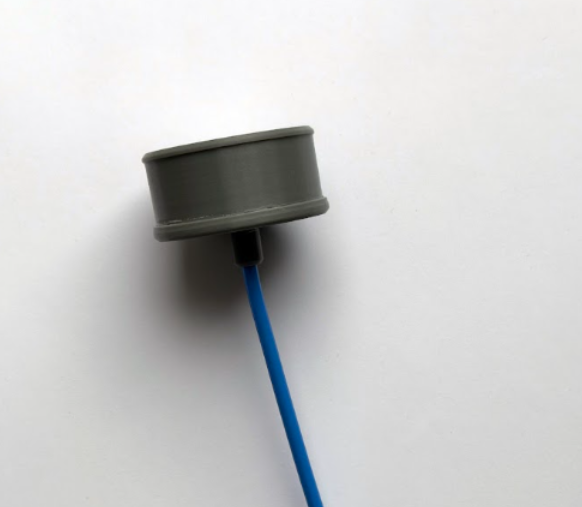
Ukraine's BlueBird Tech unveiled the CLOVER 5.8 GHz antenna. Source: RBC-Ukraine

A Ukrainian company has built a tiny antenna to solve one of the drone war's hardest problems: staying connected. Ukraine's BlueBird Tech has unveiled the CLOVER 5.8 GHz antenna, a 25-gram device for transmitting and receiving radio signals, according to RBC-Ukraine.

The antenna addresses the connectivity problem at the center of Ukraine's drone war. Keeping drones linked to their operators under heavy jamming is one of the war's persistent technical challenges, and the CLOVER is one Ukrainian company's answer.

Previously, Serhii “Flash” Beskrestnov, an adviser to the Ukrainian president, confirmed that the main problem for Ukrainian forces operating some 25,000 combat robots is not hardware limitations but connectivity restrictions.

The design is built to hold a link in motion

The antenna's shape is engineered for stability. Due to its clover design, circular polarization, and omnidirectional radiation pattern, the antenna works even in dynamic conditions.

Weight is decisive for a drone. At 25 grams, the CLOVER adds almost nothing to a small aircraft, leaving weight for payload, battery, or range, which matters for the small FPV drones that do much of the fighting, where a reliable signal and low weight are both at a premium.

It works on drones and ground robots

The antenna is not only for flying drones. It can be installed and used on ground robotic systems as well as FPV drones, and extended to the uncrewed ground vehicles that Ukraine increasingly uses for logistics and evacuation, which face the same connectivity challenge.

In June, Ukrainian ground robots ran nearly 17,000 supply and evacuation missions. Every one of those runs depends on the robot holding a signal, the problem the CLOVER is built to address.

It is built for quick integration. Despite its compact size, the CLOVER covers a wide 4.9-6.1 GHz range and comes with an SMA male connector and an RG402 cable, allowing it to integrate quickly into drone-detection tools, radio-monitoring complexes, and measurement equipment. It is compatible with the main systems on the market.

This Ukrainian 344-kg armored capsule keeps wounded soldier in constant contact with operator, with emergency exit he controls himself

29 juillet 2026 à 16:41

The "Murakha CaseEvak," a robotic evacuation complex. Source: Robotized Complexes

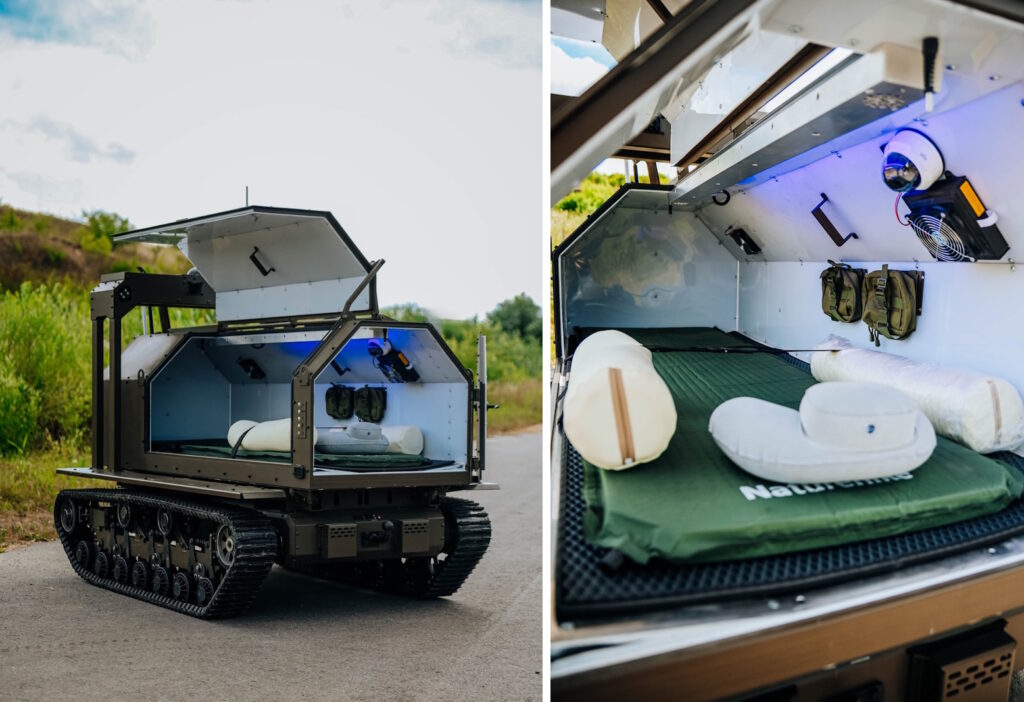
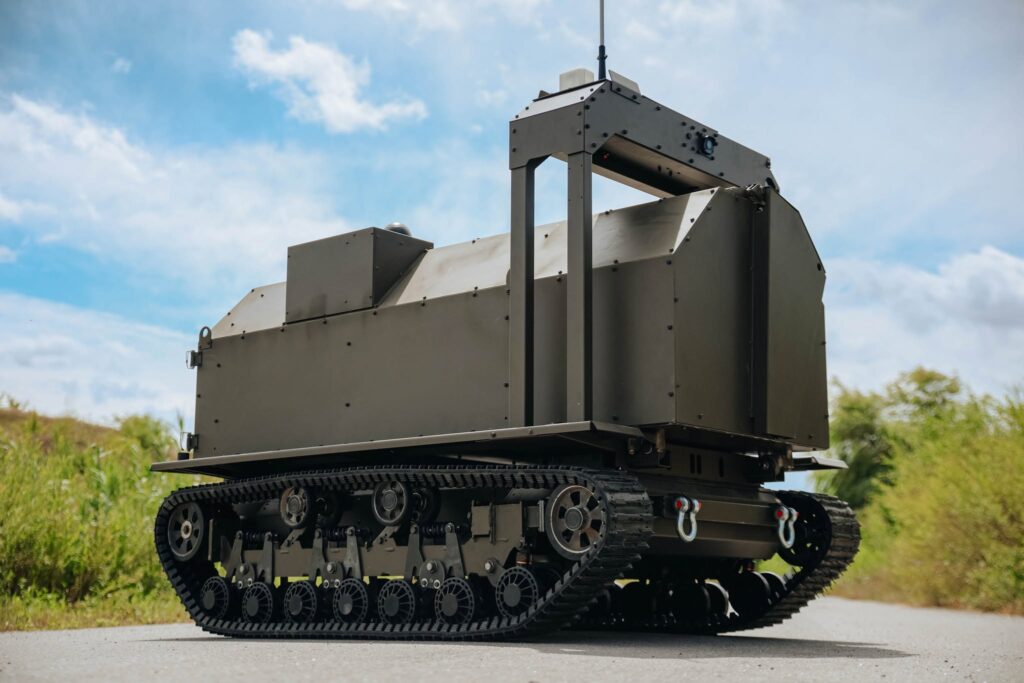
Ukraine has built a robot to carry wounded soldiers out of the kill zones. Evacuation is a fight for the life of the wounded soldier, as well as for the lives of those who set out to help them, the manufacturer Robotized Complexes said, unveiling the "Murakha CaseEvak", a robotic evacuation complex that removes a soldier from a danger zone remotely, minimizing the risk to personnel.

Casualty evacuation on a front saturated with Russian drones is one of the deadliest tasks in the war, with wounded soldiers sometimes waiting days for extraction.

Troops told Euromaidan Press in May 2026 that there were essentially zero purpose-built casevac robots on the market, with evacuation handled by logistics robots not designed to handle the wounded. The Murakha CaseEvak is built specifically for that job: an armored medical capsule on a ground robot, controlled remotely so no rescuer has to enter the drone-hunted zone. It is the specialized casevac machine that the gap called for.

The "Murakha CaseEvak," a robotic evacuation complex. Source: Robotized Complexes
The capsule is armored to survive the trip

The core of the system is a medical capsule built to protect the wounded soldier from the threats that make evacuation lethal. The armored capsule is made of Armox 500T armor-piercing-resistant steel, protecting the person inside from shrapnel and other external threats and creating conditions for safe transport even in zones where enemy drones are actively operating, per Robotized Complexes.

Folding side and rear covers allow a wounded soldier to be loaded quickly, and inside the capsule is a life-support system, ventilation, heating, interior lighting, video surveillance, two-way audio communication, and an emergency door-opening function from inside. A wounded soldier sealed in the capsule can be monitored and spoken to by the operator throughout the drive, and can get himself out if something goes wrong.

The armored approach has already proven itself. In December 2025, a Ukrainian robotic evacuation capsule took a direct hit from a Russian FPV drone mid-evacuation, and the wounded soldier inside survived, a demonstration of exactly why putting armor around the casualty matters when drones hunt the rescue.

The robot was rebuilt to carry the weight

Carrying an armored capsule required upgrading the robot underneath it. The evacuation capsule weighs 344 kilograms, and the complete complex weighs 1,031 kilograms, so Robotized Complexes modernized the Murakha platform itself, increasing motor power to 8 kilowatts and substantially expanding battery capacity.

The connectivity is built to survive Russian jamming, the problem that grounds so many ground robots. The complex carries day, night, and thermal cameras and supports several control channels, including ELRS, LTE, Starlink, and fiber-optic, allowing it to operate even in environments where the enemy is actively using electronic warfare.

  • ✇Euromaidan Press
  • Machines over men: Ukraine’s new military leadership adopted fired minister’s program
    Ukraine's new military leadership has named its program: machines over men. Ukraine will bet on long-range strikes, robotic systems, and other technologies to increase pressure on Russia and preserve the lives of Ukrainian soldiers, acting Defense Minister Yevhenii Khmara said after meeting the new Commander-in-Chief, Major General Mykhailo Drapatyi, according to the Ukrainian Defense Ministry.  The direction is the one championed by Mykhailo Fedorov, the reformist defense
     

Machines over men: Ukraine’s new military leadership adopted fired minister’s program

22 juillet 2026 à 10:12

Acting Defense Minister Yevhenii Khmara at the meeting the new Commander-in-Chief, Major General Mykhailo Drapatyi. Source: The Ukrainian Defense Ministry

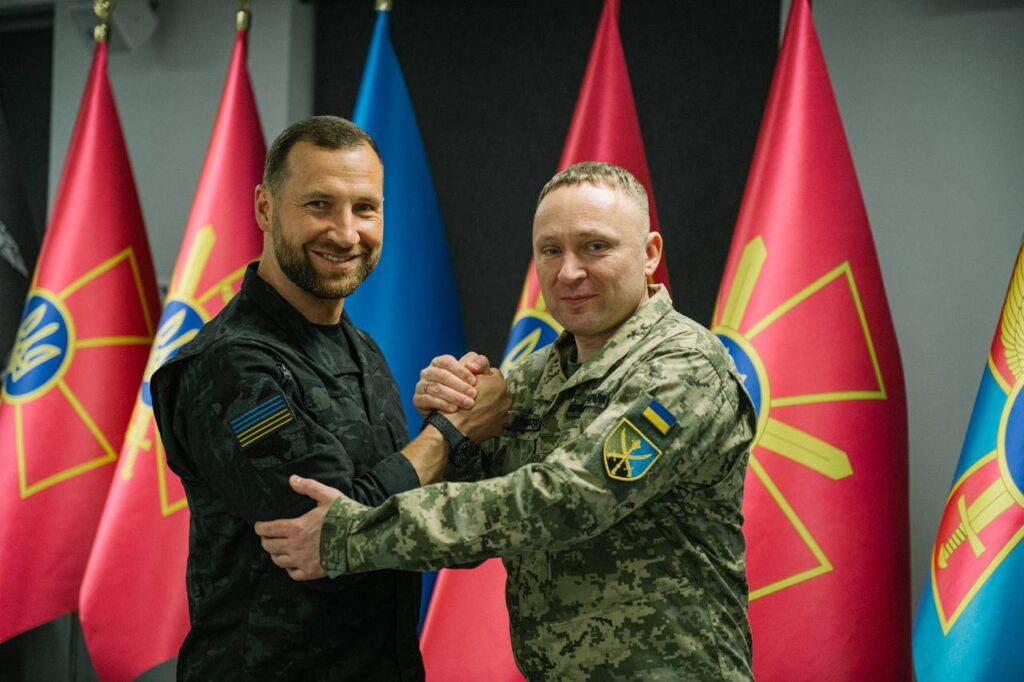
Ukraine's new military leadership has named its program: machines over men. Ukraine will bet on long-range strikes, robotic systems, and other technologies to increase pressure on Russia and preserve the lives of Ukrainian soldiers, acting Defense Minister Yevhenii Khmara said after meeting the new Commander-in-Chief, Major General Mykhailo Drapatyi, according to the Ukrainian Defense Ministry. 

The direction is the one championed by Mykhailo Fedorov, the reformist defense minister whose dismissal on 15 July set off six days of nationwide protests. Fedorov is the architect of Ukraine's "Army of Drones" but was fired after a clash with then-Commander-in-Chief Oleksandr Syrskyi.

The protests demanded his reinstatement and Syrskyi's removal. Syrskyi is now gone, and Fedorov remains out of government, too.

What is first priority?

The first-priority decisions of the new military leadership, Khmara said, are to strengthen the front, reinforce support from international partners, and, to the maximum extent possible, transfer combat operations onto the aggressor's territory.

"We must scale what we are already effective at: deep strike, middle strike, ground robotic systems, and other solutions that preserve soldiers' lives and inflict maximum damage on the enemy," Khmara claimed.

Ukrainian units will receive more modern strike systems, above all long-range ones, and new technological solutions that let them carry out combat tasks with less risk to personnel.

"Ukraine will continue its strike and technological pressure on Russia by all available means," he said.

The statement is the first joint declaration of intent from the leadership that emerged from a week of protests.

Khmara says he proposed Drapatyi for job

The acting minister disclosed his own role in the appointment. Khmara said he fully trusts Drapatyi, whose candidacy he himself had earlier proposed to President Volodymyr Zelenskyy for the post of commander-in-chief.

"We agreed to be honest with each other, and to resolve all differences exclusively in the interests of Ukrainian soldiers," Khmara stated.

He and Drapatyi see the further development of the Defense Forces in the same way, he said, and Zelenskyy has backed that vision.

What the statement leaves unsaid is the question the protests have not dropped: whether Fedorov himself returns.

  • ✇The Kyiv Independent
  • Ukraine approves new 'Murakha' ground robot for combat use
    The Defense Ministry has approved the Ukrainian-made ground-based robotics complex "Murakha" ("Ant") for combat operations, the ministry announced on June 28. Since 2024, Ukraine has been scaling up robotics development in hopes that mass production of unmanned ground vehicles (UGVs) will "minimize human involvement on the battlefield." The Murakha is a tracked robotic platform designed to support front-line units working under challenging conditions, such as under enemy artillery and in heavily
     

Ukraine approves new 'Murakha' ground robot for combat use

29 juin 2025 à 00:58
Ukraine approves new 'Murakha' ground robot for combat use

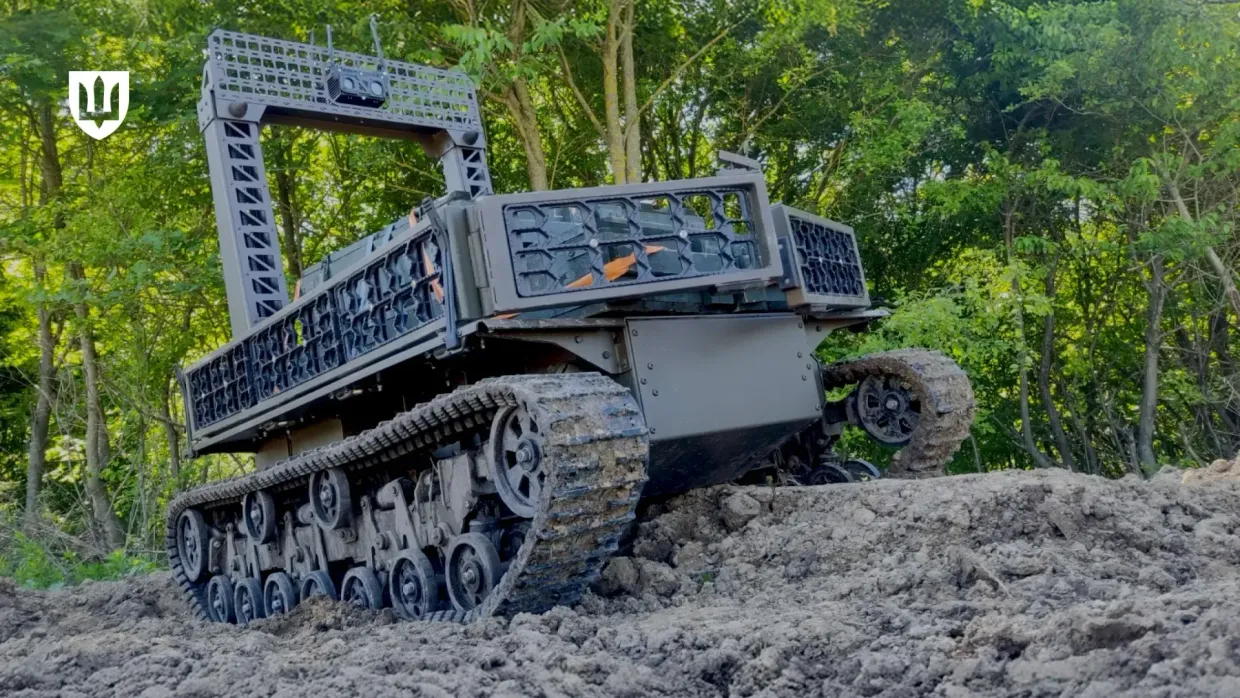
The Defense Ministry has approved the Ukrainian-made ground-based robotics complex "Murakha" ("Ant") for combat operations, the ministry announced on June 28.

Since 2024, Ukraine has been scaling up robotics development in hopes that mass production of unmanned ground vehicles (UGVs) will "minimize human involvement on the battlefield."

The Murakha is a tracked robotic platform designed to support front-line units working under challenging conditions, such as under enemy artillery and in heavily mined terrain, the Defense Ministry said.

Its larger size makes it one of Ukraine's leading UGVs in terms of load capacity. The Murakha can reportedly carry over half a ton of weight across dozens of kilometers. It can also cross difficult terrain and shallow water.

According to the Defense Ministry, the Murakha's multiple control channels allow it to function successfully even in areas of the battlefield where Russian electronic warfare (EW) systems are operating.

Mobile robots are capable of performing several tasks on the battlefield, including offensive and defensive activities, evacuation of the wounded, logistical support for units, and mining and demining.

In April, the Defense Ministry unveiled the D-21-12R UGV, a ground-based robot equipped with a machine gun.

Ukrainian drones strike missile, drone arsenal in Russia’s Bryansk Oblast
Ukraine’s military intelligence (HUR) struck on June 28 the 1060th Material-Technical Support Center in the city of Bryansk, Ukraine’s General Staff said. The facilities store a Russian missile and drone arsenal, Ukrainska Pravda reported, citing a source in HUR.
Ukraine approves new 'Murakha' ground robot for combat useThe Kyiv IndependentDmytro Basmat
Ukraine approves new 'Murakha' ground robot for combat use
❌