❌

Vue normale

Ukraine’s former defense minister, dismissed suddenly, has announced Army of Robots. He says target is $10,000 per unit and need is tens of thousands
1 octobre 2026 à 19:38

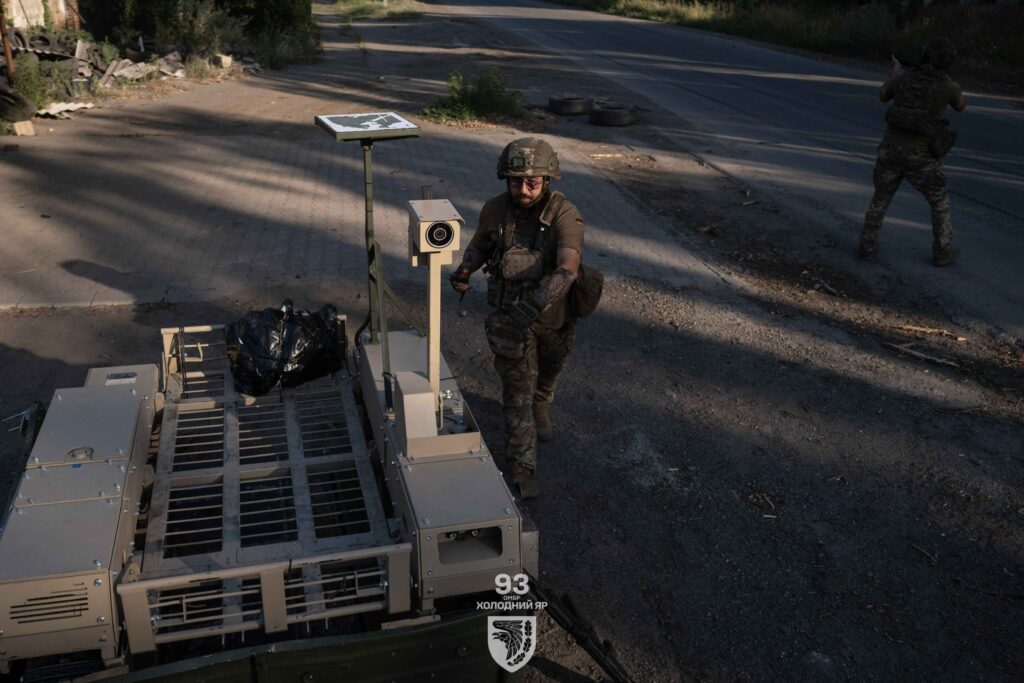
An armed ground robot. Photo: 93rd Brigade

The robots Ukraine wants to throw into its deadliest fights should cost as little as $10,000 each, Mykhailo Fedorov says. The former defense minister has set out the first stage of his Army of Robots: cheap, simple humanoid-like machines that would take over an infantry's most dangerous jobs, with tens of thousands needed, he said on Telegram, citing his own interview with Forbes.

On 26 September, Fedorov, who continues to work on military tech reforms despite his sudden and unexpected dismissal, announced the creation of the Army of Robots.

Humanoid robots would carry ammunition and pull out the wounded, lay and clear minefields, scout, hold positions, and strike, taking the roles that today cost soldiers their lives.

Potential need amounts to thousands

"Our main goal is to save lives. A human should not take risks where a machine can do the job," Fedorov says.

At the first stage, it will not be a classic humanoid but a simpler humanoid-like robot that can be produced quickly and scaled up, he adds.

Such a machine should perform some of an infantryman's tasks directly on the battlefield.

Today, such platforms cost $40–70 thousand on average. For mass use in war, Ukraine needs something much cheaper: the target is $10–20 thousand per unit, he believes.

"The potential need is tens of thousands of such machines," Fedorov continues.

Next come prototypes

The former defense minister adds that he and his team are already working with teams that have ready-made MVPs and are designing solutions.

"Next come prototypes, simulations, model training, and finding the right combination of hardware and software," he explains.

The Army of Robots is not a single product but an ecosystem that will unite companies, startups, engineers, R&D, and capital around the robotization of the front.

"Our task is to get from prototype to mass product as quickly as possible," he adds.

  • ✇Euromaidan Press
  • Old American armor, new Ukrainian brain: Skelya regiment nears completion of M1117 unmanned conversion
    Ukraine's 425th Separate Assault Regiment Skelya is converting American-made armored vehicles into remotely operated platforms as part of its "remote infantry" concept, head of the regiment's innovation support group Edhar Vinnik wrote in an exclusive column for 24 Kanal. The approach rests on a simple principle: if a machine can do the job, no soldier should risk their life doing it, Vinnik argued. The regiment established an Innovation Center to develop unmanned systems and robotic platf
     

Old American armor, new Ukrainian brain: Skelya regiment nears completion of M1117 unmanned conversion

23 septembre 2026 à 09:33

M1117 in service with Ukraine’s 425th Assault Battalion “Skala,” 2024

Ukraine's 425th Separate Assault Regiment Skelya is converting American-made armored vehicles into remotely operated platforms as part of its "remote infantry" concept, head of the regiment's innovation support group Edhar Vinnik wrote in an exclusive column for 24 Kanal. The approach rests on a simple principle: if a machine can do the job, no soldier should risk their life doing it, Vinnik argued. The regiment established an Innovation Center to develop unmanned systems and robotic platforms, Militarnyi reported.

The M1117 is the second vehicle Skelya has converted to unmanned control—after completing the Novator armored car in June—and the regiment's approach won a Defense Ministry DELTA innovation competition on 31 August 2026, earning approximately $33,700. The pattern suggests Ukraine's cheapest path to unmanned ground capability may not run through purpose-built robots but through vehicles already in service, upgraded with off-the-shelf hardware.

M1117 conversion nears completion

The regiment is in the final stages of converting the American M1117 Guardian into a remotely controlled platform. The 4x4 vehicle has been in Ukrainian service since 2023.

"The project of remote control of the American armored wheeled vehicle M1117 is in the final stage," Vinnik said.

This is Skelya's second such conversion. In June, the regiment completed a similar project with the Novator armored car. The Novator received multiple communication channels: Starlink, LTE, and Silvus radio systems. Vinnik argued the conversions prove that remote control can scale to any vehicle in service, if the hardware supports it.

Software ties the system together

Without adequate software, all unmanned platforms would remain isolated machines, Vinnik noted. The regiment's IT Innovation Department develops proprietary software for coordinating unmanned systems. One solution replicates functionality similar to R2D2—a network data-relay infrastructure that enables remote equipment operation. Using off-the-shelf routers cut the cost roughly fourfold.

"Without adequate software, all these drones and ground systems would remain just separate machines," Vinnik said.

The cost reduction matters for scalability, Vinnik argued. A technology that exists in one copy is a demo—one cheap and reliable enough for hundreds of crews is a capability. The regiment measures its progress by one number, he wrote: how many soldiers were not sent where they could be killed or wounded.

Why old armor gets a second life

The M1117 Guardian—built on the Cadillac Gage Commando chassis from the Vietnam War era—exemplifies the trend. The regiment's Innovation Center, established in autumn 2025, won a Defense Ministry DELTA innovation competition on 31 August 2026. Skelya's approach reflects a broader Ukrainian trend of converting existing vehicles into unmanned platforms rather than building robots from scratch. The National Guard's Khartiia Corps earlier converted a 12-ton US-made M113 armored personnel carrier into an unmanned platform for remote demining and logistics, fitting it with anti-drone armor and a mine flail. Ukraine is also rebuilding Soviet BRDM-2 armored scouts into remotely operated robotic platforms, and three units recently received Kaban—a bolt-on kit that turns ordinary vehicles into uncrewed ones.

Danish defense startup guarding undersea cables runs on 15 Ukrainian suppliers. Ukrainian fund is putting in €2 million in it

22 septembre 2026 à 11:53

Denmark

A Ukrainian fund is investing in a Danish defense startup, a reversal for a country far better known for taking in foreign capital than for sending it abroad. Resist.UA is backing BlueShadow, a maritime security firm run by a former US Navy submarine commander but largely engineered in Ukraine, to build defenses for coasts and undersea cables against drones and hybrid attacks.

BlueShadow is registered in Denmark, but almost its entire engineering team works in Ukraine, and it folds gear from more than 15 Ukrainian suppliers of drones, sensors, and communications into a single system.

Resist.UA, which signed a letter of intent to join the company's €2 million pre-seed round, runs a new €50 million fund, Resist 2.0, designed to bring Ukraine's battlefield-proven technology to global markets.

Ukraine engineers the Danish startup

The company was founded in 2025 and is led by Charles Maher, a former commander of a US Navy nuclear submarine, according to Defender Media.

This summer, it registered as a Ukrainian legal entity and builds on Ukrainian components, planning to fit its maritime platforms with M-Fly's RB-220 gimbal, a day-and-night targeting sensor used until now only on flying drones.

The two sides first met in January 2026 and formalized the partnership as BlueShadow raised its round and Resist.UA launched its second fund.

The systems guard the sea

BlueShadow is building two of them. BlueDragon, still in development, is designed to shield Ukraine's coastal cities, ports, and shipping lanes from drone strikes. BlueSentry, which the company plans to launch in October, is aimed at protecting ports, offshore wind farms, undersea cables, and maritime borders from hybrid attack, the kind of sabotage that has repeatedly damaged Baltic Sea infrastructure.

"This partnership will fuel the next phase of our mission to protect people, infrastructure, commerce, and natural resources at sea," the company said.

Ukraine's defense tech turns outward

Ukrainian defense technology, tested in real combat, has drawn growing investor interest, and Ukrainian figures are now building funds to channel it: the former Defense Minister, Mykhailo Fedorov, is raising what he calls the country's largest defense-tech venture fund.

  • ✇The Kyiv Independent
  • Russia cannot launch 500 drones every day, Ukraine's intel chief says
    Russia has the capacity to launch as many as 500 Iranian-designed Shahed attack drones at Ukraine in a single attack, but doing so on a daily basis is not possible, Ukraine's military intelligence chief Kyrylo Budanov said on July 2, according to Suspilne.In recent weeks, Russia has intensified its drone assaults on Ukrainian cities, often launching hundreds in a single day. The largest aerial attack since the start of the full-scale invasion occurred overnight on June 29, when Moscow launched 4
     

Russia cannot launch 500 drones every day, Ukraine's intel chief says

2 juillet 2025 à 05:05
Russia cannot launch 500 drones every day, Ukraine's intel chief says

Russia has the capacity to launch as many as 500 Iranian-designed Shahed attack drones at Ukraine in a single attack, but doing so on a daily basis is not possible, Ukraine's military intelligence chief Kyrylo Budanov said on July 2, according to Suspilne.

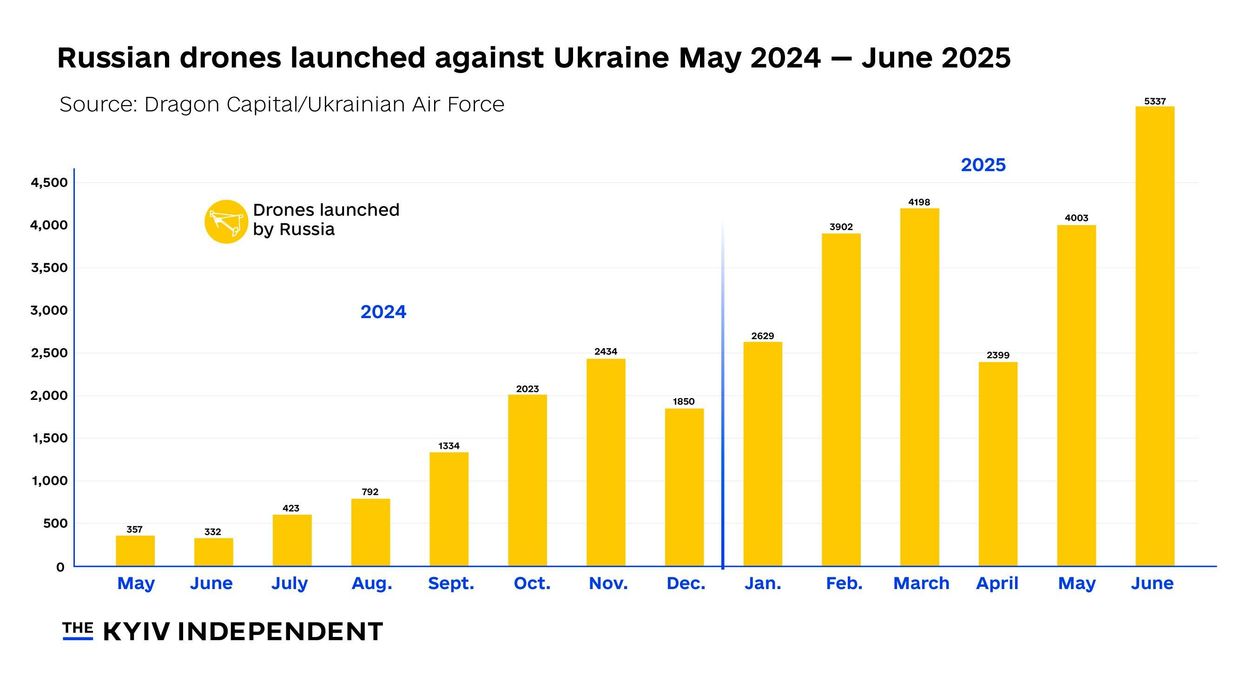
In recent weeks, Russia has intensified its drone assaults on Ukrainian cities, often launching hundreds in a single day. The largest aerial attack since the start of the full-scale invasion occurred overnight on June 29, when Moscow launched 477 drones and 60 missiles across Ukraine.

"Launching 450–500 Shaheds every day — it's just not realistic," said Budanov during a ceremony recognizing five Ukrainian intelligence achievements in the national record book, according to public broadcaster Suspilne.

"But unfortunately, they do have the ability to do it periodically. They can realistically launch up to 500 in one strike," Budanov added.

Budanov also said Russia is upgrading the capabilities of the Shahed-type drones by improving their CRPA (Controlled Reception Pattern Antenna) systems, which protect the drones from GPS jamming. He noted that Russian engineers are now producing 16-channel CRPA antennas, which are harder to counter electronically.

Russia cannot launch 500 drones every day, Ukraine's intel chief says
Russian drones launched against Ukraine by month (Nizar al-Rifai/The Kyiv Independent)

"These antennas are currently produced in Russia, but the engineer who developed this CRPA antenna was here in Ukraine," Budanov said.

"Back in the early 2000s, no one here needed it, so the engineer moved to Russia. One (of the two engineers involved in the development) has already died under unclear circumstances. The other is still alive, though probably not for long."

Russia has used thousands of Shahed-type drones throughout its full-scale invasion to strike Ukrainian cities and infrastructure, often in large overnight waves. Ukrainian air defenses have adapted over time but face growing challenges as Moscow improves drone resilience and electronic warfare capabilities.

President Volodymyr Zelensky said that Moscow has launched 28,743 Shahed-type drones at Ukraine since the start of Russia's full-scale invasion.

Budanov also said Russia has made unsuccessful attempts to develop its own naval drones. The last known effort came in early June, when experimental models detonated before reaching Ukrainian territorial waters, he said.

"They didn't achieve results. Based on our information, they were heading toward the city of Yuzhne, searching for targets," he said.

Ukraine has been using domestically developed Magura naval drones to target Russian military assets in the Black Sea, keeping much of Russia's fleet pinned in port.

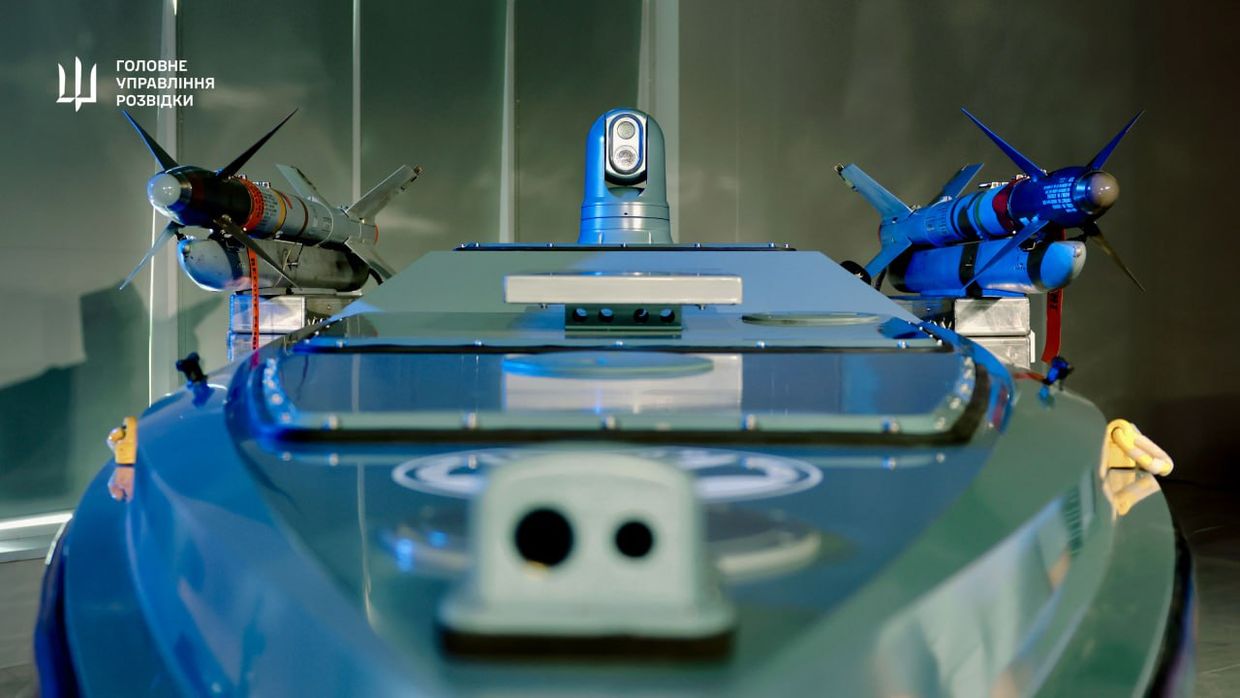
Despite their small size, the unmanned surface vessels have proven effective, including in a May 2 operation when Ukraine's military intelligence used Magura-7 drones armed with air-to-air missiles to shoot down two Russian Su-30 fighter jets near Novorossiysk. It was the first recorded instance of fighter jets being downed by naval drones.

Ukraine shows its latest ‘ship-killer’ Magura drone series to the public for the first time
The Magura drones, as well as the Sea Baby drones of the Security Service of Ukraine (SBU), were pivotal in turning the tide of the war in the Black Sea, destroying or damaging Russian ships and other assets.
Russia cannot launch 500 drones every day, Ukraine's intel chief saysThe Kyiv IndependentMartin Fornusek
Russia cannot launch 500 drones every day, Ukraine's intel chief says
  • ✇The Kyiv Independent
  • Ukraine approves new 'Murakha' ground robot for combat use
    The Defense Ministry has approved the Ukrainian-made ground-based robotics complex "Murakha" ("Ant") for combat operations, the ministry announced on June 28. Since 2024, Ukraine has been scaling up robotics development in hopes that mass production of unmanned ground vehicles (UGVs) will "minimize human involvement on the battlefield." The Murakha is a tracked robotic platform designed to support front-line units working under challenging conditions, such as under enemy artillery and in heavily
     

Ukraine approves new 'Murakha' ground robot for combat use

29 juin 2025 à 00:58
Ukraine approves new 'Murakha' ground robot for combat use

The Defense Ministry has approved the Ukrainian-made ground-based robotics complex "Murakha" ("Ant") for combat operations, the ministry announced on June 28.

Since 2024, Ukraine has been scaling up robotics development in hopes that mass production of unmanned ground vehicles (UGVs) will "minimize human involvement on the battlefield."

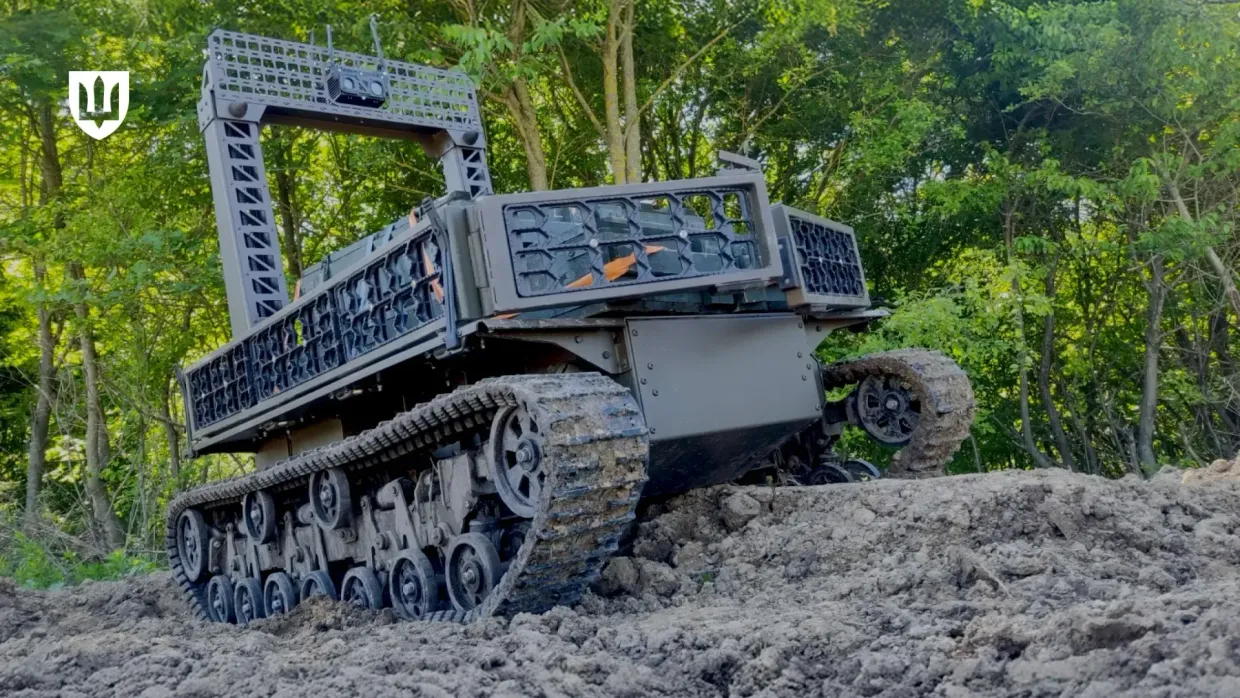
The Murakha is a tracked robotic platform designed to support front-line units working under challenging conditions, such as under enemy artillery and in heavily mined terrain, the Defense Ministry said.

Its larger size makes it one of Ukraine's leading UGVs in terms of load capacity. The Murakha can reportedly carry over half a ton of weight across dozens of kilometers. It can also cross difficult terrain and shallow water.

According to the Defense Ministry, the Murakha's multiple control channels allow it to function successfully even in areas of the battlefield where Russian electronic warfare (EW) systems are operating.

Mobile robots are capable of performing several tasks on the battlefield, including offensive and defensive activities, evacuation of the wounded, logistical support for units, and mining and demining.

In April, the Defense Ministry unveiled the D-21-12R UGV, a ground-based robot equipped with a machine gun.

Ukrainian drones strike missile, drone arsenal in Russia’s Bryansk Oblast
Ukraine’s military intelligence (HUR) struck on June 28 the 1060th Material-Technical Support Center in the city of Bryansk, Ukraine’s General Staff said. The facilities store a Russian missile and drone arsenal, Ukrainska Pravda reported, citing a source in HUR.
Ukraine approves new 'Murakha' ground robot for combat useThe Kyiv IndependentDmytro Basmat
Ukraine approves new 'Murakha' ground robot for combat use
❌