❌

Vue lecture

Le sexisme gagne du terrain dans les écoles

Le Centre d’aide et de lutte aux agressions à caractère sexuel de l’Est du Bas-Saint-Laurent (CALACS) s’inquiète de la montée du sexisme et du masculinisme chez les adolescents.

Les discours misogynes et antiféministes, qui visent à soi-disant rétablir le rôle et la place des hommes dans la société, sont de plus en plus populaires dans les écoles.

Même son de cloche de la part des enseignants, qui déplorent l’impact des propos sexistes de l’extrême droite sur les progrès de l’égalité des genres. Une pétition visant à légaliser le viol a circulé récemment dans une école secondaire de Saint-Hyacinthe. Présenté comme une mauvaise blague, le geste d’un groupe d’élèves montre toutefois que le Québec n’échappe pas au masculinisme.

« Une étude publiée l’été dernier montre que 75 % des jeunes de 15 à 25 ans adhèrent à des mythes qui mettent en doute la crédibilité des victimes de violences sexuelles et déresponsabilisent les auteurs des agressions », souligne la coordonnatrice sociopolitique du CALACS, Émilie Pelletier.

L’idéologie diffusée en ligne par des influenceurs d’extrême droite comme Andrew Tate prône le retour aux rôles traditionnels des genres et banalise les violences envers les femmes.

« C’est très inquiétant de voir la montée du masculinisme », estime madame Pelletier. « Ce sont les jeunes, les décideurs de demain. Il faut plus de prévention, beaucoup plus de financement pour les organismes qui travaillent à prévenir ces violences. »

Alimentés par les réseaux sociaux

Ces discours qui banalisent les violences sexuelles, verbales et physiques sont alimentés et amplifiés par les réseaux sociaux.

De nombreuses enquêtes ont montré que la violence de la part des garçons est de plus en plus présente dans les relations amoureuses. Au CALACS, les demandes d’aide ont triplé depuis cinq ans. Globalement, 70 % des personnes accompagnées ont moins de 30 ans.

Dans les classes, les enseignants constatent également les effets du discours masculiniste sur les comportements des adolescents. La présidente du Syndicat de l’enseignement de la région de la Mitis, Sylvie Lefebvre, constate que les jeunes garçons n’ont plus de retenue.

La présidente du Syndicat de l’enseignement de la région de la Mitis, Sylvie Lefebvre (Photo courtoisie)

« Avant c’était plus en catimini, là il y a une banalisation des commentaires dégradants ou qui vont toucher le respect des femmes. C’est un phénomène de gang », explique-t-elle, en soulignant que les jeunes agissent rarement seuls. « Ils ne se cachent plus, il y a moins de gêne devant les adultes. Ce qui nous inquiète aussi. Et les commentaires sont de plus en plus acerbes. »

La montée de ces comportements demande aussi davantage d’interventions des enseignants et des professionnels de l’école, qui ne sont pas toujours en nombre suffisant, rappelle madame Lefebvre.

Ce qui nuit à l’enseignement. Elle croit que la solution au phénomène masculiniste repose sur l’ensemble de la société, pas seulement sur les écoles. « Il doit y avoir une réflexion. De se questionner sur l’égalité homme-femme. »

Le CSS en observation

La direction du Centre de services scolaire des Phares (CSS) refuse pour le moment de se prononcer sur la montée du masculinisme ou des comportements antiféministes dans les écoles.

Par courriel, le CSS précise ne pas avoir de données pour évaluer la banalisation de la violence ou des agressions sexuelles envers les filles. L’organisme affirme être vigilant face aux différentes.

« Nous souhaitons outiller les personnes qui interviennent directement auprès des jeunes afin qu’elles soient en mesure de mieux comprendre ces phénomènes, de reconnaître les situations préoccupantes et d’intervenir adéquatement », explique sa directrice des communications, Zoé Ross-Lévesque.

« Une activité est prévue avec une équipe clinique spécialisée qui ac-compagne les écoles au Québec dans le but de maintenir des milieux sécuritaires et respectueux. »


  •  

Florida officials say six people dead from Hurricane Isaias

Governor Ron DeSantis says death toll ‘sad’ but praises work of local officials for helping to minimize storm’s impact

Six deaths have been confirmed in Florida in the aftermath of Hurricane Isaias.

In a press conference on Tuesday, Florida governor Ron DeSantis praised the work of local officials for minimizing the impact of the storm, which made landfall late on Friday, ⁠bringing strong winds, rain, flash floods and tornado ​threats across parts of the ​US south-east, leaving hundreds of thousands ​of residents without power.

Continue reading...

© Photograph: Jen Golbeck/SOPA Images/Shutterstock

© Photograph: Jen Golbeck/SOPA Images/Shutterstock

© Photograph: Jen Golbeck/SOPA Images/Shutterstock

  •  

Katie Zacharia Makes Bumpy Debut as Trump’s New Press Secretary

Ms. Zacharia spent eight minutes reading from a script, called on only three reporters and made an awkward slip-up.

© Kenny Holston/The New York Times

Katie Zacharia, the new press secretary, said that she had wanted to work for President Trump “for a very long time.”
  •  

Ransomware Attacks Have Swept Japan. A.I. May Be Making Them Easier.

Critical infrastructure has been targeted in a wave of cyberattacks, which experts say are rising because of artificial intelligence.

© Haiyun Jiang/The New York Times

Japan has been hit by a wave of cyberattacks that have affected businesses and government.
  •  

UAW’s Shawn Fain Wins Second Term as President

The United Auto Workers has grown under Mr. Fain, who has also drawn scrutiny from federal prosecutors.

© Jose Juarez/Associated Press

Shawn Fain, president of the United Automobile Workers union, was re-elected to a second term.
  •  

Ukraine’s 3rd Army Corps took the lessons of the failed 2023 counteroffensive into Operation Vivaldi. It fought small, and won.

Par : David Axe

3rd Army Corps.

  • Ukraine's Operation Vivaldi has succeeded because ground commanders thought small instead of big
  • Rather than hoping for a major breakthrough, they fought incrementally and with heavy support from the air
  • Contrast Operation Vivaldi's small but successful thinking with the big thinking of Ukraine's failed 2023 counteroffensive

Five months after launching Operation Vivaldi, a local counteroffensive in northern Donetsk Oblast, the Ukrainian 3rd Army Corps has eliminated the Russian bridgehead on its most important long-term objective: the Zherebets River, which flows south through eastern Ukraine and forms a natural defensive barrier east of the last big free cities in Donetsk: Sloviansk and Kramatorsk.

Attacking methodically under strict secrecy, the 3rd Army Corps has pushed back the Russian 20th and 25th Combined Arms Armies and returned 176 sq km of northern Donetsk to Ukrainian control as of 30 September, according to Ukraine's presidential office. The figure could not be independently verified. Operation Vivaldi netted the Ukrainians hundreds of Russian prisoners and erased 18 months of Russian advances toward Sloviansk.

"Ukrainian forces have defeated the 2026 Russian campaign to seize Donetsk Oblast," the Institute for the Study of War in Washington concluded.

It's a remarkable feat for the overall outgunned and outmanned Ukrainian forces. Equally remarkably, the Ukrainians deftly dodged several potentially fatal traps as they flanked the 20th and 25th CAAs. They didn't get stuck in the Russians' dense minefields. They didn't expose themselves to devastating air attack. Perhaps most importantly, they didn't set their sights on distant objectives. They thought small instead of big, stacking small gains on top of small gains until those wins amounted to a big victory.

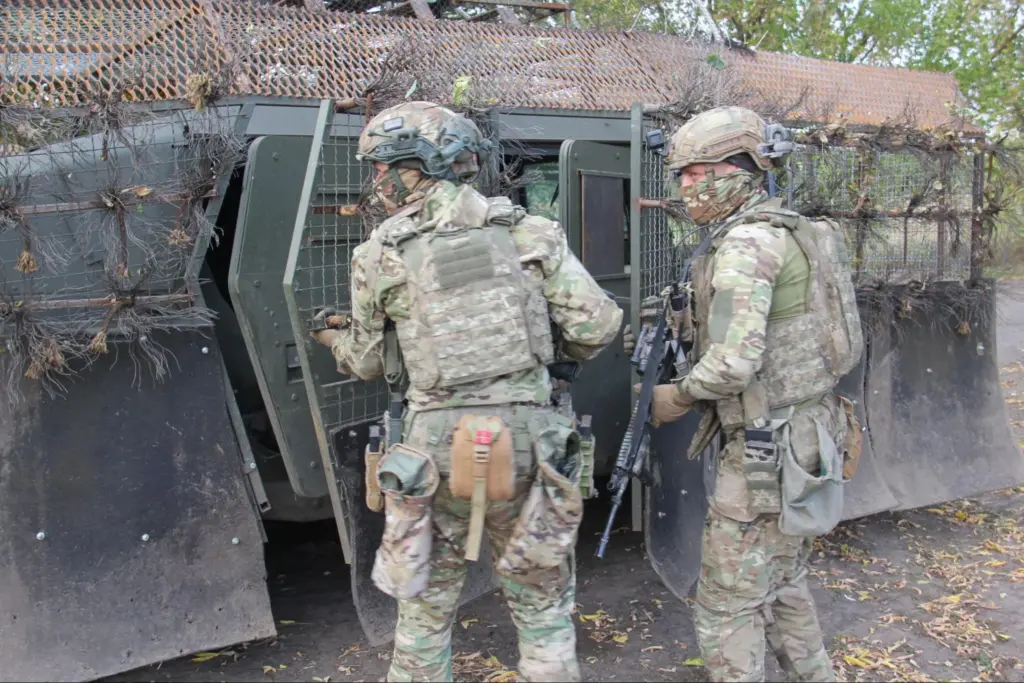
3rd Army Corps troops disembark from an armored vehicle.
Explore further

Armored assaults aren’t dead. Robots got the credit, but it was Ukrainian infantry in armored trucks that reversed a year of Russian gains near Lyman

A trio of US Army officers—Col. Timothy Price, Capt. Patrick Visser, and Capt. Andrew Carter—described this achievement in academic terms. The corps' defeat of the Russian bridgehead on the Zherebets "had little to do with maneuver warfare," the officers wrote for the Modern War Institute at the US Military Academy in West Point, New York.

In military parlance, "maneuver" generally involves heavy ground forces supported by air strikes and artillery decisively breaking through enemy lines and then rushing vehicles and troops into the panicking enemy's unguarded rear area to quickly inflict maximal destruction and achieve maximal territorial gains.

That's not what the 3rd Army Corps did in its five-month—and ongoing—counteroffensive. No, the Ukrainians "won through systematic, geometric interdiction and positional pressure," Price, Visser, and Carter wrote. Put plainly, the corps carefully probed for tree-covered assault lanes toward key settlements, deployed unmanned ground vehicles to clear mines and explode the most important nearby Russian strongpoints, and then rushed in armored vehicles carrying infantry.

Map of settlements Ukraine's 3rd Army Corps says it liberated north of Lyman, as of 28 September 2026.
Settlements Ukraine's 3rd Army Corps says it liberated during Operation Vivaldi north of Lyman, Donetsk Oblast, Ukraine, as of 28 September 2026. Map: ISW

They marched step by step, incrementally liberating a kilometer at a time instead of running a marathon toward a major objective tens of kilometers away. In that way, Operation Vivaldi is the very opposite of Ukraine's failed 2023 summer counteroffensive, which massed tanks for what commanders hoped would be a decisive breakthrough around the village of Mala Tokmachka in southern Ukraine's Zaporizhzhia Oblast.

The objective at that time was to break into the Russian rear and speed tanks 80 km to the occupied city of Melitopol near the Sea of Azov. That never happened. The Ukrainians got mired in minefields around Mala Tokmachka, suffered badly from Russian air attacks, and, after a grueling season of costly attacks, lost momentum just 10 km south of Mala Tokmachka. Later Russian counterattacks erased even those modest Ukrainian gains.

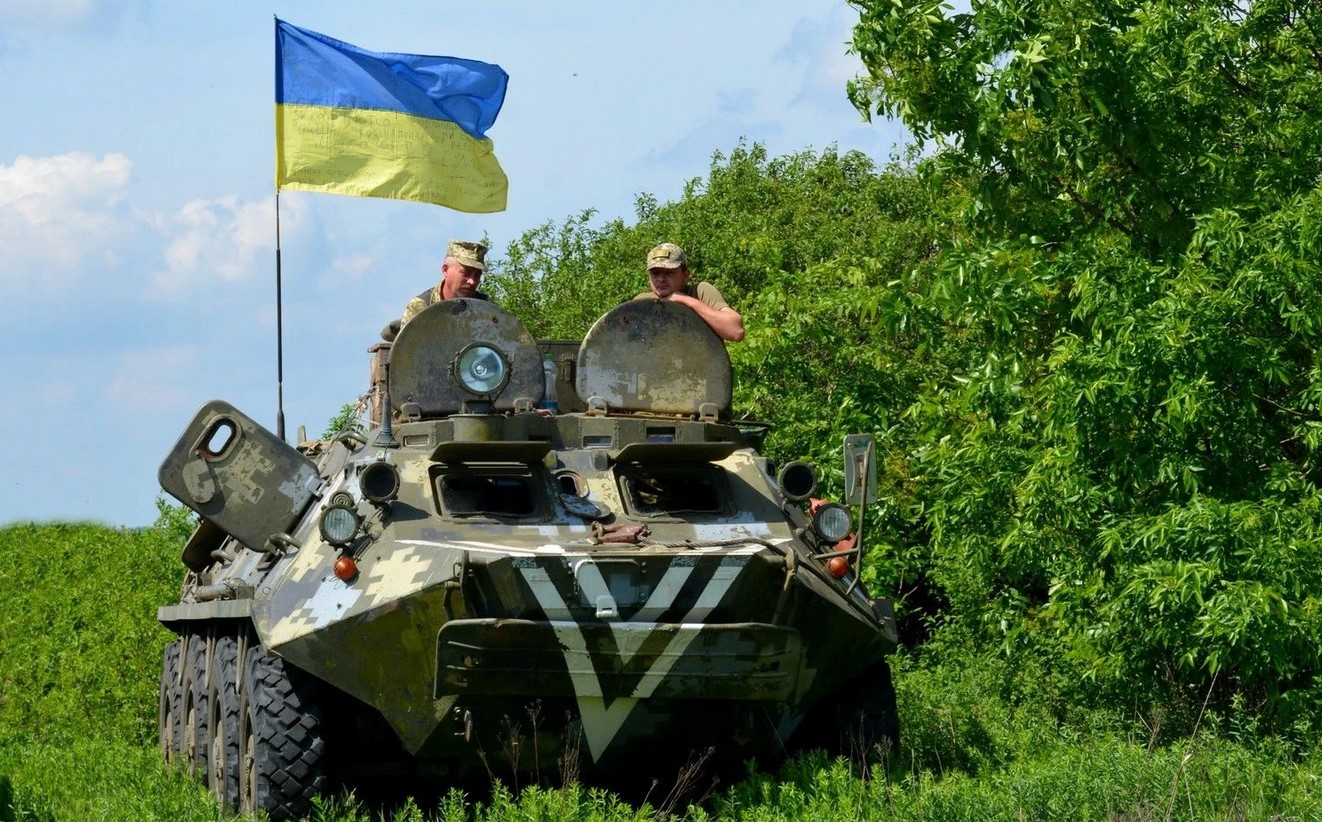
A BTR-60B. Source: Ukraine's Ministry of Defense.
Explore further

In Ukraine’s Vivaldi offensive, nobody rides in the BTR-60s. Bulgaria’s old troop carriers go into Russian bunkers packed with mines

Old thinking versus new

The planners of the failed 2023 counteroffensive were stuck in an old way of thinking about maneuver warfare. The planners of the successful 2026 counteroffensive shrugged off obsolete ideas. They thought smaller—and, ironically, achieved much more as a result.

The 3rd Army Corps couldn't, and didn't, do it alone. Indeed, the corps depended on the Ukrainian Unmanned Systems Forces to fray the Russians' supply lines, electronic warfare teams to jam Russian drones, and the Ukrainian air force to bomb Russian drone operators the EW teams couldn't suppress. By contrast, the Ukrainian forces attacking south from Mala Tokmachka in 2023 did so without much aerial support.

The aerial and electronic preparation was a prerequisite for each of the 3rd Army Corps' incremental advances this spring and summer. The lesson, the officers argue, is that "higher headquarters must degrade key enemy capabilities" before a smaller ground formation can expect to gain ground and keep it. If the support falters, the ground forces won't be able to hold.

Think small. Prepare hard. Now that the Ukrainians know this is how to win on the ground, can they repeat Operation Vivaldi's success?

There's some evidence they're already doing so in the southeast, where a clutch of Ukrainian air assault brigades has been pushing back the Russian 29th Combined Arms Army.

  •  

Accident de travail à Mont-Joli : un homme blessé

Un employé de la Ville de Mont-Joli a subi des blessures graves, le 6 octobre dernier, lors d’un accident de travail survenu sur un chantier de la Ville situé sur la rue Maisonneuve.

L’homme a dû être hospitalisé à la suite de l’événement. L’accident a eu lieu pendant des travaux d’excavation.

« La Ville a avisé la CNESST (Commission des normes, de l’équité, de la santé et de la sécurité du travail) et collabore pleinement avec elle afin que les faits puissent être établis. Dans ce contexte, nous ne commenterons pas davantage l’accident pour le moment. Nos pensées accompagnent notre collègue et ses proches », mentionne le directeur des communications et du service aux citoyens de la Ville de Mont-Joli, Pierre Fiola.

Selon nos informations, la victime aurait été percutée par une pelle mécanique, subissant ainsi des blessures graves ayant nécessité son transport par avion vers un hôpital de Québec.

  •  

Trump Squeezes Ukraine, Again

The president’s proposed fuel deal with Russia and a one-sided cease-fire plan are putting Kyiv in a tough spot as winter approaches.

© Genya Savilov/Agence France-Presse — Getty Images

The Russian strike on Pryluky, Ukraine, last week.
  •  

The Rise and Fall of Ambassador Kimberly Guilfoyle

President Trump cut her loose after damaging news reports about her tenure as ambassador to Greece. Once a prominent Trump insider, she suggested she will now fight to defend her reputation.

© Doug Mills/The New York Times

Kimberly Guilfoyle with President Trump at a White House event in March. In announcing her resignation, Ms. Guilfoyle decried what she called false accusations.
  •  

The Rise and Fall of Ambassador Kimberly Guilfoyle

President Trump cut her loose after damaging news reports about her tenure as ambassador to Greece. Once a prominent Trump insider, she suggested she will now fight to defend her reputation.

© Doug Mills/The New York Times

Kimberly Guilfoyle with President Trump at a White House event in March. In announcing her resignation, Ms. Guilfoyle decried what she called false accusations.
  •  

Arbitrage dans le sport : opération sensibilisation dans les écoles contre l'incivilité

Par : FRANCE24
Durant ce mois d'octobre, les Journées de l’arbitrage sont de retour en France pour une édition qui a pour thème : et si l’on faisait de l’arbitrage un levier d’éducation pour lutter contre les incivilités ? Objectif : sensibiliser le public, et notamment la jeunesse, à l’importance du rôle de l’arbitre. Parmi les ambassadeurs, l'arbitre international français de basketball Nicolas Maestre nous explique les difficultés du métier d'arbitre et la rencontre qu'il a pu faire avec Victor Wembanyama.

  •  

Russo-Ukrainian war, day 1693: Russian ballistic missiles hit Kyiv before air raid sirens, as fears grow that the US could cut launch warning data

Exclusives

“Now it’s your turn”: US envoys planned to show Moscow a refinery pause and a diesel deal, then ask for something back, a source tells Reuters. Ukraine’s part of that exchange was to stop striking Russia’s oil plants, a request Kushner repeated at the Miami meeting.

Military

Ukrainian scouts used a captured Russian soldier’s radio to gather intelligence for four days. Recon soldiers shared stories about their daily lives with ArmyInform.

No contact with command, a comrade maimed by a mine. A former TV director fought—and halted the Russians. He saved three soldiers in six months, ArmyInform says. One wounded comrade he could only hear on the radio.

Ukraine says it hit 12 Russian refineries in September. No refinery strikes reported since Trump’s “energy ceasefire”. Zelenskyy said Russia’s attacks on Ukrainian energy facilities continued after Trump’s announcement, while Moscow had yet to confirm a ceasefire.

The night Trump announced a diesel deal with Putin, drones knocked out more than half the tanks at a Russian fuel-export terminal. The Rostov-on-Don site, which loads oil products onto river and sea tankers, burned for two days and was still smoking on the third.

“We don’t need to hit the entire plant”—Ukraine’s drones go for refinery parts sanctions make hard to repair. Of 54 strikes The Washington Post examined, more than half appear to have damaged the units that start turning crude into fuel.

Intelligence and technology

Ukraine’s swimming robot can tow 10 tons, its maker says. Hook up a gun, and the shells ride aboard. It has already swum across the Desna River, its team says, and Ukraine’s Defense Ministry cleared it for use in 2025.

Russian ballistic missiles hit Kyiv before sirens, gap that lands hard amid fears that Washington could cut data that warns of launches. The alert came late because Ukrainian radar detected the missiles only during the attack, with no advance data on launches, the Air Force says.

Kinzhal is 90% identical to Iskander-M: Ukraine’s intelligence identifies 58 companies in production chain. Russia is developing a modified version of the Kinzhal missile, equipped with a warhead that strikes targets with fragments and a blast wave.

Built by Ukraine’s ex-defense minister and unit that wrecked $12 billion of Russian gear, new interceptor downs two jet drones over Kyiv. Mykhailo Fedorov and Lasar’s Group commander Pavlo Yelizarov developed the drone in a month, Fedorov says.

Russia is building satellite network that could put all of Europe in reach, defense executive warns. Oleksandr Danyliuk, head of the European defense-tech firm Destinus, called Russia’s Rassvet system an extraordinary threat, first to Ukraine and then to Europe.

International

Ukraine wins seat on UN Human Rights Council, vows to seek accountability for Russian abuses. Elected with 162 votes, Ukraine says it will focus on documenting violations, protecting prisoners of war and unlawfully detained civilians, and returning children taken by Russia.

Finland calls for EU tourist visa ban on Russians until Moscow ends war against Ukraine as bloc weighs tougher restrictions. As suspected Russian sabotage and other hybrid operations spread across Europe, EU officials are weighing tighter restrictions on Russian travel, diplomats, and former combatants to reduce security risks.

Germany works to organize a Coalition of the Willing meeting as Russia strikes Ukraine’s energy sector. Ukraine and Germany have also agreed to hold a meeting of national security advisers in the E3 format.

France seizes Russian shadow fleet tanker in Indian Ocean, vows to combat illicit oil trade “wherever it may be in the world”. The French Navy intercepted the DF Peak in the Indian Ocean over suspicions it was sailing under a false flag. Russia relies on shadow fleet tankers to keep oil revenues flowing despite Western sanctions.

Germany detains two Turkish nationals suspected of torching a Polish Starlink station that helps route internet to Ukraine. Polish radio reports that two more people who may be tied to the arson are in German custody.

Russia’s sabotage of Europe should bring Ukraine more weapons through US purchase scheme, with clear statement of where its red lines lie, NATO’s top European commander says. The PURL program lets allies fund US-made weapons for Ukraine and drew nearly $5.5 billion in pledges before May.

EU blacklists 1,569 Russian arms suppliers and their bosses in its biggest sanctions round ever, as Trump eases up on Moscow. Most of the listed firms feed the supply chain behind the ballistic missiles Russia fires at Ukrainian cities, and EU ministers vowed to keep up the pressure despite the US-Russia fuel arrangement.

Humanitarian and social impact

Russia used civilians as human shields, then shelled them near Kupiansk, Ukraine’s Khartiia says. Aerial reconnaissance footage recorded casualties among a group that included two women and a child, according to Khartiia. The Ukrainian corps says Russian media could use the incident to accuse Kyiv of attacking civilians.

Russian strike collapses a Kharkiv apartment stairwell and kills three, days after the US waived sanctions on Russia’s diesel. Rescuers dug through the night to reach the people buried in the four-story building, while the White House still wants Kyiv to stop striking Russian refineries.

Ukraine’s largest steelworks begins cold shutdown after extensive damage from Russian strikes, saying safe operation is impossible while war continues. The plant will spend two months shutting down safely before mothballing its industrial assets, with any restart dependent on conditions after the war.

Political and legal developments

Energy truce with strings attached: Kyiv reportedly told to spare Russian refineries or lose US intelligence and arms. EU loans ease Ukraine’s budget, yet satellite data, Patriot interceptors, and US-made weapons still hinge on Washington, giving US President Donald Trump room to squeeze Kyiv.

US continues sharing intelligence with Ukraine, Trump says amid Russia deal backlash. Questions remain over missed warning for latest attack. Ukraine received no advance warning before Russia launched five ballistic missiles and more than 100 drones, President Volodymyr Zelenskyy said, raising questions about how intelligence support was functioning.

Frozen assets, embargoes, entry bans: Ukraine names the pressure it wants the EU to put on Moscow. Kyiv says it is ready for energy, food-security, and full ceasefires—and that Moscow has to be forced to agree.

“Zelenskyy is helping Democrats”: Trump’s MAGA base accuses Ukraine of trying to swing US midterms, says journalist in US. The narrative runs across all levels of the US information space, from anonymous accounts to national television.

Bipartisan US senators say Trump’s Russian diesel deal conflicts with 2022 ban, as he presses Kyiv to spare Russian refineries. The administration says the deal will lower fuel prices, but lawmakers warn it could help finance Russia’s war against Ukraine.

For years, Hungary tied Ukraine’s whole EU course to ethnic Hungarians’ language rights. Kyiv has now passed the schooling law meant to lift the block. Hungary had blocked four stages of Ukraine’s membership process over the matter.

Zelenskyy says Ukraine could hold elections if Russia agrees to 60-day ceasefire. Moscow counters with truce lasting only voting day. Spokesperson Dmitry Peskov says Ukraine needs the 60 days not to hold elections but to heal its wounds and keep fighting.

Read our previous daily review here.

  •  

Miami Tugboat Captain Gets 18 Months in Crash That Killed 3 Children

Five girls and a camp counselor were thrown into the water off Miami Beach in July last year when a barge pushed by a tugboat struck their stalled sailboat.

© WSVN-TV, via Associated Press

Emergency workers responding to the Miami Yacht Club after the barge collided with the sailboat in July 2025.
  •  

RDC : l’ancien président Joseph Kabila prend la tête du Front pour la refondation de la nation (FRN)

Dans l'est de la République démocratique du Congo, Joseph Kabila prend la tête d'un nouveau mouvement politico-militaire : le Front pour la Refondation de la Nation (FRN). Cette nouvelle plateforme englobe désormais l’AFC/M23, mouvement rebelle qui a conquis de vastes pans de territoire dans l’est du pays.

  •  

Former NFL star Mark Sanchez reaches settlement over stabbing altercation

  • Former QB fought with 69-year-old last October

  • Fox Sports parted ways with Sanchez over incident

  • Sanchez was charged over Indianapolis confrontation


Former NFL quarterback and Fox Sports analyst Mark Sanchez has reached an agreement in principle with the truck driver who stabbed him during an altercation last October, according to the Athletic.

Sanchez was stabbed and pepper sprayed by Perry Tole, who was 69 at the time, during the incident in Indianapolis, where the former New York Jets star was due to cover an NFL game between the Colts and Las Vegas Raiders. Prosecutors said Tole used pepper spray and a knife to defend himself ​after Sanchez attempted to enter ‌his truck during an argument over a parking spot.

Continue reading...

© Photograph: Brooke Sutton/Getty Images

© Photograph: Brooke Sutton/Getty Images

© Photograph: Brooke Sutton/Getty Images

  •  

Ukrainian scouts used a captured Russian soldier’s radio to gather intelligence for four days

Ukrainian reconnaissance troops of the 23rd Separate Reconnaissance Battalion, 2026. Photo: ArmyInform

Ukrainian reconnaissance troops used a captured Russian soldier’s radio for four days to listen to Russian military communications and relay important intelligence to their command, according to a report by ArmyInform, which covered the episode. The soldiers serve in the 23rd Separate Reconnaissance Battalion, which operates in the Oleksandrivka sector, the report noted.

Russia uses infiltration tactics involving small groups to slip through Ukrainian positions undetected, establish themselves into the rear of Ukrainian positionse, and create conditions for the further advance of its main forces. They are countered not only by reconnaissance drones but also by specialized reconnaissance teams, which sometimes cover several dozen kilometers on foot to reach their designated targets.

Ukrainian scouts capture Russian soldier in the grey zone

Ukrainian reconnaissance troops captured a Russian soldier in the grey zone as he was trying to enter a neighboring house, the report said.

“He took off his body armour and set his rifle aside. He felt right at home. Our commander went over and offered him a chance to surrender, and he agreed. He then stayed with us for four days. He told us everything he knew,” a soldier with the call sign Kubik said in the report.

The soldiers’ hideout was later discovered. Fleeing a Ukrainian drone, a Russian infantryman ran into the building where the reconnaissance troops were staying. The position was subsequently attacked by FPV drones, followed by an artillery barrage.

Reconnaissance soldier with the call sign “Kubik” of the 23rd Separate Reconnaissance Battalion, 2026. Photo: ArmyInform

One Ukrainian soldier sustained a minor injury, but the group managed to withdraw without suffering serious losses.

Reconnaissance soldier Kubik spent 23 days on a combat mission

For reconnaissance troops, the journey to their positions and the return trip remain perhaps the most dangerous parts of a mission. During his year of service, Kubik has completed five combat missions, one of which lasted 23 days, according to the report.

During their most recent mission, the soldiers covered 20 kilometers on foot in one direction, moving mostly through tree lines, Kubik said. He added that they had to run across open areas and destroy enemy drones lying in wait before quickly retreating to cover.

Because of the constant threat from the air, the length of time reconnaissance troops can remain at their positions depends on the weather and the situation, the report noted. Sometimes, staying in place longer is safer than risking exposure while a team is being replaced.

Dzhus’s first mission: 20-year-old reconnaissance soldier chooses infantry

Twenty-year-old Mykyta, whose call sign is Dzhus, is preparing for his first combat mission as part of the 23rd Separate Reconnaissance Battalion, the report said. He joined the military under the “18–24 Contract” program after leaving the police force.

“Many people who join under the ‘18–24’ contract go into UAV operations, but I’m more interested in infantry work. We have many experienced reconnaissance soldiers, and the guys are constantly giving advice and sharing their experience,” Dzhus said.

Reconnaissance soldier with the call sign “Dzhus” of the 23rd Separate Reconnaissance Battalion, 2026. Photo: ArmyInform

He is heading out on the mission under the guidance of an experienced commander, he said. The soldiers prepare thoroughly for every mission, practicing at the training ground and rehearsing procedures tailored to the specific task, the media outlet noted.

Russian troops seek new hiding places for infiltration along the front

Russian forces continue to use small-group infiltration tactics. For example, the Russian army is likely increasing its infiltration efforts in Kharkiv Oblast, taking advantage of the remaining summer foliage for concealment, the Institute for the Study of War reported on 9 October. In particular, Russian forces are seeking to infiltrate the city of Kupiansk in small groups, according to an RBC-Ukraine report published on 7 October.

Similar incidents have also been reported in Donetsk Oblast. Russian troops are attempting to infiltrate the gaps between Ukrainian observation posts in small groups and establish positions there, Artem Prybilnov, spokesperson for the 155th Separate Mechanized Brigade, said during a broadcast on Suspilne.Studio on 7 October, NV reported. Their aim is to build up forces for a further advance toward Dobropillia. Ukrainian infantry, working alongside drone operators, is repelling the ongoing Russian attacks and preventing them from achieving this goal, Prybilnov added.

As autumn sets in and vegetation becomes thinner, Russian troops find it increasingly difficult to conceal themselves in tree lines, Prybilnov noted. During the summer, they used these areas for cover and to accumulate personnel, ammunition, and equipment, the spokesperson said. Russian forces are now attempting to infiltrate villages, where they can hide in buildings and basements and establish positions, he added.

  •  
❌