❌

Vue lecture

A fourth Ukrainian pharmaceutical warehouse has burned in a Russian strike since the start of the month

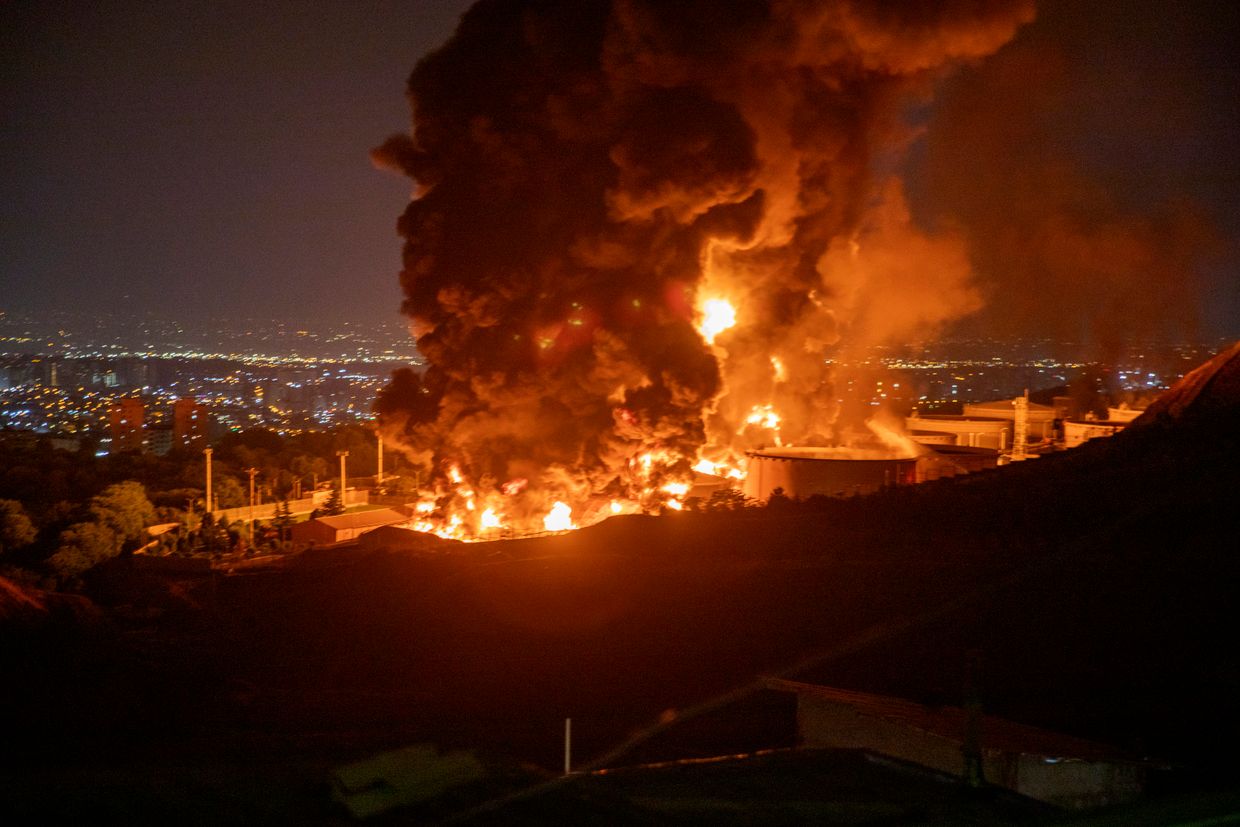
fourth ukrainian pharmaceutical warehouse has burned russian strike since start month · post fire damage medicine distributor badm after odesa ukraine 14 2026 росіяни зруйнували вже четвертий склад ліків за

Russia struck a fourth Ukrainian pharmaceutical warehouse in two weeks on 14 September, setting fire to the Odesa depot of medicine distributor BaDM, Ekonomichna Pravda reported. Russian forces hit it during an attack they ran across the country through the night. 

Russia fights a ground war on the front and bombs the country behind it with drones, cruise and ballistic missiles, and glide bombs, and in recent months it has aimed much of that at the civilian supply system, taking out the depots of retailers and carriers along with the rail that moves them. Burning stored goods does not move the front line, but it changes how a country at war feeds, supplies, and treats itself.

The fourth depot, and what Russia did to it

The BaDM complex stands on the edge of Odesa. The strike started a fire on the grounds, and the State Emergency Service worked at the site. It left significant damage to the storage buildings.

Preliminarily, nobody was hurt, sources on the pharmaceutical market told Ekonomichna Pravda. BaDM is one of the biggest wholesalers moving medicines to Ukrainian pharmacies.

The three depots Russia hit before it

  • Russia opened the run on 3 September, when it damaged the Biokon logistics complex in Boryspil raion, Kyiv Oblast. That site counts as the country's largest specialized pharmaceutical warehouse.
  • Overnight on 8 September, Russian forces attacked the Kyiv warehouse of Optima-Pharm with two ballistic missiles. They had already destroyed that site, which belongs to one of the largest distributors, in 2025.
  • On 13 September, Russian forces struck Universal Logistic, the second-largest medicine warehouse in Ukraine. Four specialized sites in two weeks is a pattern, and Russia now hits medicine storage as it has hit food, construction materials, and parcels.
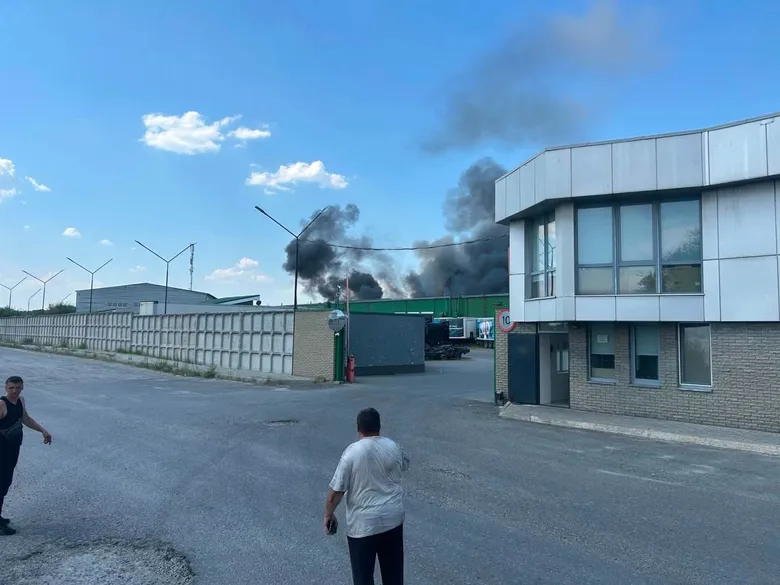
Dnipro WHO Humanitarian Warehouse,
Explore further

WHO humanitarian warehouse in Dnipro destroyed in strike, Director-General says

The attack the Odesa strike came in

Russia launched 108 strike drones from 18:00 on 13 September, Ukraine's Air Force said. The wave carried Shahed-type drones, among them jet-powered ones, Gerbera drones, and Parodiya decoys. Air defense downed or suppressed 85 of them by 08:00. Ukrainian forces recorded hits at seven locations, and the Air Force said the attack was still running when it published that count.

Medicine is not the only category on Russia's list. Its strikes have wrecked so much large-format storage that Ukrainian retailers are now building small sites everywhere instead of a few big ones. In August, a strike destroyed a World Health Organization humanitarian warehouse in Dnipro, which held medical supplies for frontline facilities, and the WHO did not name who fired it.
  •  

Ukraine says drones hit Russia’s gas heartland over 3,000 km from its border—a wartime record

A tall flame rises above an industrial facility in Novy Urengoy at night.

Ukraine's Special Operations Forces (SSO) said the 9 September operation struck the Purovsky and Novy Urengoy gas processing plants in the Yamalo-Nenets Autonomous Okrug.

Kyiv's earlier energy campaign concentrated on oil refineries and export hubs in western Russia. The new operation shifts the target set toward Siberian gas processing and challenges the protection once provided by distance, although its effect on production remains unknown. The SSO said drones operated by its Deep Strike units traveled more than 3,000 kilometers, making the operation Ukraine's deepest strike of the war.

Both the Purovsky and Novy Urengoy plants feed Russia's fuel and petrochemical industries. Ukraine's broader deep-strike campaign aims to cut the revenue and supplies sustaining Moscow's war.

Fire Point, the Ukrainian manufacturer of the FP-1, identified the drones as FP-1s and put the distance to the Novy Urengoy plant at more than 3,200 kilometers. The company reported a hit on the plant grounds but did not describe the damage.

Russian authorities have not confirmed the full Ukrainian account. Yamalo-Nenets Governor Dmitry Artyukhov said Russian forces had repelled the attack, according to The Times. Falling drone debris nevertheless caused a fire at an industrial facility in Novy Urengoy, he said.

Artyukhov reported no injuries but did not identify the facility. Russian officials have not acknowledged any strike on Purovsky.

Ukraine says drones hit two Siberian gas plants over 3,000 km from its border in Novy Urengoy, Russia, 9 September 2026. Map: Euromaidan Press

Fire Point put the Novy Urengoy plant's annual design capacity at up to 19.5 million metric tons of raw material.

CyberBoroshno, a Ukrainian group that analyzes public imagery and data, said the strike hit a gas-processing unit at Gazprom Processing's Urengoy plant. Dnipro OSINT shared the analysis.

Gas condensate is a liquid produced alongside natural gas. The reported target separates ethane-rich gases from it. Those gases can be used to make polyethylene, a common plastic. CyberBoroshno said damage to the unit could disrupt supplies to a nearby chemical plant. Neither its identification of the unit nor the extent of the damage has been independently verified.

At Purovsky, the SSO reported damage but did not identify the equipment hit. Owned by Russian gas producer Novatek, the plant processes condensate into fuels and raw materials for the petrochemical industry. It processed 13.4 million metric tons in 2025, according to the SSO.

The effect on production at either plant remains unknown, as does whether any damage will be lasting.

The wider campaign

Ukraine's deep-strike units repeatedly struck Novatek's Ust-Luga gas-condensate complex on the Baltic Sea. Ukraine says drones hit two Siberian gas plants over 3,000 km from its border earlier in 2026. The facility processes stabilized gas condensate and has a design capacity of over 6 million metric tons a year, according to the General Staff.

A 31 March attack briefly halted port operations, while the 14 August strike was the sixth attack on the port that year. Ukraine has not disclosed how much production those attacks disrupted.

  •  

Romania trailed a Russian agent for seven months—then revealed what he was filming

SRI - Serviciu Român de Informații, Romanian intelligence institution

Romania's domestic intelligence service says it prevented a Russia-coordinated sabotage operation on its soil, Militarnyi and Radio Svoboda reported. For months, it watched a Russian citizen who was filming military sites across the country—including, it says, Ukraine's Antonov cargo planes.

A wave of arson, drone incursions, and covert surveillance blamed on Russian handlers has spread across the continent, aimed at the logistics that keep Ukraine armed.

What the suspect was told to film

The Romanian Intelligence Service (SRI) announced on Tuesday that it had prevented the plot with national and international partners. The man had been under SRI monitoring since February 2026, part of a wider investigation into sabotage attempts on Romanian soil.

An intermediary instructed him to make photos and videos of targets of strategic military interest, SRI said. The list ran from NATO-used bases and communications nodes to defense institutions, critical infrastructure, and Ukraine's Antonov cargo planes.

SRI says the pattern matches saboteur networks run by Russian entities across Europe. It points to similar cases foiled in Romania in 2024 and 2025. The service added that Russia keeps leaning on people from vulnerable groups to carry out this work.

The Leipzig link

The case recalls an incident in Germany. On 4 August, workers found a drone rigged with explosives and a detonator beside an An-124 Ruslan at Leipzig airport. The Ruslan is a giant Antonov cargo plane. Ukraine's Antonov fleet moves oversized loads few other planes can carry, a standing target for a Kremlin trying to slow Western support without firing a shot.

Germany's government blamed Russia, and the attempt sharpened tensions between Berlin and Moscow. Russia denies any role in Europe's sabotage wave and has not addressed Romania's findings.

The disclosure comes days after Russian Shahed attack drones struck the Orlivka ferry crossing in Odesa Oblast, overnight on 1 September. The crossing sits on the Ukrainian-Romanian border.

  •  

“Now on the 1,657th day”: Ukraine’s crews restored power to over 900,000 homes last week as Russia keeps striking grid before winter

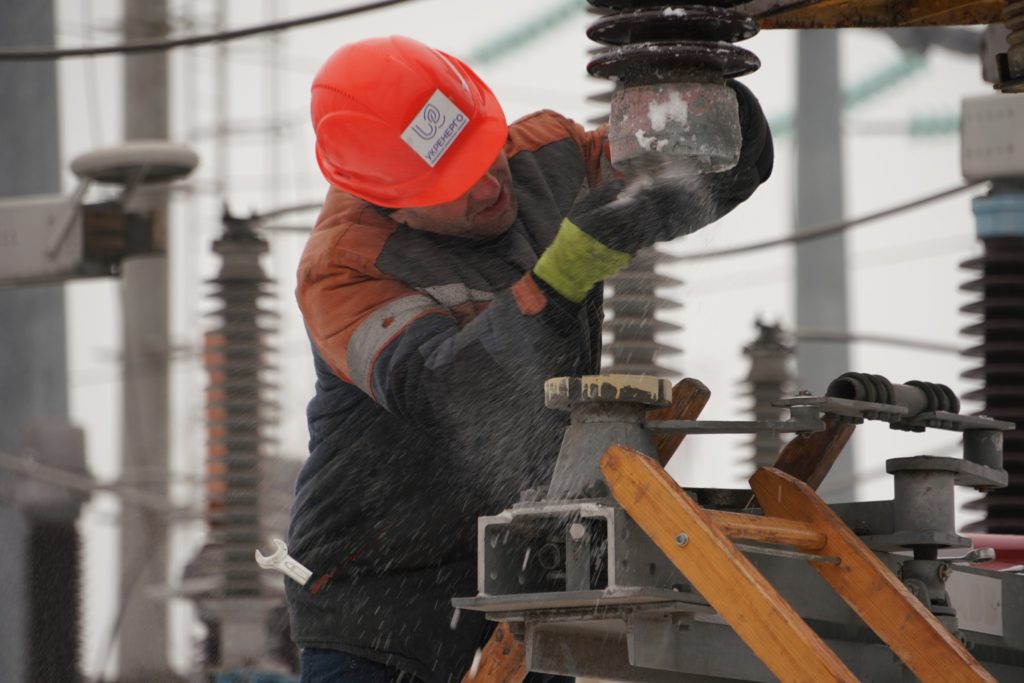
Ukraine's energy workers

Russian strikes cut power to nearly a million Ukrainian families across four oblasts last week. Ukraine's largest private energy company, DTEK, brought it back, fully or partly restoring electricity to 596 settlements in Donetsk, Odesa, Dnipropetrovsk, and Kyiv oblasts between 31 August and 6 September, the company said.

Russia is hammering Ukraine's power grid again as the cold season nears, and the country's winter-resilience plans were less than half complete at the start of September.

Odesa and Donetsk absorb the worst

Most of the week's work was in Odesa Oblast, which Russia has been striking without pause. Ukrainian crews there returned power to more than 366,000 families, DTEK said.

Much of that damage followed a massed missile-and-drone strike on the region's main energy facilities on 2 September, after which national operator Ukrenergo imposed temporary grid limits to keep damaged equipment from overloading.

Donetsk Oblast came close behind, with power restored to nearly 360,000 homes despite what the company called an extremely difficult situation for its repair teams. In Dnipropetrovsk Oblast, crews reconnected almost 172,000 homes, and in Kyiv Oblast nearly 9,000 more.

Strikes keep cutting the grid

The reconnections are happening under continued fire. Russia keeps attacking energy sites in Odesa and Dnipropetrovsk oblasts, damaging lines faster than they can be fully secured. DTEK crews can only begin repairs once the military and emergency services have cleared access to the damaged equipment.

"Russia keeps attacking our energy system. Despite everything, we keep working and restoring power — now on the 1,657th day," said Alina Bondarenko, chief executive of DTEK Grids.

Winter sharpens the threat

The timing is the danger. Ukraine has until the heating season to shore up a grid that Russia has spent the war trying to break.

This year's attacks have again concentrated on the energy system as temperatures start to fall.

  •  

Ukrainian drones took Ryazan’s blending unit after knocking out two of its four crude units

ukrainian drones took ryazan's blending unit after knocking out two its four crude units · post black smoke rising over ryazan oil refinery drone strike russia 6 2026 пожежа на

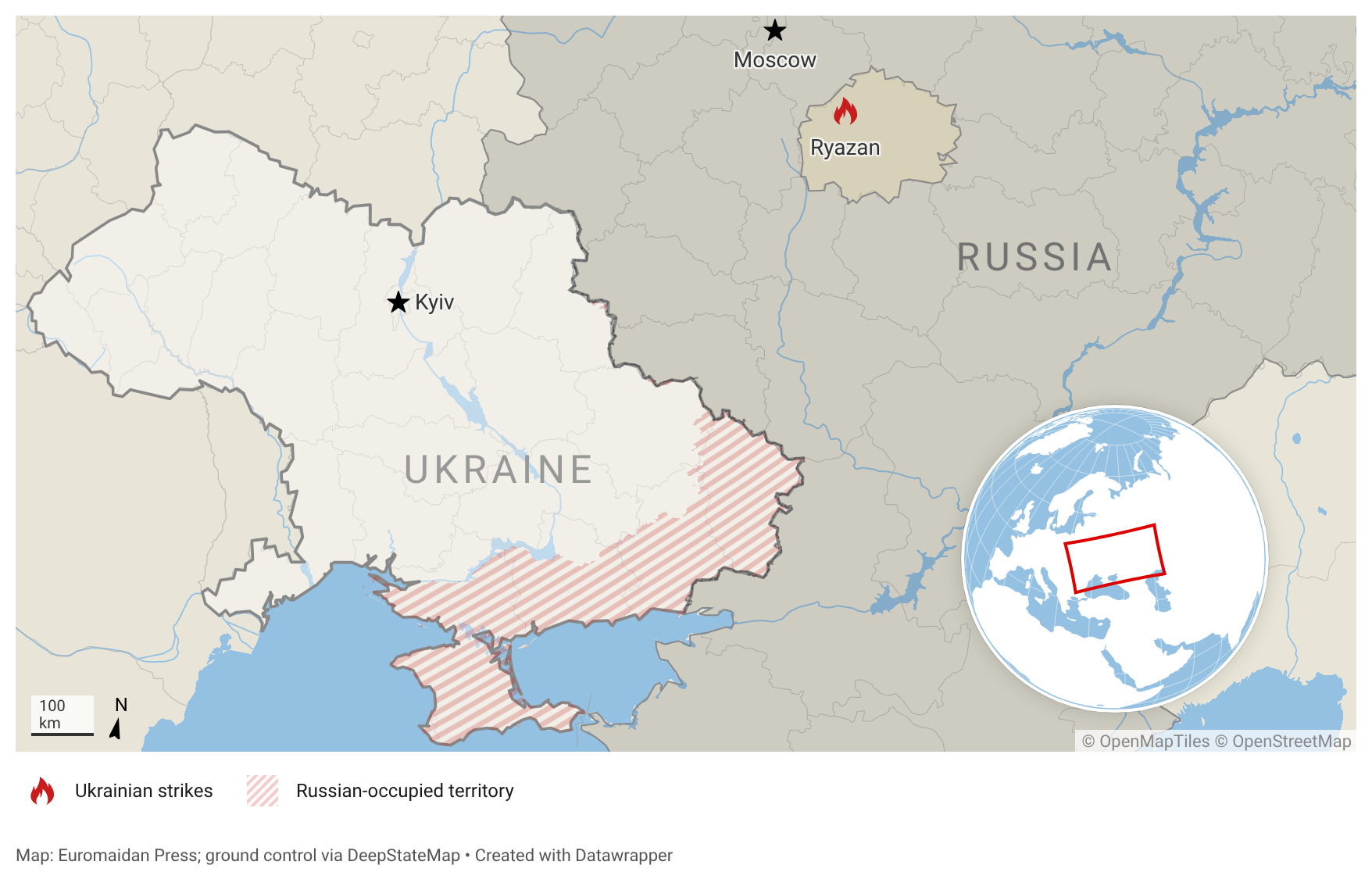
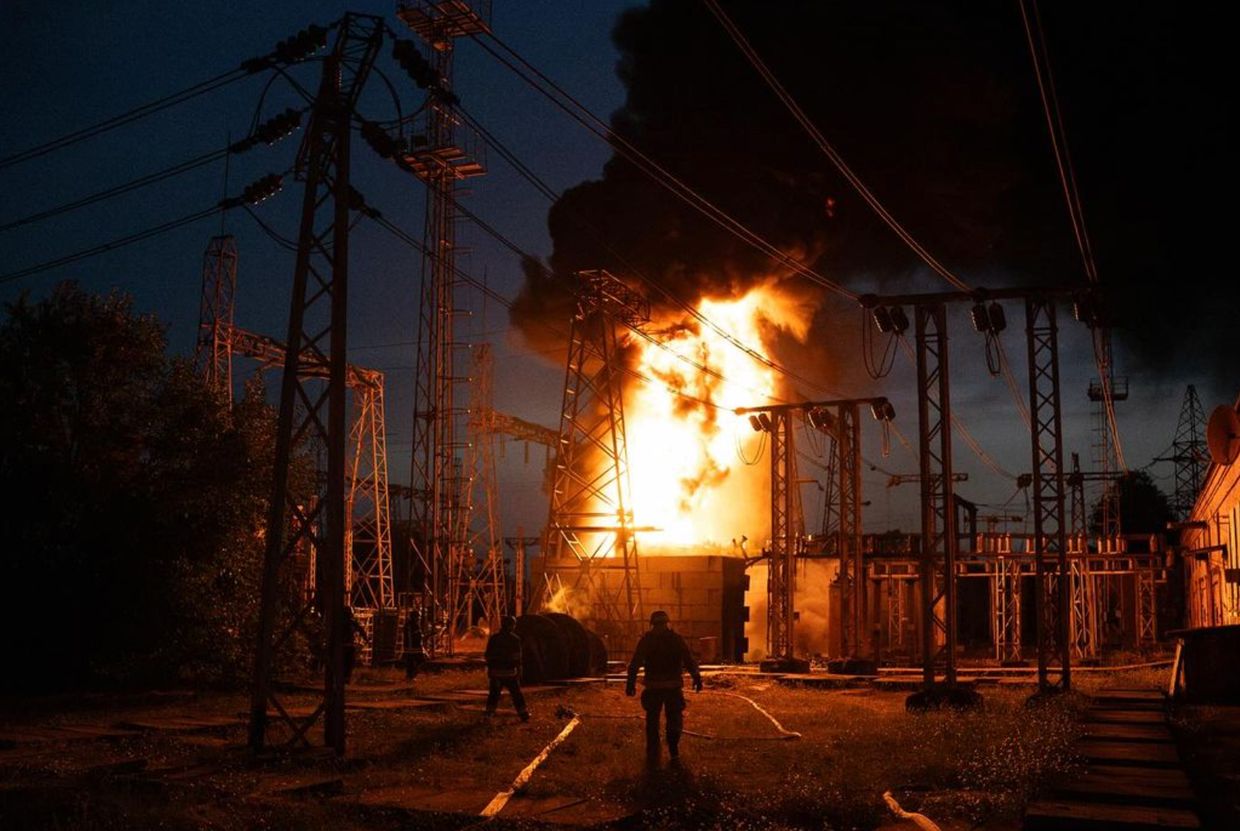
Ukrainian drones struck the Ryazan oil refinery in Russia on the morning of 6 September and set one of its core units on fire, Ukrainian defense outlet Militarnyi reported. The unit produces the high-octane component the Rosneft plant needs for its higher grades of gasoline. Russian regional authorities acknowledged a fire without naming the site. Ryazan is situated southeast of Moscow, about 470 km from Ukraine.

Ukraine has spent this year pushing long-range drones deeper into Russia, working methodically through refineries, pipelines, and export terminals to cut the fuel that moves Russian armies and the oil income that pays for the war. The pressure now runs deep past Russia's borders, with the shortage reaching Central Asian markets.

What burned at Ryazan

Drones hit the low-temperature isomerization unit for pentane-hexane fractions, designated Izomalk-2-LIN-800, according to Militarnyi's analysis. The unit sits on the refinery's grounds and is one of the critically important links in the plant's production cycle.

It converts low-octane straight-run oil fractions into a cleaner high-octane blending component. That component is what allows the refinery to produce gasolines of the higher environmental classes, Euro-5 among them, without adding harmful additives. 

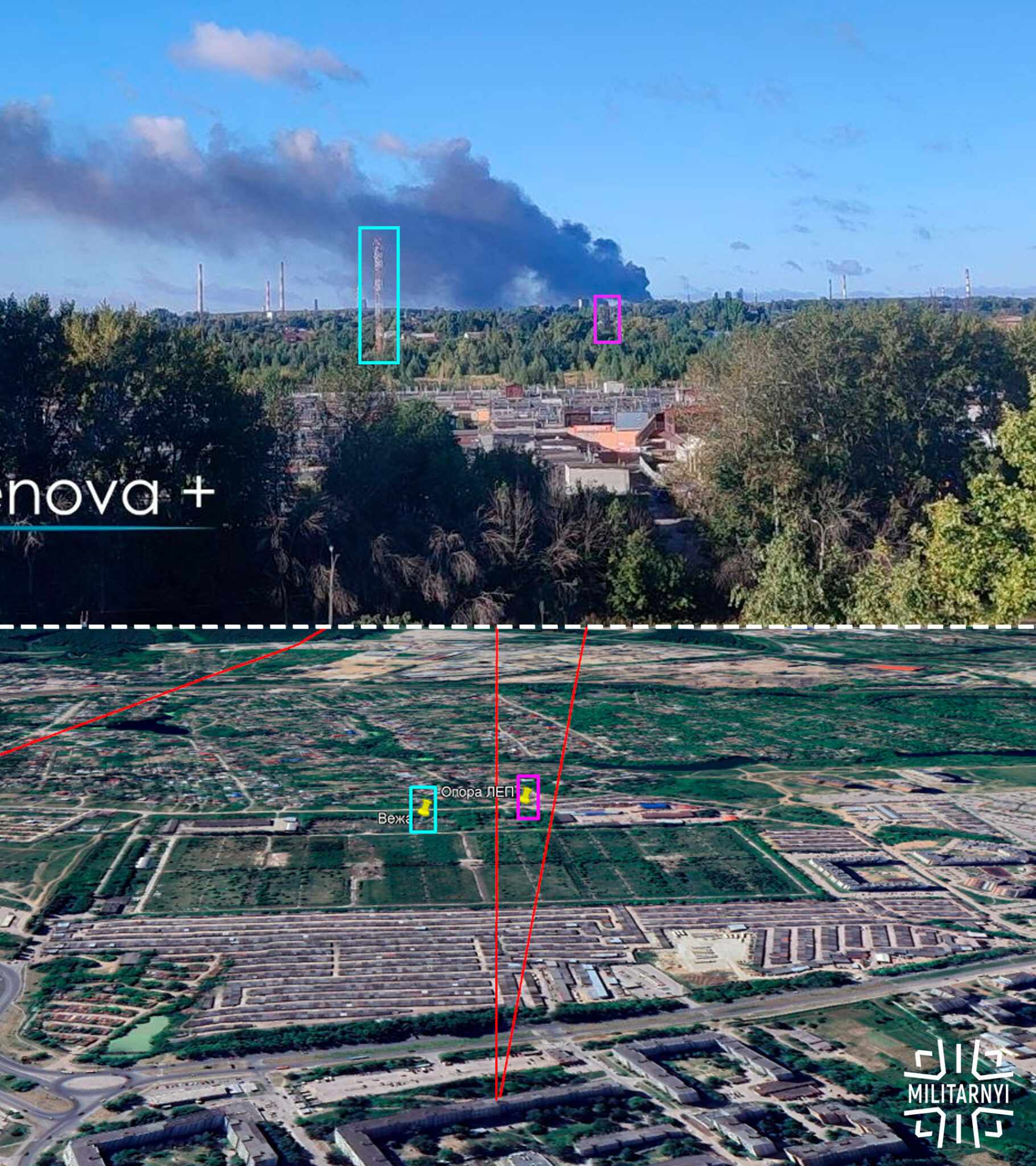
ukrainian drones took ryazan's blending unit after knocking out two its four crude units · post geolocation fire ryazan oil refinery drone strike russia 6 2026 sss ukraine news reports
Geolocation of the fire at the Ryazan oil refinery after a Ukrainian drone strike, Ryazan, Russia, 6 September 2026. Graphic: Militarnyi, imagery: ESRI
The refinery belongs to Rosneft and ranks among Russia's largest refining enterprises, with a capacity of about 17 million tons of crude a year. It makes motor gasolines of all grades, diesel, aviation kerosene, fuel oil, liquefied gases, bitumen, and petrochemical feedstock. Four crude distillation units sit on the site, along with equipment for vacuum gasoil hydrotreating, cracking, and catalytic reforming.

Ukrainian monitoring channel Exilenova+ published videos of the strike.

Ryzan Oil refinery pic.twitter.com/VcPfnSGgi4

— Exilenova+ (@Exilenova_plus) September 6, 2026

The same unit was hit in December

Drones already attacked this unit in December 2025 and damaged it. Earlier waves targeted the plant's ELOU-AVT-3, ELOU-AVT-6, and AVT-1 units.

By May 2026 the refinery had lost 90–100% of its refining capacity. Satellite imagery from 3 August 2026 showed Ukraine's Defense Forces had disabled two of the four crude distillation units on site.

Ukrainian drones struck the refinery in May, and FP-1 drones set it and a nearby warehouse burning in July.

Russian officials report a fire, not a target

Ryazan Oblast governor Pavel Malkov confirmed the region came under drone attack. Drone debris damaged residential buildings in Ryazan and Sapozhkovsky district, he stated, and a fire broke out at an enterprise he did not name. He said there were no casualties and that emergency services were working.

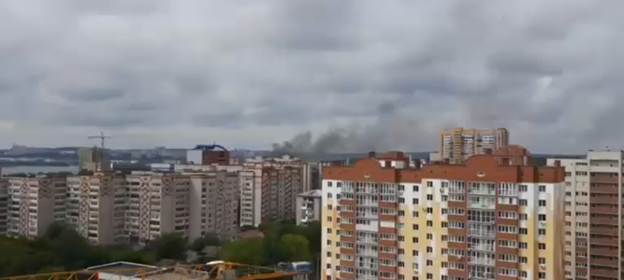
Russian news Telegram channel Astra said its analysis of photographs taken by residents established that the fire was on the grounds of the Ryazan refinery. Ukrainian channel Exilenova+, which tracks such attacks, also reported a hit on the plant.

Ryazan, locals report oil refinery is on fire after attack pic.twitter.com/0Dqhjo5FNI

— Exilenova+ (@Exilenova_plus) September 6, 2026

Russia's fuel squeeze

Ukraine's General Staff said strikes on 26 August and 1 September fully stopped two large refining enterprises: Lukoil-Nizhegorodnefteorgsintez in Kstovo, Nizhny Novgorod Oblast, and the Novatek-Ust-Luga complex in Leningrad Oblast. Both supply the Russian army.

Short of gasoline, Russia has been buying more fuel abroad. Moscow discussed importing gasoline from Kazakhstan in June, and a Kazakh refinery deal would cover 0.3% of Russian demand. Belarus increased its gasoline supplies to Russia nearly 20-fold in the first half of the year.

  •  

Ukraine's power exports surge 2.5 times, recovering to pre-Russian attack levels

Ukraine's power exports surge 2.5 times, recovering to pre-Russian attack levels

Ukraine boosted electricity exports by 150% in June 2025 compared to the previous month, reaching over 237,000 megawatt-hours (MWh), according to consulting firm ExPro Electricity.

Current export volumes have returned to autumn 2022 levels, before Russia launched systematic attacks against Ukraine's energy infrastructure that caused massive blackouts across the country.

This marks Ukraine's return to exporting more electricity than it imports for the first time since October 2023, ExPro analysis reports.

Electricity cannot be stored in large volumes for long periods, so it can be exported during certain hours when there is surplus in Ukraine’s energy system, and imported during deficit hours.

Hungary imported the majority of Ukrainian exports, with shipments jumping from 34,000 to 122,000 MWh in a single month.

The recovery represents a dramatic turnaround from June 2024, when Ukraine had no exports at all and imported 858,000 MWh, four times more than in June 2025.

Russia continues to target Ukraine's energy infrastructure, with the latest strike hitting a critical energy facility in Kherson Oblast on June 27 that caused widespread blackouts across multiple communities.

Governor Oleksandr Prokudin warned residents to prepare for prolonged outages as power engineers work to restore electricity, saying "Russia decided to plunge Kherson Oblast into darkness."

In February 2025, Emergency energy power shutdowns were introduced in eight Ukrainian oblasts due to Russian attacks on the country's energy system.

‘With surgical precision’ — Ukrainian drones strike Russian plant 1,300 km away, SBU source says
The SBU said its long-range drones targeted the Kupol plant in Russia’s Udmurt Republic on the morning of July 1, resulting in at least two confirmed strikes and a fire at the site.
Ukraine's power exports surge 2.5 times, recovering to pre-Russian attack levelsThe Kyiv IndependentAnna Fratsyvir
Ukraine's power exports surge 2.5 times, recovering to pre-Russian attack levels
  •  

Russian attack on key energy facility plunges parts of southern Ukraine 'into darkness,' governor says

Russian attack on key energy facility plunges parts of southern Ukraine 'into darkness,' governor says

Russian forces struck a critical energy facility in Kherson Oblast, causing widespread power outages across several communities, Governor Oleksandr Prokudin said on June 27.

"Russia decided to plunge Kherson Oblast into darkness," Prokudin wrote on Telegram. He said the attack has disrupted electricity supply to multiple settlements.

Local power engineers are working to stabilize the situation, Prokudin said.

"I ask the residents of the region to prepare for a prolonged power outage. Power engineers are doing everything possible to stabilize the situation," he said.

Kherson and the surrounding regions have frequently come under Russian fire since Ukrainian forces liberated the city from occupation in November 2022. Russian troops continue to attack the area with artillery and drones from across the Dnipro River.

The Russian army consistently targeted Ukrainian energy infrastructure. Throughout 2024, Moscow launched 13 mass attacks with drones and missiles on Ukraine's energy infrastructure. Ukraine was forced to introduce emergency blackouts across the country.

Ukraine and Russia agreed to a partial 30-day energy truce, following consultations with the U.S. in Riyadh on March 25. Moscow violated the ceasefire more than 30 times, Foreign Ministry Spokesperson Heorhii Tykhyi said on April 16.

Russia pulls its scientists out of Iranian nuclear plant, as Israeli strikes threaten decades of collaboration
Israel’s strikes on Iranian nuclear facilities have alarmed none more than Russia, the country that first brought nuclear power to Iran in defiance of Western objections. We’re “millimeters from catastrophe,” said Kremlin spokeswoman Maria Zakharova on June 18 in response to a bombing campaign that Israel launched against Iran on June 13. Decades of conflict with the West have united Iran and Russia, despite a cultural gulf between the two nations that dwarfs the Caspian Sea that physically di
Russian attack on key energy facility plunges parts of southern Ukraine 'into darkness,' governor saysThe Kyiv IndependentKollen Post
Russian attack on key energy facility plunges parts of southern Ukraine 'into darkness,' governor says
  •  

Ukraine state grid operator appoints CEO after 10-month vacancy, Ukrainian media report

Ukraine state grid operator appoints CEO after 10-month vacancy, Ukrainian media report

Ukrainian state grid operator Ukrenergo's supervisory board has appointed Vitaliy Zaichenko, the company's current chief dispatcher, as its new head, Ukrainian media reported on June 23.

The appointment comes after ten months of interim leadership following the controversial dismissal of former CEO Volodymyr Kudrytskyi in September 2024.

The company has been under temporary management of Oleksiy Brekht while the supervisory board struggled with prolonged disputes over the selection process.

Ukrenergo, which operates Ukraine's electricity transmission system and is a member of the European electricity grid network (ENTSO-E), plays a critical role in the country's energy security, especially during wartime when Russian attacks have repeatedly targeted energy infrastructure.

Zaichenko beat out two other finalists: Oleksiy Brekht, the interim head of Ukrenergo, and Ivan Yuryk, former acting head of Ukrainian Railways.

The supervisory board's June 4 attempt to elect a new CEO failed amid conflict with the Energy Ministry, which changed appointment rules without consulting the Energy Community Secretariat, drawing criticism from European partners.

The new rules complicated the selection process by requiring five out of seven supervisory board votes instead of the previous four needed to elect a chairman.

According to Ukrainian MP Max Khlapuk, the European Bank for Reconstruction and Development (EBRD) threatened to block 141 million euros ($152 million) in funding and demand early repayment of 533 million euros ($574 million) already received over the rule changes.

Former Ukrenergo CEO Volodymyr Kudrytskyi was dismissed on Sept.2, 2024, after President Volodymyr Zelensky called for his resignation over alleged failures to protect substations from Russian missiles and drones.

Kudrytskyi disputed this account, saying he initiated the supervisory board meeting himself, though he did not reveal the reasons for his dismissal.

Following Kudrytskyi's dismissal, supervisory board chairman Daniel Dobbeni and member Peder Andersen resigned early, citing political pressure in personnel decisions.

Ukrainian energy giant to build $115 million solar program with British partner
Ukraine’s largest private energy company DTEK and British clean energy group Octopus Energy have launched a program to install rooftop solar panels and battery storage systems at Ukrainian businesses and public institutions, DTEK announced in a press release on June 23.
Ukraine state grid operator appoints CEO after 10-month vacancy, Ukrainian media reportThe Kyiv IndependentYana Prots
Ukraine state grid operator appoints CEO after 10-month vacancy, Ukrainian media report

  •  

Ukrainian energy giant to build $115 million solar program with British partner

Ukrainian energy giant to build $115 million solar program with British partner

Ukraine's largest private energy company DTEK and British clean energy group Octopus Energy have launched a program to install rooftop solar panels and battery storage systems at Ukrainian businesses and public institutions, DTEK said in a press release on June 23.

The program, called RISE (Resilient Independent Solar Energy), was announced at Octopus Energy's Tech Summit in London and aims to raise 100 million euros ($115 million) to finance 100 energy projects over three years, helping stabilize the grid, lower electricity costs and protect customers from outages, the company said.

DTEK’s facilities have been repeatedly targeted since the start of Russia’s full-scale invasion as Moscow sought to cripple Ukraine's energy infrastructure. The company was forced to shut down its gas production facilities in Poltava Oblast in March.

"About 70% of Ukraine's thermal generation capacity has been damaged, destroyed or seized since the full-scale invasion," said DTEK CEO Maksym Timchenko in the press release.

“This has created not only an urgent need to rebuild but also an opportunity to accelerate the shift to a decentralized, renewable energy system,” he added.

The alternative energy systems will be installed by D.Solutions, DTEK's business unit operating under the Yasno retail brand.

Installed equipment will run on Octopus Energy's AI-powered Kraken operating system, enabling businesses to optimize energy use in real time, reduce consumption during peak hours and sell surplus electricity back to the grid.

"They (DTEK) are rebuilding at pace and pioneering a decentralized, smart energy system powered by homegrown renewables," said Greg Jackson, Octopus Energy Group founder and CEO.

According to DTEK, Ukraine's commercial and industrial energy market has an untapped potential of 300 megawatts annually, valued at 200 million euros ($229 million). DTEK's Yasno brand serves over 60,000 business customers and can generate projects worth 30 million euros per year.

DTEK previously announced plans to build one of Europe's largest energy storage facilities with six installations across the country, totaling 200 megawatts to power 600,000 households. The company secured a $72 million loan from three Ukrainian banks.

Russia pulls its scientists out of Iranian nuclear plant, as Israeli strikes threaten decades of collaboration
Israel’s strikes on Iranian nuclear facilities have alarmed none more than Russia, the country that first brought nuclear power to Iran in defiance of Western objections. We’re “millimeters from catastrophe,” said Kremlin spokeswoman Maria Zakharova on June 18 in response to a bombing campaign that Israel launched against Iran on June 13. Decades of conflict with the West have united Iran and Russia, despite a cultural gulf between the two nations that dwarfs the Caspian Sea that physically di
Ukrainian energy giant to build $115 million solar program with British partnerThe Kyiv IndependentKollen Post
Ukrainian energy giant to build $115 million solar program with British partner
  •  

'Spit in the face' — Zelensky condemns Russia's mass attack, dismisses idea of Putin as peacemaker

'Spit in the face' — Zelensky condemns Russia's mass attack, dismisses idea of Putin as peacemaker

President Volodymyr Zelensky on June 15 condemned Russia's latest mass attack against Ukraine, calling the strikes on energy infrastructure "a spit in the face of everything the international community is trying to do to stop this war."

Earlier in the day, Russia targeted the city of Kremenchuk in Poltava Oblast with a combined missile and drone attack, damaging energy and agricultural facilities. The strike involved nearly 200 drones and missiles, including both cruise and ballistic missiles. The attack came shortly after a phone call between U.S. President Donald Trump and Russian President Vladimir Putin.

In his nightly address, Zelensky said the attack on Kremenchuk was "deliberately and treacherously planned to target our civilian infrastructure" and that Russia intended to damage energy facilities.

"This is Russia's spit in the face of everything the international community is trying to do to stop this war," Zelensky said in his nightly address.

"It happened right after Putin's conversation with Trump. After the Americans asked us not to strike Russian energy facilities. At the same time as Putin tries to portray himself as a mediator for the Middle East ... The level of cynicism is staggering."

Following his call with Putin, Trump claimed he would be "open" to the Russian president acting as a mediator in the rapidly escalating conflict between Israel and Iran. Zelensky rejected the idea of Putin — who has waged war against Ukraine for over 10 years and has taken no steps towards a lasting ceasefire — playing the role of peacemaker.

Putin "is war itself," Zelensky said, urging the international community not to fall for "Russian manipulation and lies."

Zelensky also warned that Russia may be planning additional attacks on Ukraine's energy sector, including nuclear power infrastructure. According to the president, Ukrainian intelligence agencies have obtained evidence of Russia's threat and shared the information with the International Atomic Energy Agency (IAEA) and the Trump administration.

"Russia is planning further attacks on our energy sector — attacks that may be less visible to the world right now because all eyes are on the situation in the Middle East," he said.

Throughout the full-scale war, Russia has attempted to disrupt Ukraine's power grid through targeted attacks on energy infrastructure. After rejecting a U.S. proposal for a 30-day unconditional ceasefire in March, Moscow instead agreed to a month-long ceasefire on energy attacks.

Russia subsequently violated the partial ceasefire, which ended in in April. The Kremlin continues to refuse calls for an unconditional truce.

With no new US aid packages on the horizon, can Ukraine continue to fight Russia?
The U.S. has not announced any military aid packages for Ukraine in almost five months, pushing Kyiv to seek new alternatives. But time is running out quickly as Russian troops slowly advance on the eastern front line and gear up for a new summer offensive. “While Ukraine’s dependence on
'Spit in the face' — Zelensky condemns Russia's mass attack, dismisses idea of Putin as peacemakerThe Kyiv IndependentKateryna Hodunova
'Spit in the face' — Zelensky condemns Russia's mass attack, dismisses idea of Putin as peacemaker

  •  
❌