Vue normale

Ukraine asks the EU for €220 million to unlock €4 billion in farm loans as Russia’s port strikes choke exports

13 août 2026 à 12:10

A green combine harvester cuts wheat beneath a blue, partly cloudy sky.

Ukraine and international partners agreed to work urgently on a mechanism for up to €4 billion ($4.6 billion) in farm loans, Ukrinform reported on 13 August. The plan would use a proposed €220 million ($253 million) EU grant, the Agriculture Ministry said.

Ukraine rebuilt its maritime trade after pushing Russia’s fleet away from its coast. By 2025, its Black Sea route carried about 92% of the country’s grain and oilseed exports. Russia is now striking the Odesa ports sustaining that recovery. The ministry says the attacks have closed three deep-water ports. Ukraine planned to export 64.4 million tons of agricultural products in 2026/27, but now says shipments may reach only 29.6 million tons. The proposed loan mechanism is meant to cover that cash shortfall before next year’s sowing.

EU and Norwegian diplomats joined the meeting with representatives of the World Bank and the UN Food and Agriculture Organization.

The participants agreed to develop the plan through the Ukraine Facility and EU guarantee institutions. They aim to do so in the coming weeks, before fall storage use peaks. The grant has not yet been approved.

Odesa attacks send Kyiv toward Baltic ports

The loan plan comes as Russia’s attacks force Ukraine to seek new export routes.

Russia initially blockaded Ukraine’s ports after launching its full-scale invasion. Ukraine later restored a sea corridor after forcing much of Russia’s Black Sea Fleet away. Moscow then shifted pressure to missiles and drones, hitting Ukrainian ports 90 times in 2025 and intensifying attacks this summer.

A Russian strike killed 10 people aboard the grain-carrying Golden Leo on 19 July. Three days later, no ship passed through the corridor.

Kyiv is now considering the Polish Baltic ports of Gdańsk, Gdynia, Szczecin, and Świnoujście. Yet the ministry estimates that all alternative routes may eventually carry only 2.9 million tons a month. Ukraine’s monthly target was 5.4 million tons.

Farm loans target next year’s sowing

The €220 million would not go directly to growers. It would subsidize interest and partly cover banks’ lending risks, including by expanding Ukraine’s “5-7-9%” affordable-loan program.

The ministry wants the support to generate €4 billion in farm loans at annual rates no higher than 10%. It calculates that every euro of grant money could mobilize more than €18 in lending.

Ukraine has also temporarily adjusted minimum export price coefficients to offset higher logistics costs, meeting participants noted. Without grain sales, farmers struggle to pay wages and land rents or buy fuel and fertilizer. By November, Ukraine's storage shortfall could reach 11 million tons of crops, with more than €10.8 billion ($12.4 billion) tied up in unsold stocks.
  • ✇Euromaidan Press
  • One tower linked two Russian regiments near Kharkiv border. Ukrainian partisans say they disabled it 
    On 13 August, the Ukrainian-Crimean Tatar partisan movement ATESH said its agents had disabled a communications tower near Pylna in northern Kharkiv Oblast. The group said the damage disrupted links between two Russian motor rifle regiments near the border. Pylna lies on the Russian border and was among the villages seized when Moscow opened the northern Kharkiv front in May 2024. The claimed tower attack is part of a wider Ukrainian resistance effort behind Russian li
     

One tower linked two Russian regiments near Kharkiv border. Ukrainian partisans say they disabled it 

13 août 2026 à 12:00

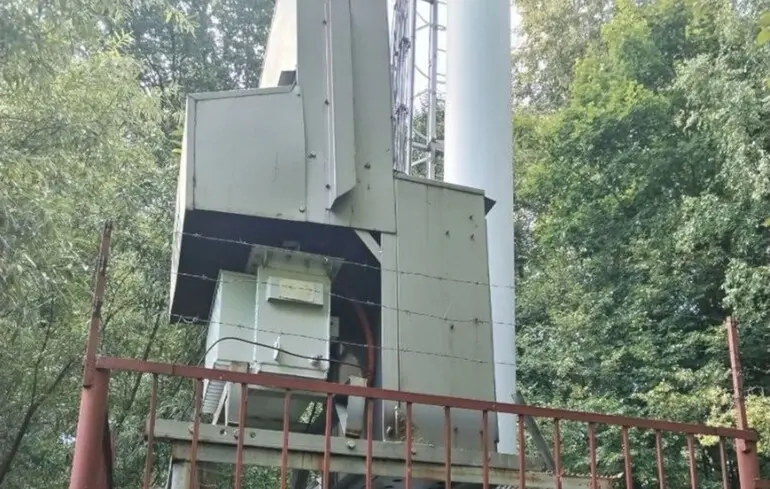
Close-up of equipment at the base of a communications tower behind a metal fence in a wooded area.

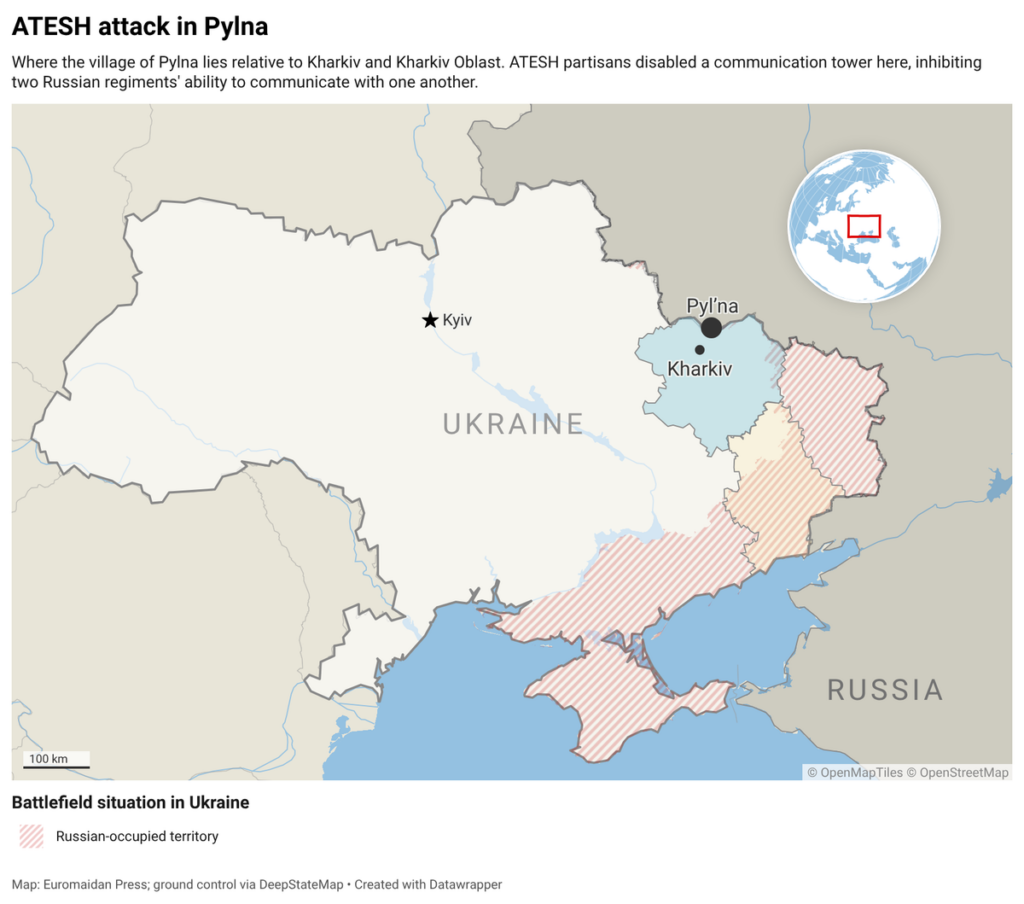
On 13 August, the Ukrainian-Crimean Tatar partisan movement ATESH said its agents had disabled a communications tower near Pylna in northern Kharkiv Oblast. The group said the damage disrupted links between two Russian motor rifle regiments near the border.

Pylna lies on the Russian border and was among the villages seized when Moscow opened the northern Kharkiv front in May 2024. The claimed tower attack is part of a wider Ukrainian resistance effort behind Russian lines. Moscow's forces still depend on infrastructure in occupied territory to communicate, move supplies, and hold the line. Ukraine’s underground fighters exploit that dependence from within, targeting communications, transport, and fuel supplies to create problems for Russian units at the front.

ATESH said the tower carried data between Russian command posts and coordinated units in the area. The movement said its loss disrupted command channels and delayed border-zone mobile groups. It did not say how agents disabled the tower or how long the interruption would last.

The partisans stated that the communications between Russia’s 345th and 380th motor rifle regiments were hit hardest. The regiments operate in neighboring sectors and rely on stable links for joint action and rapid responses, according to the group. ATESH claimed their offensive tempo and ability to support each other had fallen.

Neither the claimed ATESH sabotage nor its reported effects have been independently verified.

ATESH attacks on Russian supply lines

The tower claim follows ATESH’s 10 August account of sabotaging an electric locomotive near Voronezh. The group said it carried military supplies toward the Kupiansk front in Kharkiv Oblast. In June, ATESH also said agents damaged power and rail equipment near Russia’s Novomoskovsk Azot plant, whose output feeds explosives production.

ATESH has also reported intelligence work inside Russian forces. In July, the group said an agent reported a Ukrainian strike on five military fuel trucks in occupied Luhansk. Together, the claims describe a campaign against transport, fuel, and communications behind the front.

Ukrainian resistance works behind the front

The claimed tower operation is one part of the Ukrainian resistance behind Russian lines. Underground networks also gather intelligence and sustain civil defiance. 

A Euromaidan Press investigation documented groups planting explosives, tracking Russian positions, distributing leaflets, and painting Ukrainian symbols despite the threat of imprisonment and torture.

ATESH says its network includes Ukrainians, Crimean Tatars, anti-war Russians, and sources inside Russia’s military and occupation administrations. Its claims are often impossible to verify independently. Taken together, they portray a campaign to make Russia’s rear less secure while other groups preserve Ukrainian identity under occupation.

  • ✇Euromaidan Press
  • Poland and the Baltics risk Russian sabotage for backing Ukraine, Bloomberg says
    Russia may expand hybrid attacks against Poland and the Baltic states, including infrastructure sabotage or false-flag attacks, Bloomberg reported on 12 August, citing an unnamed European intelligence official.  The warnings come amid concern that Moscow wants to intimidate Ukraine’s supporters. The CIA warning follows Russian threats, incursions, alleged sabotage plots, and disinformation against Poland and the Baltic states. Most Western military aid reaches Ukraine t
     

Poland and the Baltics risk Russian sabotage for backing Ukraine, Bloomberg says

13 août 2026 à 09:29

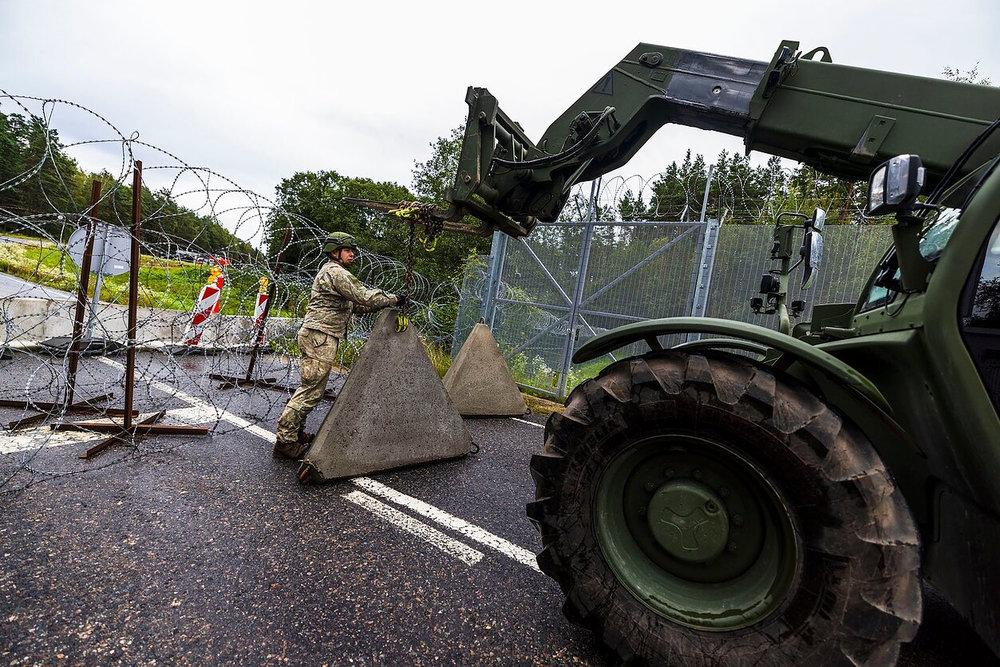
Lithuanian soldier installs concrete barriers and razor wire across a road during a civil defense exercise.

Russia may expand hybrid attacks against Poland and the Baltic states, including infrastructure sabotage or false-flag attacks, Bloomberg reported on 12 August, citing an unnamed European intelligence official. 

The warnings come amid concern that Moscow wants to intimidate Ukraine’s supporters. The CIA warning follows Russian threats, incursions, alleged sabotage plots, and disinformation against Poland and the Baltic states. Most Western military aid reaches Ukraine through Poland, while the Baltic states rank among Kyiv’s strongest supporters. Sabotage of transport, energy, or communications can slow aid delivery and test NATO while hiding Russia’s role.

Separately, a European government official told Bloomberg that the CIA had warned countries in the region of a possible future Russian attack. The CIA declined to comment.

The same official said Russia might instead be creating the impression of an impending attack to sow fear as part of an information operation. The official saw no signs that Moscow was preparing a conventional attack or invasion.

Moscow tests NATO’s eastern flank

Poland and Lithuania had already raised similar concerns. In July, Poland said it had credible intelligence that Russia was planning new provocations. Lithuania later warned that Moscow might rebuild captured Ukrainian drones for false-flag strikes on critical infrastructure.

In September 2025, between 19 and 23 Russian drones entered Polish airspace, shutting down airports and damaging buildings. Poland closed four airports as NATO aircraft responded.

Meanwhile, five people are on trial in Lithuania over attacks allegedly organized for Russian military intelligence in 2024, Bloomberg reported. Lithuania has reinforced infrastructure sites and deployed troops since June.

These warnings and incidents place the CIA alert within a wider pattern of pressure on NATO’s eastern flank and Ukraine’s supporters. 

How Russia strikes without starting a war

Bloomberg cited several recent unexplained drone incidents in Germany alongside the CIA warning. Citing Die Zeit, Euromaidan Press reported that an explosive-laden drone struck the wing of a parked Ukrainian An-124 at Leipzig-Halle airport and failed to detonate. A US Defense Department official in Europe told CNN that Washington assessed the drone belonged to Russian intelligence. 

Bloomberg also reported that a cargo plane hit an unidentified object and that drones appeared over a military base the following day. It did not connect either incident to Russia.

More broadly, Russian hybrid operations have grown sharply since the full-scale invasion. CSIS found that attacks in Europe tripled from 2023 to 2024, after quadrupling the previous year. Separately, the US Helsinki Commission mapped nearly 150 operations in NATO territory attributed to or suspected of Russia between February 2022 and November 2024.

Retired Lt. Gen. Ben Hodges told Euromaidan Press in February that attacks on ports, railways, and cables can probe routes needed for NATO reinforcements. Their deniability raises the political cost of responding.

By hiding its role, Moscow can disrupt support for Ukraine and test NATO without openly starting a war. 

A 12-year-old dies in occupied Kherson Oblast where no hospital or ambulance is left, Ukrainian official says

13 août 2026 à 07:34

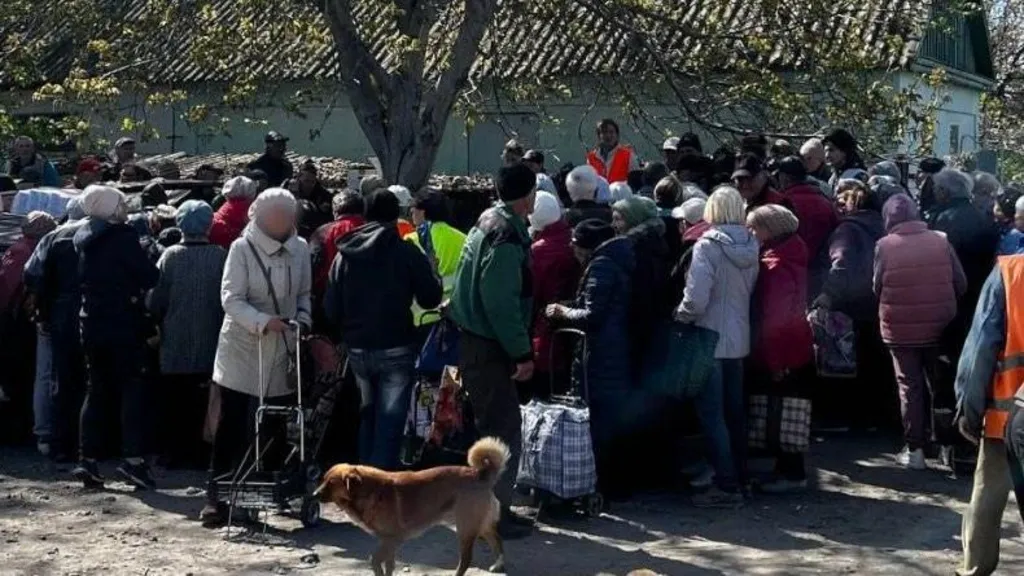
Residents, many elderly and carrying shopping trolleys, gather outdoors in occupied Oleshky, Kherson Oblast.

A 12-year-old with a high fever died without medical care in Russian-occupied Kherson Oblast, Hola Prystan official in exile Svitlana Linnyk told Ukrinform on 13 August 2026.

No medicine or medical worker was available locally, and the child’s mother could not reach an ambulance pickup point, she said.

The child's reported death comes amid a wider humanitarian crisis in Russian-occupied Kherson Oblast. UN and OSCE monitors found drone attacks, mines, and movement restrictions obstructing medical aid and evacuations around Oleshky and Hola Prystan, two occupied communities across the Dnipro from Kherson city. About 6,000 civilians, including 200 children, remained in and around the two communities as of May. Similar medical shortages span occupied Ukraine, while access to free medicines has been tied to having a Russian passport.

The Hola Prystan community where the child died has no operating hospital or rural medical post, Linnyk said. Only two pharmacies remain: one in the city of Hola Prystan and another in the nearby village of Nova Zburivka. Both are selling their remaining supplies.

The nearest hospital is in Skadovsk, an occupied Black Sea port about 60 kilometers by road from Hola Prystan. Nova Zburivka’s ambulance has not operated since 2025. 

Russian occupation authorities have distributed no humanitarian aid for at least eight months to villages surrounding Hola Prystan, or for over a year in the city itself, Linnyk said. 

Linnyk said a Moscow Patriarchate priest occasionally brought supplies but gave them only to Russian passport holders. This reflects a broader pattern of tying basic services in occupied Ukraine to accepting Russian citizenship.

Ukrainian children face a medical system stripped bare 

The medical dangers surrounding the 12-year-old’s death are not confined to Hola Prystan.

In April 2025, Ukraine’s National Resistance Center reported that occupation officials were administering vaccines to children under six in Luhansk Oblast. It described the vaccines as uncertified and of unknown origin.

That November, the Center said a Russian inspection found Crimea’s main children’s hospital lacked breathing bags and cardiac monitors. It said infant mortality on the occupied peninsula had risen 9% over the previous year.

Aid comes with a Russian passport

Hola Prystan is not the only occupied community where access to care has depended on Russian citizenship.

In 2023, Russian-installed officials in occupied Zaporizhzhia Oblast threatened to deny medical care to residents without Russian passports. A 2025 Kremlin policy later tied free medicines for chronic illnesses to Russian citizenship.

Ukraine’s Health Ministry reported in July 2024 that Russian forces had destroyed 214 medical facilities. It said the full toll remained unknown because authorities had limited access to occupied territories. 

❌