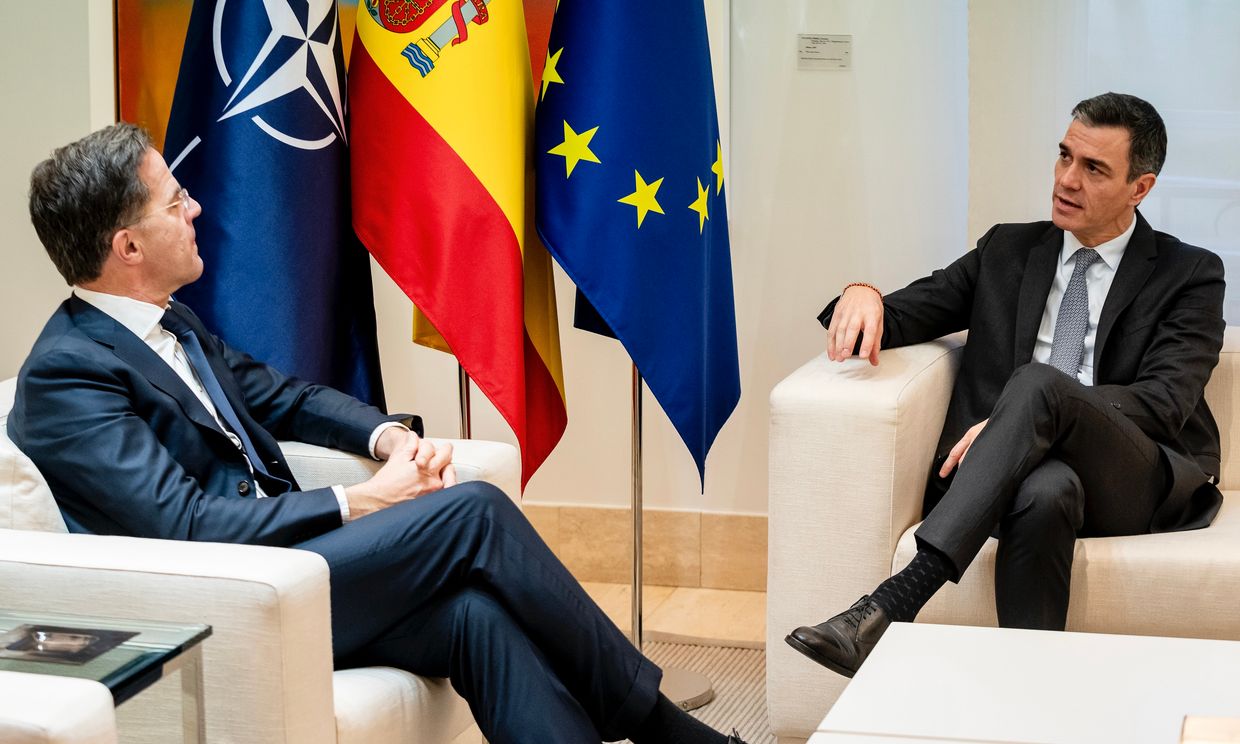
Spain will give Ukraine a new €437 million (about $490 million) military aid package, Spanish Prime Minister Pedro Sánchez told Ukrainian President Volodymyr Zelenskyy at their meeting in Madrid on 5 November, the Ukrainian president’s office reported. Neither government has said what the package contains. Whether it will help Ukraine’s thinning air defense is still an open question.
Russia is striking Ukraine’s cities, power plants, and railways daily as winter approaches. Ukraine’s main shield against ballistic missiles is nearly empty: in October, it stopped only about 7% of them. Foreign aid packages now arrive in a war where the scarcest item is the interceptor. The size of a pledge says little until its contents are known.
Zelenskyy says the package will help troops at the front
Zelenskyy thanked Spain after the talks. “Throughout all the years of this war, Spain has consistently helped and supported us,” he wrote. He said the two leaders discussed the package’s contents and Ukraine’s most urgent defense needs, without naming any weapons.
The next day, he said the package “will help our warriors at the front.” In the same post, he listed a German winter package for energy resilience and work to speed up deliveries of Patriot missiles, IRIS-T systems, and help for F-16 jets. He did not say whether Spain is part of that effort.
Madrid’s own account left the money out. The Spanish government’s readout said Sánchez reaffirmed support for Ukraine and its EU membership, condemned Russia’s recent attacks on Ukrainian cities, and noted €570 million Spain mobilized for Ukraine’s reconstruction in 2026. It did not mention a military package.
Ukraine asked Spain for help with air defense
Zelenskyy was in Madrid for the Ibero-American Summit, the first time Ukraine took part. He also met King Felipe VI and told him about Russia’s daily strikes. “We are now actively working with partners to strengthen our air defense and better protect people. We count on Spain’s support in this,” he posted after the audience.
Power-grid help is on the table too. On 6 November, Zelenskyy said Ukraine has agreements with Germany and Spain to supply generators, cables, and other equipment, which he discussed with leaders and companies during his visits.
Spain has sent Patriot missiles and F-16 rounds before
Spain is one of the few European countries that operate Patriot systems, and it has shared their missiles with Ukraine. In March, Madrid pledged five older PAC-2 interceptors, and in September its foreign minister confirmed a new batch was being prepared. Spain, like Greece, has refused to part with its Patriot systems themselves, calling them essential for national defense. Spain also began handing over cannon rounds that Ukrainian F-16s use against Russia’s jet-powered drones.
Explore further
Spain pledged €1 billion to Ukraine—then helped block NATO’s plan to count it
In March, Sánchez pledged €1 billion in military aid for 2026, part of it through the EU’s SAFE defense loans. Neither government has said whether the new package comes out of that pledge or on top of it. During Zelenskyy’s previous Madrid visit in November 2025, the two countries launched a joint project to supply long-range detection radars.
Other aid stalls as Russia’s winter strikes build
Other deliveries have hit snags. German Chancellor Friedrich Merz admitted occasional resupply difficulties after meeting Zelenskyy on 3 November. He said he will try to resolve them at a Berlin summit of Ukraine’s backers on 19 November.
The US is delaying the PAC-3 Patriot missiles built to stop ballistic strikes, while older PAC-2s keep arriving, a NATO source told Radio Svoboda in late October. Zelenskyy also said 16 billion in US aid agreed under earlier decisions was stopped and never provided. “At the very least, Ukraine must fight for this money,” he said.

 Connexion