The justices previously allowed the Trump administration to lift protections for Venezuelans covered by the program known as Temporary Protected Status.
The Trump administration on Wednesday urged the Supreme Court to step in quickly, though an appeals court order later in the day made an immediate intervention unlikely.
The inquiries would focus on President Trump, his family and top officials in his administration and would include a look at Commerce Secretary Howard Lutnick and policies related to Nvidia.
Representative Robert Garcia, Democrat of California, sent a dozen notices to members of President Trump’s family and current and former administration officials asking them to preserve documents on investigative targets.
Exclusive: Trump administration continues to award deals to private contractor CSI Aviation and agreed to remove ICE flights from tracking websites
Immigration and Customs Enforcement (ICE) has agreed to pay the private contractor CSI Aviation up to $305.7m without competitive bidding on top of existing larger contracts and changed an existing agreement so it can keep aircraft off public flight-tracking websites, federal contracting records show.
The change in September was to “add LADD”, the name of a Federal Aviation Administration (FAA) program that prevents planes from appearing on some tracking websites. It may further inhibit monitoring of ICE flights, including flights to third countries, by immigrant and civil rights advocates.
The inquiries would focus on President Trump, his family and top officials in his administration and would include a look at Commerce Secretary Howard Lutnick and policies related to Nvidia.
Representative Robert Garcia, Democrat of California, sent a dozen notices to members of President Trump’s family and current and former administration officials asking them to preserve documents on investigative targets.
Child reunited with family after he was detained by immigration agents in San Diego and transferred to Texas
An eight-year-old Haitian boy who was put into restraints and detained by immigration agents in San Diego on 4 November and transferred to a facility in Texas has been reunited with his family in California.
Representative Juan Vargas shared a photograph of the boy and his family in a social media post on Monda, writing: “11 days ago, an 8-year-old in San Diego was taken into federal custody during an immigration check-in. He was separated from his loved ones and held in a facility in Texas. Today, he’s finally home.”
New Jersey university’s Republicans club invited Bovino, who oversaw Trump’s ICE surges, to speak on campus
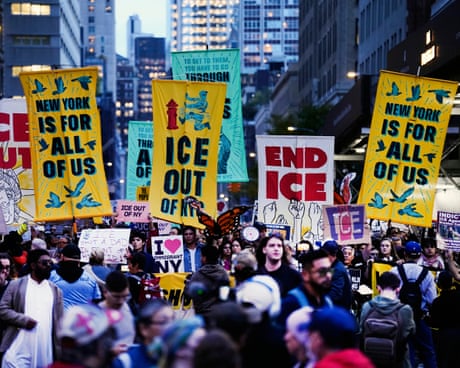
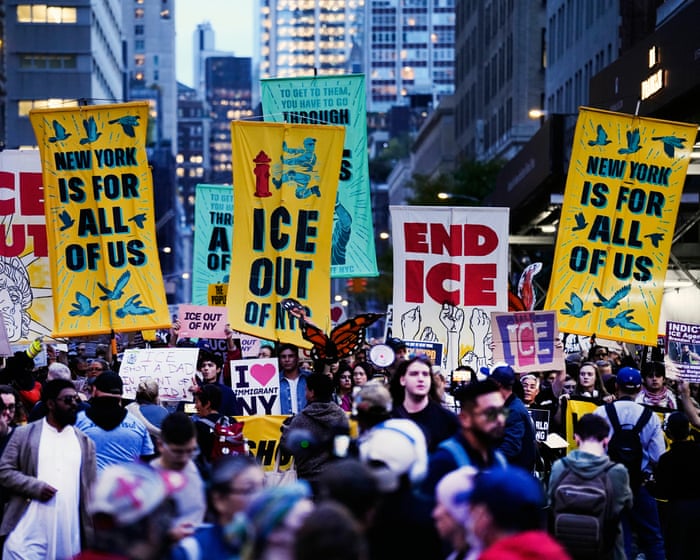
Hundreds protested outside a Rutgers University campus building on Monday night, jeering the former border patrol commander Greg Bovino, who was inside addressing a crowd of about 25 people.
The university’s Republicans club had invited Bovino to speak, calling him the “Great Commander” and the “GOAT” in social posts promoting the event at the New Brunswick, New Jersey, campus. During the two-hour talk, the room never quite filled up, occupied mostly by journalists, club members and other students criticizing the former border patrol chief.
Despite House and Senate majorities, Democrats face a battle to enact legislation – but they have the power to conduct tough new oversight
The Democrats’ midterm “blue wave” wins gave them strong majorities in both chambers of Congress, new governors’ mansions and power in some unexpected places. Voters dealt a stunning rebuke to Donald Trump – and his ruthless deportation campaign and violent ICE raids across the country were among the key issues that cost Republicans support. But what will Democrats do about the immigration crackdown?
Ultimately, the president and his subordinates have given no signs that policies will be easing - and they plan to continue deportations.
Lizbeth Vargas Andrade, 23, was arrested after being pushed to the ground and on to her stomach, her attorney says
US Immigration and Customs Enforcement (ICE) agents pepper-sprayed a pregnant US citizen and threw her to the ground during a protest in California on Sunday, according to her family’s attorney, who shared footage of the incident.
Lizbeth Vargas Andrade, 23, was filming and protesting against the presence of several ICE officers outside the Stanislaus county jail in Modesto, in California’s Central valley, before she was taken down by officers and arrested while she was lying on her stomach during a chaotic encounter.
Germany, Austria, the Netherlands, Greece and Denmark are seeking to establish a hub for rejected asylum seekers. Here’s what to know about their effort.
Ministers from the Five Country Group, which includes Austria, Germany, Denmark, the Netherlands and Greece, after a meeting on immigration and integration in Copenhagen in September.
Overall, US campuses saw a 9% decrease in international enrollment this fall compared with last year, according to a survey from the Institute of International Education (IIE). And the number of new students entering the United States for the first time fell by 15%.
Attorneys say federal officials are expediting immigration hearings and exhausting legal tools to prioritize mass deportations without any semblance of due process
Four days. That’s all the notice that the New Orleans immigration court gave attorney Corinne Beth to get a family of six ready to defend their asylum case to stay in the US, an intensive process that lawyers estimate requires at least 50 to 75 hours of dedicated preparation.
The court had already brought forward the family’s next hearing once, from a date in July 2028, saying that it was “a priority case” and must be completed by the end of November without explaining why.
Members of Congress and advocates warn that returning people to their home countries could be a death sentence
Dozens of Afghans who are currently in the US but fear being deported back to Afghanistan along with a larger group and possibly killed by the Taliban are experiencing “fragile relief” this weekend after it appeared that the Trump administration had put on hold plans to remove them within days.
Members of Congress and advocates have repeatedly warned that the deportations could effectively be a death sentence.
Lower courts have ruled against the policy, which has effectively shut down avenues for people seeking asylum protections and to remain in the United States.
Trump officials seek to overturn lower court rulings that found executive order banning asylum applications illegal
The US supreme court agreed on Friday to consider Donald Trump’s ban on asylum at the US-Mexico border, a pillar of the Republican president’s far-reaching crackdown on immigration.
The Trump administration wants to overturn lower court decisions that found the executive order banning asylum applications is illegal.
Ann Lawani was taken from her home, sparking a huge outcry among students and faculty at her university
Nearly two months after ICE agents whisked a beloved California nurse and professor from her home in Lodi, her university has ramped up calls for her release.
“She needs to come home,” said Eileen Fry-Bowers, dean for the University of San Francisco’s nursing school,in reference to Ann Lawani, who was arrested by immigration agents in September and has since been shuffled between detention centers in California, Texas, and Louisiana, in a series of opaque transfers.
A lawsuit by San Antonio is part of a wave of legal challenges slowing the Trump administration’s effort to build immigration detention centers across the country.
Members of Congress seek to ‘bring sanity’ to system but decline to give details on plans to reform or abolish agency
A group of congressional Democrats on Wednesday pushed for immediate efforts to rein in the Trump administration’s sweeping immigration enforcement operation and “bring sanity” to an immigration system that Donald Trump said, after his party’s midterm drubbing, had been “too tough” in certain aspects.
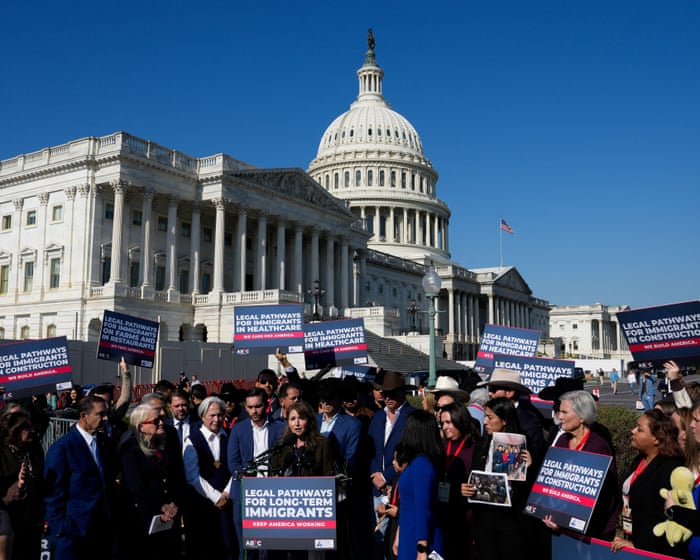
Just over a week after the midterm elections in which the US president’s harsh crackdown on immigration fueled a voter backlash against Republicans, some sitting and newly elected Democrats gathered outside the US Capitol in Washington to advocate for a bipartisan approach to reforms – even as they gear up to take control of both legislative chambers next year.
Prosecutors used statements made during a green card interview to pressure a former bodyguard to provide evidence against the Minnesota congresswoman, his lawyer said.
‘Video footage appears to show the use of restraints on a child who seemed to pose no threat to those around him’
Democratic lawmakers in California are demanding answers from the Trump administration about the safety and whereabouts of an eight-year-old Haitian boy who they say was put in restraints and taken into custody by federal immigration officers at a check-in last week.
Video obtained by NBC News shows the third-grader being led away by three armed officials after he was summoned to what his family said was a routine immigration appointment in San Diego on 4 November.
Stephen Miller is an ideologue on a mission to reshape the world. But his appointment has a silver lining for Democrats
Has the midterms bloodbath made Donald Trump go all woke? Has his party’s historic rebuke finally made him reflect on his actions and forced a road to Damascus moment?
Of course not; this is the world’s least introspective man we are talking about. However, for about 30 seconds on Sunday, the usually incoherent president managed the amazing feat of speaking a little bit of sense.
The remains of migrant boat involved in an accident at sea washed upon a beach in northwestern Senegal. Officials said it had been used by migrants to try to cross the Atlantic Ocean to Europe.
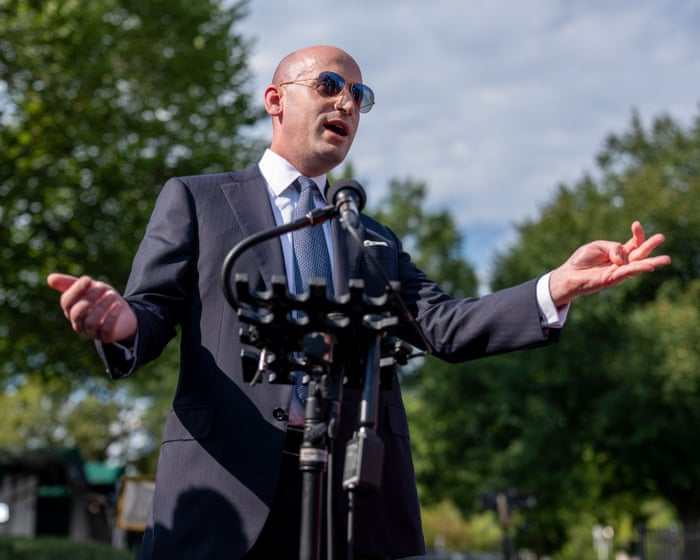
Stephen Miller, the architect of Donald Trump’s mass deportation policy and hardline crackdown on immigration, took up his new role as White House chief of staff on Monday.
Miller, 41, began his new role serving as Trump’s right-hand man after Republicans suffered massive losses nationwide in the midterm elections. He was previously serving as a deputy chief of staff.
The president was asked in a “60 Minutes” interview that aired on Sunday whether his deportation policies went too far. “I think it might be too tough,” he said.
Democratic Congressman Hakeem Jeffries, currently the House minority leader who is poised to become new Speaker next year, told CBS News that the Trump administration will hold a closed-door congressional briefing today to discuss Jensen Huang’s affair with an alleged Chinese spy.
Last week the Republican chairs of three key House committees also called on Huang to appear before lawmakers in a closed-door hearing on 18 November.
Trump’s most controversial aide begins his first day as White House chief of staff
Stephen Miller, the influential architect of Donald Trump’s aggressive immigration crackdown, is due to start as White House chief of staff today. His promotion has horrified many, handing even more power to the president’s most controversial aide.
The 41-year-old has been with Trump since the beginning of the US president’s political career – serving as a speechwriter during his 2016 presidential campaign – and has long been seen as a hardliner on the right, serving as the driving force behind first-term Trump policies such as family separation at the US-Mexico border and the travel ban on people from many Muslim-majority countries.
President makes unusual acknowledgment that one of defining policies of his second administration had become a political liability
Donald Trump has admitted that his deportation policy was “too tough” and has offered to strike an immigration deal with Democrats in a concession after the Republicans’ disastrous defeat in the midterm elections.
In an interview on the CBS network’s 60 Minutes broadcast on Sunday, the president acknowledged that the aggressive crackdown had hurt him politically and said he was open to an arrangement to allow some undocumented immigrants to remain in the US.
The president was asked in a “60 Minutes” interview that aired on Sunday whether his deportation policies went too far. “I think it might be too tough,” he said.
Carel Aaron Van Der Merwe immigrated to US at 14 and has been waiting seven years for asylum case to be heard
A Wisconsin state patrol trooper, whom federal immigration agents detained on Thursday at an airport, has been released from their custody.
Immigration and Customs Enforcement (ICE) agents approached Carel Aaron Van Der Merwe, a South African national, as he waited to board a domestic flight, according to his law firm Christopher & De León.
Hardline aide offers ‘unwavering commitment’ to president amid fears White House will double down on far-right immigration agenda
Stephen Miller, Donald Trump’s most controversial aide and the architect of his sweeping immigration crackdown, has lavished praise on the president after his appointment as White House chief of staff.
In his first public remarks since the move was announced, Miller – who begins the role on Monday – pledged “total devotion” to Trump amid concern the administration is now poised to double down on its far-right, nativist immigration agenda.
US voters repudiated mass deportation campaign, but choice of new chief of staff is an ominous signal that Trump is driving ahead at full speed
On Tuesday, US midterm voters resoundingly rebuked Donald Trump and his brutal mass deportation campaign that sent military tanks and masked agents though residential streets.
But on Friday, the president doubled down. He named Stephen Miller – the architect of the administration’s most aggressive immigration policies – as his chief of staff.
Mayor said only immigrants that ‘pose a danger’ would be referred to ICE, after Democrats gain control of governor’s seat
The mayor of Houston on Friday said the city would limit cooperation with federal immigration authorities, heralding “a new model” of immigration enforcement after Democrats won power in Texas for the first time in decades.
Houston’s mayor, John Whitmire, said the city would go after immigrants “that pose a danger, not those that are going about their family business, work and education”.
Mayor John Whitmire has instructed Houston police to stop notifying immigration agents when they encounter someone without legal status during routine street stops.
The Trump administration has arranged a flight to send dozens of Afghan immigrants back to Afghanistan, despite the risk of persecution by the Taliban.
The Trump administration plans to fly the Afghan immigrants from Louisiana to Pakistan, where they are expected to be expelled over the border to Afghanistan.
Son premier roman intitulé «C’était ça ou mourir» vient à peine d’être publié, qu’il suscite un engouement monstre. Près d’une quinzaine de maisons d’édition...
— Permalien
Pour cette émission consacrée à la rentrée littéraire, Augustin Trapenard accueille Thélyson Orélien, pour son premier roman, "C'était ça ou mourir", publié ...
— Permalien
Il paraît que l’Allemagne et le Danemark devraient servir d’exemple au Québec en matière de politique migratoire. C’est ce que laisse entendre le député Alex Boissonneault dans une vidéo voulant défaire le « mythe » que « plus d’immigration veut dire moins de pénurie de main d’œuvre ». Selon lui, les gouvernements allemand et danois ont changé leur politique d’immigration après avoir réalisé que l’immigration ne règle pas la pénurie de main-d’œuvre. M. Boissonneault connaît-il réellement la politique migratoire de ces deux pays et leurs fondements?
À gauche: Alex Boissonneault, député d’Arthabaska-l’Érable depuis 2025 À droite: Mette Frederiksen, première ministre du Danemark depuis 2019
« Il y a plusieurs exemples de pays qui ont changé de politique en matière d’immigration parce qu’ils ont constaté cette situation. C’est le cas de l’Allemagne. L’Allemagne qui comptait beaucoup sur l’immigration pour combler ses postes vacants mais qui a constaté en 2023 que l’augmentation de l’immigration avait créé une pénurie de main d’œuvre dans les secteurs névralgiques. Donc il y a eu changement de politique. »
C’est complètement faux. La modification de la politique migratoire allemande en 2023 n’a rien à voir avec des considérations économiques ou sociales. Au même moment où le gouvernement d’Olaf Scholz renforçait le contrôle des frontières, l’Allemagne cherchait à attirer des travailleurs étrangers, en particulier les travailleurs qualifiés, notamment en réduisant les barrières administratives. Voici ce qu’affirmait Scholz en novembre 2024: « Aucun pays du monde ne peut connaître de croissance économique avec une main-d’oeuvre qui diminue. C’est la vérité à laquelle nous sommes confrontés. » Dans le même discours, le chancelier allemand défend le droit de l’Allemagne de choisir qui est admis en son sein, donc de repousser les réfugiés. Le problème de l’Allemagne n’est pas que l’immigration ne suffit pas à combler la pénurie de main-d’oeuvre, mais qu’elle ne parvient pas à attirer une main d’oeuvre de souche européenne en assez grande quantité.
« Même chose pour le Danemark avec un gouvernement social-démocrate, normalement considéré de gauche. Le gouvernement danois a constaté que l’augmentation de l’immigration a eu des conséquences négatives sur les services à la population. Il y a donc eu un changement de politique. »
Encore une fois, ce « changement de politique » du gouvernement danois n’a rien à voir avec l’économie ou avec les services à la population. C’est une question purement idéologique et, ce gouvernement ne s’en cache pas, raciste.
Commençons par dire que le racisme n’est pas une question de droite ou de gauche. On peut très bien être à gauche économiquement et à droite sur le plan de l’identité nationale. C’est le cas de la première ministre danoise, Mette Frederiksen, très attachée à l’État-providence danois, mais ouvertement raciste. En 2018, elle proposait de renvoyer les migrants « non occidentaux », non seulement du Danemark, mais de l’Europe, et de les placer dans des camps de concentration en Afrique sous supervision des Nations unies. À son arrivée au pouvoir en 2019, Frederiksen a promis de faire du Danemark un pays « sans demandeur d’asile ». En 2021, le gouvernement danois a voté une loi pour expulser les demandeurs d’asile hors d’Europe en attendant le traitement de leur demande, en contradiction totale avec les traités internationaux et les directives européennes. En 2022, une entente est signée avec le Rwanda. En gros, le Danemark paie le Rwanda pour détenir les demandeurs d’asile. Un bien triste revirement pour le premier pays à avoir signé la Convention de 1951 sur les réfugiés. Ce n’est pas sans raison que ce gouvernement « social-démocrate » est appuyé par l’extrême droite danoise.
En soi, la politique de Frederiksen et des sociaux-démocrates ne jure pas avec celle des administrations précédentes. Depuis le début des années 2000, le gouvernement danois est hostile à l’immigration. Le délai nécessaire pour obtenir la résidence permanente est passé de trois à huit ans. La « loi sur les étrangers » est modifiée régulièrement pour devenir toujours plus restrictive et viser des groupes en particulier. Elle a été modifiée 42 fois entre 2017 et 2019. Et la loi danoise est ouvertement raciste en ciblant des groupes spécifiques. En 2016, les Syriens ont été directement ciblés par une loi restreignant l’accés au regroupement familial pour les réfugiés et confisquant leurs objets de valeur pour financer leur séjour. En 2018, des mesures sont prises pour que des peines plus sévères soient infligées aux « résidents non occidentaux ». Des amendes importantes sont infligées aux personnes venant en aide aux « immigrants irréguliers ». Et pour bien montrer que la politique danoise est motivée par le racisme et non pas par des préoccupations économiques ou sociales, le Danemark a ouvert grand ses portes aux réfugiés ukrainiens fuyant l’invasion russe.
Ironiquement, ces dernières années, c’est la droite (modérée) qui a commencé à demander un assouplissement des politiques migratoires au Danemark. Pas pour des raisons humanitaire, mais pour des raisons économiques. Il y a une pénurie de main-d’œuvre, voyez-vous. Et les employeurs aimeraient bien qu’on leur permette de recruter à l’étranger les travailleurs qu’ils ne trouvent pas localement.
Christèle Meilland, chercheuse à l’Institut de recherches économiques et sociales (IRES), explique que la politique migratoire danoise s’appuie sur un discours « assimilant les étrangers, et particulièrement les réfugiés, à un fardeau pour l’État-providence ». Ça vous rappelle quelque chose?

 Connexion