Dan Osborn, an independent candidate for Senate in Nebraska, lost his race against Senator Pete Ricketts. Much of the state shifted to the right in a year where most of the country shifted left.
An impeachment vote on the defense secretary, a spending deal and several major bills are in play in a post-election session that will be shaped by last week’s electoral earthquake.
Following their midterm victories, Democrats are preparing to open wide-ranging investigations into President Trump, his family and his administration. Michael Gold, a Times congressional reporter, identifies some of the Democrats’ biggest targets.
Colorado’s leftward shift, the presence of evangelical Christian groups in the state and a flood of ballot measures have made it a fertile testing ground for ideological battles.
The Democrat was leading the race for a district when officials realized there were missing votes from a single memory card. Now the Republican has the edge.
Representative Gerald Greene, the Republican incumbent, appeared to be in the lead after the votes in the memory card had been accounted for, said Brad Raffensperger, Georgia’s secretary of state, in a statement on Friday.
Mr. Eisenkot, a career general and the leading rival of Prime Minister Benjamin Netanyahu of Israel, will now have up to six weeks to form a coalition.
The echoes of history surround Scott Colom’s final push toward victory, but assembling the coalition that propelled him took hard work after many Democratic misses.
After last week’s midterm losses, the Republican Party entered its most uncertain moment in years. Some Republicans called for moderation and cleaning house, but that will be difficult with President Trump still in the White House.
For a decade, President Trump has controlled the G.O.P. with an iron grip, remaking Republicanism in his MAGA image with little tolerance for dissenting views.
The African National Congress lost big in local elections, turning a once-dominant force credited with overturning apartheid into “any other political party.”
Gadi Eisenkot, a former military chief, hopes to succeed Benjamin Netanyahu as prime minister by cobbling together a coalition after an inconclusive election.
White voters without a college degree, a cornerstone of the Republican base in the Trump era, moved left this year. Some cited high prices, the war with Iran and more in their decisions.
Kylee Wilson, at her house in Prairie City, Iowa, said she voted for Democrats after voting for President Trump three times. “Trump put a target on America’s back,” she said.
The Democratic leader still faces skeptics in his ranks and hostility from some activists, but aides say he has enough commitments of support to be elected majority leader.
Senator Chuck Schumer, Democrat of New York, and his political team engaged in a $550 million push to put more Senate seats in play and increase their chances of regaining the majority.
Some blamed President Trump for backing the novice candidate after the death of her brother, Lindsey Graham. Others accused Mr. Graham’s team of pushing her to run despite her lack of experience.
Chris Mann, a former police officer and prosecutor, defeated Mr. Kobach, a Republican who helped elevate concerns about election fraud to national prominence.
Gina Hinojosa and James Talarico in Houston, three days before the midterm elections. Democrats won every statewide office in Texas on Tuesday, including judges.
In the lead-up to an election in which economic concerns dominate, there was no clear front-runner. Minor parties will most likely determine who governs.
Sweeping midterm successes in Georgia and North Carolina have given the party an opportunity, and a test, to lay out a vision for governing in the South.
Gadi Eisenkot, the leading rival of Prime Minister Benjamin Netanyahu, now has a chance to form Israel’s governing coalition. Here are three routes he could try.
Two sanctioned tankers carrying Russian diesel toward the US under President Donald Trump’s deal with Vladimir Putin have changed course away from American ports, the Associated Press reported. At least three more have since followed, and no Russian diesel has reached the United States since the deal was struck in October. A tanker expected in New York this weekend has yet to confirm where it will unload, while Moscow insists the shipments are still on their way.
Russia pays for its war against Ukraine largely with oil money, and Western sanctions have spent years squeezing that income. Ukraine adds pressure from the other end, with drones hitting Russian refineries, five of them over the past week alone. Washington, meanwhile, has loosened its own grip: Trump already waived the tariffs Congress set for buyers of Russian oil. A US market for Russian fuel would give the Kremlin both revenue and a political win.
The first three tankers turn away, a fourth may still be bound for New York
The Russian tanker Talisman, under US, UK, and EU sanctions, and the Sierra Leone-flagged Leruo, sanctioned by the UK, EU, and Canada, loaded diesel at the Baltic port of Primorsk in October and first declared the US Atlantic coast as their destination.
The Leruo changed its signal to “Brazil” on 2 November, the day before the US vote, while the Talisman steered into the Mediterranean, the Financial Times reported. A third sanctioned tanker, the Beast, loaded at Primorsk on 27 October and set off signalling “Atlantic,” a sign it was bound for the US coast.
The Greek-owned Agioi Fanendes appeared to be continuing toward the US but signalled only “for orders,” meaning no confirmed unloading port. “The third one, Agioi Fanendes, is set to arrive in New York this weekend,” Kpler analyst Matt Smith told the FT, adding that it would not be surprising if it diverted too.
Free ship-tracking data show three of them now moving away from the US. The Talisman was south of Sicily on 6 November, heading east at about 12 knots and signalling “for order,” according to VesselFinder. The Leruo last appeared near the Azores on 3 November, heading south-southwest with “Brazil for order” as its destination, MyShipTracking data show.
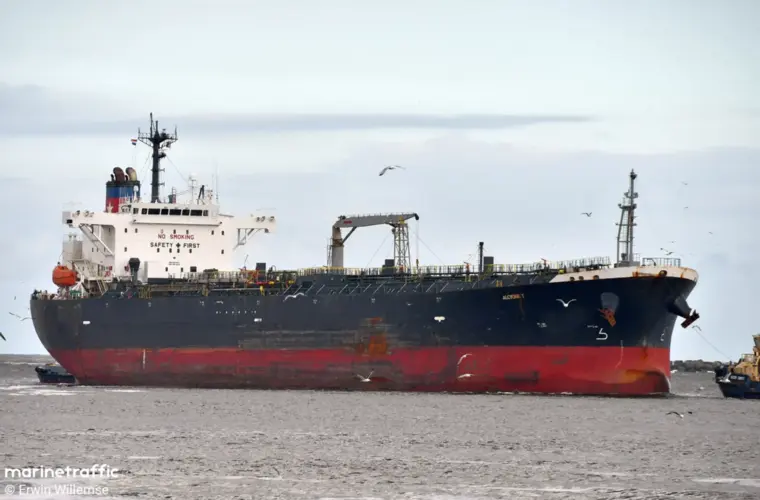
The Sierra Leone-flagged tanker Leruo, under EU, UK, and Canadian sanctions. Photo: Erwin Willemse/MarineTraffic
The Beast turned later. On 4 November, the day after the vote, it was still signalling “Atlantic for order” off the Shetland Islands, MyShipTracking shows. By 5 November, it was northwest of Scotland, heading southwest, with “Brzil” (sic!) as its new destination and arrival expected on 25 November, according to VesselFinder.
The Agioi Fanendes loaded about 40,000 tons of diesel at Primorsk on 22 October. Its last position on free tracking sites dates from 28 October, off the north coast of Scotland, heading west, AIS Vessel Tracker shows. Such sites often lose ships far out at sea, so the gap alone says nothing about its course.
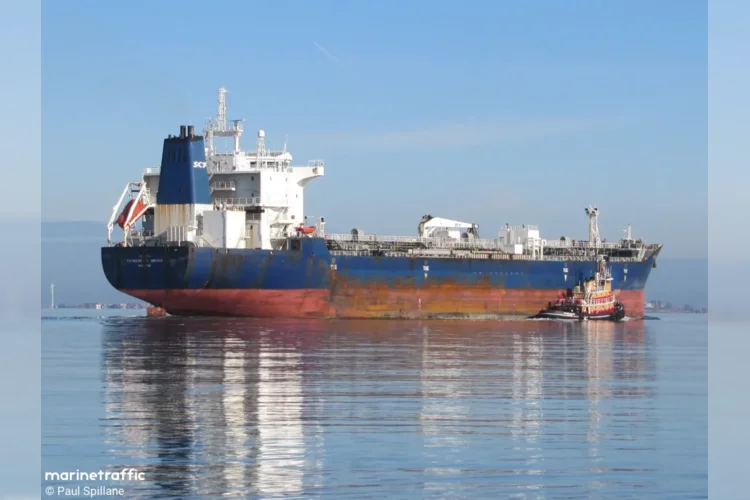
The Russian-flagged tanker Talisman, under Western sanctions. Photo: Paul Spillane/MarineTraffic
A Ukrainian monitor names more tankers that could be US-bound
Ukrainian monitors see a wider picture. Of 49 oil-product tankers that left Russia’s Baltic and Arctic ports from 29 September and were still at sea on 3 November, eight could be considered bound for the US, Andrii Klymenko of the monitoring group at Ukraine’s Institute of Black Sea Strategic Studies wrote. He stressed this was only an assumption: the ships change their destinations in response to world media attention, and no reliable information about their cargo is public. His list included the Agioi Fanendes and the Beast, plus six more tankers.
Two of those six have since turned away. The Hanna, which had listed a yacht marina near Boston, was off the Iberian coast on 6 November, heading south for Tema in Ghana, according to VesselFinder. The Manta, under EU and UK sanctions and also once listed for the Boston-area marina, now signals “Tanger Med for order,” Morocco’s port on the Strait of Gibraltar, VesselFinder shows.
Explore further
US weighs relief for sanctioned shadow fleet tankers, days after freeing Russian diesel
Two still point at the US or nowhere. The Iblea still lists Corpus Christi, Texas, according to VesselFinder, and was last tracked near the Azores on 4 November, heading west, MyShipTracking shows. The Marina M, which had listed Fairless Hills, Pennsylvania, now signals only “for orders,” according to VesselFinder. Its last free-tracker position dates from 2 November, north of Scotland, MyShipTracking shows.
The last two are harder to place. The PVT Azura still lists Norfolk, Virginia, but MyShipTracking last logged it in the North Sea on 20 October, while VesselFinder shows it back in the Baltic Sea. The TG Aries lists Trois-Rivières in Canada rather than a US port. MyShipTracking placed it north of Scotland on 2 November, but VesselFinder shows it nearly stationary in the Baltic Sea.
Don’t believe your eyes and vessel trackers: Moscow calls the reports fake
Kremlin envoy Kirill Dmitriev dismissed the diversions in a post on X, saying the US-bound cargoes continue on course, Reuters reported on 5 November. Ship-tracking data from Kpler and LSEG showed at least six Russian diesel cargoes announcing Atlantic crossings by then. Two of them had turned away, and none had arrived in the US. Kremlin spokesman Dmitry Peskov said “all the diesel will find its buyers” and denied any link between the course changes and the US midterm elections.
Kirill Dmitriev, Russian President Vladimir Putin’s special envoy, speaks beside US First Lady Melania Trump at a White House event on the Oleshky ceasefire in Washington, US, 5 November 2026. Video still: The White House/YouTube
Dmitriev was in Washington that day. He spoke at a White House event hosted by First Lady Melania Trump on the Oleshky evacuation ceasefire, and Trump met him afterward.
A US ban stands in the way, and Congress changes hands in January
Asked late on 5 November about the 2022 US law banning Russian energy imports, Trump said: “Then it probably makes it a pretty bad law. I will take a look at it.”
Critics say the Treasury waiver Trump’s administration issued, valid until April 2027, cannot override that ban. New Jersey Governor Mikie Sherrill has warned port operators that handling Russian diesel could bring civil and criminal penalties, and senators from both parties have called the imports illegal.
Explore further
Bipartisan US senators say Trump’s Russian diesel deal conflicts with 2022 ban, as he presses Kyiv to spare Russian refineries
Analysts see several possible reasons for the turnaround. Buyers may have balked at UK and EU sanctions that kick in once a European insurer or bank is involved, Maximilian Hess of the consultancy Enmetena Advisory told France 24. Kevin Rowlands of the UK’s Royal United Services Institute said the midterm results raised the risk of cargoes being seized in US ports.
Democrats won both chambers in the 3 November vote but take control only when the new Congress meets in January. Until then, Republicans keep their majorities, and after that, Trump keeps his veto.
Since publication, this piece has been updated with a Ukrainian monitor’s list of six more tankers that could be US-bound and their latest tracked positions.
Tundu Lissu, the Tanzanian opposition leader, gestures to supporters as he stands inside the dock at the high court in Dar es Salaam, Tanzania, on Friday.
Ukrainian President Volodymyr Zelenskyy has called wartime elections unfair to soldiers who cannot vote and floated online voting as a possible way out, he told German broadcaster ZDF. He also said he had asked Washington to secure a winter ceasefire from Moscow, which would protect power and water and open a window for a vote. At home, critics warn that remote voting carries heavy risks, and Ukrainian law makes no room for it.
Russia is heading into another winter of strikes on Ukraine's power plants, substations, and pumping stations. This week, one of its largest barrages on the grid left Kyiv without running water. Washington keeps pressing Kyiv for a vote and a deal, while Moscow's stated price for peace is still more Ukrainian land. Any Ukrainian election therefore depends on a pause that only the Kremlin can grant, and Putin has already rejected a ceasefire on Ukraine's grid.
Why Kyiv calls a wartime vote unfair
Zelenskyy spoke to German satirist Jan Böhmermann on ZDF Magazin Royale, aired on 4 November. A vote under martial law, he argued, would shut out soldiers at the front, about nine million Ukrainians abroad, and millions living under Russian occupation. Under martial law, imposed on 24 February 2022, elections are banned. The troops themselves oppose a vote they could not take part in, he said.
“Allowing elections but not giving soldiers a chance to vote is unfair. It is 100% unfair. We can think about online elections. That may be realistic, but then parliament has to look for and find a solution,” Zelenskyy said, Radio Svoboda reported.
He added that elections split society, and that this is a particular challenge for a country at war.
Explore further
After Trump, Musk tells Ukraine’s president to go. Zelenskyy says he won’t resign and will never accept Ukrainian land as Russian
A winter truce as the window for a vote
Zelenskyy said he had urged Washington to work out a winter truce with Moscow, Kyiv Post reported. He hinted that some in Washington would like him gone, yet said a vote only counts if Ukrainians can actually take part.
“I told the Americans: You can reach an agreement with the Russians for a ceasefire during winter. Then people will have electricity and water, and during that time we can also hold elections,” he said.
Asked why Ukraine would not give up land for peace, Zelenskyy pointed at Moscow. “Putin does not want to end the war. Putin does not accept a ceasefire,” Zelenskyy said, noting that Kyiv had backed ceasefire proposals that Moscow turned down. In excerpts from the interview he posted on Telegram, he said Ukraine would do everything to end the war, “but end it with dignity for us.”
Explore further
US Congress turns blue, Trump keeps the veto—and Ukraine’s balance sheet in Washington gets both wins and losses
The request answers mounting US pressure. On 10 October, US President Donald Trump said it was time for Ukraine to get a new president. Zelenskyy offered elections if Russia agreed to a full 60-day ceasefire. The Kremlin countered with a halt to strikes on voting day alone. US envoys have also pitched Russian gas transit as a reward for an energy truce before winter, and Moscow rebuffed it. Trump has since met Kremlin envoy Kirill Dmitriev and predicted a “big agreement” ahead of US-Russia-Ukraine talks in Abu Dhabi next week.
No legal path to voting from a trench
Ukraine's Electoral Code requires every voter to vote in person, with ballots handed out by election commission members. In February 2025, Central Election Commission head Oleh Didenko said the commission had long dropped electronic voting and called postal voting wide open to interference. Online, it may be hard or impossible to check that a voter casts a ballot in person and without coercion, Radio Svoboda noted. Estonia, which has voted online since 2005, deals with coercion by letting each new vote cancel the last, so citizens can recast their ballot until polls close.
Ballot boxes at a polling station in Ukraine at the start of voting in the presidential election, 31 March 2019. Photo: Tohaomg/Wikimedia Commons
Political scientist Oleksii Koshel went further on Radio NV, saying the president had been “set up.” He warned that online elections would have catastrophic consequences and noted that the Central Election Commission does not support electronic voting. Because Zelenskyy gives so many interviews, Koshel said, it is hard to tell where he meant to send a signal to the West and where he simply said too much. He urged the president's team to cut back his media appearances.
Scott Colom, the Democratic nominee, has kept his edge over the Republican incumbent, Cindy Hyde-Smith, as more provisional and mail ballots were reported throughout the state.
The rare Democrat in a fabled family of wealthy Republicans, he served 30 years as senator and helped bring health insurance to millions of low-income children.
Lawmakers in states with new total Democratic control said they would try to join an effort to try to elect the next president effectively by popular vote. But momentum has stalled before.
Voters casting their ballots in Dearborn Heights, Mich., on Tuesday. A state lawmaker said that after Tuesday’s midterm results, “The time is right” to reconsider the Electoral College.
A phalanx of lawyers, observers and campaign officials are watching the counting of votes in the race for Senate, where a Democratic challenger has a slim lead.
A mural of Simón Bolívar in downtown Caracas, Venezuela, last year. Mr. Rubio urged patience in creating conditions for a free and fair vote in a country that has come under effective U.S. control following a military intervention in January.
Mary Peltola, the Democrat, was leading Senator Dan Sullivan, the Republican, in incomplete returns. A New York Times analysis suggested she was on track to prevail.
Election officials reviewed ballots in Anchorage on Wednesday. Former Representative Mary Peltola, a Democrat, is in a tight race against Senator Dan S. Sullivan, a Republican, for his seat.
They won Senate races in North Carolina, South Carolina and Georgia, with a Mississippi race still too close to call. Their wins lifted down-ballot candidates too.
Sam Forstag’s pro-labor message resonated with voters in Montana, giving him the first Democratic win in a congressional race there in more than three decades.
A top adviser to President Javier Milei of Argentina met Flávio Bolsonaro, the defeated Brazilian presidential candidate, at an Argentine airport, three people involved in the operation said.
Scott Colom, a Democrat, ran a viral ad and courted Republicans at a Trump rally before winning virtually the same number of votes as Senator Cindy Hyde-Smith, a Republican.
President Isaac Herzog wrapped up two days of talks with party leaders by saying he will ask one of them on Sunday to try to assemble a governing coalition.
The Israeli leader and his allies are alleging that Arab voters last month stole the election. Election officials say that while foul play was being investigated, it could not have affected the result.

 Connexion