❌

Vue lecture

They say Dobropillia is encircled, but they are actually 10+ km away: ISW publishes map disproving Russia’s claim

A map showing the territories around Dobropillia that Russia claims to have captured (purple) and analysts’ assessment that Russian forces are 10.2 kilometers from the southeastern outskirts of Dobropillia. Map: Institute for the Study of War

The Institute for the Study of War (ISW) published a map in its analytical report on 24 September that contrasts the claimed Russian encirclement with the location of Russian forces as assessed by the experts. Based on the evidence observed by ISW, the nearest area where Russian forces are present is 10.2 kilometers from the southeastern outskirts of Dobropillia.

Russia has been spreading disinformation about its successes around Dobropillia as part of what ISW calls a cognitive warfare effort to portray Ukrainian defenses as on the verge of collapse. Russia's Defense Ministry published a map claiming the city was surrounded. ISW's own map challenges it. The Ukrainian military says the city remains under its control.

Russian Defense Ministry claims it is already destroying encircled Ukrainian troops in Dobropillia and moving further

Units of Russia's Center Grouping of Forces continue combat operations against encircled Ukrainian forces in the Dobropillia area of Donetsk Oblast while simultaneously advancing toward Oleksandrivka, the Russian Defense Ministry claimed. ISW analysts, meanwhile, said they have not observed evidence supporting Russia's claim that the city is encircled. They also noted that Ukrainian officials "directly refute" the claim.
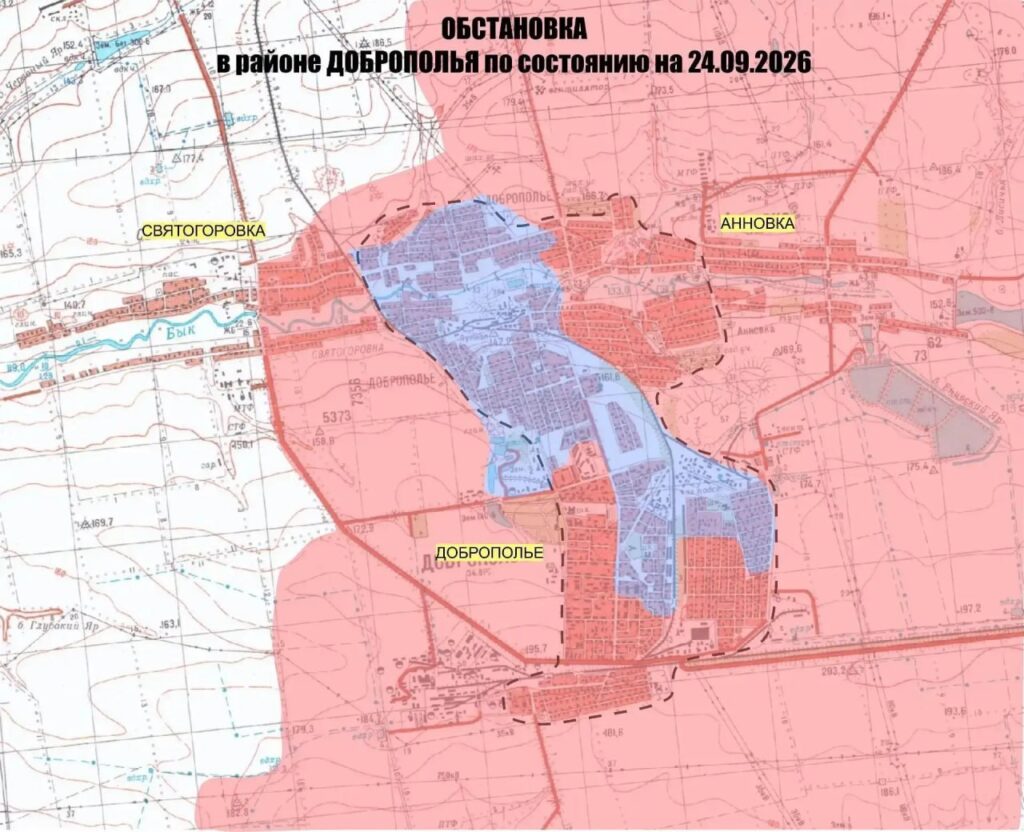
A Russian map showing the complete encirclement of Dobropillia. ISW and the Ukrainian Armed Forces reject this claim. Map: Russian Defense Ministry

ISW observed evidence that Russian infiltrators, small groups, were operating east and northeast of Dobropillia on 19 and 20 September. The institute did not assess that these infiltrators had consolidated their positions.

Ukrainian forces maintain positions south and northeast of Dobropillia, military observer Kostiantyn Mashovets said on 20 September, according to ISW.

Russian forces have not made major gains in the Dobropillia direction, the chief of staff of an artillery reconnaissance battalion said on 22 September, according to the institute. On the same day, a Russian milblogger described the "alleged Russian encirclement of Dobropillia" as potentially meaning not the direct presence of infantry, but only the establishment of fire control over Ukrainian logistics, including roads west of Dobropillia and toward Sviatohorivka, according to ISW.

ISW noted that Russia's pervasive military culture of lying—what Russian milbloggers themselves call "beautiful reports"—has degraded the Defense Ministry's own ability to understand the battlefield and enabled inflated claims like the Dobropillia encirclement.

Russia uses this disinformation as a "diversion"

In its statement, the Russian Defense Ministry itself described Dobropillia as a "strongly fortified settlement" whose seizure would threaten key Ukrainian supply lines running from Dnipropetrovsk Oblast toward the Fortress Belt—the Sloviansk-Kramatorsk-Druzhkivka urban agglomeration.

Russia has recently renewed its attempts to break through toward Dobropillia.

Third Army Corps Commander Andrii Biletskyi said that Russian forces sought to bypass the fortified cities through Dobropillia and link up with troops advancing from north of Lyman, rather than launch a direct assault. ISW noted on 16 September that the Vivaldi operation disrupted Russia's two-pronged plan. In its 24 September report, ISW said Russia's claims about Dobropillia were partly intended to divert attention from Ukraine's elimination of the Russian salient north of Lyman, which has likely forced Russia's command to rethink its wider encirclement plans.

  •  

Vivaldi erased Russia’s Lyman pincer. Now Moscow is pushing toward Sloviansk instead

Two soldiers of Ukraine’s Third Army Corps silhouetted among bare trees at twilight; one holds a radio to his mouth.

Ukraine's Vivaldi counteroffensive rolled back a Russian advance north of Lyman in Donetsk Oblast. However, Moscow shifted part of its forces south, Roman Pohorilyi, co-founder of the Ukrainian battlefield mapping project DeepState, told Radio NV. Russian troops are now infiltrating Mykolaivka, a key strongpoint on the approach to the fortress city of Sloviansk, Pohorilyi said.

The halted advance was one arm of Russia's plan to encircle Ukraine's Donetsk fortress belt—the fortified cities of Sloviansk, Kramatorsk, Druzhkivka, and Kostiantynivka. Pohorilyi warned that losing Mykolaivka would create serious problems for Sloviansk's defenders. Russia is still pressing toward Dobropillia on the belt's southwestern flank.

Pohorilyi said Russia formed a "claw" north of Lyman by exploiting Ukrainian brigades short of personnel and pushing small groups into their lines. Ukraine's Third Army Corps stabilized the area, built up forces, and counterattacked. The push "multiplied all [Russia's] previous efforts by zero," he said.

Russian forces had repeatedly tried to capture or bypass Lyman, Pohorilyi said. Russian groups still infiltrate the approaches to the city, although Ukrainian forces have stabilized the situation there.

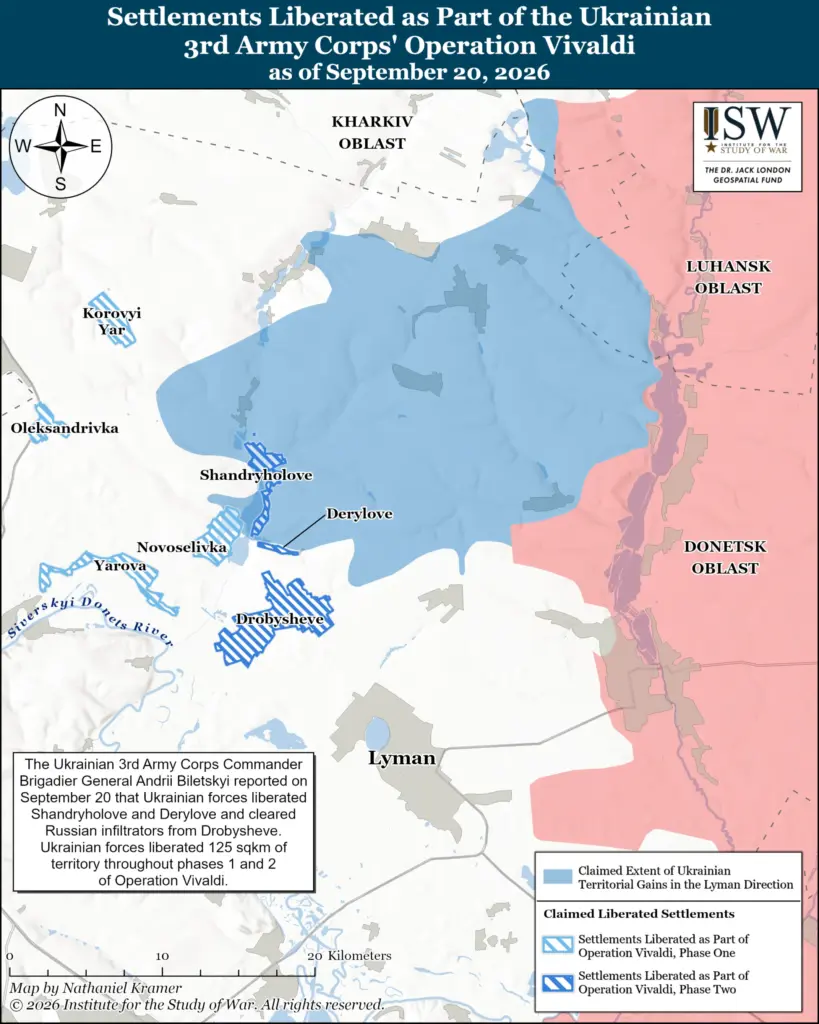
The corps says Vivaldi's first two phases regained control of 125 square kilometers, including 50 that had been under Russian occupation. It reported liberating Shandryholove and Derylove, securing Drobysheve, and inflicting more than 3,000 Russian personnel losses. Those battlefield figures have not been independently verified.

vivaldi's secret weapon targeting robots third corps reconnaissance mapped russian command nodes hit cause panic · post graphic ukraine's army / telegram під час операції вівальді нрк десантували щоб порушити
Explore further

Vivaldi’s secret weapon was the targeting, not the robots: Third Corps reconnaissance mapped Russian command nodes, then hit them to cause panic

Pohorilyi noted that the area around Mykolaivka had, until recently, been under the responsibility of Ukraine's 11th Army Corps and is now under the Third Army Corps.

Ukrainian troops must now find and stop infiltrating Russian groups before they establish control, he said. Personnel shortages on the Lyman axis persist, although he said reinforcements are being distributed more evenly.

Map: ISW

Operation Vivaldi and the wider fight for Donetsk's fortress belt

The Third Army Corps first disclosed Operation Vivaldi on 15 September after conducting the counteroffensive north of Lyman under information silence. Commander Andrii Biletskyi said the announced gains were only the first phase; the corps said its attacks had disrupted Russian supply routes.

A 60th Mechanized Brigade captain said Ukrainian units quietly assembled near Derylove and Drobysheve, then struck Russian drone launch sites at planned times so infantry could advance. The corps disclosed a second phase on 20 September.

Farther southwest, Dobropillia faces even heavier pressure, Pohorilyi said. Russia has concentrated large forces there and is pushing with relentless infantry across a wide front, backed by thousands of drones each month—reconnaissance, strike, FPV, and Lancets—with numbers still rising. Russian troops are moving on settlements south of Dobropillia to establish a strongpoint and push deeper into Donetsk Oblast.

The pressure is not new: Biletskyi said Ukrainian troops halted a Russian incursion there last year. After Moscow claimed on 22 September to have encircled the town, the Institute for the Study of War found no evidence to support the claim.

  •  

Russia was sure the terrain made this village impossible to take—Ukraine walked in anyway

Soldiers of Ukraine’s 425th Separate Assault Regiment Skelia. Photo: Skelia

Ukrainian troops pushed into a front-line village Russian forces were sure they could never reach, an officer from the assault force told Army TV. He described a methodical, house-by-house clearing—then a Russian response that, once the village fell, called the footage an AI fake.

Through 2026 Russia has pressed on this stretch of the eastern front, creeping toward the fortress belt, the chain of fortified cities anchoring Donetsk Oblast. Retaking Serednie is one move in a quiet Ukrainian counteroffensive that has clawed back ground on this axis—which is why this village changing hands lands harder than the map suggests.

The terrain Russia trusted

Serednie sits on the Lyman direction in eastern Ukraine, an axis where Russian forces have been pressing toward Ukrainian-held Sloviansk and Kramatorsk. Troops from Ukraine's 66th Separate Mechanized Brigade entered the village during Operation Vivaldi, said the deputy commander of its first mechanized battalion, Kassta, callsign Timokha.

Ukraine's Third Army Corps commander Brigadier General Andrii Biletskyi announcing "Operation Vivaldi," 15 September 2026. Screenshot from video: Ukraine's Third Army Corps
Explore further

Ukraine’s Vivaldi counteroffensive disrupts Russia’s plan to encircle Donetsk Fortress Belt – ISW

Sitting on their own gains there, the Russians assumed no counterattack could follow and were certain the terrain itself ruled out any move into the village.

"The enemy, having success in this direction, did not expect that any counterattack or offensive could come in response," Timokha said.

Preparing for the operation took more than a day or two, he added, because the village was full of basements and buildings that each had to be checked. Reconnaissance came first, then fire from drones, heavy bomber drones, and artillery to grind down a garrison he put at at least a platoon, before assault groups moved in with friendly units alongside.

Operation Vivaldi as a whole, run under an information blackout, has cleared 75 km² of enemy infiltration pockets and de-occupied another 10.

Then the Russians called it AI

Small Russian attempts to retake the village broke apart on the approaches, Timokha said. The louder reaction came online: Russians claimed the Ukrainian liberation videos were made with artificial intelligence.

He likened it to Sviatohirsk, where Vladimir Putin announced the town's capture before the commander of Ukraine's Third Army Corps, Brigadier General Andrii Biletskyi, publicly denied it, Timokha said.

  •  
❌