Vue normale

  • ✇Euromaidan Press
  • Ukrainian company builds single device that detects FPV drone, reads its video feed, and jams it
    A Ukrainian defense company has built a single device that finds an FPV drone, reads its video feed, and jams it. Rebel Group has developed Brama, a stationary electronic warfare and reconnaissance system to counter FPV drones, which it plans to codify for use by the Defense Forces, the company's press service told Oboronka. Brama can both detect a drone's signal and jam it, allowing an operator to move from spotting a drone to suppressing it. Two jobs from one poin
     

Ukrainian company builds single device that detects FPV drone, reads its video feed, and jams it

31 août 2026 à 16:04

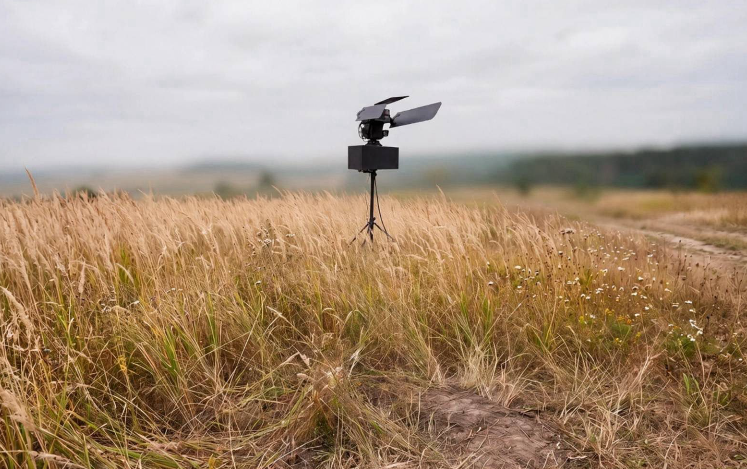
The Brama system by Rebel Group. Source: Rebel Group

A Ukrainian defense company has built a single device that finds an FPV drone, reads its video feed, and jams it. Rebel Group has developed Brama, a stationary electronic warfare and reconnaissance system to counter FPV drones, which it plans to codify for use by the Defense Forces, the company's press service told Oboronka.

Brama can both detect a drone's signal and jam it, allowing an operator to move from spotting a drone to suppressing it.

Two jobs from one point

Brama can detect the frequency of an analog video signal, decode it, and then apply directed electronic warfare to suppress both the video channel and the drone's control link, the press service explained. Once an operator receives target data and locates a drone, they can suppress it immediately without additional equipment, Militarnyi reports.

"Both functions are implemented in a single device, so the operator does not need to use additional equipment to move from detection to suppression," a Rebel Group representative says.

Rebel Group is seeking codification

Brama has already passed laboratory testing and trials in combat conditions, according to the company. It is now going through Ukraine's military codification procedure, the required step before defense equipment can be approved for broader use by the armed forces.

Its producer company, Rebel Group, specializes in electronic warfare and reconnaissance systems, and some of its equipment has already been codified and tested at the General Staff's proving grounds, the press service noted.

It joins a widening Ukrainian EW effort

Brama is one of several recent Ukrainian counter-drone systems. In July, Ukraine unveiled Lima Quant, an upgraded electronic warfare system built to defeat the advanced satellite-navigation antennas Russia now fits to Shahed drones, cruise and ballistic missiles, and guided bombs, United24 reported.

Those antennas, newer 12- and 16-element arrays, had proven resistant to earlier jammers, which is why each side keeps building the next countermeasure as the other adapts.

  • ✇Euromaidan Press
  • 800 jet drones in four days: Russia is now firing type Ukraine’s interceptors cannot catch
    More than half the drones Russia fired at Ukraine over the past four days were jet-powered, and Kyiv was the main target. Of the more than 1,500 drones launched, about 800 were jet-powered, Colonel Yurii Ihnat, head of the communications department of Ukraine's Air Force Command, said, UNIAN reports. A massive attack on Kyiv and the Kyiv region began on 27 August, two days after US Central Intelligence Agency (CIA) Director John Ratcliffe’s visit to Moscow. According t
     

800 jet drones in four days: Russia is now firing type Ukraine’s interceptors cannot catch

31 août 2026 à 15:36

A fire burns at a Nova Poshta fulfillment and sorting center in Sviatopetrivske, Kyiv Oblast, after a Russian drone strike on 28 August 2026. More than 60,000 books were destroyed in the attack. Photo: Readeat

More than half the drones Russia fired at Ukraine over the past four days were jet-powered, and Kyiv was the main target. Of the more than 1,500 drones launched, about 800 were jet-powered, Colonel Yurii Ihnat, head of the communications department of Ukraine's Air Force Command, said, UNIAN reports.

A massive attack on Kyiv and the Kyiv region began on 27 August, two days after US Central Intelligence Agency (CIA) Director John Ratcliffe’s visit to Moscow. According to President Donald Trump, the visit was related to efforts to broker an end to Russia’s war against Ukraine, per Sky News.

Previous interceptors won't work

The attack on Kyiv and the surrounding region, accompanied by repeated air-raid alerts, has continued for all five days since then.

A jet-powered Shahed is a version of the strike drone fitted with a turbojet engine in place of a propeller, which makes it three times faster and far harder to shoot down.

Ukraine intercepts about 88 to 90 percent of all drones, but the rate against jet-powered ones is lower precisely because of their speed, Ihnat noted.

The problem is structural: Ukraine's interceptor drones reach roughly 300 kilometers per hour and physically cannot catch a target moving faster and flying at about five kilometers' altitude, beyond the reach of mobile fire teams and portable SAM systems.

Russia adds jet drones every month

Moscow began using jet-powered UAVs in large numbers in July, launching five times as many as in June, Ihnat noted. Their number may rise further by the end of August, he added.

The jet-drone attacks come from every direction. Ihnat said the debris of recovered Shaheds shows they were manufactured just two weeks earlier, meaning production is running without pause.

Banderols fly like cruise missiles

Russia has also stepped up its use of Banderols, systems that combine features of drones and missiles and fly at up to 600 kilometers per hour, Ihnat said. They are harder to shoot down, so short-range surface-to-air missile systems and aircraft with air-to-air missiles are used against them.

Jet-powered drones are significantly more expensive than conventional ones, Ihnat noted.

The strikes hit specific targets

Russia's attacks are aimed not only at psychological pressure on the capital's residents but at specific targets, Ihnat said. These are logistics and shopping centers, postal terminals, critical infrastructure, and other strategic sites.

Strikes of this kind have destroyed about 90 percent of Ukraine's modern warehouse space in recent weeks and slowed grain exports through the Black Sea corridor.

“In intercepts, they’re screaming”: Russia occupied this spit to control Ukraine’s ports. Military says it has now isolated 2,500-strong grouping and destroyed all its artillery

31 août 2026 à 12:06

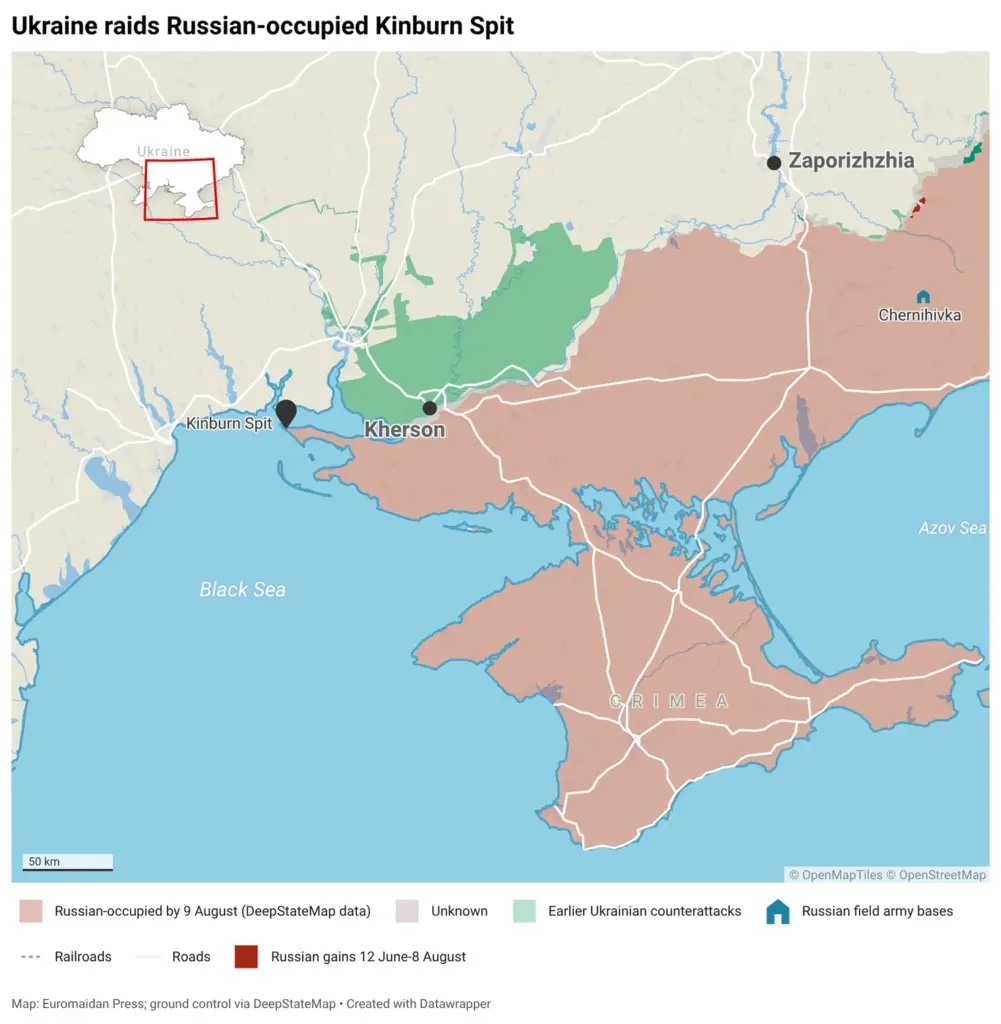
Location of Kinburn Spit. Map: Euromaidan Press

Ukrainian troops say they have trapped about 2,500 Russian soldiers on the Kinburn Spit. Systematic drone strikes and remote mining have let them cut the Russian supply lines and destroy almost all of Russia's artillery on the spit, scouts told Radio Free Europe/Radio Liberty's "Crimea.Realities" project.

The Kinburn Spit is a narrow sandy peninsula about 40 kilometers long, between the Dnipro-Buh Estuary and the Black Sea, the last part of Mykolaiv Oblast that Russia has held since 2022. Whoever controls the spit controls the sea exit from the ports, which is why Moscow kept artillery there to shell the southern coast, said former Head of the Mykolaiv Regional State Administration Vitali Kim.

Now, the troops say, Russia can reach the coastal zone of Mykolaiv Oblast only with long-range guns from occupied Kherson Oblast.

Supply runs through a single corridor

The Russian force has one way in — a single land route Ukrainian troops keep under fire, from Zaliznyi Port through Heroiske.

"Our task here is to neutralize everything that drives onto the Kinburn Spit. Since we started destroying Russian troops at a rapid pace, they cannot bring in anything effective," reconnaissance unit commander with the call sign "Yava" explained.

A scout calls the spit a trap

Intercepts show panic among the Russian units, the troops say.

"In the intercepts, they're screaming that they can't do logistics, that they don't want to go in, because it's death. The road is cut, and they have very little ammunition. The spit is a trap for them," the scout said.

Mining the supply routes is the main method

The problem, the troops say, is that the occupiers disguise themselves as civilians, changing into civilian clothes, which places limits on when Ukrainian soldiers can strike. The main method is catching the Russians on logistics by mining their routes.

"A vehicle hit a mine that was dropped maybe a week ago, maybe yesterday. The first thing is cutting Russia's logistics — the vehicles, the resupply by quad bikes and motorcycles," deputy reconnaissance company commander with the call sign "Holova" explained.

About $150 for airframe, about $875 for finished glider: Ukraine’s BlueBird is selling its drone at every stage of assembly

31 août 2026 à 11:33

The Bebradron KIT. Source: BlueBird Tech

A Ukrainian drone maker is selling its unmanned aerial vehicle as a kit that users assemble themselves. BlueBird Tech has unveiled the Bebradrone Kit, a modular drone whose configuration the buying unit sets when it orders, choosing the control system, video transmitter, camera, flight electronics, and navigation gear, Defender Media reports.

The name Bebradron comes from the Ukrainian joke meme “nyukhai bebru” (“sniff the bebra”), a humorous euphemism for the male genitalia.

The airframe comes in three grades

Units choose how much is pre-assembled. The Base version is a bare mechanical airframe for self-installation, at about $150, according to Brave1 Market. The ARF adds pre-installed motors for about $335, and the Pro comes with a configured flight controller for about $130.

A fully built Bebradrone glider without added configuration runs about $875 on the marketplace. BlueBird also offers a custom option, with its own engineers selecting and integrating equipment for a specific mission.

The specifications hold in the base build

In its base configuration, the Bebradrone Kit cruises at 90 kilometers per hour and reaches up to 150. Its tactical radius is up to 45 kilometers, and it carries up to 7.5 kilograms.

Flight time can reach 30 minutes, with a working altitude of 150 to 500 meters. The drone launches from a pneumatic catapult, which needs no runway or prepared strip.

The company grew from a volunteer group

BlueBird describes itself as having started with a small group of enthusiasts testing drone ideas and learning from their own mistakes. That grew into an R&D operation and production workshops, with separate units for development, manufacturing, quality control, service, and military contact.

The company now employs more than 350 specialists across several Ukrainian cities, building electronic warfare, drone detection, strike FPV, and communications systems. Its products are tested under real-world conditions and refined based on feedback from the front lines.

  • ✇Euromaidan Press
  • Fired Ukrainian minister offers to help build America’s drone army— for Patriot missiles in return
    Ukraine's former defense minister Mykhailo Fedorov has offered to help the United States build a fleet of attack drones if Washington sends Ukraine the Patriot interceptor missiles it needs to get through winter, he told the Financial Times. The idea is Fedorov's own proposal, not a deal, and he holds no government post that would let him negotiate one for Kyiv. He is in Washington mainly to raise American money for a fund that would both invest in Ukrainian defense-tech c
     

Fired Ukrainian minister offers to help build America’s drone army— for Patriot missiles in return

31 août 2026 à 10:06

mykhailo fedorov

Ukraine's former defense minister Mykhailo Fedorov has offered to help the United States build a fleet of attack drones if Washington sends Ukraine the Patriot interceptor missiles it needs to get through winter, he told the Financial Times. The idea is Fedorov's own proposal, not a deal, and he holds no government post that would let him negotiate one for Kyiv. He is in Washington mainly to raise American money for a fund that would both invest in Ukrainian defense-tech companies and build new ones of its own.

Over the past year, Ukraine's partners have shifted from handing over weapons off their shelves to funding and co-producing Ukrainian-designed drones and missiles, inside and outside the country.

What the fund would do

Fedorov used his working trip to Washington to line up venture funds, entrepreneurs and tech companies as backers, Suspilne reported. The fund would not simply invest in existing Ukrainian defense-tech firms, he wrote; it would also create new companies around the technologies the front line needs most. He set out three targets: battlefield robots to replace soldiers in the most dangerous positions, jet-powered interceptor drones to bring down Russia's faster new attack drones, and cheap missiles that use artificial intelligence. He did not say what his own role would be, or whether he would profit. He said the next step is to assemble a team and launch the first projects.

A column of protesters demanding reinstatement of Mykhailo Fedorov as Defense MInister walks in vul. Khreschatyk in Kyiv, 1 August 2026. Photo: Serge Kostezh/Kyivpost
Explore further

The Fedorov protesters lost. But they backed a man for what he built, not what he promised—and that may be new in Ukraine.

The interceptors behind the offer

Fedorov framed the drone help as a straight swap.

"I'm ready to make that trade," he told the FT.

Ukraine is running low on interceptor missiles for its Patriot batteries, one of the few air-defense systems able to reliably stop Russia's ballistic missiles. Fedorov declined to say whether he would meet anyone from the Trump administration.

Ukraine's ex-minister turns open critic

President Volodymyr Zelenskyy dismissed Fedorov on 15 July, after six months in the job. Fedorov said a feud with Commander-in-Chief Oleksandr Syrskyi, who he says blocked his reforms, drove the split, Zelenskyy removed Syrskyi on 21 July as protests spread. in an interview with Reuters published on 25 August.

"it looks as though we're gradually, slowly losing," he said in an interview with Reuters.

  • ✇Euromaidan Press
  • The US built itself a Russo-Ukrainian drone-war drill—Poland is the first ally in
    US Army Green Berets have begun training Poland's special forces to move and strike on the kind of drone-saturated ground Ukraine fights on, the Associated Press reported. No ally besides the US had taken on the drone-heavy drill until now, and US instructors built it only months ago from Ukraine's battlefield lessons. Ukraine has turned from an aid recipient into a source of tactics, feeding allies the counter-drone methods and strike tactics it forged against Russia's
     

The US built itself a Russo-Ukrainian drone-war drill—Poland is the first ally in

31 août 2026 à 08:59

Green Berets during Falcon Talon 2022 military exercise in Pakistan

US Army Green Berets have begun training Poland's special forces to move and strike on the kind of drone-saturated ground Ukraine fights on, the Associated Press reported. No ally besides the US had taken on the drone-heavy drill until now, and US instructors built it only months ago from Ukraine's battlefield lessons.

Ukraine has turned from an aid recipient into a source of tactics, feeding allies the counter-drone methods and strike tactics it forged against Russia's invasion. NATO is still behind: an alliance war game in February exposed how badly its own forces fare against drone warfare of that kind.

Bavaria plays the part of Russia

The drill spans a 1,100-square-mile (3,000 km²) stretch of Bavarian countryside around the US Army's Hohenfels training center, an hour southeast of Nuremberg. Polish commandos must slip past a US airborne unit playing the enemy, then move about 60 miles (100 km) north to Grafenwoehr and blow up a mock target.

In earlier runs, Green Berets removed their uniforms to blend in, a senior enlisted soldier familiar with the scenario said. He and a Green Beret officer at the training complex spoke anonymously, under a US policy against naming special forces personnel.

"This is supposed to be Russia and you're going to stand out in Russia," he said.

Farms, villages, cameras, and a populous city line the route. German civilians, largely unaware of the exercise, become the test: any tip they phone to police can help the military pinpoint the team. Once a team is spotted, "now you have the entire Russian arsenal coming at you," the soldier said. The US side can send military police with dogs or direct more drones to the area, and had more than 100 available in earlier runs.

British defense firm to maintain UK-donated artillery in Ukraine under new deal
Explore further

Ukraine’s drones crushed a US armored brigade in a war game in Germany

Allies want Ukraine's lessons—the US Army is stepping back

A Green Beret officer said the drill tries to replicate "all of those effects that we're seeing either Russia or Ukraine having to overcome." Ukraine pioneered this kind of drone warfare across four and a half years of fighting Russia. Its combat experience has been entering NATO training elsewhere in Poland, and its drone crews recently outmatched a US brigade in another German drill. The exercise has run just twice before, both this year with US teams, and the officer said he expects most, if not all, of NATO's 32 members to show interest in trying it.

The wider US message on drones has been mixed, AP said. On 20 August, the Army's acting chief of staff ordered a Europe-based drone unit back to infantry duty. US President Donald Trump has also wavered on cutting troop levels in Europe, and his administration launched a force review.

Ukrainian President Volodymyr Zelenskyy said in March that Ukraine was already helping five Middle East and Gulf states counter Iranian drones fired during the US-Israeli war on Iran, and that US and European governments had asked for help too, AP reported.

❌