❌

Vue normale

  • ✇Euromaidan Press
  • For the 17th or 18th time, Putin promised to take Donetsk “in a few months” – Zelenskyy
    Russian President Vladimir Putin has again told US officials that Russia can capture Ukraine’s Donetsk Oblast within several months, according to Ukrainian President Volodymyr Zelenskyy. Speaking to the UN General Assembly on 24 September, Zelenskyy said this was the latest in a long series of similar promises as Russia has spent nearly five years trying to seize the region. He said Putin has made such promises 17 or 18 times, repeatedly pushing the deadline further back. He contrast
     

For the 17th or 18th time, Putin promised to take Donetsk “in a few months” – Zelenskyy

24 septembre 2026 à 15:36

Ukrainian President Volodymyr Zelenskyy speaks during the UN General Assembly in New York on 24 September 2026. Photo: Ukrainian President's Office

Russian President Vladimir Putin has again told US officials that Russia can capture Ukraine’s Donetsk Oblast within several months, according to Ukrainian President Volodymyr Zelenskyy.

Speaking to the UN General Assembly on 24 September, Zelenskyy said this was the latest in a long series of similar promises as Russia has spent nearly five years trying to seize the region. He said Putin has made such promises 17 or 18 times, repeatedly pushing the deadline further back.

He contrasted those promises with Russia’s heavy battlefield losses and relatively limited territorial gains.

Russia has paid a huge price for its Donetsk offensive

Zelenskyy said Russian forces suffered 248,964 troops killed or severely wounded between January and August 2026.

He said Russia had captured only slightly more than 1,000 square kilometers of Ukrainian territory this year, while Ukraine had already liberated a significant portion of those gains.

Zelenskyy presented the figures as the human cost of Putin’s continued attempt to seize Donetsk, arguing that Russia is paying an enormous price for relatively limited territorial gains.

“Always the same: ‘Just a few more months,’” Zelenskyy said, adding that Putin would again fail to meet his latest deadline.

The Russian offensive is also facing a recent setback in northern Donetsk. Ukraine launched Operation Vivaldi in September to clear Russian infiltrators and retake ground near Lyman, disrupting Russia’s plan to encircle the fortified cities of the Donetsk “Fortress Belt.”

Ukrainian forces have reported retaking several settlements and clearing up to 125 square kilometers in the operation, although the full scope of the offensive remains undisclosed.
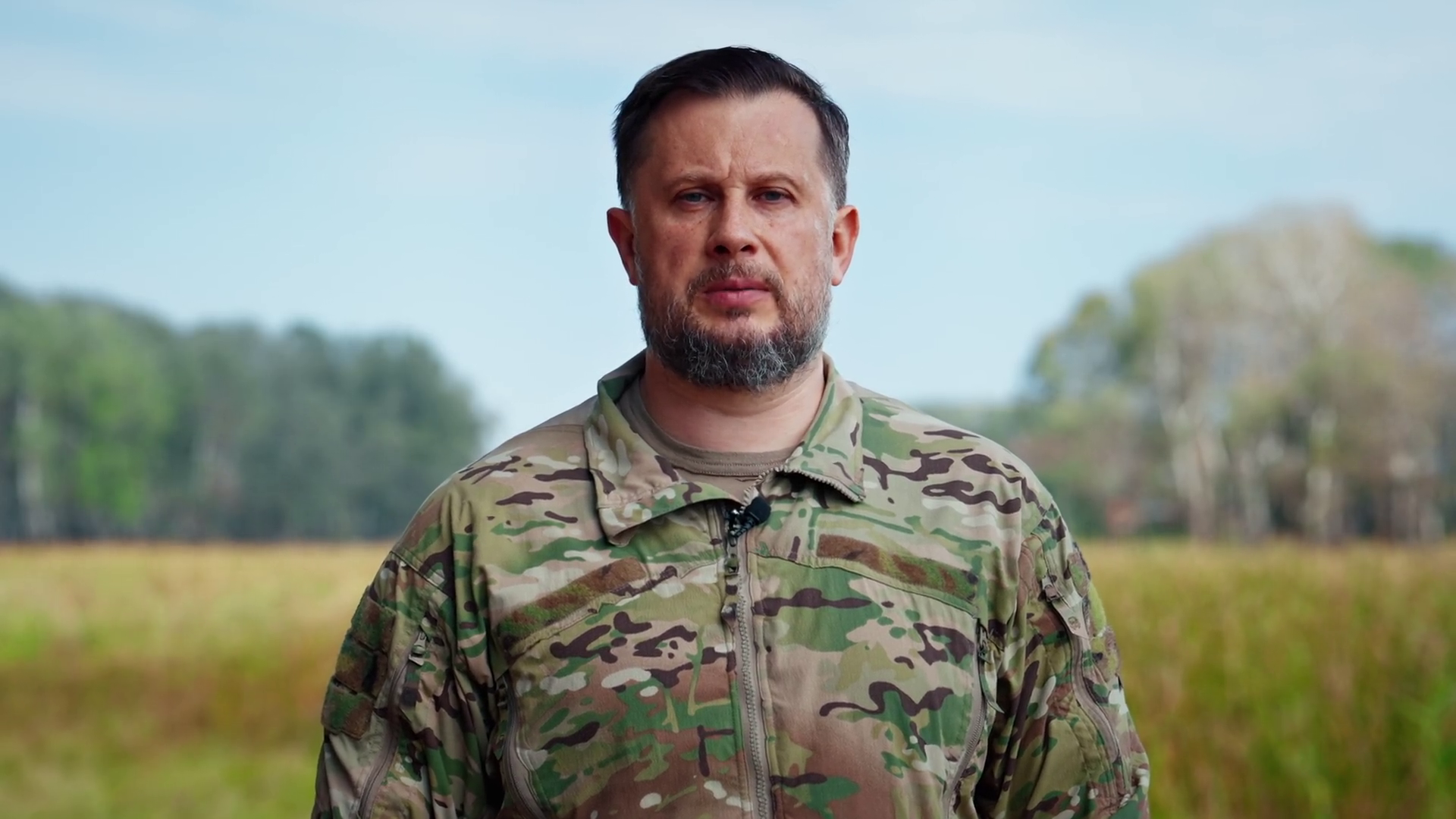
Ukraine's Third Army Corps commander Brigadier General Andrii Biletskyi announcing new developments in "Operation Vivaldi," 20 September 2026. Screenshot from video: Ukraine's Third Army Corps
Explore further

Ukraine retakes ground in a region Russia has fought for years to capture. “Vivaldi” is only getting started but is already “one of the most important victories for Ukraine in 2026”

Zelenskyy also warned that Russia’s ambitions extend beyond Donetsk. After saying Putin would again fail to capture the region, he said Russia would continue seeking other Ukrainian cities, naming Odesa, Kharkiv and Dnipro, while also pointing to Russian pressure on Moldova and threats toward Poland and the Baltic states.

Russia continues to pour missiles and drones into Ukraine

The battlefield campaign has been accompanied by a sustained Russian long-range attack campaign against Ukrainian cities and infrastructure.

Since the beginning of 2026, Russia has launched more than 2,100 missiles against Ukraine, including more than 950 ballistic missiles, according to Zelenskyy.

Ballistic missiles are particularly difficult for Ukraine to counter because it has a limited supply of interceptors capable of engaging them. Russia’s heavy use of ballistic weapons is therefore contributing directly to civilian deaths and infrastructure destruction.

Over the first eight months of the year, Russia also used 63,000 attack drones of various types, Zelenskyy said. More than 7,700 were jet-powered Geran drones, which he described as particularly destructive and dangerous.

The newer jet-powered drones are faster and more advanced than earlier Shahed-type models, making them harder to intercept and adding to the pressure on Ukraine’s air defenses as Russia attacks cities and infrastructure.

Zelenskyy said Russia was using the drones continuously to disrupt economic activity and normal life in Ukrainian cities, including by making it harder for children to attend school.

The figures show the scale of the Russian campaign beyond the front line. Alongside its ground offensive, Russia is using sustained missile and drone strikes to kill civilians, destroy infrastructure, and exhaust Ukraine’s air-defense resources.

North Korean troops add to Russia’s war effort

Zelenskyy also highlighted North Korea’s direct involvement in Russia’s war, saying its troops have suffered heavy losses while gaining battlefield experience alongside Russian forces.

He said North Korea’s military capabilities were also benefiting from its cooperation with Russia, pointing to improvements in its ballistic missiles and drone capabilities.

Ukraine recently transferred two North Korean prisoners of war to South Korea. Zelenskyy said capturing the soldiers alive had been difficult and described one prisoner’s attempt to take his own life after realizing he was about to be captured.

He said the soldiers had been conditioned to believe they had to die rather than surrender.

“Do you really want to give such a force more time to learn how to fight?” Zelenskyy asked.

Zelenskyy calls for de-escalation before winter

Zelenskyy separately warned that Russia could again target Ukraine’s energy and heating infrastructure this winter.

Russia has already intensified attacks on Ukraine’s energy system ahead of the cold season.

Russia has also explicitly threatened to “freeze” Ukraine this winter, with its Defense Ministry linking the threat to attacks on Ukrainian infrastructure. The country spent much of the previous winter dealing with the consequences of Russian strikes on power and heating infrastructure, including blackouts and disruptions to heat supplies.

Zelenskyy said Ukraine expects the coming winter to be difficult but warned that if Russia continues attacking Ukraine’s energy and heating systems, Ukraine will make the winter painful for Russia as well.

He called for steps toward de-escalation before winter, saying that diplomacy and military strength were both needed to end the war.

Zelenskyy asks Japan for air-defense technology and offers Ukraine’s drones in return, while courting Chile to expand Ukraine’s reach in Latin America

24 septembre 2026 à 06:43

Volodymyr Zelenskyy and Sanae Takaichi at a meeting in New York.

Ukrainian President Volodymyr Zelenskyy has used the UN General Assembly in New York to court partners outside Ukraine's NATO core, pitching air-defense cooperation with Japan and drone cooperation with Chile, Ukrainska Pravda reported. In a single day of bilateral talks, he met Japan's Prime Minister Sanae Takaichi, Chile's President José Antonio Kast, and UK Prime Minister Andy Burnham.

The meetings turned on shielding civilian infrastructure before winter and trading Ukraine's battlefield-tested technology for capabilities it still needs. More than four years into Russia's war, a nation that entered the war reliant on donated arms now iterates drones faster than many of its Western backers, and that expertise has become leverage in its own diplomacy.

Zelenskyy pitches Ukraine's know-how for Japan's air-defense tech

In their first summit meeting, Zelenskyy cast the relationship as a two-way exchange.

"Ukraine is ready to share its experience and technologies on a mutually beneficial basis," he said.

While Japan has advanced technologies for protecting lives, particularly in air defense, that could carry Ukraine through the winter if Russia again rejects talks, the President's Office reported.

Ukraine walks into winter with two air-defense problems. It is still testing home-built interceptors to catch Russia's jet-powered drones. And it does not have enough Patriot interceptors to stop ballistic missiles over its cities. Japan holds the key to the second one.

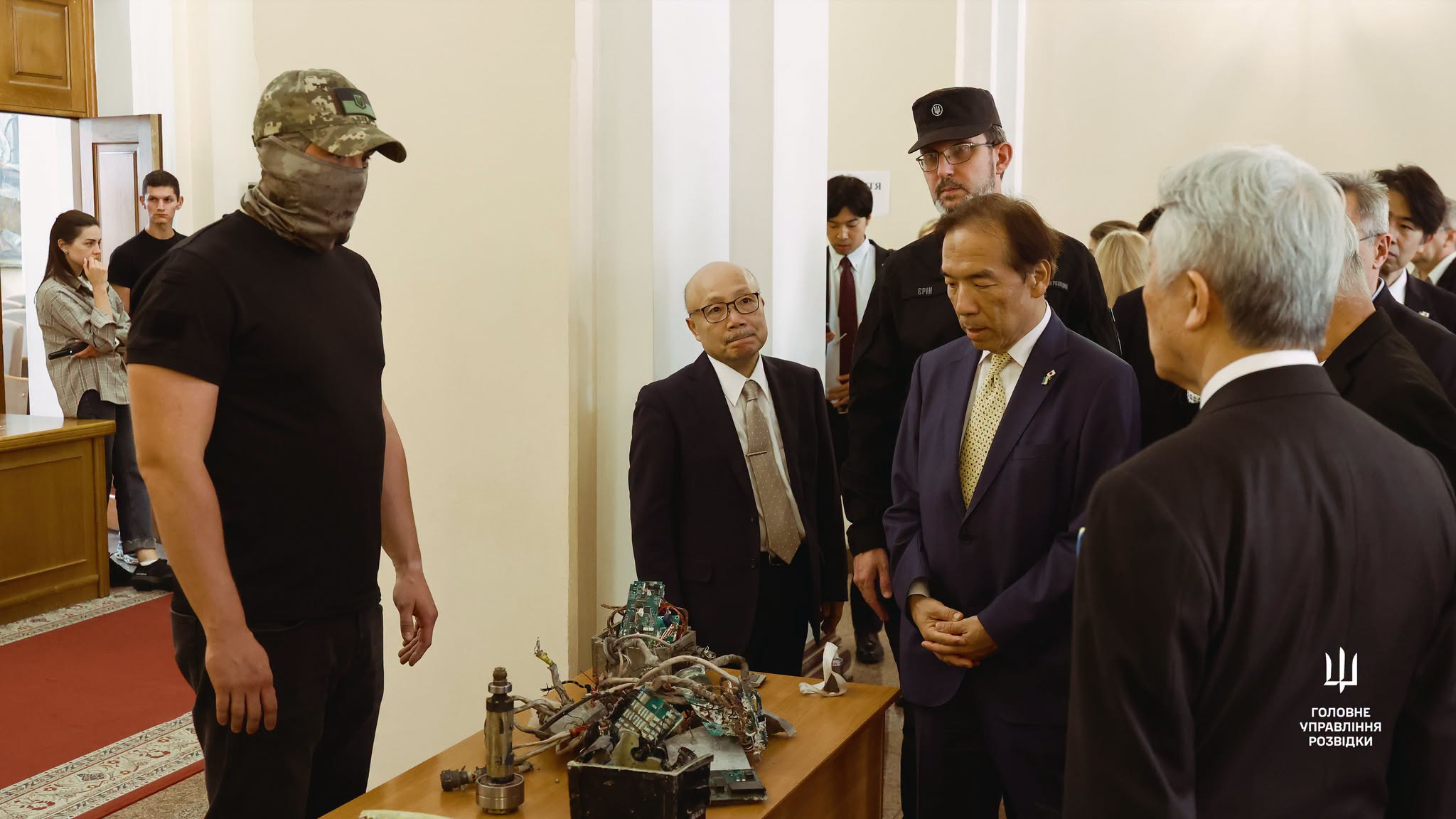
Ukraine's Defense Intelligence has given Eisuke Mori, speaker of Japan's House of Representatives, a close look at a North Korean weapon: the components of a ballistic missile Russia fired at Ukraine. Source: Ukraine's Defense Intelligence
Explore further

North Korea has fired around 150 ballistic missiles at Ukraine, learning from each one. Same missiles threaten Japan, and Kyiv just shows its speaker what is inside them

Mitsubishi Heavy Industries runs the only plant outside the US licensed to assemble the PAC-3, the advanced Patriot interceptor. Japan is also the sole maker of the guidance gyroscopes inside older PAC-2 missiles. It has already shipped Japanese-made PAC-3s to the US to refill stocks drained by transfers to Ukraine, and Zelenskyy has floated Mitsubishi as the model for Ukraine's own Patriot line.

The exchange runs both ways. Russia keeps pressing Japan over the Kuril Islands the Soviet Union seized in 1945. Against that backdrop, Ukraine's combat-tested drones could appeal to Tokyo. Kyiv offers the drone know-how it now leads in, and asks for the air-defense edge Japan already has.

Zelenskyy also thanked Tokyo for its sanctions on Russia, energy packages, and humanitarian projects, and Takaichi assured him of continued support. Zelenskyy invited her to Ukraine, including the Kyiv-Pechersk Lavra, which Japan helped restore after a Russian drone strike in June.

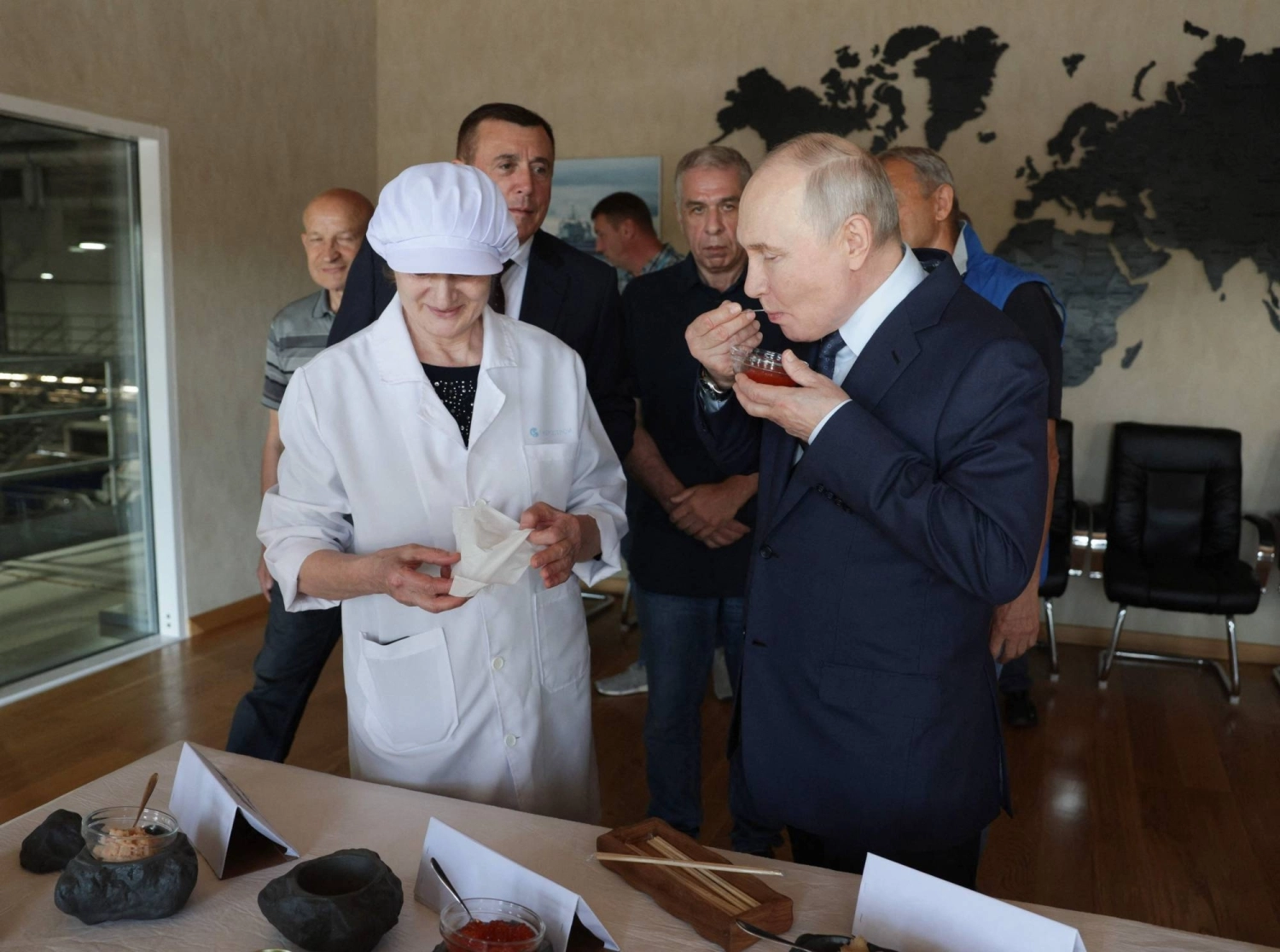
Vladimir Putin visits Etorofu island,
Explore further

Japan weighs sanctions after Putin’s first visit to disputed Kuril Islands

Chile opens a door to Latin America

With Kast, Zelenskyy discussed deepening security and drone-technology ties and thanked Chile for backing Ukraine at international forums and for helping return Ukrainian children abducted by Russia. He welcomed Santiago's willingness to help expand Ukraine's presence across Latin America, calling it an opening for "even more promising opportunities," and invited Kast to visit.

Building on ties already in place

Both partnerships rest on existing ground. Japan, barred by its own laws from sending lethal weapons, has delivered generators, transformers, and non-lethal gear, pledged a $6 billion package for 2026, and agreed to help rebuild the Lavra through UNESCO. Talks in Tokyo in July recast Ukraine as a security partner rather than an aid recipient.

Chile joined the coalition to bring abducted Ukrainian children home and, in an April call, heard Zelenskyy float a security arrangement modeled on Ukraine's Gulf-state pacts. The outreach tracks Kyiv's drive to turn its wartime industry into an export business under its "Drone Deals" framework.

  • ✇Euromaidan Press
  • Russia fabricates Dobropillia encirclement to strengthen its case for Kyiv’s capitulation at UN – ISW
    Russia’s Defense Ministry claimed on 22 September 2026 that it had surrounded Dobropillia, but the Institute for the Study of War (ISW) found no evidence to support the announcement. Dobropillia is a small town in Donetsk Oblast, known as the "pearl of the Donbas" for its coal industry, which has helped make Ukraine's Fortress Belt cities, holding the region from Russians since 2014, per RBC Ukraine. Ukraine’s Vivaldi counteroffensive in Donetsk Oblast broke the northern arm of Russia’s
     

Russia fabricates Dobropillia encirclement to strengthen its case for Kyiv’s capitulation at UN – ISW

23 septembre 2026 à 14:13

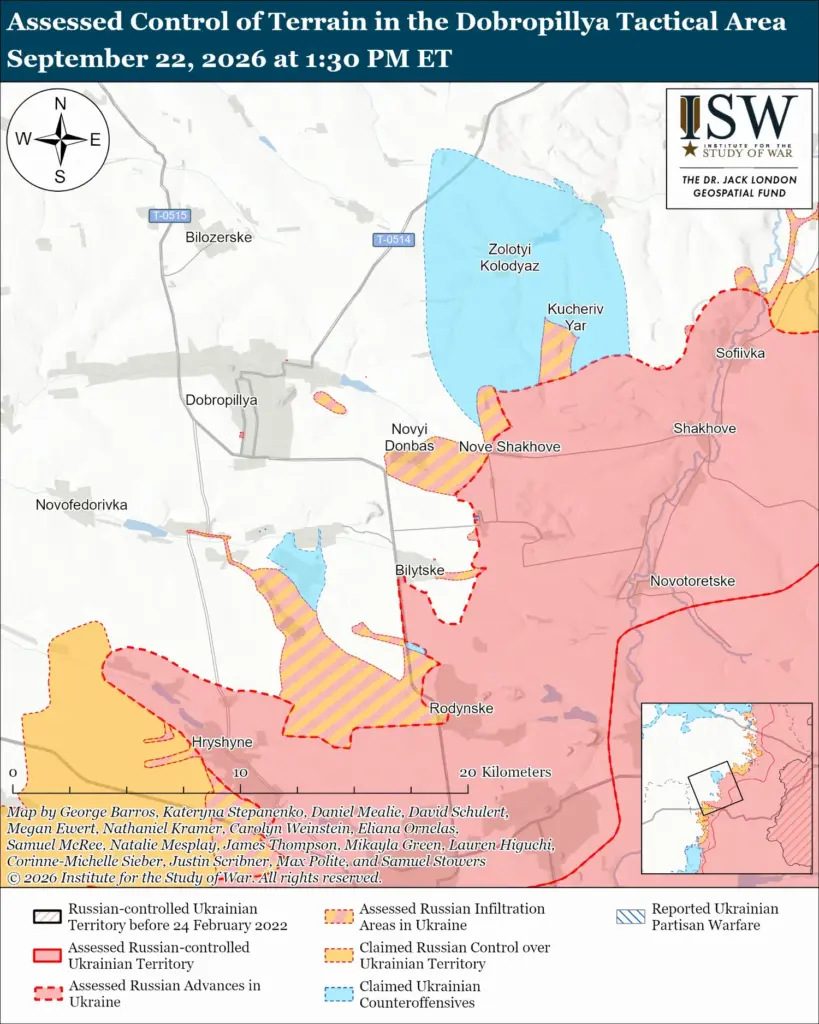
Map of Dobropillia and nearby towns, with Russian-controlled territory shaded pink mainly to the east and south, striped areas marking Russian infiltration, and blue areas marking claimed Ukrainian counteroffensives. Dobropillia is not shown as encircled.

Russia’s Defense Ministry claimed on 22 September 2026 that it had surrounded Dobropillia, but the Institute for the Study of War (ISW) found no evidence to support the announcement. Dobropillia is a small town in Donetsk Oblast, known as the "pearl of the Donbas" for its coal industry, which has helped make Ukraine's Fortress Belt cities, holding the region from Russians since 2014, per RBC Ukraine.

Ukraine’s Vivaldi counteroffensive in Donetsk Oblast broke the northern arm of Russia’s plan to surround the fortified cities. ISW says Moscow’s Dobropillia claim diverts attention from that setback and portrays Ukrainian defenses as collapsing during the 81st session of the UN General Assembly, held on 21-28 September. The institute says Russia is likely spreading such claims to support its push for Ukraine’s capitulation.

Meanwhile, Ukrainian officers say Russian assault groups are still trying to break through toward Dobropillia, but have made no major gains.

Russia’s encirclement claim clashes with Ukrainian battlefield reports

Russia’s Ministry of Defense has claimed its troops were advancing toward Oleksandrivka, a village northwest of Dobropillia, but published no map to support its account.

At the same time, Ukrainian military observer Kostyantyn Mashovets said Ukrainian troops still held positions south and northeast of the city, which the experts said was inconsistent with the claimed encirclement.

ISW reported that a Ukrainian artillery reconnaissance battalion chief of staff said on 22 September that Russia had made no major advances near Dobropillia. He said Russian commanders kept postponing deadlines because of heavy losses and a gap between their plans and battlefield conditions.

A Ukrainian battalion officer said Russian troops were still trying to slip through Ukrainian lines in small groups.

How Dobropillia fits Russia’s plan to surround the fortress belt

Dobropillia is a transport hub on the southwestern approach to Ukraine’s “fortress belt,” which includes Kostiantynivka, Druzhkivka, Kramatorsk, and Sloviansk. These cities have anchored Ukraine’s defense in Donetsk Oblast since 2022.

Ukraine’s Third Army Corps commander, Andrii Biletskyi, whose corps is conducting the Vivaldi counteroffensive north of Lyman, explained that Russian forces advancing through Dobropillia were meant to join another force coming from north of Lyman, behind the fortified cities, encircling them rather than attacking them head-on.

Andrii Biletskyi, commander of Ukraine’s Third Army Corps, stands outdoors in camouflage beside an orange “Operation Vivaldi” graphic.
Ukraine’s Third Army Corps commander, Brigadier General Andrii Biletskyi, announced “Operation Vivaldi” on 15 September 2026. Source: screenshot from Ukraine’s Third Army Corps announcement of Vivaldi

ISW had already assessed on 16 September that Vivaldi had made the two-sided plan infeasible. In its 22 September report, ISW said Russia’s false claim about Dobropillia partly aims to divert attention from those Ukrainian gains.

Russian assaults toward Dobropillia continue

The setback north of Lyman has not stopped Russia’s push toward Dobropillia. Ukrainian staff sergeant Dmytro Davydenko reported on 14 September a sharp increase in assault groups moving toward the city, sometimes more than his unit could engage. He said Ukrainian troops had mined, blocked, or destroyed the main approaches.

ISW reported that Russia was preparing armor and drone support for possible assaults using armored vehicles this fall. A Ukrainian battalion officer said fog might help Russia move that equipment, although Ukrainian reconnaissance and drones would make it difficult. He said Russian glide bombs continued to strike infrastructure in the area.

  • ✇Euromaidan Press
  • “Food must never be used as a weapon”: EU calls for Black Sea attack moratorium
    EU foreign-policy chief Kaja Kallas called for a moratorium on attacks in the Black Sea to restore safe navigation and allow Ukraine's grain exports to reach global markets. She made the call at a UN General Assembly side event co-chaired with the foreign ministers of France, Romania, and Ukraine on 22 September in New York. Since June, Russia has systematically struck Ukrainian ports, grain terminals, and commercial cargo ships in the Black Sea, killing crew members and crippling the e
     

“Food must never be used as a weapon”: EU calls for Black Sea attack moratorium

23 septembre 2026 à 12:27

food never used weapon eu calls black sea attack moratorium · post foreign-policy chief kaja kallas speaks press stakeout during un general assembly new york 23 2026 ukraine news ukrainian

EU foreign-policy chief Kaja Kallas called for a moratorium on attacks in the Black Sea to restore safe navigation and allow Ukraine's grain exports to reach global markets. She made the call at a UN General Assembly side event co-chaired with the foreign ministers of France, Romania, and Ukraine on 22 September in New York.

Since June, Russia has systematically struck Ukrainian ports, grain terminals, and commercial cargo ships in the Black Sea, killing crew members and crippling the export corridor that carries the bulk of Ukraine's agricultural output. The campaign—part of Russia's broader war, now in its fifth year—has disrupted global food supply chains and pushed the Black Sea toward a crisis the EU warned could surpass the 2022 grain-price shock.

Kallas said Black Sea exports have effectively ground to a halt since August because Russian attacks made commercial shipping unviable. The Gulf conflict and climate change are adding further pressure, she said. Ukraine supplies 15% of global corn exports, 10% of wheat, 15–20% of barley, and about 50% of sunflower oil, with around 90% moving through the Black Sea corridor, Kallas said. Egypt, the world's largest wheat importer, has shifted some purchases away from Russia and Ukraine as costs have risen.

"Food must never be used as a weapon in the Black Sea or anywhere else," Kallas said. "Wars make affordable food disappear from dinner tables of millions of people around the globe."

Kallas called the proposal a new "Black Sea grain arrangement," separate from the Black Sea Grain Initiative, a 2022 deal brokered by Türkiye and the United Nations that Russia left in July 2023. She said the 2022 grain-price surge showed the strategic importance of the Black Sea for global security, international trade, energy, and food security.

She called on the international community to ensure safe passage of civilian vessels, protect critical infrastructure, and restore the trade route. If Russia simply stopped its attacks in the Black Sea, farmers, traders, and international food markets would have the predictability they need at this critical moment, she said. In 2025 alone, the EU mobilized €2.1 billion to strengthen global food security, Kallas added, and the EU Solidarity Lanes have facilitated about €304 billion in trade since May 2022.

At a press stakeout on 23 September, Kallas said the EU was "particularly concerned by the attacks in the Black Sea" and that "Russia is trying to choke off Ukrainian grain exports, thus jeopardizing global food security."

Russia has not publicly responded to Kallas's call. In August, Moscow dismissed a similar proposal relayed by Türkiye, with Foreign Ministry spokeswoman Maria Zakharova stating it saw no grounds for measures that would give Kyiv a "temporary reprieve."

A summer of strikes

Russia intensified strikes on Ukrainian ports and commercial shipping in June and July. Those strikes cut Ukrainian deepwater terminal capacity from roughly 7 million to 4–5 million metric tons per month, according to Barva Invest analyst Bohdan Kostetskyi. Ukrainian forces, in turn, struck Russia's grain terminals at Novorossiysk and Taman. Those strikes and the suspension of navigation in the Sea of Azov since July took more than 90% of Russia's Azov–Black Sea grain export capacity offline by mid-August.

The cost of sailing

The Lloyd's of London Joint War Committee has extended its high-risk designation to the entire Black Sea, pushing war-risk insurance premiums to hundreds of thousands of dollars per voyage. Alternative routes through the Danube have partly compensated, but shipping from Ukraine to Egypt has taken 26–33 days, more than twice as long as before.

For Ukraine, restoring safer navigation would reopen its largest agricultural export route, reduce reliance on slower and more expensive alternatives, and help exporters move the harvest and earn foreign currency.

The attacks have not stopped. Overnight on 23 September, Russia struck a cargo ship under an Antigua and Barbuda flag in the Black Sea, killing its captain, a Ukrainian citizen, Ukraine's sea ports administration said. The Navy evacuated the crew and put out the fire.

❌