Vue lecture

Russia’s strikes across 10 Ukrainian regions kill at least eight in 24 hours
least eight people were killed dozens more wounded russia strikes 10 ukrainian regions over 24 hours · post fire chernihiv oblast broke out result russian shelling 17 2026 chernihiv_16_08 ukraine

Russian forces shelled and struck front-line and border regions across northern, eastern, and southern Ukraine over the past 24 hours, killing at least eight civilians and wounding more than 40, regional authorities reported on 17 August. Sumy, Donetsk, Kherson, and Zaporizhzhia oblasts reported deaths, while people were wounded in Kharkiv, Kherson, Dnipropetrovsk, Chernihiv, and Odesa Oblasts.

Russia's daily strikes have hit populated areas and civilian infrastructure both near the front line and far behind it. President Volodymyr Zelenskyy said that 13 regions had come under attack over the past week, with more than 1,550 attack drones, nearly 1,560 guided aerial bombs, and 62 missiles, most of them ballistic, launched at Ukraine.
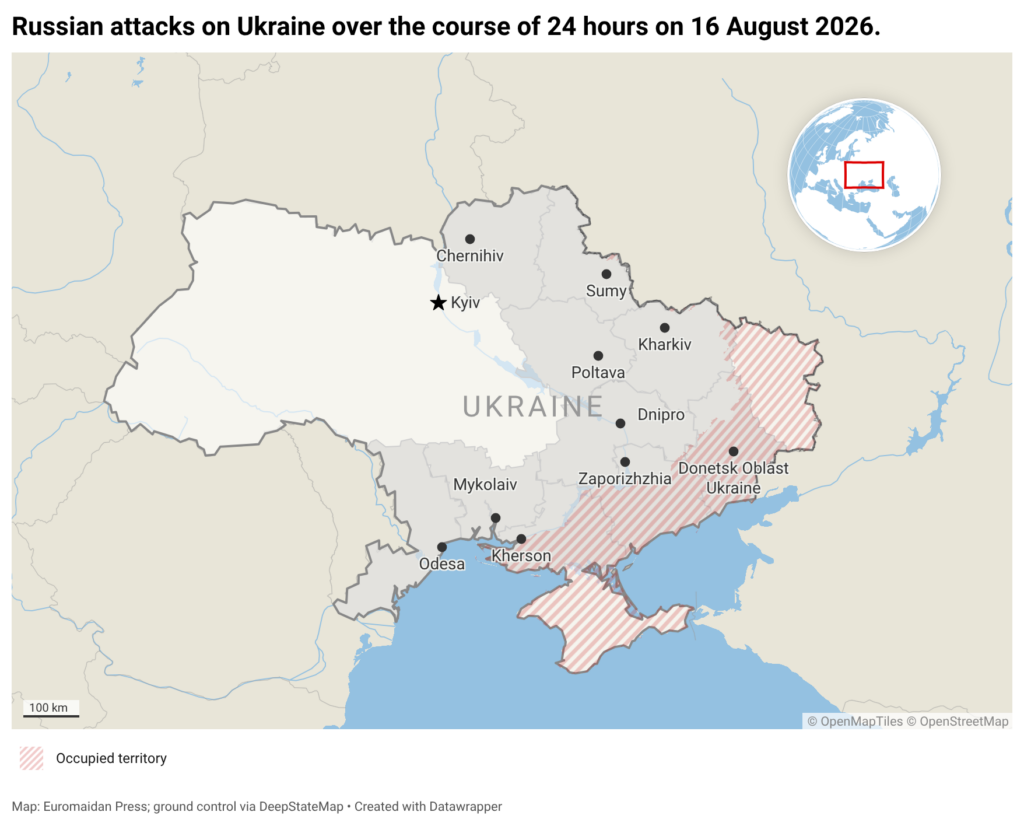
Map: Euromaidan Press

North: FPV drone attacks firefighters’ vehicle

In Sumy Oblast, Russian forces carried out more than 50 strikes on 24 settlements across 11 communities. A drone strike in the Sumy community killed a 75-year-old man and a 72-year-old woman and wounded another civilian, the Sumy military administration said. It also said two more people were wounded in the Seredyna-Buda community. A mass drone attack on Sumy caused large fires and wounded at least one person, Sumy city military administration head Serhii Kryvosheienko said.

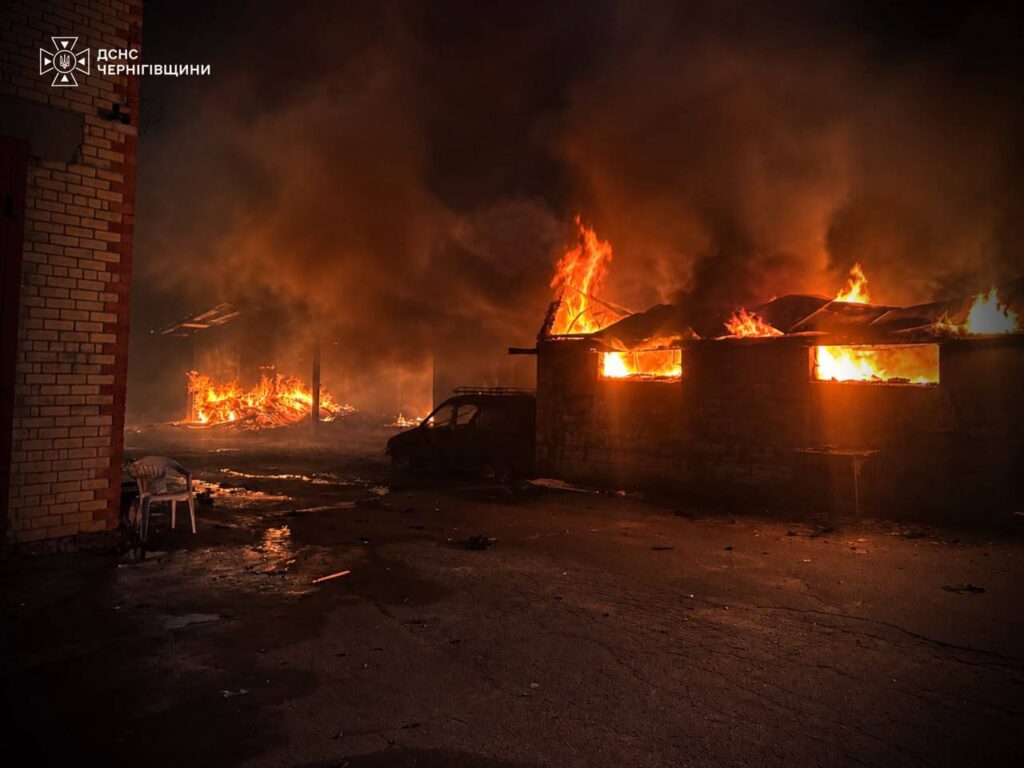
In Chernihiv Oblast, a 41-year-old man was wounded in a Geran drone strike on the Kozelets community, Head of the Regional Military Administration Viacheslav Chaus said. He added that Gerbera drones destroyed a hangar and farm equipment in the Kholmy community. In a border village in the Horodnia community, an FPV drone struck a yard, and a second FPV drone hit a firefighters' vehicle that had arrived at the scene. A house later caught fire. A critical infrastructure facility was also hit.
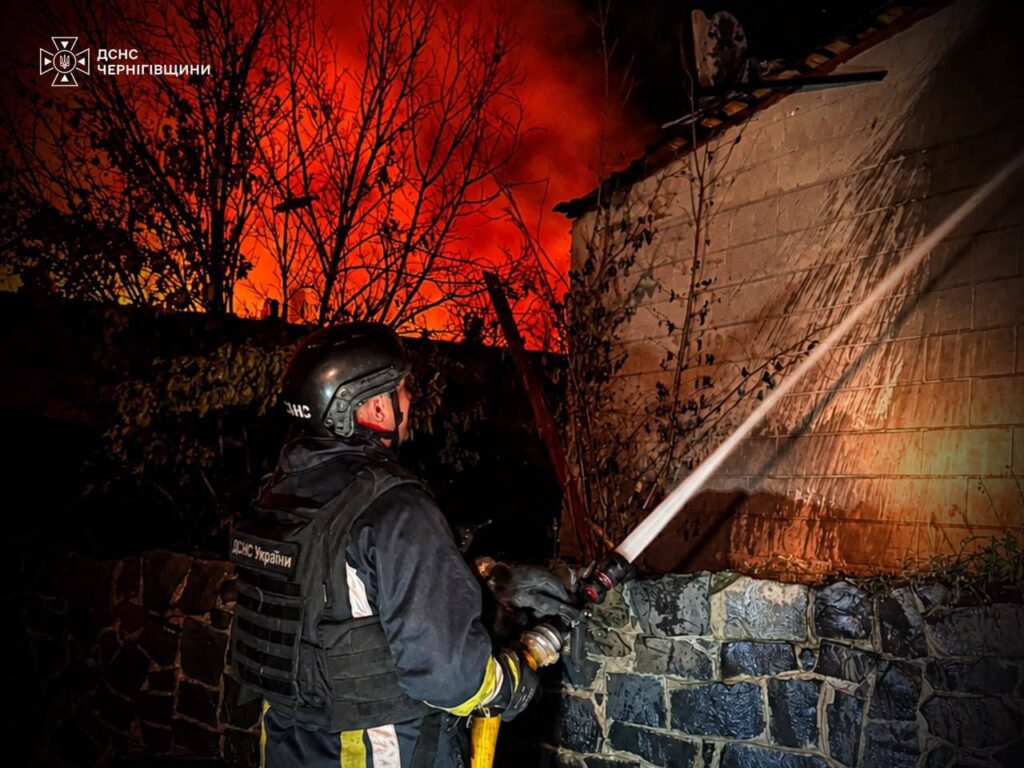
Firefighters put out a fire in Chernihiv Oblast that broke out as a result of Russian shelling. Approximately, morning of 17 August. Photo: Chernihiv Oblast State Emergency Service

In Kharkiv Oblast, six people were wounded in strikes on Kharkiv and nine other settlements. The heaviest damage was reported in Izium, where 19 houses and four apartment blocks were damaged, head of the Regional Military Administration Oleh Syniehubov said.

East: Russian strikes destroy 30 stalls

In Donetsk Oblast, Russian forces killed two residents of Kramatorsk and wounded 18 people across the region, Head of the Regional Military Administration Vadym Filashkin said. In Sloviansk, round-the-clock strikes damaged critical infrastructure and destroyed 30 stalls at the Lisnyi market, Sloviansk City Military Administration Head Vadym Liakh said.
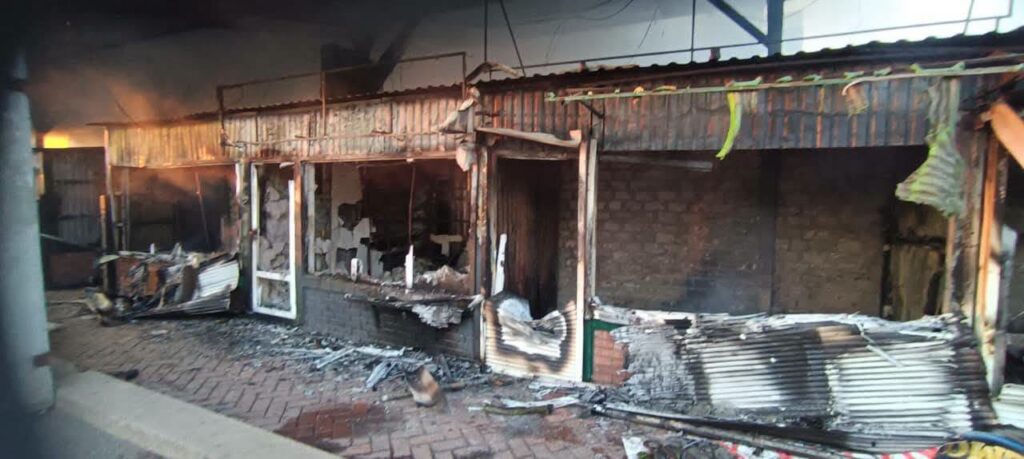
Consequences of Russian strikes on Sloviansk on 16 August and overnight into 17 August. Photo: Vadym Liakh


In Poltava Oblast, two industrial facilities were hit, causing fires, and drones also attacked another industrial facility in Myrhorod district, Head of the Regional Military Administration Vitalii Diakivnych said. No casualties were reported.

In Dnipropetrovsk Oblast, Russian forces attacked four districts nearly 20 times from the evening of 16 August, wounding five people, Head of the Regional Military Administration Oleksandr Hanzha said. He added that houses and outbuildings caught fire in Pavlohrad and Nikopol district.

In Zaporizhzhia district, two people were killed and three wounded, Head of the Regional Military Administration Ivan Fedorov said. He also reported 1,217 strikes on 60 settlements across the oblast, including 20 air strikes, about 846 drone attacks, and 350 artillery strikes.
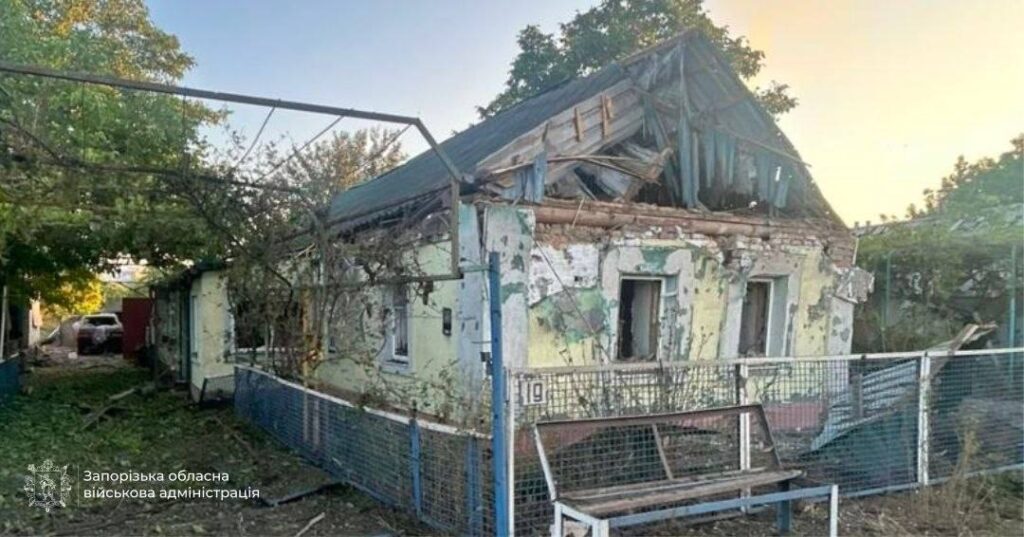
Consequences of Russian strikes on Zaporizhzhia Oblast on 16 August. Photo: Zaporizhzhia Regional Military Administration

South: strike damages civilian vessel flying the flag of Togo

In Odesa Oblast, a night-time strike on port infrastructure damaged a civilian vessel flying the flag of Togo and wounded four people, one of them seriously, Head of the Regional Military Administration Oleh Kiper said.

In Kherson Oblast, in the early morning, Russian forces killed two residents of the village of Novokayiry in the Mylivska community, – Head of the Kherson Regional State Administration Oleksandr Prokhudin said. Also russian forces attacked 52 settlements, including the regional capital. Six people were wounded, while 11 apartment blocks and 15 private houses were damaged, Prokudin said.

In Mykolaiv Oblast, Russia attacked with Shahed and Gerbera drones, but no casualties were reported, acting Head of the Regional Military Administration Heorhii Reshetilov said. He added that the roof of an agricultural enterprise building was damaged in the Horokhivska community.

  •  

Kushner Meets Netanyahu in Israel in Effort to Break Logjam Over Gaza

Prime Minister Benjamin Netanyahu of Israel has refused to pull back the country’s military until Hamas fully disarms. But the Trump administration is under pressure to show progress.

© Evan Vucci/Associated Press

Jared Kushner speaking about the Board of Peace, an organization backed by the Trump administration to end the war in Gaza, during the World Economic Forum in Davos, Switzerland, in January.
  •  

World Archery just reinstated Russia’s flag and anthem, despite its killing more than 760 Ukrainian athletes and coaches since 2022

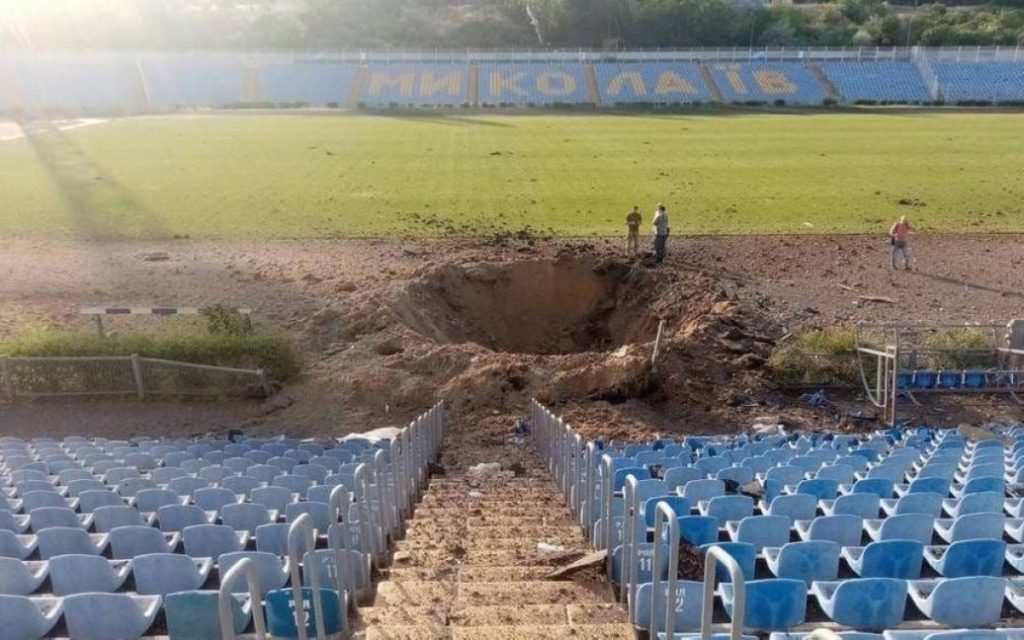
Mykolaiv stadium ruined by Russian missile strike2

An international sports body has welcomed Russia back under its flag while Russia keeps killing Ukraine's athletes and civilians. The World Archery Federation has lifted restrictions on Russian athletes, allowing them to compete with their country's identity, including under the Russian flag and anthem, the federation announced.

Russia has killed more than 760 Ukrainian athletes and coaches since the start of the full-scale war, with many others made refugees or losing loved ones to strikes on civilians, and some who took up arms without combat experience. Among them is Ukrainian archer Oleksandr Onyshchuk, a master of sport and European champion, killed fighting the occupiers.

What World Archery decided

The federation acted on an Olympic ruling. Its Executive Board met online on 14 August to review the International Olympic Committee's (IOC) 7 July decision, which confirmed that earlier recommendations restricting Russian athletes no longer applied, then lifted the restrictions on Russian athletes, teams, and officials at its events.

The Russians may now compete fully. They can take part under their national flag and anthem at events including the Archery World Cup and World Championships, and the 2022 restrictions on the Russian flag and anthem were removed, in line with a similar decision on Belarus in May. The federation said participation remains subject to standard eligibility, anti-doping, host-country, and visa requirements, and that it supports the Ukrainian archery community and all affected by the war.

Ukraine calls it sportswashing

For Ukraine, the reinstatement serves Russia's propaganda. Allowing Russian athletes into international competition is a means of sportswashing, spreading disinformation, and legitimizing the aggression against Ukraine before foreign audiences, while presenting Russia as still part of the civilized world.

Ukraine also points to who Russia sends. Ukrainian intelligence has documented Russian athletes who are direct participants in the war, including a lieutenant colonel in Russia's armed forces and a deputy brigade commander who competed internationally, according to Ukraine's Defense Intelligence.

Ukraine's National Olympic Committee called the IOC decision behind the reinstatement premature and unjustified and has appealed it to the Court of Arbitration for Sport. The archery ruling arrives as Russia's strikes keep killing Ukrainian civilians and athletes in the war that the returning competitors' flag represents.

  •  

Democrats Face a Potential Tea Party Moment

A string of primary wins by progressive candidates has revealed the strength of a high-energy insurgent movement but also its possible limitations.

© Angelina Katsanis for The New York Times

Bernie Sanders and Zohran Mamdani at a rally last week.
  •  

A jet-powered BM-35 can now hit 350 km/h. Russia says that’s specifically to outrun Ukraine’s interceptors

A Russian drone is flying at Ukraine. Source: NTV

Russia is upgrading more of its drones to escape Ukraine's drone hunters. Russia has begun fitting jet engines to another attack drone model, the BM-35, presidential adviser Serhii "Flash" Beskrestnov reported.

The move is a direct answer to Ukraine's interceptors, and it is spreading across Russia's drone fleet. As Ukraine's interceptors have improved, the Russians are replacing their engines with jet engines not only on long-range Geran drones but also on budget mid-strike drones.

Each Ukrainian advance in shooting drones down pushes Russia to make them faster, Beskrestnov says.

The jet BM-35 is built to be harder to catch

Beskrestnov shared a Russian report showing the jet version of the BM-35 and its claimed characteristics. According to the Russian segment, the jet BM-35 can reach over 350 kilometers per hour, has a range of over 200 kilometers, and carries a 10-kilogram warhead.

The speed is the whole point. Russian fighters claim the increased speed is intended to make the drone harder for Ukrainian interceptors to catch, according to the Russian report. A faster drone gives Ukraine's interceptors less time to close and strike, which is exactly the problem the jet engine is designed to create.

The change is driven by Ukraine's own success

Ukraine has scaled up cheap interceptor drones that take down tens of thousands of Russian drones a month, and that success is what forces Russia to respond, swapping propeller engines for jets to fly above the speed interceptors can reliably catch.

The result is a cost-and-speed contest. Jet engines make each drone more expensive and complex than the cheap propeller models Russia has relied on for mass attacks. So by making its interceptors effective, Ukraine has pushed Russia toward pricier, faster drones, the same dynamic seen with the jet Gerans that now strike Ukrainian cities.

Russia's war is driving advances in weapons technology without limits. This means that soon Ukraine will have to find more ways to protect itself from new weapons, as well as its allies, who have also come under Russia's attacks, such as Poland, Romania, and the Baltic States.

  •  

Sherrod Brown Seeks Senate Comeback in Ohio, Hoping His Populist Pitch Still Resonates

At 73, Sherrod Brown is mounting a comeback bid in Ohio. He is one of the Democrats his party is counting on to retake control of the Senate.

© Aaron Blum for The New York Times

  •  

With Trump’s Hamas Deal in Peril, Kushner Set to Visit Israel for Gaza Talks

Jared Kushner, President Trump’s senior aide, is expected to meet with Prime Minister Benjamin Netanyahu of Israel, who has rejected a U.S.-backed deal to disarm Hamas.

© Nathan Howard/Reuters

Jared Kushner, President Trump’s senior aide and son-in-law, at the Capitol in Washington in February.
  •  

American Missionary Kidnapped in Niger Is Said to Be Released From Captivity

The release of Kevin Rideout, an American missionary pilot who was seized in Niger’s capital last fall, has been a priority for the White House.

© Mahamadou Hamidou/Reuters

Niamey, Niger, earlier this year. Kevin Rideout, an American missionary, was kidnapped outside his home in Niamey last fall.
  •  

Trump Is Sued Over Plan to Sell Early Access to His Truth Social Posts

The lawsuit filed in federal court said President Trump “stands to gain financially by giving ‘market-moving’ government information to those who are willing and able to pay his personal company.”

© Amir Hamja for The New York Times

President Trump is the largest shareholder in Trump Media & Technology Group, which owns Truth Social.
  •  

Abdul El-Sayed Deleted Old Posts and Videos Defending ‘Defund’ and Floating an End to Fireworks

The removed posts from Dr. Abdul El-Sayed, the Democratic nominee for Senate in Michigan, immediately set off Republican attacks.

© Finn Gomez/Getty Images

Dr. Abdul El-Sayed is facing former Representative Mike Rogers in a November contest seen as crucial to control of the Senate.
  •  

Ned Lamont Wins the Democratic Primary for Connecticut Governor

Josh Elliott, a state representative who mounted a primary challenge, pledged to raise taxes on the rich and take the state on a more progressive path.

© AP Photo/Jessica Hill

If Gov. Ned Lamont emerges victorious in the general election in November, he would become one of the longest-serving governors in Connecticut history.
  •  

With El-Sayed’s Victory Comes a Wave of Islamophobia

As Muslim politicians like Abdul El-Sayed in Michigan have become more prominent, they have experienced considerable bigotry. President Trump said Democrats were electing “jihadists.”

© Nick Hagen for The New York Times

Since Dr. Abdul El-Sayed’s victory in the Democratic Senate primary in Michigan last week, Republicans have embraced Islamophobic attacks and falsehoods.
  •  

Frenzy for Solar Eclipse Glasses Takes Over London

Ahead of Wednesday’s rare cosmic event, thousands of people in London are searching for protective eyewear, as prices surge and stocks sell out.

© Henry Nicholls/Agence France-Presse — Getty Images

Solar eclipse glasses for sale in East London on Tuesday.
  •  
  •  

Trump Stokes Islamophobia by Calling Democratic Candidates ‘Jihadists’

Along with his comments about Muslim candidates, Mr. Trump spoke disparagingly of Somalis in the United States, saying “they’re not smart.”

© Doug Mills/The New York Times

President Trump told reporters in the Oval Office on Monday that “we have jihadists being elected all over the place.”
  •  

A.I. Agents Are Taking Entire Online Courses for Cheating Students

As colleges and students embrace virtual classes, the ease of A.I. cheating is raising questions about the value of an online degree.

© Jay L. Clendenin/Getty Images

More American college students are taking online classes.
  •  

The Campaign Tactics Helping Progressives Win Primaries Ahead of the 2026 Midterms

Progressives are being outspent and are receiving little support from the Democratic Party. Their tactics show a different way to succeed.

© Jenn Ackerman for The New York Times

The campaign of Francesca Hong, a democratic socialist running for governor of Wisconsin, has recruited about 7,000 volunteers, knocked on hundreds of thousands of doors and hosted roughly 500 canvassing events.
  •  

A.I. Agents Are Taking Entire Online Courses for Cheating Students

As colleges and students embrace virtual classes, the ease of A.I. cheating is raising questions about the value of an online degree.

© Jay L. Clendenin/Getty Images

More American college students are taking online classes.
  •  

Senate Bows to Reality, Leaving Trump’s Voting Bill Undone

The summer exit confirmed what had been apparent for weeks: that Republicans lacked the votes to pass the voting restrictions the president has made a top priority.

© Haiyun Jiang/The New York Times

Senate Majority Leader John Thune has repeatedly pointed out the lack of Republican support to push through the strict voter identification legislation.
  •  

Michigan Senate Candidate, a Former Trump Critic, Shifts Toward Election Skepticism

Mike Rogers, the Republican nominee, has suggested that further scrutiny of the 2020 election was warranted and that voting irregularities sank his first Senate bid two years ago.

© Brittany Greeson for The New York Times

Mike Rogers, a Republican candidate for Senate in Michigan, has become an election skeptic as he returns to the campaign trail.
  •  

Poll: Voters See Political Parties as More Extreme Than Their Own Candidates

In a New York Times/Siena poll of battleground states, national parties were seen as too far to the right or the left, while nominees were viewed as more moderate.

© John Tully for The New York Times

A wide gap between perception of political parties and individual candidates was revealed in several states, including Iowa, North Carolina and Maine.
  •  

Moderate Democrat in Hawaii Easily Defeats Progressive House Challenger

Representative Ed Case beat Jarrett Keohokalole, a younger progressive, in a race that centered on questions of generational change and the state’s skyrocketing cost of living.

© Alex Brandon/Associated Press

  •  

Senate Bows to Reality, Leaving Trump’s Voting Bill Undone

The summer exit confirmed what had been apparent for weeks: that Republicans lacked the votes to pass the voting restrictions the president has made a top priority.

© Haiyun Jiang/The New York Times

Senate Majority Leader John Thune has repeatedly pointed out the lack of Republican support to push through the strict voter identification legislation.
  •  

The U.S. Is Burning Through Weapons in Iran. Russia and China Are Taking Note.

The Iran war has depleted U.S. weapons stockpiles, resulting in a significant erosion of firepower. A more drawn-out Iran conflict benefits Moscow and Beijing, some analysts say.

© Arash Khamooshi/Polaris for The New York Times

Buildings targeted by airstrikes in Tehran in April. Bombing Iran burned through thousands of multimillion-dollar missiles that contain precision parts from a global web of suppliers and can take years to produce.

  •  

Fact-Checking 3 Competitive Senate Races in Maine, Michigan and Ohio

Par : Linda Qiu
Republican attacks have focused on terrorism and illegal immigration, while Democrats have sought to capitalize on the unpopularity of President Trump’s cuts to Medicaid.

© Photographs by Paul Sancya/Associated Press, Alex Kent/The New York Times and Sophie Park for The New York Tim

Former Representative Mike Rogers, Senator Jon Husted and Troy Jackson.
  •  

Democrats Vow to Unite Behind Abdul El-Sayed in Michigan, but Tensions Remain

Par : Tim Balk
The party is racing to get behind Dr. Abdul El-Sayed after a poisonous Senate primary in Michigan, but some Democrats still have reservations.

© Jeff Kowalsky/Agence France-Presse — Getty Images

At a unity rally on Friday night in Detroit, Dr. Abdul El-Sayed, the new Democratic nominee for Senate in Michigan, was joined by other prominent Democrats in the state.
  •  

A Spurned Schumer Reaches Out to the Left

In a phone call this week, the Democratic leader told the new Michigan Senate nominee who had opposed him to just win, working to foster unity ahead of a difficult race.

© Haiyun Jiang/The New York Times

Senator Chuck Schumer’s stewardship of Senate Democrats has stirred some grumbling from more progressive senators who resented his jumping into the primaries.
  •  

Trump Administration Fast-Tracks Military Partnership With Colombia to Target Drug Traffickers

The country’s new Trump-endorsed president takes office on Friday. Sweeping plans to target drug traffickers with U.S. help are already underway.

© Federico Rios for The New York Times

Colombian soldiers in 2025. Colombia has historically been a key ally in the U.S. fight against drug trafficking.
  •  

Moderate Democrats Prepare for ‘War’ Against an Ascendant Left

One moderate group says the progressive wins are “deeply troubling” and is planning a $15 million effort against democratic socialism.

© Nick Hagen for The New York Times

After a closer than expected election night, Dr. Abdul El-Sayed won his primary contest against a more moderate candidate.
  •  

Mayor Says El-Sayed’s Win Shows He Is More Than a ‘Mini-Mamdani’

Mayor Zohran Mamdani of New York said that Dr. Abdul El-Sayed’s close victory in the Michigan Senate primary put “working-class Americans back at the heart of our politics.”

© Vincent Alban for The New York Times

Mayor Zohran Mamdani of New York last month at Gracie Mansion in Manhattan. Mr. Mamdani was asked on Wednesday about similarities between him and Dr. Abdul El-Sayed, who won Michigan’s Democratic Senate primary.
  •  

After Michigan Loss, AIPAC Weighs a Second Effort to Defeat El-Sayed

The pro-Israel organization spent $32 million in an unsuccessful effort to defeat Abdul El-Sayed in Michigan’s Democratic Senate primary. It might try again in the general election.

© Nick Hagen for The New York Times

AIPAC’s super PAC spent $32 million to boost the opponent of Dr. Abdul El-Sayed in the primary.
  •  

Why Polling Overestimated Abdul El-Sayed’s Advantage in Michigan

Surveys greatly overestimated how Dr. Abdul El-Sayed would fare in the state’s Democratic Senate primary, revealing some typical polling challenges.

© Nick Hagen for The New York Times

Polling ahead of the Democratic Senate primary in Michigan had indicated stronger support for Dr. Abdul El-Sayed than he received on Election Day.
  •  

Where El-Sayed Showed Strengths, and Weaknesses, in the Michigan Primary

Dr. Abdul El-Sayed had a strong showing in college towns, while Representative Haley Stevens did well in Black urban centers.

© Nick Hagen for The New York Times

  •  

El-Sayed’s Michigan Senate Primary Win Sets Up the Left’s Biggest Test of the Fall

Abdul El-Sayed’s Senate candidacy poses a critical challenge for Democrats’ ascendant progressive wing: Can an insurgent candidate, with unabashedly liberal positions, win a general election in a moderate state?

© Nick Hagen for The New York Times

Dr. Abdul El-Sayed greeting the audience at his election watch party in Detroit.
  •  

Muslim Americans Celebrate Abdul El-Sayed’s Win in Michigan Primary

Muslim voters from across the country said they felt hope and anxiety as Dr. El-Sayed moved closer to becoming the nation’s first Muslim senator.

© Nick Hagen for The New York Times

The audience at Abdul El-Sayed’s election watch party in Detroit on Tuesday night.
  •  

Takeaways From the Primary Elections in Michigan

Dr. Abdul El-Sayed narrowly prevailed over Representative Haley Stevens in the Democratic primary for Senate in Michigan, setting up a nervy race to November for the party.

© Nick Hagen for The New York Times

Dr. Abdul El-Sayed’s close primary victory signaled that he has work to do to unite Democrats and turn out swing voters in November.
  •  

Abdul El-Sayed Wins Democratic Senate Primary in Michigan in a Victory for the Left

Dr. El-Sayed, a progressive former public health official, narrowly defeated Representative Haley Stevens, a moderate, in a bitter primary dominated by the politics of Israel.

© Nick Hagen for The New York Times

Dr. Abdul El-Sayed pushed Israel to the center of the Democratic Senate primary in Michigan, criticizing the country’s actions in Gaza and promising to pull back American military support.
  •  

American tank missiles, an Israeli radar, a Dutch truck—Ukraine welded them into one drone-killer

The STASH air defense system mounted on a truck chassis. Ukraine, August 2026

Ukraine has publicly shown off a homemade air-defense weapon that turns American anti-tank missiles into a drone-killer, The Defence Blog reported. The launcher stacks spare parts from three countries onto an ordinary military truck. It hands Ukraine a cheaper way to knock down the Russian attack drones that hit its cities.

Ukraine has become a proving ground for cheap air defense, forced there by a Russian bombing campaign that leans on mass and low cost. Then what works over Ukrainian cities is increasingly getting copied abroad.

Three countries' parts, one Ukrainian drone-killer

Ukraine's 302nd Anti-Aircraft Missile Brigade released an official video of the weapon, called STASH. Clips had leaked online for months, but this is the first time the military has shown it openly.

High-quality images of another variant of Ukraine's STASH short-range air defense system, this time mounted on a DAF YA 4442 truck and operated by the 302nd Anti-Aircraft Missile Brigade.

The STASH system can carry up to four AGM-114L Longbow Hellfire missiles for engaging UAVs.… pic.twitter.com/ewCiLHoJlj

— OSINTWarfare (@OSINTWarfare) August 3, 2026

The build is a patchwork. The missile is American. The radar comes from RADA, an Israeli maker of defense electronics. The truck is a Dutch DAF, a type that the Netherlands has long supplied to Ukraine. Crews bolted them together into a single launcher.

Why a tank missile now hunts drones

The missile at the core is the Hellfire, built to punch through tanks and armored vehicles when fired from helicopters. Ukraine repurposed it to shoot things out of the sky instead.

Ukraine's mobile gun team. Photo: Ukraine's Air Force via Facebook
Explore further

Ukraine’s private air defense has quadrupled since spring: businesses are now shooting down Shaheds over their own sites

Not just any Hellfire, though. This is the radar-guided Longbow version (AGM-114L), not the common laser-guided one. After launch, the missile picks out its target and stays on it without further help from the crew. The crew does not have to keep pointing anything at the drone. They can fire without staying locked in place to guide the missile. The Israeli radar spots small, low-flying drones that slip past standard air-defense sets.

What it can and can't do

The weapon reaches about 10 kilometers (6.2 miles). That makes it a short-range system, built to guard one specific site rather than cover wide stretches of sky the way Patriot batteries do.

The STASH air defense system mounted on a truck chassis. Ukraine, August 2026
The STASH air defense system mounted on a truck chassis. Ukraine, August 2026. Screenshot from a video by the 302nd Anti-Aircraft Missile Brigade.

It is built to stop Russia's Shahed and Geran attack drones—including the newer jet-powered versions that now fly too fast for Ukraine's cheap interceptor drones to chase down. What it cannot reach are Russia's cruise and ballistic missiles, which travel much faster still.

The cost math behind the welding

A single Patriot interceptor runs into the millions of dollars. A Shahed-type drone sets Russia back just a few tens of thousands of dollars, and it launches them in swarms of hundreds during a single night. Trading costly missiles for cheap drones is a losing exchange, and it drains Ukraine's limited stock of interceptors.

STASH is how Ukraine tries to rebalance those numbers. It leans on anti-tank missiles that are cheaper and more available than purpose-built interceptors, carried on plain trucks rather than the permanent emplacements a full battery demands. Ukraine has been chasing cheaper ways to stop drones for a while now.

antónio costa, volodymyr zelenskyy and ursula von der leyen in kyiv on 24 february 2026
Explore further

EU releases another €3.47 billion for Ukraine’s “urgent needs” – drones, missiles, air defense, and Gripen jets

Not the first improvisation

STASH is not brand-new. It draws its missile and radar from a prior system, Tempest, built by the American contractor V2X and reportedly already flying with Ukraine's Air Force. Footage of Tempest downing drones at night surfaced in January 2026. STASH appears to strip that idea down, swapping the buggy-style chassis for a simpler truck or trailer launcher—less mobile, but cheaper to run and better for guarding fixed sites.

Ukraine has welded mismatched gear together like this before, pairing donated missiles with whatever launchers and trucks it can find.

  •  

Burnham considering public inquiry into UK activities of Jeffrey Epstein

Minister says PM has agreed to meet victims of sex offender – and is mulling separate inquiry into Mohamed Al Fayed

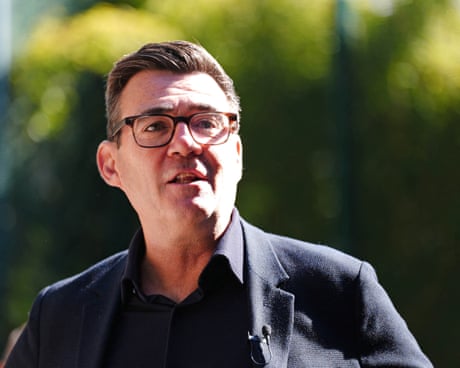
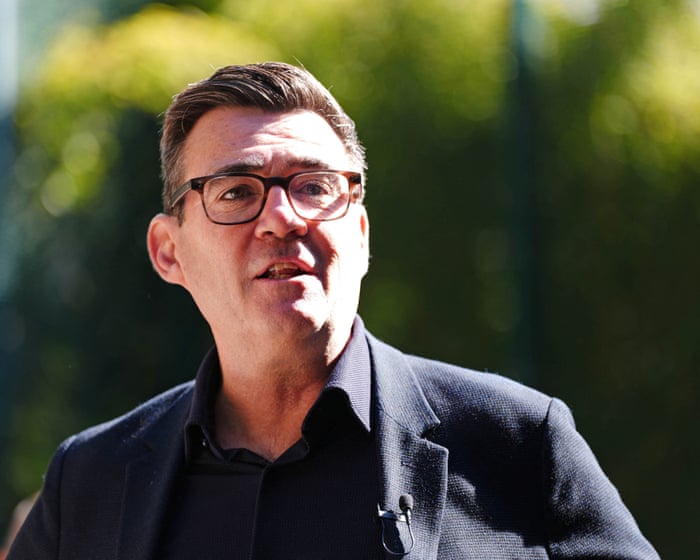
Andy Burnham is considering launching a public inquiry into the UK activities of the convicted sex offender Jeffrey Epstein, a minister has said.

The victims’ minister, Alex Davies-Jones, said the prime minister had agreed to meet Epstein’s victims, was “looking into” an inquiry and was “taking this very seriously”. A separate inquiry into the alleged actions of the former Harrods owner Mohamed Al Fayed is also being considered.

Continue reading...

© Photograph: Annabel Lee-Ellis/Reuters

© Photograph: Annabel Lee-Ellis/Reuters

© Photograph: Annabel Lee-Ellis/Reuters

  •  

5 Things to Know About Abdul El-Sayed, Democratic Senate Hopeful in Michigan

Par : Tim Balk
Dr. El-Sayed, a progressive candidate, is a vocal critic of Israel. He is known for his rhetorical abilities, which have drawn cheers and criticism.

© Nick Hagen for The New York Times

  •  

5 Things to Know About Haley Stevens, Democratic Senate Hopeful in Michigan

Par : Tim Balk
Ms. Stevens, a fourth-term congresswoman, is the choice of Democratic leadership in Washington, D.C., and Michigan.

© Nic Antaya for The New York Times

Representative Haley Stevens is the choice of party leaders in Michigan and Washington, D.C.
  •  

El-Sayed Leads Stevens in Michigan Democratic Senate Primary, Polls Show

The progressive Democrat has consistently had large leads over Representative Haley Stevens, despite debates about which candidate will be more electable in November.

© Nick Hagen for The New York Times; Nic Antaya for The New York Times

  •  

What Was on the Minds of Michigan Voters? Many Cited the Economy and Trump.

As they cast ballots in the Democratic Senate primary, voters said they were concerned about data centers, health care, Israel and the war with Iran.

© Nick Hagen for The New York Times

As voters went to the polls, they said that they were motivated by a variety of issues.
  •  
❌