❌

Vue normale

  • ✇Euromaidan Press
  • Russia fabricates Dobropillia encirclement to strengthen its case for Kyiv’s capitulation at UN – ISW
    Russia’s Defense Ministry claimed on 22 September 2026 that it had surrounded Dobropillia, but the Institute for the Study of War (ISW) found no evidence to support the announcement. Dobropillia is a small town in Donetsk Oblast, known as the "pearl of the Donbas" for its coal industry, which has helped make Ukraine's Fortress Belt cities, holding the region from Russians since 2014, per RBC Ukraine. Ukraine’s Vivaldi counteroffensive in Donetsk Oblast broke the northern arm of Russia’s
     

Russia fabricates Dobropillia encirclement to strengthen its case for Kyiv’s capitulation at UN – ISW

23 septembre 2026 à 14:13

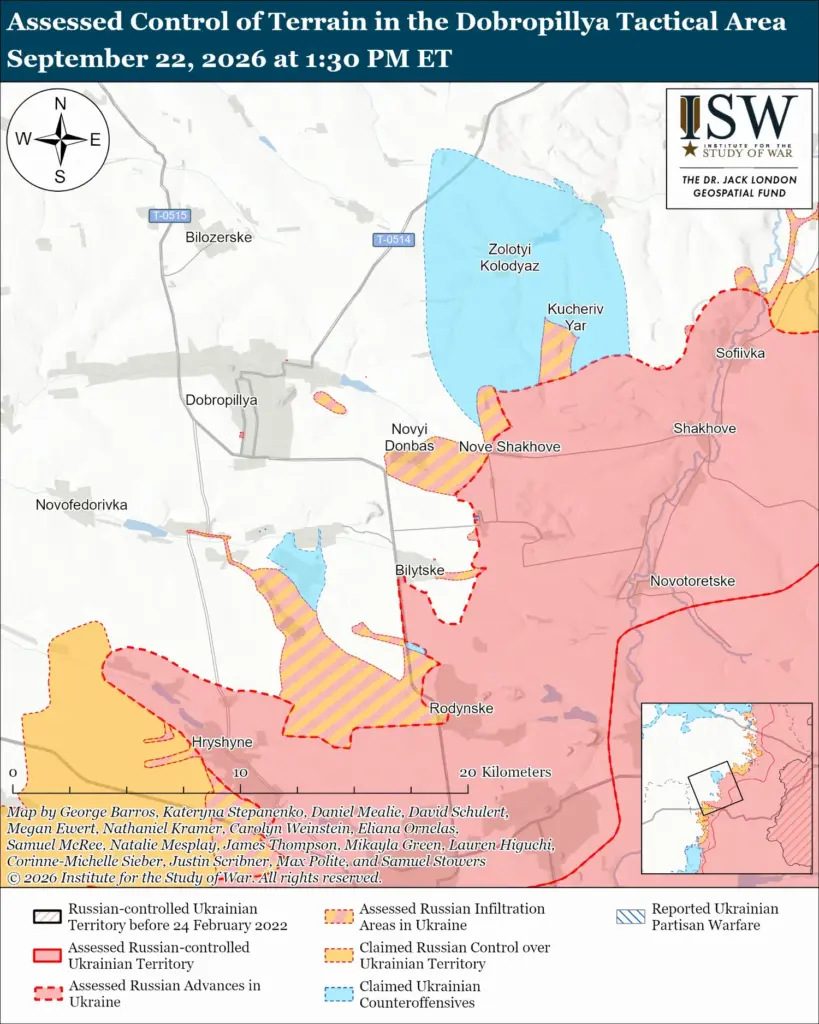
Map of Dobropillia and nearby towns, with Russian-controlled territory shaded pink mainly to the east and south, striped areas marking Russian infiltration, and blue areas marking claimed Ukrainian counteroffensives. Dobropillia is not shown as encircled.

Russia’s Defense Ministry claimed on 22 September 2026 that it had surrounded Dobropillia, but the Institute for the Study of War (ISW) found no evidence to support the announcement. Dobropillia is a small town in Donetsk Oblast, known as the "pearl of the Donbas" for its coal industry, which has helped make Ukraine's Fortress Belt cities, holding the region from Russians since 2014, per RBC Ukraine.

Ukraine’s Vivaldi counteroffensive in Donetsk Oblast broke the northern arm of Russia’s plan to surround the fortified cities. ISW says Moscow’s Dobropillia claim diverts attention from that setback and portrays Ukrainian defenses as collapsing during the 81st session of the UN General Assembly, held on 21-28 September. The institute says Russia is likely spreading such claims to support its push for Ukraine’s capitulation.

Meanwhile, Ukrainian officers say Russian assault groups are still trying to break through toward Dobropillia, but have made no major gains.

Russia’s encirclement claim clashes with Ukrainian battlefield reports

Russia’s Ministry of Defense has claimed its troops were advancing toward Oleksandrivka, a village northwest of Dobropillia, but published no map to support its account.

At the same time, Ukrainian military observer Kostyantyn Mashovets said Ukrainian troops still held positions south and northeast of the city, which the experts said was inconsistent with the claimed encirclement.

ISW reported that a Ukrainian artillery reconnaissance battalion chief of staff said on 22 September that Russia had made no major advances near Dobropillia. He said Russian commanders kept postponing deadlines because of heavy losses and a gap between their plans and battlefield conditions.

A Ukrainian battalion officer said Russian troops were still trying to slip through Ukrainian lines in small groups.

How Dobropillia fits Russia’s plan to surround the fortress belt

Dobropillia is a transport hub on the southwestern approach to Ukraine’s “fortress belt,” which includes Kostiantynivka, Druzhkivka, Kramatorsk, and Sloviansk. These cities have anchored Ukraine’s defense in Donetsk Oblast since 2022.

Ukraine’s Third Army Corps commander, Andrii Biletskyi, whose corps is conducting the Vivaldi counteroffensive north of Lyman, explained that Russian forces advancing through Dobropillia were meant to join another force coming from north of Lyman, behind the fortified cities, encircling them rather than attacking them head-on.

Andrii Biletskyi, commander of Ukraine’s Third Army Corps, stands outdoors in camouflage beside an orange “Operation Vivaldi” graphic.
Ukraine’s Third Army Corps commander, Brigadier General Andrii Biletskyi, announced “Operation Vivaldi” on 15 September 2026. Source: screenshot from Ukraine’s Third Army Corps announcement of Vivaldi

ISW had already assessed on 16 September that Vivaldi had made the two-sided plan infeasible. In its 22 September report, ISW said Russia’s false claim about Dobropillia partly aims to divert attention from those Ukrainian gains.

Russian assaults toward Dobropillia continue

The setback north of Lyman has not stopped Russia’s push toward Dobropillia. Ukrainian staff sergeant Dmytro Davydenko reported on 14 September a sharp increase in assault groups moving toward the city, sometimes more than his unit could engage. He said Ukrainian troops had mined, blocked, or destroyed the main approaches.

ISW reported that Russia was preparing armor and drone support for possible assaults using armored vehicles this fall. A Ukrainian battalion officer said fog might help Russia move that equipment, although Ukrainian reconnaissance and drones would make it difficult. He said Russian glide bombs continued to strike infrastructure in the area.

  • ✇Euromaidan Press
  • “Food must never be used as a weapon”: EU calls for Black Sea attack moratorium
    EU foreign-policy chief Kaja Kallas called for a moratorium on attacks in the Black Sea to restore safe navigation and allow Ukraine's grain exports to reach global markets. She made the call at a UN General Assembly side event co-chaired with the foreign ministers of France, Romania, and Ukraine on 22 September in New York. Since June, Russia has systematically struck Ukrainian ports, grain terminals, and commercial cargo ships in the Black Sea, killing crew members and crippling the e
     

“Food must never be used as a weapon”: EU calls for Black Sea attack moratorium

23 septembre 2026 à 12:27

food never used weapon eu calls black sea attack moratorium · post foreign-policy chief kaja kallas speaks press stakeout during un general assembly new york 23 2026 ukraine news ukrainian

EU foreign-policy chief Kaja Kallas called for a moratorium on attacks in the Black Sea to restore safe navigation and allow Ukraine's grain exports to reach global markets. She made the call at a UN General Assembly side event co-chaired with the foreign ministers of France, Romania, and Ukraine on 22 September in New York.

Since June, Russia has systematically struck Ukrainian ports, grain terminals, and commercial cargo ships in the Black Sea, killing crew members and crippling the export corridor that carries the bulk of Ukraine's agricultural output. The campaign—part of Russia's broader war, now in its fifth year—has disrupted global food supply chains and pushed the Black Sea toward a crisis the EU warned could surpass the 2022 grain-price shock.

Kallas said Black Sea exports have effectively ground to a halt since August because Russian attacks made commercial shipping unviable. The Gulf conflict and climate change are adding further pressure, she said. Ukraine supplies 15% of global corn exports, 10% of wheat, 15–20% of barley, and about 50% of sunflower oil, with around 90% moving through the Black Sea corridor, Kallas said. Egypt, the world's largest wheat importer, has shifted some purchases away from Russia and Ukraine as costs have risen.

"Food must never be used as a weapon in the Black Sea or anywhere else," Kallas said. "Wars make affordable food disappear from dinner tables of millions of people around the globe."

Kallas called the proposal a new "Black Sea grain arrangement," separate from the Black Sea Grain Initiative, a 2022 deal brokered by Türkiye and the United Nations that Russia left in July 2023. She said the 2022 grain-price surge showed the strategic importance of the Black Sea for global security, international trade, energy, and food security.

She called on the international community to ensure safe passage of civilian vessels, protect critical infrastructure, and restore the trade route. If Russia simply stopped its attacks in the Black Sea, farmers, traders, and international food markets would have the predictability they need at this critical moment, she said. In 2025 alone, the EU mobilized €2.1 billion to strengthen global food security, Kallas added, and the EU Solidarity Lanes have facilitated about €304 billion in trade since May 2022.

At a press stakeout on 23 September, Kallas said the EU was "particularly concerned by the attacks in the Black Sea" and that "Russia is trying to choke off Ukrainian grain exports, thus jeopardizing global food security."

Russia has not publicly responded to Kallas's call. In August, Moscow dismissed a similar proposal relayed by Türkiye, with Foreign Ministry spokeswoman Maria Zakharova stating it saw no grounds for measures that would give Kyiv a "temporary reprieve."

A summer of strikes

Russia intensified strikes on Ukrainian ports and commercial shipping in June and July. Those strikes cut Ukrainian deepwater terminal capacity from roughly 7 million to 4–5 million metric tons per month, according to Barva Invest analyst Bohdan Kostetskyi. Ukrainian forces, in turn, struck Russia's grain terminals at Novorossiysk and Taman. Those strikes and the suspension of navigation in the Sea of Azov since July took more than 90% of Russia's Azov–Black Sea grain export capacity offline by mid-August.

The cost of sailing

The Lloyd's of London Joint War Committee has extended its high-risk designation to the entire Black Sea, pushing war-risk insurance premiums to hundreds of thousands of dollars per voyage. Alternative routes through the Danube have partly compensated, but shipping from Ukraine to Egypt has taken 26–33 days, more than twice as long as before.

For Ukraine, restoring safer navigation would reopen its largest agricultural export route, reduce reliance on slower and more expensive alternatives, and help exporters move the harvest and earn foreign currency.

The attacks have not stopped. Overnight on 23 September, Russia struck a cargo ship under an Antigua and Barbuda flag in the Black Sea, killing its captain, a Ukrainian citizen, Ukraine's sea ports administration said. The Navy evacuated the crew and put out the fire.

❌