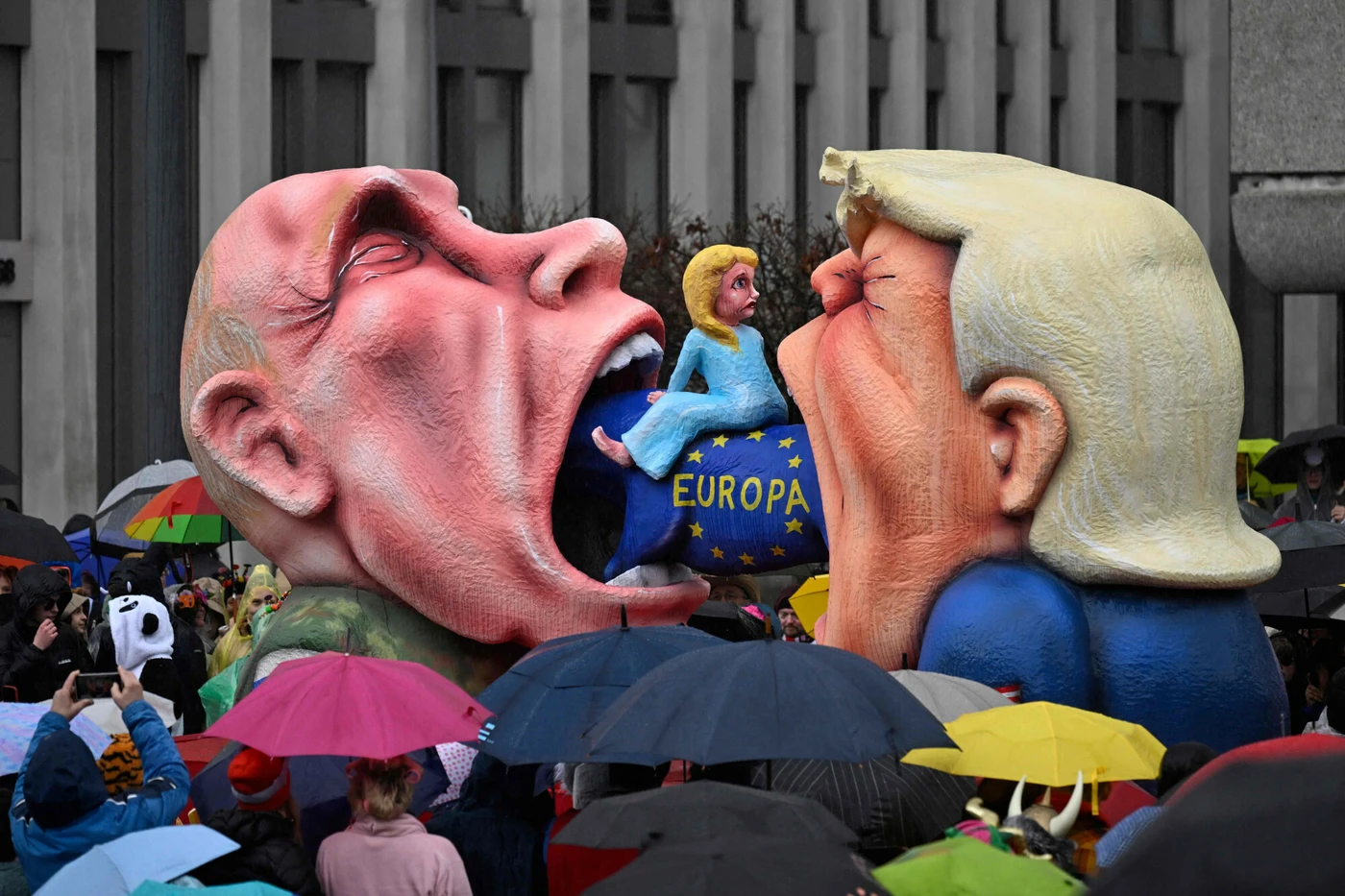
The Ukrainian president’s defiant decision to continue attacking Russian refineries underscores President Trump’s inability to end a war he had promised to resolve.
The Ukrainian president’s defiant decision to continue attacking Russian refineries underscores President Trump’s inability to end a war he had promised to resolve.
President Trump during a campaign stop in Alaska on Tuesday. He has not delivered on his promises to end the war in Ukraine, or to lower prices, and recent deals with Russia could complicate both issues.
The Ukrainian president’s defiant decision to continue attacking Russian refineries underscores President Trump’s inability to end a war he had promised to resolve.
The Ukrainian president’s defiant decision to continue attacking Russian refineries underscores President Trump’s inability to end a war he had promised to resolve.
President Trump during a campaign stop in Alaska on Tuesday. He has not delivered on his promises to end the war in Ukraine, or to lower prices, and recent deals with Russia could complicate both issues.
On 11 October, Trump declared an “energy ceasefire” between Russia and Ukraine. It binds only Ukraine. In the two days that followed, Kyiv held its fire while Russia kept hitting Ukrainian energy and critical infrastructure across 19 regions. A Russian strike collapsed an apartment stairwell in Kharkiv and killed three. And before Russia’s latest ballistic missile strike, five missiles and more than 100 drones, Ukraine received no early warning at all. Washington then said both sides were
On 11 October, Trump declared an “energy ceasefire” between Russia and Ukraine. It binds only Ukraine. In the two days that followed, Kyiv held its fire while Russia kept hitting Ukrainian energy and critical infrastructure across 19 regions. A Russian strike collapsed an apartment stairwell in Kharkiv and killed three. And before Russia’s latest ballistic missile strike, five missiles and more than 100 drones, Ukraine received no early warning at all. Washington then said both sides were to blame.
This is what one of Trump’s decisions looks like on the ground. There were four of them, in three days, 9 to 11 October.
Three days that further weaken the West and undermine liberal democracies. Three days that encourage Putin to continue his war against Ukraine and his hybrid war against Europe. Like China, the US has sided with Russia against Ukraine and Europe. Whatever the motives in Washington—diesel prices before the midterms, a long feud with the court—the effect is the same.
International law
On 9 October, the Trump administration announced new sanctions against the International Criminal Court (ICC), an institution crucial for holding Putin and the Kremlin responsible for the war of aggression and its atrocities. The sanctions came hours after the Nobel Peace Prize went to Navi Pillay, a former ICC judge.
"We will ban transactions with this rogue court, cutting off their resources and crippling its ability to operate," Secretary of State Marco Rubio said. "Either the ICC will end its threats, or we will end the ICC." He expects allies, many of them ICC members that rely on American servicemembers for their defense, to rein in the court.
The ICC exists to investigate, prosecute, and try individuals accused of the world's gravest international crimes. Washington wants to end it. The court called the measures an assault on the rule of law and the foundations of the international legal order.
Explore further
What if Russia uses nuclear weapons? Can we say Ukraine brought peace to world? Norwegian professor who nominated Zelenskyy and Ukrainians for 2026 Nobel Peace Prize takes on tough questions
Funding Russia's war
On 9 October, Trump also lifted sanctions on Russian diesel exports. The deal comes less than a month after he signed the sweeping Russia sanctions law dedicated to the memory of Sen. Lindsey Graham, which allows tariffs on buyers of Russian oil. Multiple US lawmakers argue the move violates federal law. Congress banned Russian energy imports in 2022, and a bipartisan group of seven senators, including Republicans Thom Tillis and Lisa Murkowski, stated that the decision "runs directly counter to that law." They also argue that the administration failed to consult Congress or justify its decision as the statute requires.
Western sanctions and Ukraine's strikes on Russian refineries—its own "sanctions"—aim at the same effect: making the war unaffordable for Russia. Trump's decision does the opposite: it helps Russia pay for the war. It also breaks with the principle of unity of effort, further undermining Western cohesion.
Zelenskyy said the deal showed US weakness, as Washington had secured no concessions in return: "What did [Trump] get? That he will have more diesel? For whom? More Russian diesel for Americans? ... It looks like Alaska No. 2. You know, it looks like a happy birthday present for Putin. It looks absolutely terrible."
Stability and sovereignty
On 10 October, Trump said of the elected president of a country fighting off Russia's full-scale invasion: "I think it's time for Ukraine to get a new president... I suggest they get a new leader who can make a deal, because he could have made many deals and, for some reason, he never does." He claimed Zelenskyy could have ended the war many times, and insisted that Zelenskyy "wants to make problems for the world" by authorizing strikes on Russian refineries.
The Trump Administration conspicuously ignores the Swiss Summit on Peace in Ukraine, President Zelenskyy’s 10-point peace plan based on international law, and not least, the international effort to establish unity of efforts to enforce a just peace.
Zelenskyy has repeatedly proposed talks and shown willingness to compromise for a peace that guarantees Ukraine's sovereignty. On 18 July, he said: "This year alone, we have reached out to Russia dozens of times with proposals to stop this war—but all we got in return were refusals."
The "deals" Trump alludes to would not have secured peace or guaranteed Ukraine's future existence, nor safeguarded Europe against future Russian aggression. They were not rooted in international law, but in the prospect of great wealth for Trump and his associates—business deals dressed up as "peace plans”. Ukraine and its European partners instead proposed amendments and defined red lines to bring the drafts up to the standards of international law.
The Kremlin itself exposed the absurdity of Trump's claim. In a phone call with Trump, Putin categorically ruled out resuming peace talks, his aide Yuri Ushakov said, and sought to convince Trump that Ukrainian resistance has "no prospects whatsoever."
Supporting Russia
On 11 October, Trump announced: "Effective immediately, there is an ENERGY CEASEFIRE in the War between Russia and Ukraine. Both parties have agreed. Do not break it!"
He gave no details. Zelenskyy had no prior knowledge, but said Ukraine would agree if Russia did. He had already offered to stop striking Russian refineries if Russia stopped attacking Ukraine's energy infrastructure.
It was not an energy ceasefire. It was a gift to Putin. A White House official told Axios that, as Trump understands it, the term means only that Russia and Ukraine stop attacking each other's oil refineries—and that this is what Washington expects Ukraine to do. Ukraine has one refinery, while Russia has 38, of which 21 have been targeted by Ukrainian drones.
Explore further
Three days after Washington announced an energy ceasefire, Russia fires 39 ballistic missiles at Ukraine’s grid
To most of the world, an energy ceasefire covers the whole energy sector: nuclear power, oil refineries, power plants, the grid down to local transformers. But not in Trump's world. The official said a deal on power plants and grids could come next—if Ukraine first stops striking the refineries fueling Russia's war.
Axios wrote that White House officials see Ukraine's refinery strikes as doing more damage to Zelenskyy's relationship with Trump than to Russia. The administration has reportedly threatened to cut Ukraine off from US intelligence if the strikes continue.
Forcing Ukraine to halt its refinery strikes, while Russia keeps hitting not only power plants and the grid but heating and water systems, hospitals, schools, railways, ports and civilians, does not motivate Russia to stop. Within hours of Trump's announcement, Russia struck a power plant in Kharkiv. Trump's one-sided pressure encourages Russia to continue.
Enabling Russian aggression
Moscow paints Ukraine as the intransigent party, though Russia has offered no concessions and rejected numerous compromise proposals from the US and Ukraine. Still, Trump insists that Ukraine, not Russia, is the problem.
In three days, Trump has sanctioned the court that could hold Russia accountable, called on Zelenskyy to step down, secured revenue for the Kremlin's war, and declared an "energy ceasefire" that only asks Ukraine to stop striking Russian refineries, while Russia goes on turning winter into a weapon.
The call for Zelenskyy to step down led Marie-Agnes Strack-Zimmermann, chair of the European Parliament's Committee on Security and Defence, to say: "If Trump calls on Zelenskyy to step down, he is clearly siding with a murderer. Only the Ukrainian people can decide who leads Ukraine in free elections, not the White House, and certainly not the Kremlin." Her conclusion: "By once again attacking allies and democratic institutions, Trump is weakening the West and undermining democracy. [...] Europe must therefore remain firmly on course and support Ukraine, because the US can no longer be relied on."
The US's latest National Security Strategy does not merely shift America's foreign policy priorities. It aligns them with Moscow's on seven separate issues, while explicitly calling for Washington to "cultivate resistance to Europe's current trajectory" by backing nationalist parties against sitting EU-aligned governments.
Explore further
Europe has 11 ways to choke Russia’s war. It doesn’t need Trump’s permission for any of them
Europe must stand on its own
The last three days demonstrate that the US is no longer an ally, but a strategic adversary. None of Trump's recent decisions helps end the war on Ukrainian or European terms. On the contrary, they encourage Putin and push any realistic hope of peace years away. They undermine international law and support the notion that might makes right.
Worse still, they help explain why war between Russia and Europe by 2029 is becoming more likely. Trump—Putin's close ally—leaves office on 20 January 2029.
Europe must stress its support for continued Ukrainian strikes on Russian refineries unless the Kremlin agrees to a comprehensive energy ceasefire in line with Ukraine’s demands.
Europe urgently needs to distance itself from the US and its foreign policy. Heads of state must join Canada's efforts to unite middle and small powers in common defense against increasingly aggressive great powers. As this series has repeatedly argued, Europe must build a Coalition of Like-Minded countries strong enough to confront Russia, China and, sadly, the US.
Explore further
The alternative to NATO: A Coalition of Like-Minded European Countries
Hans Petter Midttun, independent analyst on hybrid warfare, Non-Resident Fellow at the Centre for Defense Strategies, board member of the Ukrainian Institute for Security and Law of the Sea, former Defense Attaché of Norway to Ukraine, and officer (R) of the Norwegian Armed Forces.
Editor's note. The opinions expressed in our Opinion section belong to their authors. Euromaidan Press' editorial team may or may not share them.
Students protesting in Paris on Thursday for better school conditions. President Emmanuel Macron has left his prime minister to publicly address nationwide school protests.
Au fil des années, Mont-Joli fête Noël est devenu bien plus qu’une activité locale. Cet événement s’est progressivement imposé comme un grand rendez-vous familial pour Mont-Joli, La Mitis et toute la région.
Par le maire de Mont-Joli, Martin Soucy
L’an dernier, près de 8 000 personnes ont participé aux différentes activités. Cette année, nous souhaitons franchir un nouveau cap et accueillir environ 10 000 visiteurs.
Cette croissance démontre à quel point l’événement répond à un besoin
Au fil des années, Mont-Joli fête Noël est devenu bien plus qu’une activité locale. Cet événement s’est progressivement imposé comme un grand rendez-vous familial pour Mont-Joli, La Mitis et toute la région.
Par le maire de Mont-Joli, Martin Soucy
L’an dernier, près de 8 000 personnes ont participé aux différentes activités. Cette année, nous souhaitons franchir un nouveau cap et accueillir environ 10 000 visiteurs.
Cette croissance démontre à quel point l’événement répond à un besoin : celui de se retrouver, de célébrer ensemble et de profiter d’activités accessibles à toute la famille.
Du 27 au 29 novembre, plusieurs incontournables seront de retour, dont le traditionnel et impressionnant défilé de Noël et son feu d’artifice de clôture, place de la famille au beau milieu du centre-ville, les spectacles jeunes et adultes tout au long du week-end, et différentes activités qui font maintenant partie de la programmation.
Quelques nouveautés, à venir, viendront également bonifier la programmation et rendre cette quatrième édition encore plus rassembleuse.
Cette année, nous ajoutons aussi une dimension qui nous tient particulièrement à cœur en nous associant à l’Association du cancer de l’Est-du-Québec.
Cette collaboration permettra de soutenir une organisation bien présente dans notre région et qui accompagne quotidiennement des personnes touchées par le cancer ainsi que leurs proches.
Événement régional
L’Association jouera également un rôle important dans la recherche de partenaires, de commanditaires et dans la mobilisation entourant le défilé.
Et puisque Mont-Joli fête Noël est désormais un événement régional, cette mobilisation doit elle aussi dépasser les frontières de notre ville. Les entreprises de Mont-Joli et de La Mitis seront sollicitées, mais également celles de Rimouski et des municipalités environnantes.
C’est ensemble que nous pouvons faire grandir cet événement.
Mont-Joli fête Noël, c’est une occasion de faire rayonner notre ville et notre région, de soutenir nos commerces, d’accueillir des familles de partout dans la région et de redonner à notre communauté.
La programmation officielle sera disponible au début du mois de novembre sur toutes les plates-formes de la Ville de Mont-Joli et de l’Association du cancer de l’Est-du-Québec.
Je vous invite donc à venir célébrer avec nous, du 27 au 29 novembre, à Mont-Joli. La programmation complète sera dévoilée au début du mois de novembre.
On 9 October, three weeks after signing the first major Russia oil sanctions in two years, Donald Trump agreed with Vladimir Putin to bring Russian diesel back to world markets. The US Treasury suspended its sanctions on that trade until April 2027 the same day. In the two days before, Russian strikes had killed more than 80 Ukrainian civilians.
Europe answered on 12 October with its largest sanctions package yet: nearly 1,600 new listings, almost all in Russia’s military-industr
On 9 October, three weeks after signing the first major Russia oil sanctions in two years, Donald Trump agreed with Vladimir Putin to bring Russian diesel back to world markets. The US Treasury suspended its sanctions on that trade until April 2027 the same day. In the two days before, Russian strikes had killed more than 80 Ukrainian civilians.
Europe answered on 12 October with its largest sanctions package yet: nearly 1,600 new listings, almost all in Russia’s military-industrial complex. Its core, says Ukraine’s sanctions envoy Vladyslav Vlasiuk, is Russia’s missile program and the electronics inside it, from capacitors to semiconductors. Six in ten listings came from Ukrainian proposals, and Brussels adopted them within weeks.
That is the right reflex, and proof that Europe can move fast when it chooses. But the package names companies and people one by one. On the measures that cut whole sectors, the ones that would hurt Moscow most, Europe still waits for Washington.
It waits for Trump to decide whether to enforce the Graham Act he signed in September. It waits for him to decide whether to lean on Hungary and Slovakia or let them off. It waits for the G7 to rule on tanker services before touching its own ships. Europe keeps asking the Trump administration to decide things it is perfectly able to decide itself.
If the EU is serious about ending a war on its own continent, it does not need a miracle from Washington. It needs to pull the levers already in its hands. Here they are.
Strip Russian weapons of European parts
1. Fix export-control enforcement on dual-use goods. It is unacceptable that the newest Russian drones and missiles contain not only Chinese parts but American and European ones. The "War and Sanctions" portal logs what turns up. The EU should find and close the enforcement gaps in its own dual-use export law. Choking the supply to Russia's war industry serves Ukraine and Europe alike.
Cut Russia's energy money
2. Force Hungary and Slovakia off Russian oil. The EU banned Russian oil imports in 2022, with temporary exemptions for landlocked states: Czechia, Slovakia, Hungary. Czechia has since diversified and dropped Russian oil entirely. Slovakia and Hungary can do the same; the Czech case proves it is a question of will, not feasibility. Ending the exemptions would also make good on REPowerEU's central promise, phasing out Russian energy. The gas-import ban is already decided. Oil is the gap that remains.
3. Close the Greek and Maltese tanker loophole.Up to 40% of Russia's seaborne oil travels on European tankers, Greek and Maltese. The EU has banned maritime services for Russian oil since 2022, with one exception: cargoes sold below the price cap. This spring the Council discussed scrapping that exception, which would have meant a full ban, then made any change conditional on coordination with the G7. Once again, Europe is asking Washington to act for it. The EU should overcome Greek and Maltese resistance and ban every maritime service for Russian oil: transport, insurance, and the rest.
4. Stop the shadow fleet in European waters. Russia ships oil to India, China, and Türkiye through a shadow fleet of aging, often uninsured tankers. Europe can check their insurance and turn away any that lack EU or G7 cover, especially in the North Sea and the Baltic, where any spill would be an ecological disaster, and an uninsured operator would not pay for it.
Patrols in territorial waters and exclusive economic zones have to be reinforced. Russia also uses these ships for espionage, sabotage, and damage to undersea infrastructure. Strengthen NATO's Baltic Sentry. Consider adding a maritime operation by the UK-led Joint Expeditionary Force or the Coalition of the Willing across the North and Baltic Seas and the Skagerrak, before the Danish straits. If the Russian Baltic Fleet escalates, Europe should be ready for confrontation. Moscow should hear that it is not feared and that it will be stopped. At sea, it is weaker than even NATO's Baltic Sea states alone, never mind NATO's European members together.
5. Scrap the Lingen nuclear-fuel deal. In July, Lower Saxony approved a plan for the French state company Framatome to make nuclear fuel jointly with Rosatom, Russia's builder of nuclear weapons, at Lingen. It is dressed up as serving REPowerEU, since the venture lets Hungary, Slovakia, and Bulgaria buy fuel from a Franco-Russian joint operation instead of straight from Rosatom.
This is nonsense. Ukraine was once wholly dependent on Russian nuclear fuel and diversified fast; Finland and Czechia have done the same. Hungary, Slovakia, and Bulgaria can follow. Stretching the dependence out and hiding it behind a French partner is the opposite of what REPowerEU is for. Lower Saxony's own environment minister called the deal "grundfalsch," fundamentally wrong.
Fund Ukraine from Russia's own money
6. Build a Ukraine Fund from frozen Russian assets. Supporting Ukraine will cost more next year, not less, so it is time to get serious about Russia's frozen assets. Not confiscation, which European capitals still resist, and not a simple transfer to Kyiv, which amounts to the same thing, but a dedicated EU-run Ukraine Fund that could invest these assets and use them better than they are used now. ICUV has set it all out in a policy paper.
Isolate Russia further
7. Adopt the Graham-bill sanctions. Sanction every Russian state company (majority or controlling state stake) and every Russian oligarch who has not taken a public anti-war stand. Forbes counts 155 Russian billionaires.
8. Cut every Russian and Belarusian bank off SWIFT. Russia still has 301 operating banks, yet only 103 Russian banks and financial institutions sit under the EU's transaction ban, and just a handful of Belarusian ones. Gazprombank, which the US Treasury says pays Russia's soldiers, is still not on the EU list. Stop listing banks one by one: disconnect the entire Russian and Belarusian banking systems and put them under a full transaction ban, with narrow exceptions for food, medicine, and humanitarian trade.
9. End land transit to and from Russia, Kaliningrad included. Stop all overland freight, rail and road, between the EU and Russia. Baltic ports should carry no Russian trade at all, not just grain. Halt the gas transit to Kaliningrad through Lithuania's pipelines, too; let it arrive by sea, where Russia already runs an LNG terminal. Winters are mild now, so the real effect is mostly higher costs, and even that is worth doing.
10. Ban visas for Russian (ex-)servicemen and their families. The EU's 21st sanctions package laid the legal basis in July and then set no start date. Bring it into force, and extend it to the families.
Deliver accountability
11. Launch the Tribunal for the Crime of Aggression and the Claims Commission. Speed up the creation of, and accession to, the tribunal for the crime of aggression against Ukraine, and the convention establishing a Claims Commission.
The point
Europe cannot escape this burden. A Russian victory, even a partial one such as a peace on Moscow's terms, would cost it far more than helping Ukraine to a partial victory of its own, a peace along the line of contact. If Europe wants the war to end, it has to lead, alongside Ukraine, instead of waiting on a miracle from the Trump administration. The tools are already in its hands.
Explore further
Norway did the math: Arm Ukraine to win, or pay double when Russia does
Party leaders are working to connect Washington profiteering and the influence of billionaires and corporate America to affordability, in what they hope will be a potent closing message.
Party leaders are working to connect Washington profiteering and the influence of billionaires and corporate America to affordability, in what they hope will be a potent closing message.
“Corruption is why things don’t work for the American people.” Senator Jon Ossoff, a Democrat running for re-election in Georgia, said in a recent campaign video.
A sample of people at the president’s midterm stump speech in Tennessee defended the Pentagon’s announcement that it would livestream the execution of a mass shooter.
A sample of people at the president’s midterm stump speech in Tennessee defended the Pentagon’s announcement that it would livestream the execution of a mass shooter.
People gathered during a March 4 Mercy protest against the death penalty at the Tennessee State Capitol in Nashville last month, ahead of the scheduled execution of Christa Pike.
In a top Senate battleground, Representative Ashley Hinson, the Republican nominee, sparred with Josh Turek, her Democratic rival, on policy issues ranging from Medicaid to term limits.
In a top Senate battleground, Representative Ashley Hinson, the Republican nominee, sparred with Josh Turek, her Democratic rival, on policy issues ranging from Medicaid to term limits.
The president offered support for the Republican Senate candidate, after earlier grumbles, but focused much of his speech on a defense of his own record.
The president offered support for the Republican Senate candidate, after earlier grumbles, but focused much of his speech on a defense of his own record.
Attendees at the party’s annual conference have been buoyed: both by leader Kemi Badenoch’s rising poll ratings and by a mock Bayeux Tapestry. But the challenge from Reform U.K. remains.
Attendees at the party’s annual conference have been buoyed: both by leader Kemi Badenoch’s rising poll ratings and by a mock Bayeux Tapestry. But the challenge from Reform U.K. remains.
Latino voters, who shifted Republican in the 2024 presidential election, view the party more negatively than they have in the past decade, according to an NBC News/Telemundo poll released on Monday.
Latino voters, who shifted Republican in the 2024 presidential election, view the party more negatively than they have in the past decade, according to an NBC News/Telemundo poll released on Monday.
A polling site in San Antonio, Texas, in May. Movement among Latino voters in Texas as well as Florida could be a key factor in whether control of the Senate changes hands in November.
Pedro Sánchez, the Spanish prime minister, has faced challenges including a migration crisis and several corruption scandals involving his inner circle.
Pedro Sánchez, the Spanish prime minister, has faced challenges including a migration crisis and several corruption scandals involving his inner circle.
An online spot for Mr. Hilton, the G.O.P. candidate, is full of sexual innuendo that has befuddled Republicans and Democrats watching the race for governor in California.
An online spot for Mr. Hilton, the G.O.P. candidate, is full of sexual innuendo that has befuddled Republicans and Democrats watching the race for governor in California.
Nous sommes dans le dernier droit de la campagne électorale au Québec, un moment idéal pour que les municipalités fassent connaître leurs priorités et leurs besoins, et ceux-ci sont nombreux pour Rimouski et le Bas-Saint-Laurent.
Texte par le maire de Rimouski, Guy Caron
Il y a bien sûr le financement du renouvellement des infrastructures municipales, qui totaliseront plus de 200 M$ pour les 20 prochaines années, l’aide financière à la décontamination de l’ancien dépotoir, les programmes d
Nous sommes dans le dernier droit de la campagne électorale au Québec, un moment idéal pour que les municipalités fassent connaître leurs priorités et leurs besoins, et ceux-ci sont nombreux pour Rimouski et le Bas-Saint-Laurent.
Texte par le maire de Rimouski, Guy Caron
Il y a bien sûr le financement du renouvellement des infrastructures municipales, qui totaliseront plus de 200 M$ pour les 20 prochaines années, l’aide financière à la décontamination de l’ancien dépotoir, les programmes de logements sociaux et abordables, la lutte contre l’itinérance, et bien d’autres.
Mais s’il y a un thème principal à retenir, un enjeu qui freine actuellement le développement de Rimouski et de la région, c’est bien celui des transports :
Pas de connexion aérienne directe avec Montréal;
Des trains de nuit trois fois par semaine;
Sous-financement du transport en commun;
Des autoroutes dont le trafic a augmenté de 50 à 100 % depuis une vingtaine d’années sans oublier le fait que Rimouski est maintenant la plus grande ville du Québec à ne pas être connectée par une autoroute.
Passer au 21e siècle
Qu’est-ce qui nous permettrait de passer au 21e siècle et de compter sur des services de transports fiables et viables?
Relance immédiate des études pour développer les tracés du tronçon Trois-Pistoles–Le Bic et un échéancier ferme pour le début des travaux des deux dernières phases (Phase 2B de Notre-Dame-des-Neiges à Trois-Pistoles et Phase 3 de Trois-Pistoles au district Le Bic);
Début des travaux d’agrandissement dans les plus brefs délais du tronçon de l’autoroute 20 entre Pointe-au-Père et Mont-Joli et réalisation des études vers un élargissement à quatre voies de ce secteur;
Mise en oeuvre du projet-pilote de la liaison aérienne Mont-Joli-région métropolitaine de Montréal, déjà développé par la ministère des Transports, mais qui a été tabletté;
Financement pour la mise aux normes et la canadianisation du traversier acquis par les Industries Ri-lec et adoption d’un projet de loi spécial permettant aux villes de Rimouski et de Forestville de financer le service;
Financement accru pour les services de transport en commun de Rimouski, et soit prélever une taxe de 0,02 $ le litre OU octroyer une subvention annuelle de 5 M$, pour financer une Régie du transport du Bas-Saint-Laurent.
Ce qui est demandé n’est pas du luxe. Il s’agit simplement de nous doter des outils qui permettront à Rimouski et à la région de poursuivre son développement économique et social.
Democratic advantages in the races for governor in Texas, Iowa, Ohio and Alaska reflect deep unhappiness with President Trump and the economy. A Republican leads in Kansas.
Democratic advantages in the races for governor in Texas, Iowa, Ohio and Alaska reflect deep unhappiness with President Trump and the economy. A Republican leads in Kansas.
Democrats are competitive in Alaska, Iowa, Ohio, Texas and even Kansas as they try to wrest control of the Senate from Republicans. Here’s a look at why.
Democrats are competitive in Alaska, Iowa, Ohio, Texas and even Kansas as they try to wrest control of the Senate from Republicans. Here’s a look at why.
Dmitry Muratov, the Nobel Peace Prize laureate and co-founder of Russia's shuttered Novaya Gazeta, has lent his name to an idea that sounds like pure humanitarianism. Russia frees some of the people it jails for opposing the war; in return, the United States eases its sanctions on the Russian economy.
The scheme did not even start in an American office. According to The Atlantic, which reported the plan on 29 September, it was Muratov himself who urged Donald Trump's envoy, John Coale,
Dmitry Muratov, the Nobel Peace Prize laureate and co-founder of Russia's shuttered Novaya Gazeta, has lent his name to an idea that sounds like pure humanitarianism. Russia frees some of the people it jails for opposing the war; in return, the United States eases its sanctions on the Russian economy.
The scheme did not even start in an American office. According to The Atlantic, which reported the plan on 29 September, it was Muratov himself who urged Donald Trump's envoy, John Coale, to try it. Coale had used the same model on Belarus, where some 500 prisoners were released, sanctions softened, and trade talks reopened.
Now, with Trump's approval, he wants to run it on the Kremlin.
Explore further
“A direct investment in ammunition flying across the border”: Belarusian defectors warn US sanctions relief is funding Russia’s war
The prisoners should go free. There is nothing to argue about there. No one jailed for anti-war words, for journalism, or for political dissent belongs in a cell. But here is the small detail: the price for their freedom is easing the pressure on a state that is waging war, not on the United States, which is being asked to ease the sanctions, but on Ukraine.
And here is where the real humanitarian arithmetic begins. We do not yet know which sanctions would be lifted. Whichever they are, the logic is the same: Moscow lets some of its political prisoners go, and Washington gives the Russian economy some breathing room in return. People walk out of Russian prisons, and the Kremlin gets more oxygen.
More money for the Russian state in wartime is not merely a figure in a bank report. It is more resources for the army, for missiles, for drones, for the war's continuation. And Ukrainians are the ones who feel it.
I can picture the Kremlin ghoul rubbing his hands at an idea like this. Now he can be not just president, but the director of a prisoner market: release a hundred today, jail three hundred tomorrow, so there is something to trade next time. New dissidents, journalists, activists, and merely inconvenient citizens he can pack away far faster than the West can lift a sanction.
The Kremlin ghoul can now be the director of a prisoner market: release 100 today, jail 300 tomorrow
A tidy little business model: Russia produces the prisoners, the West buys them back with its policy, and Ukraine settles the account.
Because if easing sanctions widens Russia's room to finance the war, then Ukrainians effectively get a very strange bill for someone else's humanism: a Russian political prisoner walks out of prison, and a Ukrainian gets a fresh portion of missiles and drones on their head.
By the way, about those Ukrainian civilians. By the estimates of international and Ukrainian rights groups, Russia is holding, or has held, some 16,000 of them illegally. The real figure may be higher, since not every case can be documented.
This is exactly where Muratov, as a Nobel peace laureate, might find his powers of persuasion useful. Why not put in a word for the Ukrainians in Russian prisons? The same people seized in occupied territory during "filtration," taken from their homes, buried under fabricated cases, held for years without a proper trial.
And among them are children.
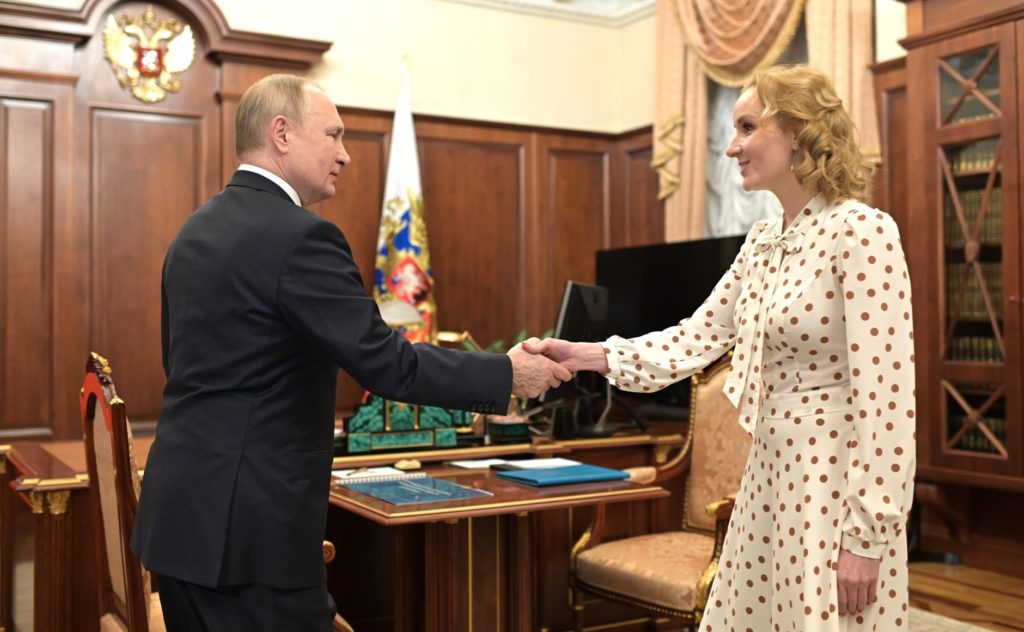
Maria Lvova-Belova and Vladimir Putin. Photo: Kremlin.ru
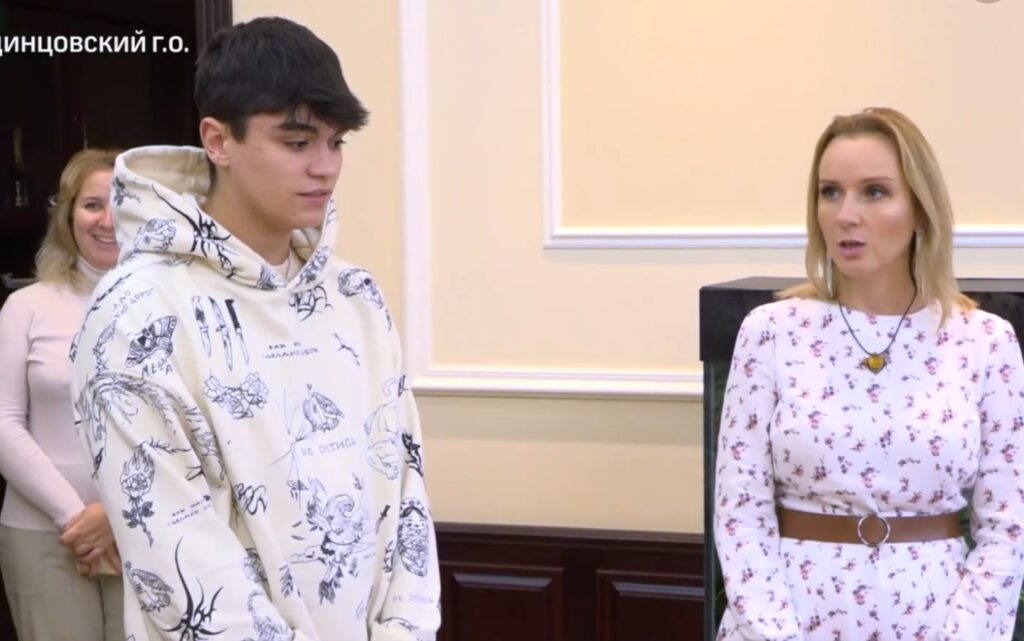
And here onto the stage steps Russia's Baba Yaga of "child protection": Maria Lvova-Belova, the so-called presidential commissioner for children's rights. She herself told Putin, in public, about a boy from Mariupol she had taken into her care after he was removed from the occupied city. Ukraine and international organizations view such cases as part of a wider system of unlawful transfers of Ukrainian children to Russia. The International Criminal Court has issued a warrant for her arrest on exactly those charges: the unlawful deportation and transfer of Ukrainian children.
That is what Russian care for children looks like: take a Ukrainian child from Mariupol, carry him off to Russia, and set about turning him into a Russian. If this is how Russia's children's commissioner works in public, it is frightening to imagine what happens where there are no cameras and no international warrants.
Nobody is offering to lift a single sanction for them.
Russian Children’s Rights Commissioner Maria Lvova-Belova and her Ukrainian "adopted son" Pylyp from occupied Mariupol.
And Muratov's pacifist initiatives are not new, either. After the full-scale invasion, he was among the authors and promoters of the ceasefire appeals. One public statement, signed by 51 Nobel laureates, called for an end to the fighting, which Muratov later described as a plea for a "genuine ceasefire" before talks.
On paper it all looks wonderful: stop shooting, stop killing one another, make peace. But there is one small problem. Russia did not wander into this war alongside Ukraine. Russia launched the full-scale invasion itself.
And in these appeals, Muratov did not demand that the Kremlin withdraw its troops from Ukraine. He did not demand the de-occupation of Ukrainian territory. He did not put the question of responsibility for the aggression and the war crimes to Russia. The formula was far more convenient: just stop shooting.
But "stop killing each other" is a beautiful phrase for people who would rather not notice who attacked whom.
It turns aggressor and victim into two symmetrical sides, as though Ukraine and Russia had simply quarreled and now both must show wisdom and stop firing. There is just one nuance: if, after such a "peace," the Russian army remains on occupied Ukrainian territory, that is not an end to the aggression. It is a pause with a Russian flag on Ukrainian soil.
Now add the prisoner proposal on top. Russia does not withdraw its troops. Ukraine does not get its occupied territory back. The Kremlin answers for nothing. But a few Russian political prisoners are released, and for that, Russia's sanctions are eased too. And Ukraine, meanwhile, is simply supposed to stand to one side and rejoice that humanism has triumphed.
Ukraine is simply supposed to stand to one side and rejoice that humanism has triumphed.
Except there is a difference of principle. A Russian political prisoner can walk out of a Russian prison. A Ukrainian civilian can stay in one. And a Ukrainian soldier can be killed by a weapon Russia bought thanks to that same sanctions relief.
And then a very simple question arises for the great humanist and Nobel laureate: why should the freedom of Russia's political prisoners be bought at the expense of the freedom, the safety, and the lives of Ukrainians?
After a dry spell of more than three decades, Democrats are daring (yet again) to believe they can win one or more top-of-the-ballot races in a vast and stubbornly red state.
After a dry spell of more than three decades, Democrats are daring (yet again) to believe they can win one or more top-of-the-ballot races in a vast and stubbornly red state.
According to recent polls, James Talarico, a Democratic state legislator, is ahead of his Republican rival, Ken Paxton, the Texas attorney general, in the race for a U.S. Senate seat.
The failed execution of Christa Pike, which left her clinging to life in Tennessee, was the latest grisly error to take place in an American execution chamber.
The failed execution of Christa Pike, which left her clinging to life in Tennessee, was the latest grisly error to take place in an American execution chamber.
Democrats are performing strongly in five reliably Republican states where they are trying to flip Senate seats to win control of the chamber, new New York Times/Siena polls found.
Democrats are performing strongly in five reliably Republican states where they are trying to flip Senate seats to win control of the chamber, new New York Times/Siena polls found.
President Trump spent the day preaching to his most fervent fans, not the voters he will need to help elect or re-elect a slate of Republicans fighting in states from Alaska to Maine.
President Trump spent the day preaching to his most fervent fans, not the voters he will need to help elect or re-elect a slate of Republicans fighting in states from Alaska to Maine.
Republicans lined up a series of doomed votes in their final hours, hoping to portray Democrats as obstructionists. But some conceded that their party was more likely to be punished.
Republicans lined up a series of doomed votes in their final hours, hoping to portray Democrats as obstructionists. But some conceded that their party was more likely to be punished.
Republicans are battling stiff headwinds, including economic concerns and President Trump’s sagging approval ratings, in their battle to maintain control of Congress.
President Trump’s remarks offered a glimpse into how his attempts to help his party in the midterms often clash with his brand of personality-driven politics.
For decades, Europe operated on a series of assumptions: that borders were essentially settled; that economic interdependence would constrain major-power conflict; that international law would increasingly regulate state behavior; that military force was becoming less relevant; and that, ultimately, the United States would guarantee European security.
Russia's invasion of Ukraine has shattered those norms, as Moscow attempts to change borders by force and reshape the European security o
For decades, Europe operated on a series of assumptions: that borders were essentially settled; that economic interdependence would constrain major-power conflict; that international law would increasingly regulate state behavior; that military force was becoming less relevant; and that, ultimately, the United States would guarantee European security.
Russia's invasion of Ukraine has shattered those norms, as Moscow attempts to change borders by force and reshape the European security order. NATO now describes Russia as the most significant and direct threat to Allied security, while also identifying sabotage, cyberattacks, disinformation, economic coercion, and other hybrid actions as part of the threat.
The foreign policy of the Trump administration is further undermining past postulations. It threatens to annex Canada, speaks of occupying Greenland by force, and ignores Spain's sovereignty. It disrespects European military contributions, then demands European support for operations of its own choosing, legal justification optional. It negotiates European security over Europe's head while resetting relations with the power that threatens the continent, calls European countries "decaying" and their leaders "weak," and has launched a trade war against its former allies while pursuing business with its former strategic opponent.
Discussing solutions without first agreeing on the problem is meaningless. Yet that is what Europe has done since the war started in 2014.
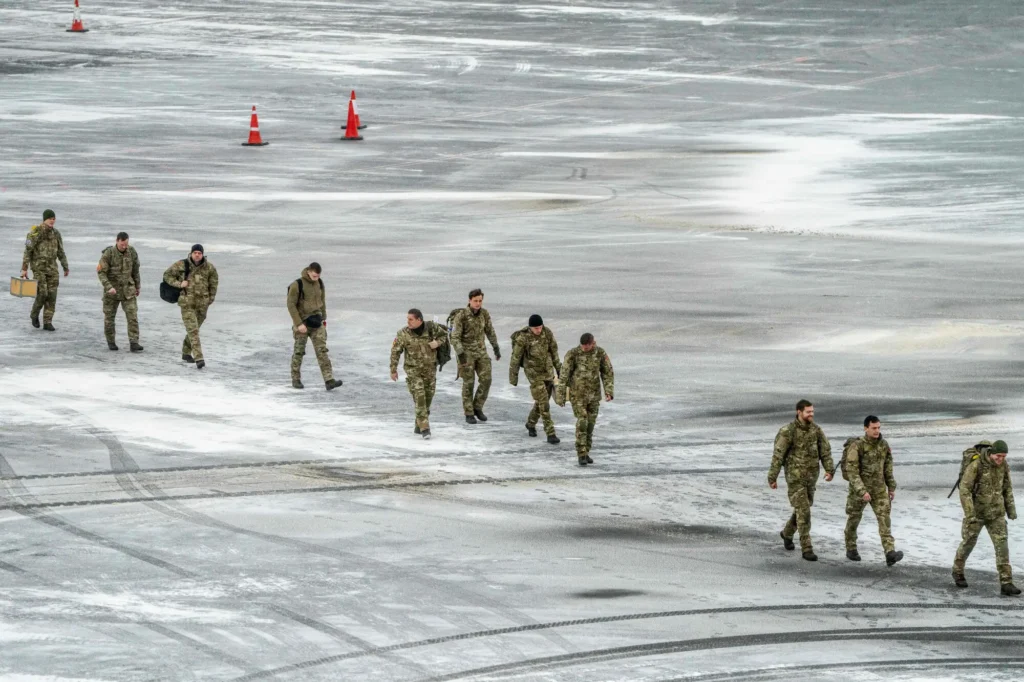
Danish soldiers walk across the frozen tarmac after arriving at Nuuk airport, Greenland, on 19 January 2026, following US President Trump's annexation threats. Photo by Mads Claus Rasmussen / Ritzau Scanpix / AFP) / Denmark OUT/Eastnews
Eight realities
Analyzing the security environment, before recommending solutions, I have identified eight fixed points that I regard as constants.
1. It was never a Russia/Ukraine war
Russia has offered the West four tales, all unpleasant, one designed to look like an "easy way out." The first calls on Ukraine to give up Crimea, Luhansk, Donetsk, Zaporizhzhia and Kherson, the lie Trump's plan is built on. But Putin's demands transcend Donbas, as his 2024 speech and Russia's operations show. The second, "Novorossiya," adds Kharkiv, Dnipropetrovsk, Mykolaiv and Odesa to the first lie.
The third, "one people, one nation," claims all of Ukraine. In the words of former US National Security Advisor Zbigniew Brzezinski: "Without Ukraine, Russia ceases to be an empire, but with Ukraine suborned and then subordinated, Russia automatically becomes an empire." The fourth, "the Russian World," is the only one formalized in Russian strategic documents, encompassing the "former territories of Kyivan Rus, the Kingdom of Muscovy, the Russian Empire, the Soviet Union, and the contemporary Russian Federation."
Ukraine's defeat is crucial to Russia's broader strategy. Integrated with Belarus, a subjugated Ukraine would give Russia the population, economy and technology to be seen as a near peer to the US and China, project power across the post-Soviet space, and ease its own demographic decline, while handing Moscow the country's defense industry, farmland and mineral, gas and oil deposits, and moving Russian military power nearly 900 km closer to London, Berlin and Paris.
It would create an aggressive, imperialist power on Europe's border, emboldened to force NATO's withdrawal to its 1997 borders and to deny the US the ability to deploy forces and nuclear weapons to Europe. The West, not Ukraine, has been defined as Russia's enemy.
2. A war is ongoing in Europe
Russia has been conducting an ever-escalating hybrid war against NATO's European member states since 2014. The EU Parliament acknowledged as much in September 2021. Its aggressions include sabotage against critical infrastructure, cyberattacks, disinformation, GPS jamming affecting civilian aviation, repeated airspace violations by strike drones, and attacks on Europe's defense-industrial base.
Russia's acts of violence against Western targets are becoming increasingly brazen. In August, Western intelligence sources reported a new wave of attacks on weapons factories in Europe under cover of "plausible deniability," The Telegraph reported. A CIA report shared with European governments warns Russia may attack Spain, France or Italy with Gerbera drones launched from ships, El Mundo reported, citing Lithuanian sources.
It is the same hybrid war Ukraine faced until 24 February 2022, one expected to turn open by 2029. Article 5 could, and probably should, have been triggered years ago. Having failed to respond, NATO has lost credibility, raising the risk of war.
Russian Ambassador Oleg Ozerov inspects a Gerbera drone recovered in Moldova after it entered the country’s airspace, at the Foreign Ministry in Chișinău, Nov. 26, 2025. (Elena Covalenco / AFP/Eastnews)
3. The tsunami of ripple effects is changing the political landscape in the West
In May 2022, I began using the term tsunami of ripple effects to describe the cost of not intervening in a war that threatens the security of the Alliance. It is the reverberations that raise the cost of living, undermine food and energy security, and spread famine, recession and inflation, raising the risk of unrest, extremism, and, ultimately, the fall of governments. Europe is living through the biggest refugee crisis since the Second World War.
The international security architecture is being dismantled, our institutions discredited, and NATO no longer deters Russia. Building on public frustration, the tsunami of ripple effects gave us Trump and the rise of right-wing parties across Europe.
4. NATO no longer deters Russia
If Russia were deterred, it would not have launched a full-scale invasion of Ukraine. NATO's strategic concept commits it to ending, by political and military means, conflicts that threaten Alliance security, including in Ukraine. Nor would Russia be conducting an ever-escalating hybrid war against NATO's European states, or preparing for a military conflict with the Alliance, as US and European intelligence services warn. Lack of deterrence raises the risk of Russian strategic miscalculation and war, especially since NATO was the only military power able to deny Russia its Great Power aspiration and its demand for a sphere of influence over the post-Soviet space.
NATO used to display readiness and capabilities. Today it has become a religion. Europe begs it is still almighty while Russia is a disbeliever.
Explore further
NATO no longer deters Russia. A new coalition could
5. The transatlantic rupture undermines NATO and European security
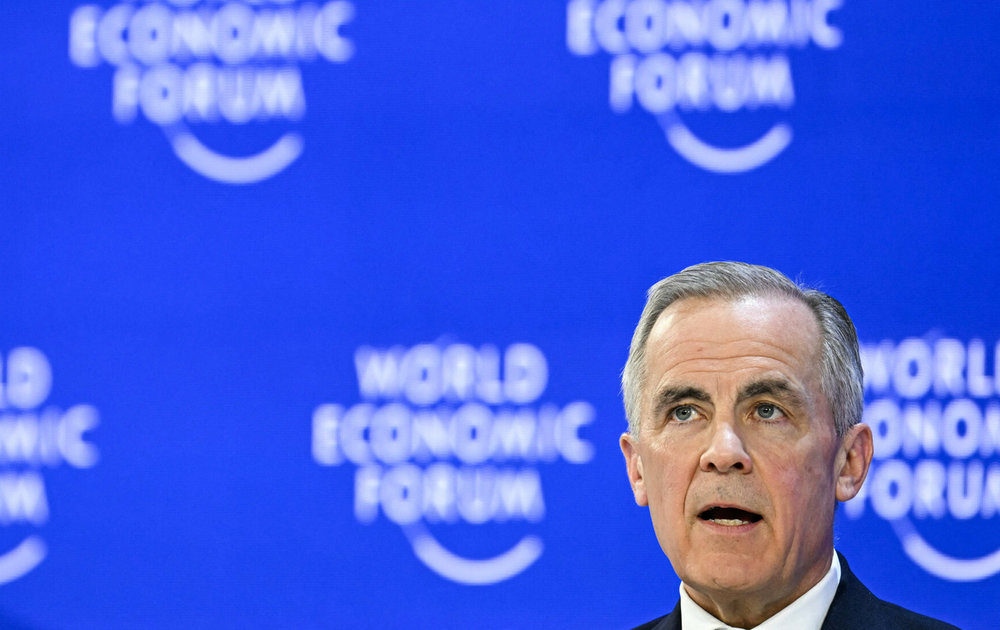
Canadian Prime Minister Mark Carney put it plainly at Davos on 20 January 2026: "We are in the midst of a rupture, not a transition." We "cannot live within the lie of mutual benefit through integration when integration becomes the source of your subordination," he said, calling for countries to organize in the face of great-power rivalry through different coalitions for different issues, based on common values and interests. As he told the World Economic Forum: "We actively take on the world as it is, not wait around for a world we wish to be."
Canada's Prime Minister Mark Carney delivers a speech during the World Economic Forum (WEF) annual meeting in Davos on January 20, 2026. The World Economic Forum takes place in Davos from January 19 to January 23, 2026. Source: Fabrice COFFRINI / AFP, via East News
6. The war is existential to both Ukraine and Russia
Ukraine is fighting for its right to exist. Russia is fighting for its Great Power status, strategic parity with the USA and China. If it is defeated in Ukraine, it will forever remain a pariah state, potentially imploding. For a negotiation to succeed, it must solve the cause of the war: Russia's Great Power ambitions, which cannot be negotiated away, only denied through military power.
7. Russia will never accept being defeated by Ukraine
Even with the tools to evict the Russian Armed Forces, Ukraine cannot expect Russia to accept defeat by a nation that, in its distorted narrative, "does not exist." Russia would only accept withdrawal from Ukraine if the alternative were to fight a far superior military power and thereby risk losing the means that secure the survival of the regime and the state.
8. Europe has very limited time to stop the war from escalating
Several European intelligence services warn of war by 2029;
French intelligence is preparing for large-scale Russian attacks by 2030, and autumn 2027 is now being discussed, France Télévisions reported;
US intelligence expects Russia may test NATO's resolve with a limited strike against a member state between this autumn and 2029, the Wall Street Journal reported in August;
Baltic intelligence chiefs told The Guardian on 20 September that an attack could come within "months, not years."
Worse still, Europe won't be ready until 2035, six to nine years too late, SACEUR warns.
Explore further
NATO’s generals warn of war by 2029. Europe won’t be ready until 2035.
Rules do not enforce themselves
International law, sovereignty, and territorial integrity remain fundamental principles. But without the capability and political will to defend them, principles become aspirations, not constraints on states prepared to use force. Acknowledging the world as it is means acknowledging that power still matters. It means accepting that deterrence requires more than statements of concern: ammunition, air and missile defense, long-range strike and counter-drone systems, secure communications, logistics, cyber resilience, and the industrial capacity to sustain a prolonged conflict.
Values mean nothing unless one is prepared to defend them.
This is where Carney's second formulation matters: countries must rely not only on "the strength of our values, but also the value of our strength." Values mean nothing unless one is prepared to defend them, as Canada is doing, raising defense spending and strengthening domestic industry. Europe needs to draw the same conclusion: strategic autonomy, not abandoning NATO, but ensuring Europe can defend itself and its interests even when an ally's priorities change.
The European Council already calls Russia's war an existential challenge and demands defense readiness be strengthened by 2030. But acknowledging reality means going further than setting targets.
It means recognizing that Ukraine is not merely the recipient of European security assistance. Ukraine is an integral part of Europe's security architecture. Its battlefield experience, defense industry, intelligence, and ability to absorb and defeat Russian attacks are crucial to European security.
Because individual member states refuse Ukraine as a member, NATO has made itself a liability, and some of the same countries are erecting hindrances to its EU membership too, letting national interest block common security.
The solution
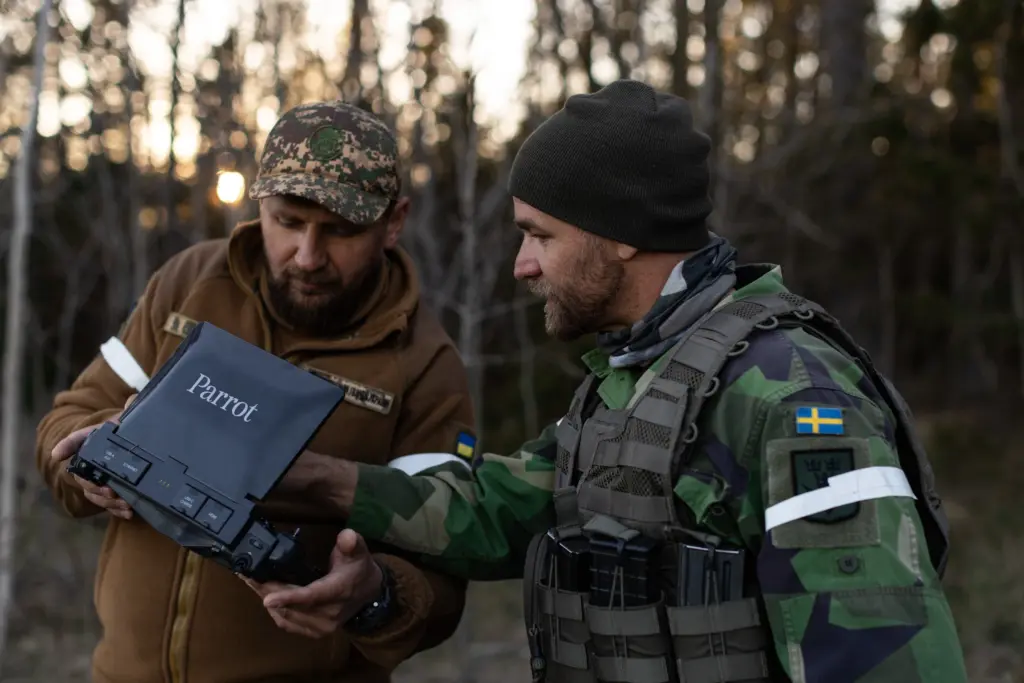
Swedish and Ukrainian drone operators check the feed from a reconnaissance drone on Gotland during Exercise Aurora 26. Ukraine sent operators to share lessons with NATO forces and to play a challenging opposing force. Photo: NATO/Flickr
The choice is not between idealism and realism. It is between pretending that the old assumptions still hold and building the capabilities required by the reality that has replaced them.
Acknowledging the world as it is means seeing the threats clearly; defending the world as it should be means acting on that knowledge, and the bridge between the two is strength.
Strength is not found in numbers, but in unity: agreeing on the enemy and a real will and capability to fight.
Accept those eight fixed points, and Europe's room for maneuver is gone, along with its present strategy. Europe cannot afford another 12 years of futile diplomacy while Russia exploits our naivety to prepare for war in the next two to three years, diplomacy that has undermined Europe's need to rearm and establish credible deterrence.
European governments have long acknowledged that their armed forces no longer provide credible defense, yet their security policy still assumes NATO guarantees collective security.
Acknowledge reality, and the illusion shatters.
Europe urgently needs a new strategy, one that looks beyond NATO and the EU's inherent weaknesses toward a military alliance credible enough to reshape the strategic environment. This is why I have long argued for a Coalition of Like-Minded European countries (CALM). It offers a path from recognition to action, from acknowledging NATO's failure to building something that works.
Strength is not found in numbers, but in unity: agreeing on the enemy, his aims and strategy, and committing to countermeasures that demonstrate real will and capability to fight.
Explore further
The alternative to NATO: A Coalition of Like-Minded European Countries
Unlike NATO or the EU, CALM does not have to wait for Europe's rearmament to reach 2035. It builds on existing NATO interoperability.
The force already exists: Ukraine's battle-hardened army, National Guard, Special Operations Forces, air defense, and Unmanned System Forces, combined with European fifth-generation aircraft and state-of-the-art navies, are credible, combat-proven, and in place.
Russia already struggles to fight Ukraine alone; it would face a different reality entirely if Ukraine formally joined a coalition of European military powers. That is why the declaration matters now, not after the capability is fully built: with the interoperability already proven, it changes Russia's strategic assessment immediately, not in 2035.
This is not only about physical capabilities. It is about changing Russia's perception of its strategic environment. It starts with a declaration; preparing for military intervention comes next. But it begins with the declaration.
Hans Petter Midttun, independent analyst on hybrid warfare, Non-Resident Fellow at the Centre for Defense Strategies, board member of the Ukrainian Institute for Security and Law of the Sea, former Defense Attaché of Norway to Ukraine, and officer (R) of the Norwegian Armed Forces.
Editor's note. The opinions expressed in our Opinion section belong to their authors. Euromaidan Press' editorial team may or may not share them.
Il y a plusieurs générations, des femmes et des hommes courageux ont défriché les territoires qui nous entourent. Bien entendu, ceux-ci n’étaient pas vierges. Les Premières Nations y pratiquaient la chasse et la pêche depuis des temps immémoriaux. Mais les premiers colons à s’y établir durent, à la sueur de leur front, affronter moult épreuves pour commencer à créer ce qui allait devenir nos régions.
Chronique « La parole aux élus » avec le préfet de la MRC de La Mitis, Bruno Paradis
Il y
Il y a plusieurs générations, des femmes et des hommes courageux ont défriché les territoires qui nous entourent. Bien entendu, ceux-ci n’étaient pas vierges. Les Premières Nations y pratiquaient la chasse et la pêche depuis des temps immémoriaux. Mais les premiers colons à s’y établir durent, à la sueur de leur front, affronter moult épreuves pour commencer à créer ce qui allait devenir nos régions.
Chronique « La parole aux élus » avec le préfet de la MRC de La Mitis, Bruno Paradis
Il y a plusieurs générations, les gouvernements ont encouragé la population à continuer cette colonisation du territoire, à créer de nouveaux villages, à déboiser les forêts pour ouvrir de nouvelles terres à l’agriculture et développer la foresterie.
Les régions ont alors grandi, les rangs se sont remplis, les ressources ont afflué vers les grands centres, le Québec s’est développé.
Il y a quelques générations, les régions se sont en partie vidées au profit des villes, vers les usines et les manufactures. Les gouvernements ont alors cherché à fermer des villages.
Nous avons résisté, nous nous sommes concertés, organisés, nous avons bataillé ferme et les Opérations Dignité nous ont permis de continuer d’exister.
Nous avons ouvert des usines pour scier notre bois, diversifié nos productions agricoles, mis en place des organismes de développement et nous avons réussi!
Mais aujourd’hui, quel avenir se dessine pour nos régions ? De moins en moins de services en santé, de moins en moins d’investissements dans nos infrastructures, dans nos usines, dans notre transport collectif. De plus en plus de terres agricoles accaparées, de plus en plus de milieux dévitalisés, de plus en plus de pauvreté.
Une élection est toujours l’occasion de changer de tangente, de direction.
J’aimerais que non seulement le prochain gouvernement, mais aussi le Québec en entier, collectivement, se pose la question suivante : souhaitons-nous occuper, de façon dynamique, l’ensemble du territoire habité aujourd’hui par les Québécois et Québécoises, du Bas-Saint-Laurent à la Côte-Nord en passant par la Gaspésie, le Saguenay et l’Abitibi-Témiscamingue ?
Si la réponse est OUI, alors je souhaite que le prochain gouvernement s’engage à passer de la parole aux actes. Je rêve, mais… pourquoi ne pas faire du Québec le « Québec des régions » ?

 Connexion