❌

Vue normale

  • ✇Coda Story
  • Darkness is losing its war with the light
    Astronomy, our window into the rest of the universe, happens in the dark. Planets, stars and galaxies – all the mysteries of the cosmos – only reveal themselves at night. But the night sky may be getting much brighter, thanks to an American company with a plan to conquer darkness itself by sending 50,000 giant mirrors into space. What you are reading first appeared as a cover story for The Atlas, our new global publication with The Continent. Sign up here to get the next edition delivered to
     

Darkness is losing its war with the light

13 août 2026 à 08:29

Astronomy, our window into the rest of the universe, happens in the dark. Planets, stars and galaxies – all the mysteries of the cosmos – only reveal themselves at night. But the night sky may be getting much brighter, thanks to an American company with a plan to conquer darkness itself by sending 50,000 giant mirrors into space.
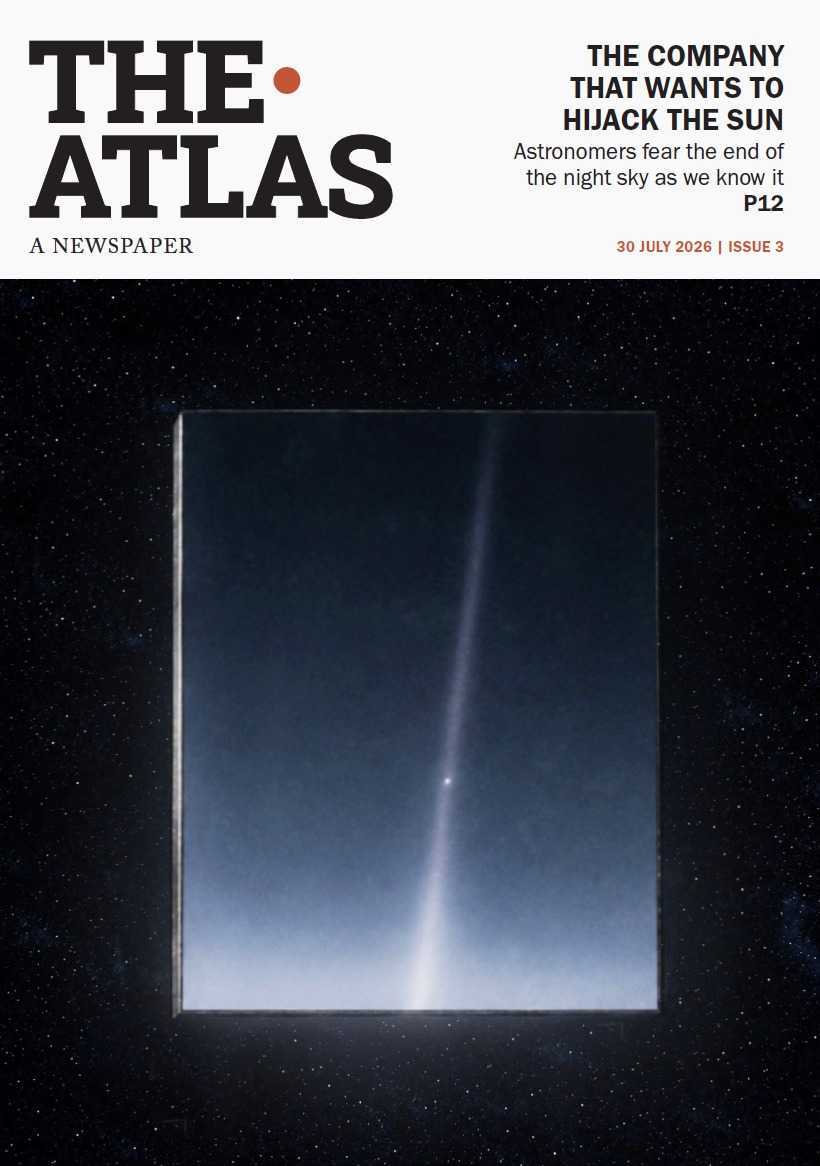
What you are reading first appeared as a cover story for The Atlas, our new global publication with The Continent. Sign up here to get the next edition delivered to your inbox on August 27.

Astronomers are panicking.

It is an “existential threat” to optical astronomy, says the European Southern Observatory. A “disastrous” idea that will “permanently scar” the night sky, according to the Royal Astronomical Society. The American Astronomical Society told Nature it “would probably mean the end of ground-based astronomy, or optical astronomy, at least.”

Sthabile Kolwa agrees. “It will take away a very crucial part of our civilization,” she tells The Atlas. Kolwa, a senior lecturer in astronomy at the University of South Africa, studies the life cycles of galaxies, but today her concerns are more immediate. “It might come to this, that we just have to find them in the parking lot and say, ‘Hey, what are you guys doing? You’re going to ruin science for us.’ ”

Like Uber, but for the sun

The parking lot in question is in Hawthorne, California, outside the headquarters of Reflect Orbital. They call themselves The Sunlight Company. The start-up is celebrating: Earlier this month, the United States Federal Communications Commission (FCC) approved the launch of Eärendil-1, likely in a few months time.

This satellite, named for a character in JRR Tolkien’s The Silmarillion, will unfurl an 18m x 18m mirror in low Earth orbit. It’s designed to reflect sunlight onto the dark side of the earth, lighting a 5km2 patch of land with the strength of four full moons.

It is a proof of concept.

By 2035, Reflect Orbital wants 50,000 of its mirrors in space, delivering illumination “comparable to daylight” on demand to paying customers (“sunlight is the new oil,” says chief executive Ben Nowack). The company says this will allow solar panels to generate clean energy overnight; provide “safer, evenly-lit streets” to cities that pay for it; and keep construction sites and farms working 24/7.

There will be an app, of course, offering “sunlight as a service” – lighting up the night will be as easy as ordering an Uber.

Clean, renewable energy is at the heart of the company’s vision, a spokesperson told The Atlas in a statement. Reflect Orbital declined to respond to specific queries and said it is in constant dialogue with astronomers, scientists and environmental researchers to mitigate the impact of the light pollution: “We are able to dim the brightness of the service and turn it off at any stage. We control where the light shines when serving an authorised customer. Most people and most places will never see this light. It is precise, targeted and customers will require permits to receive the service.”

Circadian arrhythmia

A new research paper, published in May, challenges Reflect Orbital’s position. Its author, the European Southern Observatory’s Oliver Hainault, concluded that the company’s 50,000 satellites would increase the background brightness of the sky by 300% – even when their mirrors are pointed somewhere else. This, coupled with a proposal from Elon Musk’s SpaceX to build vast data centres in space, would go “beyond the limit” of what astronomy can withstand.

What that means, in practice, is that the images from ground-based telescopes will be dramatically less useful, marred by streaks of light from passing satellites. The most distant light sources won’t be visible at all.

This will obscure evidence of other galaxies, hinder research into black holes and other cosmic phenomena, and potentially prevent early warnings of asteroid approaches. Cutting-edge astronomy will only be possible from space-based telescopes like the James Webb and the Hubble – access to which is already massively oversubscribed, and subject to political interference.

The night sky will look different to the naked eye, too. “The next time you’re away from urban light pollution, spend some time outdoors after dark and enjoy the view of the Milky Way and the constellations that have inspired awe since humankind woke to consciousness. Chances are those views are not here to stay forever,” wrote journalist Tereza Pultarova for Space.com.

Anna Jibladze

Running out of space

The night sky is already a lot brighter than it was 150 years ago, when light bulbs started to become commonplace. According to Dark Sky International, a US-based nonprofit that advocates against light pollution, 80% of Earth’s human population already lives under some form of sky glow, most of which is generated on land. This has forced astronomers to seek out “dark sky places,” like the Atacama Desert in Chile or the Upper Karoo in South Africa, for their telescopes.

Humans can adapt to less darkness. But it is much harder for animals and ecosystems that have evolved alongside predictable rhythms of day and night. Nocturnal predators lose the ability to hunt; sea turtle babies can’t find their way to the sea; migratory birds are thrown hopelessly off course; and moths expend all their energy helplessly chasing artificial light sources.

“It’s almost like we are on a mission to obliterate natural darkness from earth,” said Ruskin Hartley, Dark Sky’s chief executive. “And now rather than do it street by street and bulb by bulb, let’s do it from space.”

Space is, in theory, protected by the Outer Space Treaty, a 1967 agreement signed by 110 countries, including all the major space superpowers. It states that “space is the province of all mankind." But that’s not what’s actually happening, Hartley argues. “In the US, it’s the most wealthy, most powerful individuals who are gobbling up as much of that orbital space as they can before someone else can get that opportunity” – with China, Russia and Europe all scrambling too for a greater presence in low Earth orbit.

“Who gets to choose that we light up the night sky? Who gets to make that decision?” Ruskin asks. In the US, it is the FCC’s job to decide what satellites are allowed in space. But it has said that assessing the impact of light pollution or environmental damage is not within its remit. Instead, it wants to slash regulation so American companies can take advantage of the “space industrial revolution.”

And Reflect Orbital has rich and powerful backers. Earlier this year, it secured a $1.5-million contract from the US air force, hinting at possible military applications for its mirrors. Last year, it raised $20-million from three venture capital firms, including Sequoia Capital, one of the biggest investors in Silicon Valley. Sequoia also owns a multibillion-dollar stake in SpaceX, which has its own plans for low earth orbit.

There are already more than 10,000 Starlink satellites up there, giving Elon Musk unprecedented influence over global communications. The company wants to launch one million more satellites over the next few years to build a network of space-based data centres. In addition to the light pollution, astronomers worry the potential for collisions will increase dramatically, as will risks to the ozone layer.

A brighter future

On her blog Higher Dimensions, the astronomy professor Janna Levin contemplates our brighter future. “It is quite possible that the hot glow of the swarm of data satellites will saturate the night, washing out the stars from our perspective on Earth. We’ll look up into the sky and instead of Zeus transformed into a swan outlined in a constellation of a few stars, the machine gods will literally loom above us, glowing with radiant heat, making declarations, predicting the weather, forecasting then determining our fate.”

Kolwa, the South African astronomy lecturer, offers a different metaphor: that of empires “colonizing low Earth orbit.” This was an ambition of one of the most infamous imperialists of them all, Cecil John Rhodes, who said that he looked up at the stars and thought: “I would annex the planets if I could; I often think of that. It makes me sad to see them so clear and yet so far.”

But it hasn’t been colonized just yet.

“I’m still trying to figure out what we can do, what responsibility we have as scientists,” says Kolwa. “How could we engage our communities to stand up to these corporations and say no? We must keep our night skies dark, as dark as possible.”

The post Darkness is losing its war with the light appeared first on Coda Story.

  • ✇The Kyiv Independent
  • Ukrainian-founded Grammarly to acquire AI email app Superhuman
    Grammarly, a company with Ukrainian roots, announced its intent to acquire AI email writing app Superhuman as part of its expansion into an AI productivity platform, the company said in a press release on July 1. Grammarly is the most valuable company with Ukrainian roots, reaching $13 billion valuation as of 2021. Grammarly was founded in 2009 in Kyiv by Oleksii Shevchenko, Maksym Lytvyn, and Dmytro Lider.According to Grammarly's press release, email is Grammarly's top use case, with the platfo
     

Ukrainian-founded Grammarly to acquire AI email app Superhuman

2 juillet 2025 à 07:45
Ukrainian-founded Grammarly to acquire AI email app Superhuman

Grammarly, a company with Ukrainian roots, announced its intent to acquire AI email writing app Superhuman as part of its expansion into an AI productivity platform, the company said in a press release on July 1.

Grammarly is the most valuable company with Ukrainian roots, reaching $13 billion valuation as of 2021. Grammarly was founded in 2009 in Kyiv by Oleksii Shevchenko, Maksym Lytvyn, and Dmytro Lider.

According to Grammarly's press release, email is Grammarly's top use case, with the platform editing over 50 million emails weekly.

Superhuman is an AI email application that the company says helps users respond to emails faster and reduces time spent on email communications.

Users are already sending and responding to 72% more emails per hour after using Superhuman compared to the previous period, according to Grammarly.

"This is the future we've been building toward since day one: AI that works where people work, not where companies want them to work," said Shishir Mehrotra, Grammarly's CEO.

The acquisition follows Grammarly's recent purchase of Coda, a productivity tool company. The combined platforms will allow users to work with multiple AI agents for different tasks within email communications.

Grammarly says that its service is used daily by over 40 million users, generating annual revenue of more than $700 million for the company.

As Russia ramps up missile attacks, US halts promised air defense shipments to Ukraine
Among the items being held back from Ukraine are Patriot air defense missiles, precision artillery rounds, Hellfire missiles, and drones, three sources told Politico.
Ukrainian-founded Grammarly to acquire AI email app SuperhumanThe Kyiv IndependentAbbey Fenbert
Ukrainian-founded Grammarly to acquire AI email app Superhuman
  • ✇The Kyiv Independent
  • Russia cannot launch 500 drones every day, Ukraine's intel chief says
    Russia has the capacity to launch as many as 500 Iranian-designed Shahed attack drones at Ukraine in a single attack, but doing so on a daily basis is not possible, Ukraine's military intelligence chief Kyrylo Budanov said on July 2, according to Suspilne.In recent weeks, Russia has intensified its drone assaults on Ukrainian cities, often launching hundreds in a single day. The largest aerial attack since the start of the full-scale invasion occurred overnight on June 29, when Moscow launched 4
     

Russia cannot launch 500 drones every day, Ukraine's intel chief says

2 juillet 2025 à 05:05
Russia cannot launch 500 drones every day, Ukraine's intel chief says

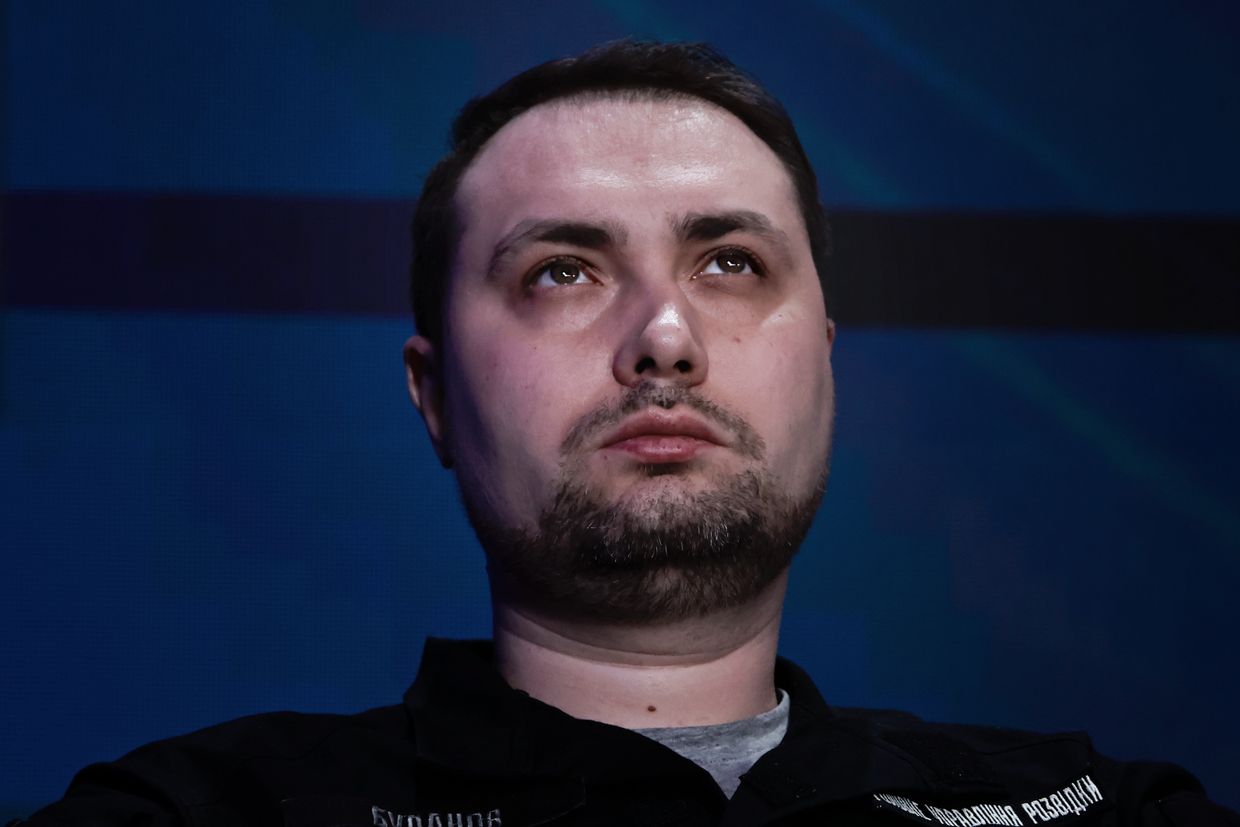
Russia has the capacity to launch as many as 500 Iranian-designed Shahed attack drones at Ukraine in a single attack, but doing so on a daily basis is not possible, Ukraine's military intelligence chief Kyrylo Budanov said on July 2, according to Suspilne.

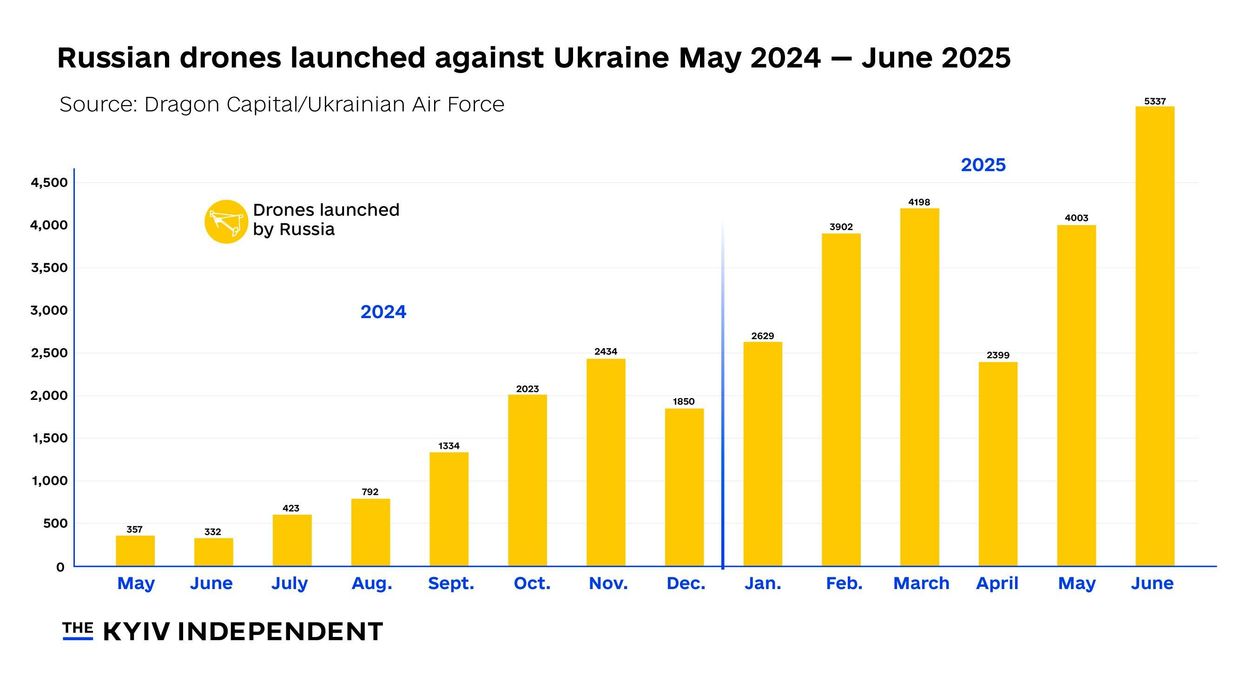
In recent weeks, Russia has intensified its drone assaults on Ukrainian cities, often launching hundreds in a single day. The largest aerial attack since the start of the full-scale invasion occurred overnight on June 29, when Moscow launched 477 drones and 60 missiles across Ukraine.

"Launching 450–500 Shaheds every day — it's just not realistic," said Budanov during a ceremony recognizing five Ukrainian intelligence achievements in the national record book, according to public broadcaster Suspilne.

"But unfortunately, they do have the ability to do it periodically. They can realistically launch up to 500 in one strike," Budanov added.

Budanov also said Russia is upgrading the capabilities of the Shahed-type drones by improving their CRPA (Controlled Reception Pattern Antenna) systems, which protect the drones from GPS jamming. He noted that Russian engineers are now producing 16-channel CRPA antennas, which are harder to counter electronically.

Russia cannot launch 500 drones every day, Ukraine's intel chief says
Russian drones launched against Ukraine by month (Nizar al-Rifai/The Kyiv Independent)

"These antennas are currently produced in Russia, but the engineer who developed this CRPA antenna was here in Ukraine," Budanov said.

"Back in the early 2000s, no one here needed it, so the engineer moved to Russia. One (of the two engineers involved in the development) has already died under unclear circumstances. The other is still alive, though probably not for long."

Russia has used thousands of Shahed-type drones throughout its full-scale invasion to strike Ukrainian cities and infrastructure, often in large overnight waves. Ukrainian air defenses have adapted over time but face growing challenges as Moscow improves drone resilience and electronic warfare capabilities.

President Volodymyr Zelensky said that Moscow has launched 28,743 Shahed-type drones at Ukraine since the start of Russia's full-scale invasion.

Budanov also said Russia has made unsuccessful attempts to develop its own naval drones. The last known effort came in early June, when experimental models detonated before reaching Ukrainian territorial waters, he said.

"They didn't achieve results. Based on our information, they were heading toward the city of Yuzhne, searching for targets," he said.

Ukraine has been using domestically developed Magura naval drones to target Russian military assets in the Black Sea, keeping much of Russia's fleet pinned in port.

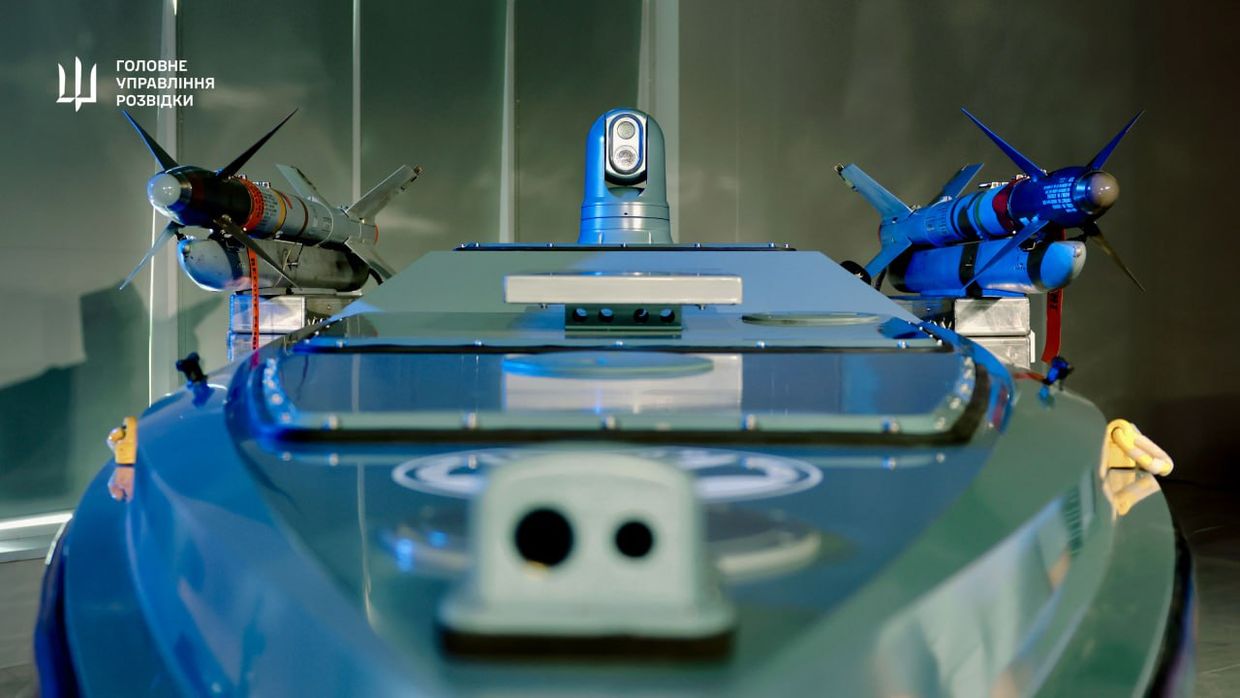
Despite their small size, the unmanned surface vessels have proven effective, including in a May 2 operation when Ukraine's military intelligence used Magura-7 drones armed with air-to-air missiles to shoot down two Russian Su-30 fighter jets near Novorossiysk. It was the first recorded instance of fighter jets being downed by naval drones.

Ukraine shows its latest ‘ship-killer’ Magura drone series to the public for the first time
The Magura drones, as well as the Sea Baby drones of the Security Service of Ukraine (SBU), were pivotal in turning the tide of the war in the Black Sea, destroying or damaging Russian ships and other assets.
Russia cannot launch 500 drones every day, Ukraine's intel chief saysThe Kyiv IndependentMartin Fornusek
Russia cannot launch 500 drones every day, Ukraine's intel chief says
  • ✇The Kyiv Independent
  • Ukraine approves new 'Murakha' ground robot for combat use
    The Defense Ministry has approved the Ukrainian-made ground-based robotics complex "Murakha" ("Ant") for combat operations, the ministry announced on June 28. Since 2024, Ukraine has been scaling up robotics development in hopes that mass production of unmanned ground vehicles (UGVs) will "minimize human involvement on the battlefield." The Murakha is a tracked robotic platform designed to support front-line units working under challenging conditions, such as under enemy artillery and in heavily
     

Ukraine approves new 'Murakha' ground robot for combat use

29 juin 2025 à 00:58
Ukraine approves new 'Murakha' ground robot for combat use

The Defense Ministry has approved the Ukrainian-made ground-based robotics complex "Murakha" ("Ant") for combat operations, the ministry announced on June 28.

Since 2024, Ukraine has been scaling up robotics development in hopes that mass production of unmanned ground vehicles (UGVs) will "minimize human involvement on the battlefield."

The Murakha is a tracked robotic platform designed to support front-line units working under challenging conditions, such as under enemy artillery and in heavily mined terrain, the Defense Ministry said.

Its larger size makes it one of Ukraine's leading UGVs in terms of load capacity. The Murakha can reportedly carry over half a ton of weight across dozens of kilometers. It can also cross difficult terrain and shallow water.

According to the Defense Ministry, the Murakha's multiple control channels allow it to function successfully even in areas of the battlefield where Russian electronic warfare (EW) systems are operating.

Mobile robots are capable of performing several tasks on the battlefield, including offensive and defensive activities, evacuation of the wounded, logistical support for units, and mining and demining.

In April, the Defense Ministry unveiled the D-21-12R UGV, a ground-based robot equipped with a machine gun.

Ukrainian drones strike missile, drone arsenal in Russia’s Bryansk Oblast
Ukraine’s military intelligence (HUR) struck on June 28 the 1060th Material-Technical Support Center in the city of Bryansk, Ukraine’s General Staff said. The facilities store a Russian missile and drone arsenal, Ukrainska Pravda reported, citing a source in HUR.
Ukraine approves new 'Murakha' ground robot for combat useThe Kyiv IndependentDmytro Basmat
Ukraine approves new 'Murakha' ground robot for combat use
  • ✇The Kyiv Independent
  • EU proposes integrating Ukraine into bloc's mobile roaming area
    The European Commission has proposed that Ukraine join the European Union's mobile roaming area starting January 1, 2026, providing Ukrainian users the ability to make phone calls, texts, and use mobile data in the bloc's 27 countries at no extra charge. "We want Ukrainian citizens to stay connected to their loved ones across the EU, as well as in their home country. That's why we propose that Ukraine join our roaming family," European Commission President Ursula von der Leyen said in a statemen
     

EU proposes integrating Ukraine into bloc's mobile roaming area

19 juin 2025 à 21:29
EU proposes integrating Ukraine into bloc's mobile roaming area

The European Commission has proposed that Ukraine join the European Union's mobile roaming area starting January 1, 2026, providing Ukrainian users the ability to make phone calls, texts, and use mobile data in the bloc's 27 countries at no extra charge.

"We want Ukrainian citizens to stay connected to their loved ones across the EU, as well as in their home country. That's why we propose that Ukraine join our roaming family," European Commission President Ursula von der Leyen said in a statement.

The proposal, first announced on June 16, will serve as a means of integration into the European Union's "Roam like at Home" provision in affect between all EU nations. The proposed change will impact the over four million Ukrainian refugees living in the EU.

Ukraine's full integration in the roaming provisions will replace voluntary measures that "allowed for roaming without surcharges and affordable international calls for EU and Ukrainian citizens abroad," according to the European Commission. The current measure will extend to December 31, 2025, ahead of the planned integration.

If approved, Ukraine will become the only country outside of the EU to join the bloc's "Roam like at Home" policy.

The move, which awaits European Council approval, comes as Ukraine continues to implement reforms in pursuing membership in the European Union.

Ukraine applied for EU membership at the onset of Russia's full-scale invasion in 2022. The country has made quick progress, achieving candidate status within months, with the initial negotiations formally launching in June 2024.

Since the start of 2025, Ukraine has opened three negotiation clusters under Poland's rotating presidency.

Poland lead the EU Council's presidency until June, and Denmark will take over the role in July. Ukraine aims to open the remaining three negotiation clusters in the second half of 2025 under the Danish chairmanship, the President Volodymyr Zelensky said.

There are six accession negotiation clusters, consisting of several individual chapters. Negotiations prepare a candidate country to become an EU member.

The EU’s Commissioner for Enlargement, Oliver Varhelyi, said that Ukraine could potentially join the bloc by 2029 if it successfully implements necessary reforms.

‘I am against Ukraine’s entry into the European Union,’ Polish president-elect Nawrocki says
“Ukraine must understand that other countries, including Poland, Hungary, and other European countries, also have their own interests,” Polish President-elect Karol Nawrocki said.
EU proposes integrating Ukraine into bloc's mobile roaming areaThe Kyiv IndependentVolodymyr Ivanyshyn
EU proposes integrating Ukraine into bloc's mobile roaming area


❌