Jessica Watkins, the first Black woman to lead a crew to orbit, is making her second trip to the space stationFour astronauts rocketed into orbit on Thursday on a space station mission that will stretch until spring, among them a Canadian whose wife will give birth while he is away.SpaceX launched commander Jessica Watkins and her crew for Nasa after a three-week delay to fix the capsule’s leaking fuel system. Thick clouds threatened all morning to halt the countdown but in the end, the skies cl
Jessica Watkins, the first Black woman to lead a crew to orbit, is making her second trip to the space station
Four astronauts rocketed into orbit on Thursday on a space station mission that will stretch until spring, among them a Canadian whose wife will give birth while he is away.
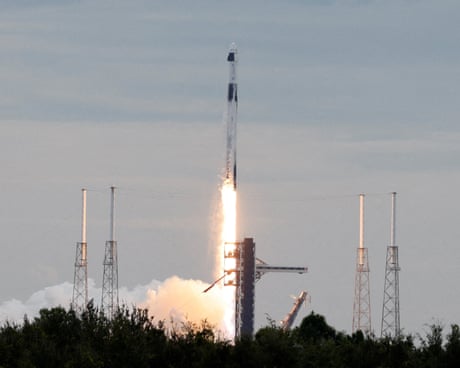
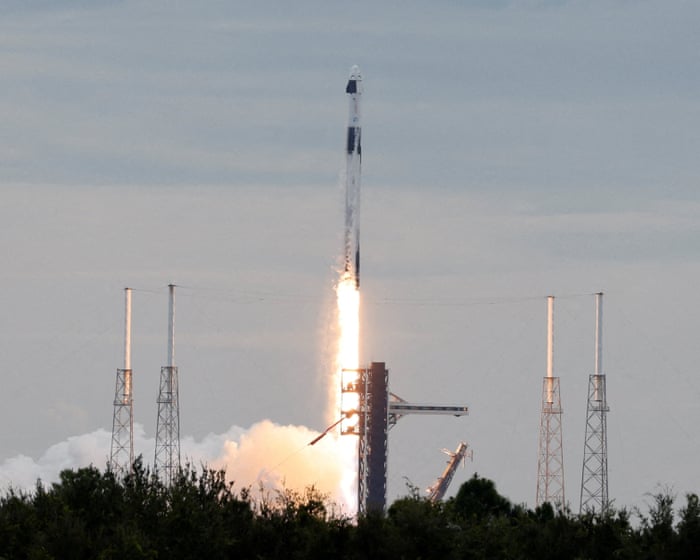
SpaceX launched commander Jessica Watkins and her crew for Nasa after a three-week delay to fix the capsule’s leaking fuel system. Thick clouds threatened all morning to halt the countdown but in the end, the skies cleared enough to allow for a safe liftoff.
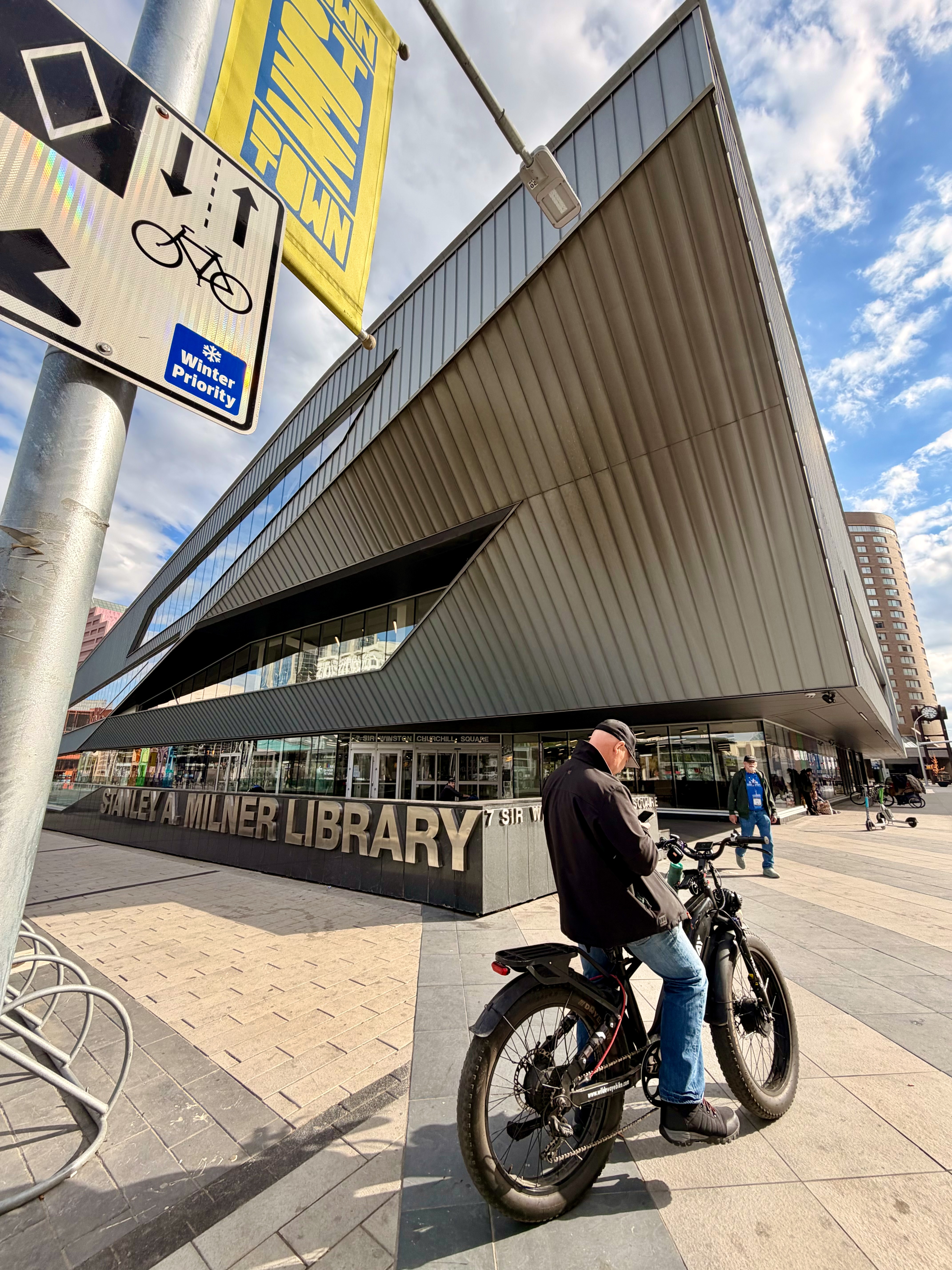
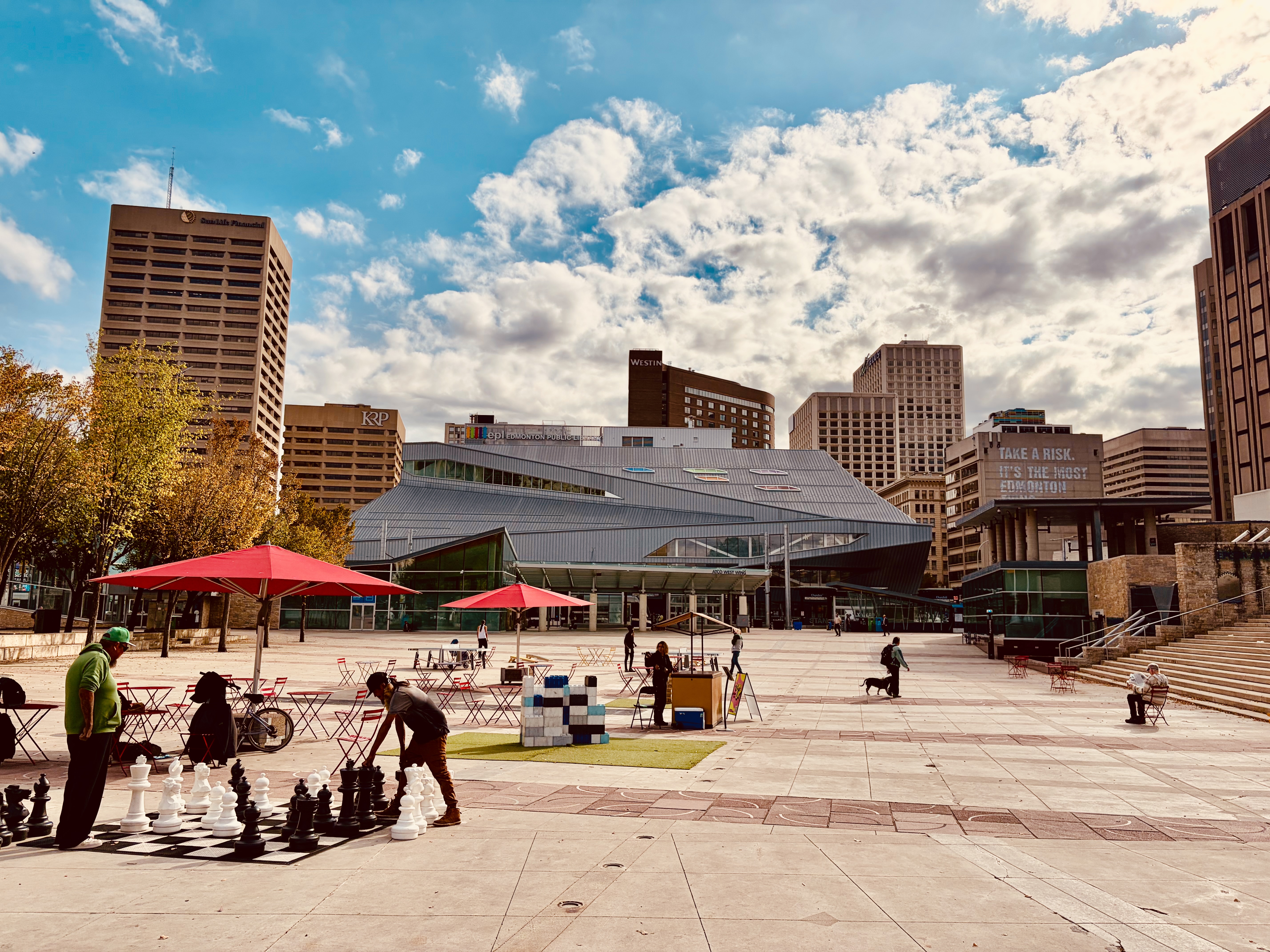
Entrée et façade de la Stanley A. Milner Library au centre-ville d’Edmonton, 2026
Je reviens à la Stanley A. Milner Library depuis 2022, et ce qui m’intéresse chaque fois, ce sont les déplacements : ceux des espaces, des usages, des priorités. C’est d’ailleurs l’une des premières choses que j’ai faites en arrivant à Edmonton cette fois-ci, comme à chacun de mes passages dans la ville : retourner voir la bibliothèque.
C’était déjà ma quatrième visite. J’y étais deux fois en 2022, en 2023 av
Entrée et façade de la Stanley A. Milner Library au centre-ville d’Edmonton, 2026
Je reviens à la Stanley A. Milner Library depuis 2022, et ce qui m’intéresse chaque fois, ce sont les déplacements : ceux des espaces, des usages, des priorités. C’est d’ailleurs l’une des premières choses que j’ai faites en arrivant à Edmonton cette fois-ci, comme à chacun de mes passages dans la ville : retourner voir la bibliothèque.
C’était déjà ma quatrième visite. J’y étais deux fois en 2022, en 2023 avant d’y revenir cette fois-ci, en septembre 2026. Assez pour que la visite ne consiste plus seulement à découvrir un lieu, mais à le comparer à lui-même. Qu’est-ce qui est toujours là? Qu’est-ce qui a bougé? Qu’est-ce qui apparaît? Et que racontent ces transformations sur la manière dont une bibliothèque publique se pense au Canada et négocie sa place dans la sphère publique ?
Un bâtiment spectaculaire, mais pas seulement
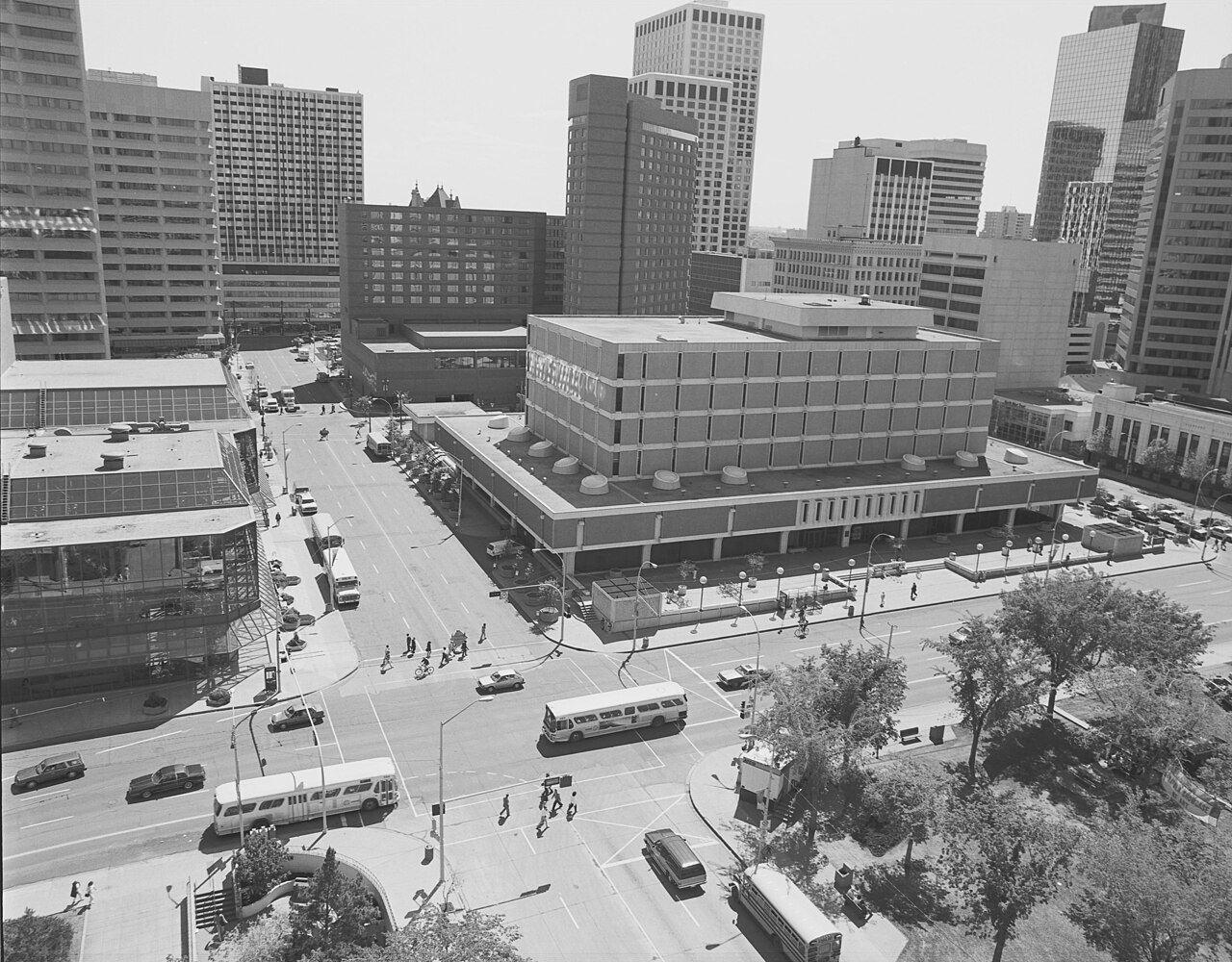
Posée sur Churchill Square, au cœur du centre-ville, la Stanley A. Milner Library occupe quelque 21 400 m² (230 000 pi²). La bibliothèque centrale de l’Edmonton Public Library (EPL) est installée sur ce site depuis 1967; elle porte le nom de Stanley A. Milner depuis 1996. Fermé à la fin de 2016, le bâtiment a fait l’objet d’une transformation majeure de 84,5 millions de dollars avant de rouvrir le 17 septembre 2020. L’intervention, réalisée par Teeple Architects en collaboration avec Stantec, a conservé la structure de l’ancienne bibliothèque tout en transformant radicalement son enveloppe et ses espaces intérieurs.
La Stanley A. Milner Library en 1989, avant sa transformation majeure. Photo : Provincial Archives of Alberta, via Wikimedia Commons. Aucune restriction de droit d’auteur connue.
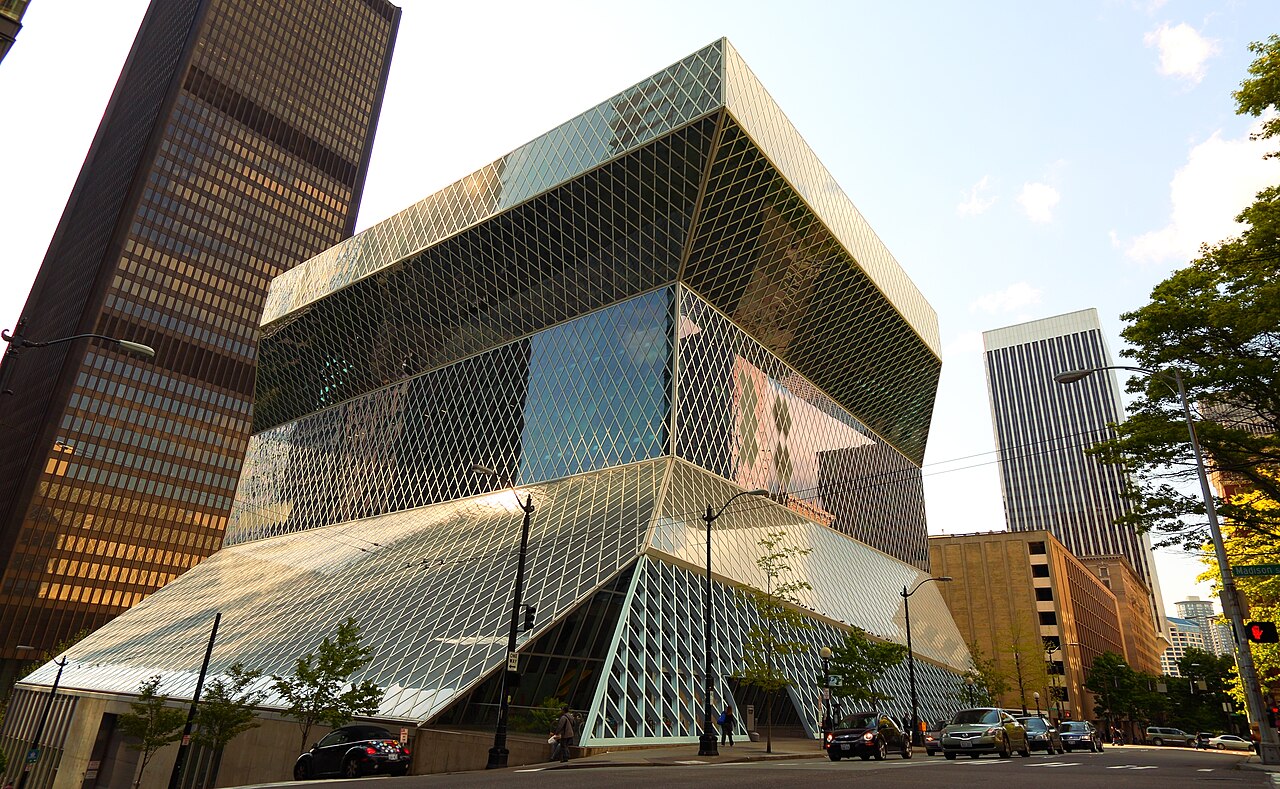
Difficile, en la regardant, de ne pas penser aussi à la Seattle Central Library, inaugurée en 2004 et conçue par OMA (Office for Metropolitan Architecture), avec Rem Koolhaas et Joshua Prince-Ramus omme architectes responsables du projet, en collaboration avec LMN Architects. La parenté n’est pas littérale, mais quelque chose circule entre les deux bâtiments : les volumes anguleux, les façades vitrées et métalliques, les plans inclinés, mais surtout cette volonté de faire de la bibliothèque centrale un objet architectural iconique abritant un spectaculaire living room dans la ville. Seattle pousse beaucoup plus loin cette logique, avec son enveloppe de verre et d’acier presque cristalline; la Milner en propose une version plus compacte, greffée sur la structure de l’ancienne bibliothèque. Dans les deux cas, l’architecture participe d’une affirmation : dans le monde des réseaux, la grande bibliothèque publique demeure un équipement civique auquel on donne une présence urbaine forte.
Mais cette fois, ce n’est pas tant l’architecture qui a retenu mon attention à la Milner. Ou plutôt : ce sont moins les formes du bâtiment en elles-mêmes que ce qu’elles permettent de faire, les usages qu’elles accueillent et, surtout, ce qu’elles donnent à voir et à mettre en valeur. Devant la bibliothèque, Churchill Square donne déjà un premier indice. Des tables et des chaises, des jeux d’échecs et de dames géants, des gens qui passent ou qui s’arrêtent : la bibliothèque s’inscrit dans un espace public qui déborde largement ses murs. Puis, on entre et le même principe semble se poursuivre à l’intérieur. On peut emprunter un livre, bien sûr, mais aussi prendre un café, voir une exposition, apprendre à cuisiner, fabriquer quelque chose, participer à une activité, rencontrer une Aînée, ou simplement rester là. C’est peut-être ce qui me fascine le plus avec cette bibliothèque : elle donne matériellement à voir l’élargissement du répertoire d’action de la bibliothèque publique au Canada.
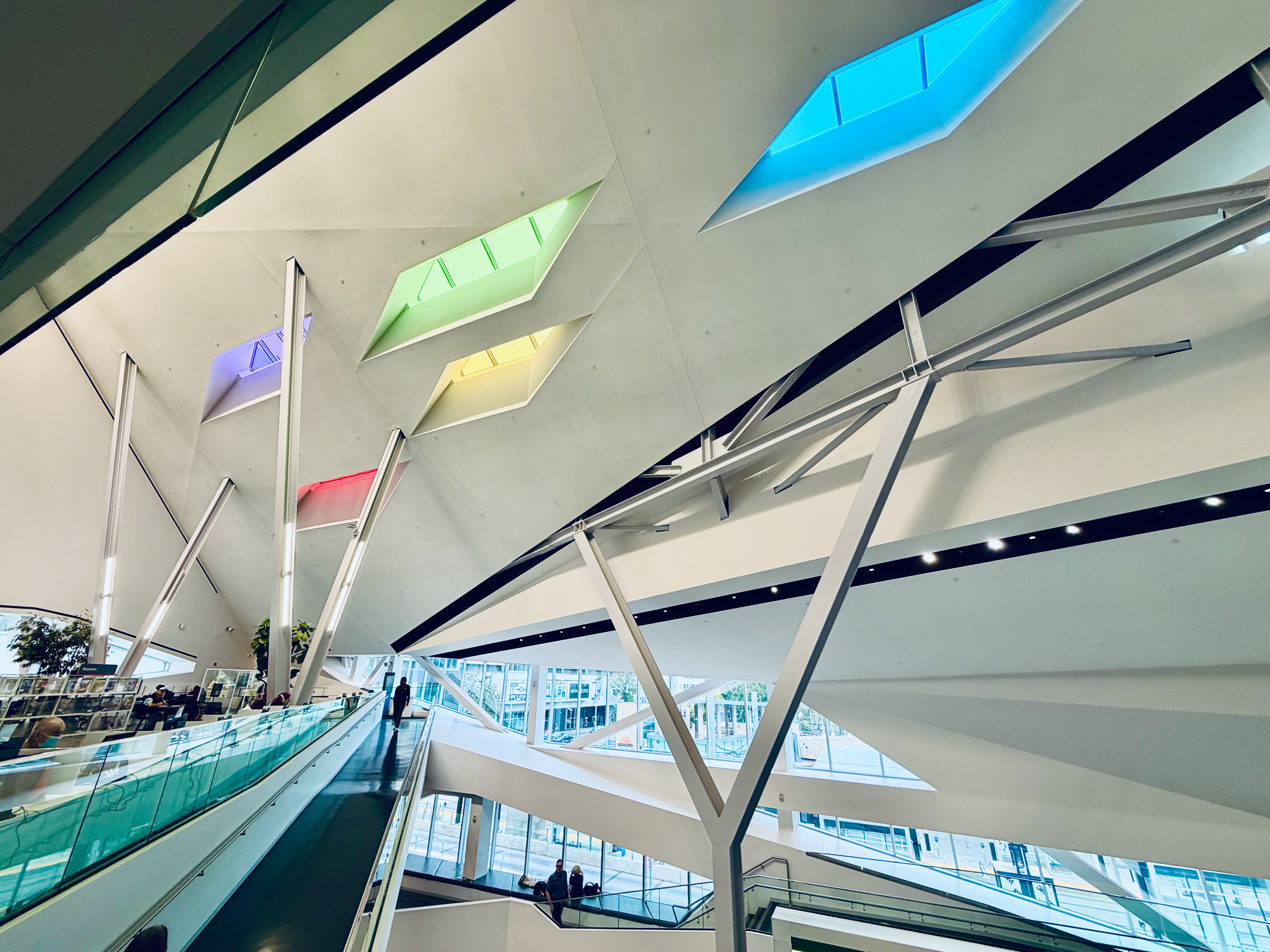
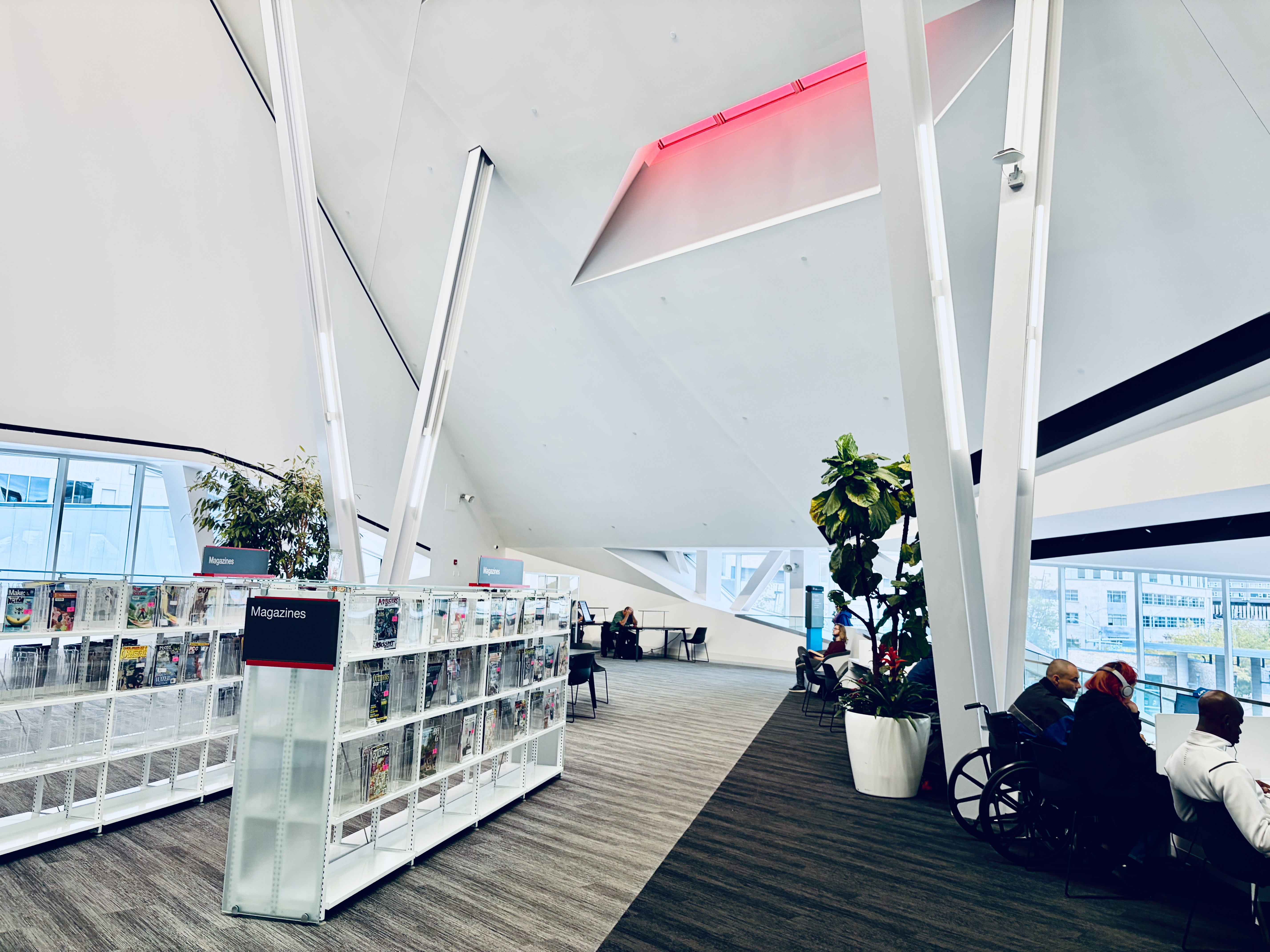
L’atrium de la Milner : volumes anguleux, passerelles et puits de lumière colorés. Photo : Marie D. Martel, septembre 2026.La Teaching Kitchen, l’un des espaces qui élargissent les manières d’apprendre et de participer à la Milner. Photo : Marie D. Martel, 2023.
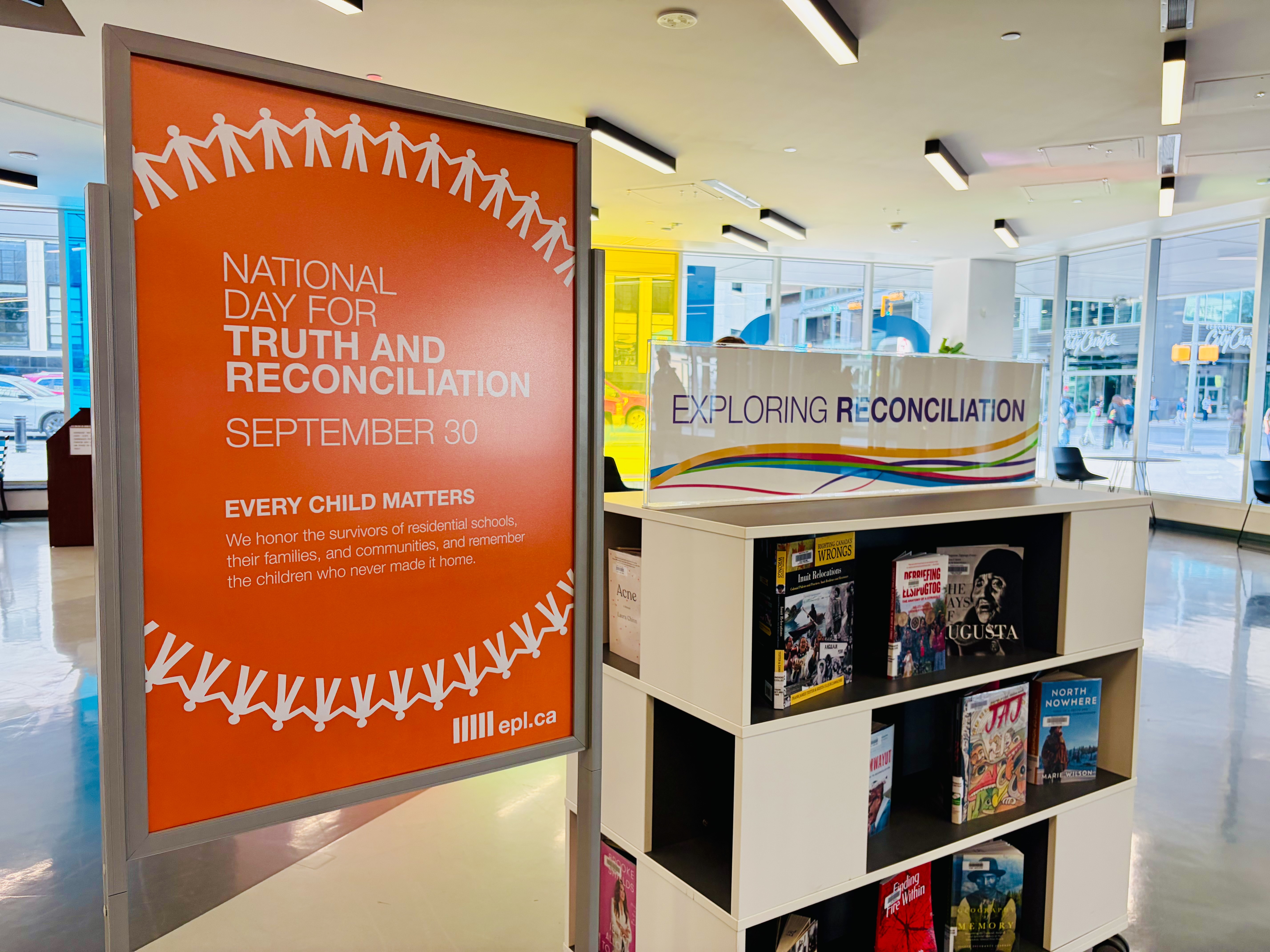
Lors de ces visites, les présentoirs racontaient d’ailleurs presque autant la bibliothèque que les rayonnages. « Exploring Reconciliation », « For Art’s Sake », « What’s Cooking? », « Canadiana » : les collections sont constamment remises en contexte et reliées à des pratiques, à des questions ou à des expériences. La Capital City Art Gallery at Milner, installée à côté du café, expose des artistes, une peintre autochtone en ce moment, et inscrit l’art dans le quotidien de la bibliothèque et des habitant.es. Ailleurs, les disques vinyles, la collection « Read Local », les clubs de lecture, les dispositifs de participation autour du cinéma, le Makerspace et la Teaching Kitchen multiplient les manières d’entrer dans la bibliothèque et d’y participer.
Une bibliothèque qui continue de se transformer
Et ce répertoire n’est pas figé. Après plusieurs visites, c’est même l’un des aspects qui me frappent le plus : la Milner n’a pas été « terminée » en 2020. La grande rénovation n’a pas fixé une fois pour toutes ce que devait être la bibliothèque. Les espaces continuent d’être ajustés et transformés.
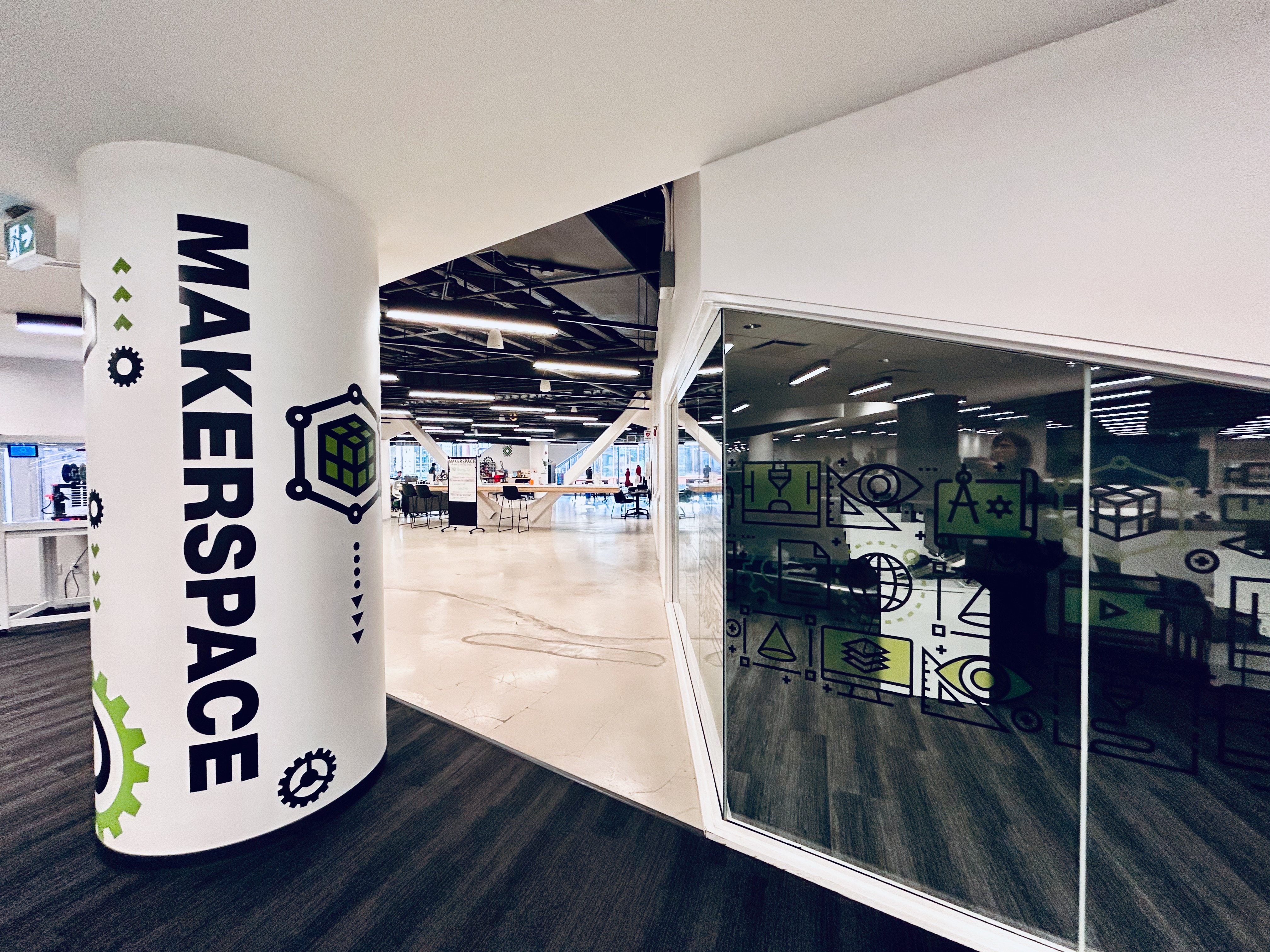
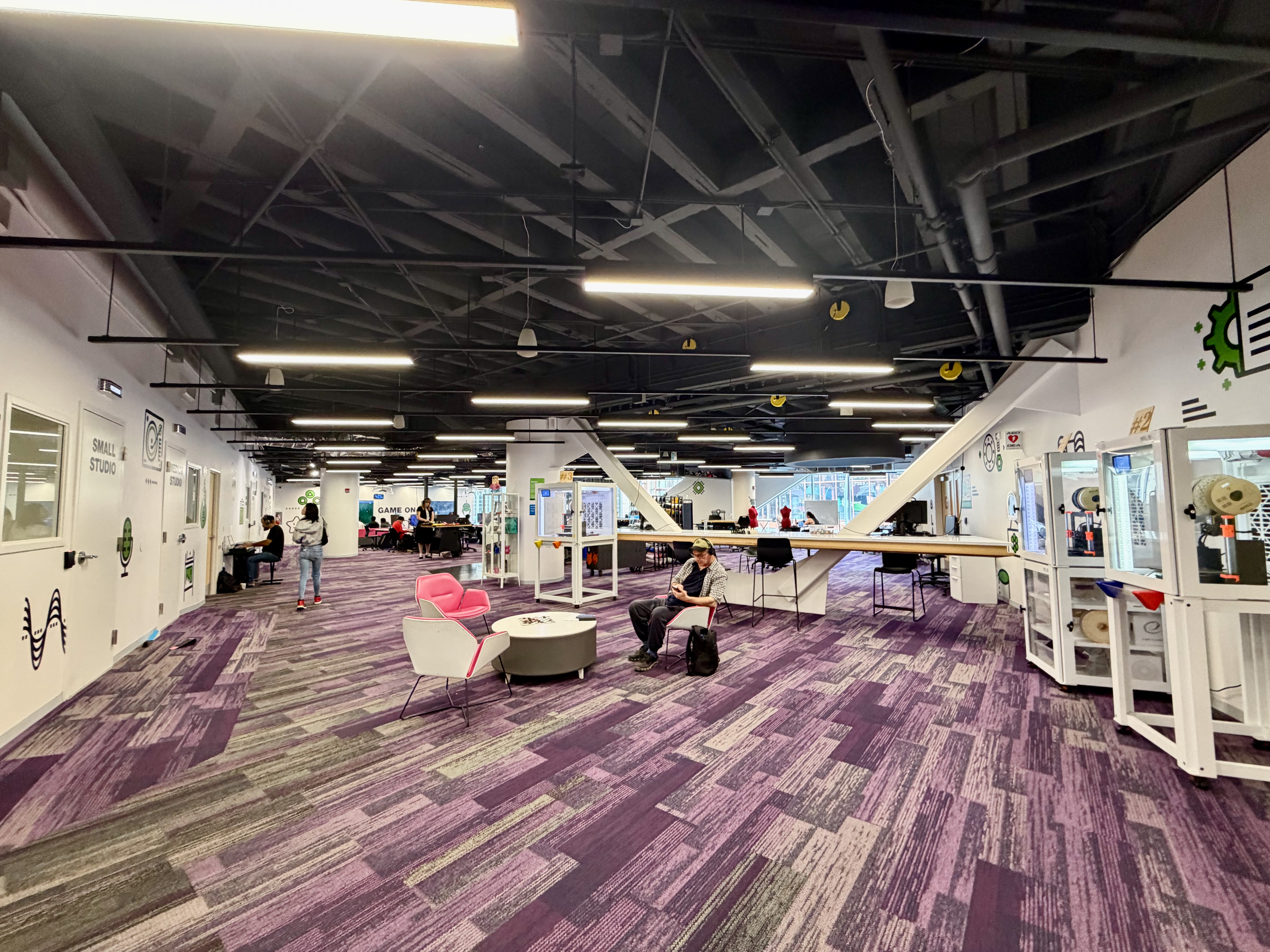
Le Makerspace en fournit un bon exemple. Il occupait déjà une place considérable dans le projet de 2020 : plus de 929 m² (10 000 pi²) consacrés notamment à l’impression 3D, à la couture, à la production sonore et vidéo, au découpage laser et à différentes formes de fabrication. Mais l’espace a de nouveau été rénové en 2025. EPL mentionne l’installation d’un nouveau revêtement de sol, un traitement acoustique, des améliorations à l’éclairage et à l’installation électrique, ainsi que l’aménagement d’un nouvel espace consacré au jeu vidéo.
Le Makerspace avant sa rénovation de 2025, avec une démarcation nette entre l’espace et le reste de la bibliothèque.Le Makerspace après la rénovation de 2025 : le nouveau revêtement de sol contribue à une plus grande continuité avec les espaces environnants.
Cette fois, c’est surtout le nouveau revêtement de sol qui m’a frappée. Le tapis semble désormais se prolonger au-delà du Makerspace et établir une continuité avec les espaces qui l’entourent. La frontière paraît moins nette : on a moins l’impression d’entrer dans un laboratoire technologique séparé du reste de la bibliothèque et du monde. Ce détail d’aménagement me semble loin d’être anodin. Il dit quelque chose d’une évolution du modèle même du makerspace : faire, fabriquer, jouer, enregistrer ou expérimenter ne constituent plus nécessairement des activités spécialisées reléguées dans une zone identifiable comme telle. Celles-ci semblent désormais s’inscrire plus naturellement dans le continuum ordinaire de la bibliothèque.
Un tipi dans l’espace commun
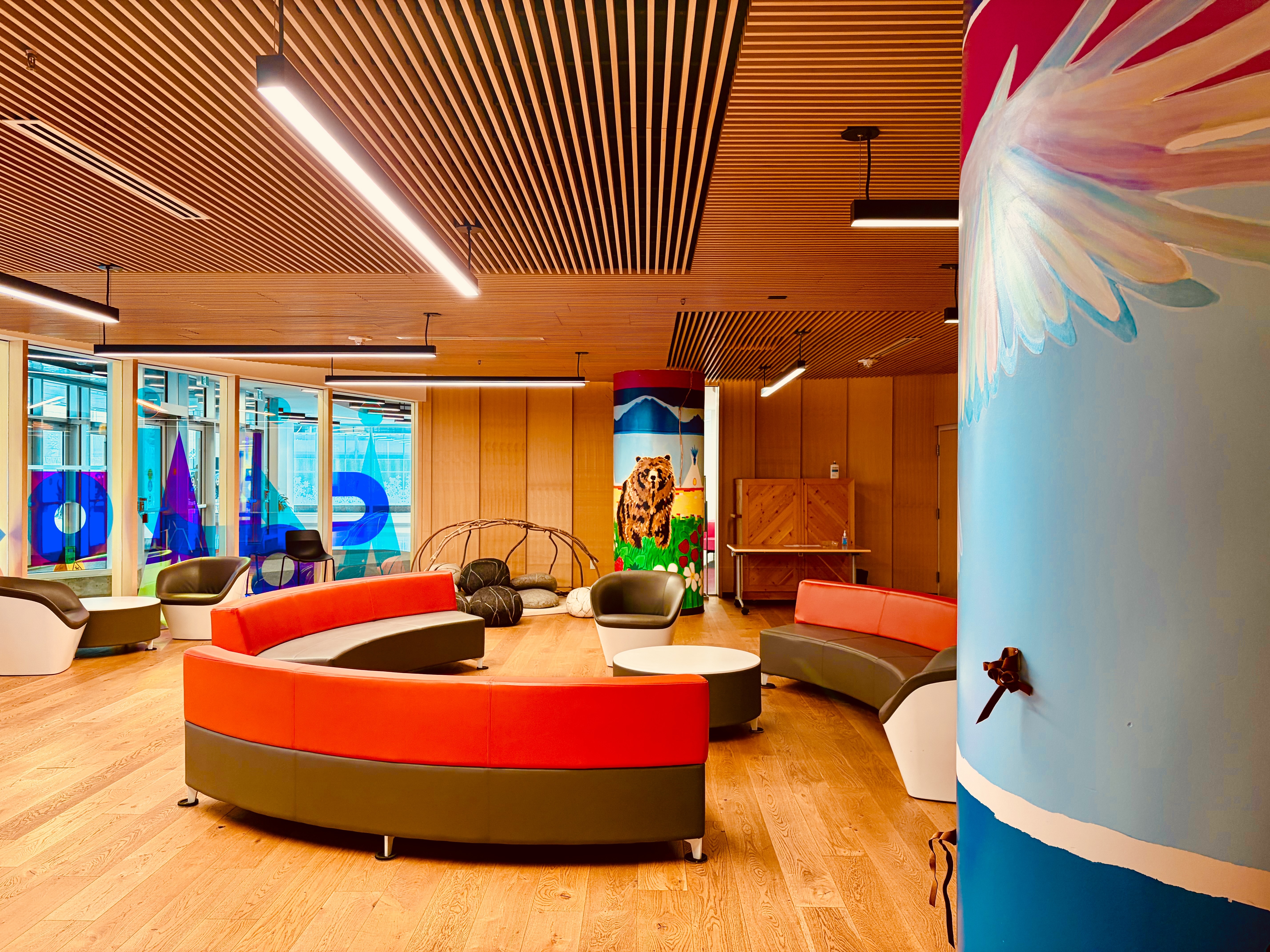
Lors de mes visites précédentes, j’avais surtout retenu PÎYÊSÎW WÂSKÂHIKAN / Thunderbird House, premier espace de la bibliothèque spécifiquement consacré aux cérémonies et aux rassemblements autochtones. EPL explique l’avoir développé avec des membres des communautés autochtones et, en particulier, avec l’Aînée Jo-Ann Saddleback, en suivant des principes nêhiyaw. Le peuplier blanc qui recouvre le sol, les murs et le plafond, l’orientation des entrées au sud et à l’est et le système de circulation d’air permettant de pratiquer une cérémonie de purification par la fumée (smudging), ne sont donc pas de simples choix décoratifs.
PÎYÊSÎW WÂSKÂHIKAN / Thunderbird House, l’espace autochtone dédié de la Milner. Marie D. Martel, septembre 2026
De tels espaces autochtones occupent aujourd’hui une place croissante dans les bibliothèques publiques canadiennes, tant dans les grandes villes que dans de plus petites collectivités. Au Québec, les équivalents sont beaucoup moins évidents. On pourrait bien sûr m’opposer Sanaaq — et j’aurais certainement une chose ou deux à dire sur le sujet. Contentons-nous ici de reconnaître que la comparaison est intéressante : Sanaaq inscrit l’autochtonisation de manière transversale — dans son nom, ses collections, sa programmation, ses partenariats et ses orientations institutionnelles — tandis que la Milner l’inscrit aussi plus concrètement dans l’organisation de ses espaces.
Le programme Kêhtêyayah (Elder) in Residence : Kokum Lorette Goulet à la Milner. Marie D. Martel, septembre 2026
Et le programme Elder in Residence approfondit cet engagement. Au moment de ma visite, Kokum Lorette Goulet y tenait des périodes de rencontre. On peut prendre rendez-vous avec une Aînée pour établir un lien avec la culture, mieux comprendre certains savoirs ou recevoir une orientation culturelle. Autrement dit, les savoirs autochtones ne sont pas seulement représentés dans les collections ou inscrits dans l’architecture : des personnes qui les portent et les transmettent ont une place reconnue dans la bibliothèque.
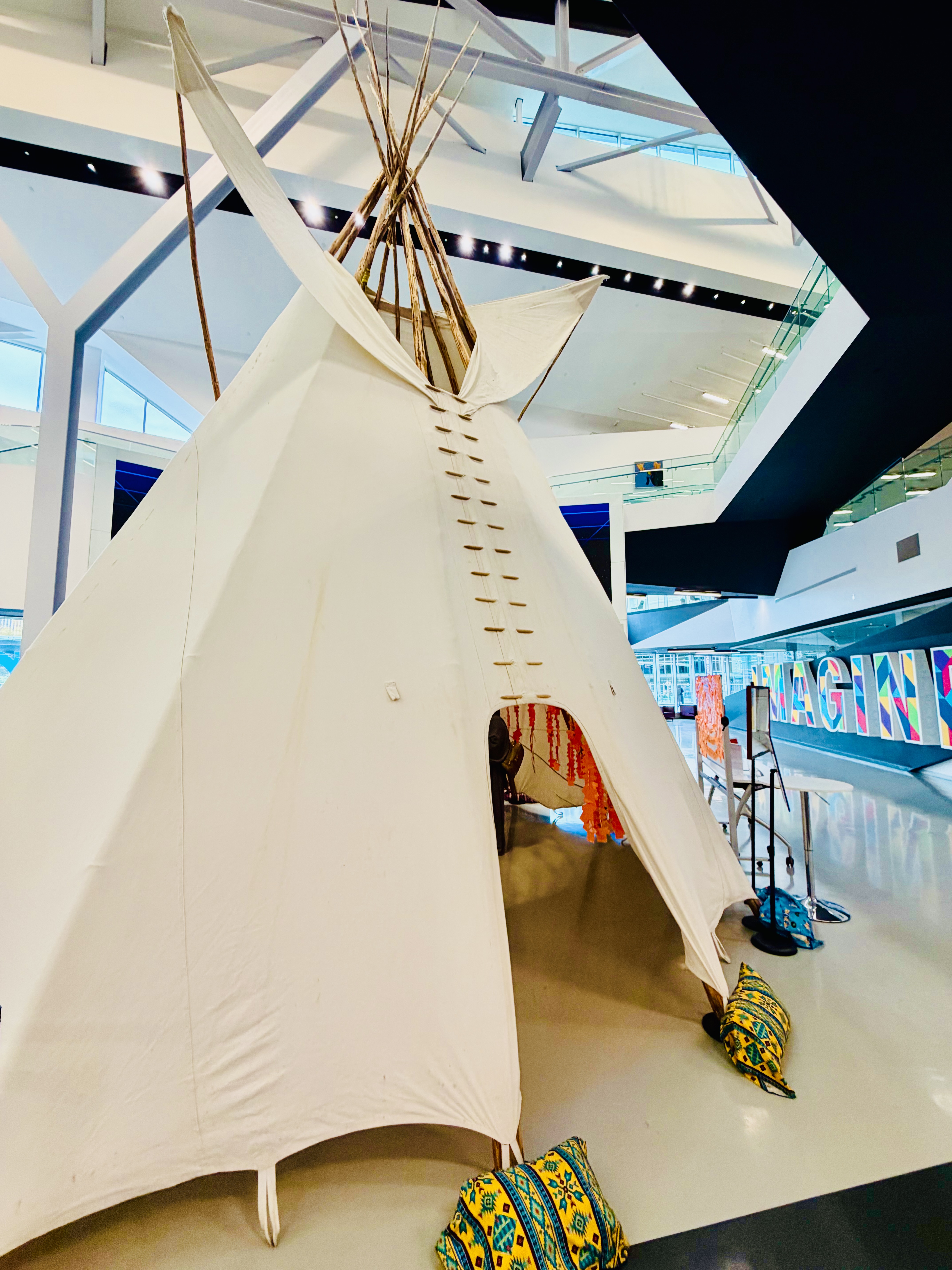
Le tipi installé dans un espace central et très visible de la Milner : une présence autochtone inscrite dans le quotidien de la bibliothèque. Photo : Marie D. Martel, septembre 2026.
Mais j’ai surtout remarqué ce changement depuis ma dernière visite : un tipi occupe maintenant un emplacement très visible dans l’espace commun de la bibliothèque. Comme mon séjour se déroulait peu de temps avant la Journée nationale de la vérité et de la réconciliation, je me suis d’abord demandé s’il s’agissait d’une installation temporaire liée au 30 septembre. Or, il semble que le tipi a été installé en mai et utilisé depuis juin 2026, notamment dans le cadre des activités du Mois national de l’histoire autochtone puis, en septembre, EPL y proposait encore régulièrement des Story Stops in the Tipi, de courtes activités mettant notamment en valeur des histoires et des auteur.rices autochtones.
Lors de mon passage, cette présence était naturellement accentuée par la proximité de la Journée nationale de la vérité et de la réconciliation : sélection documentaire, dispositif autour des « 150 Acts of Reconciliation », activités participatives et créatives (DIY) pour différents publics. La réconciliation n’est pas présentée uniquement comme un enjeu à comprendre : elle se traduit aussi par un large registre de gestes possibles à accomplir.
Je n’ai pas trouvé d’information permettant d’affirmer que le tipi constitue désormais une installation permanente. On peut toutefois établir qu’il ne s’agit pas simplement d’un décor installé pour quelques jours autour du 30 septembre. La distinction est importante. Thunderbird House demeure un espace autochtone dédié, architecturalement conçu pour certaines pratiques, cérémonies et certains rassemblements. Le tipi fait autre chose : il inscrit une présence autochtone directement dans l’espace commun et très fréquenté de la bibliothèque.
Et c’est peut-être ici que la notion de prime space devient intéressante. Ce que l’on positionne dans les espaces les plus visibles et les plus fréquentés d’une bibliothèque n’est jamais tout à fait neutre. L’emplacement lui-même participe à la production de sens : il contribue à déterminer ce que l’institution choisit de mettre au premier plan dans sa fabrique sociale et interculturelle.
Une bibliothèque-refuge, mais de quoi et pour qui?
Je considère aussi la Milner autrement cette fois-ci parce que, depuis mes premières visites, je travaille sur la bibliothèque publique comme refuge. Le terme n’est d’ailleurs pas complètement étranger à EPL : Thunderbird House est présenté comme un urban refuge, certes un lieu où l’on peut pratiquer le smudging, mais aussi simplement trouver un espace calme pour réfléchir. Cette question m’accompagne donc presque malgré moi lorsque je parcours le reste de la bibliothèque : de quoi peut-on se réfugier ici? Et qu’est-ce que la bibliothèque met concrètement en place pour permettre ce refuge?
À la Milner, la réponse est particulièrement évidente parce que la bibliothèque est située en plein centre-ville d’Edmonton, où se côtoient des réalités sociales très différentes. La bibliothèque est ainsi, tout simplement, un endroit où l’on peut être. Cette possibilité, apparemment banale, prend ici une importance particulière : pouvoir s’y arrêter, y trouver un peu de chaleur, une présence humaine et des ressources de base, sans avoir à justifier sa présence ni, en principe, à consommer quoi que ce soit.
Collections, lumière naturelle et lieux où s’installer, seul ou avec d’autres, à la Milner. Photo : Marie D. Martel, septembre 2026.
La notion de bibliothèque comme infrastructure sociale, notamment développée par Eric Klinenberg et Shannon Mattern, devient éclairante à cet égard. Elle permet de comprendre que la portée sociale de la bibliothèque ne tient pas seulement aux espaces et aux ressources qu’elle met à disposition, mais à la manière dont ceux-ci sont activés. Le travail de médiation, la présence du personnel, la programmation et l’attention portée aux conditions d’accueil contribuent à créer des possibilités de rencontre, de coexistence et de participation à la vie collective. L’infrastructure sociale est donc à la fois matérielle et relationnelle : elle repose sur des lieux, mais aussi sur le travail qui les rend habitables, accessibles et socialement actifs.
Mais une infrastructure sociale ne devient pas automatiquement hospitalière parce qu’elle est publique. Qui peut réellement y entrer, y rester, s’y reconnaître et agir sur ce qui s’y passe? L’approche community-led, caractéristique du modèle bibliothéconomique canadien, et particulièrement assumée à EPL, ajoute une dimension significative. Elle invite à ne pas seulement concevoir des services pour des communautés définies par l’institution, mais à créer les conditions pour les concevoir avec elles, à partir de leurs savoirs, de leurs relations et de leurs priorités. La question n’est donc plus uniquement de savoir ce que la bibliothèque offre, mais qui participe à définir ce qu’elle devient.
La bibliothèque-refuge se situe, pour moi, à la rencontre de ces deux perspectives. L’idée de refuge déplace le regard des services vers les conditions d’hospitalité. Un refuge n’est pas nécessairement un espace séparé ou protégé derrière une porte. Il peut tenir à une chaise que l’on peut occuper longtemps, à une prise électrique, à un accès gratuit, à la possibilité d’être seul au milieu des autres. Mais il tient aussi à la possibilité de se reconnaître dans le lieu, d’y voir ses savoirs considérés comme légitimes et, idéalement, de pouvoir contribuer à la manière dont ce lieu est pensé.
À la lumière de ces réflexions, certains des changements que j’observe prennent un autre sens. La frontière devenue plus poreuse du Makerspace élargit les manières légitimes d’occuper la bibliothèque. Le tipi placé dans un espace central donne une visibilité nouvelle à des présences, des récits et des savoirs autochtones dans l’espace commun. Et Thunderbird House constitue un cas encore plus explicite : sa conception avec des membres des communautés autochtones et l’Aînée Jo-Ann Saddleback ne relève pas seulement de la représentation, mais d’un régime qui se rapprocherait du faire avec. Il ne suffit évidemment pas de déplacer du mobilier, d’installer un tipi ou même de consulter une communauté pour produire de l’inclusion. Mais l’organisation matérielle et la gouvernance d’une bibliothèque participent bien à définir qui peut s’y reconnaître, ce qu’on peut y faire, quels savoirs y ont droit de cité et qui peut participer à la définition du lieu.
Du refuge à la liberté intellectuelle
Il faut aussi envisager une autre manière d’être un refuge : offrir un espace où l’on peut rencontrer librement des idées, des récits et des points de vue, sans que le pouvoir politique et/ou des groupes de pression interviennent dans ce qui nous est donné à lire, à voir ou à découvrir. Cette autre facette de la visibilité prend en 2026 une résonance particulière en Alberta. Car depuis ma dernière visite, ce ne sont pas seulement les espaces de la Milner qui ont bougé. Le contexte politique dans lequel EPL exerce sa mission s’est lui aussi considérablement durci.
Les débats albertains autour des collections et de l’accès aux livres, d’abord particulièrement audibles dans le milieu scolaire, ont atteint directement les bibliothèques publiques. En 2026, le gouvernement provincial a adopté le Bill 28, qui modifie notamment la Libraries Act et accroît les pouvoirs du gouvernement en matière d’inspection ainsi que de réglementation de l’accès, de l’utilisation et de l’emprunt des ressources des bibliothèques publiques. La Coalition for Alberta Public Libraries (CAP Libraries) fournit par ailleurs une excellente explication article par article de cette loi.
Or, depuis, les choses se sont précisées. Des règlements adoptés en juillet prévoient qu’à compter du 1er janvier 2027 certains documents comportant des représentations visuelles explicites d’actes sexuels devront être séparés des collections librement accessibles et leur accès contrôlé. Les personnes de 15 ans ou moins devront obtenir l’autorisation d’un parent ou d’un tuteur pour les consulter ou les emprunter.
La réaction des bibliothèques publiques de l’Alberta a été particulièrement ferme. La CAP Libraries, qui représente 324 points de service dans la province, a qualifié les mesures annoncées d’ « act of censorship ». Elle a aussi soulevé des questions très concrètes : qui devra prouver son âge? Faudra-t-il une pièce d’identité? Comment protéger la confidentialité des personnes? Qu’arrivera-t-il à celles qui ne disposent pas de documents gouvernementaux? Et jusqu’où les décisions concernant l’accès aux collections pourront-elles être retirées aux conseils locaux et aux professionnel.les des bibliothèques?
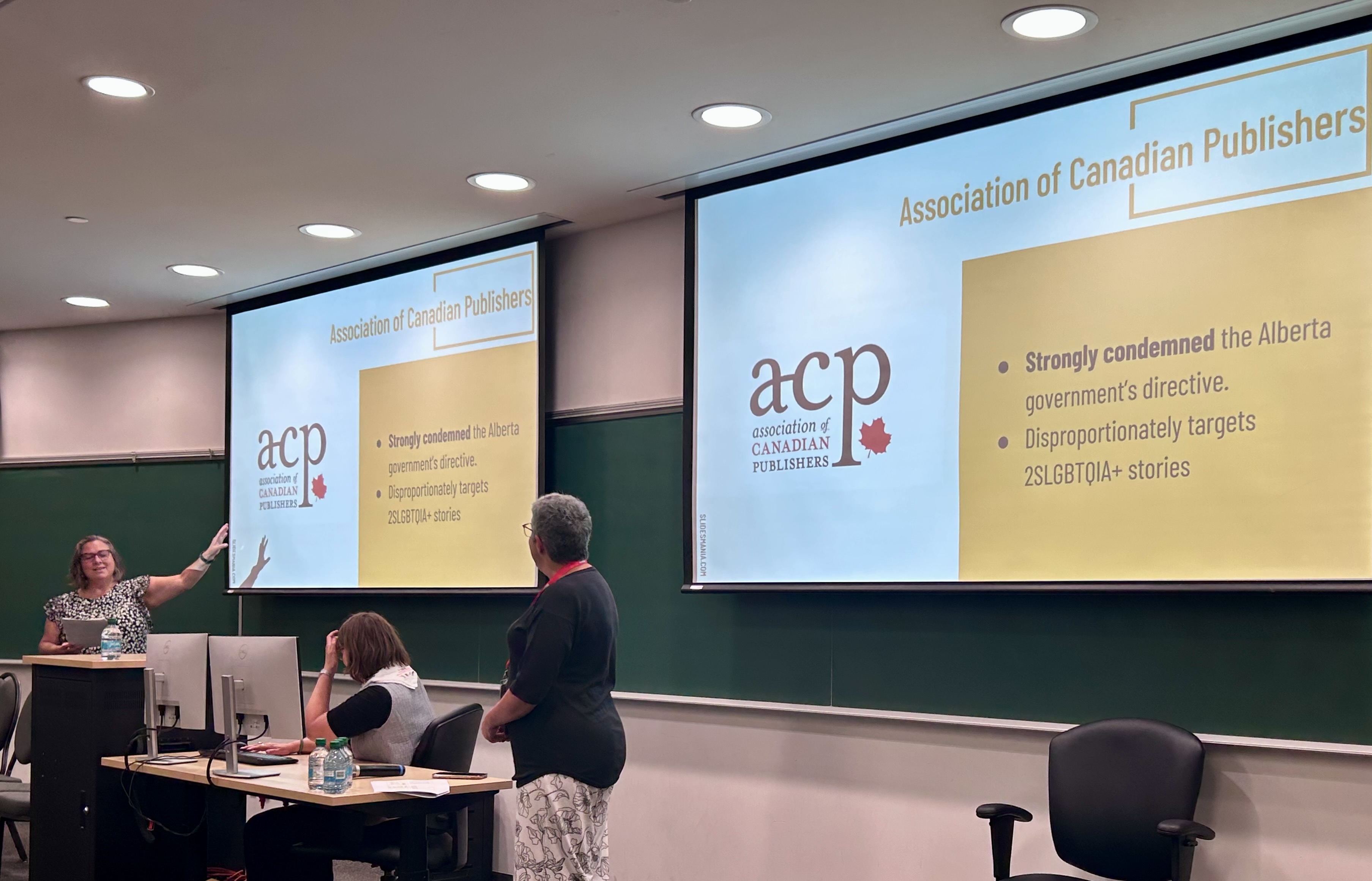
Cathy Fowler et Diana Maliszewski à IBBY 2026 : une présentation sur le contexte actuel de la censure au Canada et les mobilisations qu’il suscite, notamment autour des contenus 2SLGBTQIA+. Photo : Marie D. Martel, août 2026.
Le tapis du makerspace, le tipi installé dans un espace central et un projet de loi sur l’accès aux collections sont évidemment des sujets de nature très différente. Je ne cherche pas à les mettre sur le même plan. Mais ils ramènent tous, chacun à leur manière, à une question fondamentale de bibliothéconomie : qu’est-ce qu’une bibliothèque choisit de rendre accessible, légitime, valorisé dans l’espace public? Une bibliothèque se construit aussi par ces décisions. Où commence le makerspace et où finit-il? Où installe-t-on l’espace autochtone? Quels savoirs occupent les espaces les plus visibles? Et maintenant : Quels livres peuvent être empruntés librement? Qui décide? Et à partir de quelles valeurs professionnelles, politiques ou communautaires?
Revenir pour voir ce qui bouge
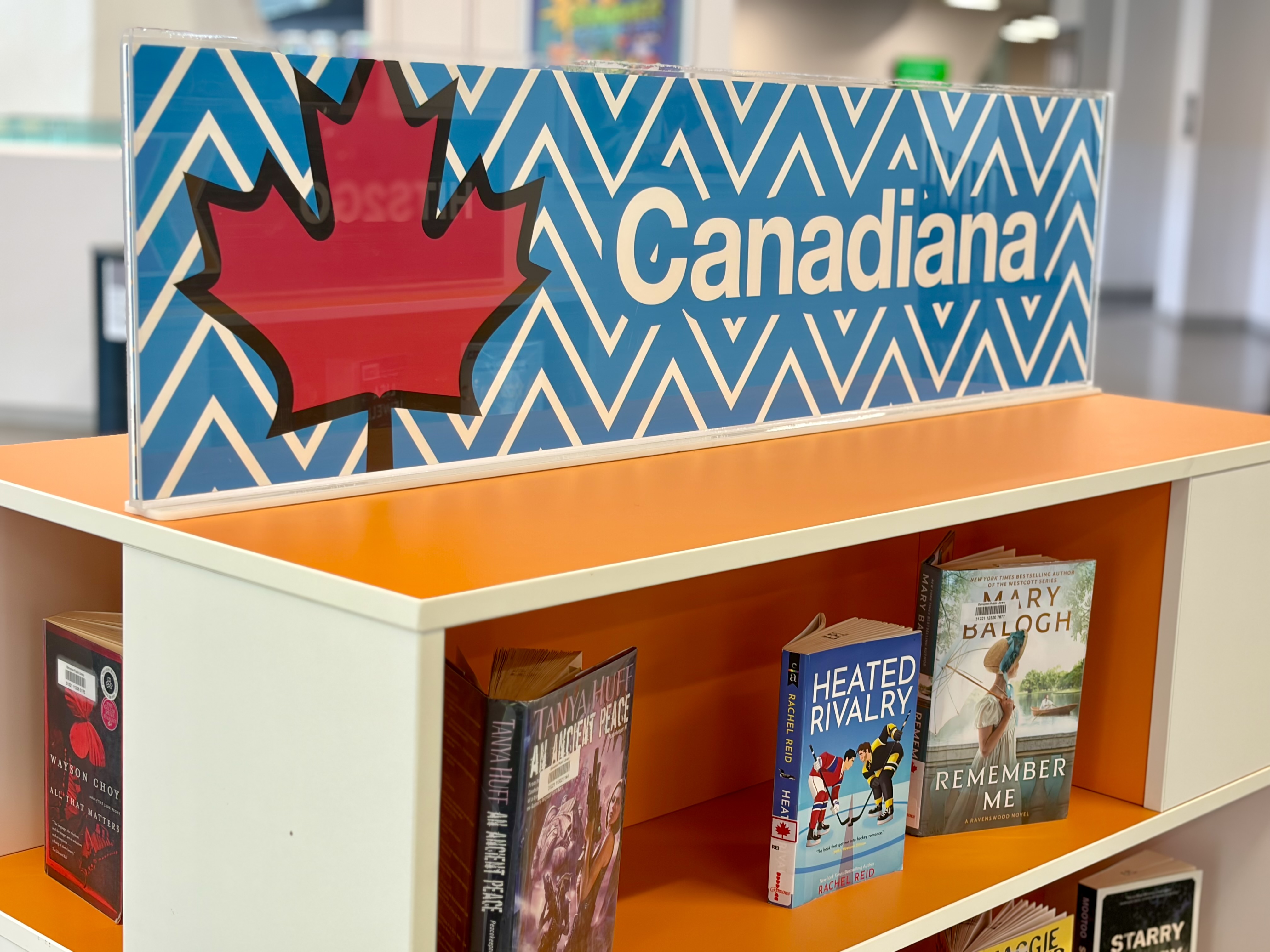
C’est probablement pour cela que j’aime revenir dans les bibliothèques que j’ai déjà visitées. Dans un premier temps, les dispositifs les plus saisissants attirent presque inévitablement le regard : l’architecture, le grand écran numérique, le Makerspace, les escaliers qui se déploient comme d’interminables déambulatoires, les espaces pour enfants. À la quatrième visite, on regarde autrement. On remarque un nouvel aménagement, un usage qui s’est installé, un espace qui a changé de fonction ou de sens. Et parfois, c’est le contexte politique lui-même qui fait vaciller le regard que l’on porte sur l’institution. On se demande du coup si, lors du prochain passage à la Milner, Heated Rivalry sera toujours mis en valeur comme un fier « Canadiana », ou même s’il sera encore simplement accessible sur les rayonnages.
La Stanley A. Milner Library reste spectaculaire. Mais ce qui m’intéresse désormais davantage, c’est peut-être précisément ce qui se passe après le grand projet architectural : la manière dont une bibliothèque continue de se refaire, par petites touches, au contact des usages, des communautés. Mais aussi des tensions de son époque, qui viennent parfois ébranler des institutions que l’on croyait inébranlables. Une bibliothèque publique, décidément, n’est jamais tout à fait terminée.
L’Agence spatiale européenne a choisi OVHcloud et CGI pour participer à la construction de Digital EO, sa future infrastructure numérique destinée à stocker, traiter et exploiter les données européennes d’observation de la Terre. Le contrat, d’une durée de 30 mois, représente plusieurs millions d’euros, sans que son montant précis ait été dévoilé. L’information, annoncée lundi […]
L’Agence spatiale européenne a choisi OVHcloud et CGI pour participer à la construction de Digital EO, sa future infrastructure numérique destinée à stocker, traiter et exploiter les données européennes d’observation de la Terre. Le contrat, d’une durée de 30 mois, représente plusieurs millions d’euros, sans que son montant précis ait été dévoilé. L’information, annoncée lundi […]
Moldova closed its airspace on the afternoon of 8 September and delayed the plane carrying Ukraine's President Volodymyr Zelenskyy to Norway after a Russian drone crossed into the country, its government said in a statement to Reuters. The aircraft was cleared for takeoff once officials established that it had come down on Moldovan territory. Norway's prime minister described the episode as a near-miss, and neither government has said how close the drone came.
Russia ru
Moldova closed its airspace on the afternoon of 8 September and delayed the plane carrying Ukraine's President Volodymyr Zelenskyy to Norway after a Russian drone crossedinto the country, its government said in a statement to Reuters. The aircraft was cleared for takeoff once officials established that it had come down on Moldovan territory. Norway's prime minister described the episode as a near-miss, and neither government has said how close the drone came.
Russia runs three things at once along the EU's eastern frontier—mass drone attacks on Ukraine, drones crossing into Moldovan and Romanian airspace almost weekly, and strikes on the border checkpoints tying the three countries together—and states without interceptors can answer only by closing their skies.
What happened, and when
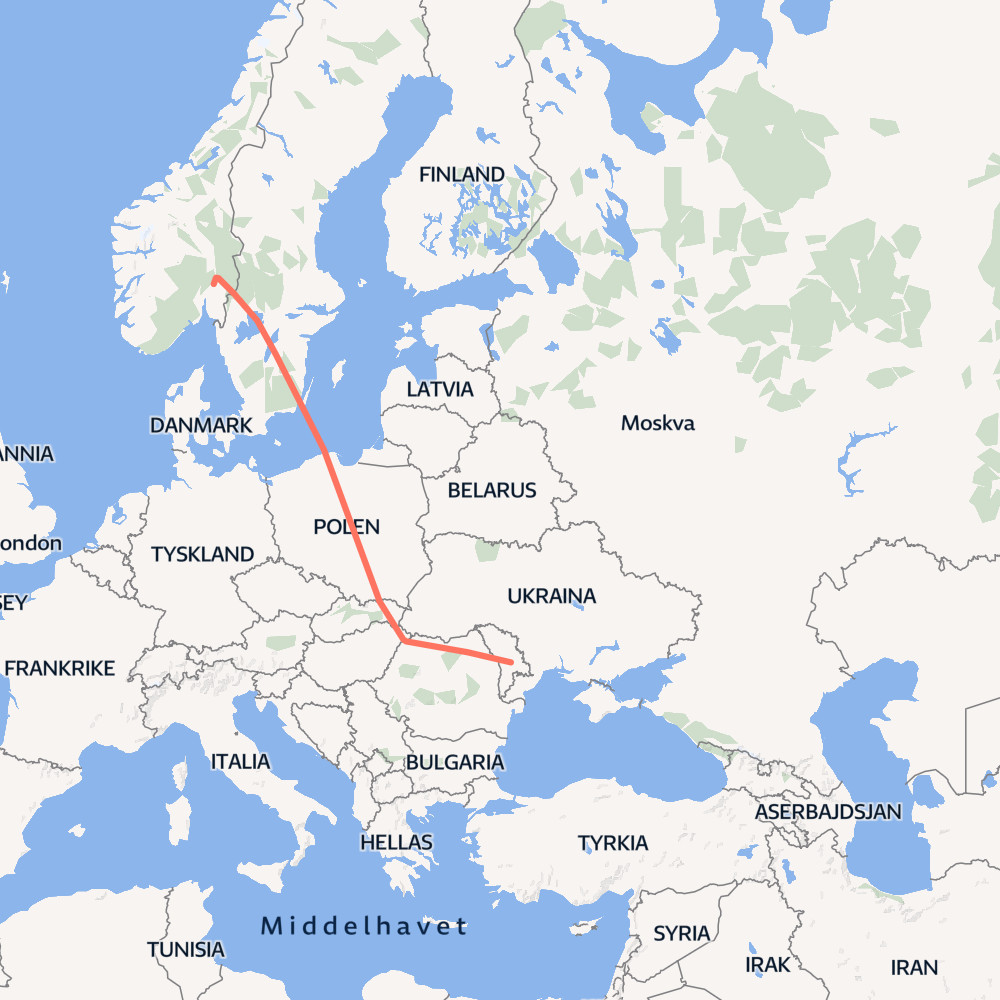
Moldova's National Army detected a Shahed-type drone entering from Ukraine at 16:20, the country's Defense Ministry reported. It flew toward Bender, a city in the Russian-backed breakaway region of Transnistria, then turned toward the capital, Chișinău, by 16:32. At 16:37, it left the country over western Moldova and headed into eastern Romania, across the Prut river border.
The route of Zelenskyy's flight from Moldova to Oslo, 8 September 2026. Map: NRK
Controllers restricted the airspace over central Moldova at 16:30. The same drone came back from the Romanian side, crossed the north of the country, and came down outside a village in the northwest, near the Romanian border, setting dry vegetation alight, according to the log. Nobody was hurt, and the airspace reopened at 17:39, more than an hour after it closed. The BBC's Ukrainian service placed the crash near a different northern village, without naming a source, so the exact spot is unsettled.
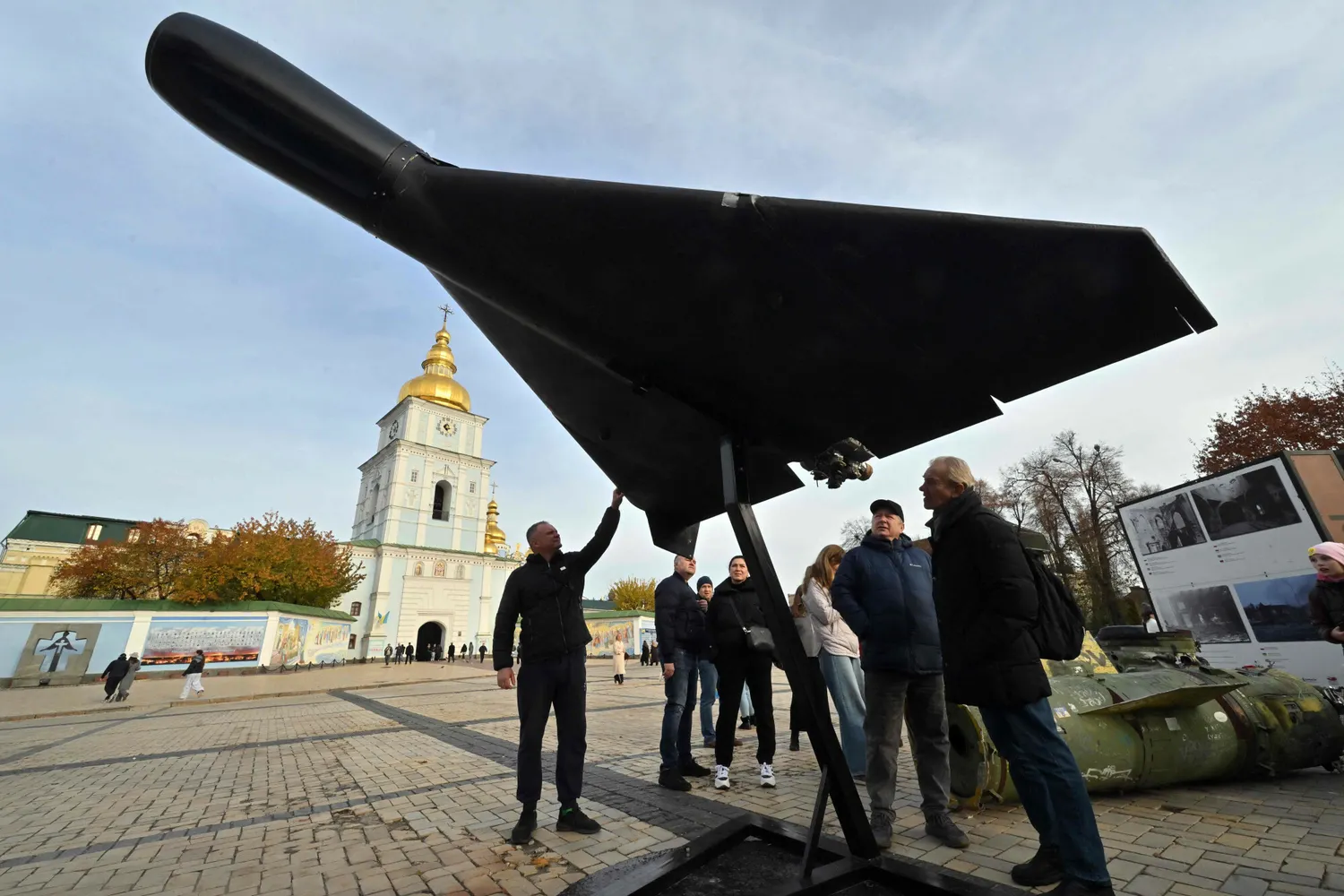
People look at an Iranian-designed Shahed 136, (Geranium-2) drone of Russian Army at an open-air exhibition of destroyed Russian equipment near Saint Michael's Golden-Domed Cathedral in Kyiv on November 2, 2025, amid the Russian invasion of Ukraine. Photo by Sergei SUPINSKY / AFP/Eastnews
The violation fell in the window when Zelenskyy's aircraft was preparing to take off, Militarnyi reported, citing the ministry. The civilian airport he was leaving from suspended operations and the border service closed the nearby crossings, the outlet added. Three departures and four arrivals were delayed in all, Reuters said.
Explore further
A drone nearly hit Zelenskyy’s plane taking off from Moldova on his way to a king’s funeral, Norway’s PM says
How the plane and the drone crossed paths
Zelenskyy flies an Airbus A319 corporate jet, and the threat to it probably came from a jet-powered Geran drone that crossed Romanian and then Moldovan airspace at around 17:00 that day, Militarnyi wrote, publishing the drone's track from the monitoring channel Oko Hora. That fits the return leg in the army's log, though no authority has tied a specific aircraft to the delay.
The route of a Russian jet-powered Geran drone across Romania and Moldova, 8 September 2026. Map: Oko Hora
Norwegian Prime Minister Jonas Gahr Støre told the broadcaster NRK the plane was almost hit as it prepared to leave, without naming his source. His office later described a danger recorded in Moldovan airspace that forced the delay. Norway's Finance Minister Jens Stoltenberg said Zelenskyy recounted the details himself at a closed meeting in Oslo.
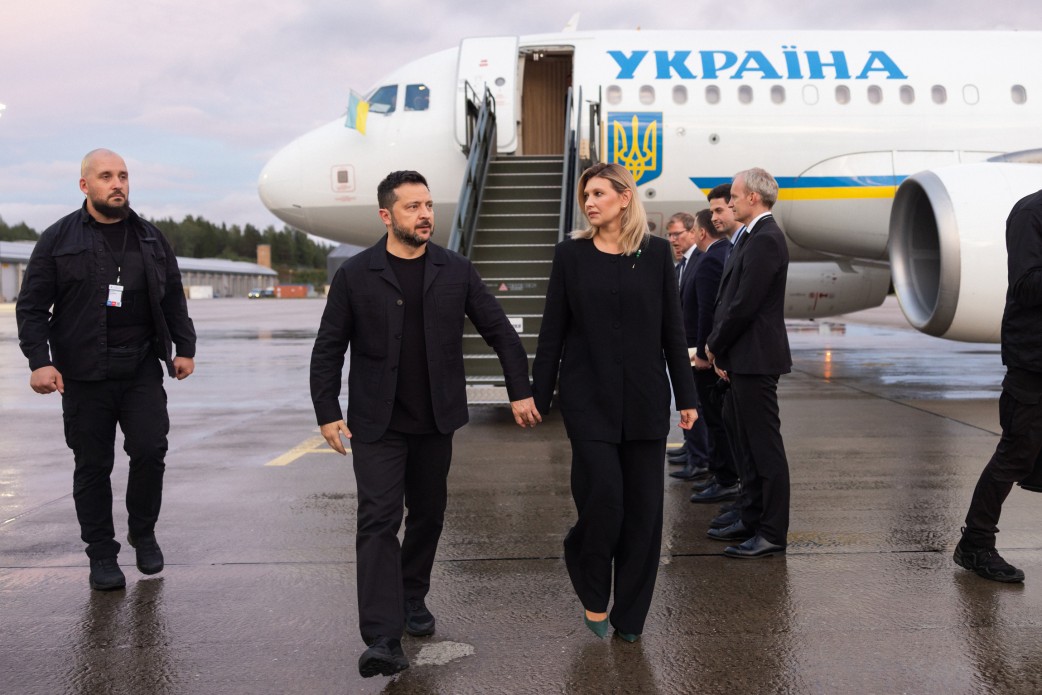
Zelenskyy and First Lady Olena Zelenska attended the farewell ceremony for King Harald V, who died on 28 August. Around it, the president worked on air defense, meeting Støre and then executives of defense companies from partner countries about the FREYJA anti-ballistic missile program, which Norway's government casts as a cheaper alternative to the Patriot.
The next night, the border crossing
Overnight on 9 September, Russian drones struck the Starokozache crossing on Ukraine's border with Moldova, killing two people and injuring three. The dead were Ukrainians, and a Moldovan citizen was among the injured, Moldova's Foreign Ministry told the broadcaster TV8. Border guards reopened the crossing that afternoon.
Russia claimed it had struck the crossing because it was used for military logistics. Moldova's Foreign Ministry rejected that outright, saying no weapons move through its territory, and that the people crossing there are families, children with their mothers, and the elderly. It is one of the working crossings on the Odesa Oblast stretch of the Ukrainian-Moldovan border, where the heaviest traffic runs through Palanca and Giurgiulești.
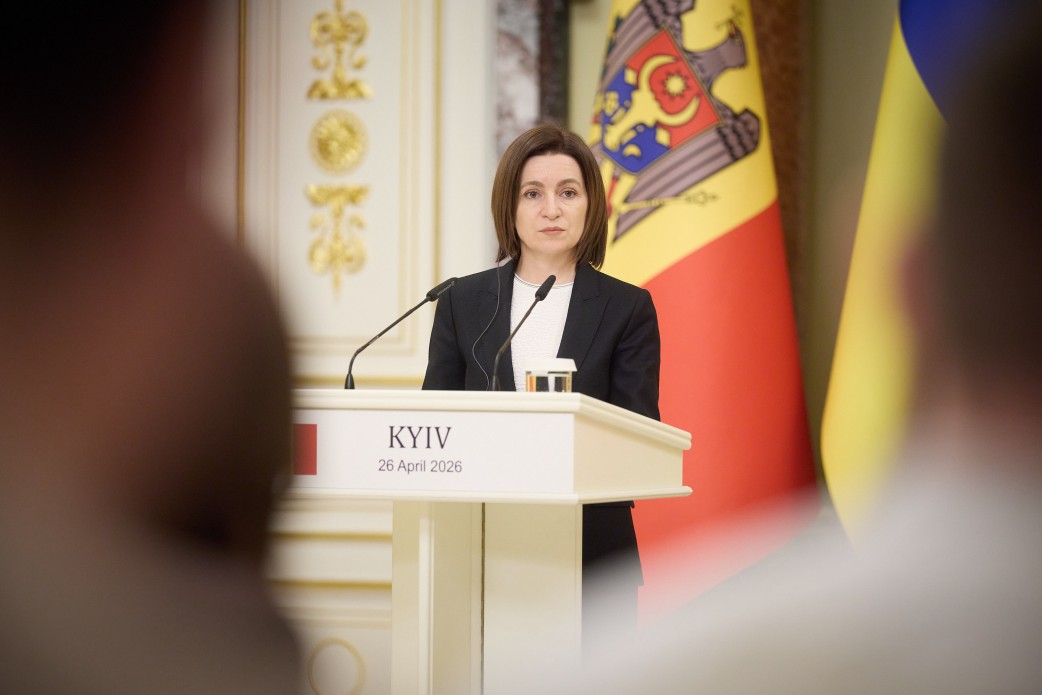
Moldova's President Maia Sandu condemned both the strike and the Geran-type drone that had forced her country to close its airspace the day before, and said the events show Ukraine needs more air defense.
Explore further
Moldova is investing in air defense against the Russian drones crossing from Ukraine—Romania shoots down the ones that reach it
The pattern, and Moldova's empty sky
Russia has hit at least five checkpoints on Ukraine's western borders since late August, four of them facing Moldova and one facing Romania, and the drone that struck the Kotlovyna crossing on 20 August flew in through Moldovan airspace. Euromaidan Press has covered part of that campaign, including burned food cargo near the Giurgiulești crossing in August. The State Border Guard Service has called such strikes an act of terrorism, because people are present at the crossings when they are hit.
In the air, Moldova can do little. It is still buying its first serious air defenses, so it restricts airspace and waits while Romania scrambles jets against the drones that reach its side. It logged three airspace breaches in nine days in August, and more than 100 drones were detected near Romania in four days that month.
Ukraine formally notified the International Civil Aviation Organization (ICAO) on 2 September that Russian airspace is unsafe for civilian flights because of increased military activity, Ukrainian Foreign Minister Andrii Sybiha said. The letter behind the notification asks the organization to urge its member states to stop civil flights over Russia altogether, ZN reported.
ICAO, the UN aviation agency, cannot close Russian airspace or order carriers to reroute. European
Ukraine formally notified the International Civil Aviation Organization (ICAO) on 2 September that Russian airspace is unsafe for civilian flights because of increased military activity, Ukrainian Foreign Minister Andrii Sybiha said. The letter behind the notification asks the organization to urge its member states to stop civil flights over Russia altogether, ZN reported.
ICAO, the UN aviation agency, cannot close Russian airspace or order carriers to reroute. European and US airlines already avoid Russia's airspace, while carriers from China, Türkiye, and the Gulf states have kept flying through it. Those remaining airlines must assess the safety of flying amid drone and air defense operations. Drone alerts during reported Ukrainian attacks have repeatedly shut Russian airports and delayed hundreds of flights.
The notification follows a 1 September warning by Ukrainian President Volodymyr Zelenskyy, who told airlines, insurers, and other aviation stakeholders that Russian skies were becoming unsafe as Ukrainian drones reached deeper into the country.
Zelenskyy said Ukraine's Foreign Ministry would pass information about the risks to international organizations. The letter to ICAO came from another office—Mykola Kalashnyk, Ukraine's minister for recovery, infrastructure, and transport, whose portfolio covers aviation.
Russian President Vladimir Putin said Zelenskyy's statement amounted to "a bid for state terrorism" and that Moscow would find a way to respond if civilian "tragedies" followed.
Sybiha urged airlines to avoid Russian airspace and said the notice was meant to prevent unintended incidents, arguing that Moscow was failing to disclose the dangers its war had created. He invoked Ukraine’s inherent right to self-defense under Article 51 of the UN Charter, the provision that recognizes states’ right to defend themselves against an armed attack. The foreign minister further stated that the war was “returning home to Russia.”
In its separate statement, ICAO warned of rising threats to civil aviation worldwide. It did not mention Russia, endorse Ukraine’s assessment, or say Kyiv’s notification had prompted it.
The UN aviation body identified long-range weapons, drones, navigation-signal interference, and advanced air-defense systems as growing dangers to civilian aircraft. It reiterated that international aviation law prohibits the use of weapons against them.
ICAO urged member states to assess airspace under their control, share threat intelligence quickly, and improve military-civilian coordination.
Russian airports were already facing repeated closures
Russian airspace has not been legally or completely closed. The disruption has instead taken the form of temporary restrictions at individual airports.
From 5–7 May 2026, restrictions during reported Ukrainian attacks delayed more than 450 flights at Moscow airports, while limits at Vnukovo remained in place for nearly 18 hours.
On 6 July 2025, Moscow's Sheremetyevo airport canceled 171 flights, while airports in five other cities suspended operations. During an earlier wave on 22 May 2025, Domodedovo halted flights four times in one day and Sheremetyevo three times, while Vnukovo and Zhukovsky also restricted operations.
Airports in Kaluga, Nizhny Novgorod, Saratov, and Tambov were temporarily closed during a 27 May attack in which Moscow claimed 99 drones were intercepted. Two days later, another alert delayed 20 arrivals and 14 departures at Vnukovo, pro-Kremlin Telegram channels claimed.
Russian President Vladimir Putin said Moscow would “find a way to respond” if civilian “tragedies” followed President Volodymyr Zelenskyy’s warning that Ukrainian drone operations were making Russian skies unsafe. Zelenskyy told foreign airlines and insurers that the “safe moments” in Russian airspace were over.
Zelenskyy’s warning seeks to extend the cost of Russia’s war beyond damaged military and energy facilities to airlines, insurers, and travelers. It does not mea
Russian President Vladimir Putinsaid Moscow would “find a way to respond” if civilian “tragedies” followed President Volodymyr Zelenskyy’s warning that Ukrainian drone operations were making Russian skies unsafe. Zelenskyy told foreign airlines and insurers that the “safe moments” in Russian airspace were over.
Zelenskyy’s warning seeks to extend the cost of Russia’s war beyond damaged military and energy facilities to airlines, insurers, and travelers. It does not mean Russian airspace is legally or completely closed. However, carriers that continue flying over Russia face higher costs from repeated airport shutdowns during drone alerts, as well as the danger that military activity in Russian airspace could endanger civilian aircraft.
Putin spoke after a 1 September Shanghai Cooperation Organization summit in Bishkek, where Russia and China coordinate regional security. Zelenskyy’s warning amounted to “a bid for state terrorism” if he had made it publicly, the Russian president said, adding that Russia does not negotiate with “terrorists.” Putin also said Russian forces were preparing massive strikes on Ukraine’s energy infrastructure.
In his evening video address, Zelenskyy said Ukraine did not threaten civilian aircraft but would keep striking Russian military targets and parts of the economy supporting the war. Ukraine’s Presidential Office head Kyrylo Budanovbacked the decision, saying long-range weapons would systematically strike military targets in Russia while the invasion continued.
Explore further
“Russian airspace will effectively be closing”: Zelenskyy warns airlines Russian skies are no longer safe
Shares in Aeroflot, Russia’s national airline, fell to an intraday low of 30.36 rubles at about 20:40 Moscow time, down 5.11%, Meduza reported, citing Moscow Exchange data. The timing does not establish that Zelenskyy’s speech alone drove the decline.
Wall Street Journal correspondent Yaroslav Trofimovposted a chart of the decline on X, writing, “Aeroflot shares after Zelensky’s warning.”
European and US carriers already avoid Russian airspace, but airlines from China, Türkiye, the United Arab Emirates, and other Gulf states continue using it, Reuters reported. Aviation-risk firm Osprey Flight Solutions assessed that daily attacks deep inside Russia were nearly certain through 2026 and warned of possible misidentification.
Andrii Kovalenko, head of Ukraine’s Center for Countering Disinformation, said it was “strange” to hear terrorism accusations from “the leader of a terrorist organization masquerading as the Russian state.” Putin’s reaction showed Moscow feared pressure on its airspace, he argued.
Previous closures of Russian airspace due to Ukrainian attacks
Russian airports were repeatedly shut during Ukrainian drone alerts well before Zelenskyy’s warning. On 6 July 2025, Moscow airports canceled 171 flights while airports in five other cities suspended operations.
Ukrainian President Volodymyr Zelenskyy warned airlines, insurers, and other aviation stakeholders on 1 September that Russian airspace is becoming increasingly dangerous as Ukrainian drones operate deeper inside the country.
The warning comes as Ukraine has increasingly carried out long-range drone strikes deep inside Russia, targeting military, energy, industrial, and other infrastructure. Russian authorities have repeatedly reported temporary airport closures and fli
Ukrainian President Volodymyr Zelenskyy warned airlines, insurers, and other aviation stakeholders on 1 September that Russian airspace is becoming increasingly dangerous as Ukrainian drones operate deeper inside the country.
The warning comes as Ukraine has increasingly carried out long-range drone strikes deep inside Russia, targeting military, energy, industrial, and other infrastructure. Russian authorities have repeatedly reported temporary airport closures and flight disruptions during drone attacks as part of air defense measures.
“We want to warn every airline that uses Russian airspace, every insurer, and everyone who still uses Russia’s key airports: Russian airspace is becoming completely unsafe,” Zelenskyy said.
“Russian airspace will effectively be closing”
Zelenskyy said Ukraine does not intend to threaten civilian aviation or civilian aircraft, but warned that the growing presence of drones over Russia means airlines must account for the risks.
“We in Ukraine do not want innocent lives to be lost. That is why we are warning our partners: the safe days in Russia’s skies are over,” he said.
Zelenskyy accused Russian authorities of failing to properly inform airlines about the risks, saying they have not adequately communicated the growing danger posed by drones in Russian airspace.
“Although the Russian authorities are not properly informing people about this, Russian airspace will effectively be closing,” Zelenskyy said, arguing that Russia’s war against Ukraine is making its own airspace unsafe.
Zelenskyy warned that the growing scale of Ukrainian drone operations over Russia will have to be factored into aviation risks. “There will simply be drones in Russia’s skies on a scale that has to be taken into account,” he said.
He called on foreign ambassadors in Ukraine and Russia to relay the warning to their governments, and said Ukraine’s Foreign Ministry and other institutions would provide international organizations with information about the risks to Russian airspace.
“Drone-infested skies are no place for civilian aviation,” Zelenskyy said.
Ukraine closed its skies in 2022. Russia has kept flying
The warning highlights a stark difference between the two countries. Ukraine has kept its airspace closed to civilian aviation since Russia launched its full-scale invasion in February 2022.
The risk is familiar to Ukraine. Russian forces have repeatedly attacked Ukrainian airports and aviation infrastructure during the full-scale invasion, making the continued operation of civilian aviation impossible.
Russia is also responsible for the 2014 downing of Malaysia Airlines Flight MH17 over occupied eastern Ukraine, which killed all 298 people aboard, showing the danger Russia’s military activities can pose to civilian aviation.
Russia, meanwhile, has continued operating major airports and regular passenger flights despite Ukrainian drones increasingly reaching deep into its territory. EASA has warned that Russian air defenses responding to Ukrainian drone and missile attacks could pose risks to civilian aircraft, including through misidentification, particularly around major airports.
Russian airports increasingly disrupted by Ukrainian drones
Russian authorities have repeatedly restricted or suspended flights at Moscow and other airports during Ukrainian drone attacks. The disruptions have generally come as Russia activates air defenses against drones targeting military, energy, industrial, and logistics infrastructure.
Russia has also moved toward broader restrictions on civilian aviation. In June, Russia imposed new restrictions on light aircraft around Moscow and neighboring regions, while regular passenger and charter flights remained exempt.
The result is a growing disruption to Russian aviation even as Moscow continues to keep its main passenger airspace open: Ukrainian drones are not being used to target civilian aircraft, but their increasing presence is making normal aviation operations more difficult and forcing Russia to restrict or suspend flights during attacks.
Astronomy, our window into the rest of the universe, happens in the dark. Planets, stars and galaxies – all the mysteries of the cosmos – only reveal themselves at night. But the night sky may be getting much brighter, thanks to an American company with a plan to conquer darkness itself by sending 50,000 giant mirrors into space.
What you are reading first appeared as a cover story for The Atlas, our new global publication with The Continent. Sign up here to get the next edition delivered to
Astronomy, our window into the rest of the universe, happens in the dark. Planets, stars and galaxies – all the mysteries of the cosmos – only reveal themselves at night. But the night sky may be getting much brighter, thanks to an American company with a plan to conquer darkness itself by sending 50,000 giant mirrors into space.
What you are reading first appeared as a cover story for The Atlas, our new global publication with The Continent. Sign up here to get the next edition delivered to your inbox on August 27.
Astronomers are panicking.
It is an “existential threat” to optical astronomy, says the European Southern Observatory. A “disastrous” idea that will “permanently scar” the night sky, according to the Royal Astronomical Society. The American Astronomical Society told Nature it “would probably mean the end of ground-based astronomy, or optical astronomy, at least.”
Sthabile Kolwa agrees. “It will take away a very crucial part of our civilization,” she tells The Atlas. Kolwa, a senior lecturer in astronomy at the University of South Africa, studies the life cycles of galaxies, but today her concerns are more immediate. “It might come to this, that we just have to find them in the parking lot and say, ‘Hey, what are you guys doing? You’re going to ruin science for us.’ ”
Like Uber, but for the sun
The parking lot in question is in Hawthorne, California, outside the headquarters of Reflect Orbital. They call themselves The Sunlight Company. The start-up is celebrating: Earlier this month, the United States Federal Communications Commission (FCC) approved the launch of Eärendil-1, likely in a few months time.
This satellite, named for a character in JRR Tolkien’s The Silmarillion, will unfurl an 18m x 18m mirror in low Earth orbit. It’s designed to reflect sunlight onto the dark side of the earth, lighting a 5km2 patch of land with the strength of four full moons.
It is a proof of concept.
By 2035, Reflect Orbital wants 50,000 of its mirrors in space, delivering illumination “comparable to daylight” on demand to paying customers (“sunlight is the new oil,” says chief executive Ben Nowack). The company says this will allow solar panels to generate clean energy overnight; provide “safer, evenly-lit streets” to cities that pay for it; and keep construction sites and farms working 24/7.
There will be an app, of course, offering “sunlight as a service” – lighting up the night will be as easy as ordering an Uber.
Clean, renewable energy is at the heart of the company’s vision, a spokesperson told The Atlas in a statement. Reflect Orbital declined to respond to specific queries and said it is in constant dialogue with astronomers, scientists and environmental researchers to mitigate the impact of the light pollution: “We are able to dim the brightness of the service and turn it off at any stage. We control where the light shines when serving an authorised customer. Most people and most places will never see this light. It is precise, targeted and customers will require permits to receive the service.”
Circadian arrhythmia
A new research paper, published in May, challenges Reflect Orbital’s position. Its author, the European Southern Observatory’s Oliver Hainault, concluded that the company’s 50,000 satellites would increase the background brightness of the sky by 300% – even when their mirrors are pointed somewhere else. This, coupled with a proposal from Elon Musk’s SpaceX to build vast data centres in space, would go “beyond the limit” of what astronomy can withstand.
What that means, in practice, is that the images from ground-based telescopes will be dramatically less useful, marred by streaks of light from passing satellites. The most distant light sources won’t be visible at all.
This will obscure evidence of other galaxies, hinder research into black holes and other cosmic phenomena, and potentially prevent early warnings of asteroid approaches. Cutting-edge astronomy will only be possible from space-based telescopes like the James Webb and the Hubble – access to which is already massively oversubscribed, and subject to political interference.
The night sky will look different to the naked eye, too. “The next time you’re away from urban light pollution, spend some time outdoors after dark and enjoy the view of the Milky Way and the constellations that have inspired awe since humankind woke to consciousness. Chances are those views are not here to stay forever,” wrote journalist Tereza Pultarova for Space.com.
Anna Jibladze
Running out of space
The night sky is already a lot brighter than it was 150 years ago, when light bulbs started to become commonplace. According to Dark Sky International, a US-based nonprofit that advocates against light pollution, 80% of Earth’s human population already lives under some form of sky glow, most of which is generated on land. This has forced astronomers to seek out “dark sky places,” like the Atacama Desert in Chile or the Upper Karoo in South Africa, for their telescopes.
Humans can adapt to less darkness. But it is much harder for animals and ecosystems that have evolved alongside predictable rhythms of day and night. Nocturnal predators lose the ability to hunt; sea turtle babies can’t find their way to the sea; migratory birds are thrown hopelessly off course; and moths expend all their energy helplessly chasing artificial light sources.
“It’s almost like we are on a mission to obliterate natural darkness from earth,” said Ruskin Hartley, Dark Sky’s chief executive. “And now rather than do it street by street and bulb by bulb, let’s do it from space.”
Space is, in theory, protected by the Outer Space Treaty, a 1967 agreement signed by 110 countries, including all the major space superpowers. It states that “space is the province of all mankind." But that’s not what’s actually happening, Hartley argues. “In the US, it’s the most wealthy, most powerful individuals who are gobbling up as much of that orbital space as they can before someone else can get that opportunity” – with China, Russia and Europe all scrambling too for a greater presence in low Earth orbit.
“Who gets to choose that we light up the night sky? Who gets to make that decision?” Ruskin asks. In the US, it is the FCC’s job to decide what satellites are allowed in space. But it has said that assessing the impact of light pollution or environmental damage is not within its remit. Instead, it wants to slash regulation so American companies can take advantage of the “space industrial revolution.”
And Reflect Orbital has rich and powerful backers. Earlier this year, it secured a $1.5-million contract from the US air force, hinting at possible military applications for its mirrors. Last year, it raised $20-million from three venture capital firms, including Sequoia Capital, one of the biggest investors in Silicon Valley. Sequoia also owns a multibillion-dollar stake in SpaceX, which has its own plans for low earth orbit.
There are already more than 10,000 Starlink satellites up there, giving Elon Musk unprecedented influence over global communications. The company wants to launch one million more satellites over the next few years to build a network of space-based data centres. In addition to the light pollution, astronomers worry the potential for collisions will increase dramatically, as will risks to the ozone layer.
A brighter future
On her blog Higher Dimensions, the astronomy professor Janna Levin contemplates our brighter future. “It is quite possible that the hot glow of the swarm of data satellites will saturate the night, washing out the stars from our perspective on Earth. We’ll look up into the sky and instead of Zeus transformed into a swan outlined in a constellation of a few stars, the machine gods will literally loom above us, glowing with radiant heat, making declarations, predicting the weather, forecasting then determining our fate.”
Kolwa, the South African astronomy lecturer, offers a different metaphor: that of empires “colonizing low Earth orbit.” This was an ambition of one of the most infamous imperialists of them all, Cecil John Rhodes, who said that he looked up at the stars and thought: “I would annex the planets if I could; I often think of that. It makes me sad to see them so clear and yet so far.”
But it hasn’t been colonized just yet.
“I’m still trying to figure out what we can do, what responsibility we have as scientists,” says Kolwa. “How could we engage our communities to stand up to these corporations and say no? We must keep our night skies dark, as dark as possible.”

 Connexion