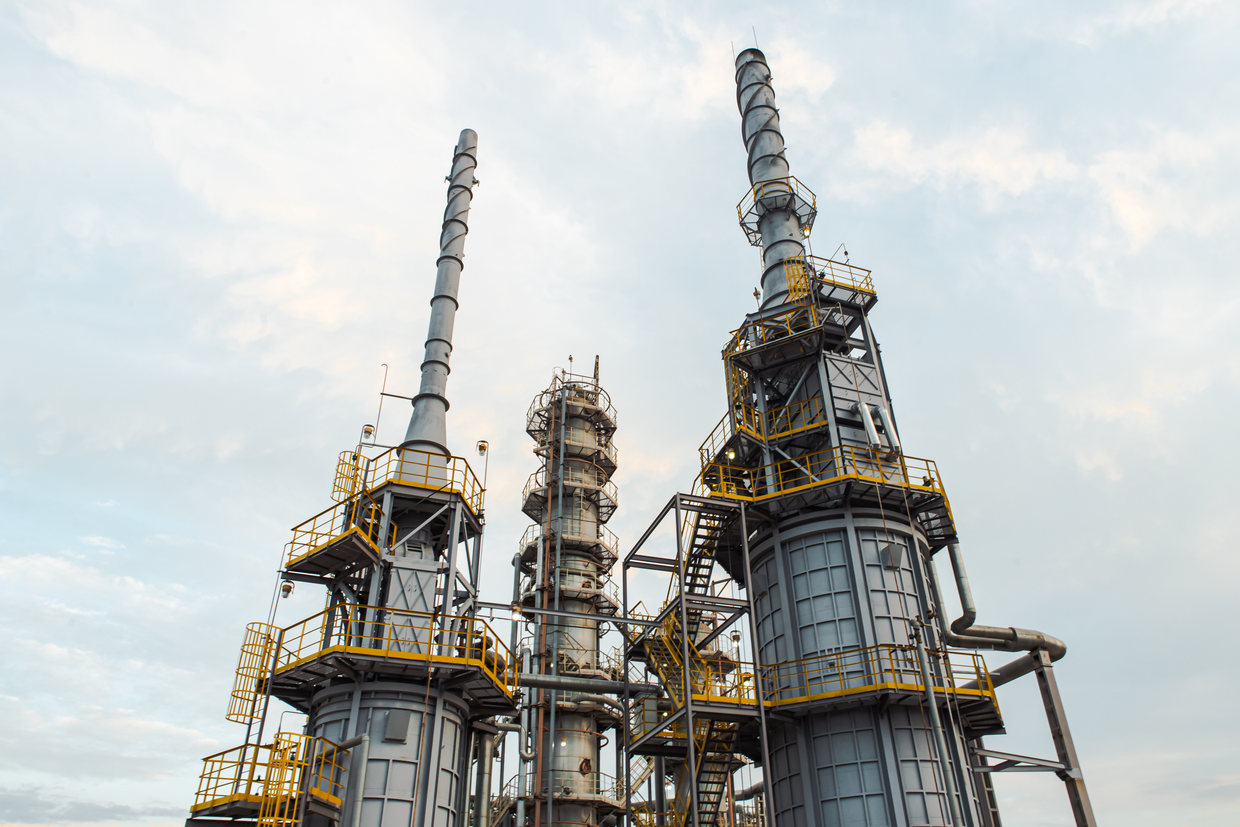
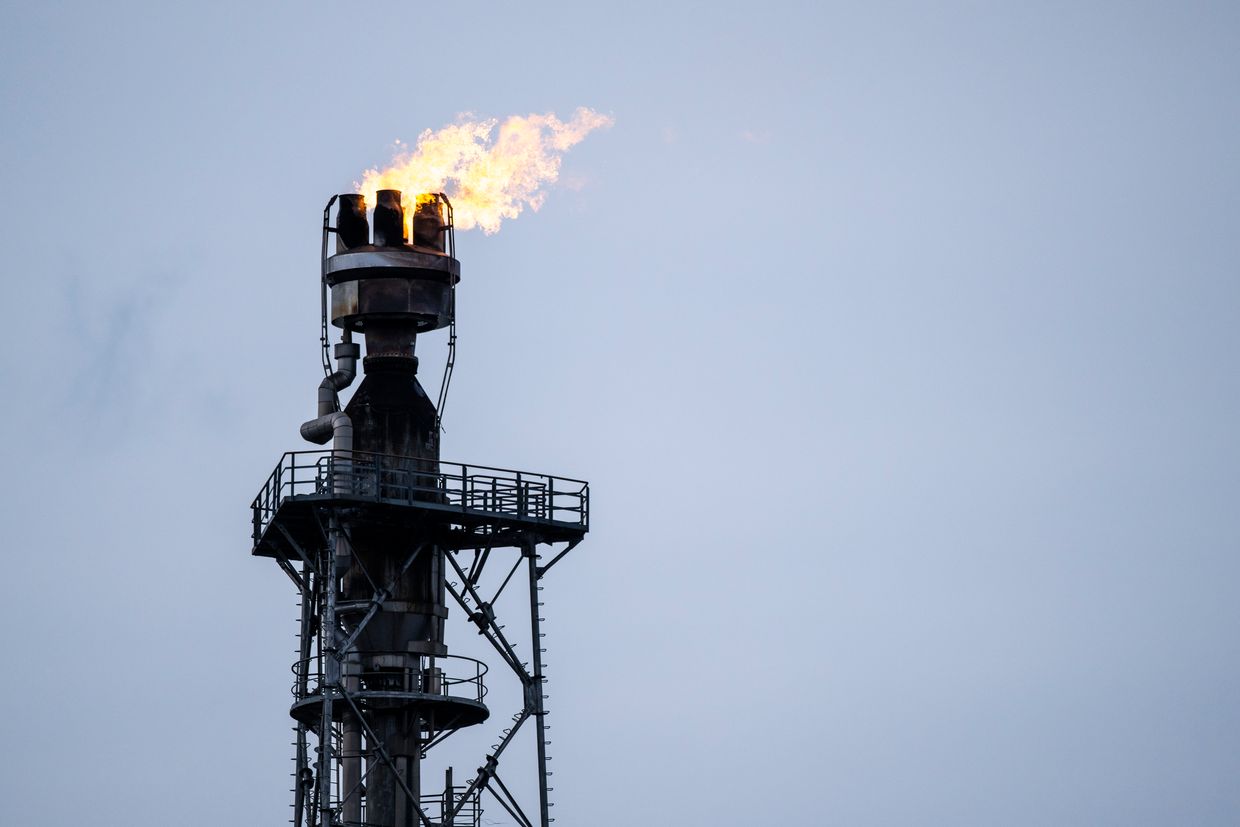
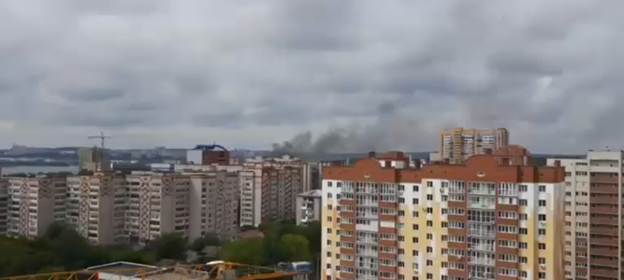
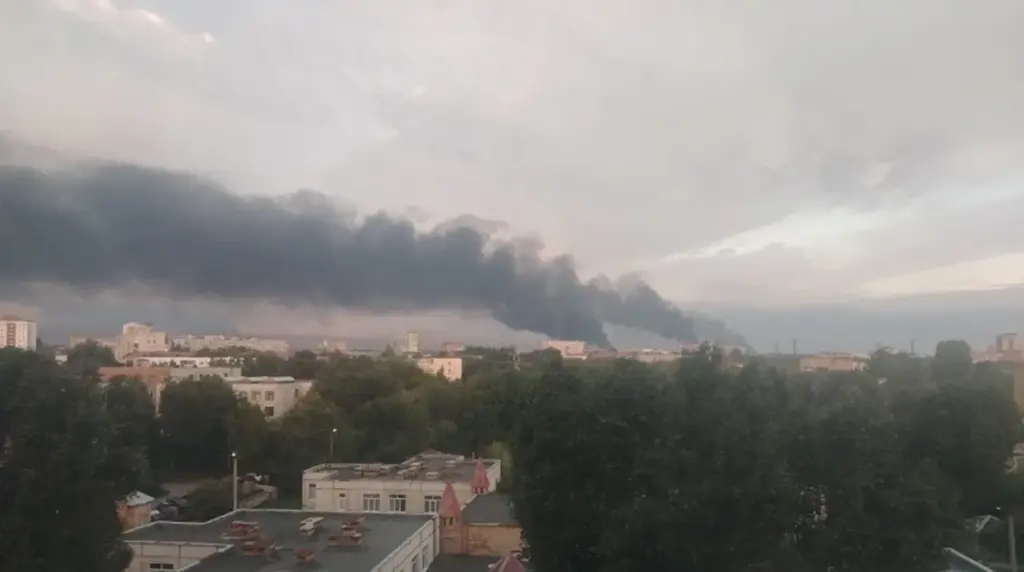
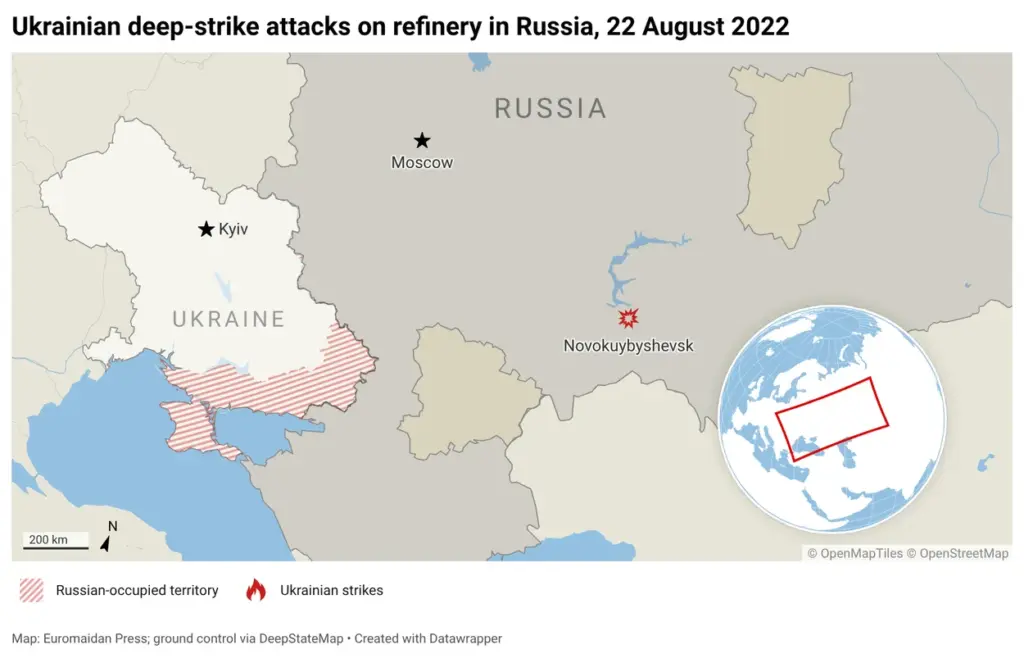
Ukrainian forces struck production facilities at the Novokuybyshevsk oil refinery in Russia’s Samara Oblast overnight on 22 August, sparking a fire at the Rosneft-owned plant, Ukraine’s General Staff said. The extent of the damage remains under assessment.
Ukraine has repeatedly targeted Russia’s oil refineries to restrict military fuel supplies and reduce the energy revenues supporting Moscow’s war. The latest strike came as gasoline rationing returned to Moscow and St
Ukrainian forces struck production facilities at the Novokuybyshevsk oil refinery in Russia’s Samara Oblast overnight on 22 August, sparking a fire at the Rosneft-owned plant, Ukraine’s General Staff said. The extent of the damage remains under assessment.
Ukraine has repeatedly targeted Russia’s oil refineries to restrict military fuel supplies and reduce the energy revenues supporting Moscow’s war. The latest strike came as gasoline rationing returned to Moscow and St. Petersburg, and Rosneft capped nationwide purchases. Militarnyi described the plant as one of Russia’s 10 largest refineries.
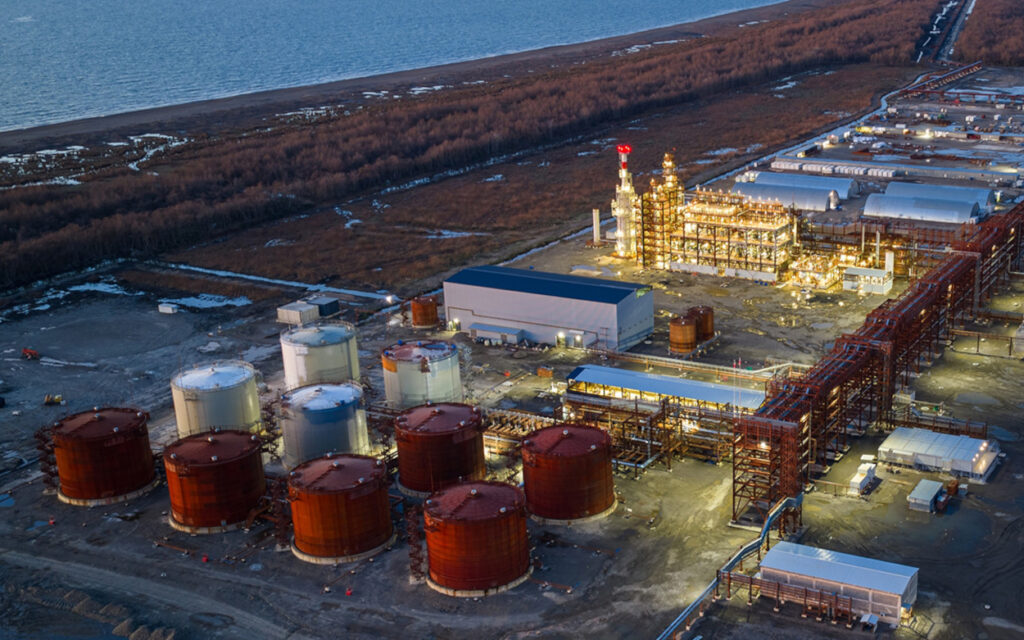
The Rosneft-owned refinery can process about 8.8 million metric tons of crude annually and produces more than 20 petroleum products, including aviation fuel and diesel, Ukraine’s General Staff said.
Fire Point said FP-1 long-range drones were used to strike the refinery.
The same overnight wave also hit an Ozon logistics center in Chapayevsk, where people were injured, and work was halted, Reuters reported, citing the company.
Neither the damage to the refinery nor any interruption to production has been independently confirmed.
Ukraine keeps pressure on Russian fuel supplies
The strike came one day after Ukraine confirmed hitting Lukoil’s Perm refinery, approximately 1,530 kilometers from Ukraine’s northern border. That attack also caused a fire, according to the General Staff.
At least four Russian refineries went offline during August amid continuing Ukrainian attacks.
By mid-August, filling stations in at least 12 Russian regions were experiencing hours-long lines. Some areas had reintroduced purchase limits or rationing based on license-plate numbers, according to the same report.
Gasoline limits had also been reinstated in Moscow and St. Petersburg, while Rosneft had capped sales at 30 liters per vehicle across its nationwide filling-station network. Diesel purchases remained unrestricted.
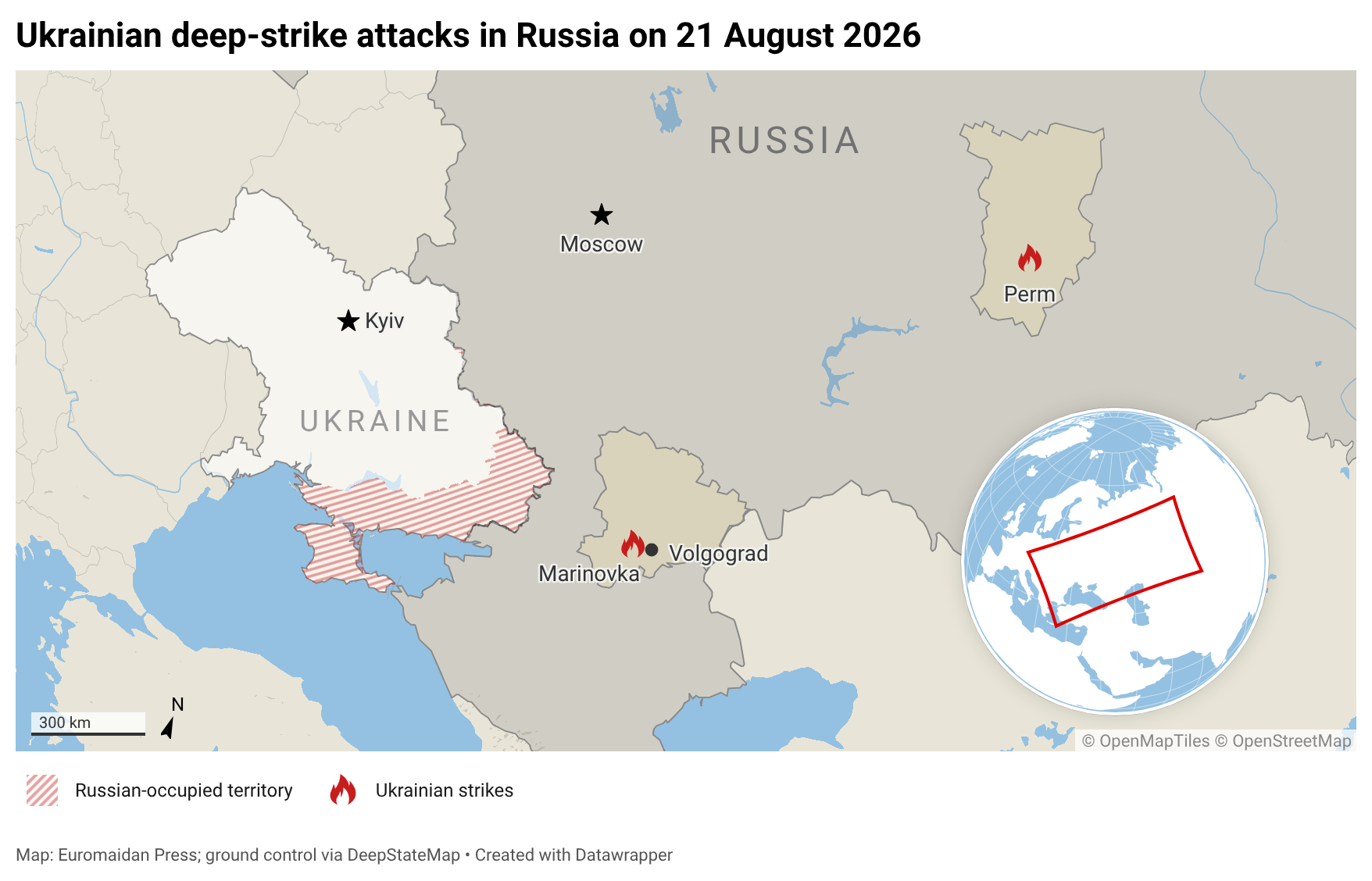
Ukraine struck one of Russia's largest oil refineries deep in the Urals and a military airfield overnight in a long-range attack, Ukrainian President Volodymyr Zelenskyy announced on 21 August. The Ukrainian Army's General Staff confirmed the refinery and airfield hits, while Zelenskyy said the same night also reached the Black Sea and brought fresh damage from earlier strikes on a Russian warplane and a drone-launch site.
Ukraine's long-range drone campaign has spent t
Ukraine struck one of Russia's largest oil refineries deep in the Urals and a military airfield overnight in a long-range attack, Ukrainian President Volodymyr Zelenskyy announced on 21 August. The Ukrainian Army's General Staff confirmed the refinery and airfield hits, while Zelenskyy said the same night also reached the Black Sea and brought fresh damage from earlier strikes on a Russian warplane and a drone-launch site.
Ukraine's long-range drone campaign has spent the year reaching ever deeper into Russian territory, forcing Moscow to spread its air defenses across thousands of kilometers and driving fuel shortages that now reach beyond its borders. Each strike on Russia's oil backbone compounds the strain on its refining and export earnings, even as the Kremlin diverts chemicals meant for weapons into keeping filling stations supplied.
Fire at a major Lukoil refinery in Perm
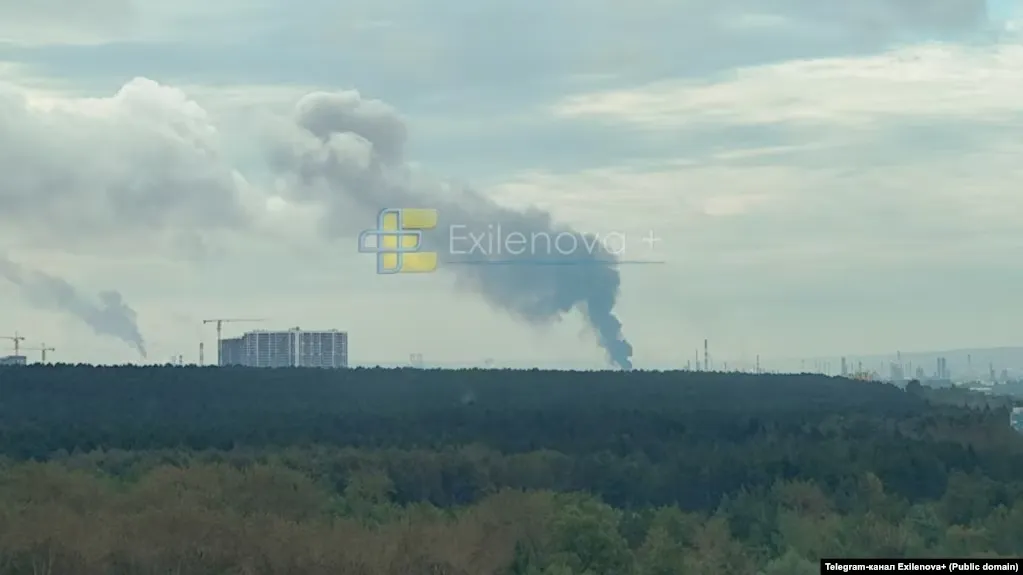
Zelenskyy said the overnight drones hit the Lukoil-Permnefteorgsintez refinery — known as PNOS — in Perm, where the General Staff recorded a fire on the plant's grounds. The target sits more than 1,500 km from Ukraine's northern border, in a region near the Ural Mountains.
The refinery is one of Russia's largest, able to process more than 13 million tons of crude a year, with more than half its output sold abroad until recently. It supplies fuel to both Russia's economy and its army.
Ukrainian Telegram channels Supernova+ and Exilenova+ shared footage of explosions and a rising plume, with locals reporting a series of blasts at the site. Russia's Perm Krai authorities claimed they repelled the attack and downed 16 drones.
Kyiv has repeatedlyhit the plant through the year. After a strike at the end of July, it had been running well below capacity.
Airfield, Black Sea, and other targets the same night
The General Staff said the same night's drones also struck the Marinovka military airfield in Volgograd Oblast, located in Russia's Volga region, with the damage still being assessed, while Zelenskyy added that Ukraine achieved unspecified results in the Black Sea. The military also reported hitting a drone storage and launch site near Donetsk, a materiel warehouse in occupied Crimea, two command posts in Donetsk and Zaporizhzhia oblasts, and six relay stations in Crimea used to steer Russia's Geran and Gerbera attack drones.
Zelenskyy also confirmed damage from earlier strikes: a Russian Su-34 fighter-bomber hit at the Akhtubinsk airfield, about 600 km from the front line, and a drone store and launch site struck at Primorsko-Akhtarsk, roughly 180 km away. The strike extends a run of deep hits this month, from the TANECO refinery in Tatarstan and a Black Sea oil terminal to three refineries hit in one night and an Omsk refinery struck 2,500 km away in Siberia.
Gasoline prices have risen roughly 10–13% in Tajikistan, Kyrgyzstan, and Uzbekistan as Russia restricts exports after Ukrainian strikes on its refineries, Kazakh economist Aidar Alibayev estimated in a 20 August interview with Current Time. He did not specify the comparison period.
Earlier Ukrainian attacks disrupted Kazakhstan’s crude exports through Russia’s Black Sea ports. Strikes at refineries are creating a different kind of squeeze: Russia has less gasoline avail
Gasoline prices have risen roughly 10–13% in Tajikistan, Kyrgyzstan, and Uzbekistan as Russia restricts exports after Ukrainian strikes on its refineries, Kazakh economist Aidar Alibayevestimated in a 20 August interview with Current Time. He did not specify the comparison period.
Earlier Ukrainian attacks disrupted Kazakhstan’s crude exports through Russia’s Black Sea ports. Strikes at refineries are creating a different kind of squeeze: Russia has less gasoline available to dependent neighbors. Tajikistan and Kyrgyzstan are seeking other suppliers, while Kazakhstan could face growing pressure if the shortages persist.
Tajikistan has been hit hardest because it depends heavily on Russian fuel and has the region’s most difficult delivery routes, Alibayev said. He estimated gasoline prices there had risen 12–13%. Current Time reported that Tajikistan is exploring supplies from China; Alibayev said it was also turning to Iran.
Kyrgyzstan, which sources more than 90% of its gasoline from Russia, asked its neighbors, Azerbaijan and Kazakhstan, as well as other countries, for help. Current Time reported that a deputy prime minister said its reserves would last about six weeks. Alibayev estimated prices had climbed around 10%, compared with 11–11.5% in Uzbekistan, which he estimated gets half its fuel from Russia.
In Uzbekistan, Alibayev estimated that fuel prices had risen by about 11% and said the country gets about half of its fuel from Russia.
Russia extended its gasoline and diesel export restrictions through 31 January 2027 as shortages mounted. Intergovernmental and humanitarian shipments remain exempt, while diesel producers regain some export rights from 1 September. Current Time also reported that Russian companies had begun buying gasoline from Belarus.
Kazakhstan is better insulated than its neighbors because its refineries in Atyrau, Shymkent, and Pavlodar produce enough fuel to meet most domestic demand, Alibayev noted. Motorists from Russia and neighboring states are crossing its borders to refuel. He attributed Kazakhstan’s price rises mainly to domestic taxes and the end of an export moratorium—not Russia’s shortage alone.
Central Asia looks for routes beyond Russia as war drags on
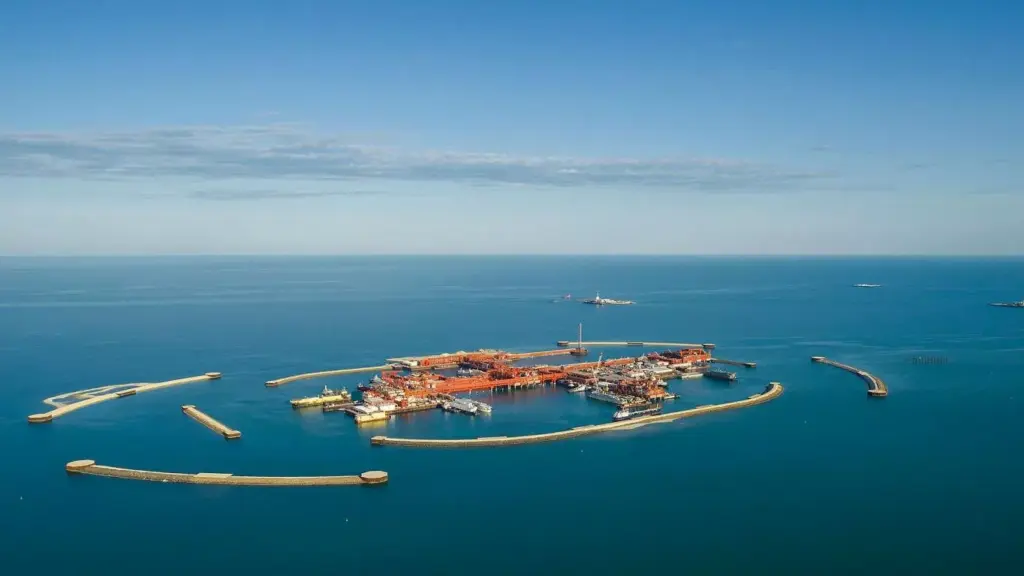
Kashagan oil field near Atyrau. CPC disruptions have prompted Kazakhstan to reroute crude to China. Map: Euromaidan Press / Datawrapper
At an informal summit of Central Asian leaders in Cholpon-Ata in early August, Tajik President Emomali Rahmon proposed building a refinery to serve the whole region. For now, Alibayev said, the decisive factor is how long Russia’s troubles last: the longer Ukraine’s strikes continue, the more they will weigh on prices across Central Asia.
Ukraine’s Defense Forces struck a major oil refinery and a Black Sea oil terminal on 19 August and overnight into 20 August, Ukraine’s General Staff reported. Drones also hit a key mainland electricity hub supplying occupied Crimea, Militarnyi reported after analyzing NASA satellite data.
Together, the reported strikes put three parts of Russia’s war machine under attack within hours: fuel production, Black Sea oil exports, and the mainland electricity bridge to occupie
Ukraine’s Defense Forces struck a major oil refinery and a Black Sea oil terminal on 19 August and overnight into 20 August, Ukraine’s General Staff reported. Drones also hit a key mainland electricity hub supplying occupied Crimea, Militarnyi reported after analyzing NASA satellite data.
Together, the reported strikes put three parts of Russia’s war machine under attack within hours: fuel production, Black Sea oil exports, and the mainland electricity bridge to occupied Crimea. They continue a deep-strike campaign intended to disrupt fuel supplies and logistics supporting Russia's invasion
A major refinery deep inside Russia
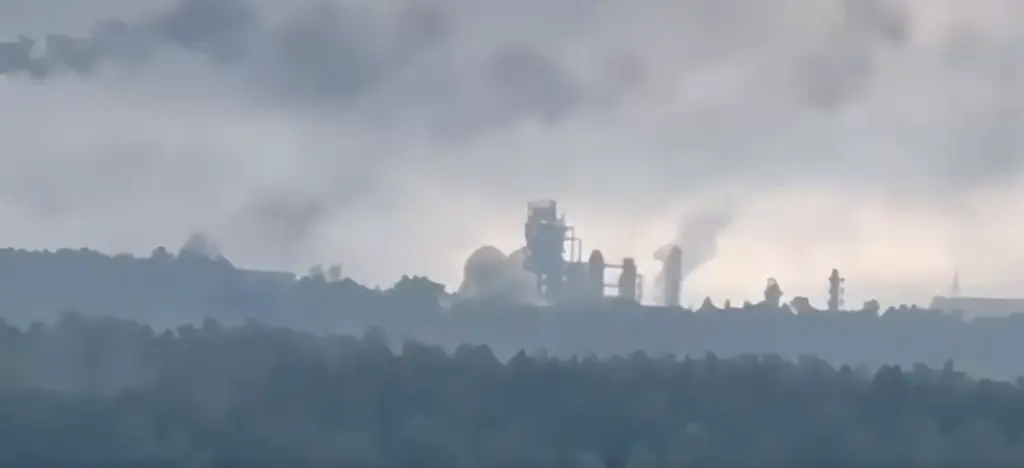
Ukraine struck the TANECO refinery in Nizhnekamsk, in the Russian republic of Tatarstan, where the General Staff reported a fire at the production site. Militarnyi had earlier identified the same facility from eyewitness footage showing a drone reaching the city’s industrial zone despite Russian air-defense fire.
Ukrainian attack drones swarmed Russia’s Nizhnekamsk Oil Refinery this morning, scoring multiple hits and setting the plant on fire.
Seen here, a Ukrainian Fire Point FP-1 maneuvers and then dives into one of the already-burning Russian refinery’s process units. pic.twitter.com/3v9AjEZFs5
Owned by Tatneft, TANECO is one of Russia’s newest, largest, and most technologically advanced refineries. It can process more than 16 million tons of crude annually and produces gasoline, diesel, aviation fuel, marine fuel, and other petroleum products.
Neither the General Staff nor the available imagery established whether processing equipment was damaged or production stopped.
A Black Sea terminal moving about 20 million tons a year
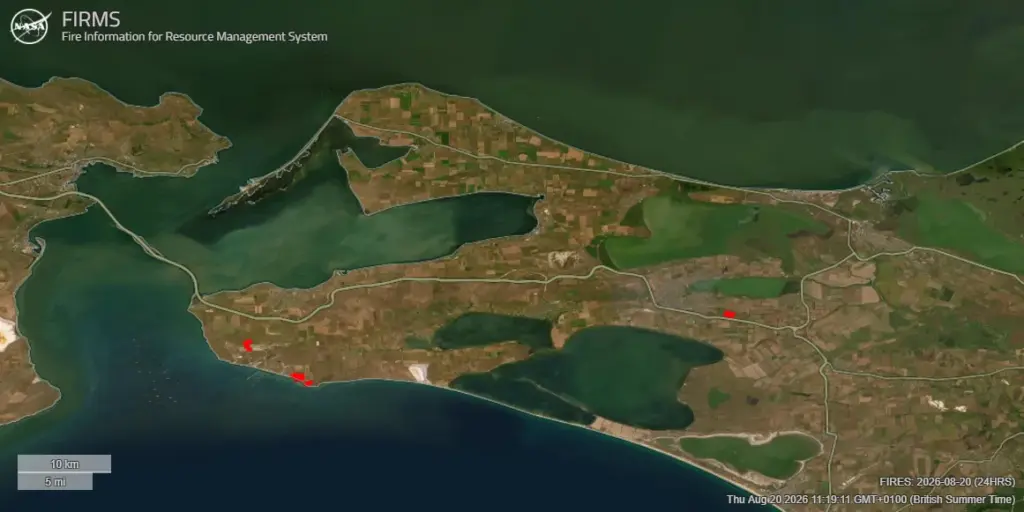
Ukraine also hit the Tamanneftegaz oil and gas terminal in the village of Volna, Krasnodar Krai, where the General Staff reported another fire. Militarnyi found a corresponding fire in NASA Fire Information for Resource Management System (FIRMS) data and assessed that storage tanks were likely burning.
Thermal anomalies on NASA FIRMS from left to right: Tamanneftegaz terminal and Taman 500-kilovolt substation. Source: NASA FIRMS
Militarnyi described Tamanneftegaz as southern Russia’s largest private oil terminal. The complex can handle about 19.9 million tons annually, while its tank farm held more than 1 million cubic meters before Ukrainian attacks began.
The Tamanneftegaz terminal receives, stores, and loads petroleum products onto tankers, making it an important link in Russia’s Black Sea exports. Drones previously hit three tanks and pipelines there on 30 July.
The mainland electricity gateway to occupied Crimea
Drones hit the Taman 500-kilovolt substation in Krasnodar Krai, where NASA satellite data recorded a fire, Militarnyi reported. All four lines of Russia’s power bridge across the Kerch Strait pass through this high-voltage hub, making it the principal mainland gateway for electricity sent to occupied Crimea, Militarnyi reported.
Confirmed: Metrics show a sudden decline in internet connectivity across Russian-controlled Crimea with high impact to Sevastopol and Simferopol corresponding to a power blackout after overnight Ukrainian drone attacks targeting energy infrastructure pic.twitter.com/dqCXzTDcWO
Power failed in Simferopol, Sevastopol, Kerch, Feodosia, and Yalta around 1:45 a.m., according to Suspilne Crimea. Electric transport stopped in several cities. Sevastopol’s occupation chief said restrictions were lifted after about 90 minutes, although the grid remained unstable and some nearby settlements still lacked electricity. Social facilities in Sevastopol switched to backup power.
Crimean Wind also reported explosions near the Kafa and Malorechenske substations inside Crimea, Suspilne Crimea reported. The available evidence therefore does not establish that the Taman strike alone caused the outages.
Ukraine’s sustained long-range strike campaign
Ukraine's long-range strikes on Russian targets have ramped up in recent months. One day earlier, drones hit a key crude-processing unit at the Bashneft-UNPZ refinery in Ufa, Militarnyi reported. Ukraine had also struck TANECO on 10 August and both Nizhnekamsk refineries on 12 June, Suspilne reported.
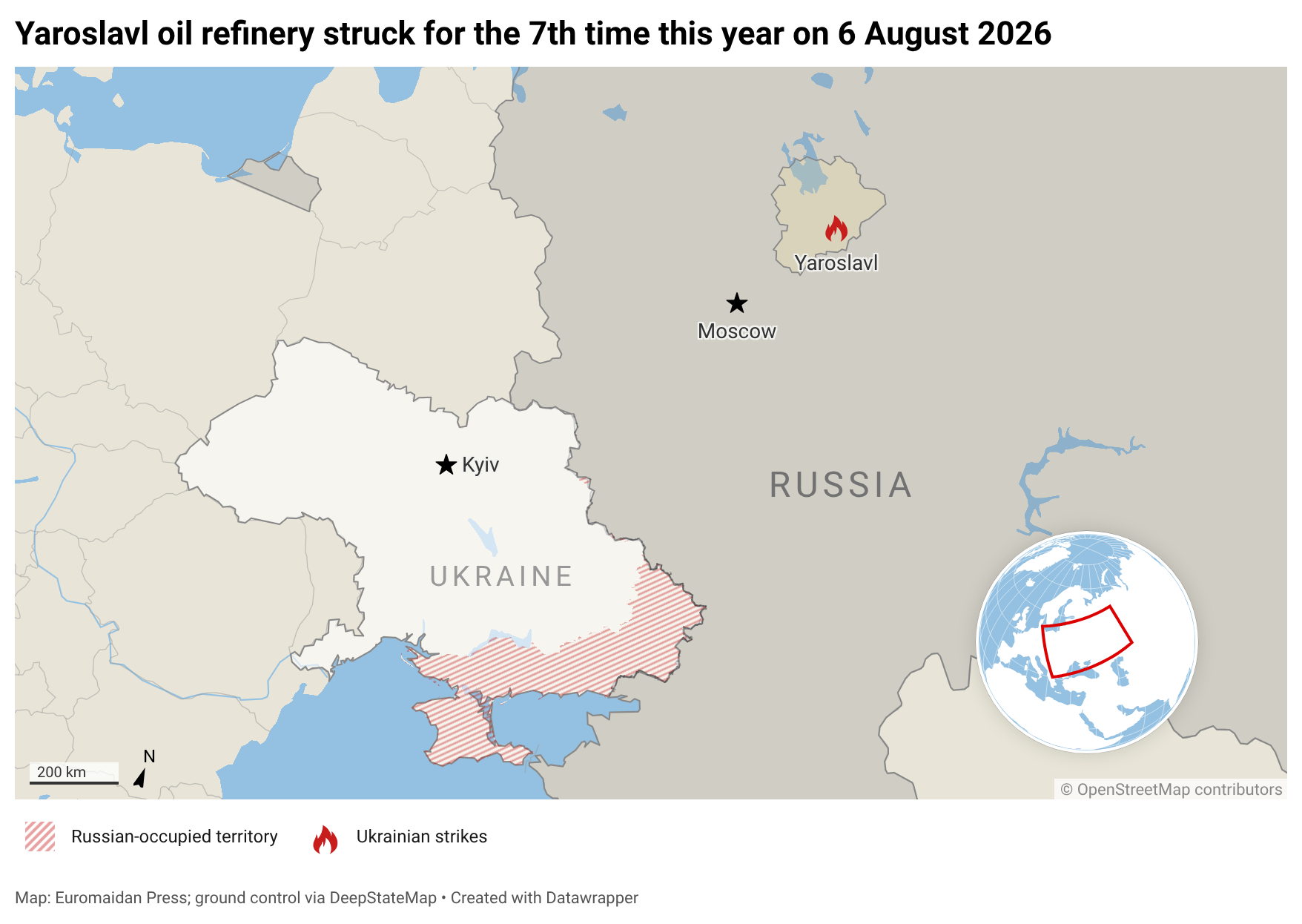
Euromaidan Press reported that Ukrainian deep strikes hit 18 Russian oil and gas facilities in May, making it the heaviest month of 2026 at that point. On 6 August, drones attacked a top-five refinery in Yaroslavl for the seventh time this year. Five days later, they reached Orsk, about 1,500 kilometers from Ukraine.
The United States has rebuilt intelligence sharing with Ukraine—the flow of satellite data, targeting, and attack warnings—to its pre-freeze peak, according to Politico. That restored flow now sharpens Kyiv's long-range strikes inside Russia, and senators from both parties say it has strengthened Ukraine. The White House says President Donald Trump stays focused on ending the war.
Russia funds its invasion largely with oil money, and Ukraine has spent the past year burn
The United States has rebuilt intelligence sharing with Ukraine—the flow of satellite data, targeting, and attack warnings—to its pre-freeze peak, according to Politico. That restored flow now sharpens Kyiv's long-range strikes inside Russia, and senators from both parties say it has strengthened Ukraine. The White House says President Donald Trump stays focused on ending the war.
Russia funds its invasion largely with oil money, and Ukraine has spent the past year burning that revenue at the source, sending drones against refineries far behind the front. Foreign backing has wavered across the war, and every US pledge now carries the question of whether it will hold.
The freeze that started with a White House blowup
The cutoff came after Trump and Ukrainian President Volodymyr Zelenskyy clashed in the Oval Office on 28 February 2025. Days later, the White House froze weapons and intelligence to push Kyiv toward talks. It did not last. Washington restored the flow within about a week, after US-Ukraine talks in Saudi Arabia.
Explore further
Intelligence: Russia’s civil aviation deteriorates under sanctions, forcing it to dismantle even new aircraft to obtain spare parts
What changed on the battlefield
Senator Mark Warner, the top Democrat on the Senate Intelligence Committee, said the renewed sharing has improved Ukraine's position.
"Everybody loves a winner and looks like Ukraine has turned the tide," said Republican Senator John Cornyn.
Better data, deadlier strikes
"Those strikes were supercharged," and became "significantly more effective when imbued with intelligence from the Americans," said George Barros of the Institute for the Study of War.
He tied the drone strikes on Russian energy sites to a plan to raise the war's cost for Moscow.
Stephen Sestanovich of the Council on Foreign Relations said Ukrainian officials give Washington confident reads on what is happening in Moscow, not just inside the Kremlin. Warner said no one in the US defense establishment, himself included, expected Ukraine to reach this point a year ago.
Explore further
Some Ukrainian farmers sell wheat below cost as Black Sea disruption stops ore operations
What the 2025 blackout cost
Euromaidan Press reported that losing the feed let Russian troops claw back territory in Russia's Kursk Oblast and left thousands of Ukrainians at risk of encirclement.
"As a result of this pause, there are hundreds of dead Ukrainians," one Ukrainian officer told.
Why the renewed backing is hard to unwind
The restored flow binds Washington to Ukraine's deep-strike campaign, making the tie harder for any ceasefire to sever. Agreement across party lines suggests the backing could outlast the next swing in American politics.
Ukrainian drones struck one of Russia's five largest oil refineries in Yaroslavl on the morning of 6 August, setting off several fires across the site, monitoring channels reported. Open-source analysts placed the blazes on the refinery grounds, while the region's governor claimed his air defenses downed the entire raid. The strike continued a months-long campaign that has pushed Russian oil refining to its lowest level in more than two decades.
Ukraine has turned long-
Ukrainian drones struck one of Russia's five largest oil refineries in Yaroslavl on the morning of 6 August, setting off several fires across the site, monitoring channels reported. Open-source analysts placed the blazes on the refinery grounds, while the region's governor claimed his air defenses downed the entire raid. The strike continued a months-long campaign that has pushed Russian oil refining to its lowest level in more than two decades.
Ukraine has turned long-range drones into an economic weapon in 2026, hitting the refineries and export terminals that bankroll Russia's war. The damage has reached ordinary Russians, with fuel shortages spreading from city pumps to farms and buses. A parallel campaign that started last month targets warehouses of Russia's largest online retailer.
Fires break out across the refinery
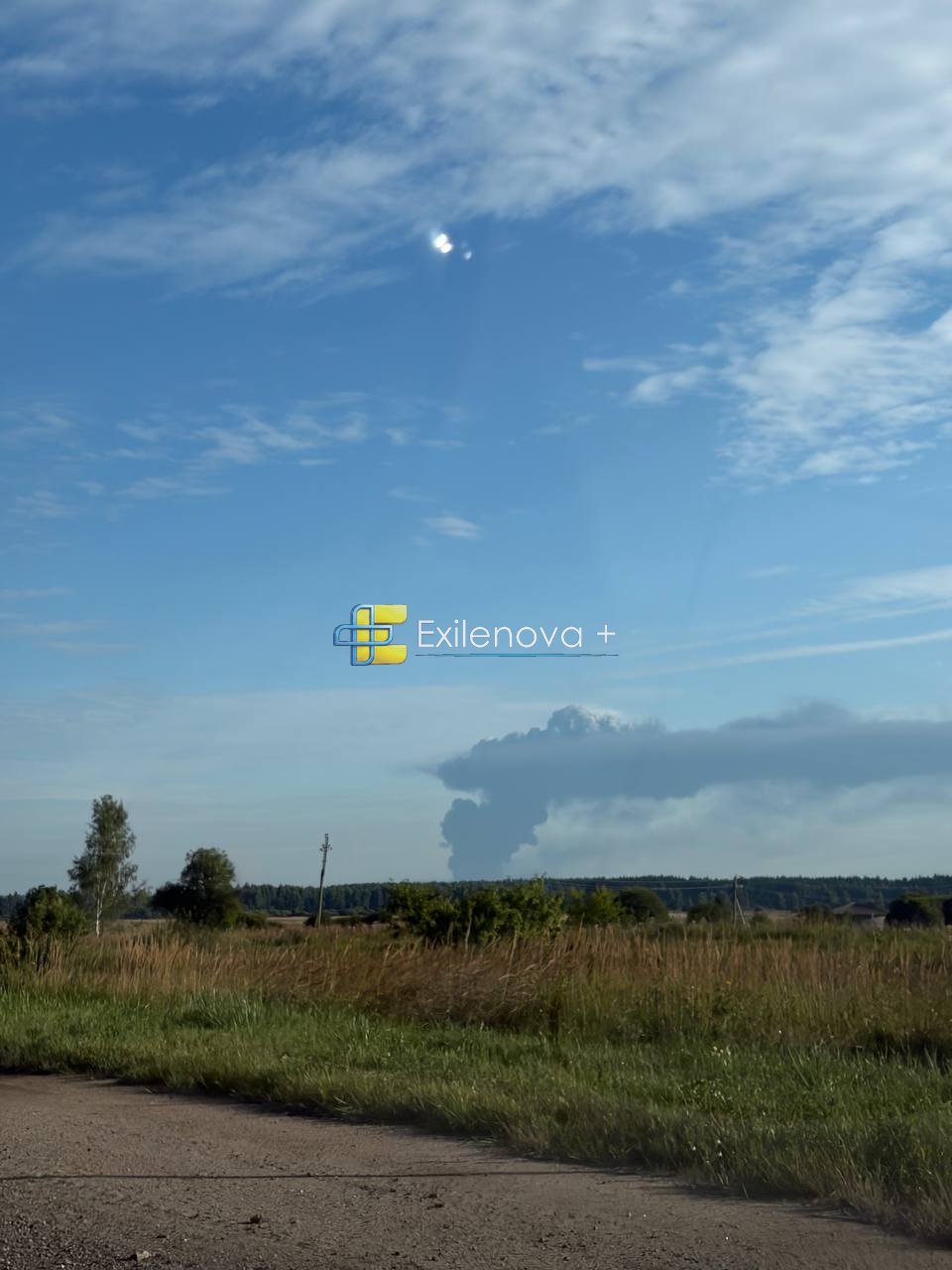
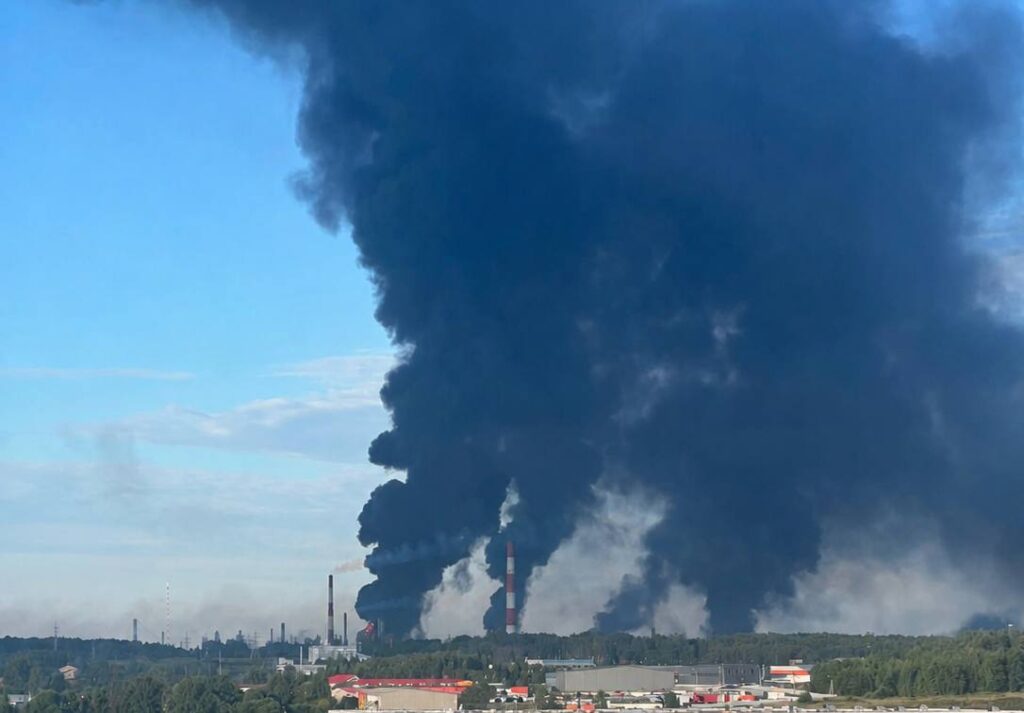
Ukrainian monitoring Telegram channel Exilenova+ first reported the attack around 4:00, later sharing footage that showed thick black smoke rising from several points on the site. Fire Point, the Ukrainian company that builds the FP-1 long-range drone, said Ukraine's Defense Forces hit the plant with the domestically made FP-1s. Open-source analysts geolocated one blaze to the refinery grounds. Astra, a Russian news Telegram channel, reported one fire on the plant's territory and a second it had not yet located.
Ukraine struck another Wildberries warehouse this morning, the 15th such facility hit in just 18 days
Thirteen of those fifteen warehouses have burned so far, a pace that turns Russia's largest online retailer into a recurring target list Exilenova+ pic.twitter.com/cGOvsmkR6L
Slavneft-YANOS, also called the Novo-Yaroslavl refinery, ranks among Russia's five largest and is the biggest in the country's central regions. It processes about 15 million tonnes of crude a year into gasoline, diesel, aviation kerosene, jet fuel, lubricants, and bitumen. Rosneft and Gazprom jointly control 99.7% of its parent company, Slavneft. The plant's fuel feeds central Russian industry, airports, the Northern Railway, and military sites. It sits more than 700 kilometers from Ukraine's border.
Russia claims it downed every drone in the region
Yaroslavl Governor Mikhail Yevraev first reported the region was under drone attack around 3:00 and closed the highway toward Moscow. He later claimed the region had repelled its most massive drone raid, downing all 88 drones with no casualties. Yevraev stated that a detached house burned, windows were shattered in several apartment blocks, and residents' cars were damaged.
A column of smoke from the burning Slavneft-YANOS refinery seen from outside Yaroslavl, Russia, 6 August 2026. Photo: Exilenova+
Russia's Defense Ministry claimed it destroyed 605 drones over several regions overnight.
The plant has burned repeatedly in 2026, catching fire on 28 March, 26 April, 8 and 22 May, and 6 and 16 July before the latest hit. That made 6 August the seventh strike on the refinery this year. In the 16 July attack, an FP-1 struck the plant's tank farm.
Russia's refining in retreat
Ukraine has sharply expanded its FP-1 deep strikes on refineries this year, knocking out around 26 plants. By late July, only eight had fully restarted and at least 11 partly. Seven refineries stayed idle. Russian refining fell to 3.6 million barrels a day, its lowest since May 2002.
Earlier, Moscow banned fuel exports, boosted gasoline imports from Belarus 25-fold, and turned to India and Morocco. It also let refiners sell Euro-2 gasoline, a grade banned in Russia since 2013, through 1 July 2027.
Georgia's only oil refinery says it has begun replacing Russian crude with supplies from Kazakhstan and Libya.
The update comes after the European Union sanctioned the refinery for processing Russian crude as part of its effort to curb revenues funding Moscow's war against Ukraine. Brussels gave the company six months to end its reliance on Russian oil before the restrictions take effect.
In a statement released on 31 July, Black Sea Petroleum (BSP), which operates t
Georgia's only oil refinery says it has begun replacing Russian crude with supplies from Kazakhstan and Libya.
The update comes after the European Union sanctioned the refinery for processing Russian crude as part of its effort to curb revenues funding Moscow's war against Ukraine. Brussels gave the company six months to end its reliance on Russian oil before the restrictions take effect.
In a statement released on 31 July, Black Sea Petroleum (BSP), which operates the Kulevi Oil Refinery on Georgia's Black Sea coast, said implementation of its crude supply diversification plan was already under way and remained on schedule.
Kazakh crude already being refined
The company said the refinery began processing crude oil of Kazakh origin at the beginning of July, with the remaining contracted volumes to be refined during August.
BSP also announced that, under an agreement signed with an international trading company on 3 July, a cargo of Libyan crude is expected to arrive at Kulevi between 20 and 30 August. The contract runs through the end of 2027 and includes an option to extend it.
According to the company, the transition will allow the refinery to operate entirely on non-Russian crude beginning in August and September, in line with plans announced on 1 July.
Explore further
Georgia’s only oil refinery to stop processing Russian crude from August, company says
Company seeks to satisfy EU sanctions requirements
The statement follows the European Union's decision on 24 July to sanction the Kulevi refinery as part of its 21st sanctions package against Russia. The measures prohibit transactions with the refinery after a six-month transition period, giving the company time to end its reliance on Russian crude.
BSP said the European Commission had acknowledged during a 24 July press briefing that the transition period was intended to enable the refinery to diversify its crude supplies. The company said the steps it has already taken are consistent with that objective and the timeline set by Brussels.
The refinery said it would continue working with the European Commission and other relevant authorities while providing "clear, verifiable evidence" of its progress toward eliminating Russian feedstock.
Explore further
EU sanctions Georgia’s only oil refinery over processing Russian crude. Company says it will switch suppliers
First major Georgian company sanctioned by the EU
The sanctions marked the first time the EU targeted a major Georgian company under its Russia sanctions regime.
The refinery came under scrutiny after Reuters reported in 2025 that it had begun processing crude supplied by Russian producer Russneft. According to research by the Centre for Research on Energy and Clean Air (CREA), the refinery received six shipments of Russian crude between October 2025 and May 2026, while refined products were exported to EU member states including Spain and Bulgaria.
EU officials have said the refinery could be removed from the sanctions list if it demonstrates that it has fully phased out Russian crude in line with its commitments.
Long-range Ukrainian drones struck the Ilsky oil refinery in Russia's Krasnodar Krai on July 7, hitting one of the facility's technological workshops, a source in Ukraine's military intelligence (HUR) told the Kyiv Independent. Located roughly 500 kilometers (311 miles) from Ukrainian-controlled territory, the refinery is among the largest in southern Russia, producing over 6 million tons of fuel annually. It is involved in the reception, storage, and processing of hydrocarbons and distributes r
Long-range Ukrainian drones struck the Ilsky oil refinery in Russia's Krasnodar Krai on July 7, hitting one of the facility's technological workshops, a source in Ukraine's military intelligence (HUR) told the Kyiv Independent.
Located roughly 500 kilometers (311 miles) from Ukrainian-controlled territory, the refinery is among the largest in southern Russia, producing over 6 million tons of fuel annually.
It is involved in the reception, storage, and processing of hydrocarbons and distributes refined products via road and rail. The refinery is part of Russia's military-industrial complex and plays a direct role in supporting Moscow's war effort, the source said.
The Russian regional operational headquarters claimed that "drone debris" fell on the oil refinery.
The strike marks a renewed wave of Ukrainian attacks on Russian oil infrastructure, following a months-long pause since March. On July 1, Ukrainian drones struck the Saratovorgsintez oil refinery in Russia's Saratov Oblast.
Kyiv has targeted dozens of refineries, oil depots, and military-industrial sites since the start of Russia's full-scale invasion in 2022. Winter drone attacks forced at least four Russian refineries to temporarily shut down.
This is the second known strike on the Ilsky refinery. Ukrainian drones, operated by the Security Service (SBU) and Special Operations Forces (SSO), previously targeted the facility on Feb. 17, causing a fire.
Krasnodar Krai, a strategic region along Russia's Black Sea coast, has increasingly come under Ukrainian drone attacks as Kyiv extends the range of its strikes deep into Russian territory.
Ukrainian drones struck the Saratovorgsintez oil refinery in Russia's Saratov Oblast, causing damage to the facility, Ukraine's General Staff reported on July 1. "An important facility has been hit," the General Staff said via its official Telegram channel. The Saratovorgsintez refinery and chemical plant, owned by Russian energy giant Lukoil, is located nearly 1,500 kilometers (930 miles) from Ukraine's border in the city of Saratov. The city hosts multiple strategic military and industrial sit
Ukrainian drones struck the Saratovorgsintez oil refinery in Russia's Saratov Oblast, causing damage to the facility, Ukraine's General Staff reported on July 1.
"An important facility has been hit," the General Staff said via its official Telegram channel.
The Saratovorgsintez refinery and chemical plant, owned by Russian energy giant Lukoil, is located nearly 1,500 kilometers (930 miles) from Ukraine's border in the city of Saratov. The city hosts multiple strategic military and industrial sites.
The refinery was targeted to "reduce the enemy's offensive capabilities," the General Staff wrote.
"The occupiers use the capacity of this refinery to supply fuel and lubricants to Russian military units involved in the armed aggression against Ukraine."
The attack was a joint operation carried out by Ukraine's military intelligence agency (HUR) and other military units, the General Staff said. A fire broke out at the site of the attack and damage to the refinery's technological installations has been confirmed. The full consequences of the strike are still being investigated.
The Kyiv Independent could not verify these claims.
The report is the latest in a series of announcements on July 1 about successful Ukrainian strikes on Russian targets. Earlier in the day, HUR released footage of Ukraine's UJ-26 drones, commonly known as Bober (Beavers), targeting high-value Russian air defenses and a fighter jet in occupied Crimea.
A source in the Security Service of Ukraine (SBU) told the Kyiv Independent that Ukrainian drones struck a major Russian military plant in the city of Izhevsk, over 1,300 kilometers (800 miles) from the front lines.
Ukraine also hit a Russian command post in occupied Donetsk Oblast, according to the General Staff.

 Connexion

 Confirmed: Metrics show a sudden decline in internet connectivity across Russian-controlled Crimea with high impact to Sevastopol and Simferopol corresponding to a power blackout after overnight Ukrainian drone attacks targeting energy infrastructure

 Exilenova+