Connexion
Russia is back at Dobropillia a year after it failed there. Now it’s the southern jaw of a pincer on Donbas’s last big free cities

- Russian reinforcements are surging toward Dobropillia in eastern Ukraine's Donetsk Oblast
- The Russians have a plan: take Dobropillia and close the southern jaw of a pincer around Kramatorsk and Sloviansk
- Ukrainian forces aren't powerless to resist, but many of their own best troops are busy attacking elsewhere
The Russians are pouring troops into a key sector just southeast of the town of Dobropillia in eastern Ukraine's Donetsk Oblast, threatening to overwhelm Ukrainian defenses and march one settlement closer to Kramatorsk and Sloviansk, the last two big free cities in Donetsk.
But the Russians' push toward Dobropillia isn't without cost. Russian losses in this sector are "colossal," according to the mapper Playfra. And every soldier the Kremlin deploys along the Dobropillia axis is a soldier it can't deploy elsewhere.
And that may help explain why the Russians are falling back in two other key sectors, in northern Donetsk Oblast and in neighboring Dnipropetrovsk Oblast. The Dobropillia axis is the Russians' clear priority. For the Ukrainians, that's an opportunity to attack elsewhere.
Dobropillia
— Unit Observer (@WarUnitObserver) September 10, 2026ORBAT - Summer 2026
Similar to last year, Russia has significantly reinforced the Dobropillia direction, seeking to capture the town itself while simultaneously developing the southeastern approach toward Druzhkivka and Kramatorsk.
To that end, the “Center”… pic.twitter.com/pDhRRlfbGW
Dobropillia, a former mining town with a pre-war population of around 28,000, is now a fortress. It anchors Ukrainian positions along the highway that threads northeast to Kramatorsk.
Russia has attacked here before. In August 2025, Russian troops pushed a salient toward the Dobropillia–Kramatorsk highway, and Ukrainian counterattacks cut it apart. By October that year, President Volodymyr Zelensky put Russian losses on the Dobropillia front at about 13,000.
Ukrainian military analyst Kostiantyn Mashovets describes the push on Dobropillia as the southern flank of a Russian operation to envelop the whole Sloviansk–Kramatorsk urban area. The other approaches are harder going. From the southeast, the Russians are blocked by stubborn Ukrainian forces still clinging to positions in the ruins of Kostiantynivka. From the north, starting this spring, the Ukrainian 3rd Army Corps rolled back 18 months of Russian gains.
For an army that's been struggling to complete its conquest of Donetsk, to say nothing of breaking through in other front-line oblasts, Dobropillia has become the priority.
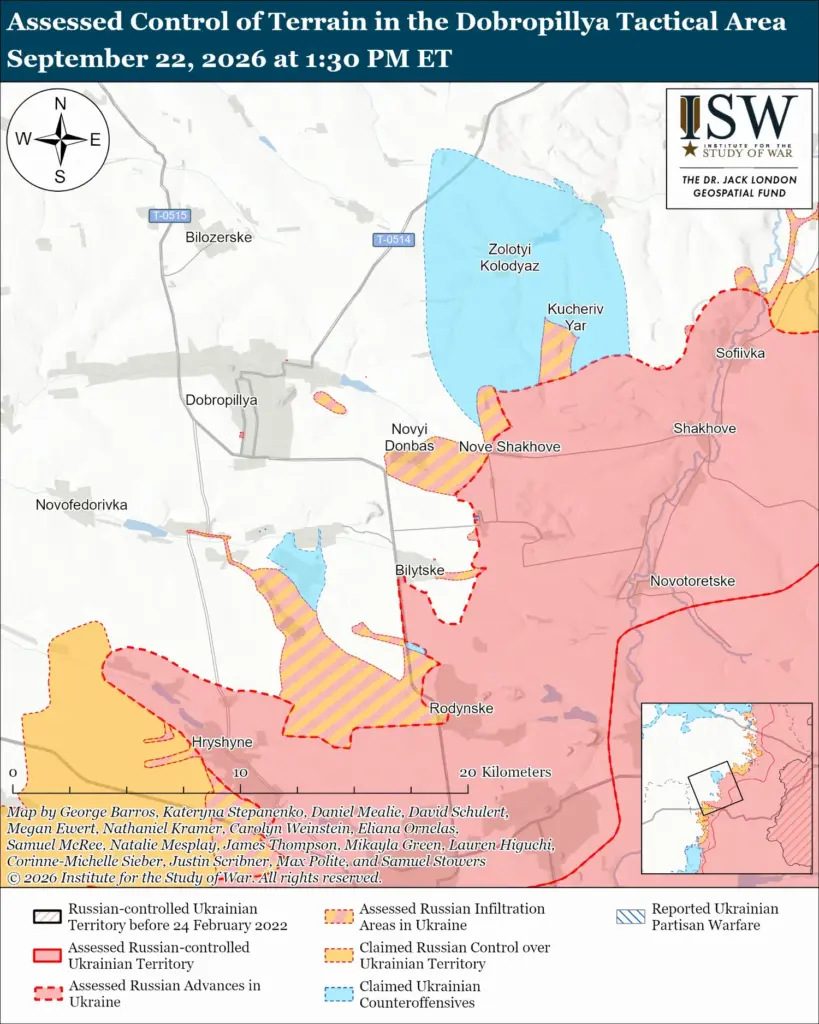
And that's why the Russians are channeling fresh forces into the Dobropillia sector. Part of the 41st Combined Arms Army and units of its 90th Guards Tank Division are now fighting there, Mashovets wrote on 9 October, and the Russian command keeps feeding fresh assault infantry into the sector through the village of Nove Shakhove despite heavy losses. The open-source account Unit Observer tracked the buildup as early as September.
Potentially tens of thousands of troops from those formations join the main forces of the 2nd and 51st Combined Arms Armies, according to Mashovets, as well as elements of the Russian naval infantry, facing the Ukrainian 1st Azov Corps and 19th Army Corps around Dobropillia.
The reinforcements give Russian commanders more options. Mashovets expects the 51st CAA to push south and southwest of Dobropillia and the 2nd CAA toward Raksha and Sviatohorivka, enveloping the town and cutting its supply routes from Bilozerske before any direct assault. The neighboring 8th CAA is fighting around Kostiantynivka. The Russians' immediate goal is "to maintain this offensive pressure from summer into the fall," Unit Observer wrote, setting conditions for a possible siege of Kramatorsk next year.
The outlook for the Ukrainian defenders of Dobropillia is "worsening," Playfra warned on 13 October:
The Russians have a seemingly infinite manpower pool here and a clear numerical advantage, which allows them to significantly increase the flow of infiltrators and, as such, the chance of some passing through Ukrainian defenses.
This leads to especially deep Russian infiltrations, which in turn slowly but surely destabilize the situation for the Ukrainians, which are progressively forced to abandon their most advanced positions.
The Ukrainians aren't without options, Playfra explained. They should double down on their current strategy of saturating the fields around Dobropillia with drones in a ring at least 2 to 3 km deep, forestalling large-scale Russian movements until the winter strips the leaves off the trees, depriving the Russians of their best cover from overhead surveillance. This could buy Dobropillia "much more time," Playfra predicted.
Mashovets puts a date on how long Dobropillia has to hold. If it and Druzhkivka, the town just south of Kramatorsk, hold until mid-to-late December, he wrote, the whole Russian plan for Sloviansk and Kramatorsk would collapse and have to be rewritten almost from scratch.
Help isn't coming
Just don't expect a lot of Ukrainian reinforcements along the Dobropillia axis. Many of Ukraine's best troops are busy attacking.
Taking advantage of the surge of Russian manpower in the direction of Dobropillia, Ukrainian forces have counterattacked where the Russians are weakest: in northern Donetsk Oblast and also in Dnipropetrovsk Oblast, just south of Donetsk.

In months of carefully planned assaults supported by ground robots and intensive drone strikes, Ukrainian forces have liberated hundreds of square kilometers in northern Donetsk and Dnipropetrovsk. The Ukrainian 3rd Army Corps' Operation Vivaldi in northern Donetsk largely removed the immediate northern threat to Sloviansk and neighboring Kramatorsk.
But it didn't do anything to help in the direction of Dobropillia, where the Russians have many more troops, much more firepower, and—equally importantly—a singular focus: closing the southern jaw around the last big free cities in Donetsk.