❌

Vue lecture

Russia’s energy war against Ukraine follows a pattern, Zelenskyy says. One oblast has taken 131 hits since September
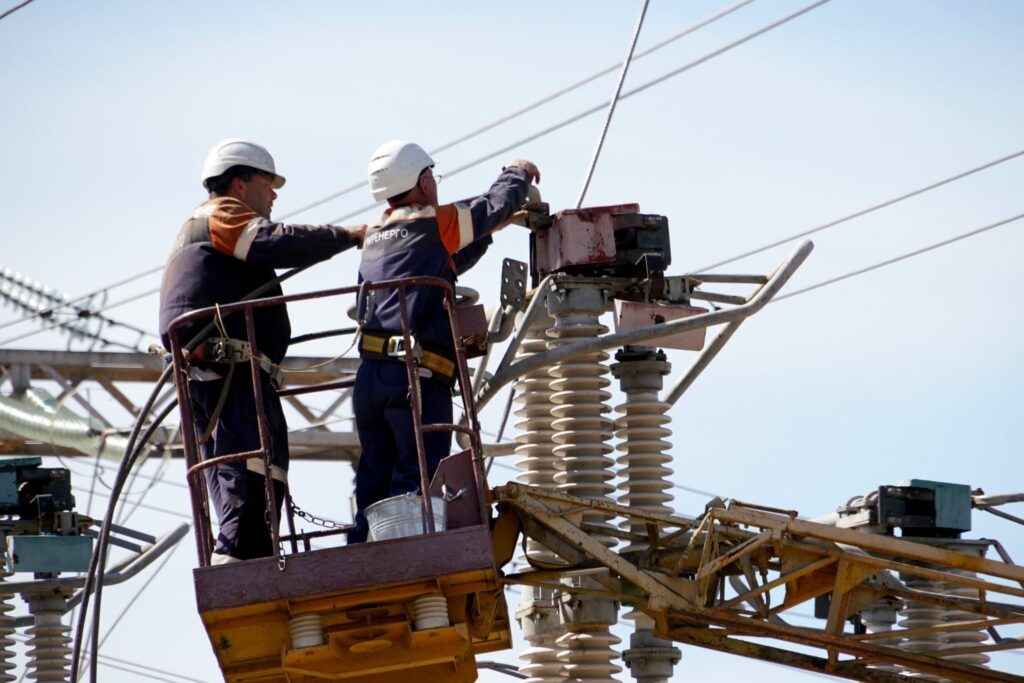
Ukrenergo workers repair high-voltage equipment at a substation in Ukraine. Illustrative photo.

Russia singles out one region, concentrates its strikes there for several days, and hits "everything, hitting power grids and substations," President Volodymyr Zelenskyy said in his evening address on 15 November, after strikes cut power to parts of Zaporizhzhia and Dnipropetrovsk oblasts.

Dnipropetrovsk Oblast tops Zelenskyy’s count, with 131 hits since the beginning of September, ahead of Kyiv Oblast with 125, he said. In the week to 15 November alone, DTEK restored power to 439,200 families there, and its crews often have to restore it where they already had more than once, the company said. The 15 November strike came a week after Russia left more than 600,000 customers in the oblast without power.

The extra emergency energy aid the EU agreed this week is meant “specifically for the cities and communities facing the greatest difficulties right now,” Zelenskyy said.

Grid strike cuts power in two oblasts

Consumers in both oblasts lost power after Russia struck an energy facility, forcing emergency outages, Ukrenergo said on 15 November. In Dnipropetrovsk Oblast, damage to main power lines cut electricity to parts of Dnipro, Kamianske, and the districts around them, according to DTEK. Hospitals switched to generators, and heated invincibility points, where people can warm up and charge phones, opened, the oblast administration reported. Russia kept striking Dnipro the next day.

In Zaporizhzhia, Russia hit critical infrastructure at the same time. Water was expected back within 30 minutes and heat for about 75% of consumers within an hour, Ivan Fedorov, co-head of the Zaporizhzhia Oblast Defense Council, said. By evening, power was back across the oblast, according to the oblast military administration.

Constant strikes slow repairs, Zelenskyy says

Zhytomyr and Sumy oblasts follow with more than 100 hits, Zelenskyy said. Those four oblasts are where energy workers, municipal services, and the State Emergency Service face the most work, and constant new alerts and strikes make repairs harder, he added. The goal is to return power to predictable outage schedules, he said.

Outages in six oblasts

By the morning of 16 November, consumers in Vinnytsia, Dnipropetrovsk, Kirovohrad, Odesa, Ternopil, and Cherkasy oblasts were without power, Ukrenergo reported. Zaporizhzhia Oblast was not on the list. Kharkiv and Poltava oblasts had emergency outages in the morning. In some oblasts, hourly outages of one to three queues stayed in place until the end of the day.

In Odesa Oblast, a morning strike on DTEK facilities left 52,200 families without power. In the week to 15 November, the company restored power to 306,200 families in the oblast.

At the same time, Zelenskyy thanked the EU for approving a Ukraine Facility payment of almost €8 billion, which he linked to Russia's intensifying attacks on Ukraine's energy, heating, and water supply.

  •  

Ukraine is hitting Russian oil, petrochemicals, and strike bases, likely to make up for scarce interceptors, ISW says

Black smoke and flames rise over an industrial skyline of chimneys and flare stacks under a cloudy morning sky in Nizhnekamsk, Russia.

Ukrainian forces struck the Nizhnekamskneftekhim petrochemical complex and the TAIF-NK refinery in Tatarstan, the Monolit aircraft plant in Trubchevsk, Bryansk Oblast, the Akhtubinsk airfield in Astrakhan Oblast, and a drone launch site near Tsymbulova in Oryol Oblast overnight on 15 November, Ukraine’s General Staff said in two statements.

The US think tank Institute for the Study of War assessed that the strikes advanced three goals at once: cutting Russia’s oil income, its army’s fuel and petrochemical supplies, and its aviation and launch capacity. The campaign is likely meant to offset Ukraine’s limited air defenses, as interceptor stocks dwindle amid a global shortage. That evening, Ukrainian President Volodymyr Zelenskyy said intelligence showed Russia was preparing new strikes, and that partners should focus on missiles for Patriot and NASAMS systems.

Synthetic rubber, a crude unit, and a glide-bomber base

At TAIF-NK, the strike hit the plant’s only primary crude unit, the General Staff said. Six people were injured in Nizhnekamsk, the city’s mayor said. Nizhnekamskneftekhim makes synthetic rubber used in military tires, and certain types of it serve as a binding base for solid rocket fuel, including for Iskander ballistic missiles, according to the General Staff. Monolit builds aircraft, including helicopters, it added.

Map of western Russia and Ukraine. Red arrows run from Ukraine to Nizhnekamsk in Tatarstan, labeled 1,130 km, and to Akhtubinsk in Astrakhan Oblast, labeled 610 km. Fire icons mark Trubchevsk, Nizhnekamsk, and Azov, and a red dot marks Tsymbulova near Oryol. Struck regions are shaded, and Russian-occupied Ukraine is hatched.
Sites in five of the Russian regions where Ukraine reported strikes on 15–16 November, from Bryansk Oblast to Tatarstan. Map: Euromaidan Press/Datawrapper

Akhtubinsk, about 610 km from the front line, hosts Su-34 jets that drop glide bombs on Ukrainian cities. The General Staff reported a powerful secondary detonation at a depot holding kits for guided aircraft missiles.

Four ways to count Russia’s refining losses

In the same address, Zelenskyy said Ukraine had “disabled more than 55% of Russia’s oil refining capacity,” citing a report from Commander-in-Chief Mykhailo Drapatyi. He did not say how the figure was calculated.

Other estimates measure different things. Strikes since late October had cut Russia’s refining capacity by about 30%, Reuters reported on 10 November, citing two industry sources. Russian refineries processed about 700,000 tons of crude a day at the end of October, and the actual cut in processing could reach 200,000 tons a day.

In July, analytics firm Kpler put refinery downtime and attacked capacity at about 58% of Russia’s total, but estimated that only 1.5 to 2 million barrels a day was effectively offline. Ukraine’s military intelligence said that by late September, refining at the 27 plants it counted as halted or cut back had fallen 55.4% from the start of the year.

Meanwhile, the General Staff said Ukrainian forces had hit the port of Ust-Luga on 11 November, and the Volgograd refinery and the Samara oil pumping station on 13 November. On 16 November, it added the Ilsky refinery in Krasnodar Krai and an oil depot in Azov to the list.

Russia targets one Ukrainian region at a time

Russia, in turn, keeps hitting Ukraine’s grid. Zelenskyy said Russia picks one region and strikes its networks and substations for days. Since early September, Dnipropetrovsk Oblast has taken 131 hits, Kyiv Oblast 125, and Zhytomyr and Sumy oblasts more than 100.

On 11 October, after US President Donald Trump announced an energy ceasefire, Zelenskyy said Ukraine was ready not to strike Russian energy facilities and expected the same from Russia. The ceasefire did not take hold, Reuters reported, and Ukraine resumed refinery strikes on 30 October. Zelenskyy now calls them “our justified response to Russia’s refusal to de-escalate.”

  •  
❌