❌

Vue lecture

War is costing Ukraine $155 billion per year. With Western aid running late, Kyiv is freezing everything but army, pensions, and public wages

russia hits kharkiv high-rise overnight injuring 43 people strikes central kyiv dnipro broad daylight · post rescuers destroyed floors apartment building hit ukraine 28 2026 synehubov5319173733626879672 news ukrainian reports

Ukraine's government plans to pay for its army, pensions, and public-sector wages first, and freeze the parks, fountains, and repaving. Prime Minister Serhii Koretskyi says his Cabinet reordered its spending priorities because part of the international aid it counted on has not arrived.

The war is costing the country at least $155 billion this year, Koretskyi stated earlier.

Defense and people come first

"We continue to take tough anti-crisis measures to ensure the most important thing, the needs of defense and our people," Koretskyi says.

The state will continue to pay for the army, pensions, social benefits, and the salaries of teachers, doctors, and other public-sector workers. Everything deemed non-critical is on hold: new construction, reconstruction, capital repairs, and tidying-up projects, among them parks, squares, fountains, and repaving.

"It is worth finally ceasing to spend money on non-priority things," he continues, promising the state will return to them later.

The aid runs late

On 27 September, Ukraine's prime minister stated that the shortfall in the defense budget's needs stands at $27 billion.

"The president, the government, and all branches of authority are working with partners to find mechanisms and sources to cover the remaining $20 billion," he stressed.

These funds are critically needed to supply the Defense Forces with drones, missiles, equipment, and other resources ahead of winter.

"The government, for its part, guarantees that by 15 October, all government decisions required to receive the international financial assistance promised by partners will be implemented," he stated.

Local budgets get the same call

Koretskyi extended the order downward, urging local councils to review their own budgets and cut spending that is not a priority now. The message across government is the same: pool what is available for the army and citizens, and leave the fountains and the rest for after the war.

  •  

After Russia hits Kyiv’s Academy of Sciences with jet-powered drone, the Kremlin says Ukraine must “pay a price”

russia hits kharkiv high-rise overnight injuring 43 people strikes central kyiv dnipro broad daylight · post firefighter tackles blaze two-story house after russian drone attack ukraine 28 2026 zelenskyy news

Russia says it is punishing Ukraine, and it is not hiding it. Dmitry Peskov, Kremlin spokesperson, says Ukraine must "pay a price" for its actions in recent months and calls Russia's intensified strikes "part of this price," according to UNIAN, citing Russian media.

Russia rarely admits its strikes are meant to punish a country rather than hit military targets, but Peskov did just that, casting the wave of attacks on Ukraine, which have struck apartment blocks, trains, and this week Kyiv's Academy of Sciences, as a "price" Ukraine has to pay. In the Kremlin's telling, Ukraine is being punished for its own deep strikes inside Russia.

Moscow calls the strikes a 'price'

Asked how Ukraine's strikes had affected Russia's position on peace talks, Peskov says Ukraine "will have to pay a price for the actions that have taken place in recent months," adding, "This is what is happening now."

Russia, he says, must ensure "no one gets the idea to announce plans to inflict devastating strikes on it."

Kyiv's deep strikes draw the reprisal

The "actions" are Ukraine's strikes deep in the Russian rear, targeting its assets, helping it to fund the war. Russian President Vladimir Putin complained last week of a large Ukrainian drone attack on Moscow during Russia's parliamentary election and a June strike on St. Petersburg during an economic forum, Reuters reported.

Ukraine has also battered Russian refineries with long-range drones and missiles, cutting fuel output enough to spark shortages and force Moscow to curb exports and buy fuel abroad.

The price falls on civilians

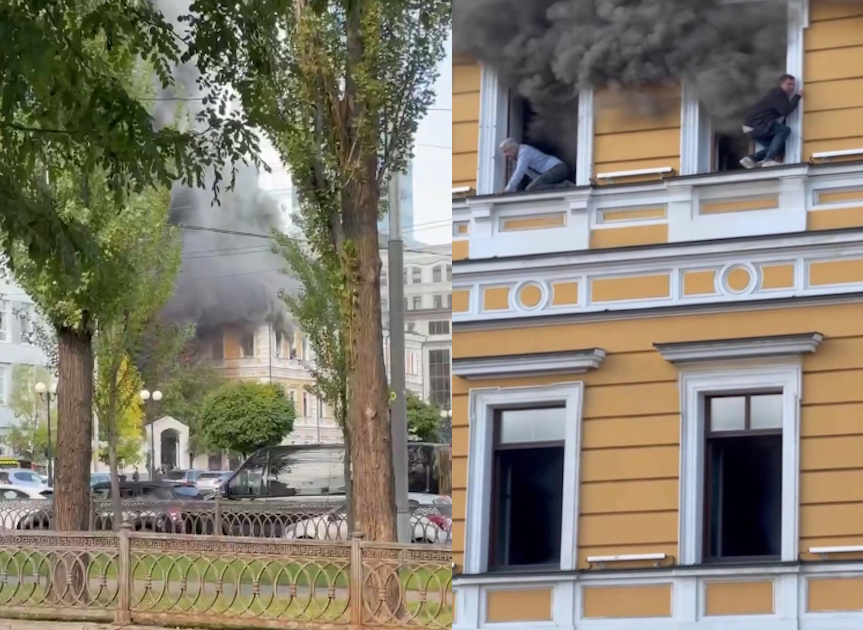
What the Kremlin calls a price has fallen largely on Ukrainian civilians. Through September, Russian strikes have hit trains, data centers, gas stations, and educational institutions, and on 28 September, a drone set fire to the National Academy of Sciences in central Kyiv as people inside fled through the windows.

  •  

“Reminiscent of 11 September at World Trade Center”: Russia strikes Ukraine’s century-old National Academy of Sciences in central Kyiv, people are climbing onto windows not to be buried alive

A Russian drone struck the National Academy of Sciences of Ukraine in central Kyiv on 28 September. Image: Sternenko

Russia has struck the National Academy of Sciences of Ukraine (NAS) in Kyiv on the afternoon of Monday, 28 September. People inside the building are climbing out onto the windows to avoid being burned alive.

Since the start of the full-scale invasion, Russia has damaged more than 4,650 educational institutions in Ukraine. Another 423 educational institutions have been completely destroyed, Ukrainian Ombudsperson Dmytro Lubinets reports.

The Academy was founded in Kyiv on 27 November 1918. Its first president was the eminent, world-renowned scientist Volodymyr Vernadsky.

As of 1 January 2026, the total number of people working at the NAS of Ukraine was 23,982, including 13,003 researchers. Among them are 2,332 doctors of science and 6,435 candidates of science.

Volunteers say the world looks away

According to Telegram channel "Lachen Writes": "There are injured and dead as a result of Russia's strike on the National Academy of Sciences."

Meanwhile, military volunteer Serhii Sternenko, whose fund has purchased 291,502 FPV drones and helped the Ukrainian military shoot down 12,954+ aerial targets, commented on it this way: "Just hell."

"The world just watches this. Europe is lifting sanctions on Russian oligarchs. Trump asks Ukraine not to hit Russia's oil refineries. Unpunished evil will come for them too," he wrote.

The toll remains unclear

Another journalist, Andrii Tsaplienko, who posted a video showing people trying to save themselves, added his own comparison for the drone strike.

"Footage reminiscent of 11 September at the World Trade Center," he wrote.

Ukrainian President Volodymyr Zelenskyy says a rescue operation is underway: the fire is being extinguished, and people who may have been inside the building are being searched for. He adds that "there will definitely be a response to this from Russia."

"And every one of Ukraine's partners must see, from this terror and these strikes, that support for Ukraine is truly support for people's lives, support for the principle that terror must never and nowhere be normalized," he stresses.

Russia must answer for all of this and feel real consequences. Thank you to everyone who is helping Ukraine!

  •  

Ukraine hits railways of Bryansk, Russia’s launchpad for strikes on Kyiv: downed bridge and 28 derailed cars, region’s governor says

ukraine's bulava drone can now hunt dark—one camera handles day night · post kamikaze “bulava” ukraine news ukrainian reports

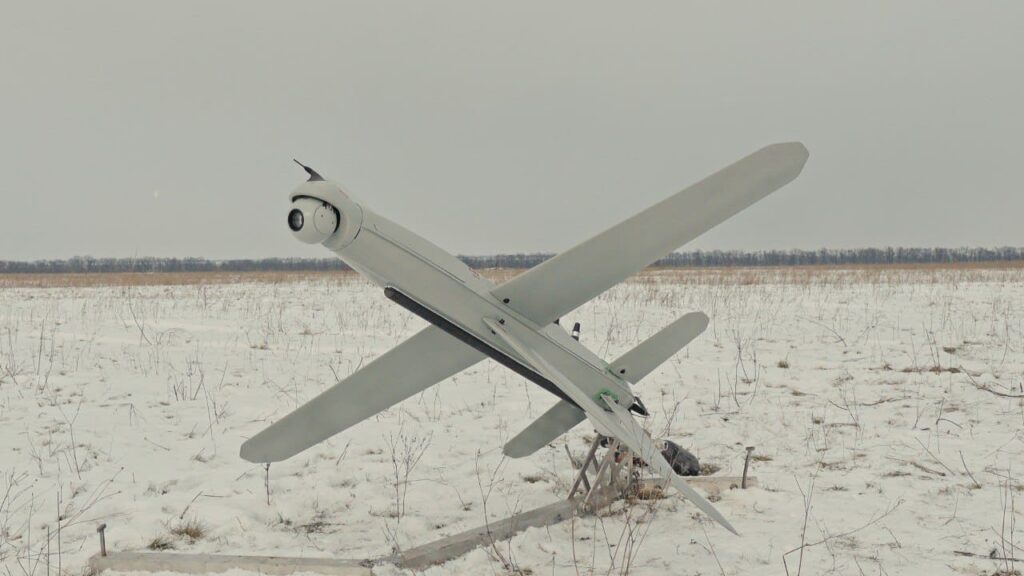
Ukraine is carrying out strikes on Russia's railways, the acting governor of Bryansk Oblast says. Yegor Kovalchuk claims that Ukrainian drones collapsed part of a bridge and derailed dozens of rail cars across the region, in a post on Telegram.

Bryansk is the main launchpad for Russia's drone and ballistic strikes on Kyiv and on the Chernihiv and Sumy oblasts, and its lines likely carry supplies that feed those attacks. For nearly a month, Russian jet-powered drones have been striking Kyiv from the region.

Kovalchuk reports damage in three districts but adds that no one was hurt in those drone attacks.

The launchpad's railways take hits

On the Dyatkovo–Lyudinovo line, a drone attack brought down part of a bridge and derailed 10 cars, Kovalchuk says. In the Unecha district, 18 empty gondola cars derailed. In the Navlia district, a strike damaged the track without stopping trains.

Repairs will begin, he notes, once the National Guard has inspected the sites.

Russia's campaign dwarfs it

Ukraine's strikes on Bryansk are modest beside what Russia is doing to Ukraine's railways. In the first eight months of 2026, Ukraine's state operator logged more than 1,600 attacks on its rolling stock and infrastructure, Oleh Holovashchenko of Ukrzaliznytsia tells DW.

Russia has damaged more than 500 locomotives since the invasion, over half of them this year, and has increasingly hunted moving trains to sever the corridors that carry Ukraine's exports and supplies.

A drone finds a train near Poland

The campaign even reaches Ukraine's western edge. On 13 September, a Russian jet Geran struck the locomotive of a passenger train at the Yahodyn crossing in Volyn, two kilometers from the Polish border.

A dispatcher spotted the drone in time to evacuate the passengers, among them former CIA director David Petraeus, and a diplomatic train carrying former British prime minister Boris Johnson had left early.

  •  

Ukraine outfoxes Russia near Donetsk’s fortress belt with Soviet BTR-60s rebuilt as kamikaze robots, storms a key hub and takes 250 Russian prisoners

The image shows Russian prisoners of war on the Lyman direction. Source: The 3rd Army Corps

Ukraine's 3rd Army Corps has defeated Russia at the key settlement of Nove in Donetsk Oblast by pointing it the wrong way. Russia has poured its reserves into counterattacks on a feint axis and "slept through" the real strike, which took the important hub in the village and closed the decisive third season of the Vivaldi offensive, commander Andrii Biletskyi said.

Vivaldi is Ukraine's counteroffensive aimed at disrupting Russian forces' plans to encircle the fortress-belt cities in Donetsk Oblast from the north and south. Among them are Sloviansk, Kramatorsk, Druzhkivka, and Kostiantynivka. These cities have helped hold back Russian forces since 2014.

Over its first two "seasons," the 3rd Army Corps and attached units have retaken more than 125 square kilometers, half of it de-occupied outright, and inflicted more than 3,000 casualties on Russian forces.

The operation in Nove was its "third season," Biletskyi said, the turning point of the whole operation. The corps liberated Nove, Ridkodub, and Katerynivka and restored control of Karpivka and Novomykhailivka, adding 51 square kilometers, bringing the total liberated since the offensive began to 176. Ukrainian forces have taken 250 Russians captive.

The feint drew Russia's reserves

The victory, by Biletskyi's account, was won by deception.

"The enemy was convinced the main direction of the strike was Shandryholove–Zelena Dolyna," he revealed, and it burned its reserves counterattacking there.

He added that the Russians slept through the real strike, which was concentrated on taking Nove. The village was the prize, a key Russian hub on the bridgehead, ringed by heights that command the surrounding ground.

"Who controls the heights holds the initiative," Biletskyi said.

By spending its reserves on the wrong axis, he suggested, Russia had little left to hold Nove when the real assault arrived.

Old APCs crack the defense

To break the strongest fortifications, the corps said, it used a homemade weapon: Soviet BTR-60 armored carriers converted into remote-controlled kamikaze robots, driven into Russia's toughest positions and detonated.

In 2024, the Ukrainian forces received another local upgrade of the post-Soviet BTR-60 wheeled armored personnel carrier. This time it was fitted with the BM-7 "Parus" turret, known from the BTR-4 "Bucephalus" The main armament consisted of a 30 mm ZTM-1 automatic cannon paired with a 7.62 mm KT-7.62 universal machine gun.

Additional armament might include a set of four anti-tank guided missile launchers mounted on the sides, or two launchers and a 30 mm KBA-117 automatic grenade launcher. As a result, this upgraded BTR-60 saw a significant improvement in firepower, although the vehicle still has very weak armor and less-than-optimal access to the troop compartment.

It was the latest of the corps' robotic improvisations in Vivaldi, which have included air-dropped ground drones and Bullspike grenade-launcher-armed UGVs. They are Bulgarian hand-held, rocket-propelled anti-tank grenade launchers based on the Soviet RPG-22, which the Bulgarian defense industry previously produced under license.

The corps has leaned on such machines throughout the operation to keep its infantry out of the deadliest fights.

Whole units surrender

As the defense broke down, Russians gave up in groups, including officers, pilots, and artillery soldiers, the corps said. The 3rd Assault Brigade carried much of the fighting, while the 3rd Border Guard Detachment, named for the fallen Colonel Yevhen Pikus, retook Ridkodub and dug in on the new line, with the 10th Mobile Border Guard Detachment "DOZOR" taking an active part in the assault.

  •  
❌