Vue lecture

July was Ukraine’s deadliest month for civilians since 2022 — and Russia is scaling its ballistic missile salvos toward 200 at once

Shahed R-60 missile decoy Flash

Russia can currently fire a simultaneous salvo of 77 ballistic missiles, and it aims to lift that ceiling to 200. Robert "Magyar" Brovdi, who commands Ukraine's Unmanned Systems Forces, told the Associated Press. He called the plan one of Ukraine's gravest weak points.

Kyiv's only reliable shield against ballistic missiles is the US-made Patriot, and its interceptor stocks are critically low. During mass barrages, dozens of warheads therefore slip through and reach their targets. Only a handful of countries can build such interceptors, and all are short, defense analysts have warned. The AP, for its part, could not independently verify Brovdi's numbers.

Ballistic missiles remain the hardest to stop

That shortfall has already turned lethal. Intensified strikes made July the deadliest month for Ukrainian civilians since April 2022, the UN human-rights office in Ukraine documented. Air defenses downed just 29 of the 195 ballistic missiles Russia fired that month, roughly 15%. Another 40 fell short on their own. Yet the largest single-night launches recorded so far run to only a few dozen. That is well below the salvo of 77 that Brovdi describes, and a fraction of the 200 Moscow is reaching for.

"Even if they only manage half of that, it will all be flying at us."
- Robert "Magyar" Brovdi, commander, Ukraine's Unmanned Systems Forces

Production running ahead of plan

His warning tracks Ukrainian intelligence. Russia's defense industry is overfulfilling its monthly targets, hitting 110% to 120% on the main missile types. So said Deputy Military Intelligence Chief Vadym Skibitskyi in an interview with RBC-Ukraine. He put July output for the Kh-101 cruise missile at 140% of plan, the Kalibr at 111%, and the Kh-35 at 200%. A pause in strikes, he judged, is unlikely.

The pivot to jet-powered drones

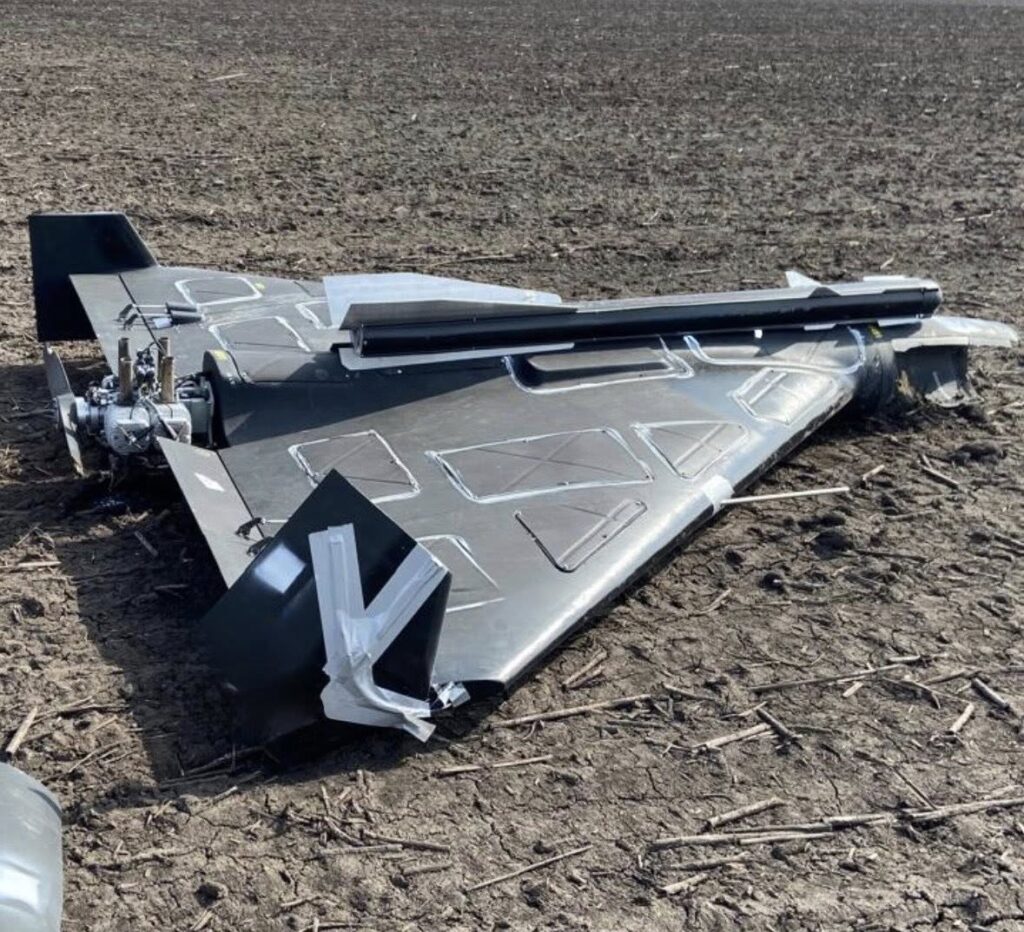
Moscow's factories are also retooling around drones. Russia plans to assemble 11,000 strike drones of various types in August 2026, Skibitskyi said. That mix spans the Geran-1 through Geran-5, the Harpia, and several Gerbera variants. Output dipped in July as the industry shifted toward the turbojet Geran-4 and Geran-5.

Those jet models fly faster and demand different interceptors or short-range air defense. They already made up half of one recent attack. The concentration of jet-powered Shaheds, meanwhile, has climbed 2.5 times in recent weeks, Brovdi added. Taken together, the assessments point one way: more missiles and faster drones, launched in larger waves, against defenses Ukraine is scrambling to rebuild.

  •  

Ukraine’s Crimea campaign could strike seven times more targets with faster funding, Brovdi says

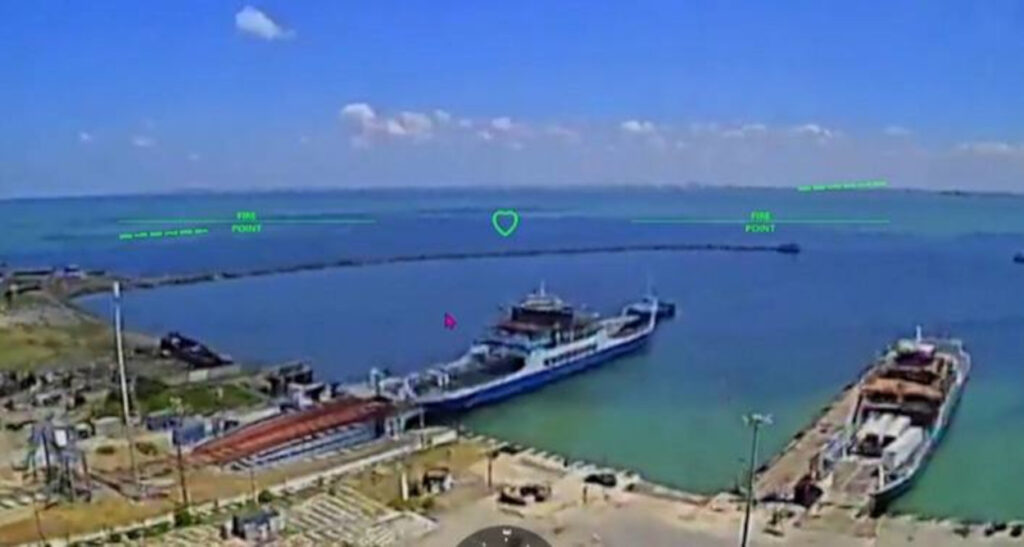
A photo shared by Robert “Madyar” Brovdi shows the Russian ferry “Maria” before it was struck in Ukrainian drone operations, with the damaged “Panagia” ferry visible to the right. Photo: Robert "Madyar" Brovdi

Ukraine's Crimea campaign aims to make the occupied peninsula unusable to Russian forces, its drone-forces commander told The Associated Press. Russia annexed Crimea in 2014. The campaign is only the first phase, said Maj. Robert "Madyar" Brovdi. His units could strike seven times more military targets with faster Western funding, he said.

The constraint is financing, not factory output. Brovdi put his forces at 14 percent of the strength a full-capacity operation would require. He traced the gap to the timing of allied money, not to Ukraine's drone production. "It's not that the production capacity of Ukrainian manufacturers doesn't allow us to make the necessary quantities" of drones, he said. He added: "It's the banal problem of untimely financing, which our partners do allocate, but which moves significantly slower than our plans."

Even so, Brovdi framed the peninsula as decisive. "Crimea falls within the key conceptual pillars on the path to ending the war," he said.

What the Crimea campaign has hit

The summer strikes have hit rail bridges, oil depots, and power infrastructure. These aim to cut supply lines and blind Russian air defenses as drones approach. To pry open a "window" for those drones, the force destroyed more than 300 air defense assets in recent months. Those included surface-to-air systems, radar stations, and electronic-warfare equipment.

Where Starlink connectivity reaches, an average of three drones can now destroy even a heavily defended target, Brovdi said. In turn, his crews match the munitions to each aim. One mix suits a bridge pier; another fits a fuel truck or a moving train. Even so, his forces avoid civilian infrastructure, he added. Still, strikes on the power grid have cut electricity for residents. Brovdi said he has twice publicly apologized to Ukrainians living in Crimea.

He also pointed to one measure of progress. Across four recent large-scale Russian barrages from the peninsula, launch sites fired only five missiles in total. He credited that drop, however, to the destruction of Russian air defenses. The AP could not independently verify the claim.

Forcing Russia off the peninsula

Much of Russia's Soviet-era air defense runs on the power grid. That is one reason Crimea's electricity network keeps drawing fire. As a result, losing power leaves Russian soldiers "blind," Brovdi said, with only machine guns and rifles.

Meanwhile, Ukraine is working to dismantle Crimea's role as a naval base. "Creating conditions that make it impossible for any kind of military capability … to remain there will make Crimea uninteresting … as a military staging ground," he said.

The offensive began in late June. Two weeks in, Ukrainian intelligence indicated Russia had ordered its military commands and security services off the peninsula, Brovdi said. In addition, a covert order called for removing secret archives and artworks. The AP could not independently verify the account.

Russian countermeasures and the missile threat

Russia is pushing back against the Crimea campaign. It is installing jamming systems that will degrade Starlink to some degree, Brovdi said. Russia is also building its own satellite network to rival the service. "This is a risk for the entire planet," he said, "because a dictatorship will gain access to information across the whole globe."

Other threats are mounting as well. Jet-powered Shahed drones are harder for Ukraine to shoot down. Their concentration has risen two and a half times in recent weeks, he said. Moreover, Russia can now fire a simultaneous salvo of 77 ballistic missiles and plans to raise that to 200. As a result, the danger is pressing. Ukraine is short of interceptors for the US-made Patriot, its only defense against ballistic missiles.

"Even if they only manage half of that, it will all be flying at us," Brovdi said. The only way to bring the number down is to hit every facility that builds the missiles, he added. That, he said, is why Ukraine's long-range strikes inside Russia matter.

Wildberries in the crosshairs

One civilian-facing target Brovdi named was Wildberries, Russia's largest online marketplace. Many call it the country's answer to Amazon. "Wildberries is, first of all, a supply platform—it's the war's quartermaster," he said. The company also runs a dedicated section selling goods for Russia's military, he noted.

For now, these strikes aim to make ordinary Russians feel the war directly. He declined to give a timeline. Instead, the strikes will continue "until it becomes impossible for it to recover quickly," he said.

Finally, he cast the retailer as a pressure point on morale. "Ultimately, Wildberries is, forgive the expression, a consumer gambling addiction," he said, comparing lost access to restrictions on social media. "It turned out to be a sensitive sensor of the comfort of Russia's massive population—people who consider themselves completely untouched by the actions of the aggressor country."

  •  

Russia’s advance in Ukraine slows as casualties per square kilometer rise 3.5-fold, Radio Svoboda reports

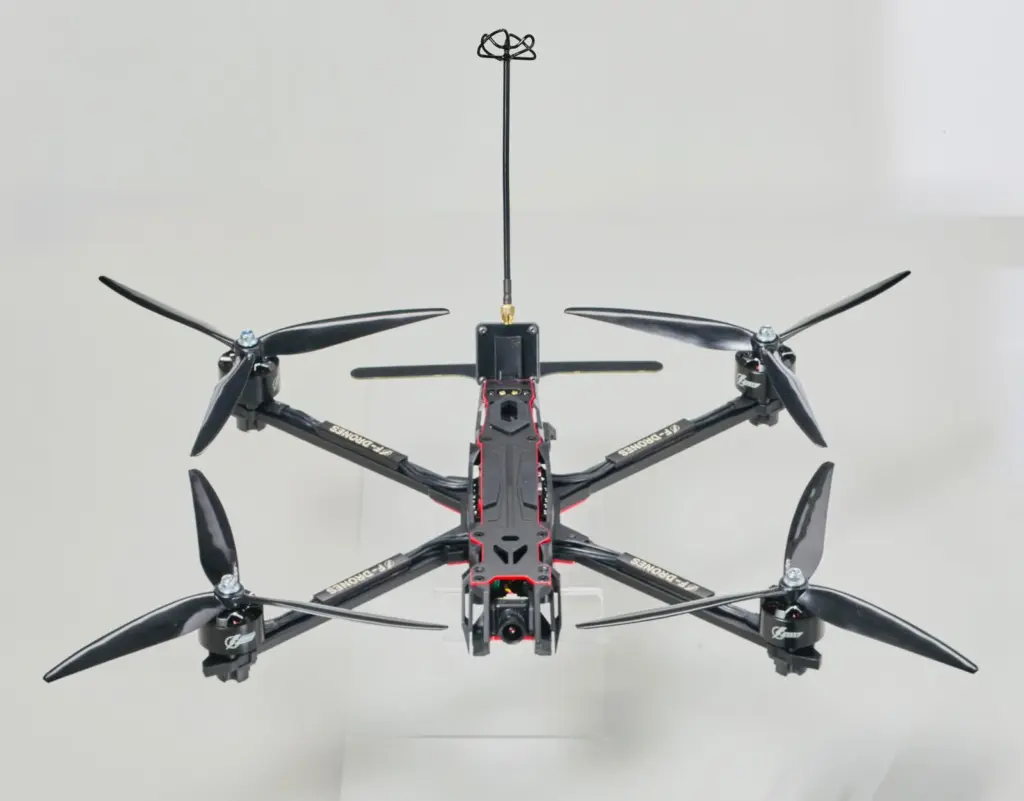
F-10 strike drone.

The pace at which Russian forces are occupying Ukrainian territory has fallen sharply since the start of 2026, while the scale of Russian losses has not, Radio Svoboda's Russian Service reports, citing data from the Ukrainian project DeepState, which tracks the front line.

DeepState's figures show Russia seized 450 to 550 square kilometers a month at the 2025 peak. The rate then declined steadily from December 2025 through July 2026: 445 square kilometers in December, 160 in April, and 27 in July. A comparable Russian project, Slivochny Kapriz, which by contrast credits the Russian army with any area where its personnel have been spotted—even without confirmed control—recorded a similar slowdown, from 550–600 square kilometers a month last year to 112 in June.

A shrinking prize in northern Donbas

At the end of last year, roughly 5,000 square kilometers remained under Ukrainian control in northern Donbas, including three "fortress" cities larger than Pokrovsk: Kostiantynivka, Kramatorsk, and Sloviansk. Even using Slivochny Kapriz's more generous estimate of the current pace, capturing that territory would take a year and a half.

Losses hold steady as gains shrink

Despite the slowdown, Ukrainian military estimates of Russian losses have not fallen and remain at roughly the level recorded in the second half of 2025. Both Ukraine's General Staff and its Ministry of Defense now publish official loss estimates. According to the General Staff, Russia lost nearly 164,000 people from February through June 2026—five months—an average of 32,800 a month. The Ministry of Defense's verified count for the same period was 157,000 killed and wounded, or 31,500 a month on average. The General Staff puts Russia's total losses since the start of the full-scale invasion at 1.4 million, a figure that includes killed, missing, wounded, and other losses, not only irrecoverable ones.

Western officials have offered comparable figures. UK intelligence chief Anne Keast-Butler said in May 2026 that the Russian army had lost 500,000 servicemen killed alone; at a ratio of two to three wounded per fatality, that implies total Russian losses of 1.5 to 2 million, according to British intelligence. US Secretary of State Marco Rubio estimated Russian losses at 7,000 soldiers a week roughly six months ago, a figure that broadly matches Ukrainian military estimates.

The cost of a square kilometer has tripled

The American Institute for the Study of War calculated in 2024 that Russia lost 125,800 people while capturing 2,356 square kilometers between September and November—53 losses per square kilometer. Radio Svoboda's own calculations, based on General Staff and DeepState data, put the 2025 figure at 85 losses per square kilometer. By the latest 2026 estimates, that figure has risen to 290—3.5 times the 2025 rate.

Drones make breakthroughs impossible, officials say

The slowdown is now widely attributed to Ukraine's growing advantage in drone warfare. CIA Director John Ratcliffe, citing US intelligence, said the average lifespan of a Russian recruit arriving at the front in Ukraine is 20 to 30 minutes. He said the Russian advance has slowed because Ukraine has made major gains in the use of drones and asymmetric warfare methods that are leveling the battlefield: "AI drones have become specialized and inexpensive killing machines."

Current Time, the Russian-language network run by Radio Svoboda, reports that the slow pace of both armies' advances today stems from the specific nature of this war: drones have made rapid breakthroughs impossible.

A Ukrainian drone operator, whose name Radio Svoboda withheld for security reasons, said the decline in the Russian advance stems from a collapse in the training level of Russian troops: "He's worse than he was a year ago. Actually, he's simply not there. They grabbed men from the garage, gave them a rifle, and said: 'Run!'"

The operator said Russian commanders now resort to any means necessary to force some forward movement: "In Kostiantynivka, they now drop supplies for the [infiltrated] soldiers a block away from where they're sitting, just so there's some kind of advance. It's absurd, but unfortunately, that's the reality." That tactic helps Russian forces advance, he said, but at a catastrophic cost: only one soldier in 15 survives.

Russian infiltration groups of two to six fighters cover 15 to 20 kilometers on foot to reach positions, carrying "everything that will help them survive," which makes them, in the operator's words, "the easiest possible target for us." He acknowledged that some Russian soldiers still slip through: "Recently, while we were destroying Russian equipment near one settlement, we missed some motorcyclists who are now hiding somewhere in the tree lines." Stopping the Russian advance entirely, he said, is simply not possible: "We're constantly adjusting our tactics, but so are they—though technology helps us, while for them, as usual, everything is done with an axe."

Kremlin prepares for a new mobilization wave

President Volodymyr Zelenskyy said recently that Russian leader Vladimir Putin is preparing to announce a new mobilization wave after Russia's State Duma elections in September, aiming to recruit 300,000 to 500,000 people. The Kremlin denies planning a mobilization, but the Institute for the Study of War says Russian authorities are taking steps consistent with preparations for a large-scale draft.

Analysts point to a law Putin signed in November 2025 allowing reservists to be sent into combat zones without a formal mobilization declaration. On 22 July, the State Duma passed in three readings a law expanding the pool of people with criminal records or under investigation who may sign military service contracts during mobilization and martial law. The day before, a draft amendment was published under which Russia's National Guard would revise its civil defense rules to explicitly reference mobilization and martial law, requiring advance protective measures for its employees, civilian staff, and their families "from dangers arising during mobilization, during martial law, in wartime," according to Meduza.

The Ukrainian drone operator said mobilization could increase the pace of the Russian advance: "You can't keep track of everyone."

  •  

ISW: Russia strikes the Mayaki bridge linking southern Ukraine to Romania and Moldova

ISW

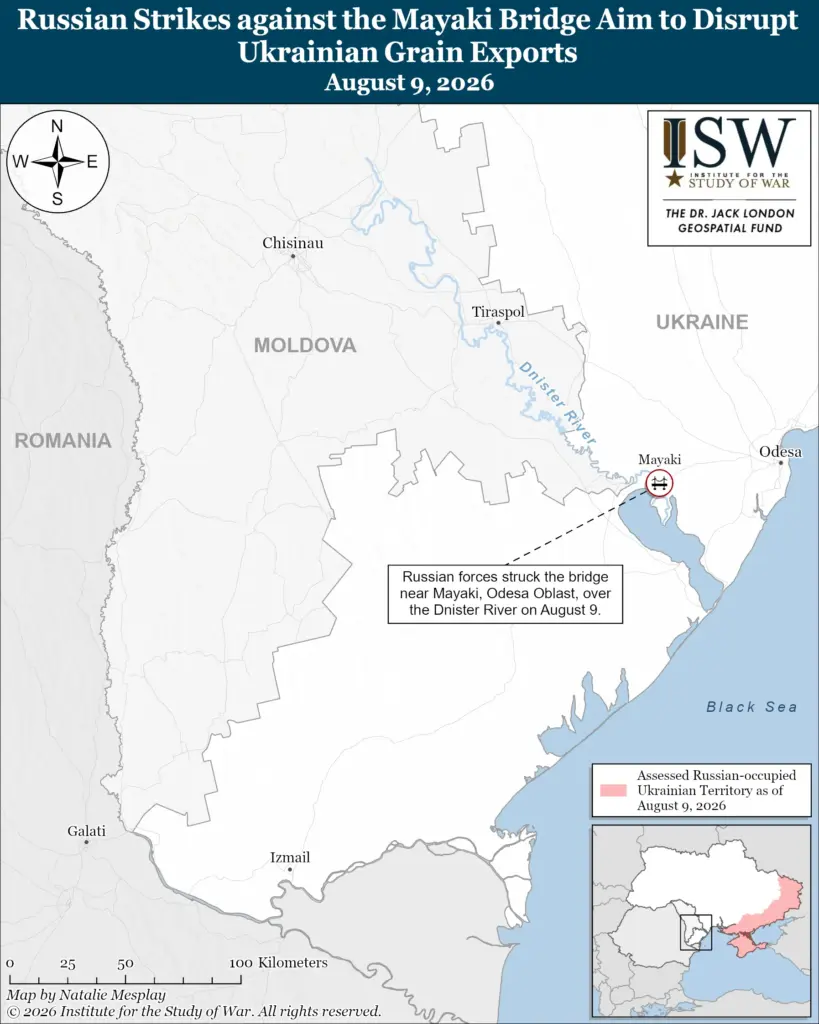
Russian forces struck the Mayaki bridge on the M-15 highway on 9 August, the Institute for the Study of War reported. The strike severed a road link that ties southern Ukraine to Moldova and Romania. That Odesa–Reni route crosses the Dniester and feeds the Danube ports. Those ports have become Kyiv's main export outlet since Russian strikes crippled its Black Sea shipping.

Conflicting claims over the Mayaki bridge

Russian milbloggers reported the attack, though their accounts diverged sharply. One claimed that Russian forces had destroyed the span. Others published footage purporting to show that it still stands. A local outlet serving nearby Izmail reported on 9 August that the strike damaged the crossing. Ukraine's State Border Guard Service separately confirmed that authorities briefly restricted traffic on the route. Moscow had already targeted the same structure in December 2025.

Why the land corridor matters

Russia likely hit the Mayaki bridge to choke Ukrainian grain exports, ISW assessed. Those exports now move through a land corridor that Kyiv has leaned on since strikes disrupted its maritime routes. Moscow has steadily intensified this campaign since July 2026. Navy Spokesperson Captain Third Rank Dmytro Pletenchuk offered one measure on 31 July. He said Russian strikes had damaged more than 20 ships near the Black Sea and sharply slowed cargo flows. Meanwhile, the country's main farmers union weighed in on 15 July. The Ukrainian Agri Council estimated that Russian attacks had cut about a third of Ukraine's grain-export capacity.

Minister of Agrarian Policy and Food Taras Vysotskyi has described the fallout. He said the strikes are forcing Kyiv to reroute grain and cargo through the Danube River. Russia used the same playbook in July 2023. Back then, then-Minister Mykola Solskyi reported that strikes destroyed 60,000 tons of grain at Chornomorsk port overnight on 19 July. Therefore, ISW concluded, Russia is likely shifting its strikes from the sea corridor to the land corridor. The aim, analysts wrote, is to block grain exports and weaken Ukraine's wider economy.

Russian forces are likely shifting their strikes from Ukraine's sea corridor to its land corridor to block grain exports and degrade the economy. — Institute for the Study of War

Türkiye floats a Black Sea moratorium

Turkish Foreign Minister Hakan Fidan raised a separate track on 9 August. He said Ankara had proposed a Russian–Ukrainian moratorium on strikes against merchant ships in the Black Sea. Both Moscow and Kyiv have received the offer, Fidan added, and Türkiye now awaits their response.

  •  

Zaluzhnyi, Fedorov, and Budanov lead Ukraine’s trust ranking as Zelenskyy places fourth – KIIS

Zelenskyy Fedorov

Ukrainians place the most trust in Valerii Zaluzhnyi, Ukraine's ambassador to the United Kingdom and former commander-in-chief of the Armed Forces, according to a nationwide survey the Kyiv International Institute of Sociology (KIIS) conducted between 16 and 31 July. Some 66% of respondents said they trust him, against 24% who do not—a net balance of +42%.

Close behind sits Mykhailo Fedorov, the former defense minister who previously led the Ministry of Digital Transformation and launched the Diia app. Pollsters recorded 63% trust and 16% distrust for him, producing the strongest net balance in the survey at +46%.

Kyrylo Budanov, head of the President's Office and former chief of Ukraine's Defence Intelligence, rounded out the top three. He drew 61% trust and 22% distrust, for a balance of +39%.

Zelenskyy ranks fourth

President Volodymyr Zelenskyy followed the three military and government figures, trusted by 56% of respondents and distrusted by 38%, for a net balance of +18%. At the opposite end of the ten-name list, former president Petro Poroshenko drew the weakest result—20% trust against 76% distrust, a balance of −56%.

The institute also flagged a rise in confidence in Fedorov as the standout shift since its May 2026 telephone survey, the only change it called significant.

Firm trust versus tentative trust

Sociologists further split the responses into "completely" and "rather" trust. Across the leading figures, roughly half—or fewer—of those expressing trust chose the softer "rather" option rather than "completely," the institute noted, a distinction it argued carries political weight.

Those who "completely" trust Zelenskyy mostly want to see him as president after the war—while those who "rather" trust him mostly want someone else.
— Kyiv International Institute of Sociology

KIIS interviewed 1,808 respondents using a mixed-mode design, splitting the sample evenly between computer-assisted telephone interviews and face-to-face tablet interviews on territory controlled by Ukraine.

  •  

Zelenskyy says Russia could receive up to 50,000 North Korean troops

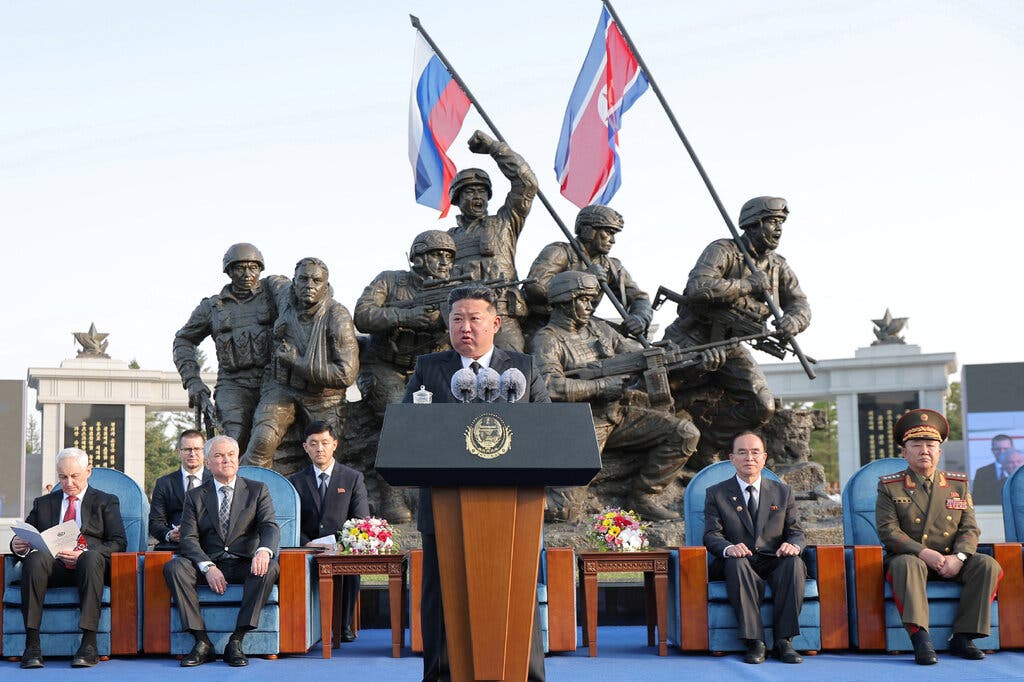
russia can't fill its own ranks—so asks north korea 30000 more soldiers new missile launchers ukraine says · post korean leader kim jong-un speaks opening memorial pyongyang russia's defense minister

Russia has decided to bring between 30,000 and 50,000 North Korean troops onto its territory, up from initial deployments of hundreds and then thousands, Ukrainian President Volodymyr Zelenskyy said in an interview with the "Yedyni Novyny" telemaraphon on 8 August.

The figure marks a sharp rise from what Zelenskyy gave two weeks earlier. In a 25 July address, he said Russia wanted 30,000 additional North Korean troops and that preparations to receive them had been underway in Russia's Voronezh region since June.

Rising troop estimates

"North Koreans appear on the territory of the Russian Federation from time to time. We see this, we know this," Zelenskyy said, adding that Russia had now made "a decision for 30,000 to 50,000 North Koreans to be on the territory of Russia." He said North Korea "will build up experience of modern warfare" and would receive licenses from Russia.

Russia and North Korea have not announced plans to expand their cooperation, Radio Svoboda reported.

Missile deployment already underway

Ukrainian authorities said Russian forces used a North Korean missile for the first time in a long period last week, striking Radushne, near Kryvyi Rih.

A North Korean missile unit has begun deploying in western Russia and may be equipped with 120 ballistic missiles and six launchers for strikes on Ukraine, Reuters reported on 5 August, citing Andrii Cherniak, a spokesperson for Ukraine's Defense Intelligence directorate (HUR). Pyongyang has already sent a new batch of 40 KN-23 and KN-24 missiles along with personnel, Cherniak said, though the final deployment configuration and total missile count are to be settled at high-level talks next month.

Foreign Minister Andrii Sybiha separately said North Korean missile launchers would "immediately become a legitimate target" if deployed in Russia, Radio Svoboda reported.

Kyiv seeks South Korean support

Zelenskyy argued the deployments carry risks beyond Ukraine. "They are studying this war," he said, warning that North Korea could apply lessons learned to future "crises and escalation" in the Pacific that would threaten "other states in the Asian direction."

He said Ukraine wants closer cooperation with South Korea, "primarily" on air defense systems, and said Kyiv is ready to work with Seoul on drone technology as well. Zelenskyy acknowledged that South Korea faces "a legal restriction under the Constitution" on such cooperation but said Ukrainian diplomats remain in contact with South Korean counterparts, as well as with Japan, over the Russia–North Korea partnership.

Military alliance since 2024

Russia and North Korea signed a comprehensive strategic partnership treaty in 2024, cementing a military alliance between the two countries.

Zelenskyy confirmed on 14 December that North Korean soldiers were fighting alongside Russian forces in Kursk Oblast, and Ukrainian intelligence reported that North Korean troops had been placed on high alert the following day. Ukraine's Special Operations Forces (SSO) captured North Korea's first documented prisoner of war in the war on 26 December, Militarnyi reported. The SSO described the raid as an operation "to destroy the enemy in the Kursk sector," in which its forces also seized a Russian BTR-82 armored personnel carrier along with weapons and documents. That prisoner died of his wounds, South Korea's National Intelligence Service confirmed on 27 December.

On 11 January 2025, Zelenskyy announced that Ukrainian forces had captured two more North Korean soldiers, also wounded, in Kursk Oblast; both survived and were taken to Kyiv, where they were questioned by the Security Service of Ukraine (SBU). Ukraine's Defense Intelligence directorate had previously reported that the first North Korean units arrived in the war zone on 23 October 2024.

South Korea's intelligence agency confirmed the capture on 12 January and pledged cooperation with Ukraine. Two days later, Foreign Ministry spokesperson Lee Jae-woong said Seoul was open to discussing relocating the two men, citing a constitutional provision under which North Koreans are considered South Korean nationals, Yonhap reported. At the time, neither soldier had expressed an intention to defect.

In late February 2025, the two soldiers — identified by the Wall Street Journal as Ri, 26, and Paek — gave the first Western interviews of North Korean troops captured in the war, published 27 February. They said they had been told they would be fighting South Korean forces, not Ukraine, and that they were not paid for their service. Paek was shot and lay wounded for five days before capture, later having several toes amputated due to gangrene; Ri was shot in the arm and jaw. South Korea's Foreign Ministry confirmed on 19 February that it would accept North Korean POWs who sought asylum, saying "they should not be sent against their will to a place where there's a threat of persecution."

By late February 2025, Zelenskyy said around 4,000 North Korean soldiers had been killed or wounded fighting for Russia; North Korea's overall troop commitment was estimated at roughly 11,000–12,000 by early 2025. Losses continued to mount — by January 2026, Ukraine put North Korean dead in Kursk Oblast at 6,000, where the contingent remained stationed and continued carrying out strikes on Ukrainian border communities. Ukrainian soldiers have described North Korean troops as reluctant to surrender, with some reportedly attempting suicide rather than be captured.

  •  

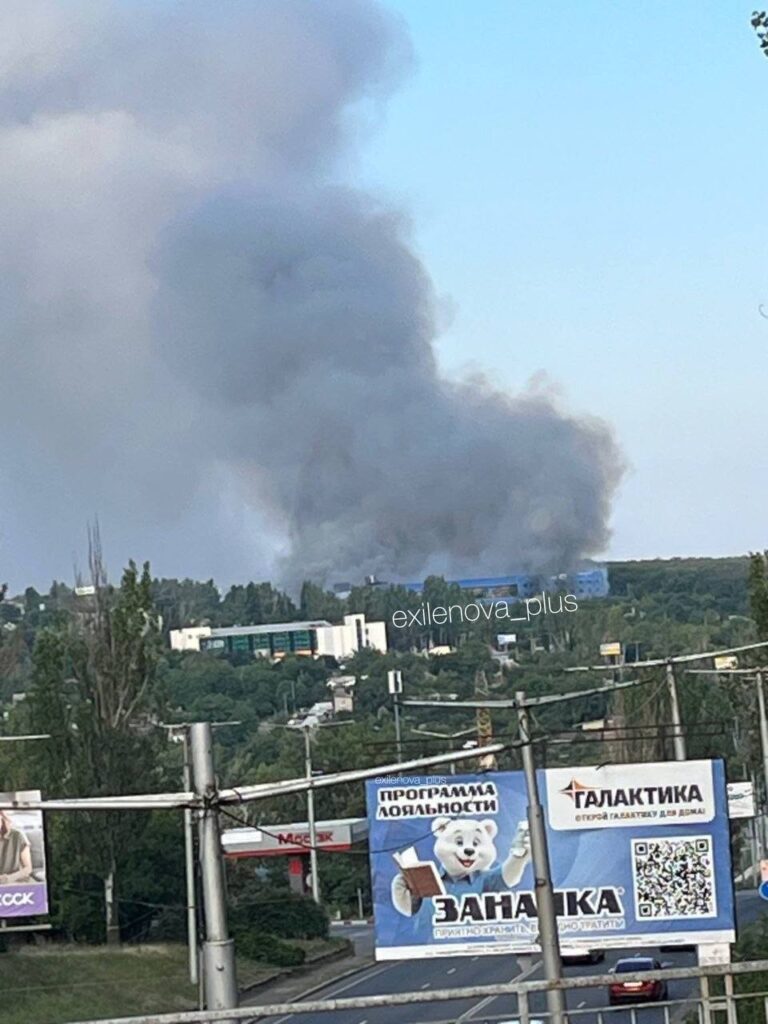
Drones strike Russian oblasts overnight: thick smoke over a Nizhnekamsk refinery as Crimea’s Krasnoperekopsk industrial zone burns

makiivka

Drones struck several Russian oblasts overnight into 10 August. A probable strike hit a Nizhnekamsk refinery in the Republic of Tatarstan, while fires spread across occupied Crimea. Local Telegram channels and Ukrainian monitoring groups reported the attacks. Kyiv has not claimed them, and the damage stays unverified.

Thick smoke over the Nizhnekamsk refinery cluster

Residents of Nizhnekamsk reported explosions on the morning of 10 August. Footage online showed drones crossing the city, with dense black smoke above one district, local channels said. Which Nizhnekamsk refinery took the hit stayed unclear. The city hosts two major plants — the TAIF-NK and TANECO complexes.

TAIF-NK processes 7.3 million tons of crude and 1 million tons of gas condensate a year. Its 49 products include AI-92 and AI-95 gasoline, diesel, and jet fuel. TANECO belongs to the Tatneft group. It ranks among Russia's largest and most advanced refineries. Its design capacity exceeds 16 million tons of crude a year.

Ukraine's Defense Forces struck both TANECO and TAIF-NK on 12 June, the General Staff confirmed. Ukrainian units hit the same cluster again in July.

Fires flare in occupied Crimea's Krasnoperekopsk

Explosions rocked Krasnoperekopsk — known in Ukrainian as Yany Kapu — overnight. Numerous fires burned by morning, the monitoring channel Crimean Wind reported. Around 7 blasts sounded between 2 and 3 a.m. Subscribers described a fire behind the railway station in the industrial area.

By the morning of 10 August, NASA's FIRMS satellite system flagged multiple heat signatures there, Crimean Wind said. The hotspots clustered in the town's southern industrial zone. Russian forces store and repair equipment in the area, the channel added.

Drones also crossed Sevastopol. Residents heard aircraft and gunfire near the Balaklava thermal power plant. The Russian-installed governor, Mikhail Razvozhaev, claimed 15 drones fell, mostly over the sea. He admitted, though, that falling debris ignited a forest fire near Inzhir beach and forced a campsite evacuation. A blast in Simferopol briefly cut power around 4 am before supply returned.

Moscow and Rostov cite downed drones

In the capital, Mayor Sergei Sobyanin said air defenses downed 13 drones approaching Moscow overnight. He gave no details on any consequences. Over Rostov Oblast, Governor Yuri Slyusar said more than 70 drones destroyed. Information on casualties and damage was still coming in, he said.

Both counts reflect Russian air-defense claims rather than independently confirmed strikes.

Overnight, Russia's aviation authority Rosaviatsia restricted takeoffs and landings at Begishevo airport in Nizhnekamsk. The curbs also covered 14 other airports, among them Kazan, Ufa, Samara, and Moscow's Domodedovo and Vnukovo.

  •  
❌