Le nouveau pont, qui relie Windsor, en Ontario, à Détroit, au Michigan, doit ouvrir le 27 juillet.
Le gouvernement américain a récemment posé des exigences financières.
Après négociation, le Canada, qui a entièrement payé la construction, partagera pendant 15 ans avec les États-Unis le profit net d’exploitation du pont à péage.
Mark Carney a précisé à CTV News que ce profit serait calculé après déduction de la dette pour la construction, et serait donc minime.
Or, selon l’interprétation de Washington rapportée par l’agence Bloomberg, ni les intérêts de la dette ni l’amortissement ne seraient déduits du profit partagé.
Deux athlètes du Club d’escrime Les Pirates de l’Est, Céline Guillemart et Misha Blanchet ont pris part au Critérium Mondial des Vétérans qui se tenait à Paris, du 4 au 6 juillet.
Guillemart s’est classée en 5e position à l’épée après avoir été en deuxième place après la ronde de classement. Elle a terminé à seulement une touche du podium.
De son côté, Blanchet a défendu sa place dans plusieurs beaux combats. Selon le Club d’escrime, il s’agit pour lui d’une expérience de plus pour lui qui marque une progression continuelle et ce périple à l’international des deux escrimeurs de la région permet de faire rayonner les Pirates.
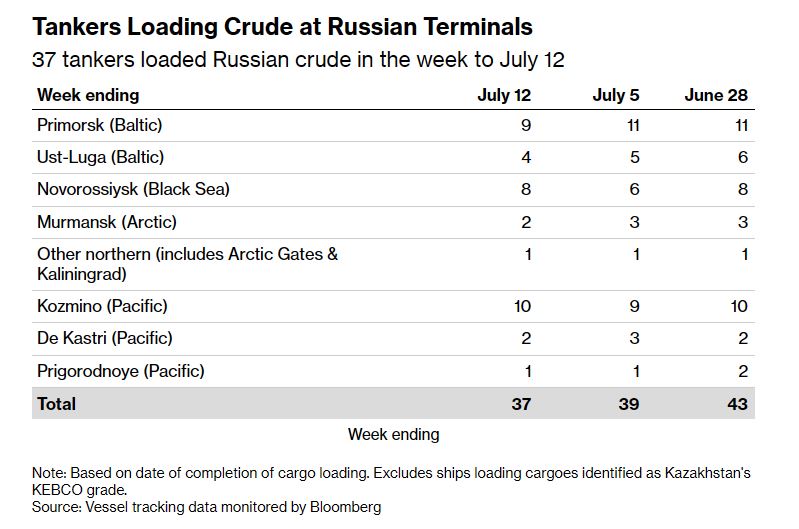
Ukraine's strikes on Russian refineries are pushing Moscow to export crude it can no longer process at home, Bloomberg reported. Buyers are not taking it fast enough, so Russian oil is piling up on tankers at sea. The value of those exports keeps sliding, and tanker loadings dipped in the week to 12 July.
Sanctions were supposed to choke the money, yet Russia keeps its crude moving on a sprawling fleet of tankers bound for Asia — the very chain Kyiv now works to break. The near-term damage is to price, not volume, but cheaper barrels, slower sales, and a fresh US sanctions push could deepen the squeeze on the revenue that pays for the war.
Ukraine's refinery strikes are forcing crude onto the water
Ukraine has stepped up its strikes on Russia's refineries. Yesterday, it hit the Gazprom Neftekhim Salavat plant far inside Russia, and the Afipsky facility near the Black Sea. The wave of attacks has driven Russian refining runs to their lowest in more than 21 years this month. That deepens a domestic fuel crunch and squeezes the global market. With less crude to process at home, Moscow is likely diverting more into exports as its own production falls. Russia pumped 8.93 million barrels a day in June — about 830,000 below the level it promised the OPEC+ producer group.
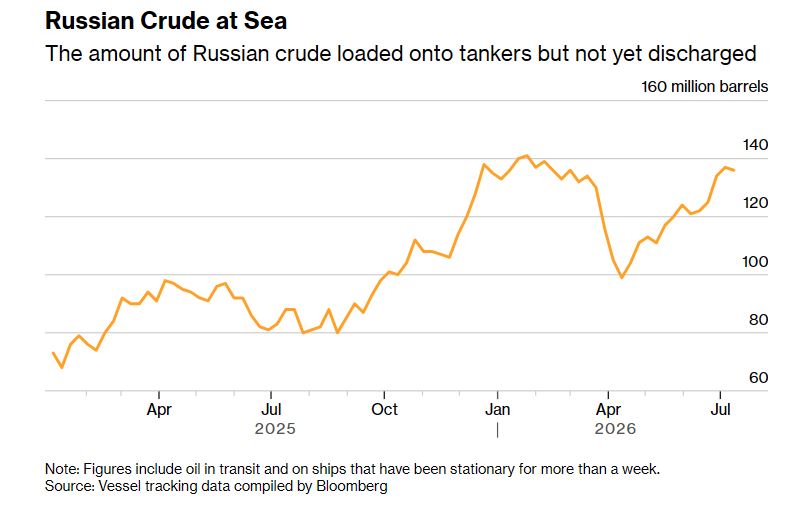
Soaring exports are not being matched by deliveries. So Russian crude is stacking up on tankers, loaded but not yet discharged, Bloomberg wrote. The total has climbed back near its start-of-2026 highs — about 135 million barrels by Sunday.
Russian crude loaded onto tankers but not yet discharged, 2025–2026. Chart: Bloomberg vessel-tracking data
Cargoes are building up near Egypt in the Mediterranean and east of Singapore. Five Urals tankers are anchored off Egypt, and another five have halted near Singapore, a gathering point for shadow-fleet ships hauling sanctioned oil. A growing share of the oil at sea is on vessels that seem to be sitting idle rather than sailing.
Tankers loading crude at Russian terminals by port, for the weeks ending 12 July, 5 July, and 28 June 2026. Chart: Bloomberg vessel-tracking data
Fewer tankers, and less money for the same oil
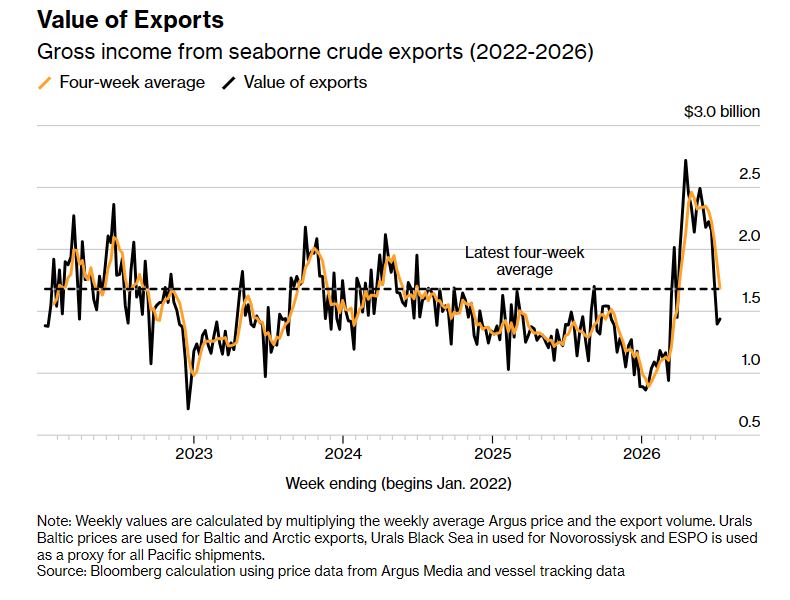
Russia shipped 3.98 million barrels of crude a day in the week to 12 July, down from 4.08 million. Year-to-date volumes remain above every annual average since 2022, yet the four-week export value fell $200 million to $1.68 billion a week. Urals prices have nearly halved since mid-April.
Gross weekly income from Russia's seaborne crude exports, 2022–2026, with the latest four-week average. Chart: Bloomberg calculation using Argus Media price data and vessel-tracking data
Russia sent 4 million barrels of oil a day toward Asia. Only about half was openly bound for India and China, while 1.9 million barrels a day remained undeclared, likely until tankers crossed the Arabian Sea. Türkiye took 160,000 barrels a day, and Syria 40,000.
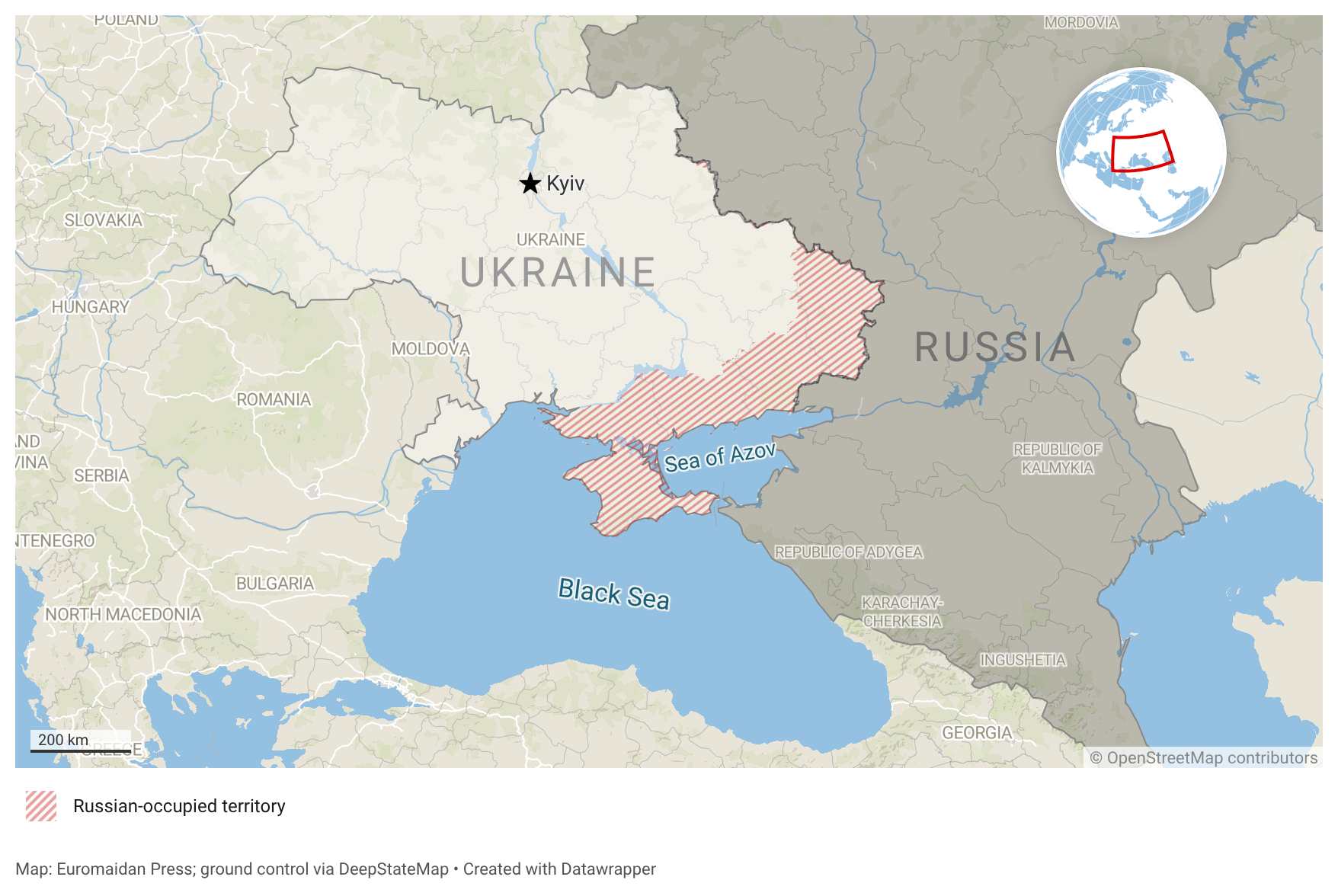
Ukraine's aerial attack drones opened a new front against Russia's sanctions-dodging shadow fleet, striking 20 vessels in the Black Sea in a single night, the Unmanned Systems Forces (SBS) reported. The raid launched the Black Sea phase of a campaign that had until now played out in the Sea of Azov, and it pushed the 10-day tally well past a hundred ships.
Oil is Russia's war chest, and through 2026, Ukraine has turned cheap drones into a blockade of that revenue at both ends — the tankers that move the oil and the refineries that turn it into cash. Extending the hunt from the shallow Azov feeder run to the deep-water Black Sea export anchorages widens the pressure on one of Moscow's biggest export earners and tightens the drone ring around occupied Crimea's fuel supply.
The Black Sea cluster opens
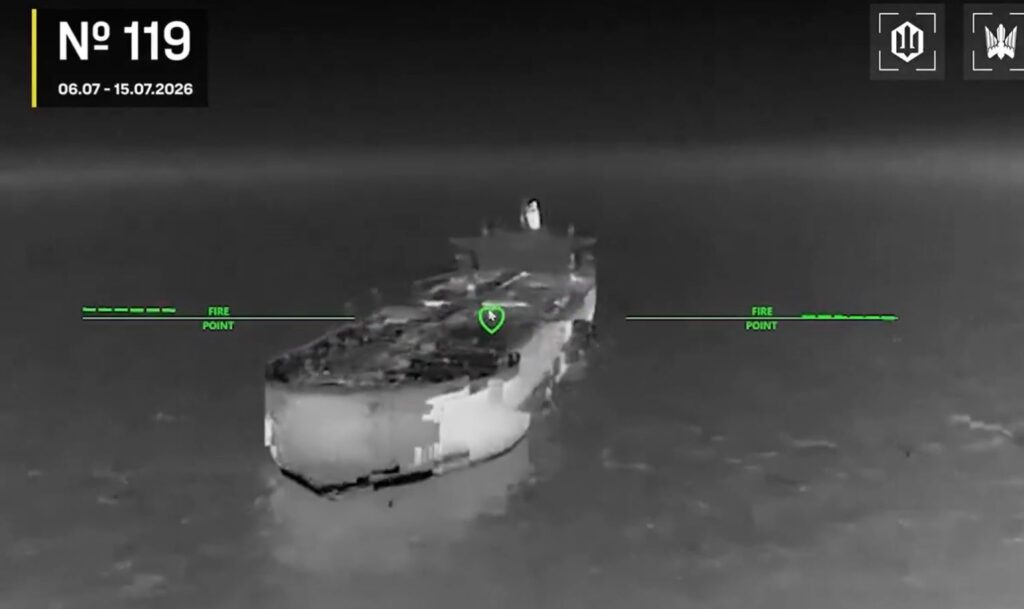
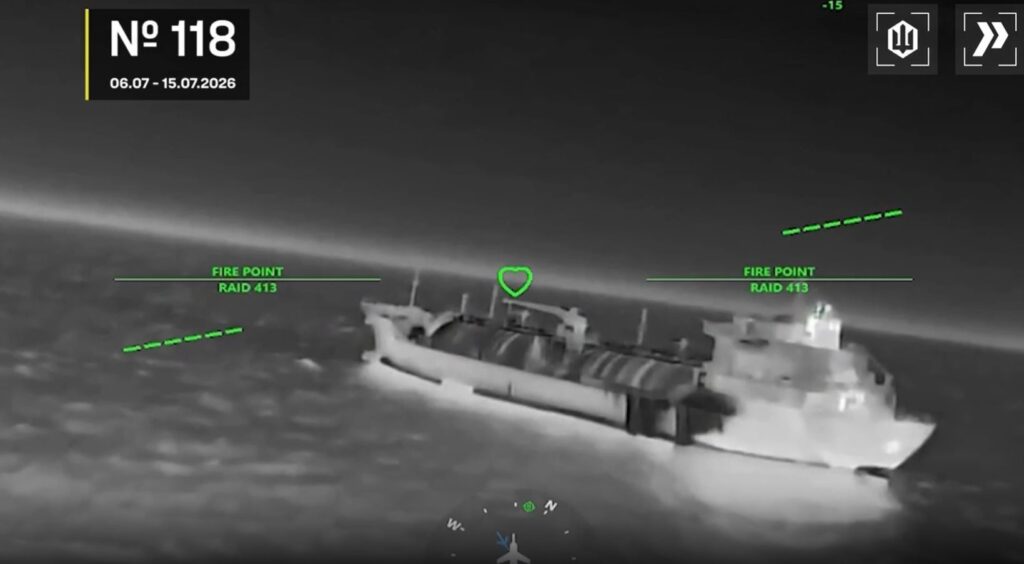
Overnight on 15 July, SBS operators struck 17 oil tankers, two gas carriers, and one tug in Black Sea waters. Six drone units ran the raid together: the 9th "Kairos" Battalion of the 414th "Magyar's Birds" Brigade, the 1st Separate Center, the 20th "K-2" Brigade, the 412th "Nemesis" Brigade, the 427th "Rarog" Brigade, and the 413th "Raid" Regiment.
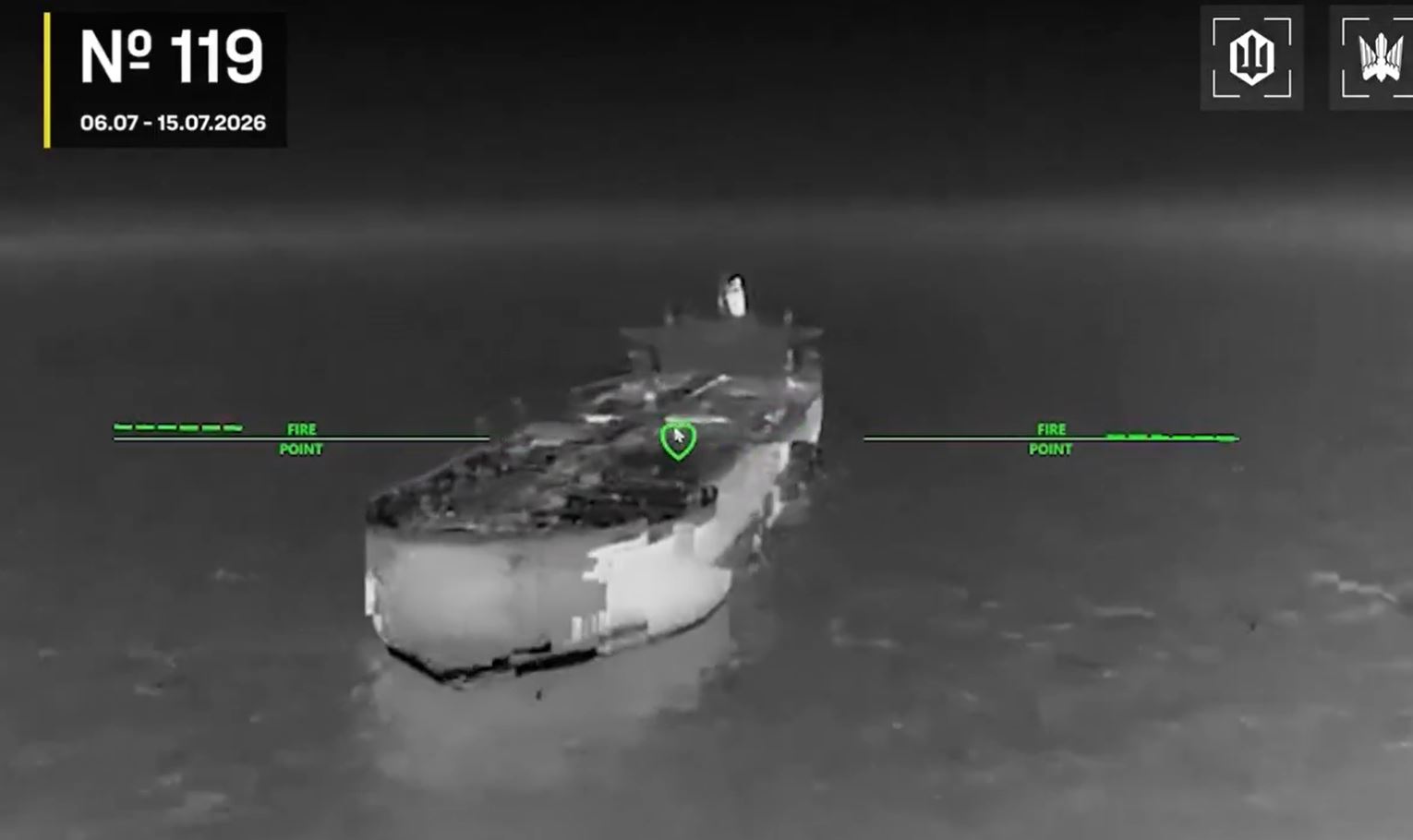
A Russian oil tanker in the thermal sight of a Ukrainian drone during strikes in the Black Sea, marked as the 119th vessel hit in the 6–15 July 2026 operation. Screenshot from SBS video
The two gas carriers fell to Nemesis and Raid operators. The 1st Separate Center took the tug.
A Russian tug in the thermal sight of a Ukrainian drone during strikes in the Black Sea, marked as the 136th vessel hit in the 6–15 July 2026 operation. Screenshot from SBS video
The timing was deliberate. SBS commander Robert "Madyar" Brovdi wrote that the Black Sea cluster of operation MoLoChKa ("Dairy") opened on 15 July, the Day of Ukrainian Statehood. He framed the night as a scoreline: 20 to nil.
Ukrainian drones switch to the Black Sea: 20 first tankers hit
Drone Forces Commander Robert Brovdi says the tally of ships hit in the Black Sea and the Sea of Azov now stands at 136.
The Black Sea haul adds to a running total that has climbed fast. From 6 to 15 July, Ukraine's drones struck 136 vessels of Russia's shadow fleet across both seas.
Of those, 116 went down in the Sea of Azov between 6 and 14 July, as an earlier daily count tracked. The 20 Black Sea kills on 15 July carried the campaign west into deeper, wider water.
The Black Sea vessels seen in the SBS video are ocean-going ships, far larger than the flat-bottomed river couriers Ukraine has been burning along the Azov feeder route. The footage from the FP-1 or FP-2 attack drones shows the operators aiming mostly for the deck structures rather than the bridges, with follow-up drones filming the fires that spread after the first strikes.
The shadow fleet exists to slip past international sanctions, move Russian oil and oil products, and funnel the proceeds into Moscow's budget for the war on Ukraine. Systematically hitting it breaks the enemy's logistics chains and jams the shadow maritime infrastructure, SBS said.
The operation's stated goal is steady disruption of Russian logistics and the money behind them. Disabling tankers, cargo ships, and support vessels complicates oil exports and limits Russia's ability to fuel its troops and the occupation force in Crimea.

 Connexion




 Madyar