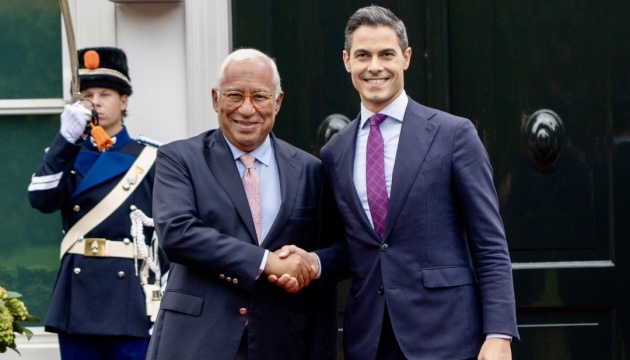
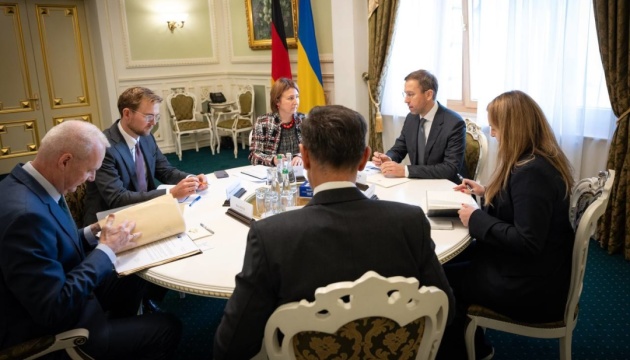
Dutch Prime Minister Rob Jetten discussed the European Union's future budget and the protection of the international legal order during a meeting in The Hague with European Council President António Costa.
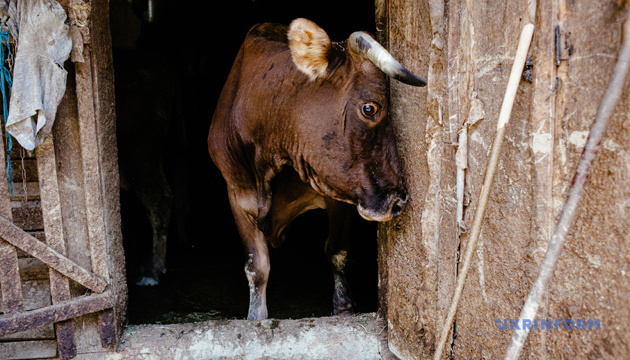
Around 90 rural households in Ukrainian-controlled areas of the Donetsk region will receive financial assistance from the International Committee of the Red Cross (ICRC) to evacuate livestock, poultry and equipment.
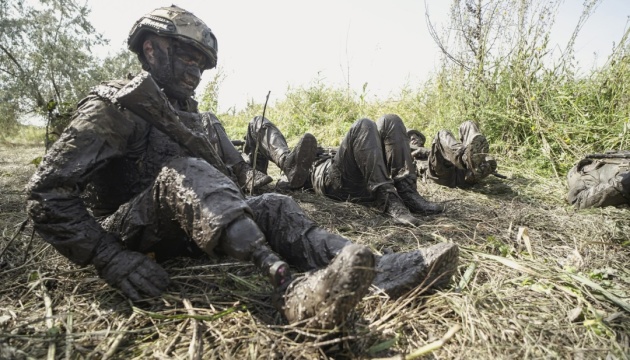
After suffering a serious injury and losing his leg, 35-year-old Yevhen Kulikov, a service member of the 426th Separate Unmanned Systems Regiment (SUSR) of the 30th Marine Corps, not only returned to military service but also climbed Mount Hoverla, completed the Marine obstacle course, and earned the right to wear the storm beret.
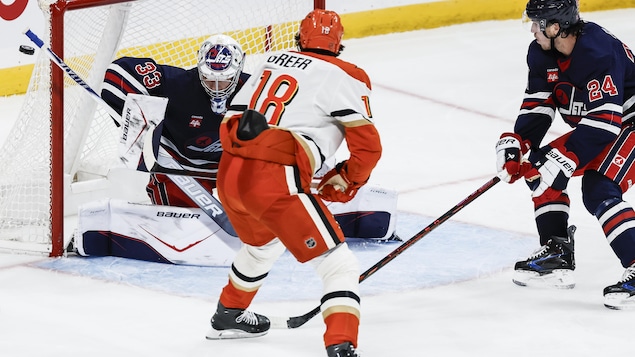
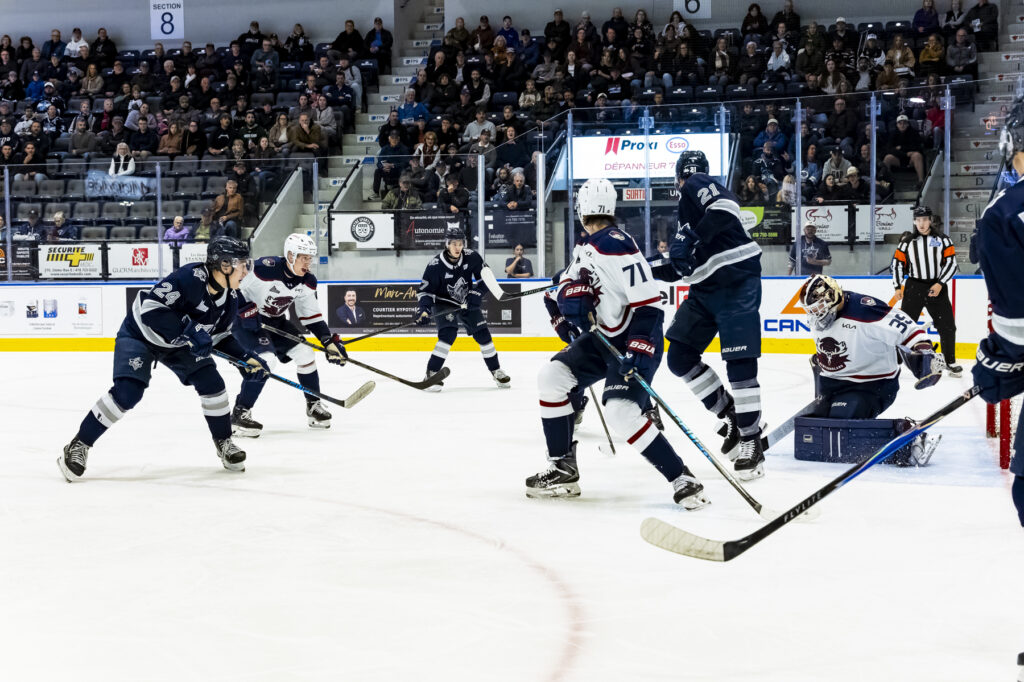
Le Régiment de Terre-Neuve présente une belle machine de hockey et l’Océanic a pu le constater, vendredi soir, quand il s’est incliné par la marque de 4-3 devant une galerie de 2 220 spectateurs réunis au Colisée Financière Sun Life.
La formation rimouskoise, qui n’avait pas son aplomb habituel dans les 40 premières minutes de jeu, a bataillé jusqu’à la fin, dominant la troisième période, mais n’a pu créer l’égalité.
« On n’était pas là du tout. J’étais très insatisfait de la façon dont on jouait après 40 minutes. On est revenu en troisième. On a davantage joué dans notre identité. Ça nous a permis de revenir à ce match-là. Tu ne peux pas jouer 20 minutes et gagner un match », a commenté Joël Perrault.
Les locaux ont bénéficié des deux premiers jeux de puissance, sans menacer outre mesure. Le Régiment a ensuite inscrit deux buts, ceux de Will Reynolds et de l’ex-Océanic, Tyson Goguen. Le Matanais Louis-François Bélanger a obtenu une passe sur les deux buts. Avant que la période ne prenne fin, Mathys Dubé a marqué son 8e de la saison.
Mathys Dubé prend un tir au but alors qu’A.J. Schaaf voile la vue du gardien. (Océanic / Folio Photo – Iften Redjah)
Le même Bélanger aurait pu doubler l’avance des siens quand il a profité d’un lancer de punition arrêté par le gardien Blackwood. Mais, sur un deux contre un, Matthew Frost a redonné une avance de deux buts aux siens. Même scénario pour le quatrième but, celui d’Alexis Michaud. À 4-1 après deux périodes, les visiteurs étaient en plein contrôle.
Sur un avantage numérique de deux joueurs, Caiden Pellegrino a ramené l’Océanic dans le match. Puis, Justin Gagnon a repéré Matyas Cutta qui a enfilé l’aiguille pour faire 4-3. La tentative de remontée s’est arrêtée là.
« On ne peut pas penser d’avoir du succès à ce niveau-là en jouant sur les talons et en ne gagnant pas nos batailles à un contre un. Par contre, je suis content de la façon dont on a joué en troisième en dominant 13-1 dans les lancers. Mais, on ne méritait pas ce match-là, mais pas du tout. Ça aurait pu être même plus que 4-1 après deux périodes. Demain (samedi), on doit absolument sortir comme on a fini ce soir. Si c’est le cas, on va se donner de meilleures chances », souligne Perrault qui apportera des changements à son alignement en utilisant les joueurs en santé qui n’ont pas joué vendredi.
Devant le filet, Morgan Blackwood a repoussé 18 lancers dans ce qui était sa première défaite après trois victoires cette saison. À l’autre bout, Antoine Proulx a été solide sur les 36 tirs en sa direction.
Le gardien Morgan Blackwood a subi un premier revers. (Océanic / Folio Photo – Iften Redjah)
En bref
Le nouveau défenseur américain Tommy Miller a fait ses débuts… Malik Vigneault, Alexandre Peterson, Edouard Lord et les blessés Teddy Drury, Benjamin Rioux et Luca Nappiot ne jouaient pas… Dans le cas de Nappiot, il n’est plus dans l’alignement officiel des 25 joueurs pour faire place à Miller. Il demeure avec l’équipe en attendant son retour au jeu. Il en a encore pour plusieurs semaines sur la liste des blessés… Régiment et Océanic se retrouveront samedi à 16 h…
President complains about not winning prize in year he started war with Iran and says: ‘We will not forget, Norway’
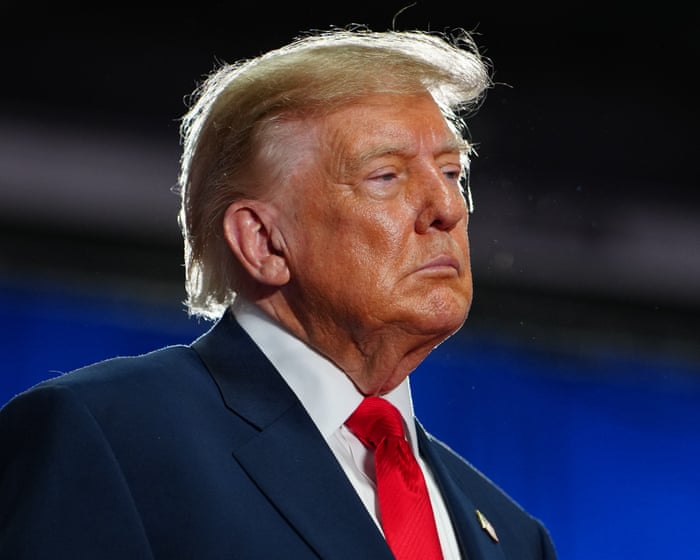
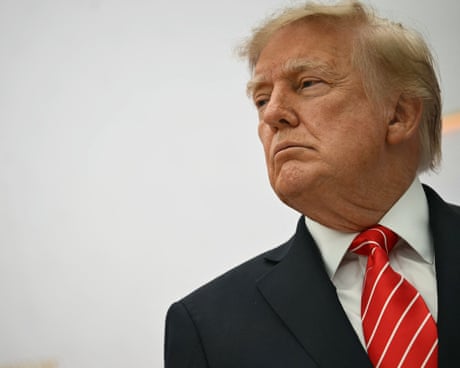
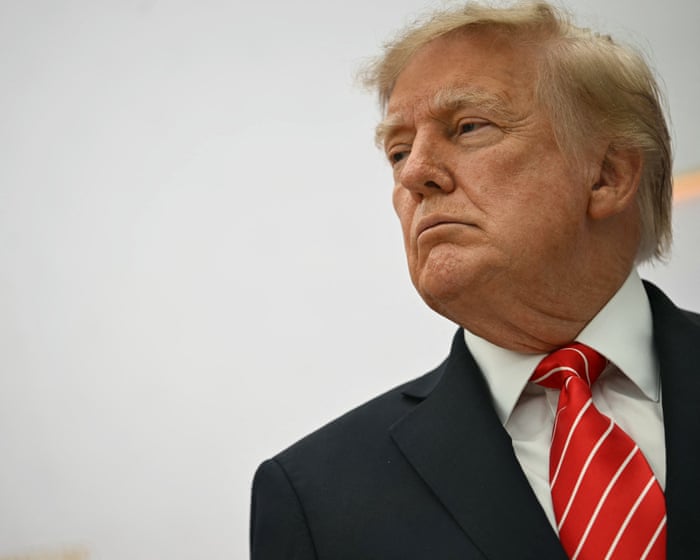
Donald Trump complained Friday about not winning the Nobel peace prize for 2026, a year in which he started a war with Iran.
At what was supposed to be a rally for other Republican candidates in Syracuse, New York, the US president devoted a long portion of his speech airing his grievances with the Nobel committee.
Russian troops have taken 25 residents, including children, from the temporarily occupied part of the Kharkiv region under the pretext of a so-called "evacuation." Their whereabouts are currently unknown.
A new pact that calls for Russia to boost the U.S. supply of diesel over the next few months is unlikely to make a dent in painfully high prices at the pump or elsewhere, energy policy experts say
Kateryna Rashevska can trace exactly how one Ukrainian child disappears into Russia: the occupied-territory orphanage, the foster placement with a Kremlin-connected family, the re-education camp, the military uniform, the draft notice that arrives at sixteen. A legal expert at Ukraine's Regional Center for Human Rights, she has filed submissions to the International Criminal Court, documented the cases behind recent EU sanctions, and spent years building the argument that this is not only a war crime but genocide.
The law, she says, is ready. In less than five years of war, Russia has forcibly transferred at least 20,651 Ukrainian children from occupied Ukraine, a crime that has already put President Vladimir Putin and his children's-rights commissioner Maria Lvova-Belova in the dock of the ICC. The 1948 Genocide Convention lists the forcible transfer of children as one of the acts that constitute genocide, and the ICC's Ukraine investigation has been mandated to examine the charge since 2022. More than 150 states have signed that convention. None has been willing to say the word about Russia.
"We don't need to change any legal framework," Rashevska says. "We simply still lack the political will to call the crimes by their proper names." She presses the point because, for her, justice is not an afterthought but a deterrent: "Without justice, Russia will feel this resentment in several years, and they will repeat their actions."
And the court that could deliver that justice is collapsing. The ICC is in the deepest crisis of its existence: its prosecutor, Karim Khan, removed, 13 of its judges and prosecutors sanctioned by the United States, and on 9 October 2026 the court itself sanctioned by Washington for the first time, with Secretary of State Marco Rubio vowing to dismantle it "brick by brick." The court called the move unprecedented and warned that "history will judge this moment."
Meanwhile the children remain. Of the more than 20,000 taken, only 2,665 have been returned, as of 7 October 2026. The rest are placed in Russia's adoption system and foster homes, taught to forget they are Ukrainian, to love Russia, and to be willing to die for it: Rashevska cites 344,000 Ukrainian children drawn into the Movement of the First and 55,000 into the Yunarmiya youth army.
Euromaidan Press spoke with Rashevska on the sidelines of GLOBSEC 2026 in Prague about the machine Russia built to steal a generation, and why the world still won't name it.
Alya: You say that Russia’s forcible transfer of Ukrainian children is the crime of genocide. In international law, genocide is defined by Article 6 of the Rome Statute. What would it take to change this legal framework to include the deportation and militarization of Ukrainian children? And is the Office of the Prosecutor in any position to do that work under current US sanctions and Karim Khan’s leave?
Kateryna: We don’t need to change any legal frameworks to prosecute what the Russians are doing with Ukrainian children. Militarization and political indoctrination, as well as Russification of young Ukrainians, is a part of Russia’s bigger strategy to destroy Ukraine as a sovereign state and to subjugate everything in the Ukrainian nation to the Russian influence and control. I don’t see legal problems; we simply still lack the political will to call the crimes by their proper names.
The UN’s 1948 Genocide Convention posits that all states that signed the convention, 154 as of today, should act to stop it—not only those affected by genocide. If the international community recognized what the Russians are doing as a crime of genocide, it would mean that yet another time in history the international community was not able to prevent genocide, to recognize some early warnings, to react properly to what the Russians did, for example, in occupied Crimea or Donbas before 2022. It is not easy, and the international community and world political leaders should be mature enough to face all these challenges, recognize that they were involved in the commission of these crimes through silence and inaction, and finally stop it.
So that is why, according to the Rome Statute, the Office of the Prosecutor can start an investigation of the crime of genocide in the Ukrainian context. It is possible: the ICC’s Ukraine-situation investigation in March 2022, supported by 43 states, included not only war crimes and crimes against humanity, but also the crime of genocide. So we have all the legal tools and means, but politically it is very difficult.
Recently, there has been a global shift towards this—in the context of the war between Arabian states and Israel, not Ukraine. But for example, Israel’s attacks against Gaza’s education have already been termed "scholasticide," so as a part of the genocidal intent, as a part of the crime of genocide. So for us lawyers and human rights defenders, this is the task—to push the international community to do the same with Russia. It is not easy because Russia is one of the five "world policemen" expected to maintain this international legal order.
I believe that, perhaps in decades, but we will see how Russia’s actions will be recognized as the crime of genocide. The forcible transfer of children from one group to another group is the fifth universally recognized element of the crime of genocide.
Kateryna Rashevska, legal expert at the Regional Center for Human Rights. Photo: Alya Shandra/Euromaidan Press
Alya: Your organization was involved in documenting this. How does this pipeline actually work?
Kateryna: Yes, let's take Olga Druzhinina, who fostered four children from the occupied territories of Ukraine. Her story is very interesting: first, it seemed that she could be just an ordinary Russian brainwashed by TV shows about children from Donbas. But then we found that Olga is very close to [former Russian President] Medvedev, and through Medvedev to President Putin. Olga is the head of one non-governmental organization, "Semia Arktiki" [Family of the Arctic], and this organization aims to find foster parents for orphans— now including orphans from occupied territories of Ukraine. The co-head of this organization also fostered Ukrainian children.
It is a very well-built, pre-planned architecture of people involved in the commission of this crime—not some sporadic reaction to the full-scale invasion. They planned to do it. And I will not be surprised if, in the future, we find that these families also adopted children from Crimea or from Donbas even before 2022.
Her husband is a veteran of the Russian Armed Forces. He participated in many wars of the Russian regime, including the wars in Chechnya. It was clearly against the child's best interest to be sent to the family of this Russian serviceman and his wife. So their case was widely publicized. We recorded many different details. Later, we found photos of these children in the "Warrior Center" camp in Novosibirsk, and her foster daughter from occupied Ukraine wearing a St.George’s [Russian imperial] ribbon and in military uniform.
So the Ukrainian identity of these children was completely eradicated. It was prohibited to mention that they were Ukrainians, and the main goal of this family was to repress their unloyalty to the Russian state, to re-educate them, mold them into Russian patriots. Unfortunately, I don’t know the fate of these teenagers from Mariupol, but as far as I know, they were not returned to Ukraine. And now they are already young adults—meaning they will soon be conscripted into the Russian army. They have this military duty because they were forcibly given Russian citizenship. And young children also remain under the control of Olga and his husband.
Olga and her husband are members of the so-called "Putin Team." They were recognized many times as the best family of the Yamalo-Nenets region. The governor of Yamal-Nenets is also Putin's person. His candidacy was supported by Putin for re-election to this position. And this governor has many times mentioned that Ukrainian children from the occupied territories of Ukraine were accepted by foster families from his region, even without the proper documents.
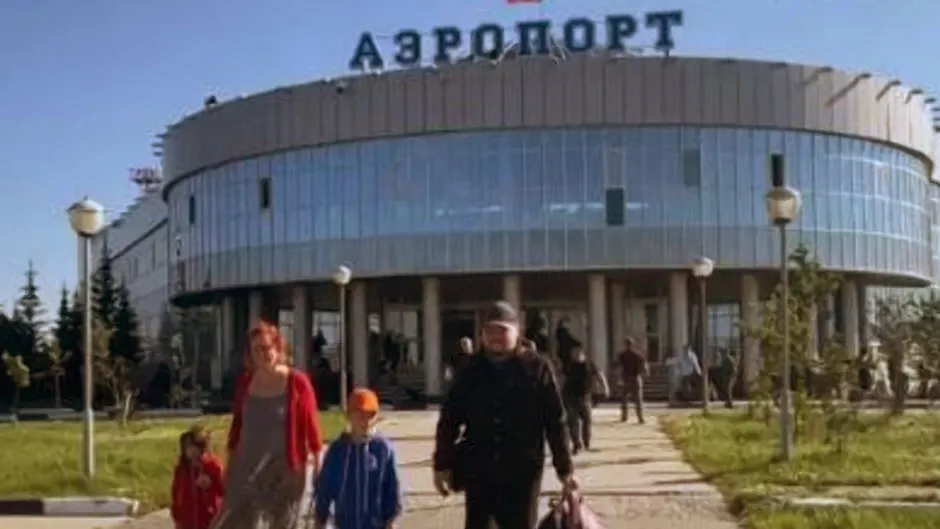
Olga Druzhinina and her husband at Salekhard airport with two children brought from occupied Donetsk Oblast, July 2022. Screenshot: Yamal-Media via Sever-Press
It is very difficult to influence their behavior without sanctions. In this sphere of foster care, the balance between placing children in Russian institutions and Russian families is hard to find. Russia presents only two options for the forcibly transferred Ukrainian children: Russian boarding institutions or Russian foster families. And of course, ordinary people think: a family is better than a boarding institution. The truth is that there is a third option: just return these children to Ukraine, to their homes.
And I would like to highlight that, according to the order of Ukrainian President Zelenskyy, these children from institutions will not be returned to boarding institutions in Ukraine. They will inevitably be placed with a foster family, and they can participate in choosing this family or changing it. Ukraine is doing its best to guarantee that its actions comply with the Convention on the Rights of the Child, but unfortunately, Russians are very hard to persuade to return these orphanage children.
Alya: On 11 May 2026, the EU Council sanctioned 16 individuals and seven entities for the systematic unlawful deportation, forced transfer, and forced assimilation of Ukrainian children, including through indoctrination and militarized education. Your organization pushed for these sanctions. Are they working?
Kateryna: In January–February 2026, we criticized the European Union’s sanctions policy. New persons were being added to lists, but we found that the level of coordination and harmonization of sanctions policies was only 5%. Only 13 individuals and three organizations were under sanctions in all jurisdictions analyzed by us: Ukraine, the United Kingdom, Canada, the United States, the European Union, Switzerland, and Japan. It was terrifying because sanctions exist, yet they are riddled by many loopholes and are actually inefficient.
That is why we started persuading them to do something with this system. And on 11 May, Canada, the United Kingdom, and the European Union synchronized their sanctions packages: the people are included in all jurisdictions. For us, this is a big achievement.
Kateryna Rashevska, legal expert at the Regional Center for Human Rights. Photo: GLOBSEC
Another achievement: a shift in their perception of where this vertical of guilty persons ends. Putin and Maria Lvova-Belova—okay; ministers, children's rights ombudspersons at the regional level, heads of the occupation authorities—okay. But what about the "ordinary" Russian people who fostered poor Ukrainian children and now contribute to their militarization? The 11 May sanctions saw the United Kingdom and Canada listing ordinary Russians, like the family from Yamalo-Nenets that fostered four Ukrainian children, including teenagers from Mariupol, and then sent them to re-education camps of the "Center Warrior" to be militarized as Russian soldiers.
If these results of our work seem small, we must remember that for the Russians, it is a very sensitive issue. They are mad because of the sanctions—and this was visible when the “Yolochka” boarding institution in occupied Crimea’s Simferopol, called a “concentration camp” by ordinary Russians, was sanctioned. Already in December 2014 [after Russia’s occupation of east Ukraine], the first Ukrainian orphans were sent to Russian foster families from this “Yolochka.” 12 years later, children from Kherson boarding institutions also went through “Yolochka.”
Alya: You've documented over 20,500 deported children. How many of that cohort are approaching Russian conscription age?
Kateryna: It is hard to tell because the way the Ukrainian side is collecting statistics is not good enough. So you should address this question to the competent bodies of Ukraine.
But according to our calculations, just to describe the situation in general: all Ukrainian teenagers under Russian control start receiving draft notices at the age of 16. According to the Russian legislation, it should be at the age of 17, but they're so afraid that these children will escape or will return to Ukrainian-controlled territories, that they start this process in violation of their own legislation.
Everything is organized around schools. They’re not about education under occupation, but have become additional buildings of the military commissariat. Specific teachers are responsible for this conscription process. Boys aged 16-17 are being brought to the military commissariat in organized groups. You cannot escape, you cannot refuse, because you will hear “knock-knock” on your door: the occupation authorities and your teacher will ask: “Where are you? You should go.”
Another problem: Russia and Belarus started exchanging data, meaning that if this child receives a draft notice at the age of 18, he will not be able to cross the border—which matters because the checkpoint of Mokrany-Domanove between Belarus and Ukraine is the main point of returning Ukrainian children from Russian control. Every year, the Russians amend their legislation to impose more obstacles to the repatriation process.
So the only way for a Ukrainian teenage boy to escape is to do this several days before a "povestka" [draft notice] comes to his house at 16 years.
Kateryna Rashevska, legal expert at the Regional Center for Human Rights. Photo: Alya Shandra/Euromaidan Press
According to our intelligence, since 2014, 48,000 Ukrainians from occupied territories were forcibly mobilized by Russians, including those from occupied Crimea. Some of them participated in the "special military operation.” Around 20% of all prisoners of war in Ukrainian camps for Russians are originally Ukrainians who were forced to sign a military contract. Many of them were forced, manipulated, or brainwashed, so it was not done of their own will.
But I would like to highlight that the average age of a Russian soldier is 35. This is not the war of young Ukrainians who reached the age of majority and were sent to the battlefield as cannon fodder. We see that the Russians’ main goal is to rebuild the army degraded by the Ukrainian side during the first month of the full-scale invasion, to have officers and other qualified personnel who will develop a strategy and conquer more and more territory. That is why they're investing in all these military patriotic movements and centers.
That is why I was really impressed when I saw that their All-Russian championship on drone racing will be for children aged seven. Should we next expect that children in kindergartens will assemble and disassemble a rifle? Their society is very militarized. This is the biggest problem. And now, Russian soldiers are those who are teaching Ukrainian children to fight tomorrow.
L'ancien président de la République démocratique du Congo s'est exprimé ce vendredi. Une allocation dans laquelle il n'épargne pas son successeur Félix Tshisekedi.
Les signalements de chiens dangereux sont en hausse depuis cinq ans, a découvert La Presse, selon une compilation des données fournies par les villes de Montréal, de Laval, de Longueuil et de Québec.
US president says agreement needed to lower fuel prices, but move likely to create fresh crisis with Ukraine and Nato allies
Donald Trump is on a fresh collision course with Volodymyr Zelenskyy and European allies after his stunning agreement to buy Russian diesel upended years of US and western pressure on the Kremlin to end its war against Ukraine.
Zelenskyy reacted furiously to Trump’s announcement of the deal with Vladimir Putin on Friday, calling it “absolutely terrible” and “not fair and not honest”.

 Connexion