Vue lecture

Ukraine: 18 of 26 Russian oil and stolen-grain ships face no sanctions
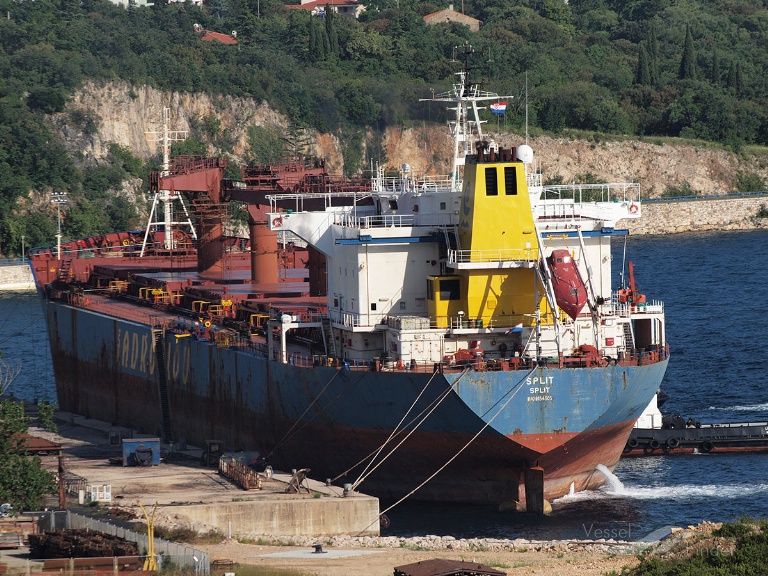
The bulk carrier now named LAMAR S, with SPLIT painted on its stern, moored beside a concrete quay near a wooded coastline.

On 14 August, Ukraine's Military Intelligence (HUR) published data on 26 vessels via its War&Sanctions portal, noting that 18 ships face no sanctions from any of Ukraine's partner countries.

The agency said the ships carry Russian oil, liquefied natural gas (LNG), or agricultural products from occupied Ukraine. Euromaidan Press could not independently verify HUR’s vessel records.

Russia relies on maritime trade both to fund its war through energy exports and to sell crops taken from occupied Ukraine. Kyiv began building a dedicated system against Russia’s shadow grain fleet in April, modeled on its oil-fleet campaign. A US bill introduced this week would also target vessels, owners, insurers, and ports involved in sanctions evasion. HUR’s new list shows how many ships remain outside those restrictions.

Russia’s grain shadow fleet

HUR divided the 26 vessels into three groups:

  • oil tankers serving Lukoil, Rosneft, Surgutneftegas, Novatek, Tatneft, and Gazprom;
  • dry-cargo ships using the occupied ports of Berdiansk, Sevastopol, Kerch, and Feodosia;
  • LNG carriers moving gas from the sanctioned SAAM FSU floating storage unit, which holds LNG from the sanctioned Arctic LNG 2 project.

HUR highlighted three of the 18 vessels that are not facing partner sanctions. The bulk carrier LAMAR S repeatedly loaded wheat at the Avlita terminal in occupied Sevastopol in 2026 for delivery abroad, including to Syria, the agency said.

NAYA FALCON carried baking soda and granulated wheat bran from occupied Sevastopol to Egypt and Cyprus, HUR said. The agency linked the oil tanker GREGAL to UAE-based Cymare Navigation FZC, which it described as affiliated with Sovcomflot, Russia’s state-controlled shipping company.

Russia steals grain while striking Ukraine’s exports

Crops taken from occupied land are sold abroad as Russian produce, while Russia's attacks leave Ukraine’s legitimate harvest with fewer routes to market.

Ukraine’s Foreign Intelligence Service said Russia sold more than 2 million tons of grain from occupied Ukraine as Russian produce in 2025. The agency said ship-to-ship transfers at Kavkaz helped conceal its origin.

Meanwhile, Russian attacks have squeezed Ukraine’s legitimate grain trade. Strikes on civilian ships brought the Black Sea corridor to a near standstill during the July harvest peak. Ten people died when Russian missiles hit the grain-laden Golden Leo on 19 July.

HUR called on Ukraine and its partners to synchronize sanctions and detain vessels that violate restrictions. It said the measures could curb Russia’s maritime logistics and war funding.

  •  

Russian Blockade of Major Ukrainian Ports Threatens Global Grain Supplies

The deadly strikes are part of a long-running maritime battle with Ukraine and echo battles over other key shipping routes around the world.

© Reuters

A vessel struck off the coast of Odesa, Ukraine, last month. The Russian campaign has halted nearly all shipping in and out of the port.
  •  

Ukraine and Moldova discuss rail corridor for grain amid Russian Black Sea attacks

Ukrainian grain

Ukraine and Moldova are discussing transporting Ukrainian grain by rail through Moldovan territory to the Romanian port of Constanta, an option driven by intensified Russian attacks on shipping in the Black Sea, according to unnamed sources in both countries cited by Reuters.

The talks come as Russian strikes on vessels using the Black Sea corridor have disrupted traffic during the harvest season and forced Ukraine to cut its export forecast. On 22 July, no ship passed through the corridor at all, and the country's agriculture ministry has already lowered its projection for the 2026–2027 season by up to five million tons.

Discount sought, volume guarantees demanded

Kyiv is asking for a discount of 50 percent off the nominal rate to transport its grain, according to the agency's sources. A source at Moldovan Railway said Moldova responded with a counterproposal: guarantees from Ukraine on the volumes of grain it would transport through the route.

"We are currently collecting information on potential volumes from interested shippers. The information-gathering process has not yet been completed," a senior Ukrainian industry official told Reuters.

Ukraine expects corridor to cover 10 percent of exports

Ukraine estimates the Moldovan corridor could handle 10 percent of its grain exports. Agriculture Minister Taras Vysotskyi said earlier that his ministry had lowered its grain export forecast for the 2026–2027 season from 43 million tons to 38–40 million tons because of Russian attacks on ports.

Ministers discuss rail links

A day before the Reuters report, Moldova's Minister of Infrastructure and Regional Development, Vladimir Bolea, visited Ukraine's Odesa region and met with his Ukrainian counterpart, Mykola Kalashnyk, to discuss improving rail connections and expanding the transit network between the two countries.

Moldova's premier defends transit revenue

Moldovan Prime Minister Vasile Tofan said his country should not pass up the opportunity to earn millions of euros from transiting Ukrainian grain cargo. He dismissed suggestions by Moldovan farming groups that Ukrainian grain prices would depress the value of their own produce.

"Let's not look for enemies where there are none," he said on Moldovan television.

Russian attacks on shipping

Russia intensified strikes on vessels using the Ukrainian Black Sea corridor in July. On 13 July, Russian forces struck a civilian ship flying the flag of Togo while it was unloading mineral fertilizer off the coast of Odesa region, killing five crew members and injuring five others.

The following day, 14 July, Russia attacked two civilian vessels in the Black Sea — cargo ships flying the flags of Tanzania and Liberia. The captain of one of the ships was killed. On the evening of 17 July, a vessel flying the flag of the Marshall Islands was struck. Attacks continued afterward.

On 22 July, no vessel passed through the sea corridor. The Ukrainian government called the disruption "deliberate economic and humanitarian terror," coming at the height of the harvest season.

Ukraine convened an urgent session of the UN Security Council over the attacks, calling on all states — particularly those "which this directly concerns" — to demand that Russia stop striking shipping. Separately, the Southern Mining and Processing Plant (Pivdennyi HZK) announced it was suspending extraction and temporarily scaling back operations.

  •  
❌