❌

Vue normale

Ukraine’s former defense minister, dismissed suddenly, has announced Army of Robots. He says target is $10,000 per unit and need is tens of thousands
1 octobre 2026 à 19:38

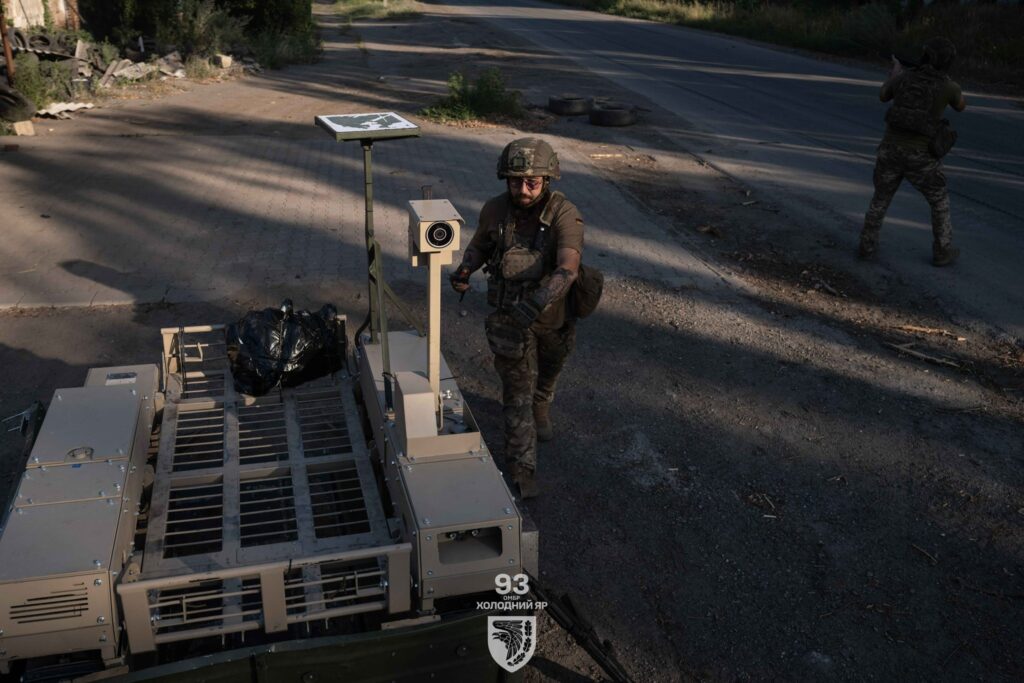
An armed ground robot. Photo: 93rd Brigade

The robots Ukraine wants to throw into its deadliest fights should cost as little as $10,000 each, Mykhailo Fedorov says. The former defense minister has set out the first stage of his Army of Robots: cheap, simple humanoid-like machines that would take over an infantry's most dangerous jobs, with tens of thousands needed, he said on Telegram, citing his own interview with Forbes.

On 26 September, Fedorov, who continues to work on military tech reforms despite his sudden and unexpected dismissal, announced the creation of the Army of Robots.

Humanoid robots would carry ammunition and pull out the wounded, lay and clear minefields, scout, hold positions, and strike, taking the roles that today cost soldiers their lives.

Potential need amounts to thousands

"Our main goal is to save lives. A human should not take risks where a machine can do the job," Fedorov says.

At the first stage, it will not be a classic humanoid but a simpler humanoid-like robot that can be produced quickly and scaled up, he adds.

Such a machine should perform some of an infantryman's tasks directly on the battlefield.

Today, such platforms cost $40–70 thousand on average. For mass use in war, Ukraine needs something much cheaper: the target is $10–20 thousand per unit, he believes.

"The potential need is tens of thousands of such machines," Fedorov continues.

Next come prototypes

The former defense minister adds that he and his team are already working with teams that have ready-made MVPs and are designing solutions.

"Next come prototypes, simulations, model training, and finding the right combination of hardware and software," he explains.

The Army of Robots is not a single product but an ecosystem that will unite companies, startups, engineers, R&D, and capital around the robotization of the front.

"Our task is to get from prototype to mass product as quickly as possible," he adds.
Europe wants drones that actually work in war, so Ukrainian maker is moving in to build them in Belgium and Luxembourg

1 octobre 2026 à 14:46

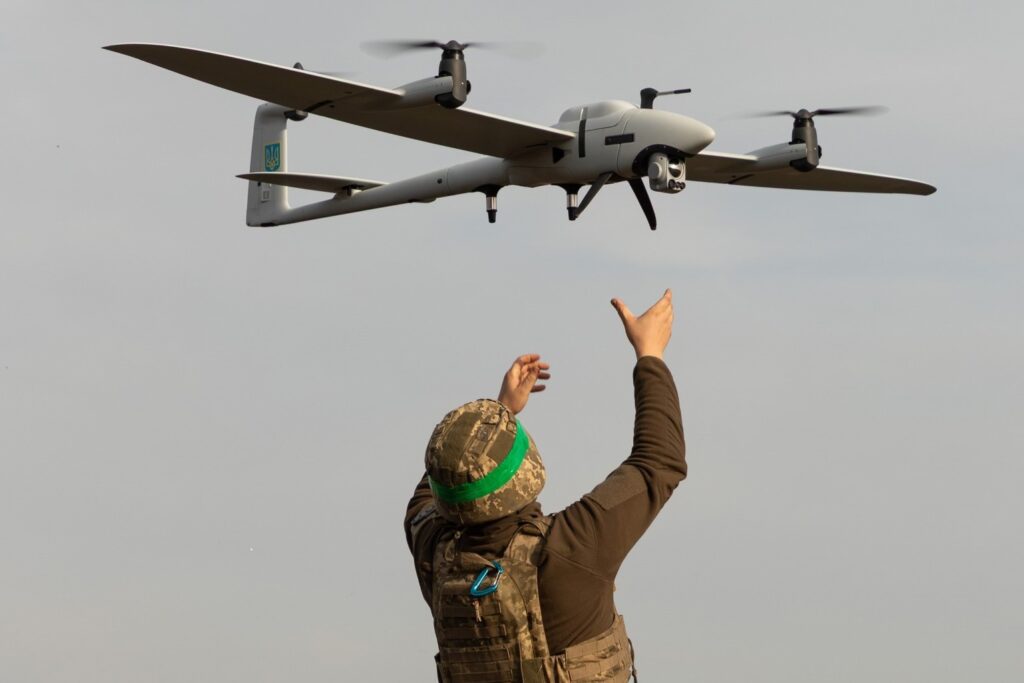
A Ukrainian soldier with a drone. Source: SBS

A Ukrainian drone maker is preparing to build unmanned systems in the heart of western Europe. TAF Industries and Luxembourg's LUXUAV have signed a memorandum to jointly develop, industrialize, and field weapons in Belgium and Luxembourg, under the Build with Ukraine initiative, TAF said.

The deal is part of Build with Ukraine, an initiative that enables Ukrainian arms manufacturers to take their operations to a new level by scaling up production beyond the country’s borders. This involves exporting Ukrainian military technologies to partner countries that support Ukraine financially and politically. In return, joint production lines will be established on their territory, according to Ukraine's Arms Council.

The deal targets the Benelux

The memorandum is a first step, TAF said, with joint work on autonomous systems in the two countries to follow. The aim is to move from signed intent to shared production lines and fielded drones.

TAF Industries, a Ukrainian unmanned-systems maker, and LUXUAV, a Luxembourg defense-tech firm, plan to develop, industrialize, and deploy drone solutions across Luxembourg and Belgium, pooling Ukraine's battlefield experience with European manufacturing muscle.

Build with Ukraine spreads west

TAF's chief executive, Volodymyr Zinovskyi, framed the memorandum as a way of "combining Ukrainian innovations, proven by war, with European industrial and technological capabilities," arguing that European security now depends on industry, states, and research working across borders.

Belgium has already contracted a Ukrainian producer to build drones and counter-drone systems on Belgian soil.

Europe wants the know-how

The timing fits Europe's new urgency. Russian drones have strayed into Polish, Romanian, and Moldovan skies in recent weeks, and member states scrambling to build defenses increasingly look to Ukraine, the one country fighting a mass drone war, for the technology and the lessons.

Earlier, Polish Prime Minister Donald Tusk warned of very difficult weeks and months ahead, “linked to Russia’s extremely aggressive stance toward Ukraine," according to TVP Info. As he emphasized, Polish security services were on heightened alert due to the situation along the country’s eastern border.

Russia lost 2026-record 46,230 troops in September by Ukraine’s count, as fighting around Donetsk fortress cities grinds on

1 octobre 2026 à 12:24

The Ukrainian "Hunter" HIMARS crew destroys enemy artillery systems, UAV positions, staging areas, and logistics hubs. Source: The 148th Separate Zhytomyr Artillery Brigade, Air Assault Forces, 8th Corps of the Air Assault Forces of the Armed Forces of Ukraine.

Russia lost more troops in September than in any other month this year, hitting the record, by Ukraine's count. The General Staff put last month's Russian casualties at 46,230, a 2026 record and 45.8% above January's.

At the same time, Russia's strikes on Ukraine's rear escalated in September and are climbing again in October. The result is a grind that bleeds Russia on the ground while Ukrainian cities absorb the blows from above.

Losses span the whole front

"Ukraine's Defense Forces continue to inflict systemic and tangible losses on the Russian occupation forces in personnel and equipment along the entire line of contact," the General Staff says.

The toll climbs all year

The monthly figures have risen almost without pause. After a dip to 26,090 in February, Russian losses climbed through the spring and summer, 39,290 in June, 42,860 in July, 42,020 in August, before last month's high.

The record reaches down to a single day: the General Staff counted 2,090 Russian casualties in the 24 hours to 28 September, which British Defense Intelligence assessed as the highest daily toll since the full-scale invasion, one of only four days to top 2,000, the other three in 2024.

British intelligence tied the high rate to intense fighting around the fortified belt of Donetsk cities, especially near Dobropillia.

Meanwhile, Kyiv is also continuing its Vivaldi Operation near Lyman, and its latest mission used ground robots, each carrying two Bullspike grenade launchers to launch an attack on Russian positions and then detonate inside their shelters.

Kyiv reads the climb

Across the war, Ukraine says it has put roughly 1.5 million Russian troops out of action, a toll that has bought little ground as the months-long summer offensive stalled short of its goals.

"Every attempt to pressure our positions ends for the enemy in disproportionate losses of wounded and killed," the General Staff says.

The figures are Kyiv's own and cannot be independently checked: they count the Russians' wounded and killed but never their own.

Ukraine’s steel output fell 57% and may hit zero next month. Expert says saving it comes down to four steps, and they’re Brussels’ to make

1 octobre 2026 à 11:32

Ukraine's steel industry, one of the pillars of its wartime economy, may produce almost no steel at all next month. Output fell 57.3% in August under Russian strikes and could approach zero in October, and the recovery of giants like Zaporizhstal and ArcelorMittal Kryvyi Rih depends less on Kyiv than on Brussels, says Stanislav Zinchenko, director of the GMK Center, the center for industrial, mining, and metals sector expertise, in an analysis for ThePage.

Steel is Ukraine's second-largest foreign-currency earner and a prop for the hryvnia, employing more than 70,000 people directly and another 250,000 in related industries, and paying close to $1 billion a year in taxes.

Russian missile strikes on the big plants, compounded by an energy crisis, closed ports, and EU competition, have cut production to a fraction and threaten to halt it, Zinchenko says.

He calls it the worst crisis the industry has faced since independence, "a perfect storm" that has struck all at once. The sector supplies 6% of Ukraine's GDP and 13% of its foreign-currency earnings.

Output could hit zero

The fall has been precipitous. In August, steel output dropped 57.3 percent year on year to 277,000 tonnes and pig iron 65.6%, Zinchenko says. Across eight months, the decline is 12.5%, and he warns that October could bring output to zero. Exports have cratered too: iron ore down 27% over eight months, long rolled steel down 45.8%, semi-finished products down 76% in a single month, and pig-iron exports halted entirely.

September may yield just 100,000 to 150,000 tonnes of steel, he says. Four producers bore the brunt: Zaporizhstal, Kametstal, ArcelorMittal Kryvyi Rih, and Interpipe.

Rebuilding breaks new ground

"No one in the world has learned how to rebuild metallurgical giants after missile strikes," Zinchenko says.

In reality, it means technical audits, clearing rubble, and ordering unique new equipment, at a cost the plants cannot meet after four and a half years of war spent at a loss or at zero margin, their reserves gone.

Three steps for Kyiv

Zinchenko sets out three moves the state could make at once to stabilize the industry:

  • Frontline rail. Give steelmakers priority access to locomotives from the state railway Ukrzaliznytsia within 150 kilometers of the front, so the product can still be moved out.
  • Energy parity. Scrap or soften the rule forcing industry to import 80% of its electricity, which leaves plants paying European prices they cannot match.
  • Market protection. Tax scrap-metal exports to keep raw material for decarbonization at home, and curb Turkish imports that undercut Ukrainian steel.

However, the recovery depends not on Kyiv, but on Brussels

Recovery is impossible without international funds and guarantees. No one will provide loans to enterprises on foreign capital markets during the war. No one will invest in recovery "into a void," the expert says.

He names four steps that would support the industry:

  • A recovery fund. A dedicated fund for the steel industry, modeled on those partners built for Ukraine's energy sector, to pool grants and cheap loans.
  • A safe sea corridor. Reopen the deepwater ports, as Ukraine managed in 2023 and 2024; without them, rail costs make exports unprofitable.
  • No EU quotas. Remove the European Union's restrictive quotas and tariffs on Ukrainian metal.
  • A CBAM exemption. Free Ukrainian steel, for the duration of the war and reconstruction, from the EU's carbon border levy, which Zinchenko says would otherwise finish off its competitiveness.

Meet those, he says, and bringing the plants back to baseline could take three to six months, with a full rebuild one to two years.

  • ✇Euromaidan Press
  • Ukraine solves riddle of metal “whiskers” on new Russia’s drones. They aren’t clever sensor
    Ukraine has cracked the riddle of strange metal "whiskers" that appeared on Russian jet-powered drones striking Kyiv, and they don't appear to be some clever new sensor. They are a simple mechanical detonator, a metal tube, and a rod that, on impact, closes a circuit to set off the warhead, Serhii "Flash" Beskrestnov, presidential adviser, says, ending online guessing about the strange devices. Photos of Russian drones with long metal prongs jutting from the nose had set off speculation
     

Ukraine solves riddle of metal “whiskers” on new Russia’s drones. They aren’t clever sensor

1 octobre 2026 à 10:43

A Russian jet-powered drone. Source: Flash

Ukraine has cracked the riddle of strange metal "whiskers" that appeared on Russian jet-powered drones striking Kyiv, and they don't appear to be some clever new sensor. They are a simple mechanical detonator, a metal tube, and a rod that, on impact, closes a circuit to set off the warhead, Serhii "Flash" Beskrestnov, presidential adviser, says, ending online guessing about the strange devices.

Photos of Russian drones with long metal prongs jutting from the nose had set off speculation about what they were for. The answer, Flash explains, is low-tech: when the prong hits something, the contact closes, and the charge goes off, with no sensors or electronics.

That simplicity sits against a more worrying trend: Russia is steadily upgrading what its drones carry, from the mix of warheads on the jet-powered Geran-4 and Geran-5 to a new charge designed to sever power pylons.

A contact closes the circuit

"It's all mechanically simple, no sensors or complex detectors," Flash says, commenting on the "whiskers".

It is the kind of crude, cheap fuze that suits a weapon meant to be built and spent in the thousands, where cost matters more than finesse.

Russia upgrades the warheads

Russia's jet drones, now built at roughly 3,000 a month, have become the dominant threat in its nightly campaign. The day when Flash published his "whiskers" post, Russia hit Kyiv with another round of drone strikes, hitting a school, a café, and warehouse buildings across the capital. The children inside the school were in its shelter. Fires broke out across two districts, and one person in the city was wounded.

On 28 September, Russia struck Kyiv's Academy of Sciences, which has a century-old history.

On the same day, Dmitry Peskov, Kremlin spokesperson, said Ukraine must "pay a price" for its actions in recent months and calls Russia's intensified strikes "part of this price."

❌