The EU locked in its sanctions on Russia for an unprecedented three years this week, and paid for it by letting two of the country's richest men off the list. Alisher Usmanov and Mikhail Fridman were delisted at the insistence of Slovakia, France, and Luxembourg, DW reported.
France pushed to remove Usmanov, a Kremlin-linked metals and telecoms magnate, as part of a secret deal to free prisoners held in Azerbaijan, and Luxembourg pushed to remove Fridman, who is pursuing the country
The EU locked in its sanctions on Russia for an unprecedented three years this week, and paid for it by letting two of the country's richest men off the list. Alisher Usmanov and Mikhail Fridman were delisted at the insistence of Slovakia, France, and Luxembourg, DW reported.
France pushed to remove Usmanov, a Kremlin-linked metals and telecoms magnate, as part of a secret deal to free prisoners held in Azerbaijan, and Luxembourg pushed to remove Fridman, who is pursuing the country for about $16 billion in arbitration over the losses his sanctions caused, the Financial Times reported.
Kyiv's reaction was immediate and furious
Foreign Minister Andrii Sybiha called the decision shameful and unjustified and urged EU states to impose their own national sanctions on the pair.
"In Moscow, they celebrate, because they got what they wanted: a sense of impunity, humiliation of the European Union, and division among Europeans," he wrote on X.
President Volodymyr Zelenskyy, who raised the issue with European Commission chief Ursula von der Leyen in New York, called the delisting "suicidal and counterproductive."
"Wars end with resolve and strength, not concessions to the aggressor's cronies," he said, thanking von der Leyen for agreeing to work on adding more Russian names to the lists.
At the same time, he stated that he "is grateful to Ursula for her willingness to work on adding more Russian individuals to the EU sanctions lists."
The step was a bargain of durability for names. Rather than roll the sanctions over for the usual six months, the EU previously extended them to 22 September 2029, keeping some 2,600 Russians and companies, including President Vladimir Putin, frozen out for three years, after weeks of deadlock that at one point nearly let the whole regime lapse.
The deal came only after the bloc pushed its deadline back a week to buy time, and its Irish presidency called the result a difficult compromise.
More than two-thirds of the Russian soldiers holding the Zaporizhzhia front carry criminal records. Ukraine's "South" grouping says a third of them enlisted to escape prosecution, most are over 30, and no fresh reinforcements are arriving, spokesperson Anastasia Shevchenko told Ukrinform.
The reasons they signed up track with that: 31 percent enlisted to dodge criminal liability, 24 percent for money, 26 percent on ordinary contracts, and 13 percent through mobilization. It is Russia's
More than two-thirds of the Russian soldiers holding the Zaporizhzhia front carry criminal records. Ukraine's "South" grouping says a third of them enlisted to escape prosecution, most are over 30, and no fresh reinforcements are arriving, spokesperson Anastasia Shevchenko told Ukrinform.
The reasons they signed up track with that: 31 percent enlisted to dodge criminal liability, 24 percent for money, 26 percent on ordinary contracts, and 13 percent through mobilization. It is Russia's prison pipeline in a single snapshot, a model that has pulled well over 100,000 inmates into the war with pardons and suspended sentences and thrown many of them at Ukrainian lines in disposable assault waves.
"It is worth noting that 69 percent of the Russian personnel have a criminal record," Shevchenko said.
The model dates to Wagner's prison recruiting in 2022 and has run under the Defense Ministry since.
A middle-aged force holds the line
The men are not young. More than a third, 36 percent, are between 31 and 40; another 24 percent are 41 to 50; 31 percent are 21 to 30; and just 9 percent are 20 or under.
This is a force of grown men with records, not fresh conscripts, and it points to who Russia can still find willing to fight in the south: people with little to lose and a sentence to escape among Ukrainian civilians, women and children.
The prison pipeline runs dry
What Shevchenko did not report is any sign of that force being rebuilt. Russia has enough men and equipment to keep fighting on the Zaporizhzhia front, she says, but no substantial replenishment is coming.
That fits a wider problem for Russia: its supply of convict recruits is thinning as word of the front's lethality spreads through the prisons, with some inmates now signing military contracts only to bolt on the way to the front, in one case killing their escort to get away.
Russia's practice of replenishing its ranks from prisons is breaking down, and officials are resorting to ever more coercive measures to keep the flow going.
Ukrainian drones struck Rosneft's Kuibyshev refinery in Samara overnight on 22 September, hitting two primary crude-processing units and triggering a large fire, Ukrainian drone and missile maker Fire Point confirmed. The strike is part of Ukraine's ongoing campaign against the fuel infrastructure that sustains Russia's war—the same plant had to halt crude processing after a drone attack in June. The attack came one day after US President Donald Trump for the second time in a week urged
Ukrainian drones struck Rosneft's Kuibyshev refinery in Samara overnight on 22 September, hitting two primary crude-processing units and triggering a large fire, Ukrainian drone and missile maker Fire Point confirmed. The strike is part of Ukraine's ongoing campaign against the fuel infrastructure that sustains Russia's war—the same plant had to halt crude processing after a drone attack in June. The attack came one day after US President Donald Trump for the second time in a week urged Ukraine's leader, Volodymyr Zelenskyy, to stop the refinery campaign.
Ukraine strikes Russian refineries to degrade the fuel supply that funds and sustains Russia's invasion—every barrel of diesel or aviation fuel that never leaves a wrecked distillation column is a barrel that cannot power Russian tanks, aircraft, or export revenue. With nearly half of Russia's refining capacity now offline, the campaign has become one of Ukraine's most effective tools for raising the economic cost of the war.
FP-1 drones hit both primary processing units
Fire Point said its FP-1 drones struck the Kuibyshev refinery, hitting the AVT-4 and AVT-5 atmospheric-vacuum distillation units—the plant's primary crude-processing installations. A large fire broke out on the refinery grounds. The Kuibyshev refinery is part of Rosneft and has a designed processing capacity of about 7 million tons of crude oil per year. It is located more than 900 km from the war zone in Ukraine.
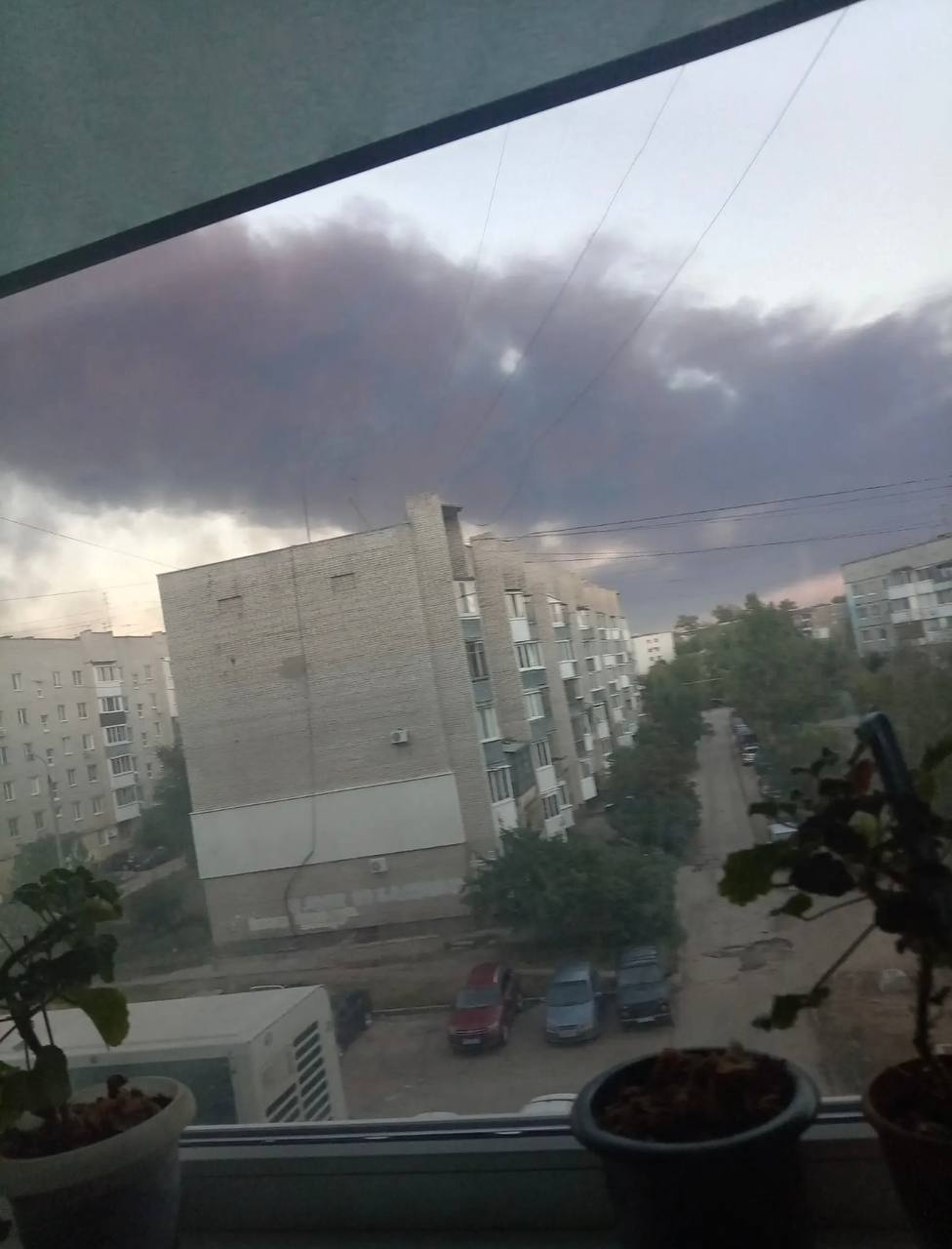
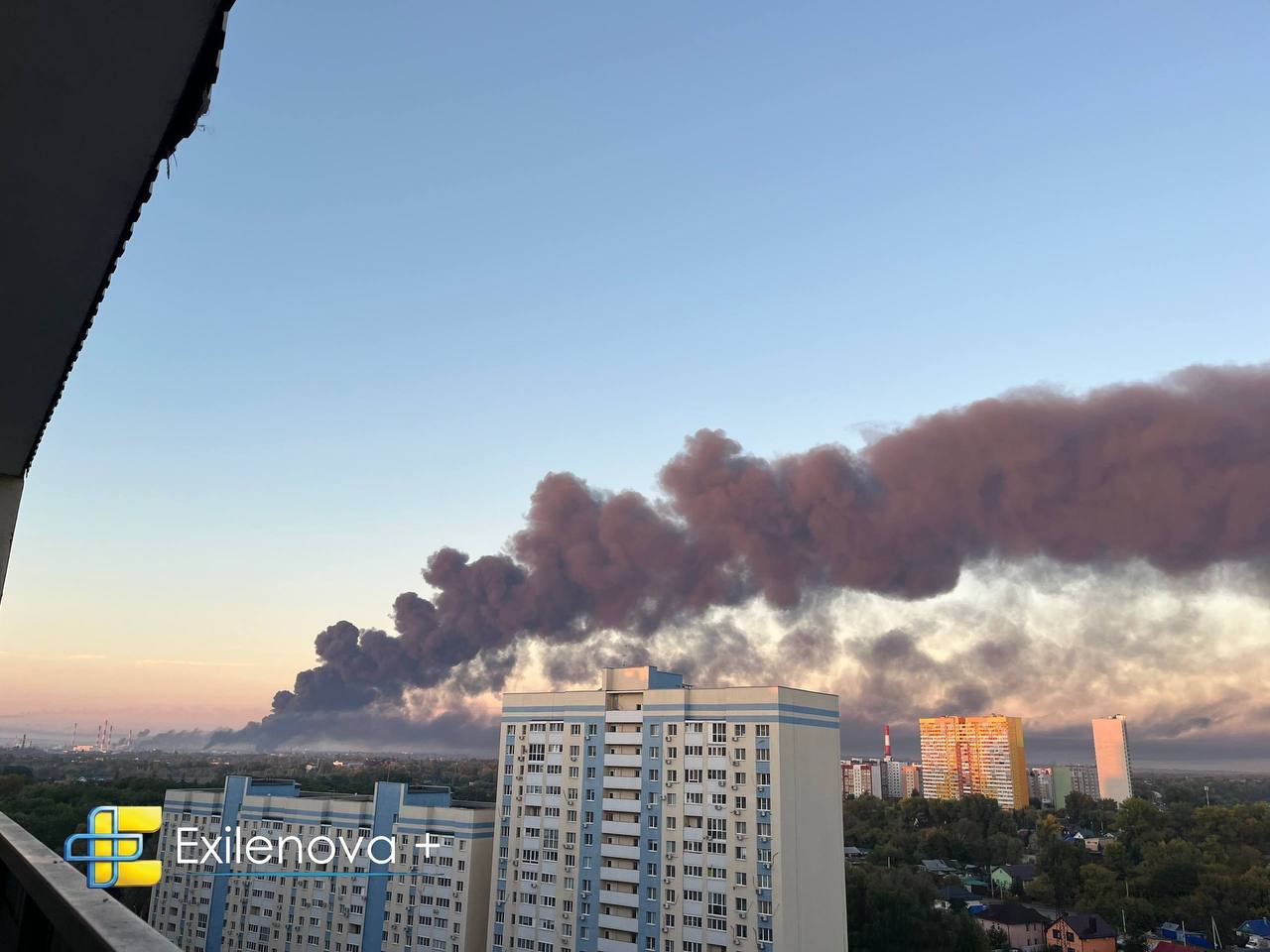
Smoke from the Kuibyshev refinery fire seen from a residential neighborhood in Samara, 22 September 2026. Photo: Exilenova+
In 2024, the plant processed 4.7 million tons of crude and produced about 800,000 tons of gasoline, 1.4 million tons of diesel, and 1.3 million tons of fuel oil.
Ukrainian Telegram channel Exilenova+ began reporting explosions and air defense activity in Samara Oblast at 3:50 a.m. By 4:24 a.m., the channel posted videos showing a night fire at the refinery. OSINT channel World Militaries identified the AVT-5 unit as the initial fire site.
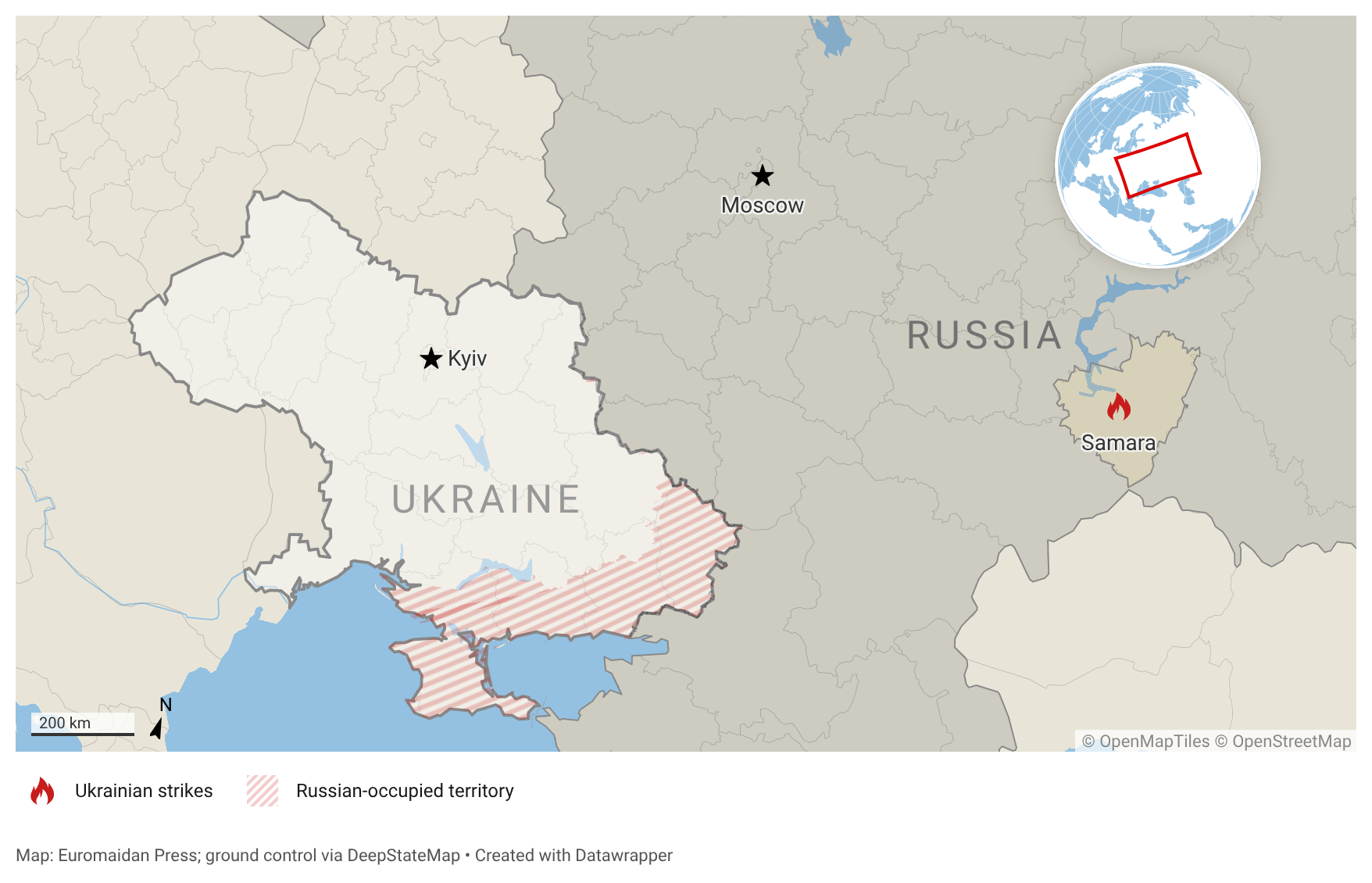
Geolocation of the Samara fire. Source: world.militares / Telegram
Russian news Telegram channel Astra separately confirmed the fire at the Kuibyshev refinery.
By morning, the fire was still burning. The smoke plume stretched about 100 km across Samara Oblast, Exilenova+ reported.
Smoke from the Kuibyshev Oil Refinery in Samara has already stretched for 100 km across Russian territory. pic.twitter.com/U5KQ0v1eTW
The Kuibyshev refinery stopped processing crude in June 2026 after Ukrainian drones hit its AVT-4 and AVT-5 units—the same pair now struck again. Each unit processes about 10,000 tons of crude per day, or roughly 73,000 barrels. The refinery had also suspended operations after a drone attack in August 2025.
Other targets in the overnight wave
Exilenova+ also reported that Ukrainian forces struck a military base in the city of Pochep in Bryansk Oblast overnight, with fire observed at the site. Residents of Tolyatti in Samara Oblast reported explosions, and witnesses suggested the Tolyattikauchuk synthetic rubber plant had been hit, Suspilne reported.
Samara Oblast Governor Vyacheslav Fedorishchev confirmed the attack, claiming Russian air defenses intercepted "dozens of drones." He said drones "targeted industrial enterprises" but did not name which ones. Russia's Defense Ministry claimed 297 Ukrainian drones were intercepted over 14 oblasts and occupied Crimea.
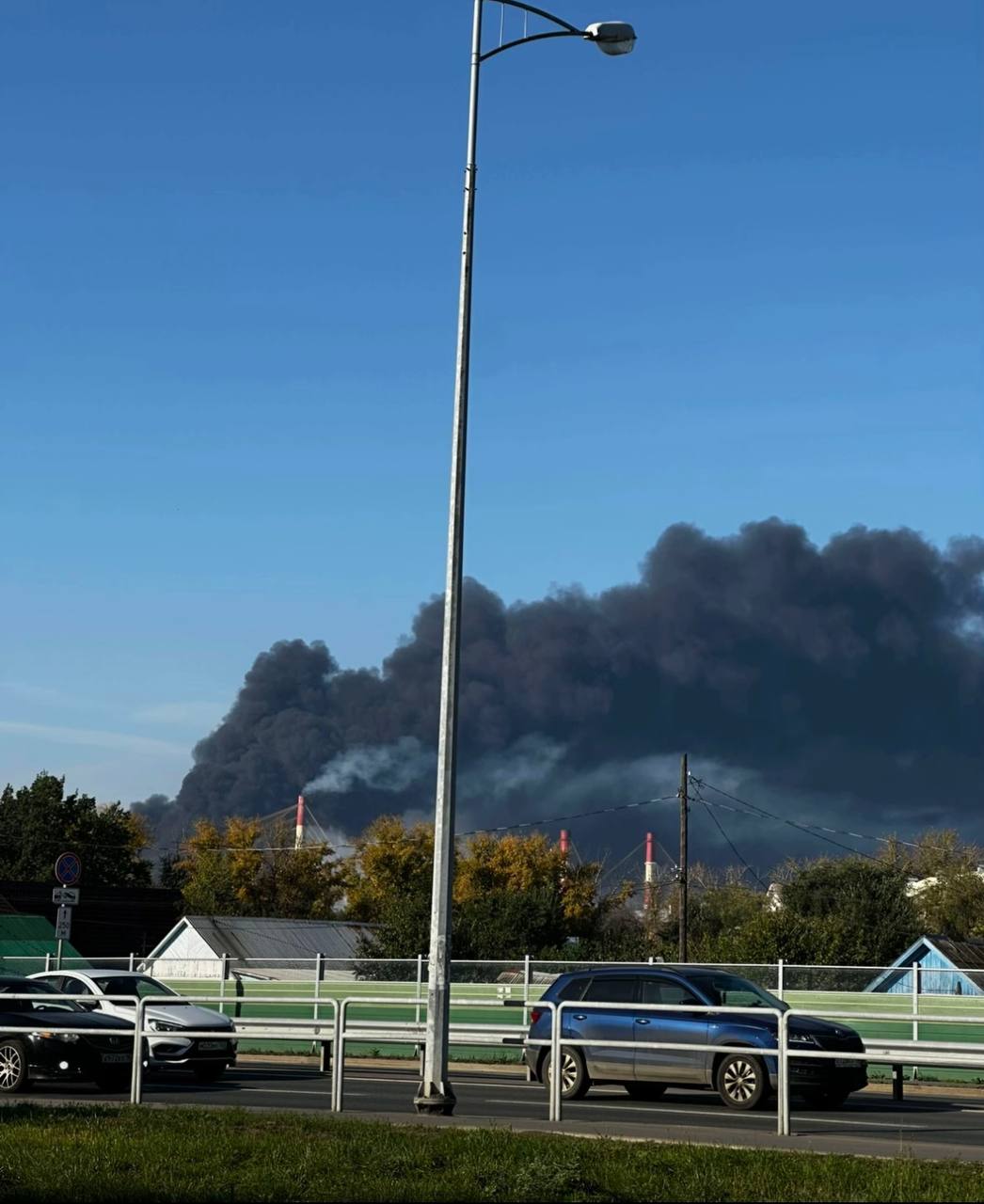
Black smoke from the Kuibyshev refinery fire seen from a highway near Samara, 22 September 2026. Photo: Exilenova+
Part of an ongoing campaign against Russian fuel infrastructure
Ukraine's General Staff confirmed strikes on both the Bashneft-UNPZ refinery in Ufa and the Kuibyshev refinery in Samara, with fire observed at both sites. Ukraine has been striking Russian refineries continuously for months—hitting targets in Saratov and Volgograd on 11 September, Slavyansk-na-Kubani on 14 September, Syzran on 15 September, Yaroslavl on 17 September, and Ufa on 21 September, the night before the Kuibyshev strike. Earlier, the General Staff said the campaign has disabled 45% of Russia's oil-refining capacity. The strikes have also pushed Russia's fuel crisis into Central Asia, where shortages forced Kazakhstan to seek emergency supplies.
Smoke plume from the Kuibyshev refinery fire seen from a high-rise in Samara, 22 September 2026. Photo: Exilenova+
Trump urged Zelenskyy to stop the campaign for the second time in a week during their 21 September call, telling him "don't hit diesel fuel" and blaming Ukrainian strikes—not the Iran conflict—for rising US diesel prices.
Each plant hit again after a previous shutdown means Russia's repair cycle cannot keep up—the forced downtime compounds, diesel exports are already banned, and gasoline production is falling faster than alternative supply from Kazakhstan or anywhere else can replace it.
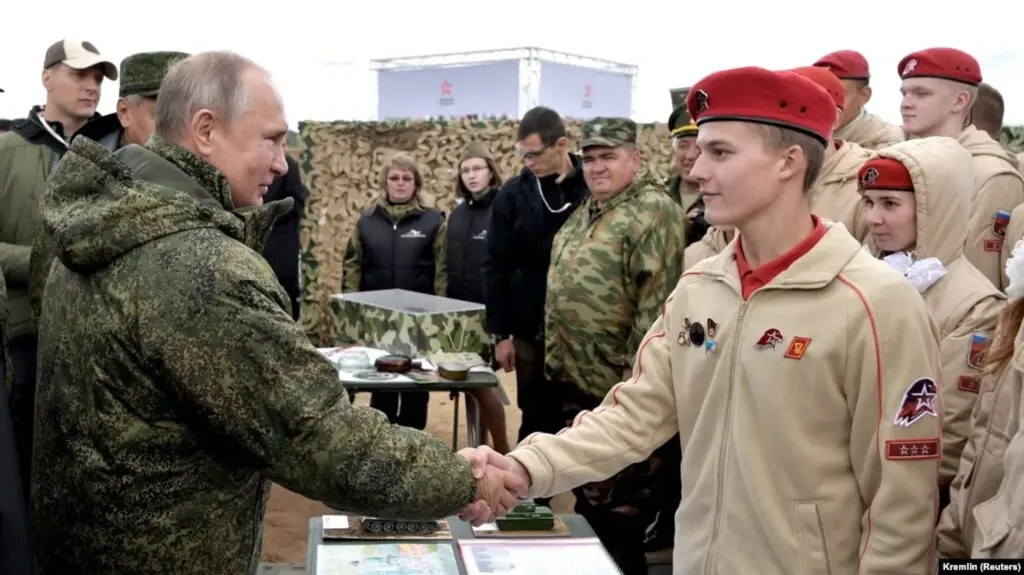
A Kremlin-backed program aimed at primary-school children claims 10,154 participants in occupied Zaporizhzhia, nearly 30 times Yunarmia's 355 members—Russia's uniformed military youth organization—Petro Andryushchenko, head of the Center for the Study of Occupation, said. Cadet classes in the same region account for another 387, according to Andryushchenko.
Yunarmia may represent only a fraction of Moscow’s system for militarizing Ukrainian children under occupation. Movement of the Fir
A Kremlin-backed program aimed at primary-school children claims 10,154 participants in occupied Zaporizhzhia, nearly 30 times Yunarmia's 355 members—Russia's uniformed military youth organization—Petro Andryushchenko, head of the Center for the Study of Occupation, said. Cadet classes in the same region account for another 387, according to Andryushchenko.
Yunarmia may represent only a fraction of Moscow’s system for militarizing Ukrainian children under occupation. Movement of the First, a Kremlin-backed mass youth group covering ages 6 to 18, claims about 65 times Yunarmia's membership in occupied Zaporizhzhia—over 23,000 by the end of 2025, up from about 14,000 a year earlier, according to Andryushchenko's breakdown of the series. A separate infographic in the same series puts the figure at over 19,000. Moscow has sustained the broader campaign throughout the full-scale invasion, combining classroom indoctrination, Kremlin youth movements, military games, and weapons training.
Andryushchenko explains why: Movement of the First is not a military organization, and that is precisely its function—a mass base that enrolls children without their joining any military-patriotic structure, then moves some into specialized programs. Through it, Zarnitsa stopped being a school game and became part of Russia's military-patriotic system. The movement functions as a gateway, not an endpoint.
In Kherson Oblast, the pattern repeated: over 2,700 children and young people passed through Movement of the First events in 2024, and by spring 2025, the registered count had reached 6,200, with primary cells growing from about 70 to 114–115.
From Eaglets to Zarnitsa: programs across occupied Zaporizhzhia
Andryushchenko said Eaglets of Russia, a program aimed at primary-school children aged 6 to 10, claims 10,154 participants across 97 schools and 626 class-teams in occupied Zaporizhzhia, while more than 2,000 children aged 11 to 17 have passed through the Zarnitsa 2.0 military game. In May 2026, children from all four occupied oblasts appeared at a federal Eaglets session alongside children from Russian regions—a sign the occupied territories are already integrated into the system.
He said military-applied instruction now fills about half of the OBZR course, Russia’s “Fundamentals of Security and Defense of the Motherland” subject, in occupation schools. He described a broader system stretching from kindergarten and mass children's organizations through military games and cadet structures to practical training in drones, tactics, weapons, and military medicine.
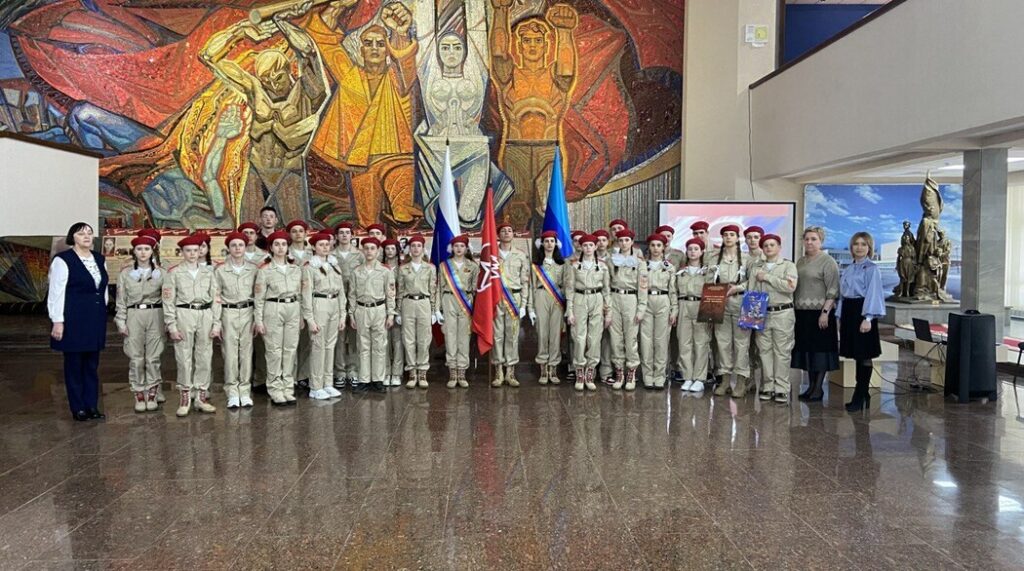
So-called "dedication ceremony for students of Milove secondary school to become members" of Russia's paramilitary organization Yunarmia. Occupied Sorokyne (ex-Krasnodon), Luhansk Oblast, April 2023. Image: lug-info.ru.
Military training center claims thousands across four occupied territories
Beyond Zaporizhzhia, Andryushchenko said the Russian military-sports training center VOIN claims 14,450 trained cadets across four occupied Ukrainian territories in his overview post. A later infographic in the series gives 10,381 for the same four territories, suggesting the figures may count differently.
That cannot be read as a count of children because VOIN programs accept participants aged 14 to 35, according to the Center's own website, and no age breakdown was provided. VOIN says it has trained more than 100,000 cadets across 21 Russian regions overall.
Andryushchenko's post opened a six-part series tracing the system "from first grade to cadet"—though the series itself showed the pipeline actually begins in kindergarten, with "Conversations about Important Things" starting at age 5. Part two, published on 22 September, broke down Movement of the First's role as a gateway, with Zarnitsa 2.0 next. The participation totals cited in his post are claims by Russian-run organizations relayed by the Center. They may overlap, have not been independently verified, and do not show how many individual children participated or whether children move from one program to another.
Luhansk school students wearing the uniform of the so-called "Young Army." 2022. Photo: lug-info
Militarization has continued throughout the full-scale invasion
These latest participation claims are the newest snapshot of a campaign that has expanded steadily throughout Russia’s full-scale invasion. In 2023, occupation schools were already teaching children to use assault rifles and provide battlefield first aid.
By late 2024, Putin had ordered the expansion of military-sports camps and youth indoctrination programs.
Reports published in 2025 and 2026 described mandatory “patriotism” lessons from first grade and documented Ukrainian orphans who entered cadet schools and later appeared in Russian military uniforms.
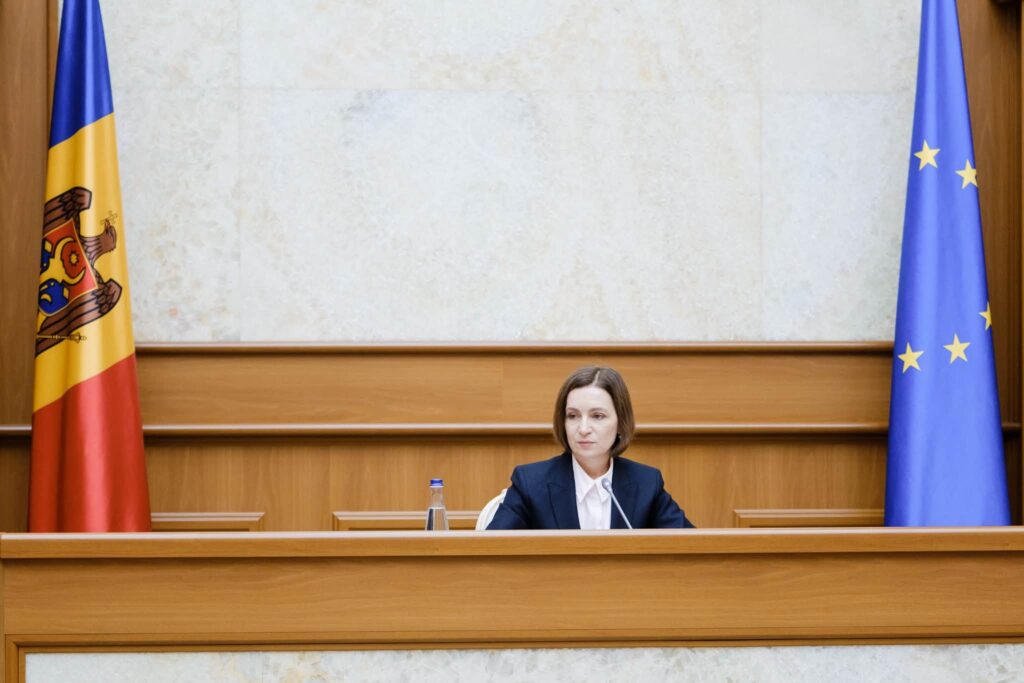
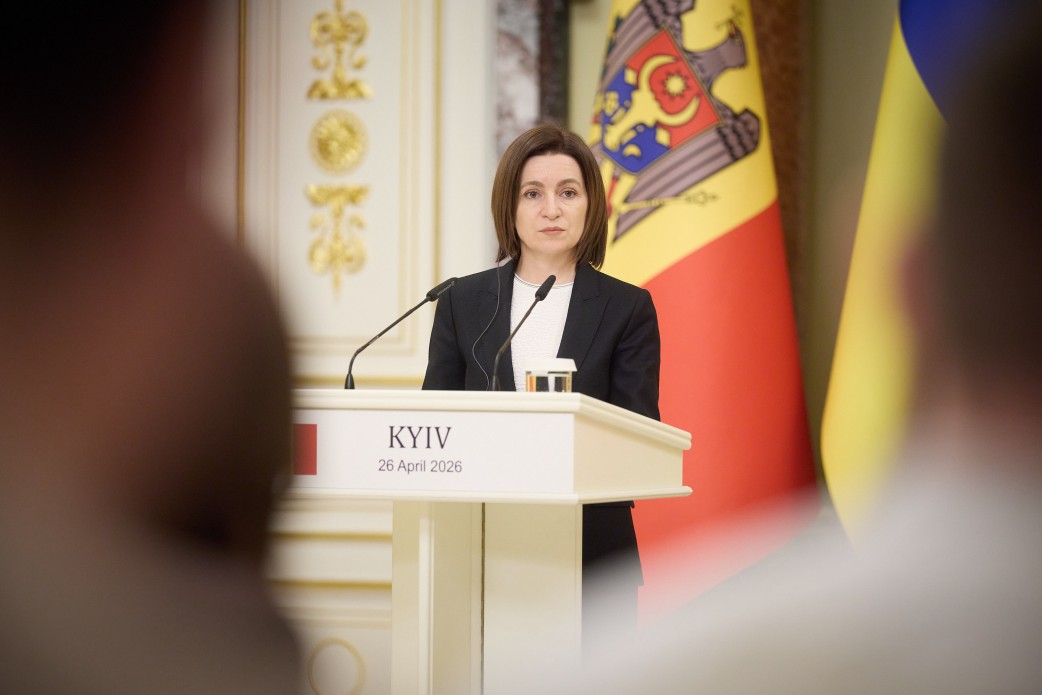
Russian drones have entered Moldovan airspace 39 times since the start of 2026, against 17 in all of last year, President Maia Sandu said after a meeting of the country's National Security Council, Liga reported. Moldova's military can defend individual sites and little more, and Sandu said the country has to speed up building air defenses it spent three decades without. The council also ordered better protection for the energy facilities the country runs on, drones included.
Russia's d
Russian drones have entered Moldovan airspace 39 times since the start of 2026, against 17 in all of last year, President Maia Sandu said after a meeting of the country's National Security Council, Liga reported. Moldova's military can defend individual sites and little more, and Sandu said the country has to speed up building air defenses it spent three decades without. The council also ordered better protection for the energy facilities the country runs on, drones included.
Russia's drone war has outgrown Ukraine's borders, and the countries around it answer with what they have: Poland scrambles jets and extends sirens along its eastern edge, Italian fighters under NATO command downed a Geran over Lithuania, Romanian F-16s shot down three drones over the Danube delta in a single 72 hours. Moldova is the one state in that arc with no alliance behind it and no interceptors of its own, so nothing over its territory stops a drone or costs Russia anything for sending it, which is how a violation hardens into a routine.
What Moldova has to shoot with
Moldovan forces hold portable anti-aircraft missiles, anti-aircraft machine guns, and electronic warfare equipment, Sandu said. Their capabilities are mostly limited to protecting individual pieces of critical infrastructure. Three decades of ignoring air defense will not be paid off in five, she said, and Moldova is working with partners to speed the process up.
The military is now working to extend the range its air defenses cover. Moldova received €120 million from the EU to buy a medium-range system, and it is looking with international partners for more modern and cheaper ways to bring drones down.
Chișinău is also deepening cooperation with countries in the region to receive and pass on threat data faster. Interception is the part Moldova cannot yet do: Romania has shot down drones that reached it after crossing Moldovan territory, while Moldova mostly records them.
Explore further
Moldova is investing in air defense against the Russian drones crossing from Ukraine—Romania shoots down the ones that reach it
A month of incidents
The pace has picked up this month. A drone tracked over Moldova on 8 September held up seven flights, among them Volodymyr Zelenskyy's plane as it took off for King Harald V's funeral in Norway.
Three days later, Moldova temporarily withdrew its staff from three border crossings on Ukrainian territory because of the threat of Russian strikes, after Russia hit at least five of Ukraine's western crossings since late August.
On the morning of 18 September, a loud explosion went off near Chișinău and police found drone wreckage at the site. In August, a blast near the village of Talmaza marked the country's third airspace breach in nine days.
Warning the public is the other gap
Moldova is still building the system that would tell people a drone is overhead. MD-Alert needs more time to implement and is costed at €5 million, Sandu said, and until it works the government will use whatever notification mechanisms it already has.
The council that produced the drone count was convened on energy, and its decisions ran from gas reserves and fuel stocks to cyber vulnerabilities. Among them, Sandu wrote, were measures to better protect the facilities the country's energy supply depends on from hostile action, including the danger of drones.

 Connexion