Vue normale

Forged end-user certificates through eight countries: how one network kept European tech flowing into Russian missiles

10 août 2026 à 16:38

Vienna, the capital of Austria. Credit: UkrInform

Austria has broken up a smuggling network feeding European technology into Russia's missile production. Austria's DSN counterintelligence service has exposed an international scheme that supplied high-tech industrial equipment to defense-industry enterprises linked to the Russian state corporation Rostec, circumventing EU sanctions, Austria's Interior Ministry reported.

The case is one strand of the vast evasion effort keeping Western parts in Russian weapons. Ukraine has documented that Russian missiles like the Iskander still contain hundreds of foreign components reaching Russia through third countries despite sanctions. The Austrian network is one of the channels that made that possible, routing European machinery to Russian arms makers through a web of front companies.

How the network worked

The smugglers hid the real destination behind a chain of countries. To conceal the supply routes, the suspects used a network of companies in Turkiye, the UAE, Hong Kong, Belarus, Kyrgyzstan, South Korea, Poland, and Lithuania, providing European manufacturers with forged end-user certificates claiming the goods would remain in third countries.

The equipment went to Russian weapons production. According to a preliminary investigation, it was used to make engines for cruise missiles and combat aircraft, among other military hardware, according to the ministry.

"It is unacceptable that high-precision European technologies find their way through roundabout paths into the production of cruise missiles and air-defense systems," Interior Ministry State Secretary Jörg Leichtfried said.

The scale and the arrests

The trade ran for years and moved millions. Purchases of industrial goods for Russian military users date back to 2019, and after sanctions tightened, the routes were redirected through third countries, primarily Hong Kong and Turkiye, with confirmed deliveries to Russian defense firms worth nearly $3.9 million since 2022.

The arrests followed searches. On 20 August 2025, police searched four sites and seized about 40 data carriers. On 13 May 2026, they detained a 28-year-old Belarusian citizen, a company director and co-owner, seizing sanctioned CNC machines and tools worth nearly $164,000. The suspect is in custody.

Part of a wider fight

DSN framed the bust as one battle in a continuous effort. The case shows the lengths to which international networks go to circumvent sanctions, DSN director Sylvia Mayer said.

The bust is a rare visible enforcement action against a problem Ukraine names constantly: that Russia's weapons still run on Western technology, reaching its factories through exactly this kind of third-country laundering. Each dismantled network closes one route, but demand keeps opening others.


A $20,000 “welcome bonus” that was never paid: how a Colombia-registered recruiter sent Peruvians into Russia’s war

10 août 2026 à 14:58

Illustrative photo. The flag of Peru. Photo: Getty Images

On 9 August, Peru's foreign ministry officially reported that 459 Peruvians had been recruited into the Russian army. Of these soldiers, 11 have been killed, 114 are missing, and three have been captured by the Ukrainian army. Another 31 Peruvians were evacuated: three of them chose to stay in Europe, and the rest returned home.

As of 29 April 2026, Russia had drawn in at least 27,000 foreign nationals from more than 130 countries to take part in its war against Ukraine, the International Federation of Human Rights reports. The Peru case is part of Russia's systematic recruitment of foreigners into its military, often through deception. Some men were offered civilian jobs or roles far from the front, only to end up in the thick of the fighting.

Relatives of the recruited men held demonstrations in Peru

On 29 April 2026, relatives of men recruited into the Russian army demonstrated outside Peru's foreign ministry in Lima, urging the authorities to help bring their family members home, according to SwissInfo.

Relatives of Peruvians affected by Russia's war against Ukraine demand urgent repatriation. 2026. Photo: Carlos Félix/LR

On 30 April, the Russian embassy in Peru responded that it agreed some Peruvian men were taking part in the war on Russia's side, but said this was their own voluntary choice. La República, however, reports that before leaving for Russia, the men were made to sign papers in Russian.

On arrival, their documents were taken, after which they underwent brief military training and were ultimately sent to the front. According to media reports, most were former military and police personnel lured by promises of jobs as security guards or civilian specialists, with salaries of $2,600–4,000 a month and bonuses of up to $20,000.

A “rear position” — until it isn’t

First, recruiters promise foreigners high salaries, signing bonuses, and “rear” or civilian positions. Debt traps and threats of deportation are also used. They lure people even through video games and chats. Once in Russia, recruits are forced to sign contracts, after which their documents are confiscated to keep them at the front. The contracts are often written in Russian, a language the foreign recruit does not understand.

Instead of the promised “rear positions,” recruits are thrown into infantry “meat assaults” after just a few days or a week of training. Mercenaries are killed while carrying out missions, while the wounded are often left on the battlefield without evacuation. Some men go missing or flee. Russia treats foreign mercenaries as “expendable labor,” according to leaked recordings cited by Radio Free Europe/Radio Liberty.

This is not an isolated case

Facing losses that now outpace its own mobilization, Russia has turned to citizens of other countries to keep its ranks filled in its war against Ukraine.

Kenya has become one of the largest sources of people recruited through deception. At first, Nairobi believed the number was only a few hundred, but the scale proved much larger. Nairobi thought Russia had recruited around 200 Kenyan citizens, but a new report says the figure is over 1,000. The scheme relied on fake job and education offers, after which recruits had their documents confiscated to keep them on the front line. The European Parliament found that Russia confiscates African recruits' documents and sends them to the front line in Ukraine.

In Cuba, recruiters promised people lucrative jobs, only to lure them into a trap. A Cuban captured near Kupiansk said he joined Russia's war effort under threat of deportation. The scale of the recruitment has been enormous. Ukrainian intelligence estimates that around 20,000 Cuban mercenaries have fought on Russia's side against Ukraine.

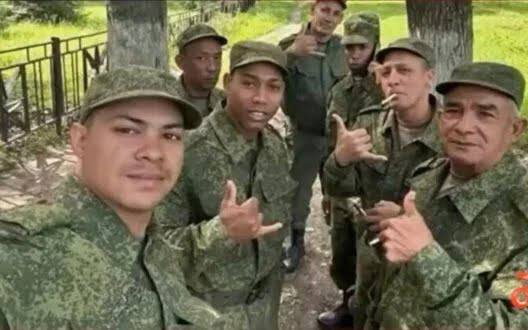
ukrainian intel nearly 20000 cuban mercenaries fighting russia’s side against ukraine nationals wearing russian military uniform 2023 video x/pstyle0ne1 florida lawmakers officials highlighted threat regional security news reports
Cuban nationals wearing Russian military uniforms. 2023. Screenshot from a video, via X/PStyle0ne1

The Philippines case shows what awaits the recruited at the end of this pipeline. Ukrainian military intelligence identified a Filipino named John Patrick among Russian soldiers killed in Donetsk Oblast. He was sent into a "meat assault" after just one week of training. He did not speak Russian and carried only a piece of paper with his unit number and his commander's name. After he was wounded, he was left to die in a tree line without evacuation, and Ukrainian intelligence warned that any work in Russia now carries a real risk of forced deployment into an assault unit. The deception relied on promises of high salaries, non-combat positions in the rear, and fast-tracked Russian citizenship, after which recruits were sent into infantry assaults.

“What happens here affects next 50 years”: why American left Pennsylvania to fight in Ukraine’s 47th Brigade

10 août 2026 à 11:32

"Lighthouse", a soldier in the 47th Brigade's reconnaissance company. Source: Magura

An American volunteer who left Pennsylvania to fight for Ukraine believes the outcome here will shape the world for half a century. "Lighthouse", a soldier in the reconnaissance company of the 47th Separate Mechanized Brigade, came to Ukraine from Pennsylvania, the brigade shared.

Lighthouse is one of thousands of foreigners fighting for Ukraine. Since Ukraine created the International Legion in 2022, volunteers from more than 50 countries, including the US, Britain, and Canada, have joined its ranks, and Lighthouse, a scout from Pennsylvania, is one American who traced the war to its roots and decided to come.

What brought him to Ukraine

The full-scale war in 2022 unsettled him and prompted him to research its causes, which took him back to where the war began. He traced it to the Revolution of Dignity of 2013 and 2014, when Ukrainians drove out a pro-Russian president. Then, Russia responded by seizing Crimea and igniting the war in the east.

"I understood pretty quickly that Ukraine was in a position to be fighting the good fight, and that Russia was being Russia, basically," he said.

He did not leave on impulse. He got in shape, went to the gym, and saved money, but the hardest part was his marriage: putting aside enough that his wife would be secure while he was gone, and making sure she was mentally prepared and would feel supported. She understood his reasoning, he said, and told him, "I support you. I support what you're doing."

Why did Lighthouse choose the 47th?

He chose the brigade carefully. He researched many units and contacted several recruiters before choosing the 47th, which has attracted a substantial foreign contingent, including a mostly Colombian reconnaissance-and-strike group.

What settled his choice was the people. He was able to talk to the men in his squad before he even came, and they would call him every few days.

"Hey, man, how are you doing? Do you need any help figuring out your schedule, or what to bring?" Lighthouse recalled.

They became friends before he got there. Ukraine has felt like home since, he said, a gorgeous place whose people are welcoming and proud of everyone who fights for their country.

He sees the war as the world's fight

For Lighthouse, the stakes reach far beyond Ukraine.

"What happens here now affects the rest of the world and potentially the future for the next 50 years," he said, which is why it matters to him that Ukraine can remain a democracy and stand up to the aggression.

He is not the first American in the 47th to say so. In May, the brigade profiled "Forrest", a 28-year-old North Carolina construction worker who followed the war since 2014 before enlisting and told others, "If you want to fight, go to the 47th."

July was Ukraine’s deadliest month for civilians since 2022 — and Russia is scaling its ballistic missile salvos toward 200 at once

10 août 2026 à 09:05

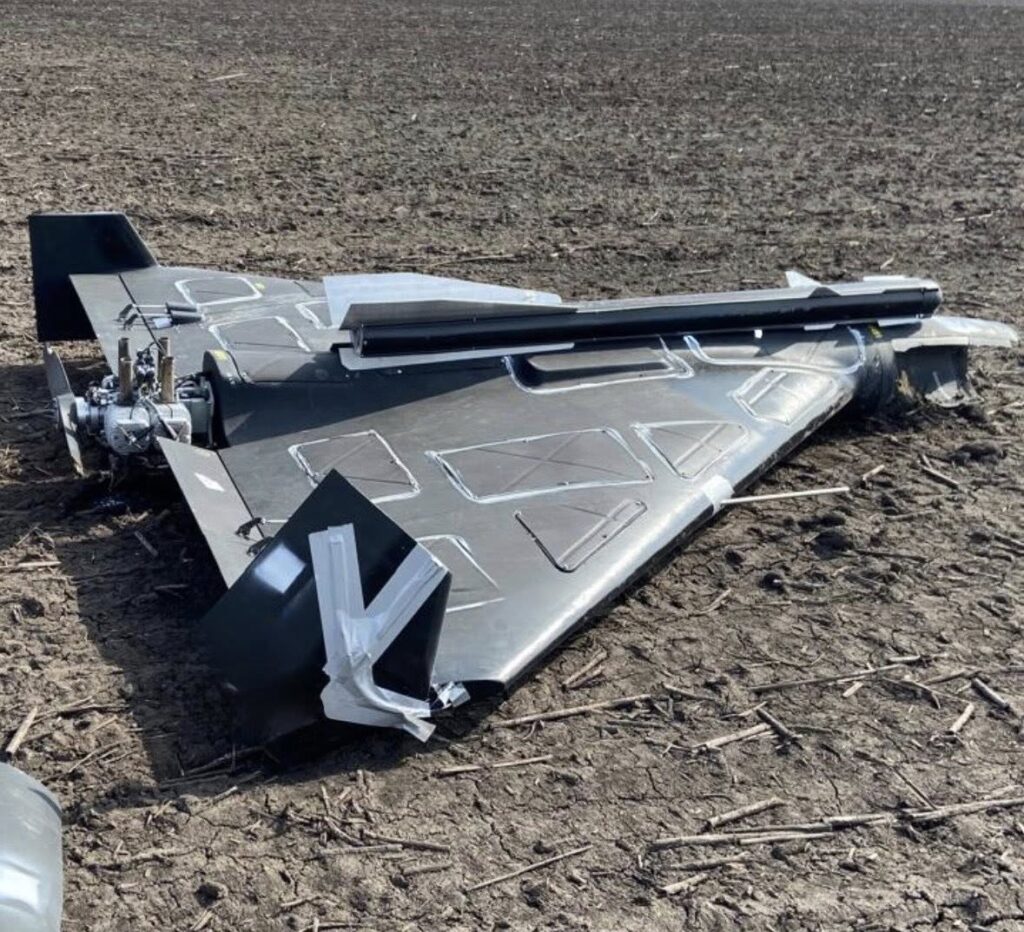
Shahed R-60 missile decoy Flash

Russia can currently fire a simultaneous salvo of 77 ballistic missiles, and it aims to lift that ceiling to 200. Robert "Magyar" Brovdi, who commands Ukraine's Unmanned Systems Forces, told the Associated Press. He called the plan one of Ukraine's gravest weak points.

Kyiv's only reliable shield against ballistic missiles is the US-made Patriot, and its interceptor stocks are critically low. During mass barrages, dozens of warheads therefore slip through and reach their targets. Only a handful of countries can build such interceptors, and all are short, defense analysts have warned. The AP, for its part, could not independently verify Brovdi's numbers.

Ballistic missiles remain the hardest to stop

That shortfall has already turned lethal. Intensified strikes made July the deadliest month for Ukrainian civilians since April 2022, the UN human-rights office in Ukraine documented. Air defenses downed just 29 of the 195 ballistic missiles Russia fired that month, roughly 15%. Another 40 fell short on their own. Yet the largest single-night launches recorded so far run to only a few dozen. That is well below the salvo of 77 that Brovdi describes, and a fraction of the 200 Moscow is reaching for.

"Even if they only manage half of that, it will all be flying at us."
- Robert "Magyar" Brovdi, commander, Ukraine's Unmanned Systems Forces

Production running ahead of plan

His warning tracks Ukrainian intelligence. Russia's defense industry is overfulfilling its monthly targets, hitting 110% to 120% on the main missile types. So said Deputy Military Intelligence Chief Vadym Skibitskyi in an interview with RBC-Ukraine. He put July output for the Kh-101 cruise missile at 140% of plan, the Kalibr at 111%, and the Kh-35 at 200%. A pause in strikes, he judged, is unlikely.

The pivot to jet-powered drones

Moscow's factories are also retooling around drones. Russia plans to assemble 11,000 strike drones of various types in August 2026, Skibitskyi said. That mix spans the Geran-1 through Geran-5, the Harpia, and several Gerbera variants. Output dipped in July as the industry shifted toward the turbojet Geran-4 and Geran-5.

Those jet models fly faster and demand different interceptors or short-range air defense. They already made up half of one recent attack. The concentration of jet-powered Shaheds, meanwhile, has climbed 2.5 times in recent weeks, Brovdi added. Taken together, the assessments point one way: more missiles and faster drones, launched in larger waves, against defenses Ukraine is scrambling to rebuild.

  • ✇Euromaidan Press
  • ISW: Russia strikes the Mayaki bridge linking southern Ukraine to Romania and Moldova
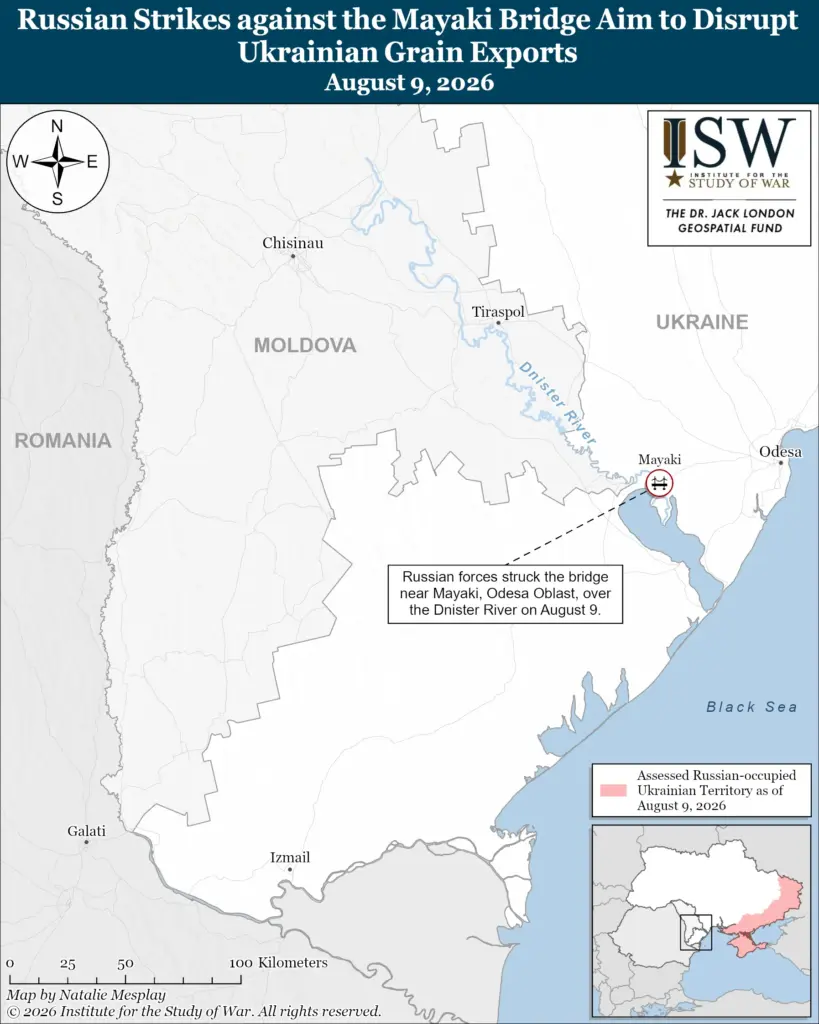
    Russian forces struck the Mayaki bridge on the M-15 highway on 9 August, the Institute for the Study of War reported. The strike severed a road link that ties southern Ukraine to Moldova and Romania. That Odesa–Reni route crosses the Dniester and feeds the Danube ports. Those ports have become Kyiv's main export outlet since Russian strikes crippled its Black Sea shipping. Conflicting claims over the Mayaki bridge Russian milbloggers reported the attack, though their
     

ISW: Russia strikes the Mayaki bridge linking southern Ukraine to Romania and Moldova

10 août 2026 à 06:51

ISW

Russian forces struck the Mayaki bridge on the M-15 highway on 9 August, the Institute for the Study of War reported. The strike severed a road link that ties southern Ukraine to Moldova and Romania. That Odesa–Reni route crosses the Dniester and feeds the Danube ports. Those ports have become Kyiv's main export outlet since Russian strikes crippled its Black Sea shipping.

Conflicting claims over the Mayaki bridge

Russian milbloggers reported the attack, though their accounts diverged sharply. One claimed that Russian forces had destroyed the span. Others published footage purporting to show that it still stands. A local outlet serving nearby Izmail reported on 9 August that the strike damaged the crossing. Ukraine's State Border Guard Service separately confirmed that authorities briefly restricted traffic on the route. Moscow had already targeted the same structure in December 2025.

Why the land corridor matters

Russia likely hit the Mayaki bridge to choke Ukrainian grain exports, ISW assessed. Those exports now move through a land corridor that Kyiv has leaned on since strikes disrupted its maritime routes. Moscow has steadily intensified this campaign since July 2026. Navy Spokesperson Captain Third Rank Dmytro Pletenchuk offered one measure on 31 July. He said Russian strikes had damaged more than 20 ships near the Black Sea and sharply slowed cargo flows. Meanwhile, the country's main farmers union weighed in on 15 July. The Ukrainian Agri Council estimated that Russian attacks had cut about a third of Ukraine's grain-export capacity.

Minister of Agrarian Policy and Food Taras Vysotskyi has described the fallout. He said the strikes are forcing Kyiv to reroute grain and cargo through the Danube River. Russia used the same playbook in July 2023. Back then, then-Minister Mykola Solskyi reported that strikes destroyed 60,000 tons of grain at Chornomorsk port overnight on 19 July. Therefore, ISW concluded, Russia is likely shifting its strikes from the sea corridor to the land corridor. The aim, analysts wrote, is to block grain exports and weaken Ukraine's wider economy.

Russian forces are likely shifting their strikes from Ukraine's sea corridor to its land corridor to block grain exports and degrade the economy. — Institute for the Study of War

Türkiye floats a Black Sea moratorium

Turkish Foreign Minister Hakan Fidan raised a separate track on 9 August. He said Ankara had proposed a Russian–Ukrainian moratorium on strikes against merchant ships in the Black Sea. Both Moscow and Kyiv have received the offer, Fidan added, and Türkiye now awaits their response.

Drones strike Russian oblasts overnight: thick smoke over a Nizhnekamsk refinery as Crimea’s Krasnoperekopsk industrial zone burns

10 août 2026 à 06:03

makiivka

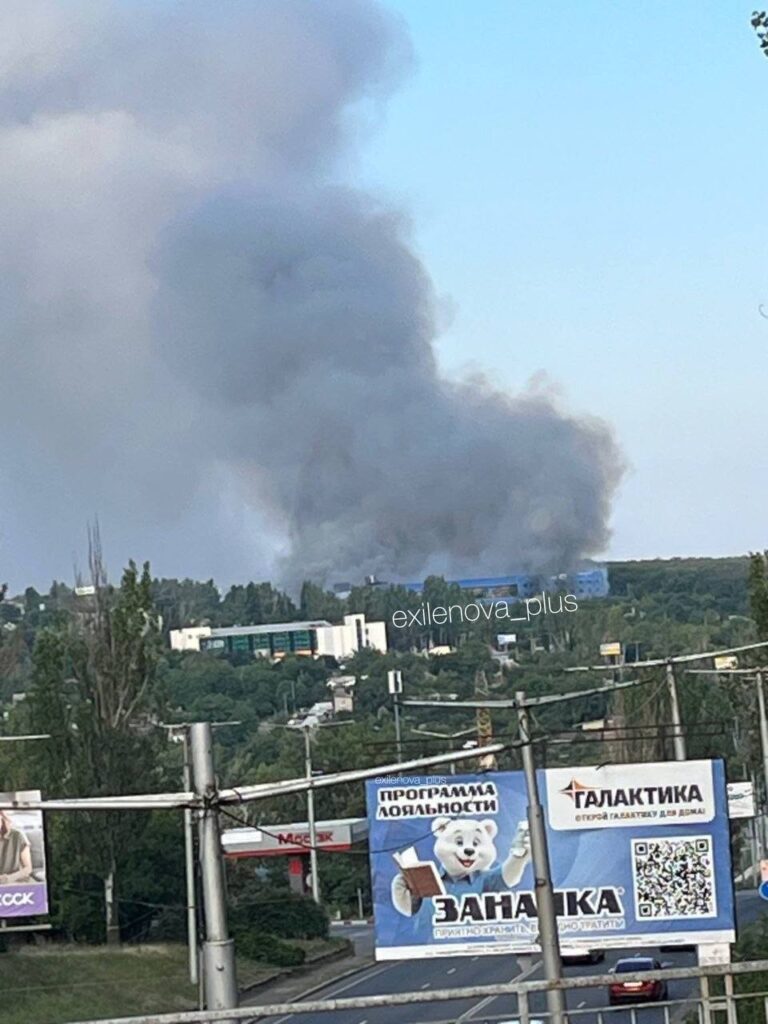
Drones struck several Russian oblasts overnight into 10 August. A probable strike hit a Nizhnekamsk refinery in the Republic of Tatarstan, while fires spread across occupied Crimea. Local Telegram channels and Ukrainian monitoring groups reported the attacks. Kyiv has not claimed them, and the damage stays unverified.

Thick smoke over the Nizhnekamsk refinery cluster

Residents of Nizhnekamsk reported explosions on the morning of 10 August. Footage online showed drones crossing the city, with dense black smoke above one district, local channels said. Which Nizhnekamsk refinery took the hit stayed unclear. The city hosts two major plants — the TAIF-NK and TANECO complexes.

TAIF-NK processes 7.3 million tons of crude and 1 million tons of gas condensate a year. Its 49 products include AI-92 and AI-95 gasoline, diesel, and jet fuel. TANECO belongs to the Tatneft group. It ranks among Russia's largest and most advanced refineries. Its design capacity exceeds 16 million tons of crude a year.

Ukraine's Defense Forces struck both TANECO and TAIF-NK on 12 June, the General Staff confirmed. Ukrainian units hit the same cluster again in July.

Fires flare in occupied Crimea's Krasnoperekopsk

Explosions rocked Krasnoperekopsk — known in Ukrainian as Yany Kapu — overnight. Numerous fires burned by morning, the monitoring channel Crimean Wind reported. Around 7 blasts sounded between 2 and 3 a.m. Subscribers described a fire behind the railway station in the industrial area.

By the morning of 10 August, NASA's FIRMS satellite system flagged multiple heat signatures there, Crimean Wind said. The hotspots clustered in the town's southern industrial zone. Russian forces store and repair equipment in the area, the channel added.

Drones also crossed Sevastopol. Residents heard aircraft and gunfire near the Balaklava thermal power plant. The Russian-installed governor, Mikhail Razvozhaev, claimed 15 drones fell, mostly over the sea. He admitted, though, that falling debris ignited a forest fire near Inzhir beach and forced a campsite evacuation. A blast in Simferopol briefly cut power around 4 am before supply returned.

Moscow and Rostov cite downed drones

In the capital, Mayor Sergei Sobyanin said air defenses downed 13 drones approaching Moscow overnight. He gave no details on any consequences. Over Rostov Oblast, Governor Yuri Slyusar said more than 70 drones destroyed. Information on casualties and damage was still coming in, he said.

Both counts reflect Russian air-defense claims rather than independently confirmed strikes.

Overnight, Russia's aviation authority Rosaviatsia restricted takeoffs and landings at Begishevo airport in Nizhnekamsk. The curbs also covered 14 other airports, among them Kazan, Ufa, Samara, and Moscow's Domodedovo and Vnukovo.

❌