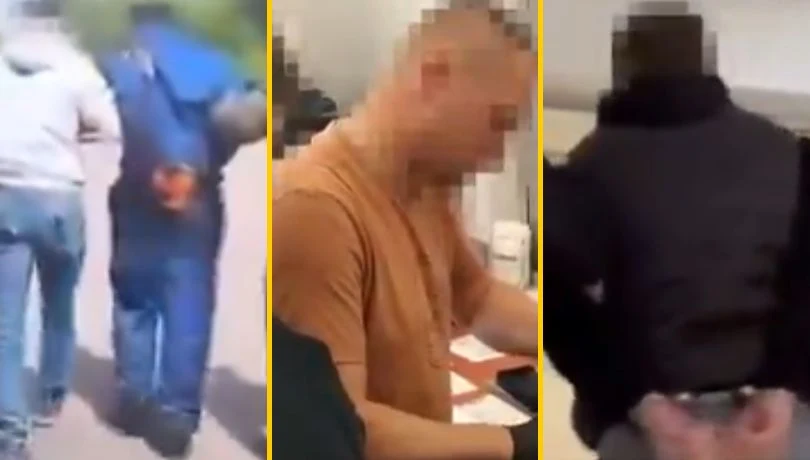
Signal relays in Belarus that helped Russia steer Shahed drones into Ukraine have stopped working. The equipment went dark on 22 June, days after Kyiv gave Belarusian ruler Aliaksandr Lukashenka a week to remove it, though it is unclear whether it was dismantled or simply switched off, President Volodymyr Zelenskyy told journalists, per UNIAN.
The relays extend Russia's reach. Repeaters placed on Belarusian towers and rooftops boosted the control signal for Shaheds flying
Signal relays in Belarus that helped Russia steer Shahed drones into Ukraine have stopped working. The equipment went dark on 22 June, days after Kyiv gave Belarusian ruler Aliaksandr Lukashenka a week to remove it, though it is unclear whether it was dismantled or simply switched off, President Volodymyr Zelenskyytold journalists, per UNIAN.
The relays extend Russia's reach. Repeaters placed on Belarusian towers and rooftops boosted the control signal for Shaheds flying the northern route, letting them hit targets across Kyiv, Rivne, and Volyn oblasts that Russia struggles to reach from its own soil.
Some strikes on Ukrainian energy and railway sites would not have been possible without that help, Zelenskyy has said. Ukraine exposed and dismantled one such network in February, yet Russia kept adapting.
Relays went dark on 22 June
Zelenskyy said the equipment fell silent this week.
"Whether they dismantled them or not, I honestly do not know yet. But we are working on it, I am watching closely, and getting daily reports. The fact is the relays are not working today," he said.
He stopped short of claiming credit or naming a cause.
Kyiv set deadline first
The silence followed an ultimatum. On 19 June, Zelenskyy gave Lukashenka one week to strip the Russian repeaters from Belarusian border towers and warned that Ukraine would act if Belarus did not.
The relays went quiet on 22 June, before the week was up. Lukashenka had apologized to Zelenskyy earlier in June and pledged Belarus would stay out of the war, though Kyiv treats the country-level threat as unresolved.
Russia keeps shifting tactics
Even without the towers, Russia has other ways to guide its drones along the border. It has drifted signal-relay balloons from Belarus into Ukrainian airspace and fitted Shaheds with SIM cards that latch onto Belarusian, Polish, and Romanian networks when Ukraine blocks its own.
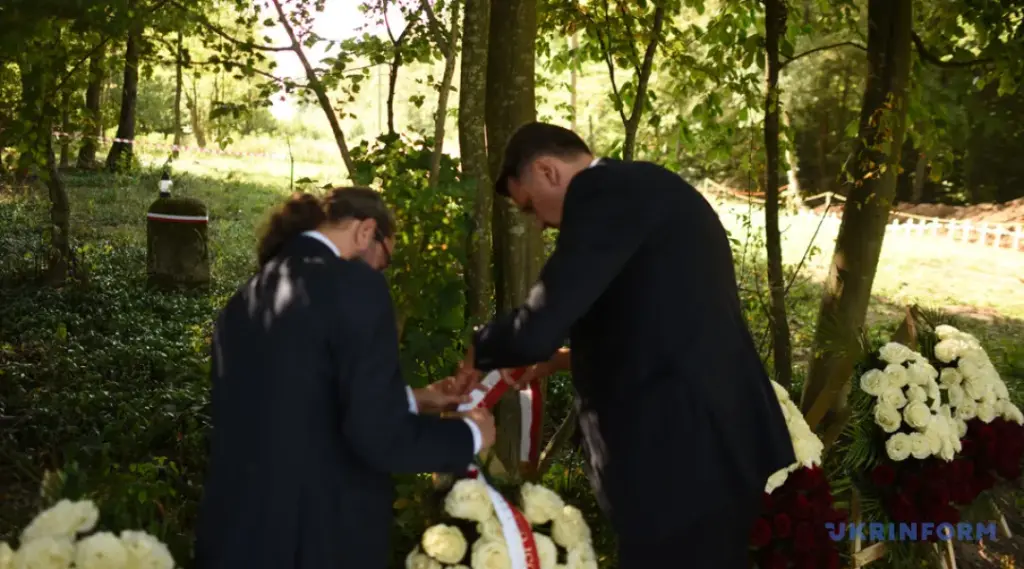
More than 24 Polish and Ukrainian civil society organizations have signed a joint open letter calling for dialogue amid historic grievances between the countries, which have already affected the current agenda, UkrInform reports. The letter addressed to the authorities of both countries calls for "responsibility, constructive dialogue, and mutual respect."
The current Polish-Ukrainian historical dispute centers on Ukrainian President Volodymyr Zelenskyy's 27 May decis
More than 24 Polish and Ukrainian civil society organizations have signed a joint open letter calling for dialogue amid historic grievances between the countries, which have already affected the current agenda, UkrInform reports. The letter addressed to the authorities of both countries calls for "responsibility, constructive dialogue, and mutual respect."
The current Polish-Ukrainian historical dispute centers on Ukrainian President Volodymyr Zelenskyy's 27 May decision to confer the honorary title "named after UPA Heroes" on the Separate Center of Special Operations "Pivnich" of Ukraine's Special Operations Forces. The Polish Foreign Ministry condemned the decision.
The Ukrainian Insurgent Army (UPA) is a contested figure in Polish-Ukrainian historical memory. Ukrainian historiography presents UPA as anti-Soviet and anti-Nazi independence fighters. Polish historiography emphasizes UPA's association with the 1943-44 Volhynia massacres.
Letter argues divisions weaken European security
The letter argues that "any divisions, misunderstandings, and mutual accusations between our peoples play into Russia's hands," positioning civil society as a counterweight to escalating tensions at the government level between Warsaw and Kyiv.
It notes that Polish and Ukrainian civil society have, since the start of Russia's full-scale war, organized humanitarian aid, refugee reception, and support for war-affected families, children, students, veterans, and the families of fallen soldiers.
"We do not allow divisions to win where solidarity has won. Together we were strong. Together we are strong. Together we can be even stronger," the letter says.
The signatories include Fundacja "Tarcza dla Ukrainy," Fundacja "Solidarność bez Granic," the Komitet Obrony Demokracji (KOD), Fundacja Otwarty Dialog, Ciepło z Polski, Sestry.EU, Ukraine SOS, the Maidan Monitoring Information Center, and 17 other foundations and civic initiatives.
The letter remains open to additional signatories from foundations, NGOs, academic communities, youth organizations, local self-government, and public figures in both countries.
Civil society pushback joins parallel media appeal and Ukrainian polling
The civil society letter sits alongside a parallel joint appeal from Polish and Ukrainian media outlets published the same week. On 23 June 2026, editorial boards from Gazeta Wyborcza, Pisma, Espreso, ZN.UA, and the Association of Independent Regional Publishers of Ukraine (ANRVU) co-signed a joint statement urging both societies to resist political escalation, per European Pravda.
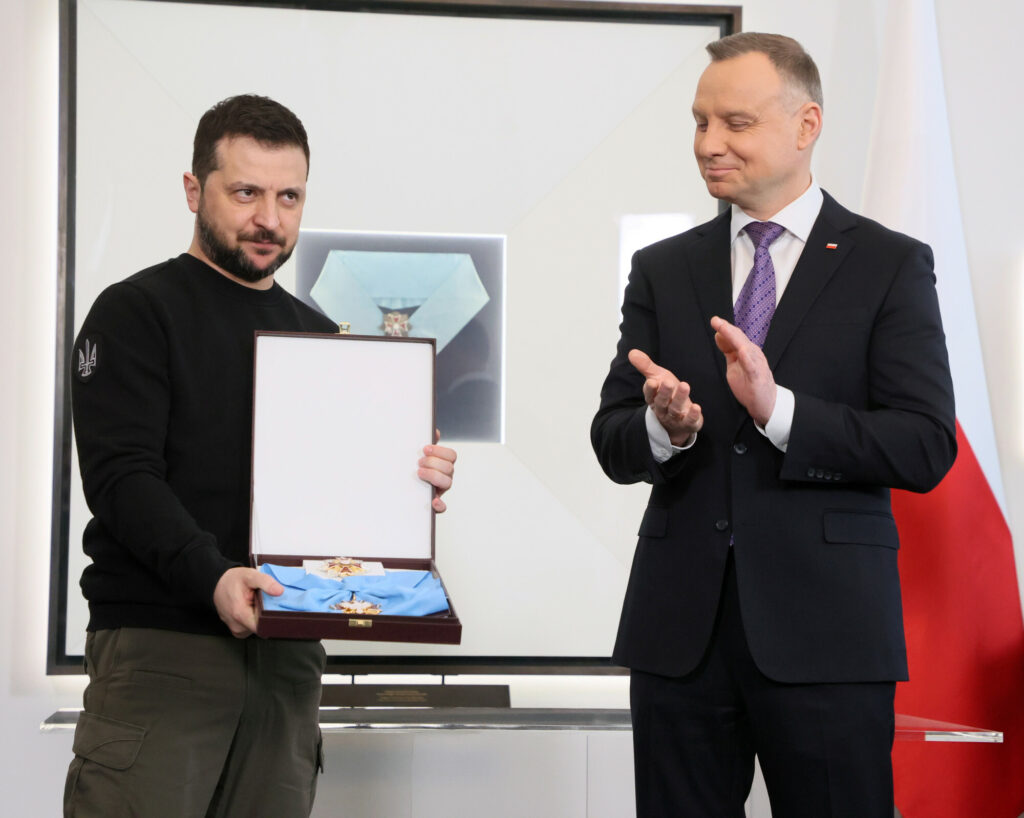
President Volodymyr Zelenskyy has returned Poland’s highest honor to Warsaw, with the office of Polish President Karol Nawrocki confirming that the Order of the White Eagle arrived on 22 June. It will now be placed in a sealed archive, preserved but never awarded again.
The handover turns what began as a one-sided snub into a mutual rupture between two wartime allies, and a lasting one. Poland remains Ukraine’s lifeline: Rzeszów is still the main hub for Western arms de
President Volodymyr Zelenskyy has returned Poland’s highest honor to Warsaw, with the office of Polish President Karol Nawrocki confirming that the Order of the White Eagle arrived on 22 June. It will now be placed in a sealed archive, preserved but never awarded again.
The handover turns what began as a one-sided snub into a mutual rupture between two wartime allies, and a lasting one. Poland remains Ukraine’s lifeline: Rzeszów is still the main hub for Western arms deliveries, and Warsaw helps shape Kyiv’s path toward the EU. A rift between the two serves only Moscow. Euromaidan Press traced the broader trend of anti-Ukrainian sentiment in Poland.
A Ukrainian was among the White Eagle's first recipients
The move is striking partly because Poland rarely revokes the Order of the White Eagle. Nawrocki’s chancellery acknowledged that the Order of the White Eagle still appears in state records alongside the names of Catherine II, who helped wipe Poland off the map in the 18th-century partitions; Benito Mussolini; and former German Chancellor Gerhard Schröder. Warsaw left the honor untouched in all three cases. Zelenskyy is the exception Nawrocki chose to make.
History adds its own irony. Among the order’s first recipients after its founding in 1705 was the Ukrainian hetman Ivan Mazepa — a detail Radio Svoboda revisited under a headline joking that history keeps laughing at Nawrocki. It wondered whether Mazepa himself might refuse the decoration today, in solidarity with the presidents now handing theirs back.
What Warsaw will do with the medal
Nawrocki’s spokesman, Rafał Leśkiewicz,said on Polsat News that the insignia and annulled certificate will be placed in the orders bureau’s deposit for permanent storage, with the dignity befitting Poland’s highest distinction. The medal itself will never be awarded to anyone else: a single retired piece, not one passed on.
The act is not yet final. The formal order still needs the countersignature of Prime MinisterDonald Tusk, whose government supports Ukraine’s EU accession. Leśkiewicz played down talk of escalation, pointing to Nawrocki’s line that the move targets a cult of history, not Ukrainians, and that Russia remains the enemy of both Ukraine and a free Europe.
Ukraine's leaders give back their Polish honors
The return of awards has gone both ways. On 20 June, Ukraine’s second, third, and fifth presidents, Leonid Kuchma, Viktor Yushchenko, and Petro Poroshenko, renounced their own White Eagles. Within days, the wave had reached serving officials: Foreign Minister Andrii Sybiha, Presidential Office chief Kyrylo Budanov, his deputy Ihor Zhovkva, Ukraine’s ambassador to Warsaw Vasyl Bodnar, and former Prime Minister Volodymyr Groysman.
The sharpest response came from Sybiha. He warned that Kyiv would “mirror all steps, especially if those steps are unfriendly and disrespectful towards our country,” called Nawrocki a destroyer of recent progress, and said it was no coincidence that he had drawn “applause from Moscow.” Even so, Sybiha stressed that Ukraine still valued the partnership and remained open to dialogue.
Zelenskyy invokes Orbán — Nawrocki denies it
Zelenskyy argued that Nawrocki was doing what Viktor Orbán has done — stoking the memory conflict as election-season theater — and warned it would end badly.
Nawrocki rejects the reading. His office says the decision had nothing to do with Poland's internal contest, and answered Zelenskyy's 26 May decree naming a special-forces unit for the Heroes of the UPA — the insurgent army Warsaw blames for killing up to 100,000 Poles in Volhynia and Eastern Galicia between 1943 and 1945, killings its parliament has declared a genocide.
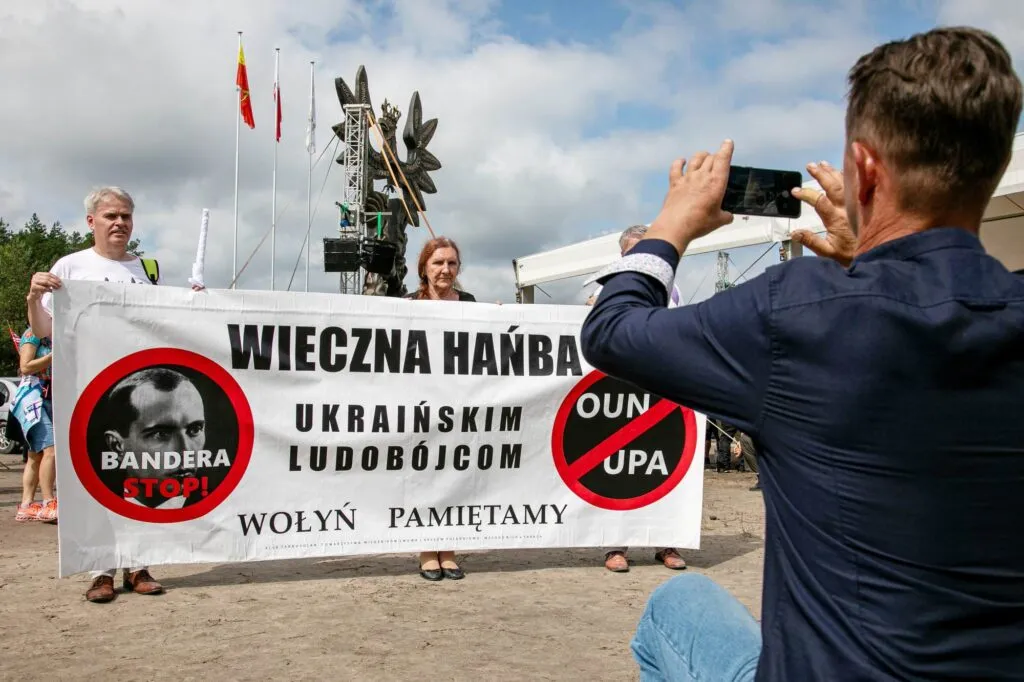
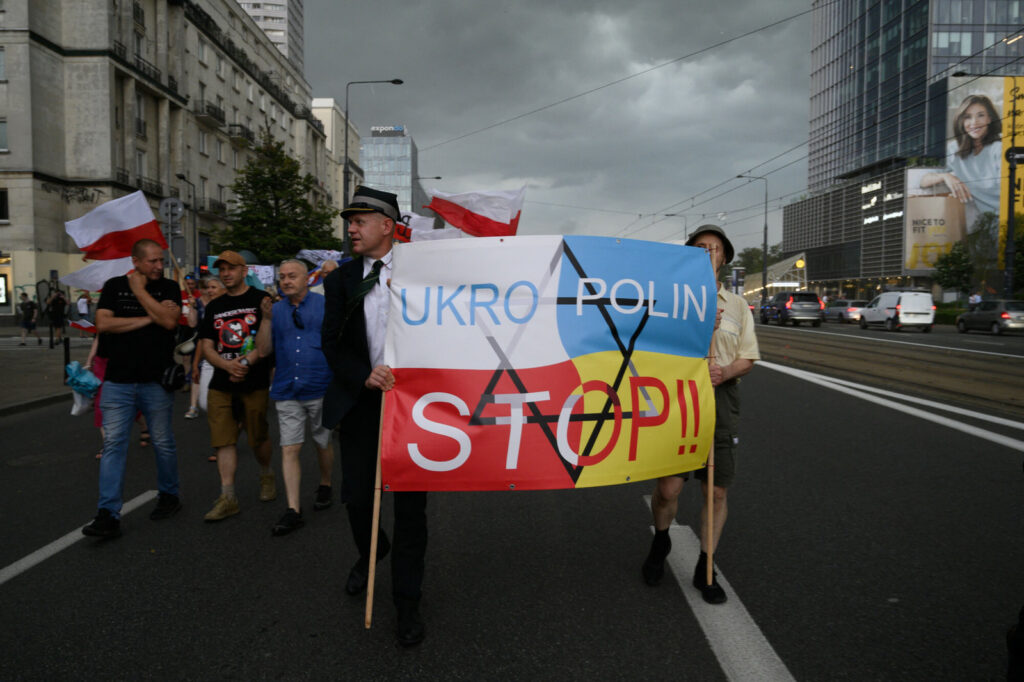
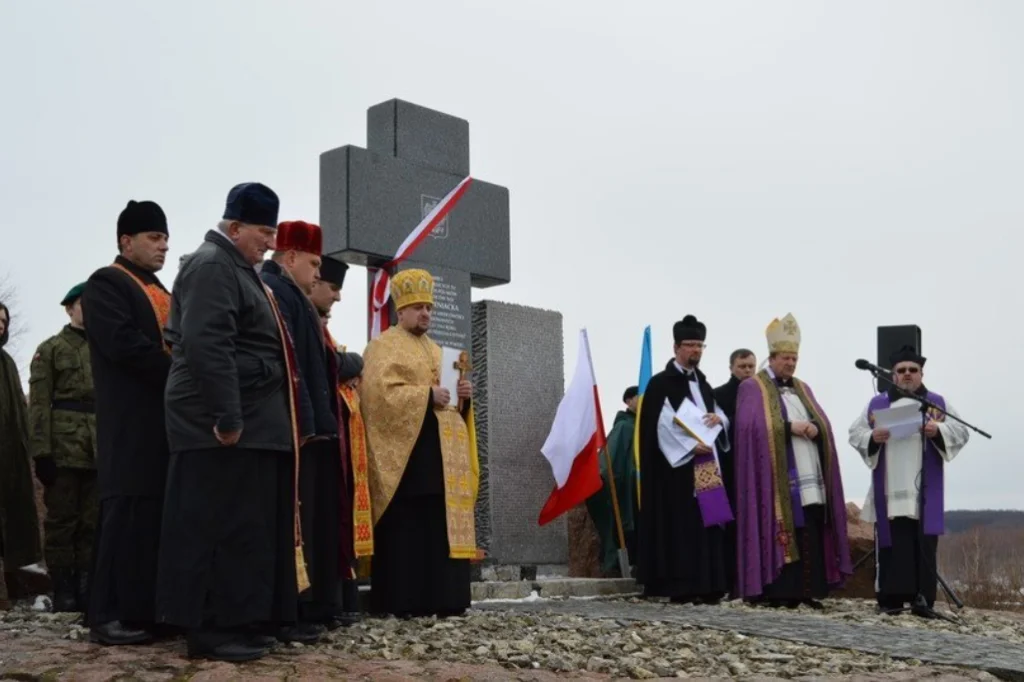
Protesters hold a sign saying "eternal shame to the Ukrainian murderers" and with a crossed-out emblem of the Ukrainian Insurgent Army (UPA) and its leader Stepan Bandera during the unveiling of the Monument to the Victims of the Wolyn Massacre in Domostawa, Subcarpathia. Photo: Dawid Wolski/East News, Domostawa, 14.07.2024.
What the rupture costs both sides
The medals are symbolic; the dependencies underneath them are not.Tusk warned the standoff was "a strategic mistake that will cost both sides: in business, geopolitically, and reputationally," and said he was working with European partners to lower the temperature.
Ukraine's western border is its lifeline for aid and trade, and Polish farmers haveblocked it before, blockading the crossings for months and holding up even humanitarian convoys. Alienating Warsaw puts that artery — and the EU path that runs through it — back at risk.
Poland carries its own exposure. Warsaw has made Ukraine's reconstruction anational economic strategy, and analysts warn the feud risks turning it from a decision-maker into a petitioner, sidelined from the rebuild it has bet on and from the forums shaping Europe's security.
The row lands days before Poland hosts the Ukraine Recovery Conference in Gdańsk on 25–26 June — an event Nawrocki will not attend.
For now, the lifelines hold. Rzeszów stays open, the trains still run, and Polish and Ukrainian forensic teams continue working together on the Volhynia graves. What is left undone is the smallest thing of all — a single decree, still waiting on the countersignature of a prime minister who would rather see Kyiv reach Brussels.
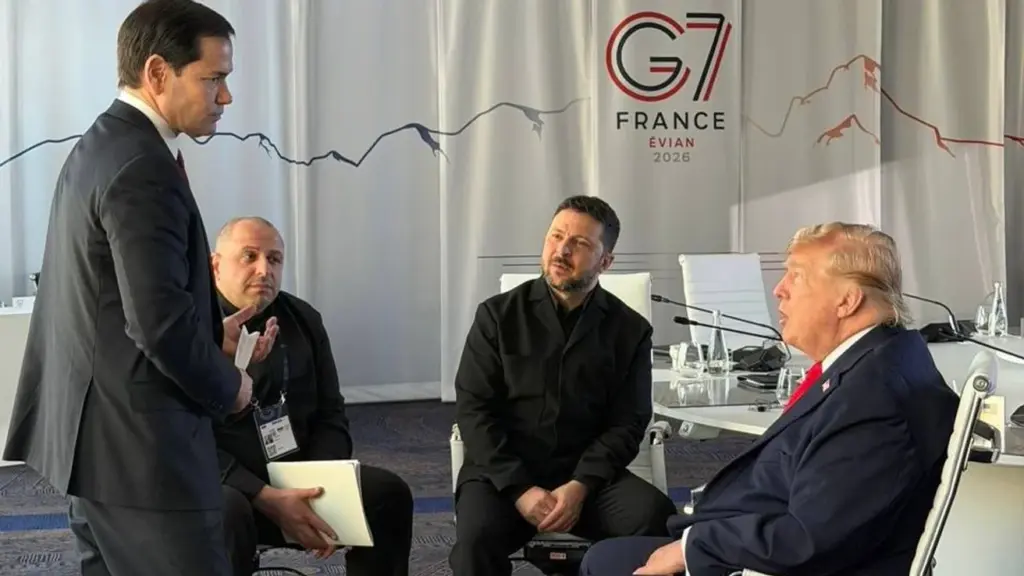
At a private dinner during last week's G7 summit in Évian-les-Bains, US President Donald Trump told Ukrainian President Volodymyr Zelenskyy that he was impressed by Ukraine's recent battlefield results, the Financial Times reported on 23 June, citing two people briefed on closed discussions among leaders.
Trump was described as "hugely impressed and enthusiastic" about Ukraine's recent campaign of long-range strikes on targets deep inside Russia, the sources told the FT
At a private dinner during last week's G7 summit in Évian-les-Bains, US President Donald Trump told Ukrainian President Volodymyr Zelenskyy that he was impressed by Ukraine's recent battlefield results, the Financial Times reported on 23 June, citing two people briefed on closed discussions among leaders.
Trump was described as "hugely impressed and enthusiastic" about Ukraine's recent campaign of long-range strikes on targets deep inside Russia, the sources told the FT. At the summit, Trump also agreed to increase sanctions on Russian energy. Those strikes have since intensified, with attacks on military targets near Moscow and on an oil refinery on the city's outskirts, and are supported by US intelligence, which western allies have urged Washington to continue providing.
Patriot licences and weapons production
Zelenskyy said after the meeting that Trump and Secretary of State Marco Rubio had "responded positively to the issue of licences" for Patriot interceptor missiles "for the first time." He said all technical capabilities needed for licensed Patriot missile production already exist and that Trump's personal approval is the remaining requirement. Trump, Zelenskyy added, "plans to ask US defence companies to establish licensed production of air-defence missiles in Europe and Ukraine."
One Ukrainian official said further negotiations between Rustem Umerov, secretary of the National Security and Defense Council, and US officials would determine the details of any Patriot agreement.
Senior Ukrainian administration officials told the FT they see signs Trump is moving toward stronger support for Kyiv and may be more willing to pressure Russia to end its war. They remain sceptical about follow-through, noting his prior unfulfilled commitments, but were cautiously optimistic following the summit meetings.
Russia accuses US of abandoning mediator role
Russian Foreign Minister Sergei Lavrov, speaking at a Moscow foreign policy conference on 24 June, claimed the US was "seemingly stepping back from the role of an objective mediator" and had "forgotten" Trump's own statements from the previous year that had moved toward Moscow's position. Russia would, Lavrov said, "focus on achieving the goals of the [invasion] on the basis that all hopes the US could be an honest mediator collapsed long ago."
He also appeared to question the Alaska summit held between Putin and Trump last August, which ended contentiously after the parties discovered they were considerably further apart than expected. "I don't even want to suspect that Alaska, just like Europe's actions, was conceived to win time to keep arming the Kyiv regime," Lavrov claimed. "But what happened happened."
Western diplomats and people involved in back-channel efforts told the FT that Russian frustration with the US has been building since last summer. Moscow felt Trump envoy Steve Witkoff had misconstrued Russia's position ahead of the Alaska meeting; the White House denied this. The White House released a statement after Alaska in which Trump abandoned his push for an immediate ceasefire and appeared to endorse Putin's demands for a permanent settlement, but the US has since returned to its earlier position, per the FT.
NATO official: Russian lines are not impenetrable
European capitals have used the apparent shift in Trump's reading of the conflict—and in particular his acknowledgment that a Russian victory is not inevitable—to push for increased support to Kyiv. "When Ukraine is properly supplied, they can generate real operational effects," one senior NATO military official told the FT. "The Russian defensive lines are not impenetrable."
Rubio told a Senate hearing this month that Russia would not achieve the objectives it set out on day one of the invasion. "They may not even be able to militarily ever achieve the objectives they're demanding now in negotiations," he said.
The Polish-Ukrainian memory war is no longer in the past. In 2026, it has spilled into the streets of Poland and its chambers of power.
Four years ago, Poland and Ukraine’s relationship looked nothing like this. In February 2022, Poles met Ukrainian refugees at the border with food, beds, and other vital supplies; within months, Poland had taken in 1.6 million refugees, provided 318 tanks to Kyiv, and supplied Western military aid to Ukraine’s defense.
In a March 20
The Polish-Ukrainian memory war is no longer in the past. In 2026, it has spilled into the streets of Poland and its chambers of power.
Four years ago, Poland and Ukraine’s relationship looked nothing like this. In February 2022, Poles met Ukrainian refugees at the border with food, beds, and other vital supplies; within months, Poland had taken in 1.6 million refugees, provided 318 tanks to Kyiv, and supplied Western military aid to Ukraine’s defense.
In a March 2022 poll, 94% of Poles backed taking in Ukrainian refugees; by early 2026, the figure had fallen to 48%, with 46% opposed.
The opinion reversal has turned violent. On a Warsaw bridge in May 2026, a 16-year-old Ukrainian refugee named Artemhad his skull fractured. He had fled Russian missiles in Zaporizhzhia, only to be assaulted abroad.
Weeks later, Lublin's city halltook the Ukrainian flag down. In Kielce, a Law and Justice (PiS)-dominated council canceled a bus donation to its Ukrainian sister city over a street named after Ukrainian nationalist Stepan Bandera. Pro-Ukrainian Polish activistsraised the funds anyway.
These incidents come as relations strain over the Zelenskyy administration's decision to commemorate the Ukrainian Insurgent Army (UPA), an armed group that fought Nazi Germany and the Soviet Union. Poland holds the UPA responsible for killing up to 100,000 ethnic Poles in Volhynia and Eastern Galicia between 1943 and 1945, killings that its parliament has declared genocide.
In Ukraine, the UPA is revered for resisting Soviet occupation into the 1950s; in Poland, the same fighters are remembered for massacring Poles.
On 26 May 2026, Volodymyr Zelenskyy signed Decree 440/2026 granting a special forces unit the honorary title "Heroes of the UPA." On 19 June, Polish President Karol Nawrocki responded by stripping Zelenskyy of the Order of the White Eagle, Poland's highest state honor. The next day, Zelenskyy returned it by post, and three former Ukrainian presidents renounced their own White Eagles in protest.
The recent memory conflict is not an aberration, nor proof of some ancient hostility between Poles and Ukrainians. It is a postponed reckoning breaking open when Kyiv and Warsaw can least afford to reopen the bloodiest parts of their shared past, even as nationalist politicians on both sides use it to their advantage.
The history behind the Polish-Ukrainian memory war
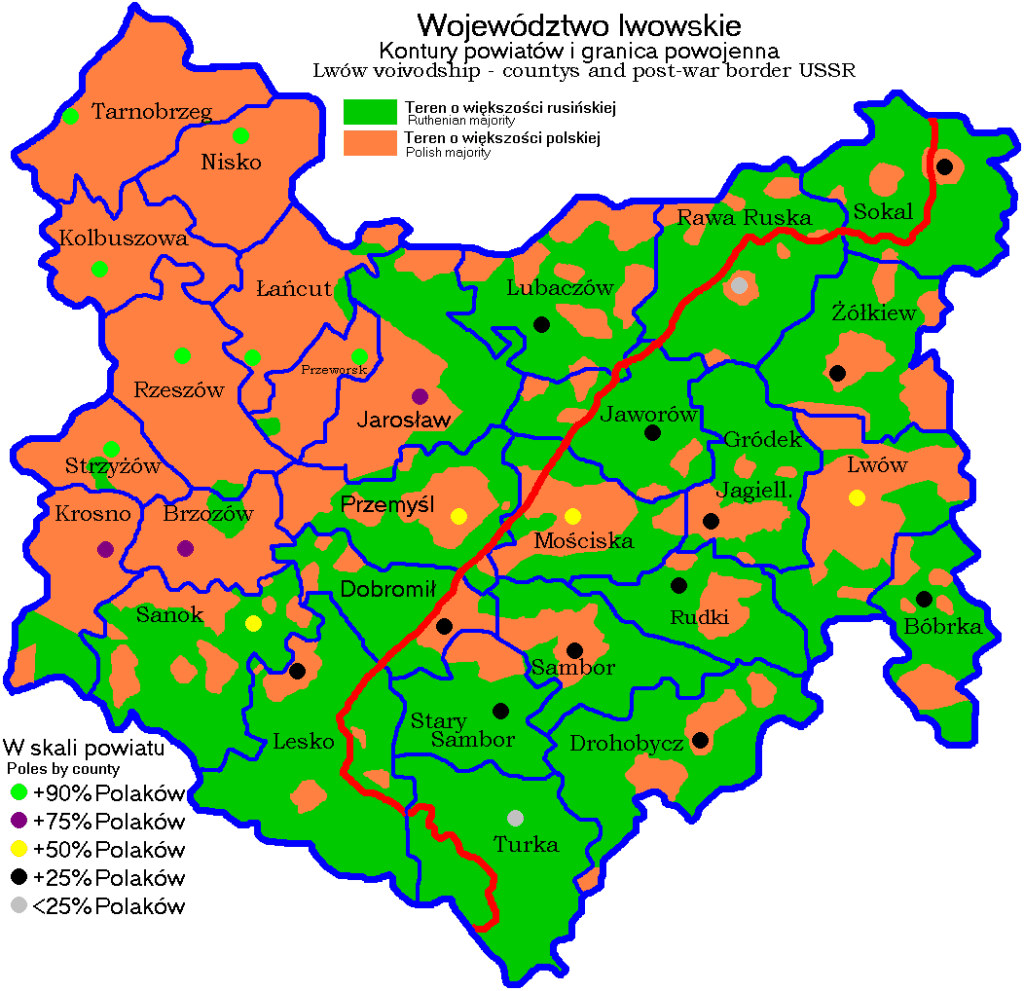
Central Galicia, as divided by the Curzon Line (red) into Polish and Ukrainian sections since 1944. Green areas were populated predominantly by Ukrainians, while orange areas by Poles. Colorful dots show the percentage of Poles in particular districts (povits). Data from the official census of Polish Republic in 1931. Source of Image: Wikipedia
The conflict stems from a confluence of historical trends. For generations, Polish nobles ruled Galicia and Volhynia (today’s Western Ukraine and Southeastern Poland). Most Ukrainians worked the land as peasants.
As rival nationalisms sharpened through the 19th and early 20th centuries, that hierarchy turned into open antagonism. In 1930, after rising attacks from Ukrainian nationalist groups, Warsaw launched thePacification of Galicia—collective reprisals, mass arrests, and the closure of Ukrainian organizations. Polish nationalist narratives often elide this state repression.
World War II turned rising antagonisms into mass killing. Between 1943 and 1945, the UPA killed and expelled those it saw as standing in the way of an independent, ethnically homogeneous Ukrainian state. The victims were mostly Poles, but also Jews, Czechs, and Ukrainians who sheltered them.
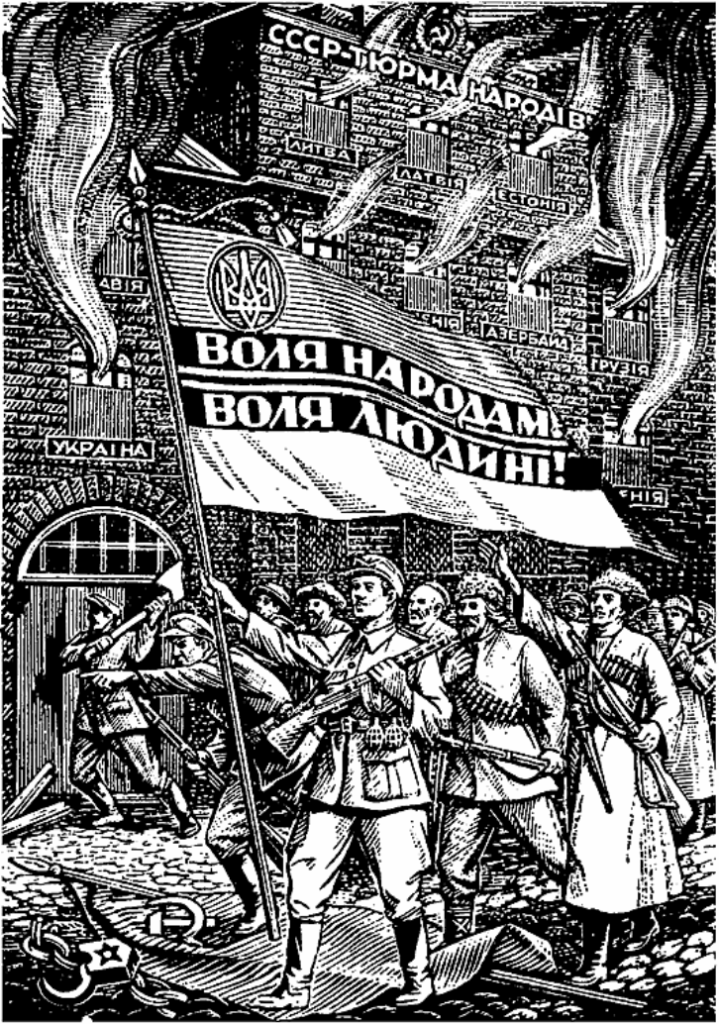
A UPA recruitment poster. Translation of the text: "The USSR is the prison of nations. Freedom to the people! Freedom to the individual!" By Nil Khasevych. 1948. Source: Opir.We Are Ukraine
In reprisal, members of the Polish Home Army — which made up the majority of Polish resistance fighters to the Nazis — killed Ukrainians, with hundreds dying at Sahryń in March 1944.
Ukrainian scholar Tamara Zlobina did not minimize the massacres, calling the UPA's killing of tens of thousands of Polish civilians "a crime and a tragedy, regardless of what the figures are." Her objection was the hypocrisy: Poland commemorates Polish resistance fighters who killed Ukrainian civilians as freedom fighters, while treating their Ukrainian counterparts as something morally reprehensible.
The USSR's grip cooled the dispute for decades, with elites in both nations finding themselves on the same side of the Cold War.
After communism fell, the wounds reopened. In 2016, the Polish parliamentdeclared Volhynia a genocide, and Kyiv answered with amoratorium on exhuming Polish remains.
A thaw came only in late 2024, when a deallifted the ban.
Why the dispute now draws blood
The question, then, is not simply why Ukraine honors the UPA. It is why this dispute now draws blood. Part of the answer is that the reckoning was deferred rather than resolved. For years, Polish journalist Piotr Malinowski told Euromaidan Press, Warsaw's instinct was to avoid the hardest parts of the shared past and wait for the war to end. "However, what is repressed eventually returns," he said.
Smaller grievances piled up and gave nationalists on both sides, but particularly in Poland, useful material. In Malinowski's reading, Nawrocki "is not a reason; he's a result," while Zelenskyy's decree became the decision that "sparked the present wave of hysteria."
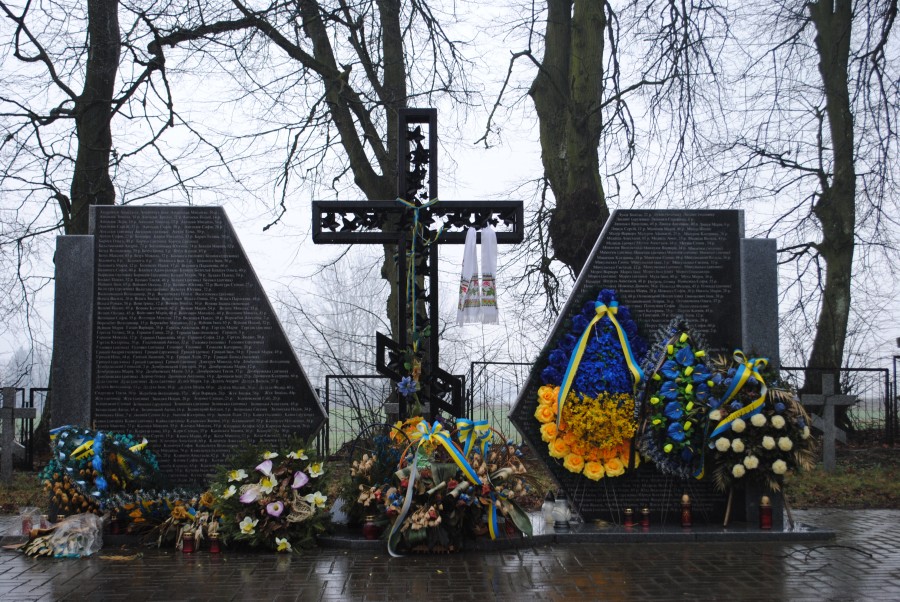
Memorial erected in 2008 to Ukrainians killed in Sahryn, in the village of Sahryn, Poland. Source: Zbruc.eu
Polish society's reaction to the UPA decree
The uniformly negative reaction of Poland’s political class showed how deep a nerve the decree struck. Prime Minister Donald Tuskcalled it "disturbing," saying the move "delights Putin and shocks our allies." Bartosz Cichocki, Poland's wartime ambassador to Kyiv,returned his Ukrainian Order of Merit, and Solidarity icon Lech Wałęsaremoved the Ukrainian flag pin from his lapel—the escalation that ended, on 19 June, in the revoked White Eagle.
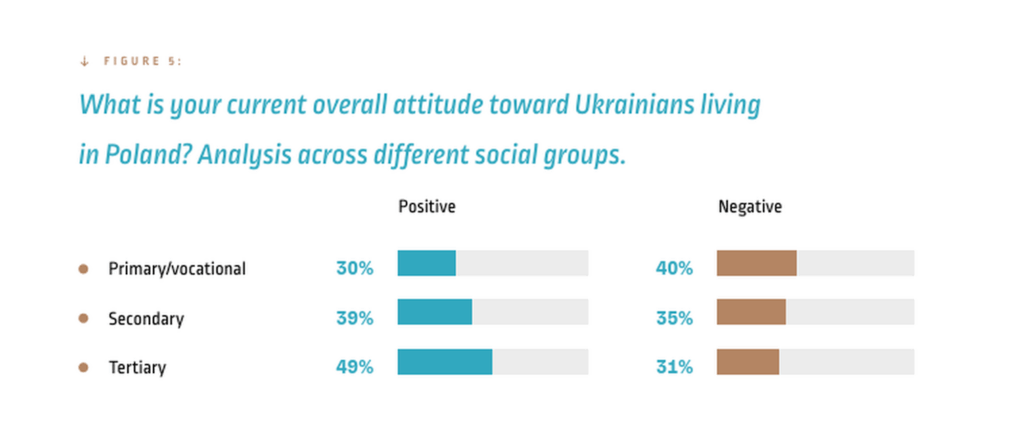
The force of the elite backlash is striking because better-educated Poles have usually viewed Ukrainians more favorably, noted Malinowski.
The Mieroszewski Center's 2025 poll of Poles’ attitudes toward Ukrainebears this out: 49% of Poles with higher education viewed Ukrainians positively, against 30% of those with primary or vocational education.
Poles' views of Ukraine based on education level. Source: Mieroszewski Centre's 2025 poll
How the war rewired Ukrainian memory
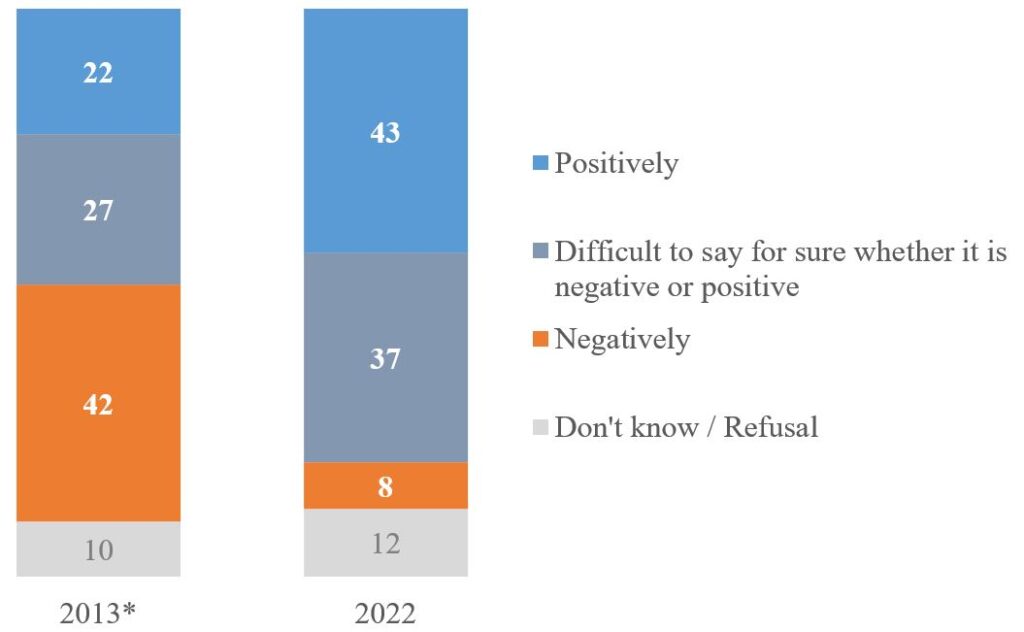
Russia's initial invasion of Ukraine in 2014 flipped Ukrainian opinion on the UPA. In 2013, 22% of Ukrainians viewed the UPA positively, against 42% negatively; by September 2022, the numbers had reversed to 43% favorable, 8% unfavorable, according to a Kyiv International Institute of Sociology (KIIS) poll.
The UPA, long "the most controversial and divisive issue within Ukrainian national memory," Ukrainian historian Yaroslav Hrytsaktold the Spectator, became after 2022 "a symbol of anti-Russian resistance."
American historian Timothy Snyder, in arecent interview with Newsweek Poland, called Zelenskyy’s decree a mistake but warned that Poland's fixation on grievance only benefits Moscow if it causes Warsaw and Kyiv to stop viewing Russia as the two capitals’ main strategic threat.
Results of the KIIS poll. The question: How do you, in general, assess the activities of the Organization of Ukrainian Nationalists - Ukrainian Insurgent Army (OUN-UPA) during the Second World War? Source: KIIS
From open arms to closed borders
In the first months of Russia’s full-scale invasion, solidarity, not grievance, defined Poland’s attitude toward Ukraine. Seeing itself as a potential frontline state, Poland understood Ukraine’s defense as tied to its own survival.
Nevertheless, the first serious rupture soon appeared. On 15 November 2022, a Ukrainian missile, fired against a Russian airstrike, veered across the border and killed two men at a grain facility in the village of Przewodów. Zelenskyydisputed it—"I have no doubt that it was not our missile", even as Biden, NATO, and a later Polish investigation concluded it was Ukrainian. Kyiv never acknowledged the deaths or apologized.
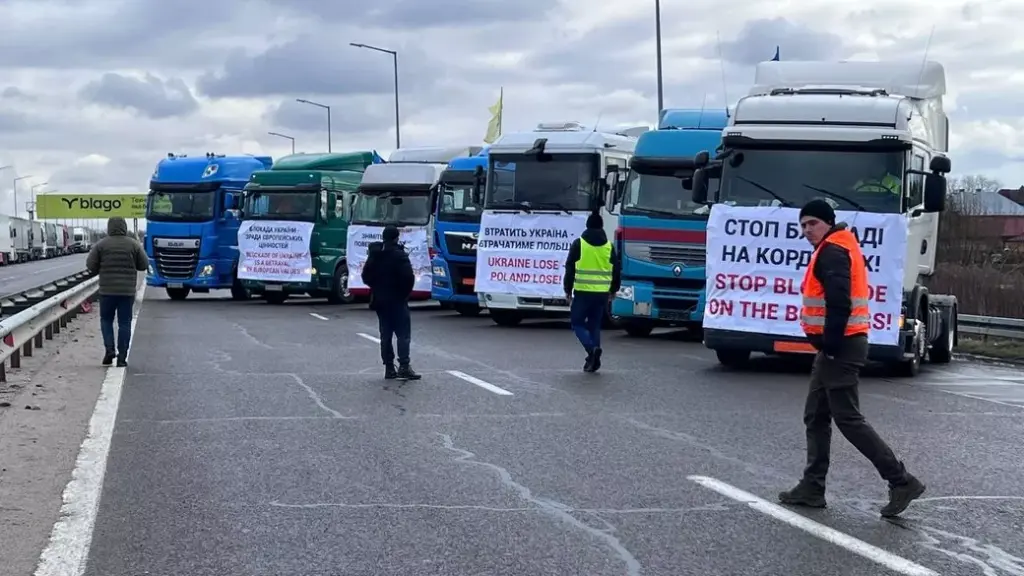
Cracks deepened the next spring. In April 2023, Polish farmersbegan blocking the border after duty-free Ukrainian grain depressed prices; by November, over 1,000 trucks were stuck at the frontier, according to aCSIS analysis.
Ukrainian truckers protesting against a Polish border blockade. Krakivets, Ukraine, 20 February 2024. Photo: Suspilne
Polish nationalists began using past grievances to garner votes: in its 2023 platform, the far-right Konfederacjaplaced historical policy at the center of relations with Kyiv, calling a Polish-Ukrainian alliance a "pipe dream."
But by 2026, politicians who peddle historical grievance are no longer confined to the margins. Before becoming president, Nawrocki led Poland's state memory body, the Institute of National Remembrance (IPN), from 2021 to 2025, a period in which criticsaccused him of advancing nationalist narratives.
The IPNinvestigates historical crimes committed against Poles from 1917 through the communist period. However, the organization also serves as Poland's main institutional vehicle for its memory politics.
After Poland's parliament declared Volhynia a genocide in 2016, the IPN amended its mandate in 2018 torequire documenting crimes committed by “Ukrainian nationalists.”
When talking to Euromaidan Press, Polish journalist Jerzy Wójcik, co-founder of the Polish-Ukrainian magazine Sestry.eu and a former Gazeta Wyborcza deputy editor-in-chief,said the IPN now acts less as an investigator of history than "a mouthpiece for the far right."
Nawrockiran on cutting social support for refugees. After he vetoed a broader extension that September, acompromise law tied benefits to employment. By early 2026, Polish opposition to accepting Ukrainian refugees hadreached its highest level since the invasion began: 48% in favor, 46% opposed.
The violent results of the Polish-Ukrainian memory conflict
For Polish supporters of Ukraine, the biggest danger is not the argument over history itself. It is what happens when rhetoric about Bandera, Volhynia, and the UPA spills into daily life and turns ordinary Ukrainians in Poland into targets. Wójcik told Euromaidan Press that the danger is structural.
"The risk starts when 'Banderite' stops describing a man who died in 1959, and starts describing a random nineteen-year-old." — Wójcik
The evidence accumulates. Polish branches of the Drunken Cherry, a Ukrainian bar chain, have been tagged with signage branding them "zones infected with Banderism." In September 2025, Polish teenagerslured a 23-year-old Ukrainian man in Wrocław to a fake date, beat him, shaved his head, and painted Nazi symbols on his face, according to a Warsaw-based outlet.
The perpetrators of Artem's beating on the Świętokrzyski Bridge in Warsaw. Source: Warsaw police via RMF24
In May 2026, the attack on Artem on Warsaw's Świętokrzyski Bridge followed the same pattern; police detained five Polish suspects aged 15 to 18, and Warsaw's mayor publiclyblamed right-wing rhetoric. Poland’s former prime minister Mateusz Morawiecki has floated deporting people for displaying "Banderite symbols." Wójcik’s fear is that, as the line between honoring Ukrainian nationalist figures and simply being Ukrainian collapses, old historical grievances will become a license to demonize Ukrainians in Poland.
What is the memory conflict's potential strategic cost for Ukraine?
By Kyiv’s own accounting, Poland ranks among Ukraine’s top backers. Rzeszów Airport in southeastern Poland remains a primary hub for Western military aid. For now, Polish lifelines remain irreplaceable.
The crisis also shadows Ukraine’s EU accession, though Nawrocki’s threats extend beyond his formal powers.
Karol Nawrockisaid Poland would bar membership for anyone refusing to renounce the “cult of totalitarianism and violence.”
However, the Polish president cannot block accession alone; that is the government's call, and Polish Prime Minister Tusk backs Kyiv's path. What Nawrocki does control is real: he opposes Ukraine's NATO bid and, as head of state, sets a national narrative that has turned actively hostile.
Then there are the 1.5 million Ukrainians in Poland, one of the EU’s largest Ukrainian diasporas. If they become unsafe, the Polish-Ukrainian front against Russia weakens. Wójcik offered a cautious note of realism, arguing the two nations are too intertwined to sever ties over “one decree.”
Why goodwill alone won't fix this
The work at Puźniki offers rare good news from one of the darkest chapters of the shared past. By September 2025, joint Ukrainian and Polish forensic teams hadexhumed and reburied 42 Volhynia victims there, in the first such dig in a decade.
"Forensic specialists from Ukraine and Poland work in the same pit. There are no incidents. They are reconciling faster than the politicians." — Wójcik
But goodwill alone will not fix the crisis, Wójcik argues. The Volhynia massacres have become too useful to Polish nationalists, especially for Nawrocki's PiS supporters, to look past.
Therefore, Wójcik says, history needs to be separate from political bargaining. Polish and Ukrainian historians and exhumation teams should continue working beyond politicians' reach, and Ukraine's future in the EU should not be held hostage to a memory dispute.
The remains of Polish victims being reburied in Puźniki, Ternopil Oblast, Ukraine. Credit: Ukrinform
Some of those in power agree. Former Ukrainian president Petro Poroshenko, renouncing his own White Eagle,warned that history should not define relations, lest a Russian conquest of both countries leave Poles and Ukrainians with “a mutual textbook from Moscow.”
Whether that separation holds depends on two things: whether Ukrainian politicians address the issue plainly, and whether Polish far-right rhetoric returns to the margins or keeps affecting Ukrainian teenagers on Warsaw bridges.
The Volhynia massacres happened over 80 years ago. Artem, beaten on that bridge, is 16. He inherited this quarrel; he didn't make it.
This material was produced as part of a project by the Institute of Mass Information with the support of the Ministry of Foreign Affairs of the Netherlands. The content of this publication does not reflect the official position of the IMI or the Kingdom of the Netherlands.
Ukraine and Germany have signed an agreement to jointly develop a new air defense system focused on countering ballistic missiles, according to reporting by Interfax-Ukraine.
The initiative comes as Ukraine continues to face sustained Russian missile strikes, with ballistic systems remaining one of the most difficult threats for existing air defense networks to intercept.
German Defense Minister Boris Pistorius said the agreement was signed together with Ukrainian De
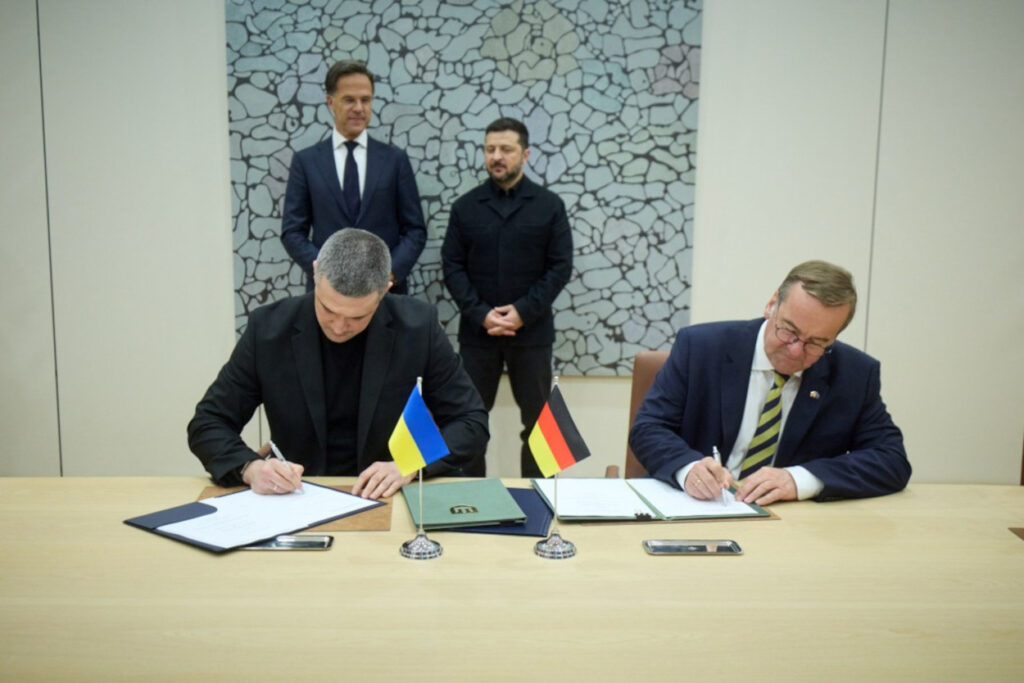
Ukraine and Germany have signed an agreement to jointly develop a new air defense system focused on countering ballistic missiles, according to reporting by Interfax-Ukraine.
The initiative comes as Ukraine continues to face sustained Russian missile strikes, with ballistic systems remaining one of the most difficult threats for existing air defense networks to intercept.
German Defense Minister Boris Pistorius said the agreement was signed together with Ukrainian Defense Minister Mykhailo Fedorov during a meeting of the Ukraine Defense Contact Group (Ramstein format), opening the way for joint work on a next-generation system if industry partners reach final arrangements.
Pistorius said several German defense companies are already interested in participating in the project, which he described as a potential contribution to both European and Ukrainian security.
Push to close gaps in ballistic missile defense
According to Ukrainian President Volodymyr Zelenskyy, who also addressed the Ramstein meeting, the agreement brings together Ukrainian and German technological capabilities to address that gap.
Zelenskyy said Russia continues to rely heavily on missile attacks as a central element of its war strategy, and called for stronger “anti-ballistic capabilities” within Ukraine’s air defense architecture, according to Interfax-Ukraine.
Industrial cooperation and coalition framework
The project is expected to involve defense industry cooperation on both sides, with Ukraine contributing its own military technology experience and Germany providing industrial and engineering capacity.
Zelenskyy also urged partner countries to accelerate joint development efforts, saying results should begin to materialize within the year and that stronger anti-ballistic capability is needed not only for Ukraine but for wider European security.
Ukraine and Germany expand cooperation with joint production of robotic systems
Update 21:15: Ukraine and Germany have also agreed to jointly produce “TerMIT” ground-based robotic systems in Germany as part of expanding defense-industrial cooperation between the two countries.
The agreement covers the production of thousands of TerMIT unmanned ground vehicles, which will be supplied to Ukrainian forces, according to the Ukrainian presidential office. Germany will finance the production.
The TerMIT system, developed by Ukrainian company Tencore, is a modular unmanned ground platform designed for logistics, evacuation, mine clearance, fire support, and other battlefield tasks. It is equipped with sensors, cameras, and communication systems for remote operation.
Wider Ramstein discussions continue
The announcement came during the latest meeting of the Ukraine Defense Contact Group, co-chaired by the United Kingdom and Germany, where allied states continue to coordinate military assistance to Ukraine.
Officials said the agreement marks a step toward deeper integration of defense industries and long-term cooperation on missile defense systems.
Photographs of the burning Dormition Cathedral that Ukrainian President Volodymyr Zelenskyy showed US President Donald Trump at the G7 summit were probably the final push that moved Washington toward firmer support for Ukraine, according to Politico. The outlet cited three G7 officials who described the private exchange in Evian-les-Bains on 16 June.
The sight of the cathedral's golden domes in flames visibly affected Trump, one of the officials said. Russia's strike se
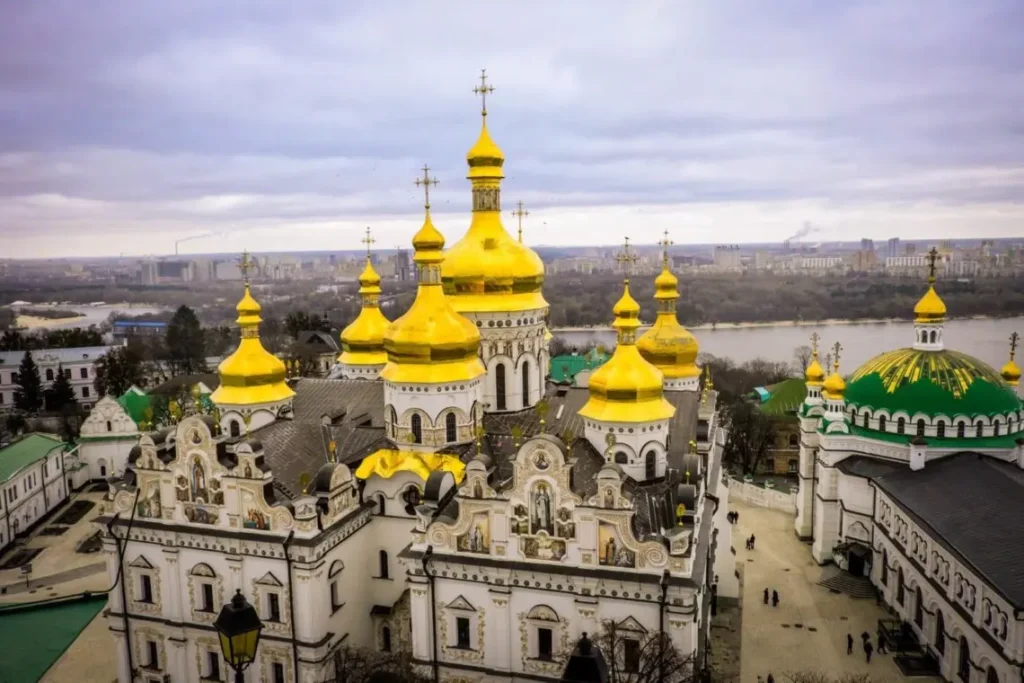
Photographs of the burning Dormition Cathedral that Ukrainian President Volodymyr Zelenskyy showed US President Donald Trump at the G7 summit were probably the final push that moved Washington toward firmer support for Ukraine, according to Politico. The outlet cited three G7 officials who described the private exchange in Evian-les-Bains on 16 June.
The sight of the cathedral's golden domes in flames visibly affected Trump, one of the officials said. Russia's strike set the roof of the church—the central shrine of Kyiv's Pechersk Lavra—ablaze during a mass missile and drone assault on 15 June.
French President Emmanuel Macron, the summit host, had spent months working out how to appeal to the American leader, Politico reported. At a dinner the night before, G7 leaders tailored their case to Trump's view of the war, casting Ukraine as the side winning and Russia as the side losing.
The leaders told Trump that Zelenskyy was winning because Russian forces could not break through the front and were even losing ground, a European diplomat told the outlet. Macron, caught on a hot mic the next day, described the conversation with Zelenskyy as difficult.
The approach produced results. The G7, including the United States, agreed to expand military support for Kyiv and backed new sanctions on Russia, pledging "unwavering support" in its 17 June statement and citing Ukraine's momentum on the battlefield.
In its 17 June joint statement, the G7 agreed to send Ukraine more air defense, interceptor missiles, and long-range capabilities, and said it was ready to consider letting Ukraine produce them domestically — but the language commits only to "consider," with no timeline, system, or manufacturer named.
The summit doubled as a sanctions moment. Canada imposed new measures on 162 Russian individuals, entities, and vessels on 16 June, announced after Carney met Zelenskyy on the sidelines and condemned the Lavra strike. Britain's £210 million ($282 million) enriched-uranium deal to feed Energoatom came packaged with fresh sanctions on Russia's oil trade, pushing UK shadow-fleet designations toward 600 vessels.
Diplomats cautioned that the gains could prove fragile. A single phone call between Trump and Russian President Vladimir Putin could undo them, the European diplomat said, noting that the US president shifts position often.
On 26 May, Volodymyr Zelenskyy signed a decree honoring a special forces unit as "Heroes of the UPA" — the Ukrainian Insurgent Army, which fought both Nazi Germany and the Soviet Union in WWII. In Ukraine, the UPA is often seen as an anti-Soviet resistance movement. In Poland, it is remembered for the 1943-1945 Volhynia massacres, in which the UPA killed up to 100,000 ethnic Poles.
Within two weeks, the decree handed Poland's nationalist right a lever it had sought for
On 26 May, Volodymyr Zelenskyysigned a decree honoring a special forces unit as "Heroes of the UPA" — the Ukrainian Insurgent Army, which fought both Nazi Germany and the Soviet Union in WWII. In Ukraine, the UPA is often seen as an anti-Soviet resistance movement. In Poland, it is remembered for the 1943-1945 Volhynia massacres, in which the UPA killed up to 100,000 ethnic Poles.
Within two weeks, the decree handed Poland's nationalist right a lever it had sought for years. The timing could hardly be worse. Poland is the land corridor for Western weapons, the host of some 1.5 million Ukrainian refugees, and one of the votes Kyiv needs to enter the EU. The quarrel over the decree now strains all three at once: weapons to Kyiv, Ukrainian refugees in Poland, and Ukraine's EU ambitions.
The damage is already visible where you would least expect it. Polish and Ukrainian forensic teams exhuming the Volhynia dead now keep cameras away from the graves, fearing images of the remains will be fed into Russian propaganda or AI deepfakes.
Citing Zelenskyy's decree naming a special operations unit for the "Heroes of the UPA," Polish President Karol Nawrocki announced on 29 May that he would seek to strip Zelenskyy of the Order of the White Eagle, Poland's highest state distinction, and put the question to the Order's Chapter. It took up the request on 8 June but broke up without deciding, leaving the dispute open.
The far-right Confederation party's Krzysztof Bosak called for blocking Ukraine's EU accession outright. Even Lech Wałęsa, the former Solidarity leader, publicly removed his Ukrainian flag pin, saying he would keep helping the Ukrainian people but would no longer support Zelenskyy.
Polish polls show strong support for President Nawrocki. Anti-Ukrainian graffiti has appeared on the walls of Drunken Cherry bars in Poland, calling them "zones infected with Banderism." The graffiti refers to Stepan Bandera, a Ukrainian nationalist whose name many Poles associate with wartime massacres. Attacks on Ukrainian youth are also rising: in May, five Polish teenagers were detained over a brutal Warsaw assault, which the city's mayor blamed on right-wing rhetoric.
On 3 June, Ukrainian Foreign Minister Andrii Sybihaurged restraint, asking Ukrainians and Poles not to "spin the flywheel of hatred."
Euromaidan Press spoke with Jerzy Wójcik, a Polish journalist and Ukraine advocate who co-founded Sestry.eu, a Polish-Ukrainian media platform for Ukrainian women, and co-organized Warmth from Poland for Kyiv, a winter 2025-2026 campaign that raised more than $2.8 million for generators after Russian strikes on Ukraine's power grid.
Wójcik discussed the shift in Polish opinion, Warsaw's pressure on Kyiv, and why joint work to identify and rebury Volhynia victims may still offer a way out, even as political pressure complicates it.
Interview edited for length and clarity.
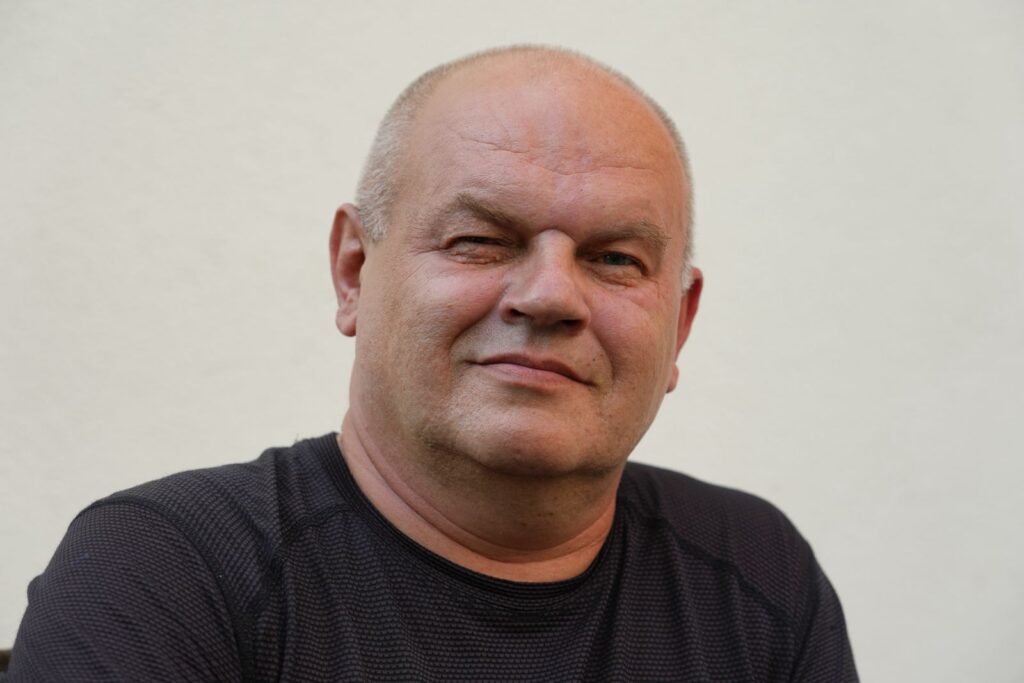
Jerzy Wójcik, Polish journalist, Ukraine advocate, co-founder of Sestry.eu, and co-organizer of Warmth from Poland for Kyiv. Source: Journalist's personal archives
"I don't want to let this happen: a repeat of what happened in Germany before the Second World War."
— Jerzy Wójcik
"I feel like I woke up in another country": how Polish public opinion flipped overnight
Daniel Thomas:The Polish Institute of National Remembrance, which Nawrocki led, called the killing of Belarusian civilians genocidal in 2005 but walked back that characterization in 2019. Does that flip prove your hypocrisy charge against Nawrocki and other Polish right-wing nationalists, or does it just prove that every memory institution, Ukraine's included, bends history to current politics?
Jerzy Wójcik: I think there is something wrong with all these kinds of institutions, because they cannot be completely independent from current politics. There is no such thing as neutral history.
With the Polish IPN, it's a tragedy from the beginning, because they use the institution and history itself to win political battles.
I don't like Nawrocki. I think he is a cynical guy. Still, most Polish voters chose him, so I have no choice. But I remain very critical.
I got the results of the public opinion poll yesterday, and there is such a mental rush in the internet polls: 75% or something like that support Nawrocki's decision to strip Zelenskyy of the Order of the White Eagle [the Wprost / SW Research poll showed 52.3% support; the Res Futura social media analysis showed 97.4%].
I feel like I woke up in another country. It's scary. This could have a real impact on the lives of real people.
I mean Ukrainians in Poland. There have already been so many attacks on Ukrainian boys, beaten almost to death [during this war]. And now there's Nawrocki's statement, plus the right-wing supporters of [Grzegorz] Braun and Confederation.
It could have a tangible negative impact in the real world. Nobody normal-headed in Poland wakes up thinking about Bandera.
[The Ukrainian nationalist massacres were] 80 years ago. Who cares? It shouldn't be a concern.
So I think it's a very dangerous game, not in symbolic terms, but in real-life aggression. I feel like anything could go wrong at any hour.
Can you imagine a Russian operation, a false flag provocation on Polish ground, pretending they are Ukrainian or some Bandera boys? It's easy to implement now because the social and mental priming is in place.
*Confederation is a far-right Polish alliance with anti-Ukrainian currents. Braun, a far-right MEP who leads the breakaway Confederation of the Polish Crown, is known for Ukrainophobic, antisemitic, and pro-Russian rhetoric.
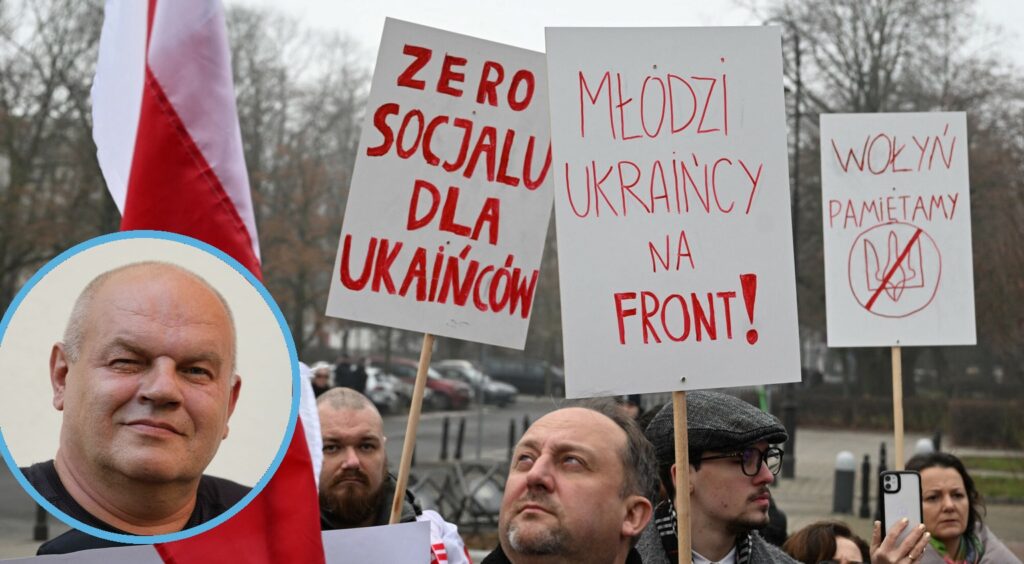
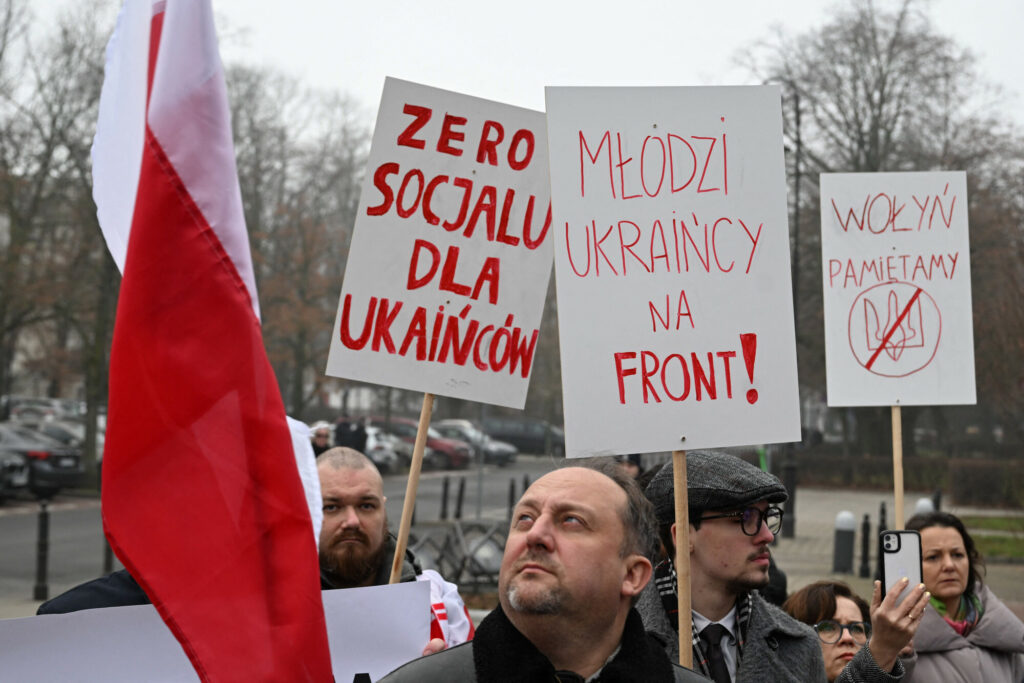
Demonstrators hold placards reading, from left, “No social benefits for Ukrainians,” “Ukrainian youth, go to the front!” and “We remember Volhynia,” a reference to the World War II-era Volhynia massacre, during a rally against the Polish government’s policy toward Ukraine outside the Sejm, Poland’s parliament, in Warsaw on December 19, 2025. During a visit to Poland, Ukrainian President Volodymyr Zelensky urged unity between Ukraine and Warsaw and warned that Moscow would attack Poland if Russia’s invasion was not stopped. (Photo by Sergei Gapon / AFP)
"There is no such thing as neutral history."
— Wójcik
"Reality will win": why Poland and Ukraine need each other more than either side admits
Thomas:You say Poland won't drop Dmowski [an interwar Polish nationalist leader] or the Holy Cross Brigade [a Polish WWII partisan unit accused of Nazi collaboration] as heroes under outside pressure. So, on what grounds can Warsaw demand Kyiv drop Bandera?
Wójcik: Reality will win. As a society and as political entities, Poland and Ukraine need each other much more than both of these guys [Zelenskyy and Nawrocki] pretend. It's all theater now.
It's in Poland's interest to help Ukraine win the war, to protect Poland. Zelenskyy and the Ukrainian politicians could underestimate this. They have other potential partners: Germany, Scandinavia, New Zealand, and Australia. But Poland is the closest neighbor. You cannot send military tools via Romania or Slovakia at the same scale.
Ukraine has its citizens living in Poland. We cannot allow relations between our countries to fracture over one symbol, one word: “Bandera.” The two governments have to find a solution.
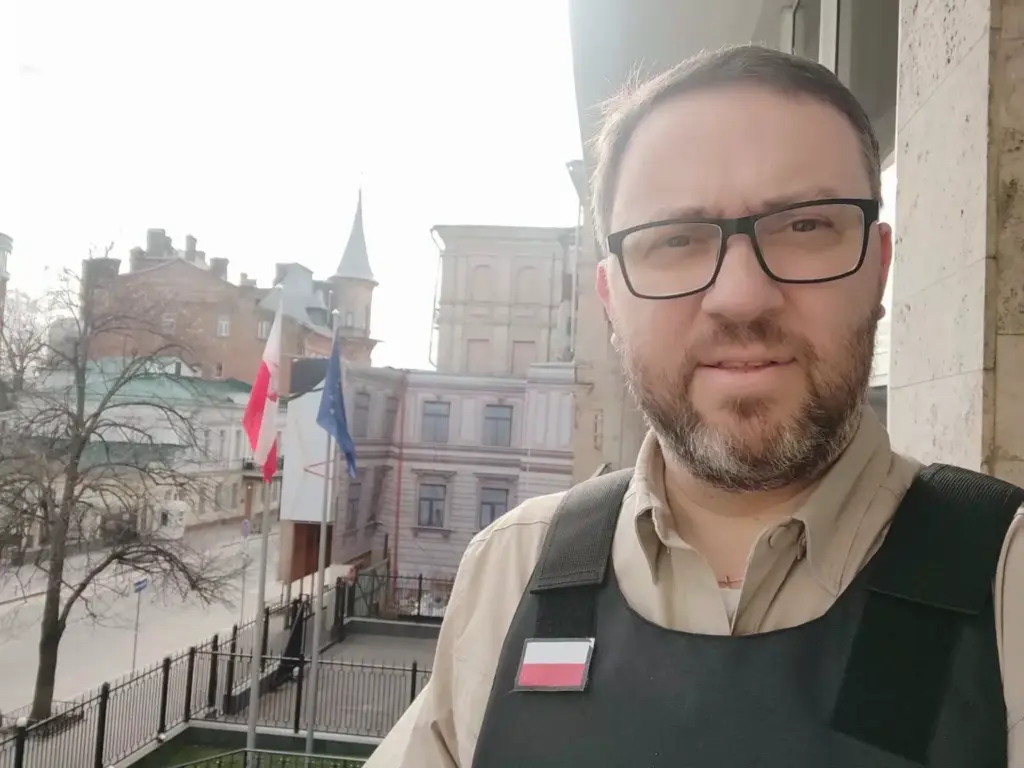
Bartosz Cichocki, Poland’s wartime ambassador to Ukraine; Cichocki returned the Order of Merit awarded to him by Zelenskyy on 1 June 2026. Source: Vikna Novyny
"Behaving like smugglers": How political weaponization affects Polish-Ukrainian archaeologists exhuming Volhynia massacre victims
Thomas:Could the symbolic fight endanger practical cooperation on exhumations and identification work?
Wójcik: This is the part that should worry everyone, because the symbolism and the work are moving in opposite directions. The work is quietly winning. Look at what's already happened.
Puźniki, spring last year. At least forty-two people were exhumed and reburied at the Puźniki cemetery in September. Last autumn, Ukraine granted further exhumation permits.
Forensic specialists from Ukraine and Poland work in the same pit, and yet there are no incidents. They are reconciling faster than the politicians.
The danger isn't that the digging stops; it's that every reburial gets dragged in front of a microphone and turned into a demand, while the families want one thing: a name on the stone before they die themselves.
You can see it best in a single detail. The archaeologist running the Puźniki dig kept the press away from the site because she feared provocations. They had to hide the most healing thing happening between our two countries so nobody could turn it into a weapon.
And that's exactly where the symbolic fight does its damage: it doesn't stop the work; it forces the people doing it to behave like smugglers.
"Forensic specialists from Ukraine and Poland work in the same pit, and yet there are no incidents. They are reconciling faster than the politicians."
— Wójcik
Why linking Polish support for Ukraine to Kyiv’s rejection of Bandera risks turning into “blackmail”
Thomas:If Poland should support Ukraine for hard-security reasons regardless of history, should Kyiv avoid symbols that complicate support for Ukraine abroad?
Wójcik: I won't tell President Zelenskyy what to do, and still less the citizens of Ukraine. They're free people, in the middle of a war for their own existence, and the choice of whom they honor belongs to them. What I can do is describe the mechanics, because they work whether or not anyone likes them.
Symbols aren't decoration; they're strategy. Every hero a state puts on a pedestal is a sentence in a story other people read: a voter in Berlin, a congressman in Washington, a Pole deciding whether the man at the next desk is a guest or a threat.
Bandera on a street sign reads differently in those capitals than it reads in Kyiv. That's a fact about the world, not a verdict on Ukraine. Moscow sees it and uses it; that's simply how it is.
But elsewhere, Warsaw gets it wrong, and here I'm entirely sure which side I'm on: you cannot demand that a nation renounce its founding myths while it's bleeding, on someone else's schedule, as the price of help. The moment memory becomes a precondition, it stops being an argument and becomes blackmail. Any country with a shred of honor will dig in.
I am not telling Kyiv what to strike from its own memory. I am telling Warsaw what not to put a price on. Once you make someone else’s identity a condition, you do not weaken it. You harden it.
The monument to murdered Polish civilians in Huta Peniatska in Ukraine’s Lviv Oblast was restored in 2017. Photo: NV
How the memory conflict could endanger Poland's 1.5 million Ukrainians
Thomas:Where does elite rhetoric become a real risk for Ukrainians living in Poland?
Wójcik: The moment it stops being about 1943 and starts being about the woman cleaning an office tonight. Historians arguing over the UPA? Fine, that's their job; let them fight.
The risk starts where "Banderite" stops, describing a man who died in 1959, and starts describing the nineteen-year-old in the back row. [Mateusz] Morawiecki floated the idea of deporting people for displaying Bandera symbols.
Think about how that lands on a teenager who fled a missile. She can't always tell you where the symbol ends and where she begins, and neither can the official ruling on her case.
So the line is simple: the risk appears where memory politics turns a million guests into a million suspects.
You don't even need a law for it. It's enough for the word "Ukrainian" to quietly start doing the work the word "Banderite" used to do.
"Few Ukrainians want to be told to rethink [their nation's history] while their country is under attack."
— Wójcik
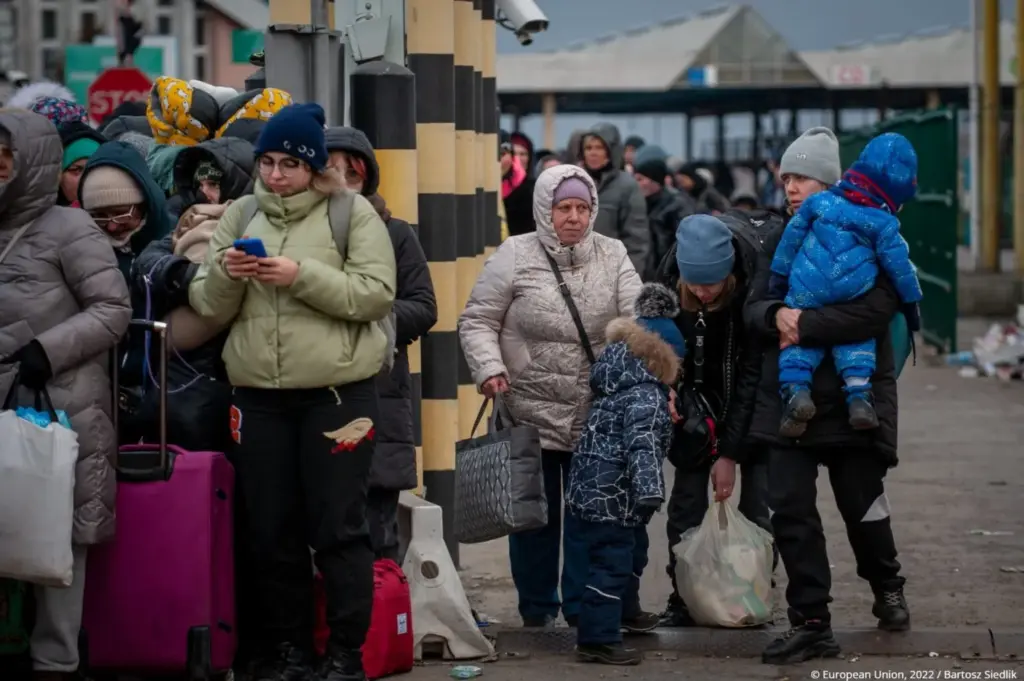
Ukrainian refugees near the Polish border, 7 March 2022. Source: EC Commission / BARTOSZ SIEDLIK
Separating hands from mouths: what a realistic off-ramp looks like
Thomas:Is there a realistic off-ramp from this dispute, or is it now built into both countries' domestic politics?
Wójcik: The off-ramp exists — it's happening right now in the forensic teams' tents — but it's blocked, because both sides have found the quarrel too useful to give up.
For Nawrocki, Volhynia is both national identity and electoral politics. For some in Kyiv, the heroic story of Ukrainian nationalism has become part of wartime morale, and few Ukrainians want to be told to rethink that story while their country is under attack.
That is why goodwill alone will not solve the dispute. Neither government has much political space to back down.
The more realistic answer is to separate the issues. Let historians and forensic teams continue exhumations and reburials without political interference, and do not make Ukraine’s EU path depend on a dispute over 1943 that no summit can resolve.
The off-ramp isn't reconciliation. That word is too big and too soon. The off-ramp, for now, is separating what can be done with hands from what we quarrel over with mouths.
And further out, over a generation, the real prize: a shared founding story for a new Central Europe, where Poland and Ukraine are co-authors rather than prosecutor and defendant. Except that only becomes possible the day we stop letting the worst chapter of the shared past [Volhynia] write the next one [Polish-Ukrainian relations going forward]. Why do we let the worst chapter of [Ukraine and Poland's] shared past write the next one?
Ukrainian President Volodymyr Zelenskyy offered to meet Russian President Vladimir Putin on the sidelines of the G7 summit in Évian-les-Bains, France, but Russia did not provide a clear response, Zelenskyy told journalists on 15 June, as reported by Reuters. US President Donald Trump, who met Zelenskyy at the summit on 16 June, stated that Russia "should make a deal" with Ukraine to end the war, the Institute for the Study of War (ISW) reported on 16 June.
The offer was
Ukrainian President Volodymyr Zelenskyy offered to meet Russian President Vladimir Putin on the sidelines of the G7 summit in Évian-les-Bains, France, but Russia did not provide a clear response, Zelenskyy told journalists on 15 June, as reported by Reuters. US President Donald Trump, who met Zelenskyy at the summit on 16 June, stated that Russia "should make a deal" with Ukraine to end the war, the Institute for the Study of War (ISW) reported on 16 June.
The offer was the latest in a series of Ukrainian proposals for high-level talks that the Kremlin has rejected or ignored. Putin had dismissed Zelenskyy's 4 June open letter proposing a bilateral leader-level meeting, and Russia's non-response to the G7 offer extended that pattern into a multilateral setting backed by both the United States and Europe, ISW reported.
G7 as a proposed venue
Speaking at the Kyiv-Pechersk Lavra, damaged in Russia's overnight attack, Zelenskyy said the United States had agreed to invite Putin to the summit. "We sent a message about readiness to meet with Putin during the G7 summit, because Trump and Macron are there, so Europeans plus America. This is a good, I think a very good, opportunity to meet all together," he said. Ukraine transmitted the invitation through US and French channels and directly to Russian counterparts, a Ukrainian official told Reuters, but received no clear answer. The Élysée Palace did not respond to a request for comment.
"Europe and the United States reached agreement, and Russia once again demonstrated that they are not ready to talk," Zelenskyy said.
US as an alternative venue
Zelenskyy said on 15 June that he and Trump had discussed on 14 June the possibility of holding peace negotiations in the United States in a format designed to be more difficult for Putin to refuse, ISW reported. On 16 June, Zelenskyy said he wants talks with Putin held in a neutral country before the start of winter 2026–2027, naming the United States as a possible venue.
Kremlin disputes the account
Kremlin Presidential Aide Yuriy Ushakov claimed on 16 June that Russia had not received any offers to organize a Putin–Zelenskyy meeting in the United States, and said the possibility was not discussed during Putin and Trump's 14 June phone call, ISW reported. Kremlin Spokesperson Dmitry Peskov separately claimed that Zelenskyy had not invited Putin to meet on the G7 sidelines.
Ukraine has repeatedly offered to arrange high-level peace negotiations with Russian officials, including Zelenskyy's 4 June open letter to Putin proposing a head-of-state meeting, which Putin subsequently rejected, ISW reported.
Canada imposed new sanctions on 162 Russian individuals, entities, and vessels on 16 June. The move came a day after a Russian strike set fire to the Kyiv-Pechersk Lavra, one of Ukraine's most revered religious sites.
Prime Minister Mark Carney announced the package after meeting Ukrainian President Volodymyr Zelenskyy on the sidelines of the G7 summit in Évian, France. He condemned the strike on the monastery and pledged continued pressure on Moscow.
The targeted ca
Canada imposed new sanctions on 162 Russian individuals, entities, and vessels on 16 June. The move came a day after a Russian strike set fire to the Kyiv-Pechersk Lavra, one of Ukraine's most revered religious sites.
Prime Minister Mark Carney announced the package after meeting Ukrainian President Volodymyr Zelenskyy on the sidelines of the G7 summit in Évian, France. He condemned the strike on the monastery and pledged continued pressure on Moscow.
The targeted categories are familiar ones. Canada has sanctioned Russia's shadow fleet, energy revenues, defense-industrial base, and disinformation networks repeatedly since 2022. What stands out is the timing—the measures arrived at the G7 table within hours of a fire at a thousand-year-old UNESCO World Heritage site.
What Carney announced
The package covers 162 individuals, entities, and vessels. "This package will target a total of 162 individuals, entities, and vessels—all assets of the Russian war machine," Carney said, according to a readout from his office.
Canada has provided $2.8 billion in military assistance to Ukraine this year, the readout said. It has also sanctioned more than 3,400 individuals and entities and more than 600 shadow-fleet vessels.
Carney confirmed the renewal of Operation UNIFIER, the Canadian mission that trains Ukrainian soldiers. He also pointed to a planned Defence, Security, and Resilience Bank meant to provide low-cost financing for defense.
The strike that framed the meeting
Overnight on 15 June, a Russian missile and drone barrage set the Dormition Cathedral of the Kyiv-Pechersk Lavra ablaze. The wider assault killed at least 11 people across Ukraine.
Five of the dead were rescuers in Kharkiv, struck by a second attack as they fought an earlier blaze. In Kyiv, the strikes cut power to about 140,000 households.
Zelenskyy called the attack "one of Russia's most serious crimes against Christian culture to date." The Lavra, founded in 1051, carries enhanced protection under the 1954 Hague Convention.
Russia's defense ministry claimed it had hit defense-industrial targets. It repeated Moscow's standard line that it does not deliberately strike civilian sites.
European capitals reacted along similar lines, EP noted. France's foreign minister compared the strike to bombing Notre-Dame, and EU states pushed to add Russian energy firms to a 21st sanctions package.
Pressure, and a possible meeting
Carney framed the sanctions as leverage. The measures are meant to increase pressure on Russia to negotiate, his office said.
The diplomatic track is moving even as the strikes continue. Before arriving in Évian, Zelenskyy said he had discussed with US President Donald Trump the possibility of arranging a meeting with Russian leader Vladimir Putin in the United States.
President Volodymyr Zelenskyy said US President Donald Trump responded "positively" to Ukraine's request for licenses to produce American air defense systems and missiles, speaking on the sidelines of the G7 summit in Évian-les-Bains on 16 June. But he warned that US output cannot meet the demand of Ukraine, Europe, and the Middle East at once, and urged European states to build their own, cheaper anti-ballistic systems.
The ask is not new. Ukraine has pressed Washingto
President Volodymyr Zelenskyy said US President Donald Trump responded "positively" to Ukraine's request for licenses to produce American air defense systems and missiles, speaking on the sidelines of the G7 summit in Évian-les-Bains on 16 June. But he warned that US output cannot meet the demand of Ukraine, Europe, and the Middle East at once, and urged European states to build their own, cheaper anti-ballistic systems.
The ask is not new. Ukraine has pressed Washington for production licenses since at least last spring, and Zelenskyy has said before that the US once promised Europe the right to manufacture Patriot missiles, then pulled the offer back. What changed in Évian is the framing. With American interceptor lines already stretched, partly by the war between the United States and Iran now in its fifteenth week, Zelenskyy is no longer only asking the US to share. He is telling Europe to build a substitute the continent can actually afford.
Licenses, and the limit of American production
"US production is not as large as our needs. We need licenses," Zelenskyy said in an online conference with Reuters. He has met repeatedly with manufacturers, he added, and knows that producing Patriot systems and missiles is hard. Whether the licenses come depends on Trump.
"Right now he was positive. And when President Trump is positive, I hope that means 'yes,'" Zelenskyy said.
That hope has been disappointed before. Washington promised the licenses and then declined to follow through when Ukraine first proposed European production years ago, by which point Germany had nearly exhausted the air defense missiles it could send.
So he turned to the alternative. "From the European side, we very much need the world to try to produce European anti-ballistic systems, strong ones and, between us, cheaper ones," he said. "Otherwise we, Europe, the Middle East will not have enough."
The meeting itself
The licenses came up in Zelenskyy's first in-person meeting with Trump in nearly four months, a behind-the-scenes encounter of the G7 summit. Zelenskyy has aslo had a bilateral meeting with French president, and the summit's roundtable with all G7 leaders, the Ukrainian and American leaders were seated on either side of Macron. The outcome of the conversation was not disclosed.
Publicly, Zelenskyy kept his stated priority narrow. "The main thing is to strengthen air defense for Ukraine and to push diplomacy so that Russia ends its war. Peace is needed," he wrote on Telegram.
Beyond weapons, Zelenskyy told G7 leaders Ukraine needs a "winter package," money for diesel, gas, and fuel to keep energy facilities running through the cold months if the war has not ended by then. Every country present would back it, he said. Before arriving, he had also discussed with Trump the possibility of organizing a meeting with Russian President Vladimir Putin in the US.
Pressure through sanctions
Zelenskyy said every G7 participant condemned Russian strikes on civilian sites, including one on the Lavra, a major Orthodox monastery, and that the main lever against Moscow would be sanctions. Canada and the United Kingdom raised the issue, he said, with London proposing measures against the tankers of Russia's "shadow fleet." All countries would act on it, he said.
Whether any of it converts into systems on Ukrainian soil is the question Évian did not answer. Zelenskyy has called Trump "positive" before.

 Connexion