The city hall in Limoges on Saturday night. The violence in the city, better known for its porcelain than its politics, was among the most surprising episodes of France’s widespread unrest.
Someone tried to set fire overnight to a Lithuanian company that stores Starlink communication equipment, but tipped-off guards foiled the attempt, Lithuanian Prime Minister Mindaugas Sinkevičius said. He linked the attack to Russia’s hybrid war against Europe. It is the third suspected sabotage of Starlink infrastructure in Europe in under a month.
Russia keeps attacking Ukraine at the front and from the air while running a sabotage campaign behind the lines in Europe, which ISW has li
Someone tried to set fire overnight to a Lithuanian company that stores Starlink communication equipment, but tipped-off guards foiled the attempt, Lithuanian Prime Minister Mindaugas Sinkevičius said. He linked the attack to Russia’s hybrid war against Europe. It is the third suspected sabotage of Starlink infrastructure in Europe in under a month.
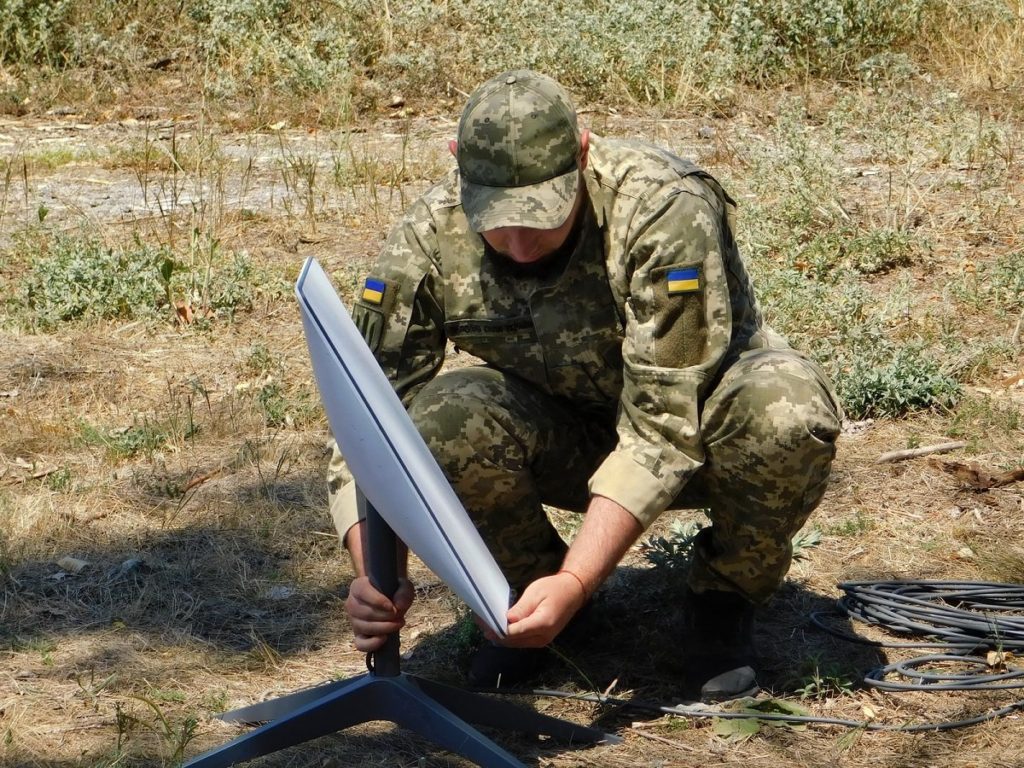
Russia keeps attacking Ukraine at the front and from the air while running a sabotage campaign behind the lines in Europe, which ISW has linked into one pattern. Starlink keeps Ukraine’s drone units and front-line troops connected, and Poland pays for much of that service.
Fuel canisters and a control unit
The attack came just after midnight, the prime minister wrote. Security services had warned the company about possible attacks, security was stepped up, and the attempt failed.
The company provides connectivity through nine Starlink satellite antennas used by Ukraine, Sinkevičius told Lithuanian public radio LRT. At almost 2 a.m., intruders tried to burn the antennas and their control unit, leaving behind incendiary liquid in canisters of 3 to 10 liters.
“It is obvious that this is part of Russia’s hybrid war with elements of sabotage,” he said, adding that the client was likely “the Russian side.”
He said he believes the people involved, and how many there were, are known, but gave no details, citing the investigation.
Police Commissioner General Arūnas Paulauskas said no suspects had been detained, any damage was minimal, and the company kept working. A pretrial investigation is under way.
Explore further
New Starlink restrictions disrupt Ukrainian drone missions. Kyiv adviser says move is tied to “political situation”
A drone the same morning
Hours later, an object that apparently entered from Poland crossed northern Lithuania, and NATO jets failed to identify it, Defense Minister Robertas Kaunas said. Possible fragments were found in the Pasvalys district near the Latvian border. Latvia’s military said the object may have blown itself up on a course toward Latvia.
Sinkevičius said the sabotage version had to be checked for the drone too. He called the National Security Commission for Monday, 19 October, to examine both incidents and consider giving services more powers to neutralize drones.
The third Starlink site
In September, a fire destroyed the distribution panel at a Starlink ground station in Wola Krobowska, Poland. Germany detained two Turkish nationals on 12 October, and Warsaw blamed Russian intelligence. In Bulgaria, masked intruders burned 11 of 17 Starlink antennas near Sofia.
After anti-government protests devolved into chaos, leaders from across the political spectrum blamed one another for the unrest, even as it largely subsided on Sunday.
After anti-government protests devolved into chaos, leaders from across the political spectrum blamed one another for the unrest, even as it largely subsided on Sunday.
Riots broke out in several French cities alongside peaceful marches of tens of thousands of people demonstrating against rising living costs and poor school conditions.
Riots broke out in several French cities alongside peaceful marches of tens of thousands of people demonstrating against rising living costs and poor school conditions.
A tourist office in Lyon, France, that was set on fire during unrest on Saturday. Many rallies stayed peaceful as weeks of student-led protests evolved into a national display of discontent.
The head of Britain’s domestic security agency accused Tehran and Moscow of escalating their hybrid campaigns in the U.K., and called Iran-led attacks on Jewish communities “sickening.”
The head of Britain’s domestic security agency accused Tehran and Moscow of escalating their hybrid campaigns in the U.K., and called Iran-led attacks on Jewish communities “sickening.”
A Ukrainian jamming-systems maker went to a US Army base to do to candidate drones what Russia does to Ukraine's: flood them with electronic warfare (EW) and see which survives. Unwave company has tested four of its EW systems at Fort Carson in Colorado as part of the Pentagon's Drone Dominance program and has been asked to continue supporting it.
The Pentagon is using Drone Dominance to choose the drones it will buy at scale, more than 200,000 by 2027, and it needs to know they work u
A Ukrainian jamming-systems maker went to a US Army base to do to candidate drones what Russia does to Ukraine's: flood them with electronic warfare (EW) and see which survives. Unwave company has tested four of its EW systems at Fort Carson in Colorado as part of the Pentagon's Drone Dominance program and has been asked to continue supporting it.
The Pentagon is using Drone Dominance to choose the drones it will buy at scale, more than 200,000 by 2027, and it needs to know they work under jamming, the condition that decides most drone fights in Ukraine.
So it brought in a Ukrainian electronic-warfare maker to supply that jamming, turning Ukraine's hard-won counter-drone experience into the test bench for American hardware. It follows a pattern in which US defense efforts adopt Ukrainian battlefield models.
Ukraine brings the jamming
From 24 August to 2 September, Unwave's team worked at the base, running scenarios that pitted its jammers against drones tasked with protecting fixed positions, moving vehicles, and infrastructure.
The crews operated from three separate positionsat short and long range to compare how drones from different manufacturers held up.
"Our mission was to create conditions as close to the real battlefield as possible," the company said, adding that it judged the tasks successfully completed but could not detail the scenarios for security reasons.
In all, 14 drone makers and three electronic-warfare firms took part.
Four systems on show
Unwave brought four:
VIHA, which it calls Ukraine's first tactical-operational jammer for directed suppression of drones
BOOMBOX, built to shield troops and positions from FPV and drop-drones
SHATRO, for vehicles
CHOVEN-2, a multi-frequency amplifier for cars.
Its participation was organized by Revenant Technologies, a US firm that specializes in bringing combat-proven defense tech to the American market, and helped design the scenarios using its ties to Ukraine and frontline experience.
A foothold in the US market
For Unwave, the value is a door into the alliance's security architecture. The event showed the importance of Ukrainian, American, and European specialists testing together, the company said, and "such interaction will help integrate Ukrainian technologies into the security architecture of our allies."
Three men were found guilty on July 8 in connection with an arson attack on Ukraine-linked businesses in London, which British authorities say was orchestrated by Russia's Wagner mercenary group, Reuters reported.The alleged ringleader, Dylan Earl, 21, had already pleaded guilty to aggravated arson over the 2024 blaze targeting companies that were supplying Elon Musk's Starlink satellite equipment to Ukraine, according to Reuters. The systems are considered vital to Ukraine's communications and
Three men were found guilty on July 8 in connection with an arson attack on Ukraine-linked businesses in London, which British authorities say was orchestrated by Russia's Wagner mercenary group, Reuters reported.
The alleged ringleader, Dylan Earl, 21, had already pleaded guilty to aggravated arson over the 2024 blaze targeting companies that were supplying Elon Musk's Starlink satellite equipment to Ukraine, according to Reuters.
The systems are considered vital to Ukraine's communications and defense against Russia's ongoing invasion.
Earl also became the first person convicted under the U.K.'s National Security Act after admitting to a separate plot to attack a wine shop and restaurant in London’s upscale Mayfair district and to kidnap its owner, a prominent critic of Russian President Vladimir Putin.
Two others, Jake Reeves, 23, and Earl’s associate, also pleaded guilty to aggravated arson, with Reeves admitting to a charge under the National Security Act for receiving a material benefit from a foreign intelligence agency.
A jury at London's Old Bailey court convicted three additional men, Nii Kojo Mensah, 23, Jakeem Rose, 23, and Ugnius Asmena, 20, of aggravated arson. They had denied the charges. A fourth man, Paul English, 61, was acquitted.
Two other defendants, Ashton Evans, 20, and Dmitrijus Paulauskas, 23, were charged with failing to disclose knowledge of terrorist activity. Evans was convicted on one count and cleared of another. Paulauskas was acquitted of both charges and reportedly broke down in tears as the verdict was read.
Commander Dominic Murphy of the London Metropolitan Police reportedly said he was confident the Wagner Group and the Russian state were behind the attacks.
The U.K. has designated the Wagner Group as a terrorist organization.
Earl had exchanged hundreds of encrypted messages with a supposed Wagner handler using the alias "Privet Bot" on Telegram. According to reporting by the Organized Crime and Corruption Reporting Project (OCCRP), the account was previously advertised by Grey Zone, a Wagner-affiliated channel.
Prosecutors said Earl expressed interest in fighting for Wagner and was encouraged to recruit contacts from British soccer hooligan networks, Irish republican groups, and organized crime circles, Reuters reported. He and Evans also admitted to unrelated charges of dealing cocaine.
The Russian Embassy in London has denied any involvement in the warehouse attack and accused the British government of blaming Russia for domestic issues.
The Kremlin has consistently rejected accusations of sabotage and espionage, despite growing evidence and convictions tied to Russian-linked operations across Europe.

 Connexion