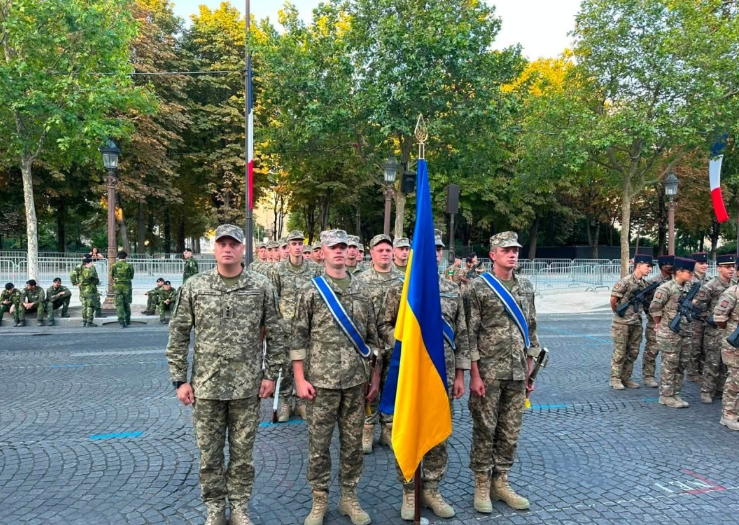
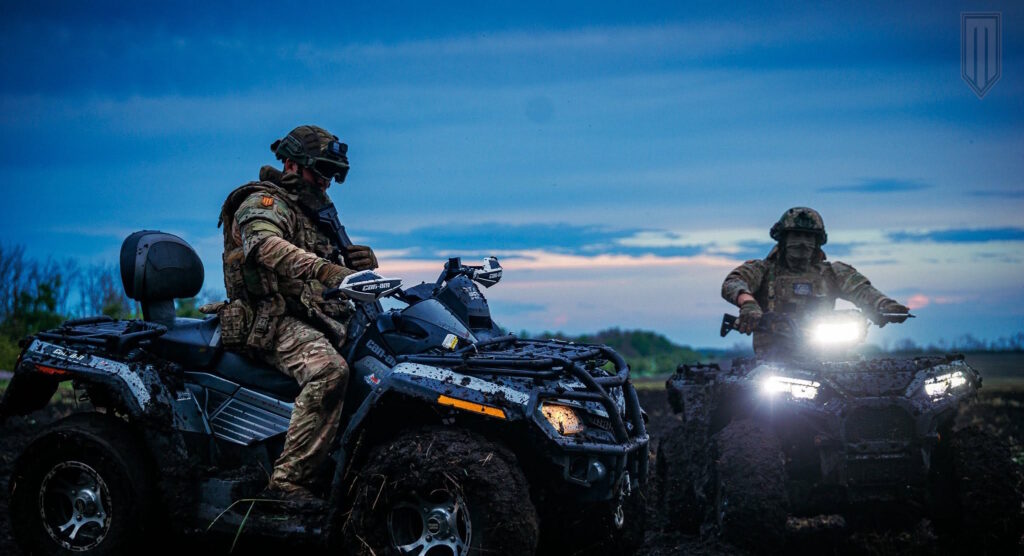
Ukrainian troops will march through Brussels for the first time. A Ukrainian unit will take part in Belgium's National Day military parade on 21 July, Belgian Defense Minister Theo Francken announced.
The Brussels appearance comes a week after Ukrainian troops marched at France's Bastille Day parade, also a first. The same units and soldiers who were in Paris will march in Belgium, according to Francken's spokesperson, per VRT.
"For the first time ever, a Ukrai
Ukrainian troops will march through Brussels for the first time. A Ukrainian unit will take part in Belgium's National Day military parade on 21 July, Belgian Defense Minister Theo Francken announced.
The Brussels appearance comes a week after Ukrainian troops marched at France's Bastille Day parade, also a first. The same units and soldiers who were in Paris will march in Belgium, according to Francken's spokesperson, per VRT.
"For the first time ever, a Ukrainian detachment will march along on 21 July. Extremely proud of this. Slava Ukraini. Never surrender," the minister wrote.
Ukraine becomes part of defense parades in Europe
Unlike in Paris, where Volodymyr Zelenskyy attended in person and watched from the presidential tribune, the Ukrainian president will not be in Brussels.
In Paris, Ukrainian pilots co-piloted French Mirage 2000B jets in the opening flyover.
Ukraine received the maximum foreign quota established by France, with each partner delegation allowed between 7 and 25 servicemembers.
The back-to-back parade appearances are a small piece of a larger European effort to fold Ukraine into the continent's defense and ceremonial life.
Two national days, one week, same Ukrainian soldiers
The symbolism runs through the calendar. On 14 July, Ukrainian troops marched on the Champs-Élysées among representatives of the Coalition of the Willing, the European planning body developing security guarantees for Ukraine after any ceasefire.
A week later, the same soldiers march in Brussels, the city that houses both NATO and EU headquarters, for Belgium's National Day, which marks the 1831 inauguration of the country's first king.
Belgium has been among Ukraine's steady European backers. It has committed F-16 fighter jets to Ukraine, pledged long-term military aid, and joined the coalition of countries building Ukraine's post-ceasefire security architecture.
Putting Ukrainian soldiers in its National Day parade is a public, high-visibility signal of that alignment, the gesture that has multiplied across Europe as the war has continued.
A Ukrainian assault regiment says it has cleared Kostiantynivka from Russian invaders. Soldiers of the 425th "Skelia" (Rock) Separate Assault Regiment reported that they conducted a clearing operation in a city in Donetsk Oblast and that the city is under the control of the Ukrainian army.
The claim is a Ukrainian counter to a Russian one. On 3 July, Kremlin spokesman Dmitry Peskov asserted that the city had been fully taken, providing no proof, according to Radio Free Euro
A Ukrainian assault regiment says it has cleared Kostiantynivka from Russian invaders. Soldiers of the 425th "Skelia" (Rock) Separate Assault Regiment reported that they conducted a clearing operation in a city in Donetsk Oblast and that the city is under the control of the Ukrainian army.
The claim is a Ukrainian counter to a Russian one. On 3 July, Kremlin spokesman Dmitry Peskov asserted that the city had been fully taken, providing no proof, according to Radio Free Europe/Radio Liberty.
The unit posted footage of strikes on Russian concentration points and of Ukrainian soldiers with a Ukrainian flag, and addressed President Volodymyr Zelenskyy with a statement that the task was accomplished and the city is "again under the blue-and-yellow flag."
Kostiantynivka is southern gate of Ukraine's "fortress belt"
The city matters because of where it sits. Kostiantynivka lies at the southern end of the chain of cities forming Ukraine's "fortress belt" — its main defensive backbone in Donetsk Oblast, with Druzhkivka, Kramatorsk, and Sloviansk standing farther north.
Capturing that urban belt is central to Putin's goal of occupying all of the Donbas. A Russian victory at Kostiantynivka would let Moscow claim it had forced open the southern gate to the remaining Ukrainian-held cities.
Costly advance
The battle has been grinding and costly. Russia advanced on Kostiantynivka at an average of about 50 meters per day in the period before its capture, according to the Center for Strategic and International Studies cited by RFE/RL, one of the slowest advance rates recorded in modern war.
Ukraine's 19th Army Corps commander reported that Russian groups had infiltrated various parts of the city but controlled none of it, while ISW assessed Russia had concentrated around 11,000 troops in the Kostiantynivka-Druzhkivka area.
While Ukraine keeps repelling Russian attacks on the Donetsk front, Russia may be planning to call up half a million people this fall, Andrii Kovalenko, head of the Center for Countering Disinformation under Ukraine's National Security and Defense Council, says.
Kovalenko adds that some of the mobilized would be thrown into battle within the first two weeks to "plug holes in the East," as others would be trained for at least a month in case a new front opens.
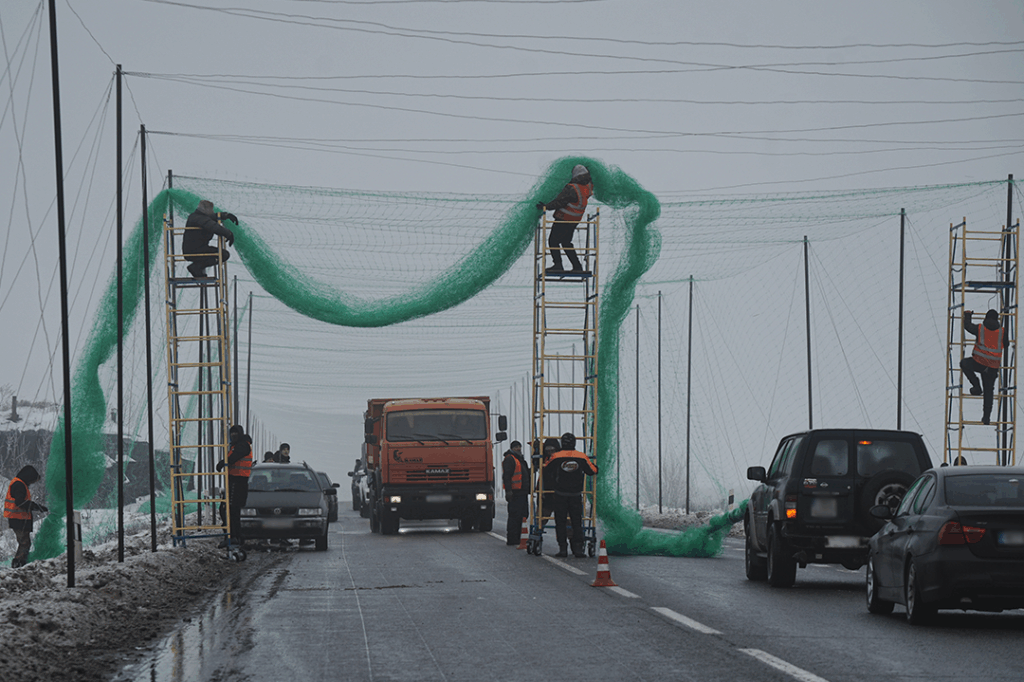
Ukraine has now covered more than a thousand kilometers of road against drones. The State Special Transport Service has built 1,066 km of anti-drone protection along key logistics routes since the start of 2026, on assignment from Ukraine's Defense Ministry, the ministry said.
The netting is what lets anything move near the front at all. Russian FPV and reconnaissance drones hunting vehicles within 15 to 30 kilometers of the front have forced Ukraine to shield its roads wit
Ukraine has now covered more than a thousand kilometers of road against drones. The State Special Transport Service has built 1,066 km of anti-drone protection along key logistics routes since the start of 2026, on assignment from Ukraine's Defense Ministry, the ministry said.
The netting is what lets anything move near the front at all. Russian FPV and reconnaissance drones hunting vehicles within 15 to 30 kilometers of the front have forced Ukraine to shield its roads with overhead netting.
Since the start of June alone, crews in frontline regions built 325 km of new anti-drone protection, restored more than 31 km, and repaired nearly 233 km of roads.
Roads are priority target, so protecting them is priority task
In modern war, logistics routes are one of the enemy's priority targets, the Defense Ministry said, which is why drone protection directly affects how reliably units stay supplied. Protected road sections allow Ukraine to move resources faster and more safely, helping maintain the tempo of combat operations.
The scale of the effort reflects how completely drones have reshaped the ground behind the front. Ukraine has been building this network at a pace that reached 9.2 kilometers a day by June, more than double the 2025 rate, and is targeting 4,000 km of covered road by the end of 2026. Kherson Oblast alone accounted for 207 km of it.
Netting is one half of two-partanswer
Road protection works alongside the vehicles and robots that use it. The nets catch the FPV before it reaches the target. The trucks, ground robots, and evacuation vehicles move along the stretch protected by the nets.
Ukraine has been pushing the moving half onto machines wherever it can. Ground robots ran more than 66,000 logistics and evacuation missions in the first half of 2026, taking over the most dangerous supply and casualty-evacuation runs so soldiers do not have to make them.
Together, the netting and the robots are Ukraine's structural answer to a front where, as the Defense Ministry put it, the safety of logistics is one of the key factors in the Defense Forces' resilience.
Repair runs alongside protection. Since restoration work began in April, crews have carried out current repairs and maintenance on more than 369.6 km of roads, with work underway on 16 sections and 27 already fully complete.
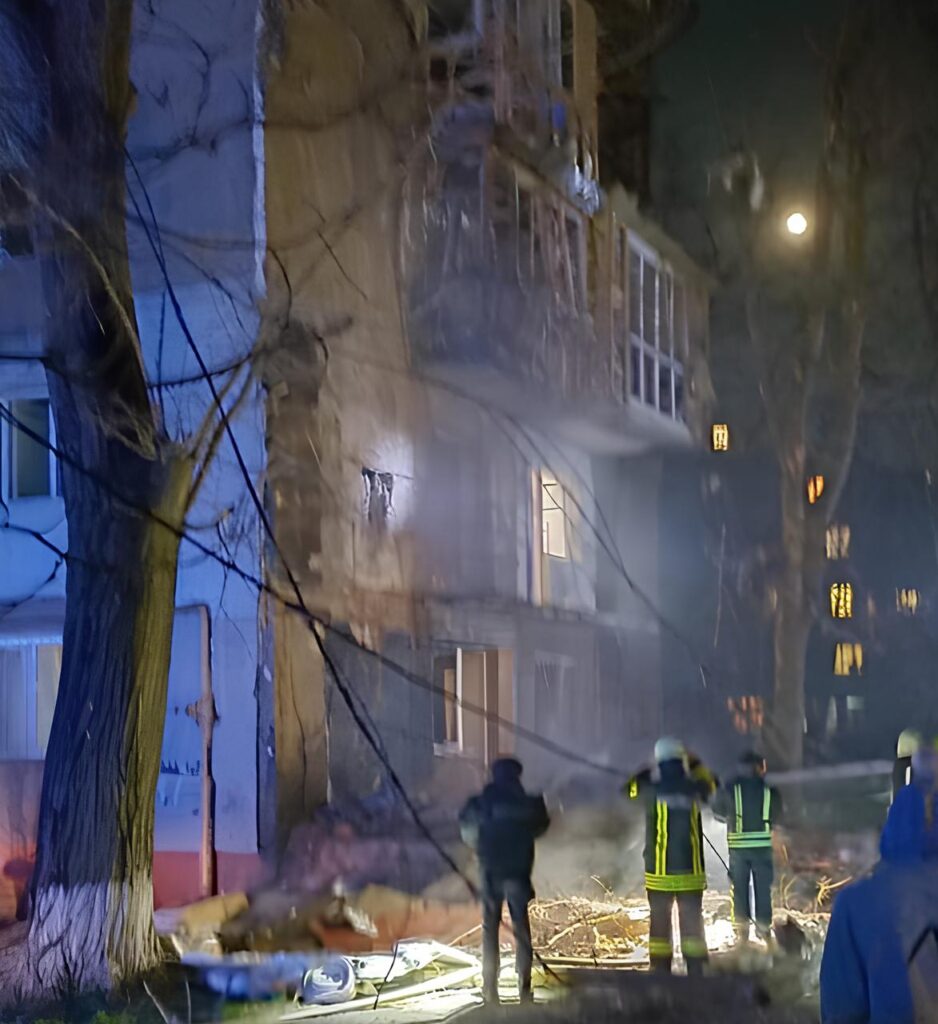
A Russian missile killed a 16-year-old boy in Odesa. Russian forces struck civilian infrastructure in Odesa Oblast on the evening of 18 July, wounding at least seven other residents, the Odesa Oblast Prosecutor's Office said.
Prosecutors opened a war crimes investigation under Part 2 of Article 438 of Ukraine's Criminal Code.
The strike came at the end of a week that had made Odesa one of Russia's most hit targets. Odesa's ports carry more than 90% of Ukraine's agricul
A Russian missile killed a 16-year-old boy in Odesa. Russian forces struck civilian infrastructure in Odesa Oblast on the evening of 18 July, wounding at least seven other residents, the Odesa Oblast Prosecutor's Office said.
Prosecutors opened a war crimes investigation under Part 2 of Article 438 of Ukraine's Criminal Code.
The strike came at the end of a week that had made Odesa one of Russia's most hit targets. Odesa's ports carry more than 90% of Ukraine's agricultural exports.
The evening attack damaged two private houses, buildings at a sports-and-entertainment complex, and eight cars, according to prosecutors.
Russia hit recreation park with families
Beyond the 16-year-old killed, the wounded included a two-year-old child, four women aged 22 to 28, and two men aged 27 and 40, all hospitalized.
Oblast administration head Oleh Kiper reported that a missile hit a recreation park, destroying fishermen's houses, and that people might still be under the rubble as a search-and-rescue operation continued. The casualty figures were still being clarified late on 18 July.
Eyewitnesses posted video of people digging through sand and debris by hand, apparently in the moments right after the missile struck, searching for anyone trapped.
Toll was still being counted late on 18 July
The information from the scene shifted through the evening, as it typically does in the hours after a strike.
Kiper initially reported two people killed and four wounded, including a child, at the recreation park, with people possibly still trapped under the rubble. He said a second location in another settlement saw a residential building and two cars damaged, with one person hurt.
The Security Service of Ukraine's Odesa directorate is conducting the pre-trial investigation and documenting the strikes as war crimes.
Odesa has been under sustained fire for over week
The 18 July strike is the latest in a campaign that has hammered Odesa and its ports throughout July. From 11 to 15 July, Russian strikes hit three Greater Odesa ports and the merchant ships anchored there, cutting the region's grain-export capacity by roughly a third, perReuters.
The civilian toll has run alongside the economic one. On 16 July, a Russian strike on Odesa killed Olena Arkhipova, a Red Cross first-aid instructor and single mother of three, as she hurried to shelter with her children; the children survived.
Exclusive
Russia's war is killing the Black Sea—so Ukraine is crippling its shadow fleet without spilling the oil. Ukraine's countershipping campaign risks polluting the fragile Black Sea. Drone operators are trying to spill less oil.
Russian troops inch toward Lyman. Drones keep delaying the plan.. Fedorov's middle-strike drones are throttling the supply lines behind the Russian push. Whether they keep doing it without him is the question hanging over Sloviansk.
Ukraine says Russia may be preparing a new wave of mobilization. This fall, Russia is planning to call up half a million people, Andrii Kovalenko, head of the Center for Countering Disinformation under Ukraine's National Security and Defense Council, said.
Kovalenko says some of the mobilized would be thrown into battle within the first two weeks to "plug holes in the East," he said, while others would be trained for at least a month for the potential opening of a new front
Ukraine says Russia may be preparing a new wave of mobilization. This fall, Russia is planning to call up half a million people, Andrii Kovalenko, head of the Center for Countering Disinformation under Ukraine's National Security and Defense Council, said.
Kovalenko says some of the mobilized would be thrown into battle within the first two weeks to "plug holes in the East," he said, while others would be trained for at least a month for the potential opening of a new front direction.
He warned that fall and winter will be intense, requiring Ukraine to hold in "very difficult infantry battles, where people, drones, KABs, and other instruments of death converge."
Russia's first deputy chief of staff Sergei Kiriyenko and General Staff chief Valery Gerasimov have assured Russian leader Vladimir Putin the mobilization would help defeat Ukraine, Kovalenko said, adding: "I know for certain that they are mistaken. Right now, we all need unity and effectiveness."
Recruitment numbers are the reason the forecast is plausible
Russia has been failing to sign enough contract soldiers to cover its losses. Its 2026 losses have outrun its recruitment.
Ukraine's Foreign Intelligence Service reported in mid-July that Russia signed only 195,000 military contracts against a target of 204,500, while losing 196,700 troops so far in 2026, and roughly 115,300 of them irretrievable and 80,400 injured.
Ukraine's Commander-in-Chief Oleksandr Syrskyi said in early 2026 that Russia planned to recruit around 409,000 troops and form at least 11 new divisions, drawing on a mobilization pool he estimated at more than 20 million.
The Kremlin's unwritten deal with its society since has been that the war would not touch those who did not volunteer, and Moscow has filled its ranks instead with high-paid contract soldiers, prisoners, and foreign recruits precisely to avoid repeating that political shock.
Even Ukraine's own official says it would not turn the war
Three weeks before this latest post, Kovalenko said that even if Russia announced a fall mobilization, it would only partially offset heavy losses.
"Even if such a decision is made in the fall, Russia will only be plugging gaps at the front caused by heavy losses and recruitment levels that remain below the rate of casualties," he said then.
He concluded that the only real fix for Russia's manpower problem is to end the war.
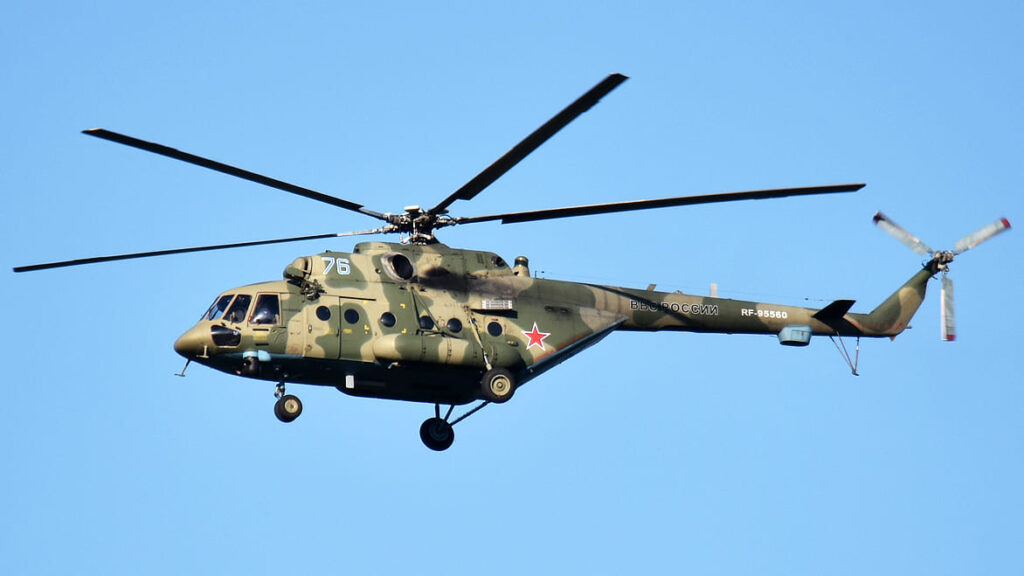
Russia has likely turned a helicopter into a flying drone-jammer. Moscow has built a new complex on an Mi-8 helicopter, likely intended to counter drones, according to Militarnyi. The whole assessment of what it does and how is Militarnyi's analysis of photographs, not a confirmed Russian capability.
The system is what the EW-versus-EW arms race looks like from Russia's perspective.
According to Militarnyi, the helicopter carries several panel antennas mounted at different
Russia has likely turned a helicopter into a flying drone-jammer. Moscow has built a new complex on an Mi-8 helicopter, likely intended to counter drones, according to Militarnyi. The whole assessment of what it does and how is Militarnyi's analysis of photographs, not a confirmed Russian capability.
The system is what the EW-versus-EW arms race looks like from Russia's perspective.
According to Militarnyi, the helicopter carries several panel antennas mounted at different angles to cover a 180-degree sector, with a likely mirror set on the other side of the aircraft for full coverage.
Each panel has only two cables running to it, which the reviewers suggest means the system operates in two channels simultaneously.
Militarnyi thinks it jams navigation, not control
The reviewers' central argument is about what the complex is not. It is unlikely to be aimed at radio-controlled drones near the front line, Militarnyi says, because it can only cover too narrow a band of frequencies for that.
Instead, their version is that it suppresses the satellite navigation of Ukraine's long-range strike drones, which fly on fixed frequencies.
If the navigation-jamming theory is right, each of the two cables might handle a separate antenna polarization, allowing the system to radiate interference in different polarizations and depend less on how a drone's navigation antenna is oriented in flight.
The cables might alternatively be split by frequency — one covering the L1 band (1.5 to 1.6 GHz), the other L2 or L5 (around 1.2 GHz) — so each panel could jam both main signals that multi-band drone receivers rely on.
Why a flying jammer, and why it might work
The one part of Militarnyi's reasoning that rests on a general principle rather than photo-reading concerns why Russia would put this in the air at all.
Long-range strike drones usually carry an inertial navigation system alongside their satellite receiver, Militarnyi notes.
But an inertial system is built to correct for drift only while a drone crosses a relatively small jamming zone, because the inertial unit accumulates its own error over time.
A jammer that can move — loitering in a helicopter along a drone's expected path — could hold a drone inside a suppression zone for longer than a fixed ground station could, forcing the inertial system to coast further and drift more.
On that logic, Militarnyi suggests Russia probably plans to use these helicopters much like the light-aircraft electronic-warfare platforms it already flies.
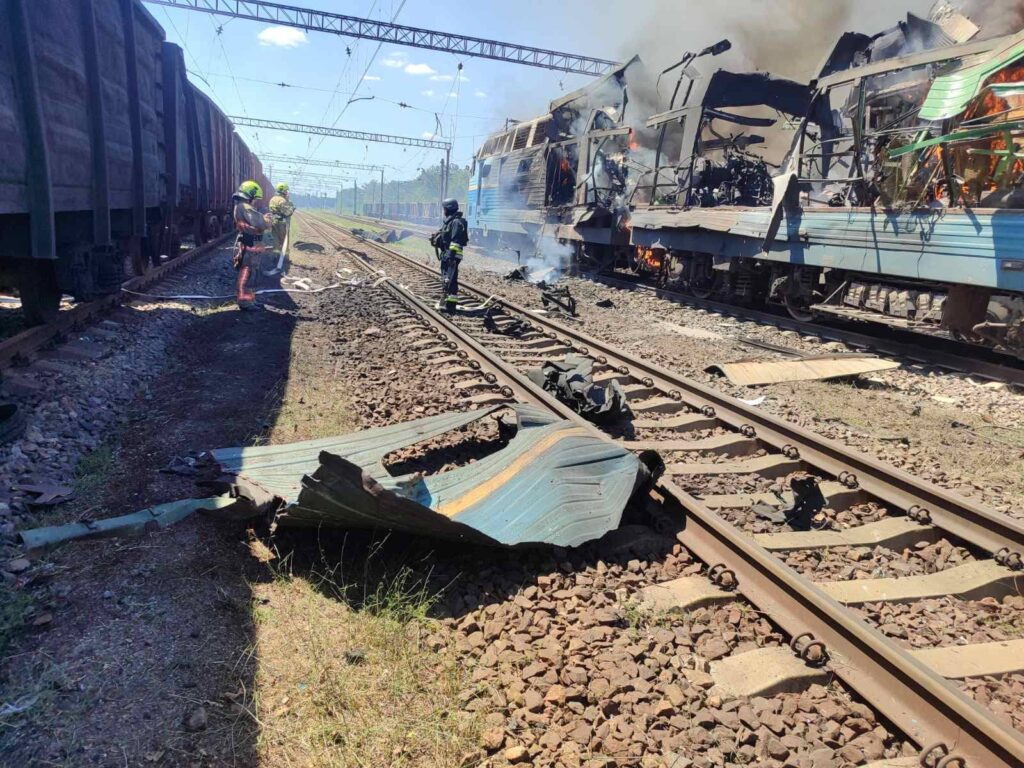
Russia hit a passenger train, then hit it again. Russian forces carried out a double strike on a locomotive and passenger carriages of a train in Zaporizhzhia Oblast, Ukrainian Minister for Restoration, Infrastructure and Transport Mykola Kalashnyk said.
Thanks to a monitoring group, the professional actions of railway workers, and a timely response, all passengers and staff were moved to safety in time. No one was hurt.
The no-casualties outcome is the system Ukraine buil
Russia hit a passenger train, then hit it again. Russian forces carried out a double strike on a locomotive and passenger carriages of a train in Zaporizhzhia Oblast, Ukrainian Minister for Restoration, Infrastructure and Transport Mykola Kalashnyk said.
Thanks to a monitoring group, the professional actions of railway workers, and a timely response, all passengers and staff were moved to safety in time. No one was hurt.
The no-casualties outcome is the system Ukraine built for exactly this. Russia has turned Ukraine's trains into targets, striking the railway about 1,200 times in 2025 and killing roughly 40 railway workers since 2022.
People have minutes to hind
To keep crews alive, Ukrzaliznytsia now runs monitoring groups that detect incoming drones and has installed more than 800 mobile blast shelters at junctions and depots so people can take cover within seconds of an alert. On this train, the warning came in time. In others in the same oblast, it has not.
"Russia deliberately continues to strike civilian infrastructure, trying to intimidate people and disrupt the transport system," Kalashnyk said.
Double-tap is the tactic that makes these strikes war crimes
The two-strike pattern is not incidental. Russia has repeatedly used the "double-tap" tactic when a first strike is followed by a second on the same target that maximizes harm to the people who respond to the first hit. Ukrainian prosecutors have documented this tactic across thousands of attacks on civilians.
Against a train, the double-tap is aimed at the moment of evacuation: the first strike to stop the train and force people out, the second to catch them in the open or the responders as they arrive.
Zaporizhzhia Oblast has already paid the other price. In June 2026, a Russian strike on three Ukrzaliznytsia locomotives killed an assistant driver who could not get clear of his rear cab in time. Crews there have had minutes, sometimes less.
Railway keeps running because breaking it is point
Kalashnyk framed the strike as part of a deliberate campaign, and the archive supports him. Russia has stepped up attacks on civilian rail specifically because the network carries both civilian passengers and wartime logistics, and because keeping it running is essential to Ukraine's economy, its evacuations, and its supply lines.
The cost is mounting faster than repairs. Russia damaged more than 200 Ukrainian locomotives in the first half of 2026 alone, roughly matching the entire prior 15-month toll, along with hundreds of passenger and freight carriages. Ukrzaliznytsia has warned that the summer of 2026 will be its hardest yet because strikes are depleting its carriages faster than the company can replace them.
"Ukrainian railways continue to work, ensuring uninterrupted connection and carrying out their critically important mission even under constant attacks," Kalashnyk said.
The Ministry, together with the Defense Ministry and Ukrzaliznytsia, is working to strengthen the resilience of rail transport even under such conditions, he added.
Ukraine's president may bring back the defense minister he just fired, in a new job. The Presidential Office is considering offering former Defense Minister Mykhailo Fedorov a new role as a "miltech czar" amid mass protests across Ukraine against the decision, ZN.UA reported, citing its own sources in Washington.
Fedorov may be proposed to become a coordinator of military technology development, while Zelenskyy is separately weighing whether to replace Commander-in-Chief Ol
Ukraine's president may bring back the defense minister he just fired, in a new job. The Presidential Office is considering offering former Defense Minister Mykhailo Fedorov a new role as a "miltech czar" amid mass protests across Ukraine against the decision, ZN.UA reported, citing its own sources in Washington.
Fedorov may be proposed to become a coordinator of military technology development, while Zelenskyy is separately weighing whether to replace Commander-in-Chief Oleksandr Syrskyi. Partners expect Fedorov to accept the new post.
The two moves, taken together, would reverse the terms of Fedorov's dismissal. Fedorov was fired on 15 July after a feud with Syrskyi.
Position is power without ministry
Fedorov may become a senior official given broad authority to coordinate a particular area of work across different government structures.
In Fedorov's case, that likely means coordinating the development of military technology, weapons production, and unmanned systems, as well as the interaction among the state, the military, and the defense industry.
That is, in substance, much of what Fedorov already did as defense minister and as the architect of Ukraine's "Army of Drones" program, but stripped of the ministry and its chain of command.
Zelenskyy reportedly reconsiders Syrskyi question
The possible replacement of Syrskyi is the larger story, and it is now in the open. The Financial Times reported that Zelenskyy is weighing the move following days of turmoil in the military leadership, and that any change would happen only if the president finds a commander who can ensure a smooth handover while holding the 1,200-kilometer front.
Fedorov himself said about the top commander: "Syrskyi saved our country in 2022, carried out several successful operations, and we cannot underestimate him. But the war has changed," he said.
Zelenskyy and Fedorov both signal more change is coming
As protests entered a third consecutive day, both men addressed the crowds on the evening of 18 July, and both pointed to decisions still being worked out.
"Yesterday and today, there were many consultations. Of course, I hear what people are saying. I spoke at length today with Mykhailo Fedorov. I also spoke today with Oleksandr Syrskyi. Decisions on the army will be worked out," Zelenskyy said.
Fedorov echoed the promise of change.
"Changes will definitely happen. For my part, thank you for the hope. I did not feel such responsibility even in government posts. Thank you to the veterans and the military for holding the front and holding honor," he said.
The Vatican's foreign minister stood in the rubble of a Russian strike in Kyiv. Archbishop Paul Richard Gallagher, the Holy See's Secretary for Relations with States and International Organizations, visited the site of a Russian missile strike that destroyed residential buildings and killed civilians, Ukraine's State Emergency Service (SES) said on Facebook.
Kyiv rescuers showed the archbishop how they work in the aftermath of Russian attacks, describing the search-and-resc
The Vatican's foreign minister stood in the rubble of a Russian strike in Kyiv. Archbishop Paul Richard Gallagher, the Holy See's Secretary for Relations with States and International Organizations, visited the site of a Russian missile strike that destroyed residential buildings and killed civilians, Ukraine's State Emergency Service (SES) said on Facebook.
Kyiv rescuers showed the archbishop how they work in the aftermath of Russian attacks, describing the search-and-rescue operations and the daily work of crews operating under the constant threat of repeat strikes.
Ukraine's rescuers work those sites under the threat of the double-tap, which is a Russian tactic of striking a location a second time after emergency crews arrive, which Ukraine's prosecutors have documented repeatedly.
Visit is one thread of Vatican's humanitarian engagement in Ukraine
It came days after Cardinal Matteo Zuppi, the pope's peace envoy, met Ukrainian Foreign Minister Andrii Sybiha in Kyiv on 16 July, where Sybiha pressed for a humanitarian corridor to evacuate civilians from Russian-occupied Oleshky, where UN and Human Rights Watch monitors say thousands are trapped without food or medical care.
The SES thanked the Holy See for its humanitarian aid to the Ukrainian people and for its solidarity, and said such visits are important evidence of international attention to the consequences of Russian aggression.
Vatican works humanitarian channels, not mediatingrole
The Holy See's engagement has focused on humanitarian work rather than mediation. Zuppi has run the Vatican's efforts on prisoner exchanges between Ukraine and Russia and on the return of Ukrainian children abducted to Russia, and the Ukrainian Greek Catholic Church has said plainly that the Vatican performs no mediating mission.
Pope Leo XIV, elected in 2025, has taken a sharper line on the war than his predecessor. Meeting Zelenskyy in December 2025, Leo appealed to Russia to make a gesture toward peace and warned that excluding Europe from peace talks on Ukraine was unrealistic.
Zelenskyy has invited him to visit Ukraine, which the pontiff said he hoped to do without committing to a date.
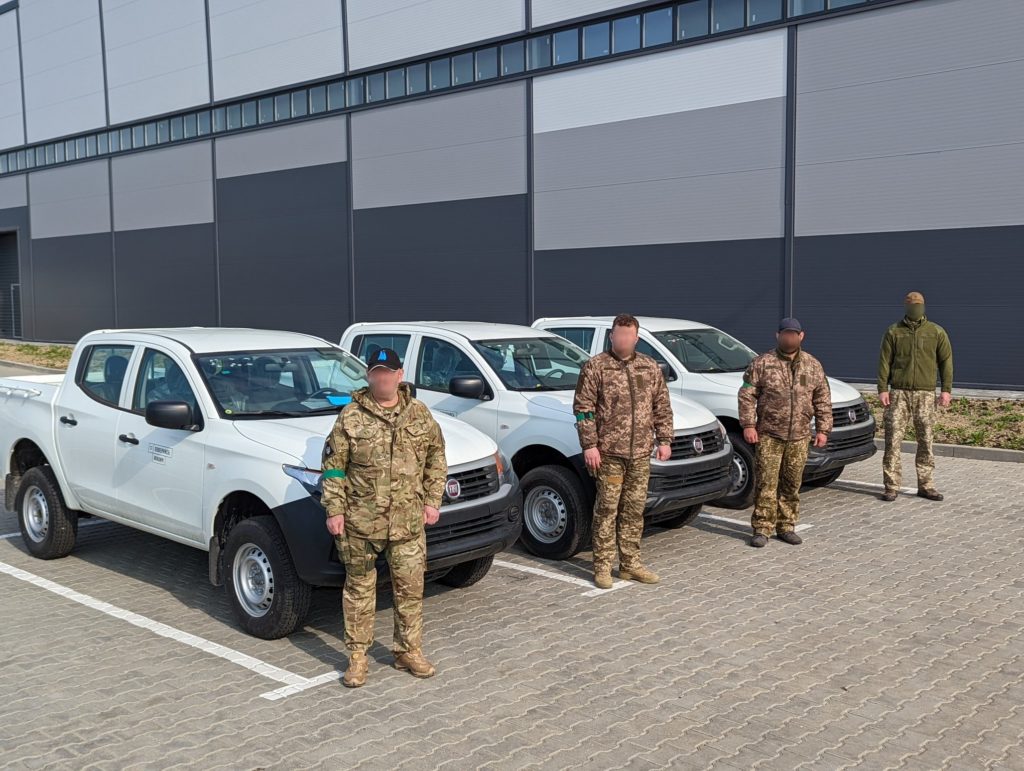
Kharkiv Oblast got 12 pickup trucks and two road rollers from Germany. The vehicles came from Germany's Federal Agency for Technical Relief (THW), Kharkiv Oblast Military Administration head Oleh Synehubov said on Facebook, secured with help from the regional administration and a charitable organization.
The pickups are going where the state has to keep functioning under fire. They will be split among seven frontline and near-frontline communities — Kurylivka, Vilkhuvatka,
Kharkiv Oblast got 12 pickup trucks and two road rollers from Germany. The vehicles came from Germany's Federal Agency for Technical Relief (THW), Kharkiv Oblast Military Administration head Oleh Synehubov said on Facebook, secured with help from the regional administration and a charitable organization.
The pickups are going where the state has to keep functioning under fire. They will be split among seven frontline and near-frontline communities — Kurylivka, Vilkhuvatka, Zolochiv, Prolisne, Lozova, Oskil, and Barvinkove — plus the Kupiansk district military administration and the regional branch of the State Emergency Service.
Why does Kharkiv Oblast need more trucks?
They will be used for rapid emergency response, delivering humanitarian aid, evacuating residents, and surveying territory. The two road rollers will be deployed for emergency recovery and to repair damaged road infrastructure.
In Kharkiv Oblast, those are combat tasks as much as civilian ones. The roads these vehicles will drive are hunted. Russian drones routinely strike civilian cars on the oblast's roads — a Molniya drone killed a 61-year-old man driving near Zolochiv, one of the communities receiving a pickup, on 14 July.
A pickup that can move fast, carry aid or evacuees, and be replaced when lost is exactly the kind of unglamorous vehicle a border region needs to keep people alive.
Pickups will drive roads Ukraine is racing to cover with nets
The vehicles arrive as Ukraine builds a national infrastructure to let anything move near the front at all. Russian FPV and reconnaissance drones hunting vehicles within 15 to 30 kilometers of the front have forced Ukraine to shield its roads with netting tunnels, wire-mesh canopies, and reinforced barriers.
Ukraine has already built more than 887 kilometers of anti-drone road protection since January 2026, adding a further 9.2 kilometers a day, and is targeting 4,000 kilometers of covered road by the end of the year. Kharkiv was among the first places the nets went up, with workers covering the city's ring road as early as February 2026.
The delivery is a small piece of a large German commitment. Germany is Ukraine's second-largest military and humanitarian backer after the US, and has earmarked €11.6 billion ($13.5 billion) for Ukraine in its 2027 budget.
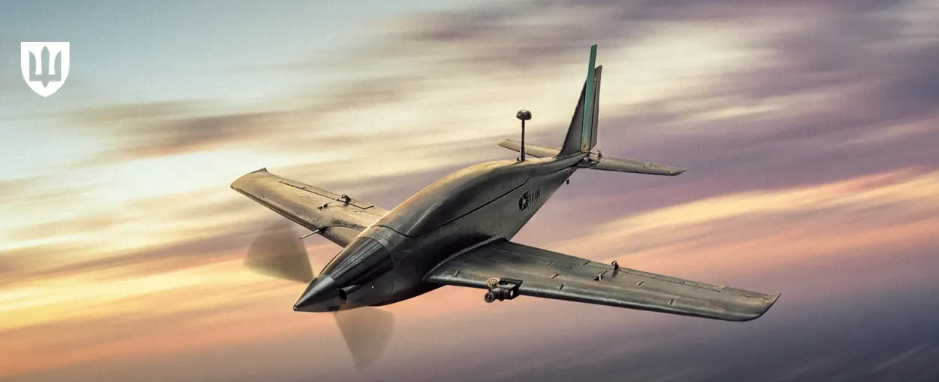
Ukraine has a new drone hunter that outclimbs its prey. Ukraine's Defense Ministry codified the Tsyklop interceptor drone, which can rise above the maximum flight altitude of Russian strike and reconnaissance UAVs and destroy them from there.
Ukraine's interceptor lineup has filled fast with systems that compete on speed and cost, and Tsyklop's distinguishing claim is a ceiling higher than what Russia's drones can reach.
It has a wingspan of a little over a meter, stays air
Ukraine has a new drone hunter that outclimbs its prey. Ukraine's Defense Ministry codified the Tsyklop interceptor drone, which can rise above the maximum flight altitude of Russian strike and reconnaissance UAVs and destroy them from there.
Ukraine's interceptor lineup has filled fast with systems that compete on speed and cost, and Tsyklop's distinguishing claim is a ceiling higher than what Russia's drones can reach.
It has a wingspan of a little over a meter, stays airborne for nearly 1.5 hours, and comes in two variants: a cheaper, simpler model for slow, low-flying air and ground targets, and a higher-performance version built to catch fast Shaheds at altitude.
The Ministry says the system's range is enough to cover any Ukrainian regional center against drone attacks, and that its V2 variant has already destroyed more than 100 air targets, and was the first to down a Russian Shahed over Kursk Oblast.
The interceptor was developed by a Ukrainian enterprise experienced in building weapons specifically for high-intensity modern warfare, and various Tsyklop modifications have been at the front for several years already, per the Defense Ministry.
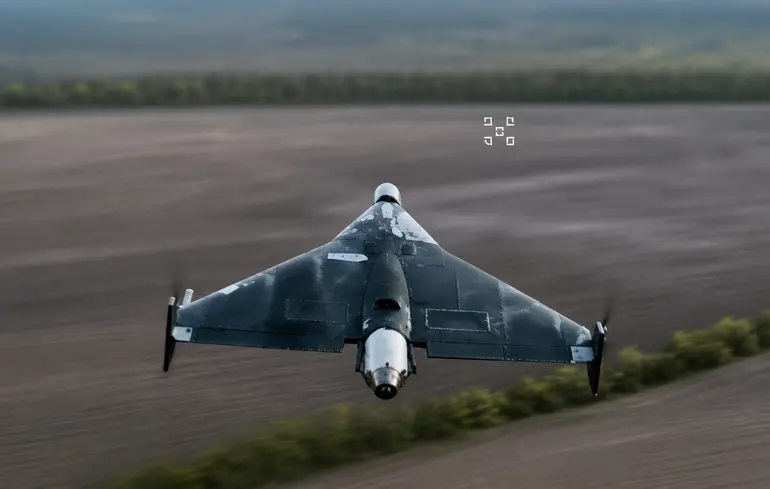
Tsyklop already kills full Russian drone catalog
The V2's more than 100 kills span the range of Russian drones Ukraine faces daily: the Gerbera decoy-and-strike drone, the Zala and Supercam and Orlan reconnaissance UAVs, the Lancet loitering munition, and the Molniya. That target list is the point — it means one interceptor is bringing down both the cheap reconnaissance drones that spot for Russian artillery and the Lancets that follow, as well as Shaheds.
Different Tsyklop modifications have been at the front for several years, the Ministry said, so codification formalizes a system already proven in combat rather than introducing an untested one. The cheaper variant handles slow, low targets; the high-performance variant is built for fast Shaheds at altitude.
Tsyklop joins fast-filling interceptor lineup
Tsyklop enters a market that Ukraine has built at speed. The Defense Ministry codified 413 unmanned aerial systems in the first half of 2026, and interceptors are one of the fastest-growing categories.
The competitors each solve the Shahed problem differently. Ukraine's Defense Ministry is procuring 8,000 Octopus interceptors with automatic terminal guidance. Germany funded 15,000 units of the STRILA, which hits 355 km/h and needs no GPS. Wild Hornets' Sting has destroyed more than 600 aerial targets and became the first Ukrainian drone control system approved to NATO standards.
Tsyklop's contribution to that mix is the vertical dimension: a drone that gets above the target rather than chasing it down.
Altitude answers the jet-Shahed problem
The high-flying variant matters because Russia's drones have been getting faster and higher. Russia has fielded jet-powered Geran-4 Shaheds that cruise at 300 to 350 km/h and can burst to 500 to 600, outrunning much of Ukraine's cheaper interceptor fleet.
Ukrainian drone units aren't just trying to strike Russia's shadow fleet
They're trying to strike the ships without spilling fuel or oil
But that requires very accurate strikes
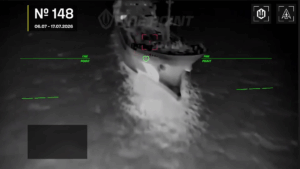
Ukraine's drone force is walking a fine line as it escalates its attacks on Russia's unregistered commercial "shadow fleet" in the Sea of Azov and eastern Black Sea. The drone operators are trying to immobilize the ships without breaching their hulls and spilling fuel or crude oil int
Ukrainian drone units aren't just trying to strike Russia's shadow fleet
They're trying to strike the ships without spilling fuel or oil
But that requires very accurate strikes
Ukraine's drone force is walking a fine line as it escalates its attacks on Russia's unregistered commercial "shadow fleet" in the Sea of Azov and eastern Black Sea. The drone operators are trying to immobilize the ships without breaching their hulls and spilling fuel or crude oil into the water.
That fleet is a big piece of how Moscow keeps its war funded—the aging tankers move Russian oil around Western sanctions—which is why Ukraine's drones have spent the past two weeks hunting it across the Azov and Black seas at better than a dozen ships a day.
"The goal is not to pollute the sea with oil spills; therefore, there must be no hull breaches," wroteRobert Brovdi, commander of Ukraine's independent Unmanned Systems Forces.
Instead, Brovdi stressed, the objective is "irreversible paralysis of oil, fuel and cargo logistics operating around sanctions. Turn every self-propelled vessel into a drifting barge, blind and deaf."
Magyar’s dairy update: Bird’s Milk is back on the menu
MoLoChKa’s bird’s milk, courtesy of the Unmanned Systems Forces: +12 shadow fleet vessels hunted in the Black Sea on 17 July.
The fleetfall continues indefinitely: 159 vessels struck during the first 12 days of… pic.twitter.com/dNWjz8FiUF
— 414 Magyar's Birds (@414magyarbirds) July 17, 2026
To immobilize a ship without breaching its hull requires accuracy: the drone must strike the ship's superstructure or screws, and only its superstructure or screws. Hitting a ship, but hitting it along its biggest part—its hull—risks polluting the already fragile Black Sea ecosystem.
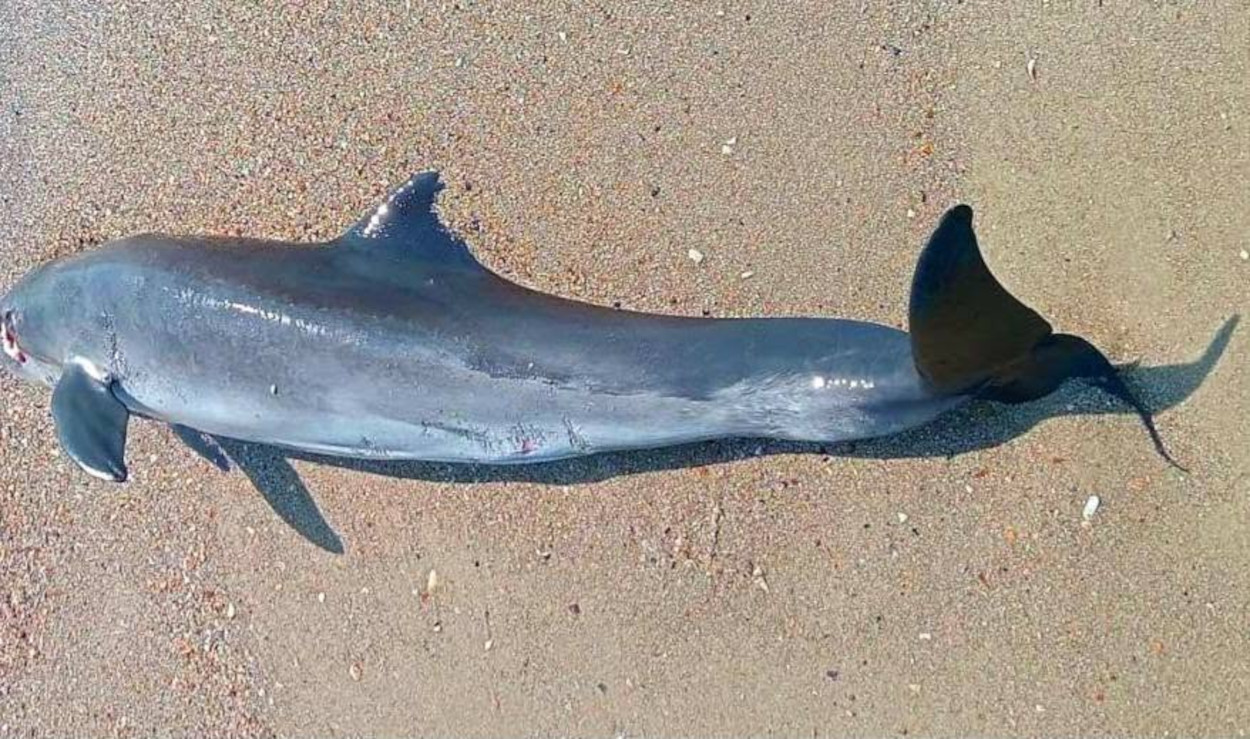
The Black Sea is home to many unique species. But the pollution and stress resulting from more than four years of naval warfare threatens to drive many of these species toward extinction. Scientists estimate tens of thousands of dolphins have died; others have fled to the Black Sea's southwestern edge in the hope of escaping the poison and noise.
Ukrainian commanders aim to throttle Russia's sea trade across the Sea of Azov and Black Sea and through the Bosporus Strait into the Mediterranean. But they hope to do it without further harming the ecosystem.
Satellite images published by Dnipro OSINT and dated July 13 show eight previously struck Russian tankers at multiple locations in the Sea of Azov. #Ukrainepic.twitter.com/vzdZQ9OZfP
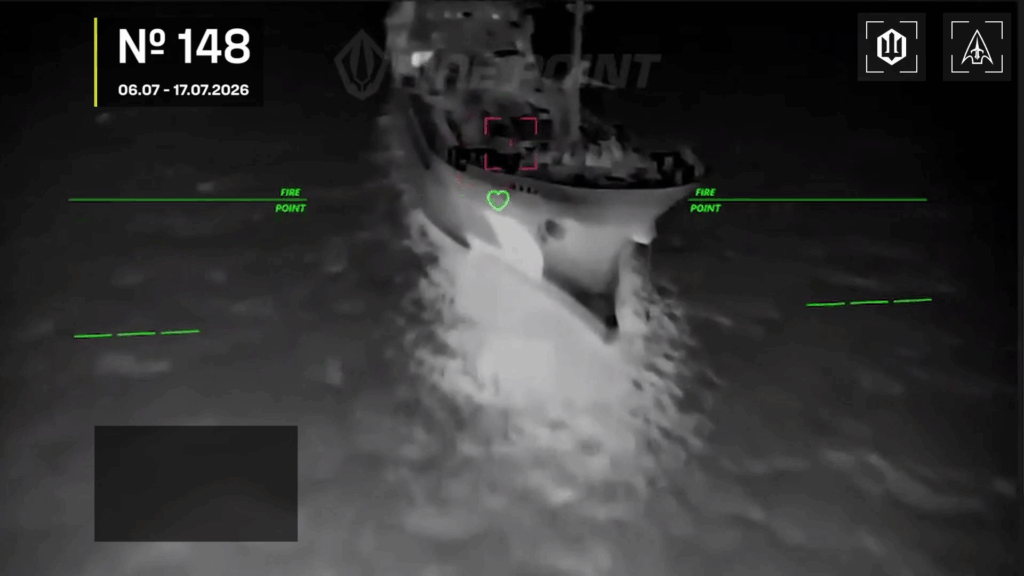
The clean hits point to skilled operators. Videos from the 12-day countershipping campaign depict remote-controlled Fire Point FP-1/2 drones maneuvering to strike the bulky sterns of dry-cargo ships and tankers, where crew and vital above-the-waterline systems are concentrated.
The targeting parameters have narrowed since the strikes commenced. "Initially, they fired at the crew in the wheelhouse—the vessel would be blinded, but the engine would still work, and the crews learned to steer from the wheelhouse using a compass and telephone," Russian political analyst Igor Dimitrievexplained.
Explore further
A $50 computer just flew Russia’s newest jet drone into a Ukrainian grain ship—and jamming couldn’t stop it
"Then they started firing at the stern: after this, the vessel is left drifting or being towed, and the tugs are also knocked out. The crews usually survive. But a disabled stern is no less unusable, and it also takes up ship repair capacity, which is otherwise almost nonexistent."
There's a new complication in this fight for clean anti-ship strikes, however. Some recent videos of FP-1/2 strikes feature the telltale symbology of AI-assisted targeting. More and more Ukrainian deep-strike drones have on-board AI systems for automatically spotting pre-programmed target types—trucks, air defenses, ships, helicopters, whatever—and autonomously maneuvering for an accurate hit.
The main benefit of AI targeting is that it works even when Russian radio jamming scrambles a drone's connection to its remote human operator. The main downside is that AI is only as good as its training. And the AI targeting seems to be struggling when it comes to ships. A video of recent shipping strikes shows one AI guiding a drone to a strike on a tanker's hold, where the oil is.
The AI may be able to tell a ship from the surrounding water, but it may not be able to tell the best part of a ship to strike for a spill-free hit.
Yet. AI improves as its data set expands. More anti-ship strikes mean more data and better AI.
And, hopefully, more clean hits.
Explore further
100,000 dolphins killed in the Black Sea because of Russia’s war, Ukrainian scientist warns: “We may lose a unique ecosystem”
Russia is now flying its Shaheds lower. Ukrainian drone and electronic warfare expert Serhii "Flash" Beskrestnov said that Russia's Shaheds are increasingly shifting from mass attacks to single, complex strikes flown under manual control.
As of 17 July, Beskrestnov became an official adviser to Ukraine's president, leaving the post of the former Defense Minister Mykhailo Fedorov.
The shift in tactics is a Russian answer to how good Ukraine's interceptors have become.
Every
Russia is now flying its Shaheds lower. Ukrainian drone and electronic warfare expert Serhii "Flash" Beskrestnov said that Russia's Shaheds are increasingly shifting from mass attacks to single, complex strikes flown under manual control.
As of 17 July, Beskrestnov became an official adviser to Ukraine's president, leaving the post of the former Defense Minister Mykhailo Fedorov.
The shift in tactics is a Russian answer to how good Ukraine's interceptors have become.
Every step Russia takes demands fast adaptation of Ukraine
"Shaheds are increasingly moving away from the tactic of mass attacks toward single but complex strikes in manual-control mode," Beskrestnov wrote.
Commenting on a video he posted, he said that one Shahed dropped to an altitude of 22 meters to attack its target, aiming to slip beneath the radar and interceptors' view.
"But our guys managed," he wrote.
Every step Russia takes demands fast adaptation of Ukrainian countermeasures, he stressed.
The tactic extends a trend Beskrestnov and others have tracked for weeks.
As Ukraine's interception rate against gasoline-powered Shaheds climbed to 92-96% in the deep rear, Russia shifted from mass strikes toward selective targeting, picking important targets, running multi-phase reconnaissance, and probing Ukraine's radar coverage and interceptor engagement zones before striking.
Low and hand-flown is how you beat a 95% intercept rate
The 22-meter altitude and the manual control are two solutions to the same problem for Russia. A drone that flies low enough hides in radar clutter and ground return. A drone flown by hand in real time can jink around interceptors rather than following a fixed, predictable route.
Ukraine's interceptor success was behind the innovation. Russia's three-part response has been jet-powered Geran variants that outrun cheap interceptors, electronic-warfare additions on the drones themselves, and border-area targeting where mesh-radio control works and Ukrainian satellite jamming does not.
The single low-altitude manual strike is the fourth adaptation: when you cannot get a swarm through, you send one drone flown carefully enough to matter.
Beskrestnov knows firsthand how deadly the manual-control threat could be. In April, Russia tried to kill him with four jet-powered, manually-controlled Shaheds that destroyed his home and wounded him — the first time, he said, that Russia had used Shaheds to try to assassinate a specific person.
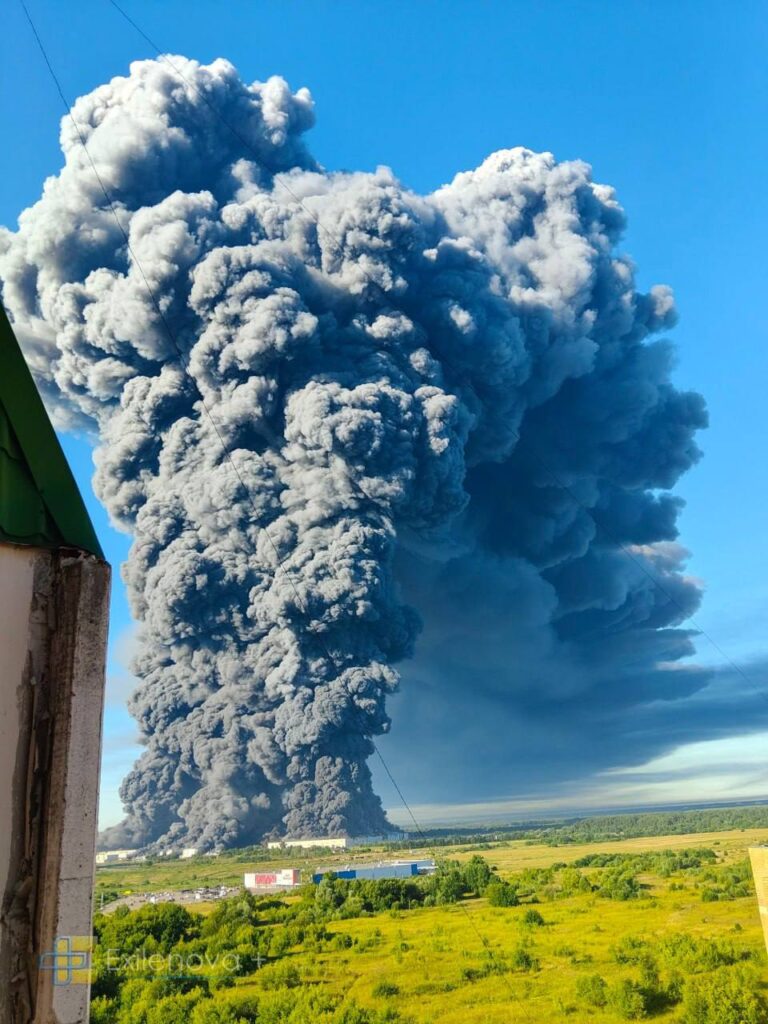
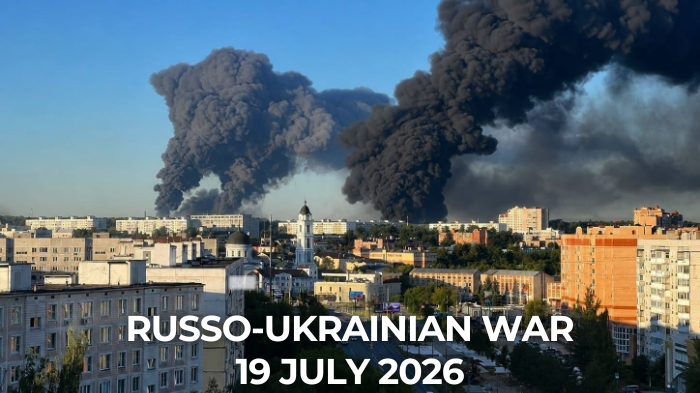
Ukraine burned a 188,000-square-meter warehouse near Moscow. The First Separate Center of Ukraine's Unmanned Systems Forces (SBS) confirmed it struck the Wildberries logistics warehouse in Moscow Oblast, saying the facility was ablaze with black smoke visible for kilometers.
Wildberries is the largest Russian online retailer and e-commerce marketplace. Ukraine has increasingly gone after the logistics and commercial infrastructure feeding Russia's war, not only refi
Ukraine burned a 188,000-square-meter warehouse near Moscow. The First Separate Center of Ukraine's Unmanned Systems Forces (SBS) confirmed it struck the Wildberries logistics warehouse in Moscow Oblast, saying the facility was ablaze with black smoke visible for kilometers.
Wildberries is the largest Russian online retailer and e-commerce marketplace. Ukraine has increasingly gone after the logistics and commercial infrastructure feeding Russia's war, not only refineries and arms plants.
"Wildberries with a crust from Moscow Oblast. A huge 188,000-square-meter Wildberries warehouse is burning brightly thanks to the work of the 1st Separate Center of the SBS, and the black smoke is visible for kilometers," the unit said, adding that "when karma works, fire extinguishers no longer help wild society."
The Russian OSINT channel Astra reported separately that military equipment and drone-tuning tools were sold through the marketplace, and that some estimates put the fire damage at up to 100 billion rubles (about $1.3 billion), with no official figure.
The claims about what the warehouse sold and the total damage are unverified, and come from Russian monitoring channels rather than from the Ukrainian unit that carried out the strike.
Russia has been hitting Ukraine's own logistics operator for years
Russia has struck Nova Poshta — Ukraine's largest private postal and logistics operator — repeatedly throughout the full-scale war.
The deadliest hit came on 21 October 2023, when a Russian missile struck a Nova Poshta terminal in Korotych, Kharkiv Oblast, killing six employees and wounding 17, and destroying hundreds of tons of parcels, per UA.News.
The pace picked up through mid-2026. Russian drones hit the Dnipro sorting center on 3-4 July, a Shahed struck the Zaporizhzhia sorting center on 2 July, and a missile partially destroyed one of the company's most modern terminals in Kyiv's Obolon district in a 5-6 July combined attack. Strikes also hit sorting terminals in Kryvyi Rih and a branch in Chernihiv in early July, and a Nova Poshta branch in Kramatorsk was struck on 16 July.
Strike hit Noginsk-Elektrostal area overnight
The night's strikes set fires at two sites in the Noginsk-Elektrostal agglomeration east of Moscow: the Wildberries logistics center in Elektrostal and an oil depot in Noginsk, Astra reports. Witnesses published video of fires and explosions on the morning of 18 July, and OSINT analysts identified the burning oil depot as the Noginsk facility.
The Noginsk oil depot presents itself as an independent fuel-market operator, used for storing, transshipping, loading, and shipping light petroleum products, including gasoline and diesel.
It holds 24 reservoirs with a total volume of 11,500 cubic meters and serves as an infrastructure partner for fuel traders and companies across the Moscow region, with large suppliers renting its tanks.
The published video showed heavy smoke near Moscow, visible up to 50 kilometers away by witness accounts.
Deep-strike campaign keeps reaching Moscow Oblast
The strikes extend a deep-strike campaign that has repeatedly reached the Russian capital region. Ukrainian drones have hit Moscow Oblast fuel and military-industrial sites through 2026, striking fuel terminals and technoparks in a massive 17 May barrage, and hitting the Kapotnya refinery 15 kilometers from the Kremlin repeatedly in June.
The oil depot fits the campaign's core logic. Ukraine's deep-strike campaign has knocked out 42% of Russia's refining and cost the industry $13.5 billion since August 2025, pushing fuel rationing into most Russian regions.

 Connexion








 shadow fleet vessels hunted in the Black Sea on 17 July.
 159 vessels struck during the first 12 days of…
 (@NOELreports)