❌

Vue lecture

“Our future cannot be the subject of agreements between Trump and Putin”: Ukraine supporters protest US policy on Russia in Europe, US, and Australia
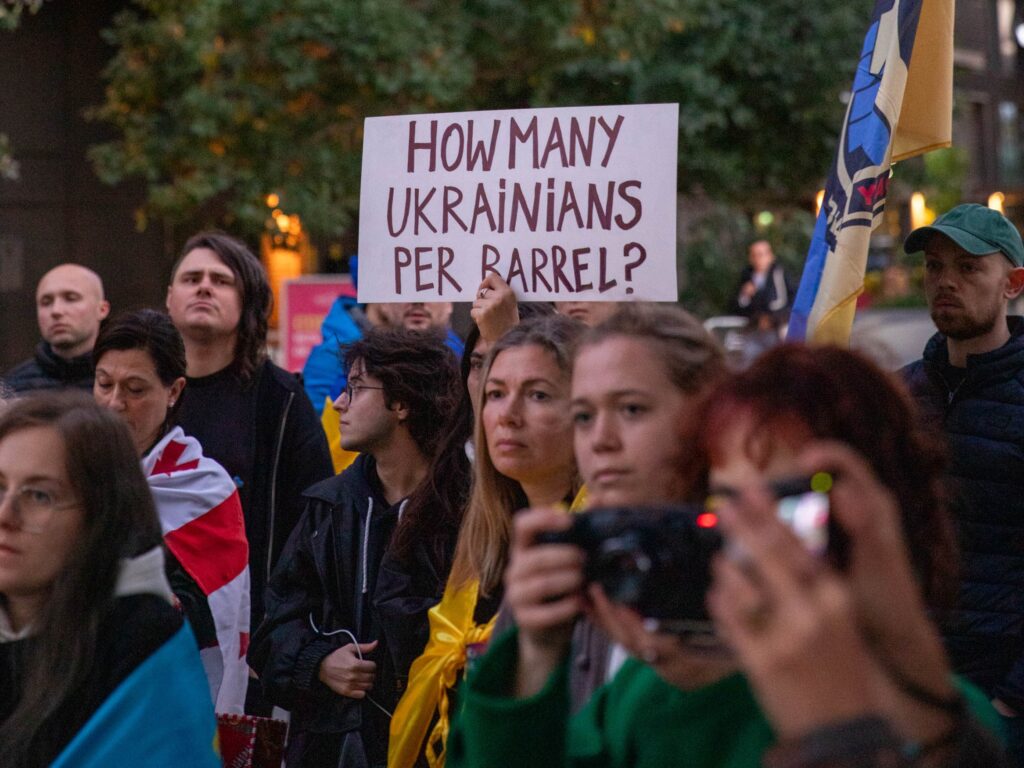
Pro-Ukraine protesters rally in London, England, against US policy toward Russia, 16 October 2026. Photo: Khrystyna Shebunchak

Pro-Ukraine demonstrations took place in more than 10 cities across Europe, North America, and Australia over the past week, with protesters opposing US President Donald Trump’s agreement to resume Russian diesel shipments, the easing of sanctions on Moscow, and restrictions affecting Ukraine’s military support.

The protests were organized by Ukrainian diaspora groups and international supporters of Ukraine, who called on Washington to maintain pressure on the Kremlin, restore Ukraine’s access to Starlink, and stop using military aid and intelligence sharing as leverage against Kyiv. 

The International Center for Ukrainian Victory (ICUV) said the actions reflected growing concern over US decisions that could benefit Russia while its war against Ukraine continues.

Pro-Ukraine protesters rally in Chicago, USA, against US policy toward Russia, 13 October 2026. Photo: Radio UA Chicago
Pro-Ukraine protesters rally outside the US consulate in Edinburgh, Scotland, against US policy toward Russia, 21 October 2026. Photo: Ukraine Solidarity Campaign

The demonstrations followed Trump’s announcement on 9 October that Russia would supply diesel to US and global markets. The US Treasury’s Office of Foreign Assets Control subsequently issued a temporary license authorizing transactions involving Russian-origin diesel, including imports into the United States, through 7 April 2027. 

The decision reversed part of Washington’s restrictions on Russian fuel imposed after Russia’s full-scale invasion of Ukraine in 2022.

“We are witnessing a dangerous situation today: Russia, which attacks Ukrainian cities every day, is being offered economic agreements and sanctions relief, while Ukraine is being asked to make concessions. But Ukrainians cannot simply stop fighting. For us, this is a matter of our state’s existence. Our future cannot be the subject of agreements between Trump and Putin. It belongs to Ukrainians,” said Olena Ivashchenko, founder of Campaign for Ukraine.

Pro-Ukraine protesters rally in Sydney, Australia, against US policy toward Russia, 16 October 2026. Photo: Ukrainians in Sydney
Pro-Ukraine protesters rally in Rome, Italy, against US policy toward Russia, 21 October 2026. Photo: Ukrainian World Congress

Protests target Russian fuel deal and pressure on Kyiv

In London, hundreds of protesters gathered outside the US Embassy on 16 October, according to organizers from Campaign for Ukraine and partner groups. Participants included Ukrainians, Britons, Americans, and members of other national communities. British lawmakers also raised the issue in Parliament.

Demonstrators carried signs reading “How Many Ukrainians per Barrel?” and “Occupation Is Not Peace,” calling on Washington to preserve sanctions and reject pressure on Ukraine to make territorial concessions.

Pro-Ukraine protesters rally in London, England, against US policy toward Russia, 16 October 2026. Photo: Khrystyna Shebunchak
Pro-Ukraine protesters rally in Sydney, Australia, against US policy toward Russia, 16 October 2026. Photo: Ukrainians in Sydney
Pro-Ukraine protesters rally in Chicago, USA, against US policy toward Russia, 13 October 2026. Photo: Radio UA Chicago

Protests also took place in Edinburgh, Chicago, Houston, Boston, San Diego, Prague, Rome, Stockholm, and Sydney. In Prague, two Ukrainian activists staged a protest outside the US Embassy on 21 October, pouring a red liquid resembling blood onto the road to symbolize the human cost of the policy.

Ukrainian activists stage a protest outside the US Embassy in Prague on 21 October, pouring red liquid onto the road to symbolize the bloodshed caused by Russia’s war against Ukraine and condemn US policies toward Moscow. Photo: Kaputin

Participants in several cities also condemned restrictions on Starlink, delays in ammunition supplies, and disruptions to intelligence sharing with Ukraine.

The diesel agreement has drawn criticism in Ukraine because Russian fuel exports generate revenue for Moscow while its forces continue attacking Ukrainian cities and infrastructure. A Russian diesel tanker carrying 40,000 metric tons of fuel departed Russia’s Baltic port of Primorsk on 22 October bound for New York, according to shipping data reported by Reuters. It was expected to arrive on 7 November.
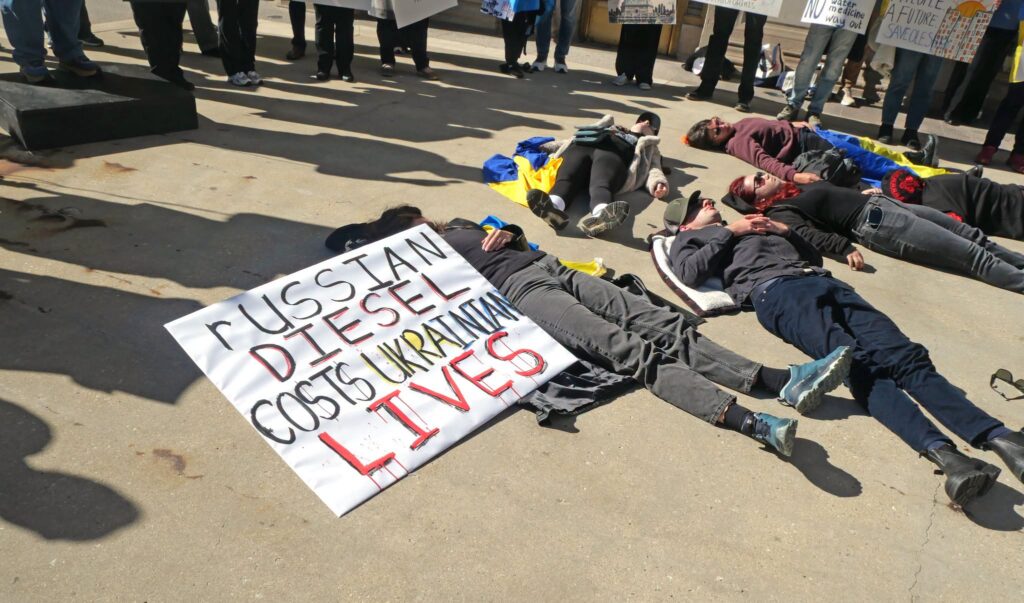
Pro-Ukraine protesters rally in Chicago, USA, against US policy toward Russia, 13 October 2026. Photo: Radio UA Chicago
Pro-Ukraine protesters rally in Stockholm, Sweden, against US policy toward Russia, October 2026. Photo: Nordic Ukraine

Organizers warn against easing pressure on Moscow

Protest organizers argued that restoring Russian fuel sales and relaxing sanctions risk helping Moscow finance its war. They also opposed any US effort to secure concessions from Kyiv without requiring Russia to end its aggression.

The demonstrations reflect concerns among Ukraine’s international supporters that Washington’s pursuit of economic agreements with Moscow could undermine efforts to isolate Russia and strengthen Kyiv’s position.

Trump has defended the diesel arrangement as a way to increase fuel supplies and lower prices. His administration has also presented engagement with Moscow as part of its broader effort to end the war, while critics question whether easing economic pressure will produce meaningful concessions from the Kremlin.

Pro-Ukraine protesters rally in Boston, USA, against US policy toward Russia, 13 October 2026. Photo: Boston Supports Ukraine
  •  

Guns fall silent around Russian-occupied Oleshky so its starving residents can get aid, but Russia’s guarantees remain secret

Oleshky, Kherson Oblast, has been under Russian occupation since 2022, following Russia’s capture of the city during the initial phase of its full-scale invasion of Ukraine.

A ceasefire around Russian-occupied Oleshky in Kherson Oblast took effect at 03:00 on 27 October Kyiv time, and both sides were complying with the agreements, Ukraine’s human rights ombudsman Dmytro Lubinets said. Russia’s Defense Ministry reported that its forces had stopped firing on the Kherson axis at 04:00 Moscow time, at the same moment.

Russia has kept Oleshky cut off for months. In June, the UN Human Rights Monitoring Mission in Ukraine documented worsening shortages of food, medicine, and medical care there and in neighboring Hola Prystan. As of 8 October, Lubinets’ office still saw no practical breakthrough toward an organized evacuation, with 358 residents verified as needing help to leave. The ceasefire is the first step that has to hold before aid can go in and residents can leave, an operation Marc Beckman, the first lady’s chief adviser, expects to take five to seven days.

By 09:00 on 27 October, Russian forces were still observing the ceasefire, according to Pavlo Drohal, spokesperson for Ukraine’s 30th Marine Corps. Kyrylo Budanov, head of the Presidential Office, announced that the mission had begun and that Lubinets had gone to the site to coordinate it.

Ceasefire brought forward by two days

The White House announced on 23 October that First Lady Melania Trump had secured a localized ceasefire, set to begin on 29 October. The same evening, Russia’s chief of General Staff Valery Gerasimov announced a ceasefire on the Kherson axis from 27 October, with engineering reconnaissance and a secured route for a humanitarian convoy. Ukraine’s General Staff followed, introducing a ceasefire in a designated area from the same hour.

Beckman told Ukrinform on 26 October that Russia had moved the ceasefire two days earlier and extended it beyond Oleshky into Kherson Oblast. Lubinets said on 23 October that the mission should effectively begin on 29 October, after demining, adding that the date was not a matter of principle for either side.

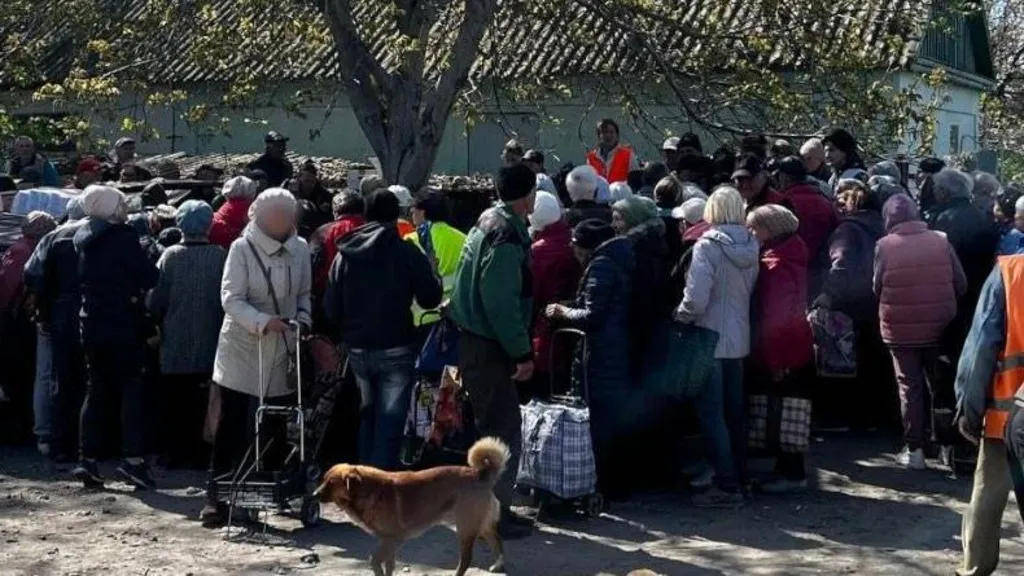
People in Oleshky wait for food supplies
People in Oleshky wait for food supplies. Photo: BBC

A day after the announcement, Lubinets and his Russian counterpart Yana Lantratova, who lead the two negotiating groups, confirmed the timing in an online meeting, he said. According to Lubinets, the agreement covers demining the road to Oleshky, delivering food, water, medicine, and hospital equipment, and safe movement for civilians.

Newsmax to document the operation

Meanwhile, Melania Trump said she had secured an “impartial American media organization” to accompany the Russian and Ukrainian teams. Beckman named it as Newsmax. He said he had worked directly with the channel’s owner, and that its journalists would record testimony as what he called neutral American observers.

Residents could leave for Ukraine or Russia, or stay, Beckman said. He added that Russia had assured Kyiv and Washington it would respect their choice of destination. Both governments asked him not to disclose what guarantees Russia gave or how violations would be handled, he said. He expects the operation to take five to seven days after 29 October, with an extension possible if both sides agree.

Diplomat doubts the truce will move peace talks

At the same time, Kostiantyn Yelisieiev, Ukraine’s ambassador to the EU in 2010–2015, told Radio NV the truce became possible only through the personal involvement of Donald and Melania Trump. The US president, he said, sees it as a way to show Americans he is bringing peace closer. He said he expects Russia to attempt provocations aimed at pushing residents toward the Russian side.

Yelisieiev said he does not share the optimism of those who think Oleshky could push the wider peace process forward. He compared it to the Black Sea grain corridor, a one-off arrangement that no longer works. He warned of a “diplomatic smokescreen”: Russia imitates negotiations while it keeps fighting, hoping Ukraine and its partners weaken over time.

Ukrainian drone delivering aid to occupied Oleshky on the night of 4 October
Ukrainian drone delivering aid to occupied Oleshky on the night of 4 October. Screenshot from video: Ivan Vyhivskyi / Facebook

A town under blockade

Oleshky lies on the left bank of the Dnipro, about 4 km from Kherson, and has been occupied since February 2022, Radio Svoboda reported. The White House says it had about 24,000 residents before the war and estimates 1,700 to 2,000 remain, mostly elderly, including about 50 children. Russian troops have also seized food dropped by Ukrainian drones, a local official said.

  •  
❌