Vue lecture

Russia’s defense ministry threatens to “freeze” Ukraine this winter

Orange State Emergency Service heated tents illuminated at night in front of Kyiv apartment buildings, some windows lit while others remain dark during blackouts

Russia's defense ministry posted photographs of attack drones in flight on its Telegram channel, captioned "like snow on your head," and told Ukrainians that "in winter, you'll get a freeze." The ministry attached the threat to its own earlier claim of strikes on Ukrainian port infrastructure and vessels.

The post puts in writing what Russia has done to Ukrainian civilians through every winter of the full-scale war: strike the power and heating grid to leave homes cold and dark. What is new is not the tactic but the candor — a ministry that usually insists it hits only military targets openly advertising the coming assault on the systems that keep civilians warm. And the taunt lands as Ukraine heads into the season more exposed than at any point in the war: President Volodymyr Zelenskyy told CNN this week that the country holds about 1% of the Patriot interceptors it needs to get through winter.

The winter campaign Russia is advertising

Since late 2022, Russia has systematically struck Ukraine's electricity, gas, and heating infrastructure, causing rolling blackouts and cutting heat and water during freezing weather. Ukrainian officials have repeatedly called the campaign "energy terrorism," and grid operators say the strikes have shifted toward knocking out entire energy districts rather than staging single mass barrages. This summer Russia widened the target set again: on 13 August a Russian drone set port infrastructure alight in Odesa Oblast and damaged a civilian vessel at a Mykolaiv port, the national rail operator and regional officials reported — the same kind of strike the ministry's post was boasting about.

Ukraine enters winter short of the weapon that stops ballistic missiles

The threat is heavier because Ukraine cannot reliably stop the missiles that would carry it out. Zelenskyy told CNN that selling Kyiv 5% of current US Patriot stocks would carry it through winter and 10% would let it "destroy all the Russians' ballistic missiles" — but that he holds 1%. On 5 August, Russia fired 28 ballistic and anti-ship missiles at Kyiv and Ukraine intercepted none, killing 17 people. July was the deadliest month for Ukrainian civilians since April 2022, according to the UN.

Europe is scrambling to add generation before the cold sets in. Finland said on 13 August it would fund a €28.5 million ($33.2 million) power plant project for Ukraine, one of several efforts to keep the lights on when the strikes resume. Ukrainian officials have warned that the coming winter could be more difficult than any before it.

  •  

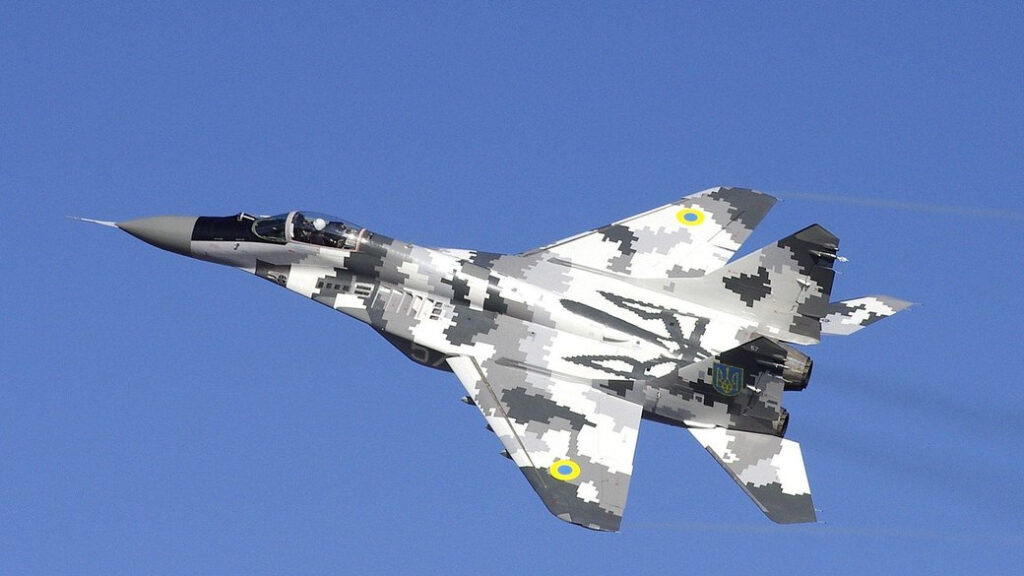
Poland was ready to scrap these MiG-29s. Bulgaria’s interest just revived the Ukraine deal.

ukrainian mig-29mu1 levels key russian-used bridge near pokrovsk pinpoint strike (video) · post mig-29 tail number 57 “white” 114th tactical aviation brigade flight 2014 military pages militarnyi arhfine-foto-myg-29-bortovyj-nomer-57-bilyj-114-brygada-taktychnoyi-aviatsiyi-2014-rik-foto-ukrainian-military-pages ukraine news

Bulgaria's interest in buying Poland's retiring MiG-29s has pushed Warsaw and Kyiv closer to finalizing their long-stalled swap, Polish officials say.

Poland and Ukraine are in the final stage of negotiating a deal to transfer Poland's aging MiG-29 fighter jets to Ukraine in exchange for drones and Ukrainian drone-warfare know-how, with the jets potentially shipping within weeks, Polish outlet Wirtualna Polska reported, citing sources in the Polish Armed Forces and Defense Ministry. The report follows months of on-and-off talks that Poland's own officials have repeatedly declared both close to done and dead.

Polish Deputy Defense Minister Cezary Tomczyk said on Polsat News that Bulgaria's competing interest in the jets has "livened up" Warsaw's discussions with Kyiv. Bulgaria has told Poland that if Ukraine will not commit, Sofia would buy the jets itself, Tomczyk said.

"I hope it will be soon," Tomczyk said when asked when Poland intends to sign the agreement with Ukraine. He said Poland has laid out the technologies and know-how it wants from Ukraine in return, calling the exchange in both countries' interest. "Today I cannot say with 100% certainty that this matter will be finalized, but we hope so."

According to Wirtualna Polska, the deal covers Soviet-era jets Poland's air force is retiring as it phases in Western aircraft, in exchange for a large batch of Ukrainian drones of various types and the transfer of Ukrainian combat know-how. The outlet reports Poland wants data on strike-drone communications links, control principles, footage of strikes on targets, and physical samples of the hardware itself.

Poland's Defense Ministry has said the process picked up pace after Rustem Umerov took over as head of Ukraine's Foreign Intelligence Service, with President Volodymyr Zelenskyy tasking him with negotiating drone agreements. A source involved in the talks told Wirtualna Polska that Ukrainian drone maker Fire Point has offered to supply Poland with 1,500 long-range drones, plus a matching batch if war breaks out — an offer the source said Poland regards cautiously, since a company citing force majeure in wartime could leave Warsaw without the hardware it was promised.

A deal that has collapsed and revived for a year

Poland and Ukraine signed a bilateral security agreement in July 2024 that raised the prospect of transferring a squadron of at least 14 Polish MiG-29s. By early 2026, Warsaw had narrowed the offer to six to eight jets. In June, Poland froze the transfer, with Deputy Defense Minister Tomczyk citing Ukraine's refusal to share its drone and counter-drone technology. Talks restarted in July after Kyiv sent Warsaw a letter with concrete proposals, and by 31 July, Poland said Ukraine had returned with a specific list of drones it would hand over — a proposal Poland's ministry was still reviewing.

Poland's ambassador to Ukraine, Vasyl Bodnar, told Ukrainska Pravda's Yevropeiska Pravda that dialogue continues but that several obstacles still stand in the way of the transfer.

Why this matters

The MiG-29 remains a core part of Ukraine's air force even as it shifts to F-16s, Mirages, and incoming Gripens — Ukrainian pilots already fly the Soviet-era jets and have adapted them to carry Western precision weapons, so a new batch could enter service without the delays a Western aircraft transition requires. Poland's own hesitation reflects the same trade-off every one of its allies faces: what it gives up in hardware, it wants back in the operational knowledge Ukraine has built fighting Russia's drone war for four years — knowledge with no equivalent on any NATO training ground.

  •  

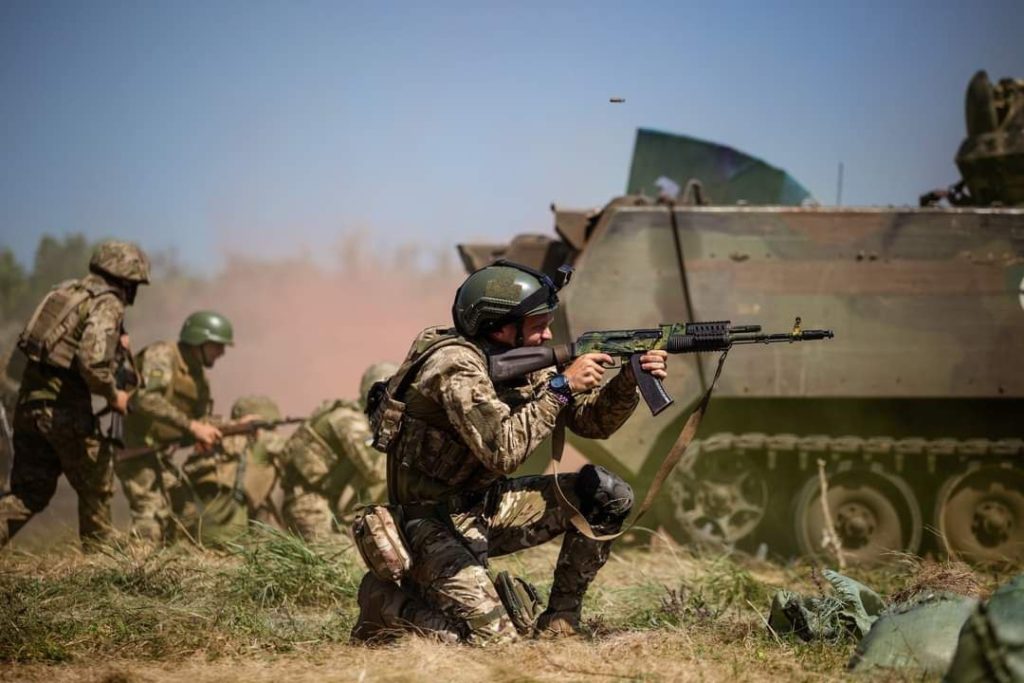
They find a sword, we find a shield: Ukrainian soldier on why drones will never replace infantry

Ukrainian soldiers

Serafim Hordiienko enlisted at 19 in 2022, fought as a mortarman near the front line, then moved into drone warfare as it grew central to Russia's war on Ukraine. In an interview with RBC-Ukraine, he pushed back on the idea that unmanned systems are phasing out infantry, arguing the two perform separate functions neither can absorb.

The debate is live inside Ukraine's own military. Ukraine's Third Army Corps has said it plans to replace roughly 30% of its infantry with ground robotic systems by the end of 2026, and other officers have called full infantry replacement an eventual goal. Hordiienko's account, shaped by his own shift from rifle-and-mortar combat to drone operations, argues against that trajectory ever completing — infantry holds ground; drones strike and surveil; neither substitutes for the other.

"Different functions of war"

Hordiienko compared infantry and drones to two halves of a single system rather than competing tools. Infantry cannot operate without supporting fire and reconnaissance, he said, and drones — while efficient at surveillance and strikes — cannot hold territory the way ground troops can. If war is still fought over front lines and captured ground, he argued, only infantry can perform that function; drones deliver cost-effective damage but do not occupy space.

He traced Ukraine's drone advantage not to hardware alone but to the system around it — production, battlefield communication, and rapid adaptation to frontline needs. Ukrainian manufacturers he named, including Skyeton, Ukrspetssystems, DeviRO, and Firepoint, built reconnaissance and strike capabilities under resource shortages that Russia's more centralized, state-linked defense industry did not face in the same way, he said.

The end of romanticized war

Hordiienko dates a turning point in how Ukrainian soldiers relate to the war to the 2023 Zaporizhzhia counteroffensive. Before it, he said, volunteers who joined in 2022 operated in an emotionally charged, maximalist mode — young men competing to reach combat before the war, as they assumed, ended quickly. After the counteroffensive stalled, he said, that gave way to a more systematic, mechanized phase he calls "a war of military machines."

He illustrated the shift with a sword-and-shield framework: each side develops a new method of attack, the other adapts a defense, and the balance resets every few months. The side that adapts and scales fastest gains the advantage, he said — a dynamic he sees as running through the drone war specifically.

Hordiienko enlisted through an unusual path. He and three other volunteers, all under 21 and already carrying combat experience from the war's opening months, could not sign standard military contracts because of their age. They were enlisted only after Ukraine's then-commander-in-chief, Valerii Zaluzhnyi, issued a personal order on their behalf.

What newer recruits are owed

Speaking about troops mobilized later in the war — arriving without the volunteer surge's initial urgency — Hordiienko said commanders now owe recruits honesty rather than appeals to abstract duty. He described his approach as a direct exchange: a commander sets out the conditions of service, and the soldier meets specific obligations in return, with consequences if either side breaks that arrangement. Motivation, in his account, rests less on invoking "fighting for Ukraine" and more on concrete terms of service, fair treatment, and — where the national cause doesn't land for a given recruit — the practical case that military service builds expertise, particularly in drone and other technical specialties, that carries into civilian life.

  •  

NATO fighter, one drone, one district: a jammed intercept lands over Latvia

nato jets over baltics get authority shoot down objects pose threat · post russian fighter fly near airspace off latvia's baltic coast seen during interception op 2025 rnqv has upgraded

A NATO fighter patrolling Baltic airspace shot down a drone over Latvia early Friday, the Latvian Armed Forces said, in the second Baltic-region drone incursion this week.

The interception happened over Balvi Municipality, near Latvia's borders with Belarus and Russia. Latvian officials said the drone entered the country's airspace after being knocked off course by Russian electronic warfare systems — not as a deliberate strike on Latvian territory. Russia has regularly bombarded Ukraine's Baltic-facing neighbors with stray drones since intensifying its own long-range strike campaign, and on 12 August, Romania detonated two Russian drones that washed up near its Black Sea gas field.

Latvian forces reported an "airspace threat" in four districts bordering Belarus and Russia shortly after 04:00, and announced the drone's destruction roughly 30 minutes later. Ieva Bērziņa, a representative of Latvia's Joint Armed Forces Staff, said the crash site had been located but its exact position was not being disclosed, and that debris may be scattered over a wide area because the drone was shot down at high altitude.

The incident coincided with a large-scale drone attack on Russian targets in Leningrad Oblast overnight.

This is not the first time drones have crossed into the Baltic states during Russian strikes on its own territory. In May, a drone that entered from Russia damaged fuel tanks at an oil depot in Rēzekne, about 40 kilometers from the border. Ukrainian Foreign Minister Andrii Sybiha said in March that Russia was deliberately steering Ukrainian drones toward Baltic airspace using electronic warfare, adding that Moscow later uses the resulting incidents in information operations targeting the region.

Latvia is weighing the purchase of Brazilian-made A-29 Super Tucano light attack aircraft for counter-drone missions, funded through more than €1 billion the government has earmarked for stronger air defense.

  •  

437 killed, over 2,600 injured: Ukraine’s deadliest month for civilians since 2022, UN says

kyiv attack

At least 437 civilians were killed and 2,610 injured across Ukraine in July, the highest monthly death toll since May 2022, according to the UN Human Rights Monitoring Mission in Ukraine (HRMMU), which published the figures on 12 August. The toll was 30% higher than June and 70% higher than July 2025.

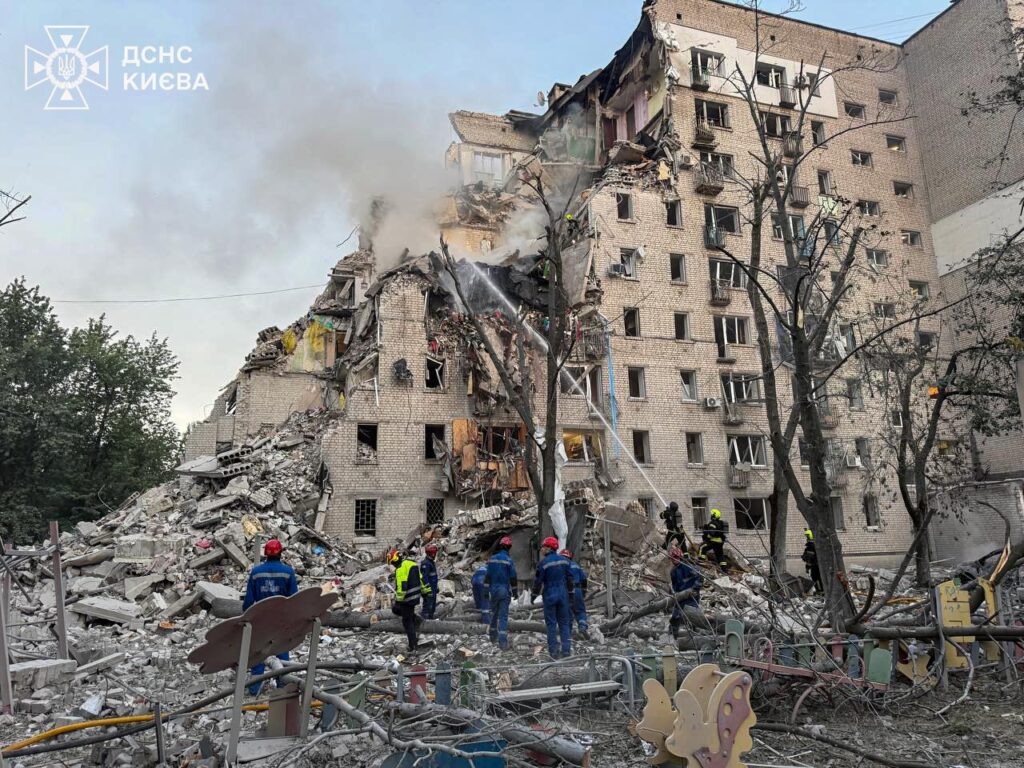
The deadliest single attack came on 2 July, when Russia launched 74 missiles and nearly 500 long-range drones at Ukraine, mainly targeting Kyiv. Ukrainian air defenses downed 524 of 570 aerial targets, but the 46 that got through — including 25 ballistic missiles — killed 30 people and destroyed a nine-story apartment block in the capital's Darnytskyi district. Russia fired at least 429 missiles at Ukraine over the course of the month, more than double June's total.

A trend that keeps getting worse

"Every month this year the number of killed and injured civilians has increased," HRMMU head Danielle Bell said. "That trend accelerated sharply in July. The number of civilian casualties in July was the highest we documented in a single month since March 2022."

Child casualties also hit a new high: 17 killed and 166 injured, the worst toll since April 2022. Over the first seven months of 2026, HRMMU verified 12,477 civilian casualties — 1,839 killed and 10,638 injured — a 44% increase over the same period in 2025 and more than double the 2024 figure.

Long-range weapons still the top killer, but glide bombs surged

Long-range missiles and drones caused 38% of all July casualties (183 killed, 967 injured), most of them far from the front line in cities. Casualties from aerial glide-bomb strikes jumped 143% compared with June — from 45 killed and 308 injured to 105 killed and 753 injured — making glide bombs the second-leading cause of civilian harm. Short-range drones near the front line killed 111 people and injured 710, the highest monthly toll from that weapon since 24 February 2022.

Kyiv, Kherson, Zaporizhzhia, and Sumy took the heaviest losses among the 14 regions where casualties were recorded. HRMMU also verified 25 killed and 50 injured in Russian-occupied territory, cautioning that shrinking access to information there means the real toll is likely far higher.

Attacks on Black Sea shipping and port infrastructure in Odesa and Mykolaiv oblasts also intensified, with at least 39 strikes — 20 of them on vessels — killing 19 port and crew personnel and wounding 25.

Since the full-scale invasion began on 24 February 2022, the UN has verified at least 16,874 civilians killed and 51,173 injured.

  •  

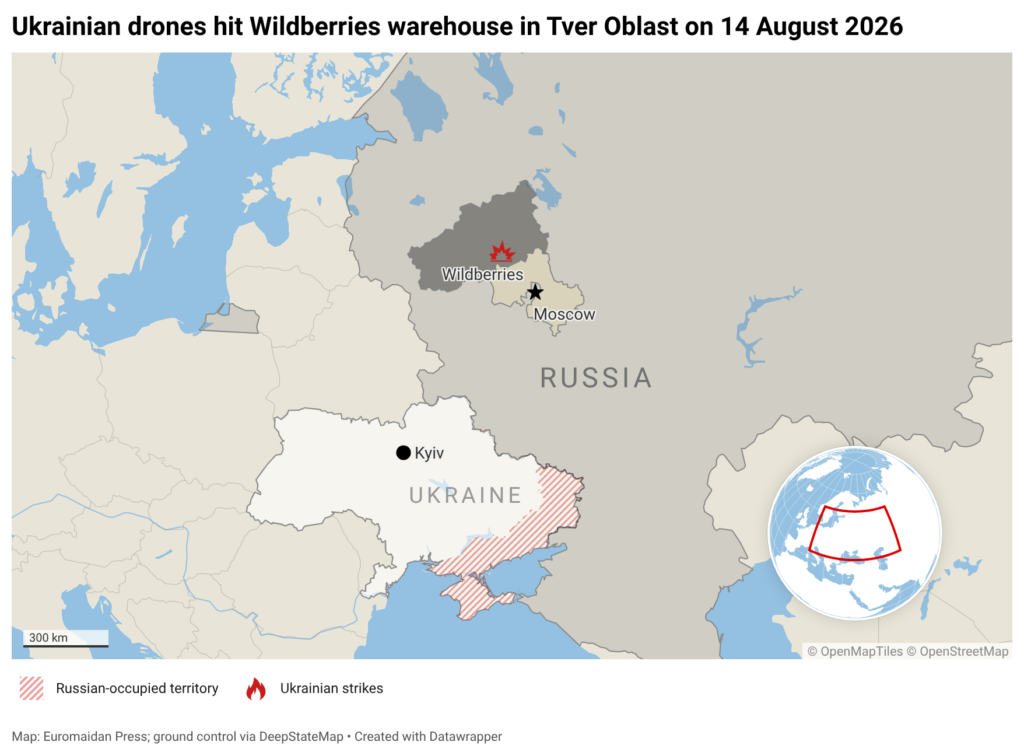
Ukrainian drones hit Wildberries warehouse in Tver for the third time in two weeks

Ukrainian drones struck a Wildberries logistics warehouse in Russia's Tver Oblast overnight into 14 August, damaging a wall for the third time in two weeks, regional governor Vitaly Korolev said. No one was hurt, and Wildberries said the goods stored there survived.

The Emmaus facility, built on a roughly 77,000-square-meter footprint about 150 km from Moscow, has become a fixture in a Ukrainian long-range drone campaign against Wildberries, Russia's largest online retailer, now in its fifth week. Since 18 July, Ukraine has hit more than 20 of the company's logistics sites, according to Russian outlet Agentstvo, part of a declared operation President Volodymyr Zelenskyy announced on 25 June to pressure the Kremlin toward ending the war.

What happened in Tver

Korolev said drone debris damaged the wall of the Wildberries warehouse building in the Kalininsky district overnight, and that the resulting smoke was "promptly extinguished." No warehouse staff were injured, he said. Wildberries confirmed "minor damage" to the logistics complex and said the fire's aftermath was "promptly eliminated," adding that "the goods were not affected."

It is the third reported strike on a Wildberries facility in the Emmaus area in under two weeks. Drones first hit the site on 4 August, damaging a wall, and returned on 6 August, damaging the facade — though Tver governor Korolev did not confirm at the time whether the two strikes hit the same building. Ukrainian monitoring channel Supernova+ has said the repeated, inconclusive strikes mean Ukrainian forces are likely to keep coming back until the hub is disabled.

A campaign built on repetition, not precision

The Tver hub is a minor player in a campaign that has concentrated on Wildberries' largest distribution centers — Koledino outside Moscow, Khryastovo in Vladimir Oblast, Oleksin in Tula Oblast — each spanning well over 100,000 square meters and each hit with enough force to halt operations for days. By contrast, all three Tver strikes have caused only minor structural damage with no confirmed disruption to the warehouse's operations.

That gap matters for how the campaign is read. Euromaidan Press has reported that Ukraine has concentrated its drones on roughly two dozen hubs that move most of Wildberries' goods, while hundreds of smaller depots — Tver likely among them — remain largely untouched or only lightly damaged. Measured against the whole network, the physical loss looks modest; measured against the major hubs Ukraine has targeted, more than half are out of action.

The financial pressure has outpaced the physical damage. Wildberries has been scouting storage space in Kazakhstan beyond the reach of Ukrainian drones, and the Kremlin has been weighing state loans to keep the company solvent, at a point when Russia's federal deficit had already outrun the full-year shortfall the Treasury had budgeted. Ukrainian officials and Estonian military intelligence say Wildberries' warehouses store and move military-linked goods, including body armor and drone parts sold on the platform — a claim Wildberries denies.

  •  

Ukrainian drones hit Russia’s Ust-Luga oil port for the 6th time this year

leningrad

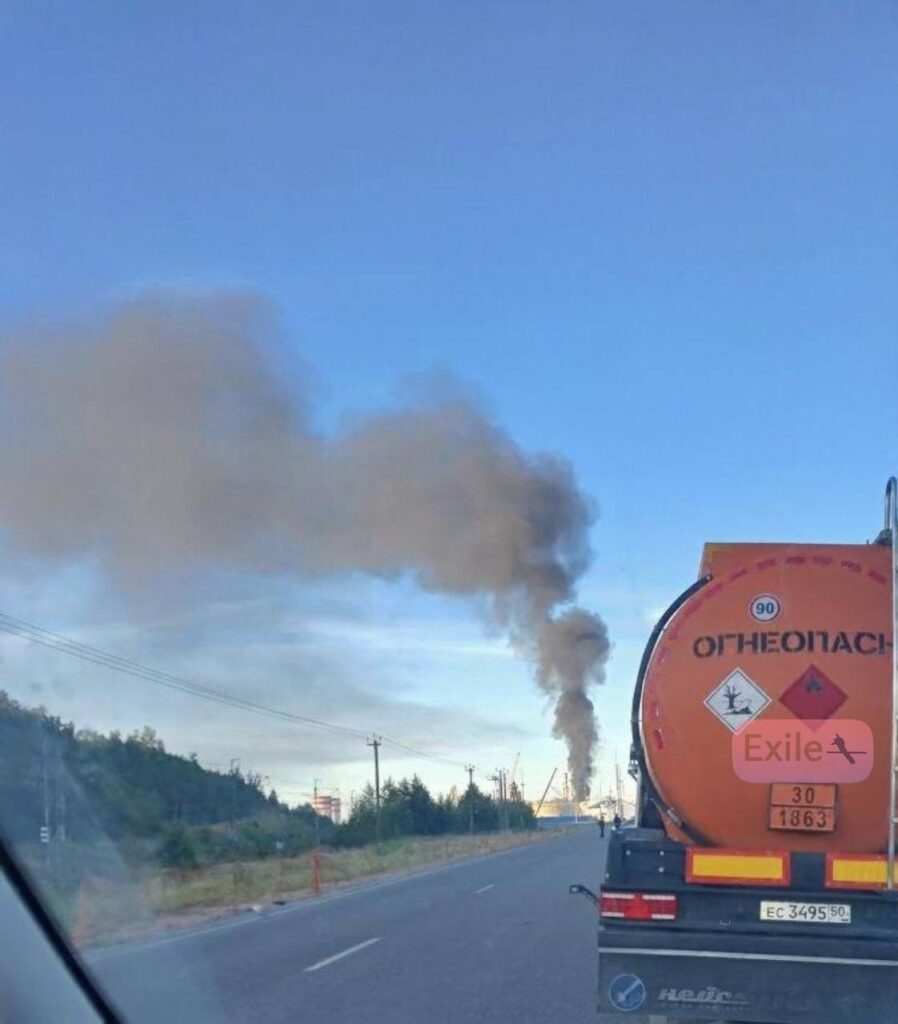
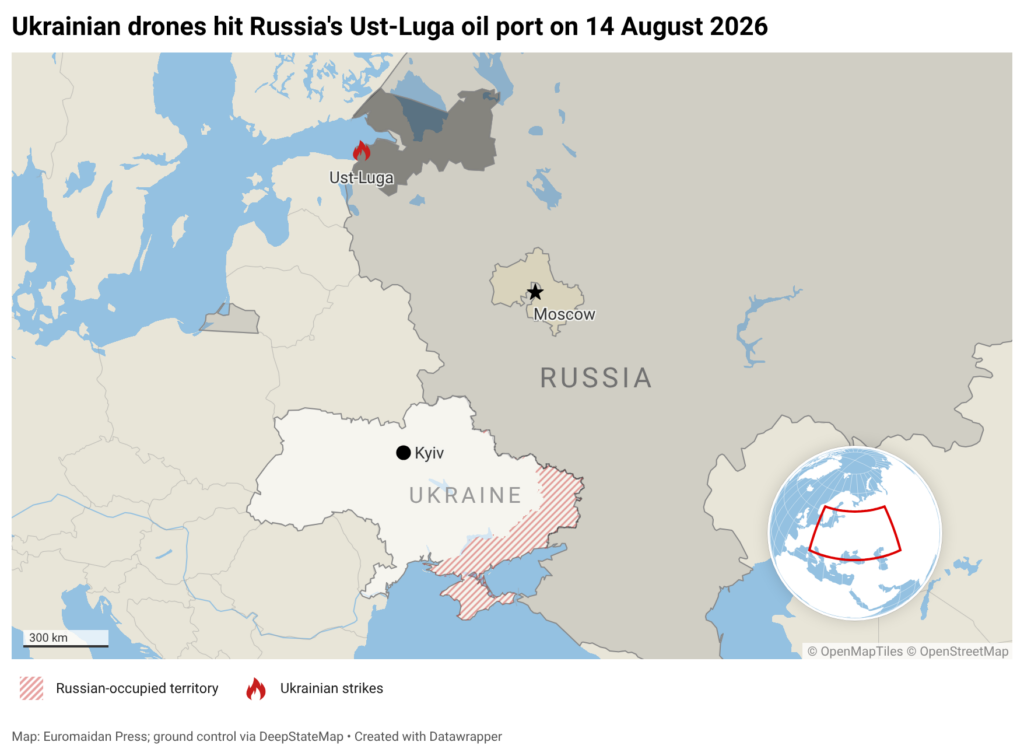
Ukrainian drones struck Russia's Ust-Luga port overnight on 14 August, sparking a fire at the Baltic Sea terminal — the sixth attack on the facility since March, according to Russian and Ukrainian reporting.

Leningrad Oblast Governor Alexander Drozdenko said air defenses shot down 51 drones over the region and that "damage was recorded" at the port, with a fire breaking out and firefighters responding. By morning he raised the regional tally to 54 drones destroyed. Moscow Mayor Sergei Sobyanin separately claimed 10 drones downed approaching the Russian capital overnight, with no casualties reported in either city. Drozdenko did not specify which facility inside the sprawling port complex was hit or the scale of the damage.

Ust-Luga is Russia's largest Baltic Sea port and, as of January 2026, handled nearly half — 47.4% — of the Baltic basin's total cargo turnover, according to industry data cited by Censor.NET. Its oil terminals ship crude and refined products, including naphtha, fuel oil, and jet fuel, and serve as the endpoint of the Baltic Pipeline System-II.

Sixth strike since March

Ukrainian forces have hit Ust-Luga repeatedly through 2026. The first major strike came overnight on 24–25 March, when long-range drones hit the NOVATEK gas condensate complex; Euromaidan Press reported the SBU and Special Operations Forces both claimed the operation. Follow-up strikes hit the port again on 27 and 29 March, and a fourth wave on 31 March damaged a mazut storage tank and two NOVATEK fuel tanks, according to Euromaidan Press's own coverage. A fifth strike reached the wider St. Petersburg port area on 3–4 July.

Drone strikes on Ust-Luga forced the terminal to cut oil-export operations by roughly half in September, Reuters reported at the time, dropping throughput to about 350,000 barrels per day after Ukraine also struck the Unecha pumping station that feeds the port.

Wednesday's strike came two days after Ukrainian drones hit Russia's Sheskharis terminal at Novorossiysk on the Black Sea — the country's largest oil-export hub after Primorsk and Ust-Luga — and follows a late-July strike on the Caspian Pipeline Consortium terminal, also on the Black Sea. Combined, Ust-Luga and Primorsk normally move about 40% of Russia's seaborne oil exports, according to Reuters figures cited by The Moscow Times.

  •  

Japan weighs sanctions after Putin’s first visit to disputed Kuril Islands

Vladimir Putin visits Etorofu island,

Japan is considering new sanctions on Russia after President Vladimir Putin made his first visit to the disputed Kuril Islands on 13 August, a senior Japanese Foreign Ministry official told reporters, according to Kyodo News.

Putin traveled to Iturup — Etorofu in Japanese — the largest of the four Russian-held islands Japan claims as its own, days after overseeing Russian Pacific Fleet exercises in the Far East. It is the first time a Russian president or prime minister has set foot on the islands. Tokyo summoned Russia's ambassador and lodged a formal protest, calling the visit "totally unacceptable." Prime Minister Sanae Takaichi said the islands are "an inherent part of Japanese territory both historically and under international law."

The Institute for the Study of War assesses that the Kremlin is likely using the visit to deter Japan from adopting a more assertive defense posture, and to discourage EU seizures of Russian shadow-fleet vessels — tying a Pacific island dispute directly to the pressure campaign around Russia's war on Ukraine.

An 80-year-old dispute, reopened on Tokyo's clock

Russia and Japan have never signed a peace treaty ending World War II, entirely because of the Kurils. The Soviet Union seized the four southernmost islands — Iturup, Kunashir, Shikotan, and the Habomai islets — in the war's final weeks, expelling the Japanese residents. Japan calls them the Northern Territories and has never dropped the claim.

Putin's visit lands as Tokyo's posture toward Moscow hardens. Japan's 2026 Defense White Paper, published earlier this month, named Russia as one of the country's principal threats — a paper Putin criticized directly on Wednesday, saying the islands became Russian territory "as a result of World War II" and accusing Japan of imposing "unprovoked sanctions" over what he called the "Ukraine conflict."

The timing cuts against the diplomatic track Tokyo pursued for years. Under former Prime Minister Shinzo Abe, Takaichi's political mentor, Japan met Putin 27 times seeking a peace treaty, and in 2018 the two sides agreed to accelerate talks on a 1956 declaration that would have returned Shikotan and the Habomai islets after a treaty was signed. Russia's full-scale invasion of Ukraine froze those talks in 2022, and Putin's visit closes even the pretense that they might resume soon.

Ukraine has already staked out a position in the dispute: Kyiv's parliament in 2022 recognized the islands as Japanese territory, and President Zelenskyy signed a decree affirming Japan's sovereignty over its "Northern territories" — a reciprocal gesture in the broader alignment between Kyiv and Tokyo against Moscow.

What Japan is weighing

A Foreign Ministry official said only that Tokyo is "considering what step to take going forward," with an additional sanctions package under consideration. No specifics on scope or target have been announced.

The precedent for a symbolic response exists: in 2010, then-President Dmitry Medvedev became the first Russian head of state to visit the islands, traveling to Kunashir — a visit that also drew formal protest without derailing bilateral contact entirely. Putin's visit as president is a harder marker, arriving alongside Russia's sustained war footing rather than a peacetime dispute.

  •  
❌