❌

Vue lecture

Ukrainian engine for Bars missile-drone passes final tests

“Bars” jet-powered drone. Photo: company press service

Ukraine has developed its own jet-powered drone, as the arms race is pushing Kyiv to produce answers to Russia's new fast Banderol and Geran-3 drones. Ukraine's “Bars” missile-drones currently consist of more than 74% Ukrainian-made components, but their turbojet engines are still imported, the developer of the “Bars” missile-drones said in an interview with RBC-Ukraine on 7 September.

The “Bars” jet-powered drone can carry out strikes at a range of up to 1,000 km, and the team plans to increase its range in the future, the developer said in the interview. To speed up and increase production of such drones for the Ukrainian army, the team is trying to make the jet-powered drone consist of as many domestically produced parts as possible. This will remove the limitation on how many such jet-powered drones Ukraine can produce and deploy in response to Russia’s use of similar drones against Ukrainian cities.

“Without exaggeration, we source them from all over the world,” the Bars developer said in the interview about the imported engines.

The UAV strikes the Russian army both in occupied territories and deep inside Russia

The developer calls Bars a missile-drone: it resembles a missile because it has a jet engine, and a drone because it can be controlled by a pilot.

The basic characteristics of Bars include a warhead weighing up to 60 kilograms, a range of up to 1,000 kilometers, and a speed of more than 700 kilometers per hour, the developer added. He also explained that the UAV’s system is a modular platform that allows the drone to be used “in different planes.”

“Our basic modularity allowed ‘Bars’ to receive three main categories of use: DeepStrike, ‘middle-strike,’ and ‘front-strike,’” the developer said in the interview.

He also said that there have been more than 40 “engineering officially” modifications and iterations of the UAV alone.
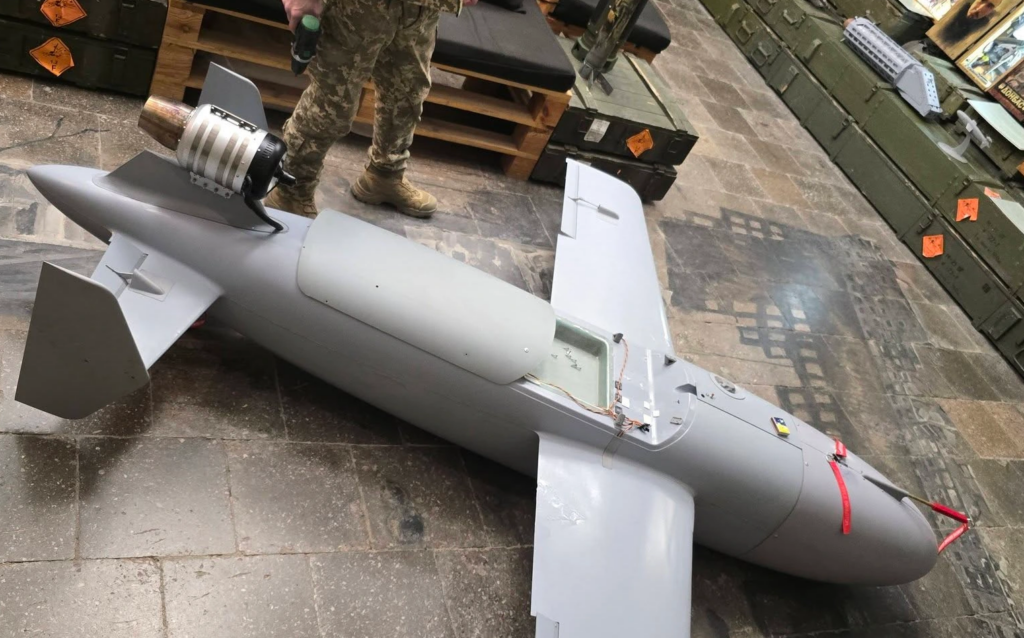
“Bars” jet-powered drone. Photo: Museum of the Russian-Ukrainian War

A Bars production facility is already in Europe and will begin operating in early September

The first batch of Bars drones is planned to be delivered as early as 10 October, according to the interview.

“As of today, the only limitation to scaling up the production of ‘Bars’ is the so-called ‘bottleneck,’ and it is not so much the volumes as the delivery times of turbojet engines,” the developer said.

It was previously reported that Ukraine and Germany had signed an agreement on the joint production of Bars drones. Ukrainian Foreign Minister Andrii Sybiha said this on 8 July 2026. He said that at the first stage of the project, Germany would finance the production, while all manufactured UAVs would be transferred to the Armed Forces of Ukraine.

  •  

Germany will close Russia’s Bonn consulate after attributing Leipzig Airport drone attack to Moscow

Germany will close Russia’s General Consulate in Bonn, terminate the agreement concerning the Russian House in Berlin, and tighten entry controls for Russian citizens. Foreign Minister Johann Wadephul announced this at a joint press conference with Interior Minister Alexander Dobrindt on 1 September, after German authorities formally attributed the attack at Leipzig/Halle Airport to Russia.

German investigators have identified two suspects allegedly linked to the operation: a Russian-born man with a Latvian passport and a Belarusian man with a Russian passport. This information was reported by Süddeutsche Zeitung. Investigators believe both have links to Russian state structures, according to the report.

Both men have already left Germany, complicating efforts to bring them to justice, Tagesschau reports. One of Berlin’s responses was the closure of Russia’s Consulate General in Bonn — the last Russian consulate general remaining in Germany.

Table of The Russian Consulate General in Bonn, Germany. Photo: Marc John/IMAGO

Germany tightens its Russia policy

Russia’s General Consulate in Bonn will close on 18 September, according to Wadephul. Germany will also seek additional EU sanctions against people linked to Russian hybrid attacks, increase pressure on Russia’s “shadow fleet,” and strengthen entry controls for Russian nationals.

He stated that since the beginning of "the unlawful war of aggression" against Ukraine, Germany's goal has been to bring the war to an end, restore the peace order in Europe, and return to a constructive relationship.

"However, this requires a minimum level of willingness on the Russian side. We must acknowledge that Russia shows no willingness to reach an accommodation,” Wadephul said.

Moscow rejected the accusations. Russian President Vladimir Putin called Germany’s response a “grave mistake,” TASS reports.

The investigation leads to two suspects

According to German investigators, the Belarusian suspect left DNA traces on one of the drones, inside a container containing explosives, and on an antenna found near the airport. The Russian-born suspect, who holds a Latvian passport, is believed to have coordinated and directed the operation, entered Germany through Berlin, and then traveled toward Saxony.

The Russian-born suspect left Germany two days before the attack, while the Belarusian suspect also left the country.

Drone found near a Ukrainian An-124 aircraft in Leipzig, Germany, on 5 August, 2026. Photo: screenshot from Bild video

What happened at Leipzig Airport

The diplomatic response stems from a sabotage attempt on 4 August, when a bomb-laden drone struck a Ukrainian An-124 cargo aircraft but failed to detonate. The drone, carrying explosives, remained unnoticed for about four hours before being discovered, while later analysis indicated it had been aimed at the aircraft near its fuel tanks.

  •  

Putin says Russia is 12 km from Sumy—1.5 km farther than in June

Russian President Vladimir Putin in the Russian army command center, 26 October, 2025. Screenshot from video.

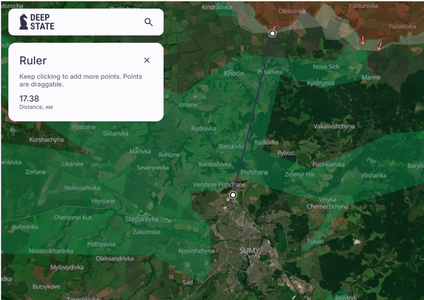
On 1 September, Russian President Vladimir Putin said during a conversation with journalists that Russian troops had 12 km left to reach Sumy. Censor.NET estimated from DeepState’s map that Russian forces were approximately 17 km from Sumy’s administrative boundary.

Russian military commanders have systematically exaggerated their gains on the battlefield. The Institute for the Study of War (ISW) describes such claims as part of a Kremlin information campaign aimed at creating the impression of major Russian gains. In this case, the Russian president cited exaggerated gains that, compared with his previous claims, appear to be a setback.

What Putin said

“The ‘North’ group of forces continues to create a security belt along the Russian-Ukrainian border in the border areas of the Sumy region... There are 12 km left to Sumy, to the Sumy ring road,” Putin said during the press conference.

Censor.NET reported that Russian forces were about 17 km from Sumy without specifying the reference point, while Putin did not say which section of the city’s ring road his 12 km figure referred to.

Approximate visualization of Censor.NET’s reported 17 km distance from the DeepState frontline toward Sumy. Map: DeepState / Chart: Euromaidan Press

Putin previously gave a different distance

On 28 June, during an interview with Russian propagandist Pavel Zarubin, Putin said that Russian troops had “about 10.5 km” left to reach Sumy. At the time, he also explained the offensive as the creation of a “security zone” along Russia’s border.

Putin’s claimed distance to Sumy therefore increased by approximately 1.5 km in just over two months, contradicting the Kremlin’s portrayal of a continuing advance.

Other exaggerations

In July 2026, Putin claimed that Russian forces had “completely captured” Kostiantynivka. Ukraine’s General Staff rejected the claim, saying Ukrainian forces continued defensive operations in the city. ISW also said some videos of Russian flags being raised in Kostiantynivka were likely AI-altered.

On 2 December 2025, Putin claimed that Russian forces had captured Pokrovsk in Donetsk Oblast. ISW found no evidence confirming the city’s complete capture and assessed that its fall would not enable Moscow to achieve a significant breakthrough.

  •  
❌