Vue lecture

Ukraine’s secret counteroffensive takes the pressure off Sloviansk
Par : David Axe

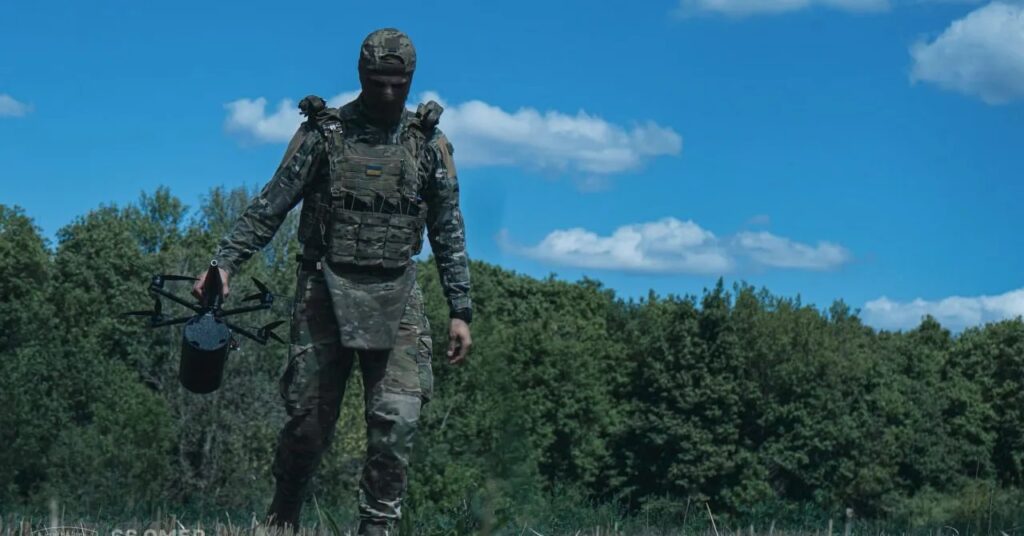
A Ukrainian soldier carries an FPV drone.

  • Without much fanfare, Ukrainian forces have been counterattacking north of Lyman in eastern Ukraine's Donetsk Oblast
  • The Ukrainian advance takes some pressure off the free city of Sloviansk, just 20 km to the southwest
  • The problem is: the Russians are advancing toward Sloviansk and Kramatorsk from several other directions

Russian forces are fighting against time to close a pincer around the last free cities in eastern Ukraine. The deadline: the coming winter, which will strip the leaves from the trees and leave any attacking force exposed to overhead surveillance and attack.

But in one key sector, Ukrainian forces are spoiling the coordinated Russian operation to partially surround Sloviansk and neighboring Kramatorsk. With admirable operational security, or OPSEC, a clutch of Ukrainian brigades under the 3rd Army Corps hasn't just blunted the advance of the Russian Center Group of Forces—it has pushed the Russians back.

This Ukrainian counterattack along the axis through the town of Lyman, ongoing since May, has largely escaped widespread notice. Yes, there is some scant video evidence of Ukrainian attacks. And yes, a few analysts have adjusted their maps to account for apparent Ukrainian advances, especially in the direction of Nove, a Russian-occupied village 15 km north of Lyman, which itself lies 15 km north of Sloviansk.

Ukrainian 🇺🇦 forces have been conducting for weeks two unnoticed counter-attacks in two directions of the frontline.

With barely any geolocation, the Ukrainians kept a good level of OPSEC and the russians have been reluctant to publish videos from these areas.

In the Ivanivka… pic.twitter.com/hNJy4YhkxG

— Clément Molin (@clement_molin) June 10, 2026

But for the most part, Ukrainian and Russian sources have avoided talking about Lyman. "The Ukrainians kept a good level of OPSEC and the Russians have been reluctant to publish videos from these areas" depicting their retreats, analyst and mapper Clément Molin noted in June, just a few weeks after the Ukrainians attacked toward Nove.

Molin, for one, expects the OPSEC to lift in the coming days. "By the end of the month, we should have an official update on the good results of a Ukrainian offensive that has largely remained secret," he wrote on Monday.
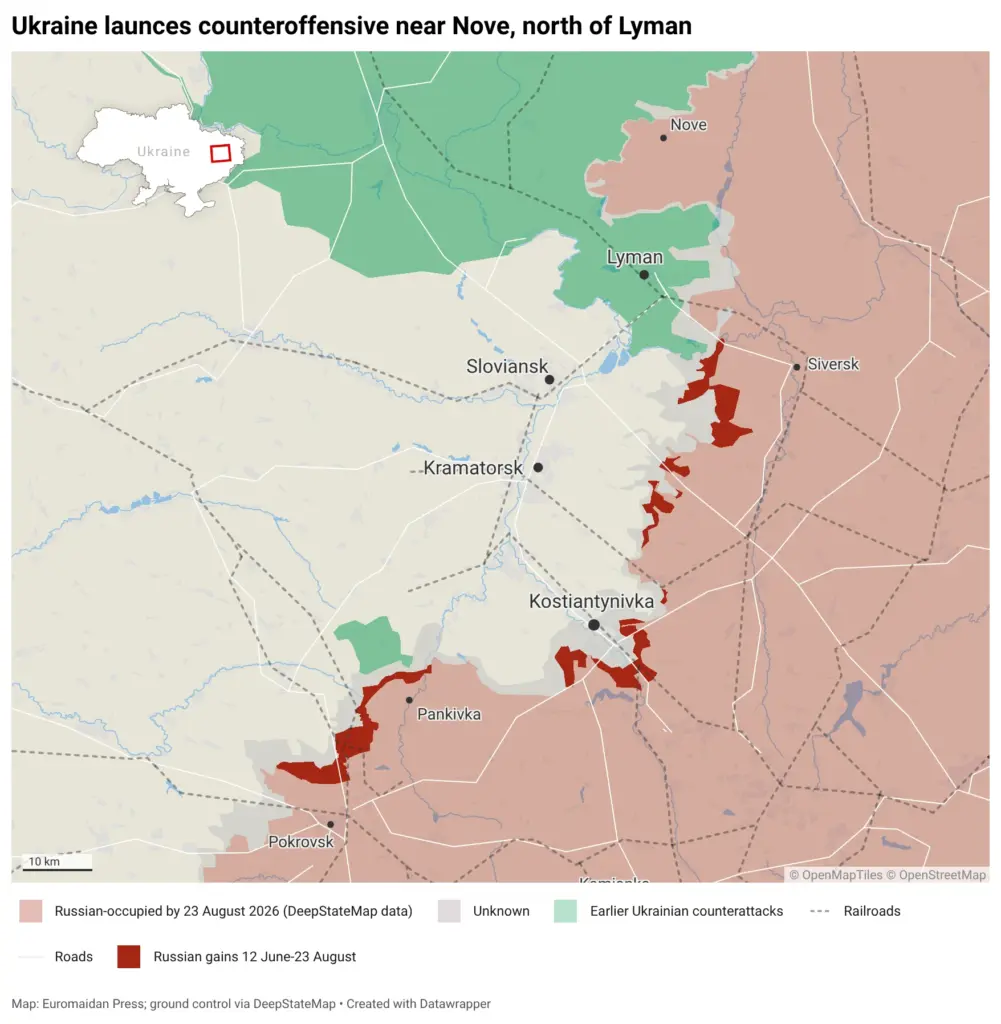
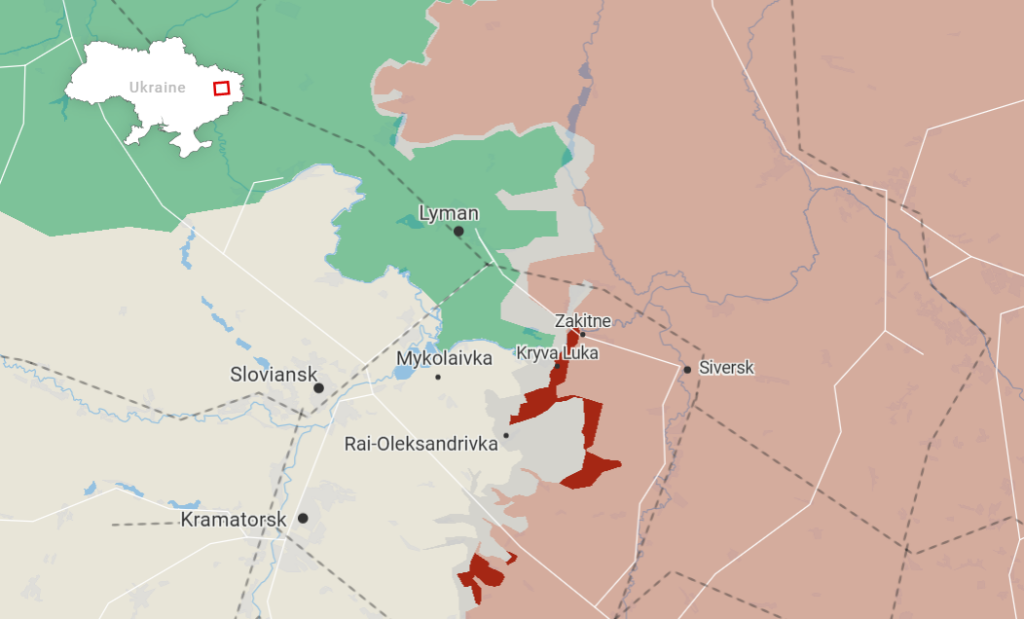
Situation near Nove as of 23 August
Situation near Nove as of 23 August. Map: Euromaidan Press

April offensive

The Ukrainians' limited counteroffensive around Lyman apparently kicked off on in mid-April. One of the first attacks that left any real evidence occurred on 22 May, when a small Ukrainian mechanized force—perhaps from the 60th or 66th Mechanized Brigade, the 77th Air Assault Brigade, or the Presidential Brigade—attacked in armored trucks and M-113, Stryker, and BTR-4 armored personnel carriers. Heavy bomber drones flew top cover.

The Russian 144th Motor Rifle Division fought back with its own drones. Interceptor drones took aim at the bombers. First-person-view and heavy bomber drones blasted at least one BTR-4, hitting it before and after it dropped off its infantry passengers. Drones struck some of the disembarked Ukrainian infantry.

How many Ukrainian troops survived and entrenched in new positions on 22 May is unclear. Regardless, the Ukrainian 3rd Army Corps wasn't done with Nove. Attacks continued. And sometime after the 22 May assault on Nove, "the Ukrainians managed to consolidate their gains," Molin concluded after scrutinizing a few videos and some satellite imagery.

By early July, Ukrainian forces had succeeded in "operationally encircl[ing] the Russian forces defending the village of Nove," according to analyst and mapper Thorkill. "Fierce fighting is currently underway to expel the Russians from that locality," Thorkill reported at the time.

Sytuacja w rejonie Nowego (Łyman).

Jednym z odcinków frontu w Donbasie, na którym wojska ukraińskie prowadzą obecnie działania zaczepne, jest rejon wsi: Nowe – Zełena Dolyna, na północ od Łymanu. Od połowy maja 2026 r. pozycje rosyjskiej 144 Dywizji Strzelców Zmotoryzowanych… pic.twitter.com/2EJQgz4eps

— Thorkill (@Thorkill65) July 8, 2026

The aim of the Ukrainian counterattacks is obvious. The 3rd Army Corps intends to put pressure on the northern right flank of 10 km-by-10-km salient jutting into the battleground north of Lyman. The Russian 144th Motor Rifle Division has been pouring troops into the salient, clearly intending to surround and isolate Lyman instead of directly assaulting it—all in order to clear a path toward Sloviansk.

Salients are risky for both sides, however. The farther the Russians extend their Lyman salient, the more exposed they are on their flanks. The Ukrainians know this. And even if the 3rd Army Corps can't fully cut across the salient in order to surround the Russians inside of it, the corps can at least take advantage of the salient's exposed flanks.

Capturing Nove, on the very northern edge of the salient, could allow the Ukrainians to bring to bear more artillery and drones on the Russians south of Nove. The 3rd Army Corps doesn't have to fully encircle the Russian troops closest to Lyman in order to hammer them with withering firepower.
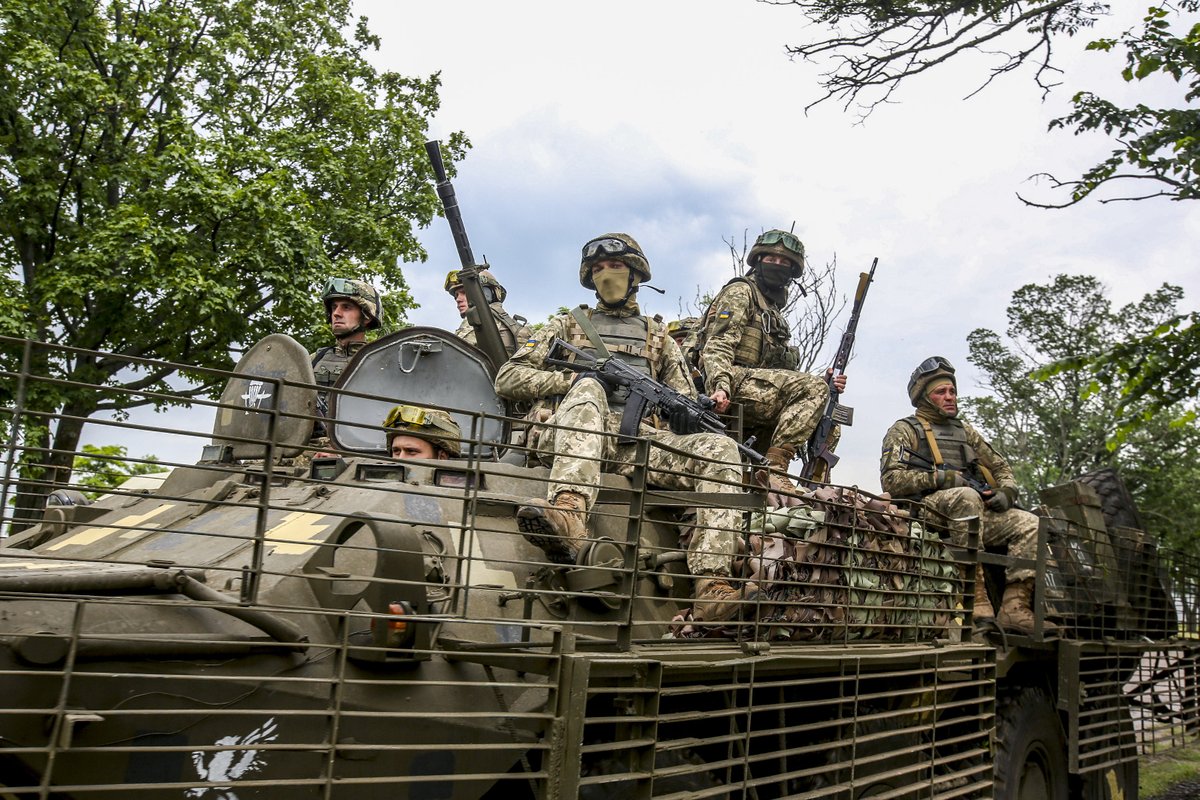
Soldiers of Ukraine's 79th Air Assault Brigade.
Explore further

Ukraine’s quiet counteroffensive took 745 square km. Russia’s dead Starlink is how

Just how successful the 3rd Army Corps has been in its local counteroffensive could become clearer very soon. That won't spell lasting relief for Sloviansk and Kramatorsk, however. Fighting against the clock as summer begins turning into fall and then winter, the Russians are slowly advancing toward the twin cities from several directions.

The siege of Kramatorsk and Sloviansk is coming. Perhaps not this year, but surely by 2027. To fully safeguard the twin cities, the Ukrainians would need to duplicate their success north of Lyman along several other directions.

That's a big ask of a Ukrainian force that's overall still outnumbered and outgunned.

  •  

Russia grinds up the eastern approach to Sloviansk after its northeastern push stalled

The aftermath of the destruction following one of the strikes in Sloviansk

Russian forces have gained ground on the eastern approaches to Sloviansk and continue to prioritize an eastern route toward the city, according to the Institute for the Study of War (ISW). Their earlier push from the northeast had bogged down, and Russia now aims to set up a future assault on one of the last major cities Ukraine still holds in Donetsk Oblast. A quick move on the city itself remains extremely unlikely, ISW said.

Russia's 2026 summer campaign in the east has advanced through field edges and small villages rather than the breakthroughs the Kremlin keeps promising, the grinding pattern that has defined the fighting across Donetsk Oblast for years.

Destroyed Kostiantynivka
Explore further

Kostiantynivka: Why one city in Donbas matters so much that Putin lies about having captured it

The eastern approach

Ukrainian military observer Kostiantyn Mashovets reported that Russian forward units are advancing across several tactical areas at once in the Sloviansk direction. He said the command of Russia's 3rd Combined Arms Army rushes assault infantry forward right after each successful infiltration. Russian troops reached the southeastern edge of Pyskunivka, east of Sloviansk, from the east and northeast, moving off positions they had seized on the southern bank of the Siverskyi Donets, Mashovets said. Zakitne lies northeast of Pyskunivka and Kryva Luka southeast of it, and ISW read the advance as evidence Russia has consolidated positions in both.

They also infiltrated the southern and southeastern outskirts of Mykolaivka from western Rai-Oleksandrivka. ISW assessed that Russia is running a dual effort to connect its units near Kryva Luka with those at Rai-Oleksandrivka, so it can assault Mykolaivka from dominant terrain to the east and south at once. Mashovets added that other Russian groups slipped through three settlements along the E-40 Bakhmut-Sloviansk highway, trying to hold the western bank of the Siverskyi Donets-Donbas Canal and reach the river just east of the city.

ISW observed reports on 23 August that Ukrainian forces repelled a Russian infiltration attempt in Mykolaivka.

Oleksandr Borodin, spokesperson for Ukraine's 3rd Army Corps, said the Lyman direction falls in his corps' zone and that Russia's goal there is to half-encircle the Sloviansk-Kramatorsk agglomeration from the flank—first securing bridgeheads across the rivers, then cutting logistics. He called those plans unrealistic:

"We have quite serious defensive positions there and have been preparing for a long time. The capabilities they currently have to try to accomplish this task are insufficient even to come close to achieving such a goal."

Why Moscow switched directions

Russia prioritized attacking Sloviansk from the northeast through Lyman when it opened its spring-summer 2026 offensive, but that effort has largely stalled. The Siverskyi Donets River, which loops north and northeast of the city, together with a web of canals, handed Ukrainian defenders a natural moat. So Russian commanders now treat Mykolaivka as a key prize. Taking it would let them strike west toward Sloviansk from the east, skirting the water obstacles that blocked the northeastern route.

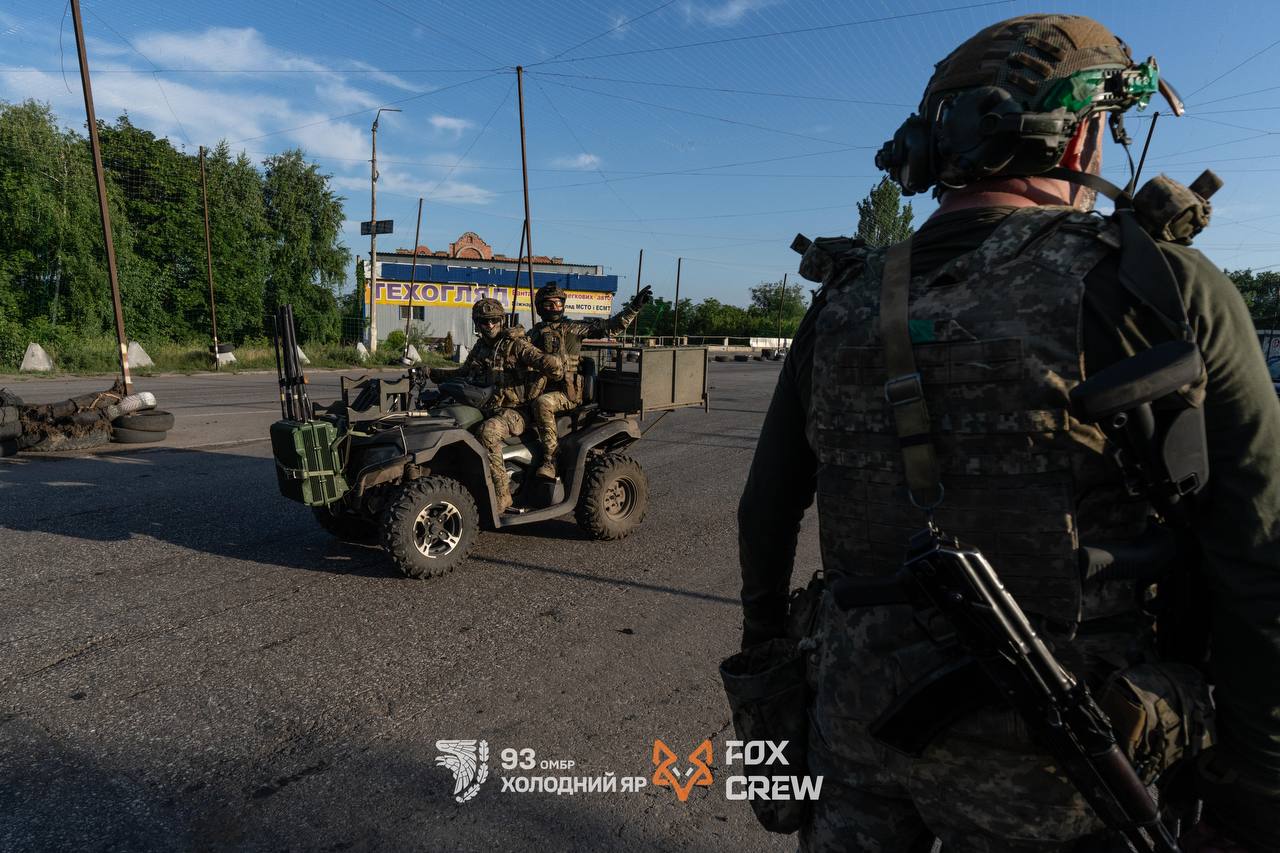
Soldiers of the 93rd Separate Mechanized Brigade’s Fox Crew prepare for a logistics run near the Kramatorsk–Kostiantynivka road in Donetsk Oblast. The unit, once focused on anti-tank warfare, now uses strike drones to disrupt Russian supply lines. Credit: 93rd Separate Mechanized Brigade / Fox Crew.
Explore further

Ukrainian intelligence units will not help: Analyst warns that once Russia breaks into Sloviansk and Kramatorsk, reinforcing them only delays inevitable

A slow road into the Fortress Belt

Sloviansk anchors the northern end of Ukraine's Fortress Belt, a chain of fortified cities that has blunted Russian advances in Donetsk Oblast since 2014. ISW cautioned that Russian forces are extremely unlikely to make fast gains west of Mykolaivka, since they still need to seize several more settlements first.

Ukraine's President Volodymyr Zelenskyy said on 23 August that Putin has ordered his army to seize all of Donetsk Oblast by 31 December. By ISW's count, it is the 15th such deadline since 2022, and Russia has missed every one that has come due.

Zelenskyy put Russia's frontline casualties this year at around 267,000, including about 155,000 killed, and said 70% to 80% of them fall in the Kostiantynivka direction. Russia holds about 79.89% of Donetsk Oblast, by ISW's count, and Zelenskyy said the Kremlin is preparing to mobilize around 300,000 men after the 18–20 September State Duma elections, partly to reinforce Donetsk and Luhansk oblasts.

  •  

Ukrainian intelligence units will not help: Analyst warns that once Russia breaks into Sloviansk and Kramatorsk, reinforcing them only delays inevitable

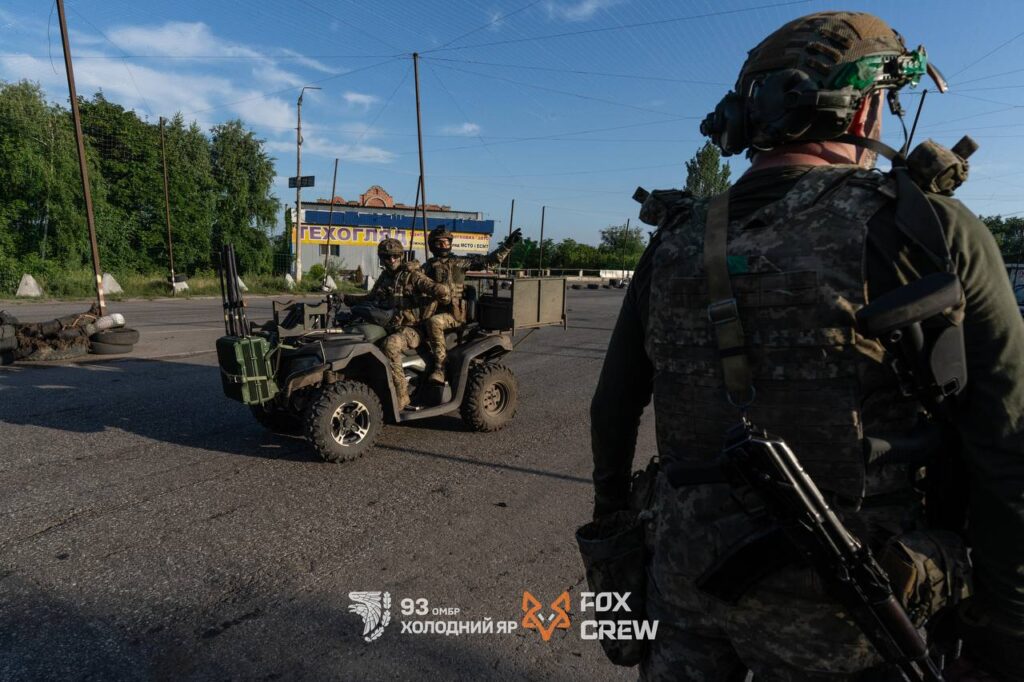
Soldiers of the 93rd Separate Mechanized Brigade’s Fox Crew prepare for a logistics run near the Kramatorsk–Kostiantynivka road in Donetsk Oblast. The unit, once focused on anti-tank warfare, now uses strike drones to disrupt Russian supply lines. Credit: 93rd Separate Mechanized Brigade / Fox Crew.

Ukrainian analysts warn that the situation on a key stretch of the Donetsk front is becoming increasingly dangerous for two cities central to Ukraine's defense. The eastern flank of the Sloviansk-Kramatorsk agglomeration is taking on an increasingly threatening character, and earlier stabilization measures are clearly not working, military analyst Oleksandr Kovalenko said.

The two cities anchor the line that has held Russia back for over a decade. Sloviansk and Kramatorsk form part of the so-called fortress belt, the line of Ukrainian fortifications that has restrained the Russian advance since 2014. The agglomeration serves as the most important bastion and logistics hub for Ukrainian forces in the east. A threat to it is a threat to the backbone of Ukraine's defense in Donbas.

Russia is 12 to 13 km away

Kovalenko laid out how close Russian forces have come. Their forward positions are 12-13 kilometers from Sloviansk and Kramatorsk. He warned that if Russia's pace does not slow, the first infiltrations into both cities could come by December 2026.

The advance is measured in ground lost. The problem on the eastern flank runs about 30 kilometers, where Russia's 3rd Combined Arms Army operates.

"Only in the third week of August, Russian forces captured 21 square kilometers of Ukrainian territory in this section of the frontline," the expert said.

Russia uses the terrain of the "Cretaceous Flora" reserve, its hilly micro-relief rather than open steppe, to advance, absorbing not just square kilometers into pockets but villages and settlements.

The flank threatens neighboring sectors

The deterioration is spreading pressure sideways. The advance creates pressure from the southern bank of the Siverskyi Donets on the zone of the 3rd Army Corps, which had stabilized the Lyman direction and pinned Russian forces near Yampil, Kovalenko believes. The former Siverskyi direction saw the fastest rate of territorial loss of any sector in 2025, slowed in April and May 2026, but the 3rd Combined Arms Army's advance has not yet been stopped.

The cumulative loss is large. After losing more than 500 square kilometers over a year, the unstable flank, sagging since June 2025, is becoming a problem for other directions, looming over or pressuring them.

Kovalenko argued the sector has gone months without attention while threatening both the main agglomeration and the successfully held directions around it.

Analysts urge reinforcement before it is too late

Kovalenko proposed a specific fix. The sector must be reinforced as soon as possible, he said, suggesting that the nearest resource, Andrii Biletsky's 3rd Army Corps, often described as one of the most capable formations in Ukraine's forces, be used at least to relieve both banks of the Siverskyi Donets.

"Once infiltrations into Sloviansk and Kramatorsk begin, reinforcing garrisons and landing intelligence-directorate troops will not solve the problem but only delay the inevitable," he warned.

A second analyst gave a similar warning. Yurii Butusov, a drone company commander in the National Guard's "Khartia" corps, said that if Ukraine's forces retreat from there, Russia gains tactical advantages and Sloviansk-Kramatorsk is gradually lost, ultimately leading to the loss of the Donbas.

He also said that only Biletskyi can take responsibility for this battle.

"Only orderly command and organization at the front now will allow us to turn the course of a battle that is so far not going in our favor," Butusov said.

  •  
❌