Vue lecture

Russia’s biggest weapons maker has been under EU sanctions since 2022. Its 482 subsidiaries are the loophole.

Vladimir Putin tours the Uralvagonzavod tank plant in Nizhny Tagil, part of Russia’s state-owned Rostec defense conglomerate, on 15 February 2024. Credit: Ramil Sitdikov/RIA Novosti via Kremlin.ru

At the G7 summit in Évian-les-Bains, France, in June, the leaders of the world's most powerful states again declared their intent to help Ukraine and to pressure Russia economically: "We commit to increase the pressure on the Russian war economy. In this context, we will strengthen our sanctions." But while G7 governments negotiate another round of political statements, the assembly lines of Russia's military-industrial complex keep turning out missiles and drones—from Western components and electronics.

A new analysis of Rostec—the giant of Russia's military-industrial complex—by the Independent Anti-Corruption Commission (NAKO) shows that the strategy of targeted strikes has reached a dead end. To make restrictive measures more effective, allies should consider wider use of export-control mechanisms against structures tied to Russia's defense-industrial complex. In many cases, export control can be a faster and more flexible instrument than full sanctions regimes.

Sanctions against Rostec

Workers assemble a T-72B3-series tank at Uralvagonzavod in Nizhny Tagil, part of Russia’s state-owned Rostec defense conglomerate, on 15 February 2024. Credit: Ramil Sitdikov/RIA Novosti via Kremlin.ru
What is Rostec?
  • Russia's largest defense and industrial holding, 100% state-owned
  • Its enterprises produce 80% of military equipment Russia uses in its war on Ukraine, Russian officials say
  • Accounts for about half of Russia's defense procurement
  • Employs 500,000–700,000 people at roughly 700–800 enterprises

Hitting the tip of the iceberg is not enough. Sanctions have been placed on Rostec itself, on its best-known holdings, and on individual plants caught manufacturing weapons. But this giant has many branches, visible and hidden, and the sanctioning process itself takes years. The result is that sanctions policy often looks ineffective—and it is easy to see why.


NAKO's analysts traced and identified 482 key legal entities within Rostec's structure. This is the most complete map of the conglomerate that currently exists, and even it covers only part of the concern. A vast network of subsidiaries operates in total secrecy: they hide financial reporting, classify tenders, and mask beneficial owners behind chains of fictitious founders.

Rostec subsidiaries identified by NAKO
Rostec subsidiaries identified by NAKO. Screenshot from NAKO report

And while the West spends months assembling evidence against a single plant, Rostec quickly spins up new "clean" shell firms or brings new enterprises and factories under its control.

Ukraine has imposed sanctions on 72% of the identified Rostec enterprises. The United States covers 45%. And here it gets interesting: the European Union has managed to sanction only 23% of the conglomerate's companies. The United Kingdom takes an even more "selective" approach.

The EU has sanctioned only 23% of Rostec's companies.

The analysis also found a huge asymmetry between jurisdictions. The US, the EU, the UK, Switzerland, and Asian states apply entirely different approaches. What is blocked in the EU can operate freely under British or Japanese law. And while sanctions from even one jurisdiction are a significant red flag for banks, manufacturers, and regulators, the legal gap itself lets Russia keep access to technology.

How Russia gets around the sanctions

This lack of coordination among allies, combined with a complex, multi-layered corporate structure, keeps feeding Russian weapons with Western microelectronics. A vivid example is KRET (Radio-Electronic Technologies Concern), which produces the electronic-warfare systems Russia uses to jam Ukrainian drones at the front. London has sanctioned not a single enterprise in this holding—and there are at least 40 of them.

The result? Legally, these smaller companies fall under restrictions purely by belonging to Rostec. In practice? British manufacturers or distributors are unlikely to spend time tracing the link between Rostec and one of its hundred-odd enterprises buried in corporate layers; seeing no risk, they simply sign the deal with an unremarkable plant.

Another example is the Shvabe holding, whose sights and thermal imagers sit on Russian equipment. It ships its products to international exhibitions in the UAE without difficulty.

Small-arms sights on display at the booth of Russia’s Shvabe Holding, part of state-owned Rostec, at the MILEX-2025 arms exhibition in Minsk, Belarus. Credit: Mikhail Voskresensky/RIA Novosti

Other enterprises and whole holdings are frequent guests at exhibitions in China and India—steadily present and visible to a range of countries that could be subject to secondary sanctions. With those same countries Russia signs deals to sell another batch of helicopters, or shows off upgraded drones that have "proven their effectiveness on the battlefield against Ukraine." And it is through such countries that Western components keep reaching Russia.

This matters because Russia's import-substitution program—including in microelectronics—has never worked. Not yet, at least. Ukrainian military institutes examining captured missiles and downed drones report that Russian high-tech electronics simply are not there, sources that study the missiles have told NAKO. What they find are chips from American, European, and Japanese giants.

What is more, even these foreign components are usually nothing remarkable technologically. Yet as of today Russia still cannot produce even these—certainly not at scale—so it works the gaps in sanctions, export control, and "business as usual" with great finesse.

The next step: strengthening export control

The direction is already shifting. On 23 July 2026, the European Union adopted its 21st sanctions package—its largest batch of individual listings in four years. Fifty-six of them target Russia's military-industrial complex, 37 tied directly to long-range drones, and 51 more entities, many in China, Kyrgyzstan, Türkiye, and the United Arab Emirates, were placed under tighter export controls for feeding Russia the microelectronics and CNC machine tools its weapons depend on. It is the right target. The limit is that it still proceeds one entity at a time—and Rostec is built to outrun exactly that.

Banning the supply of certain critical goods to Kyrgyzstan—where such exports suddenly grew by more than 800%—or issuing regular financial warnings to intermediaries in the UAE and China are the right steps, and they force Russia to pay more. More than that: over four years, sanctions policy has repeatedly caused delays in the production and delivery of weapons and military equipment. But it has not stopped that production—as Ukraine keeps seeing with its own eyes during every mass strike.

The main conclusion that follows from our map of 482 key Rostec entities is the need to change the very logic of restrictive measures against Russia's defense-industrial complex.

Sanctions remain an important instrument, but they often prove slow, selective, and politically difficult to implement. A far wider use of export-control mechanisms, by contrast, could cut off access to international technology, equipment, and components faster and more effectively.

There should no longer be any need to prove separately the role of every nominal LLC somewhere near Chelyabinsk in Russian military production.

If an enterprise is part of Rostec's production, procurement, or technological chains—or those of other structures in Russia's defense-industrial complex—it should automatically become a candidate for export-restriction lists.

This approach would make it substantially harder for Russian defense enterprises to reach Western technology and would narrow the room to evade restrictions through subsidiaries, intermediaries, or formally civilian structures. Western banks, exporters, and compliance teams should not have to identify each new shell firm on their own. Instead, they should get a clear signal: involvement in the production or supply chains of Russia's military-industrial complex means elevated regulatory risk and the need to apply restrictive measures.

Economic pressure on Russia's defense sector must stop being fragmentary and reactive. It has to become systematic, predictable, and capable of outpacing the adaptive mechanisms of Russia's war economy.

Viktoriia Vyshnivska
Viktoriia Vyshnivska is a Senior Researcher at the Independent Anti-Corruption Commission (NAKO). Her work mainly focuses on supply chains delivering critical components to Russia, the use of foreign technologies in weapons production, and the impact of sanctions regimes on the defence capabilities of aggressor states. Her additional focus also includes Ukraine’s state-owned defense industry and democratic resilience.
Kateryna Biesiedina
Kateryna Biesiedina is Communications Manager at the Independent Anti-Corruption Commission (NAKO), specialising in strategic communications and media with a professional background in journalism and television production.

  •  

Ukraine funds its war from wages, and a 1971 law keeps millions of women from earning them

A woman drives a tractor in Ukraine. Then-Deputy Economy Minister Tetyana Berezhna said agricultural companies in Poltava Oblast had begun ordering state-funded tractor training for women as part of a program opening traditionally male-dominated professions to female workers. Photo: Tetyana Berezhna/Facebook

For more than 30 years, Ukraine's Labor Code has prohibited women from working night shifts, except in those sectors where the Cabinet of Ministers permits it — and the Cabinet has never approved the list of those sectors, so the exception has no content and the prohibition has no limit.

Ukraine's State Labor Service confirms the list was never adopted, and labor lawyers describe the provision as declarative — a rule that cannot be applied in practice. What it can do is make employers in shift industries cautious, because the safer option, when the law is unclear and the inspectorate is not, is to hire a man.

This is happening in an economy that, by the Economy Ministry's count, is short roughly 4.5 million workers. Around 700,000 men are serving in the Defense Forces, some 5.3 million Ukrainians are abroad, most of them of working age, and the State Employment Service reports that the vacancies hardest to fill are precisely those traditionally considered male—industry, construction, transport, and logistics. Meanwhile, 81% of Ukraine's registered unemployed are now women, up from 55% before the full-scale invasion. The people looking for work and the jobs that need filling are, increasingly, on opposite sides of a legal line drawn in Soviet times.

The vacuum, and how employers use it

Article 175 of the Labor Code prohibits night work for all women except in sectors where it is "required by special necessity and permitted as a temporary measure." The Cabinet of Ministers was to approve the list of those sectors, and in more than three decades it never has.

Hospitals, the police, railways, and the State Emergency Service employ women on night shifts anyway, under special laws regulating service in those sectors. Under the hierarchy of legislation, codes and laws have equal status, so a specialized law takes precedence over a conflicting general one.

In other sectors, however, the ambiguity has consequences. Employing women at night may lead to inspections by labor safety authorities and the imposition of fines, which means employers in industries that depend on night work can point to the legal uncertainty as a justification for not hiring women at all. The prohibition does its damage not because it is enforced, but because it has been left unresolved.

The Law on the Organization of Labor Relations under Martial Law temporarily lifted the restrictions related to night work, leave, rest periods, and overtime. But once martial law ends, the previous rules will return unless Parliament adopts a new Labor Code—and the one draft that would have done so has since been withdrawn.

What the draft code would change

The draft code—bill No. 14386, submitted by the Cabinet in January 2026 and recommended for adoption by the parliamentary social policy committee the following month—would have abolished the general prohibition on women's night work. Pregnant women and women who have recently given birth and are breastfeeding would remain exempt from night shifts until the child reaches 18 months of age, provided they submit the appropriate documentation to their employer. All other female employees would work on equal terms with men.

The draft also addresses the second barrier employers cite: parental leave. At present, leave runs until a child turns three, and employers are required to keep the position open while receiving no compensation for doing so.

For small businesses, which account for 74% of all jobs in Ukraine, this can be financially burdensome, and it is a reason employers may prefer not to hire women of childbearing age. Instead of protecting women specifically, the draft proposes equal rights for both parents, providing each with two months of paid leave while retaining the option of unpaid parental leave. Protection against dismissal would apply to both parents of children under 18 months, and employers would be required to provide written justification if they deny flexible work arrangements to pregnant employees or parents of children under eight.

The draft code also gives pregnant women and mothers of children under 18 months the right to request remote work, and employers may refuse only if the job cannot physically be performed remotely. Bakers and surgeons cannot work from home because they lack the necessary tools and equipment, while accountants and editors can. In other words, refusal would no longer be a matter of employer discretion; it would have to be justified.

None of it came to pass. The draft drew objections—the Federation of Employers warned of risks, and the Atomic Energy Workers' Union argued that several provisions contradicted the very principles the code claimed to advance—but it never reached a vote. Parliament was scheduled to take up the bill in a first reading on 30 June 2026, but did not get to it.

Two weeks later, the government resigned, and bill No. 14386 was withdrawn along with other government bills that had not passed a first reading. A new government may resubmit it under a new number; at this stage there is no way to know whether or when. For now, the draft that would have lifted the ban does not exist, and even had it passed, it would have taken effect only six months after martial law ends—so the vacuum in Article 175 outlasts both the war and the transition that follows it.

Where the law works

The picture is not one of obstruction alone. Just a few years ago, a woman could legally be denied a job because she sought employment in one of more than 450 prohibited occupations, ranging from truck driving to mining. The list was approved in 1993 as a measure intended to protect women's reproductive health, but in practice, it restricted their access to the labor market. In 2017, the list was abolished, and women can now enter any profession provided a medical examination shows the job does not pose significant health risks. Ukraine has also allowed women to serve in the military on equal terms with men.

Women have taken advantage of these opportunities. Today, nearly 75,000 women serve in the Armed Forces of Ukraine — about 20% more than in 2022. In 2025, almost 1,000 women completed the State Employment Service's retraining program in 31 "non-traditional" occupations, ranging from machine operators to tractor drivers. Meanwhile, nearly one-third of the graduates of the Kyiv School of Economics' ProfTech program were women who trained in welding, electronics assembly, and machine operation.

These are small numbers set against a reserve of 3.5 million women who, according to VoxUkraine's research, would like to work. But they suggest that the obstacle is not a shortage of willingness on the part of women, where a legal pathway into these occupations has been opened, women have used it.

Where the law fails

Ukrainian legislation explicitly prohibits discrimination. The Law on Advertising imposes a fine of UAH 86,470 for discriminatory language in job postings, such as "looking for a woman under 30." Article 184 of the Labor Code also prohibits employers from refusing to hire women because they are pregnant or have children.

However, while violations in the first case are relatively easy to identify and punish because job advertisements are usually public, proving discrimination in hiring is virtually impossible. Employers can always claim they found a better candidate, and women have no way of comparing their qualifications with those of other applicants. According to Work.ua data for March 2026, 25% of women have experienced discrimination related to motherhood—in most cases not outright refusal to hire or dismissal, but psychological pressure, inappropriate questions, or attempts to force them to quit.

Equal pay is also required by law, under the Law on Remuneration and the Law on Equal Rights and Opportunities for Women and Men. According to official data, in 2023 — the year Ukraine adopted its strategy for overcoming the gender pay gap — the average gap stood at 18.6%. Among women aged 19–29 it reaches 41.4%, according to estimates by the Institute for Demography of the National Academy of Sciences, based on Pension Fund data. The average in the European Union is 11.1%.

One of the problems in this area is the lack of detailed statistics, which makes it difficult to determine whether wage differences are driven by women and men holding different positions — which would point to a "glass ceiling," whereby women are less likely to be hired into managerial roles—or whether women and men are actually paid differently for the same work. Ukraine does not require employers to report wage data broken down by gender, and as a result three-quarters of companies do not systematically monitor gender pay equality. Without such reporting requirements, tracking whether the gap is closing will remain difficult.

Laws alone are not enough

The new Law on Preschool Education, adopted in 2024, guarantees all children the right to preschool education and allows children to remain in daycare facilities around the clock. However, not all facilities have bomb shelters, and 24-hour childcare is available primarily in private institutions, because public facilities often lack funding for overnight staff.

The shortage of childcare places is not a legal issue. Still, it directly determines whether women can work at all: 67.5% of women outside the labor market are engaged in caregiving and household work. The war has further increased this burden. During the war years, the share of women who are the primary breadwinners in their families rose from 7% to 23%, while the amount of care work—including caring for children and sick or injured family members—also increased. That is why access to childcare is no longer a matter of convenience; it is a condition for families' survival.

A new Labor Code could one day abolish every prohibition it contains, and that would improve the chances of employment for the 3.5 million women who say they want to work. It would not, on its own, give them anywhere to leave their children.

Oleh Ivanov
Oleh Ivanov is an analyst at Vox Ukraine

  •  

Europe promised Ukraine a deterrence force. The missiles that would make it work arrive in 2029.

President Volodymyr Zelenskyy joins leaders of the Coalition of the Willing in Paris on 13 July 2026. Representatives of 40 countries discussed air defense, sanctions on Russia, winter energy support, and longer-term military assistance for Ukraine.

Andy Burnham's first move on Ukraine as British prime minister was to promise that none of Britain's commitments would lapse. Hosting President Volodymyr Zelenskyy at Portsmouth Naval Base on 27 July, a week into the job, he handed Kyiv the intellectual property behind Britain's Stone Cloak drone jammers and pledged to honor "every commitment this country has made to Ukraine in full."

What London, Paris, and the roughly 40 other members have not settled is what the force those commitments promise would be armed with.

A French and British contingent of up to 10,000 troops in Ukraine would be a useful demonstration of solidarity, but not very effective unless they, and the Ukrainian soldiers alongside them, are extremely well equipped with weapons that would deter Russia from another invasion.

Those weapons are the part of the plan that does not yet exist—and the only deep-strike production line scheduled to open before the guarantee could be called on runs through Ukrainian factories.

What the Coalition has actually promised

The Coalition of the Willing meeting in Paris on 6 January 2026. Image: president.gov.ua

Neither leader said anything new at Portsmouth about the troops themselves, and the Presidential Office recorded only that Burnham would continue co-chairing the coalition. French President Emmanuel Macron and then-Prime Minister Keir Starmer launched it in London in March 2025 to unite countries dedicated to Ukrainian peace.

Its political leaders have been putting diplomatic and economic pressure on Russia while military commanders continue to put together plans to secure Ukraine in the event that Russia agrees to a ceasefire and peace negotiations.

Those plans became clearer on 6 January 2026, when Coalition members signed security guarantees including US-led truce monitoring and a multinational troop presence in Ukraine if a ceasefire is reached, to be activated at Ukraine's request once a credible cessation of hostilities takes place. Poland, which borders Ukraine, agreed to provide logistical support only, with Prime Minister Donald Tusk stating at the time that Polish troops would not be deployed "under any scenario."

The Coalition has grown well beyond its founding pair. Around 40 countries were represented at the Paris summit on 13 July, where Moldova and North Macedonia joined; Bulgaria's government announced its exit the following day. France and the UK remain the only two to have pledged ground troops, which is why Zelenskyy has called their presence "mandatory" for the guarantees to mean anything.

The two will put 1,500 troops through the Coalition's first joint exercise in Poland in September, which Warsaw describes as logistics and transport maneuvers rather than combat ones.

Andy Burnham, the Mayor of Manchester, arrives a fringe meeting during the annual Labour Party conference in Liverpool, England, Sept. 29, 2025
Explore further

Britain’s incoming leader promises Ukraine aid “will not waver”—but money is the catch

The missiles that would actually deter Russia

Long-range deep precision strike (DPS) missiles and one-way effectors (OWE), aka kamikaze drones, are in demand following their demonstrated strategic use in the Middle East and in Russia's war on Ukraine. Ifri argued the main lesson from Ukraine is that effective deep-strike posture emerges from a layered mix of capabilities rather than from any single weapon system.

The layers do different jobs.

  • Less-expensive, mass-produced systems like OWEs and attack drones saturate air defenses, as Iran has been doing with Shahed drones in the Middle East.
  • MBDA, which builds both ends of the range, describes its own one-way effector as the weapon that breaks the door down for high-end systems like Storm Shadow/SCALP.

Getting through the door is not the same as destroying what Moscow values on the other side, and it is the heavy-payload end of the spectrum where Europe has bought least.

That gap matters because deterrence here is deterrence by counter-strike. European countries are pursuing high-value DPS systems because the alliance seeks to make its enemies fear that the use of their own deep-strike weaponry will be met with powerful retaliation.

Ground-launched systems carry that threat more credibly than air- or sea-launched ones, and Europe has been short of the class since the Intermediate-Range Nuclear Forces Treaty collapsed in 2019.

Why ground-launched, and why Europe has none

https://www.mbda-systems.com/
MBDA’s Land Cruise Missile System launcher, designed to carry up to four ground-launched cruise missiles with a range exceeding 1,000 kilometers. The European-made system remains in development. Image: www.mbda-systems.com

Same missile, different launcher. MBDA's land system is its naval cruise missile on a truck rather than a warship, and the American system Europe has been eyeing fires the same Tomahawks a destroyer does.

What changes is whether the launcher survives to fire a second time:

  • Warships must be on station and can be tracked.
  • Aircraft must reach a launch point through Russian air defenses, which is why Ukraine's Storm Shadow sorties are rationed by how many jets can get close and come home.
  • A road-mobile launcher in a treeline has neither problem—and deterrence by punishment works only if the adversary believes retaliation will still arrive after his opening strike.
Why does Europe have no ground-based deep-strike missiles?

Europe starts near zero because it was once forbidden to start. The INF treaty removed the entire class from the continent for three decades, and Europe—the theater, never a party to the agreement—complied. Russia did not.

  • 8 December 1987 — Washington and Moscow sign the INF Treaty, banning ground-launched missiles with ranges of 500-5,500 km. It eventually eliminates 2,692 of them.
  • 2014 — The United States first declares Russia in violation, over a ground-launched cruise missile later identified as the 9M729.
  • December 2017 — Russia admits the missile exists and insists it complies.
  • December 2018 — The United States declares Russia in material breach. NATO allies back the finding.
  • 2 August 2019 — The treaty lapses. Neither side is bound, and Russia already has the missile.
  • February 2026 — Six European states sign an ELSA letter of intent covering low-cost one-way effectors above 500 kilometers: the cheap layer, not the heavy one.
  • June 2026 — MBDA unveils its ground-launched cruise missile. First test firing planned for 2028, earliest availability 2029. Nobody has ordered it.

Seven years after the treaty lapsed, European militaries still lack a category of weapon they were once forbidden to field and their adversary was already building.

Despite years at war, Russia retains a substantial stock of long-range missiles, including the Oreshnik ballistic missile, the Novator 9M729 cruise missile, and its Shahed/Geran-2 attack drones. It is not holding them back.

Russia fired 126 ballistic missiles at Ukraine in July alone, the most in any month this year, from road-mobile ground launchers—the class of weapon Europe is still three years from fielding at deep-strike range.

If a ceasefire is declared and a small contingent of European troops is deployed, a significant arsenal of ground-launched DPS weapons might be the only thing standing between that contingent and a repeat.

Russian drone strike Geran on Kyiv's Unesko cathedral
Explore further

Russia is firing more missiles and drones than Ukraine can stop, and the gap is widening

The heavy layer arrives at the end of the decade

MBDA’s mobile Land Cruise Missile launcher, designed to deploy from an unprepared position in under 15 minutes with four missiles ready to fire. The system is expected to become available in 2029. Photo: MBDA-systems

France's MBDA unveiled a complete version of its "European Tomahawk," the Land Cruise Missile (LCM Mk2), at the Eurosatory show in June—the ground-launched version of its battle-proven MdCN, with a first launcher firing planned for 2028 and availability from 2029.

The naval variant is in contract negotiations with France's armaments agency, the DGA. No order has been confirmed for the land-launched version, though Poland remains interested in collaborating through the European Long-Range Strike Approach (ELSA).

ELSA itself shows where European money is going. When France, Germany, Italy, Poland, Sweden, and the UK signed a letter of intent under the program on 12 February, it covered collaborative development of low-cost effectors with ranges above 500 kilometers—the saturation layer, not the heavy one.

The six did agree in June to split ELSA into eight implementation groups, three of them covering ground-launched strike by range band. None of those lines is expected to field before the 2030s.

Ground-launched missiles Europe
Chart: Euromaidan Press

The American shelf is no fuller. Ukraine unsuccessfully requested Tomahawks from Washington, even though they would have come with authorization-to-use requirements. That option looks increasingly off the table after America's sustained use of Tomahawks under Operation Epic Fury—more than 1,000 missiles fired over the campaign's 39 days, according to CSIS—a burn rate that will take years to replace at current production rates, with Washington's own orders taking priority.

US forces also ran their Precision Strike Missile (PrSM) inventory down hard: CSIS estimates 40 to 70 fired from a prewar stock of about 90, and quotes one Army official who says the entire inventory went. Either figure casts doubt on Poland's plans to buy the American system.

The Coalition's planned "reassurance force" is being designed against that background.

As Armida van Rij, senior research fellow at the Centre for European Reform, put it in mid-July, it would likely be "a small force, light footprint, very defensive posture, quite far away from the front line," which raises the question of "how useful actually is that as a deterrent to Russia." She added that there remains "a bigger issue around the credibility of such a force and the credibility of a European deterrent without a US backstop."

Zelenskyy has made the same objection about placement, telling partners that 10,000 troops stationed in Lviv would not stop anything.

French President Emmanuel Macron and military officials attend a Coalition of the Willing virtual meeting on 24 February 2026.
Explore further

Telegraph: Coalition of the Willing will only send troops to Ukraine with Putin’s consent

The factories are not moving faster than the schedule

The two countries pledging troops are also the two whose military leadership says it is not ready. General Fabien Mandon, chief of staff of the French armed forces, warned that France was not prepared for high-intensity conflict, citing an "insufficient number of ships and armaments" and a particular need for "more missiles with greater range and lethality."

In the UK, General Sir Roly Walker, chief of the general staff, said British land forces must act "with the urgency of wartime," warning that Russia "will only take us seriously ... when they see our factories producing at wartime production rates."

The money has since moved.

An additional 36 billion euros for France's 2024–2030 Military Programming Law was definitively adopted by Parliament on 1 July, bringing total planned defense investment to 436 billion euros—nearly $500 billion—by 2030.

Britain's Defence Investment Plan was published on 30 June, a year overdue, setting out £298 billion, about $400 billion, of investment over four years. Industry welcomed the clarity.

How quickly either plan converts into contracts, and contracts into missiles, is the question the 2029 date already answers.

The one deep-strike line that opens inside the window

Ukraine had to increase domestic defense production quickly, initially with drones and OWEs, then heavier systems like Fire Point's Flamingo cruise missile, shown internationally for the first time at Eurosatory in June.

Its combat record has improved: a 27 June strike on the Titan-Barrikady arms plant in Volgograd was among its most damaging yet, and Germany's Diehl Defence is now in talks to co-produce it, as Berlin looks for alternatives after Washington shelved plans to station Tomahawks there.

For deep-strike missions Ukraine has also relied on UK and French Storm Shadow/SCALP missiles, and on 13 July France went further, licensing Ukraine to manufacture SCALP missiles, AASM bombs, and Aster interceptors on its own soil.

The bilateral roadmap authorizes SCALP and AASM production "before the end of 2026 and starting as soon as possible," the Telegraph reported, though it attaches no date to the first missiles and notes that the factories will more plausibly run after a settlement than before one.

It is the only European deep-strike production line in the plan with a 2026 authorization attached at all—and it runs through Ukrainian factories, not European ones.

The Paris declaration commits the Coalition to activate its guarantees the moment a ceasefire enters into force, at Ukraine's request. No European ground-launched deep-strike missile is scheduled to be available before 2029, and the one closest to ready has no customer.

Thomas Keller
Thomas Keller is a risk management consultant advising public institutions and private-sector clients on geopolitical risks and their market implications. His work focuses on the Euro-Atlantic region, which has become a central geopolitical risk environment since 2022.

Editor's note. The opinions expressed in our Opinion section belong to their authors. Euromaidan Press' editorial team may or may not share them.

Submit an opinion to Euromaidan Press

  •  

Ukraine is turning Crimea into an island. It just fired the minister who armed the effort

Ukraine rewards drone units for racking up the most kills

On 15 July, President Volodymyr Zelenskyy dismissed Mykhailo Fedorov, his fourth defense minister since the start of the full-scale war, after just six months in office.

Neither Zelenskyy nor the Presidential Office has attributed the decision to poor performance or misconduct, and there is no evidence of incompetence, corruption, or scandal. The evidence points the other way. Fedorov was removed at the peak of Ukraine's best months of the war—and if performance is not the reason, the question is what is.

Under Fedorov, Ukraine has at times liberated more ground than it lost and driven up the cost of every meter Russia takes: ISW assessed that in June 2026 Russian forces suffered over 19 times as many casualties per square kilometer seized as a year earlier.

The clearest results are at sea. What the Financial Times has called the largest naval warfare in half a century has, by Ukraine's own count, put at least 136 Russian and Russia-linked vessels under drone attack between 6 and 15 July—oil tankers, shadow-fleet tankers, cargo ships, ferries, even the tugs sent to rescue them.

The first round, in the Sea of Azov, is over; the campaign has now moved into the Black Sea. Ukrainian forces are striking the ships that fuel and supply occupied Crimea, at an intensity analysts compare to the Iran–Iraq "Tanker War" of the 1980s. The campaign is effectively turning Crimea into an island, setting the stage for its future liberation.

On land, the same logic runs 200 kilometers deep. Rather than seizing terrain, Ukrainian forces contest the airspace above it—a sustained interdiction campaign against the M-14 and H-20 highways that sustain Russian forces in the occupied south, striking convoys, fuel and ammunition depots, command posts, and the recovery vehicles sent after earlier losses.

M-14 Ukraine counterlogistics campaign
Map: Euromaidan Press

In June 2026 they temporarily severed every land route between occupied Kherson Oblast and Crimea. The potential prize is large: the isolation of Crimea, and with it the recovery of Zaporizhzhia and Kherson oblasts, the Zaporizhzhia Nuclear Power Plant, the farmland, and the port of Kherson.

Then the deep strikes on Russian oil. Ukraine's long-range campaign has knocked out a large share of Russia's refining capacity—by Kyiv's estimate more than 40%, by independent analysts closer to a quarter—enough to force gasoline rationing across dozens of Russian regions, hours-long queues, a fuel emergency in Crimea, and imports from India and Belarus. It has not stopped Russia's offensives, but it has degraded logistics, stretched air defenses, slowed the tempo, and made the war more expensive to keep fighting.

A trooper from the 80th Air Assault Brigade, fighting in the southeast.
Explore further

Ukraine is advancing in the southeast. It’s still not enough to win the war

Not all of this is Fedorov's, and he never claimed it was: these are the work of the Armed Forces, Defence Intelligence (DIU), and the Security Service of Ukraine (SBU). But the ministry he ran made them possible. By his own accounting—a farewell list of 22 points—his team shut down Starlink for Russian forces, rebuilt procurement so that Ukraine bought more drones in four months than in all of 2025, funded the Drone Line, and pushed interception rates sharply upward through mandatory after-action review. Western partners and Ukrainian civil society rated him one of the most effective and incorruptible ministers in the government.

So why was he sacked?

The official reason is the one Zelenskyy gave: unity. He wanted the army and the Defense Ministry aligned, and made clear he would not let the two fight each other while the war continued. That much is true—but it explains the friction, not the choice: why the friction was resolved by removing the reformer and keeping the general. The real reason is harder. Reporting from multiple outlets points not to one cause but to several, reinforcing each other.

fedorov breaks silence ukraine's army chief syrskyi gave ultimatum—then blocked reforms · post commander-in-chief oleksandr generalstaffua олександр сирський фото ukraine news ukrainian reports
Ukraine's Commander-in-Chief Oleksandr Syrskyi. Photo: GeneralStaff.ua

The first is a real and deepening conflict with Commander-in-Chief Oleksandr Syrskyi—over priorities, procurement, and command—described by well-connected Ukrainian journalists as a generational clash between a young reformer with a startup background and a traditional military general. Zelenskyy reportedly told his own faction that ideally both should go, but that he could not remove both now. Choosing between the past and the future, he chose the past. He chose Syrskyi.

The second is resistance to reform. Fedorov tried to restructure the ministry along NATO lines, digitize procurement and logistics, and close off the corruption an unreformed defense sector runs on—threatening entrenched interests inside the ministry and the defense industry, and generating significant institutional resistance.

The third is political. Fedorov had become one of the country's most popular figures, trusted by the military, civil society, and Western partners. A minister that successful, that independent, and that popular is exactly the kind a presidential office prefers to keep on a shorter leash.

No single one of these explains the decision. Together they do—and the shape is familiar. In February 2024, Zelenskyy removed General Valerii Zaluzhnyi, then Ukraine's most trusted and popular commander—also amid a real clash with Syrskyi, whom Zelenskyy then installed in his place, and also against a growing political rivalry. Success, popularity, a Syrskyi conflict, a potential future opponent: the same configuration, the same choice.

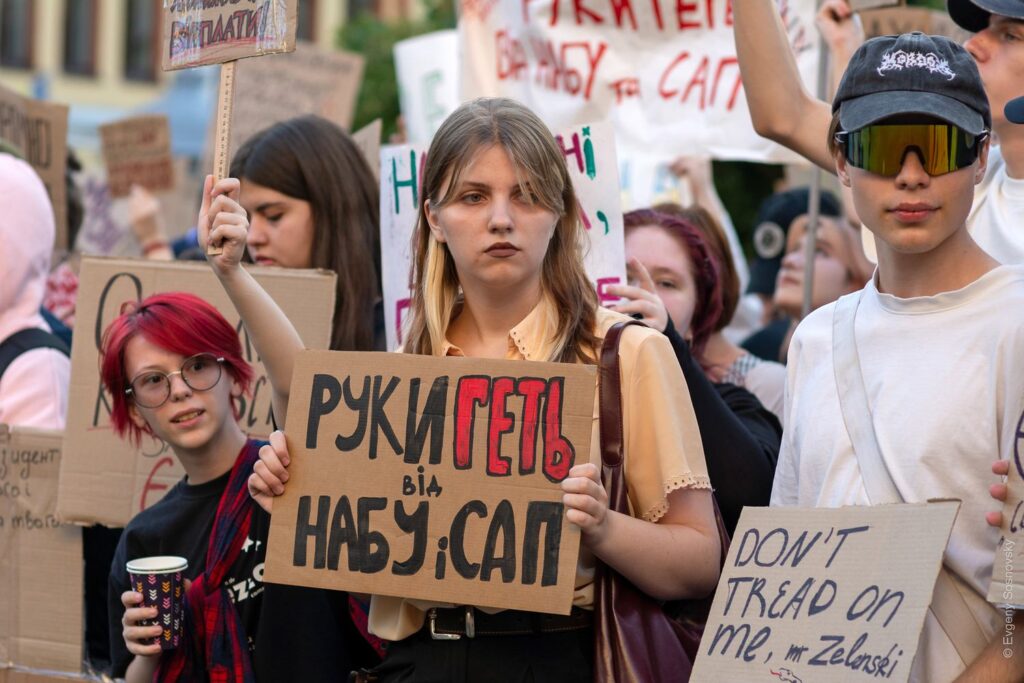
The dismissal drew rare wartime protests in Kyiv and open criticism from Western allies. "It is a pity our country today is significantly further from victory," wrote Serhii Sternenko, a former aide to Fedorov, on the day it was announced. "Real reforms have not even been allowed to begin, although we have still managed to bring about a great deal of change."

That is the cost, and it will be part of Zelenskyy's legacy: he removes the innovators and the reformers, and the potential rivals along with them—while the war is still on, and Ukraine still needs them.

Hans Petter Midttun
Hans Petter Midttun, independent analyst on hybrid warfare, Non-Resident Fellow at the Centre for Defense Strategies, board member of the Ukrainian Institute for Security and Law of the Sea, former Defense Attaché of Norway to Ukraine, and officer (R) of the Norwegian Armed Forces. 

Editor's note. The opinions expressed in our Opinion section belong to their authors. Euromaidan Press' editorial team may or may not share them.

Submit an opinion to Euromaidan Press

  •  
❌