
 Connexion

Ukraine struck Russia’s Kerch bridge again. The EU firms that helped build it barely suffered.
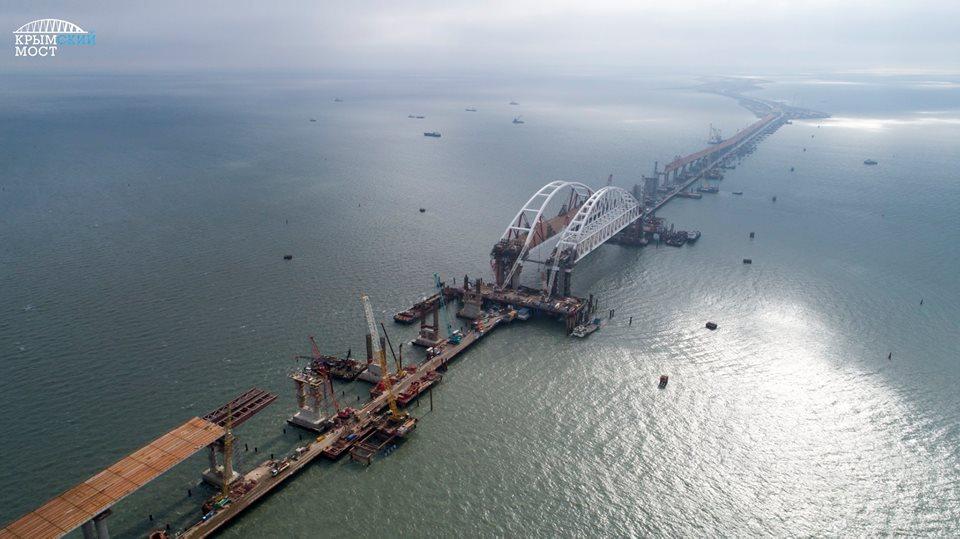
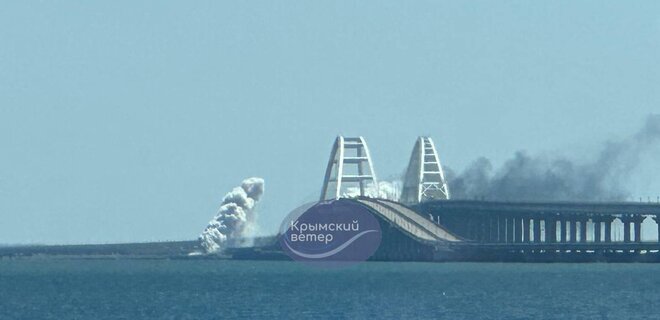
On 17 November, Ukrainians jubilated: Russia's bridge to Crimea had been struck twice in two days. The arch over its shipping channel and a road span collapsed; whether transport can resume is unclear.
The bridge Ukraine is now dismantling should never have stood. The hardest job in building it—driving piles up to 105 m deep through the Kerch Strait's silt—was done in part with European machinery, sold in breach of the EU sanctions written to prevent exactly that; the Dutch prosecutor later said the bridge was built partly thanks to Dutch knowledge and expertise.
And when the Netherlands and Germany finally caught the suppliers, years late, the reckoning was a handful of fines at a fraction of the profit made, some community service, and a single Dutch court conviction—of a company the court did not name.
That lenience may well have set the tone for today's porous sanctions regime, in which Western chips still end up in Russian missiles, reaching Russia through intermediaries—a flow no one has managed to stop.

EU companies helped Russia solidify its grip over Crimea
When Russia annexed it in 2014, Crimea had an umbilical cord through its isthmus, relying on Ukraine for over 80% of its power and water. A ferry offered a precarious connection to Russia's Krasnodar Krai.
Yet Russia gradually secured its grip over the peninsula—with the help of EU companies. Two cases stand out.
One is the Siemens turbines: sold to Russia, they were delivered to Crimea in 2017 in breach of sanctions—without its knowledge, Siemens says—and installed in new power plants in Simferopol and Sevastopol.
The other is the Kerch bridge: opened to road traffic in 2018 and rail in 2019, built with equipment from seven Dutch companies and one German one, according to Dutch and German prosecutors.
It played a key role in the 2022 invasion and was Russia's main supply artery to southern Ukraine until July 2023. Crimea still mattered to Russia's war: before this week's strike, an estimated 30–40% of supplies to Russia's forces in the occupied south came through it, according to Oleksii Yizhak of Ukraine's National Institute for Strategic Studies.

Ukraine targeted the bridge at least five times before this week, from a truck bomb in October 2022 to underwater charges in June 2025, and Russia restored traffic each time. The 16–17 November strikes, all with Ukrainian-made weapons, were the first to bring a span down from the air: Ukraine's Security Service (SBU) says its Palianytsia missile-drones dropped the road span, while Neptune and FP-5 Flamingo missiles hit the rail section.
Europe helped Russia build the bridge. It has taken Ukraine nearly five years and at least six tries to start pulling it down.
How the companies that built the bridge were found out
Russia had dreamt of this bridge for well over a century. Tsarist, Nazi, and Soviet planners all tried to cross the Kerch Strait. The only bridge actually completed, a 4.5 km Soviet railway bridge thrown across in 1944, was too lightly built for the strait: drift ice swept it away in February 1945, after about 150 days. Under the water lies the deeper problem: instead of bedrock, the strait's floor is many meters of silt and sand. To reach solid ground, the new bridge's piles had to be driven as deep as 105 m.
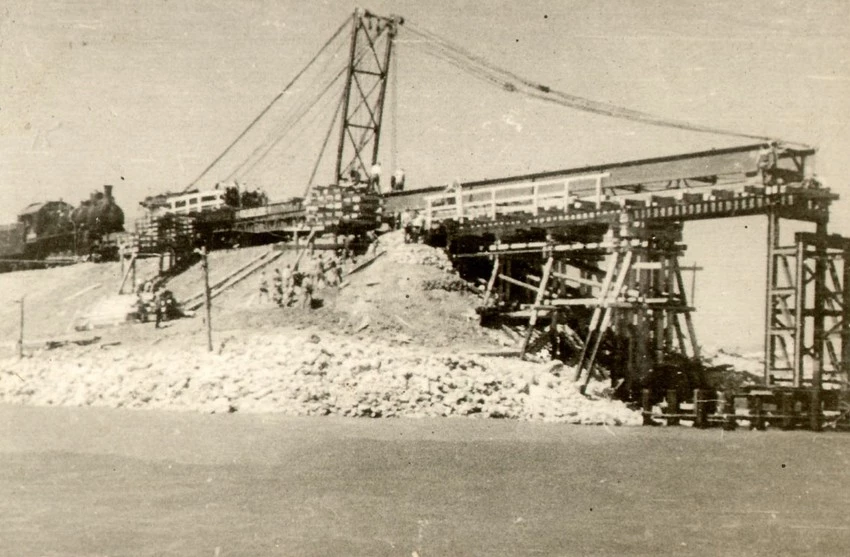
Only after occupying Crimea did Russia build the thing—this time, with the help of the sanctions-breaking Western engineering that drove the pillars past the silt. Dutch companies had the know-how: after all, they had been building on the sea for centuries.
The scheme was meant to stay hidden—Russia insisted only Russian firms had built the bridge. The companies stripped the branding off their equipment to hide whose it was. It surfaced on 1 September 2017, when the Dutch regional daily De Gelderlander revealed that two firms from the Gelderland villages of Dodewaard and Milsbeek had made key equipment for driving the bridge's piles: Dematec Equipment built a special pile-driving hammer, and Bijlard Hydrauliek supplied its key component.
The exposé prompted the Dutch Public Prosecution Service (OM) to open a criminal investigation under the EU's 2014 sanctions, which barred EU firms from helping build Crimea's infrastructure. By May 2018, it covered seven companies.
The OM named only Dieseko, so the other names come from the press and from a 2019 dossier by Ukrainian prosecutors, reported by the Dutch investigative platform Investico:
- Dieseko Group—at least four vibro blocks (~€1.5 mn each, 2015–16) to drive the bridge's piles into the seabed, shipped via Finland. The company also gave on-site technical assistance to the builders.
- CAPE Holland—powerful pile-driving hammers.
- Dematec Equipment B.V.—powerful pile-driving hammers.
- Allpacks International B.V.—a hammer to vibrate the foundation piles.
- Allnamics Pile Testing Experts B.V.—the pile-testing and measurement equipment, plus a training course for the Russian builders, to verify the piles were driven correctly and would hold.
A German company from Schleswig-Holstein supplied a hydraulic hammer—also for the hardest construction work, driving the piles into the silt. A court in Kiel later confiscated €1.3 mn from the company and fined its director. Like every Dutch company except Dieseko, it was never named by the authorities.
Ironically, Germany never sent Ukraine its powerful Taurus missiles, which Ukraine had officially requested in 2023. In a call Russia leaked in 2024, senior Luftwaffe officers discussed how Ukraine could use them to bring down the Kerch bridge. A German firm, meanwhile, had supplied the hammer that helped build it.
A slap on the wrist
The Russian firms that did the actual building shrugged off their own penalty. The EU sanctioned six of them in July 2018: Mostotrest, Stroygazmontazh, Stroygazmontazh Most, VAD, GPSM, and Zaliv Shipyard. Arkady Rotenberg, the Putin ally who owns the first three, brushed it off: "We're all proud of our work and if someone doesn't like it that's not our problem."
By then, the road bridge was already open. The sanctions meant to stop it—the EU's 2014 ban on helping build Crimea's infrastructure—had not.

The European suppliers fared better still. The OM settled with six companies and ten individuals out of court, starting with four companies and eight individuals in October 2023. A seventh company was fined €120,000 by an Amsterdam court in November 2024—the only Dutch conviction in seven years. It is still unnamed. Two more individuals were acquitted.
The figures look serious until you read them.
Dieseko paid €1.78 mn; the German supplier, €1.3 mn. But the bulk of both is confiscation—the state clawing back the profit from the job, which leaves the company no worse off than if it had never taken it. The actual fines, on top, are beneath the pain threshold: €180,000 for Dieseko, €18,000 for the German firm's director, €120,000 for the convicted Dutch company, and €160,000 split among the four fined in 2023. Hand back what you earned, add a fine worth a fraction of it, and the account is closed.
For helping build a bridge that would carry an occupying army, eight people agreed to between 20 and 60 hours of community service in settlements with prosecutors.

Importantly, the companies' reputations did not suffer. The prosecutors named no company apart from Dieseko—every other settlement was anonymized, sparing the firms the single penalty a company actually fears: its name in the press beside the word "sanctions."
It was slow, too: the first Dutch penalties came in 2023, six years after the breach surfaced.
"Six years is a very long time in the Netherlands to be under suspicion," the Dutch sanctions lawyer Heleen over de Linden told Euromaidan Press. "This is the only reason for the very mild convictions."
On the penalties themselves she was blunter: "for Dutch standards, these are very low penalties, basically nothing."
What helping Russia costs
A penalty this small is not a deterrent. It is a price—cheap, deferred, and anonymous.
The Kerch Bridge cases put that price on public record: hand back the profit, years later, with your name kept out of the papers. For a firm weighing a lucrative Russian contract, that is hardly a reason to say no.
In 2017, the suppliers' defense was that they had sold to Russia, not Crimea. "EU sanctions state that we are not allowed to work in Crimea, but we can in Russia," Dematec director Derk Van den Heuvel said. Bijlard Hydrauliek's Marcel Bijlard said he had "just delivered a part to a customer in the Netherlands. No more."
That line did not always hold. In the one Dutch case that reached a verdict, the company's own staff working on site came to suspect they were in Crimea, the court found.
The pattern repeats today. Western microchips and parts keep turning up inside the missiles and drones Russia fires at Ukrainian cities, routed in through Kazakhstan, Armenia, Türkiye, and others.
It is the same maneuver the bridge suppliers, and the shippers of the Siemens turbines now running in Crimea's power stations, used back then: sell to "Russia," not "Crimea"; let an intermediary blur the final destination; say you could not have known. The bridge and Siemens cases were an early test: caught in the open, documented—and toothless.
We do not know if more resolute action on the bridge and the Siemens turbines would have slowed the flow of chips into Russian missiles now. We do know that the sanctions regime failed to stop Western help for Russia's occupation back then, and is failing to stop it for Russia's war now.
Kyiv put the road span in the sea this week; it is the only party that has made the bridge cost Russia anything it noticed. European prosecutors learned of the breach nine years ago and, in the end, publicly named only Dieseko. Until helping Russia costs more than handing back the change, there is no reason on earth for the next company to refuse.

