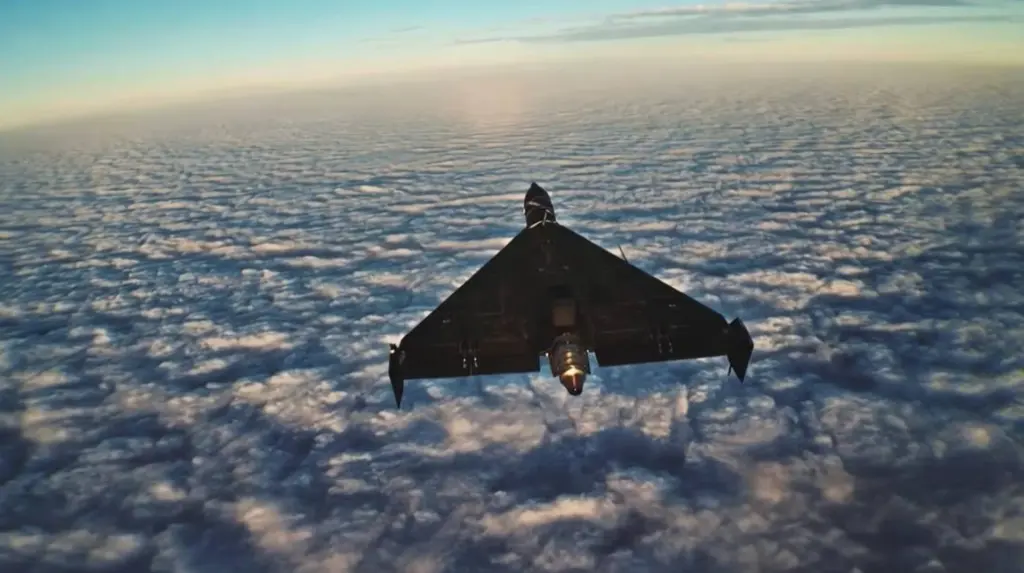
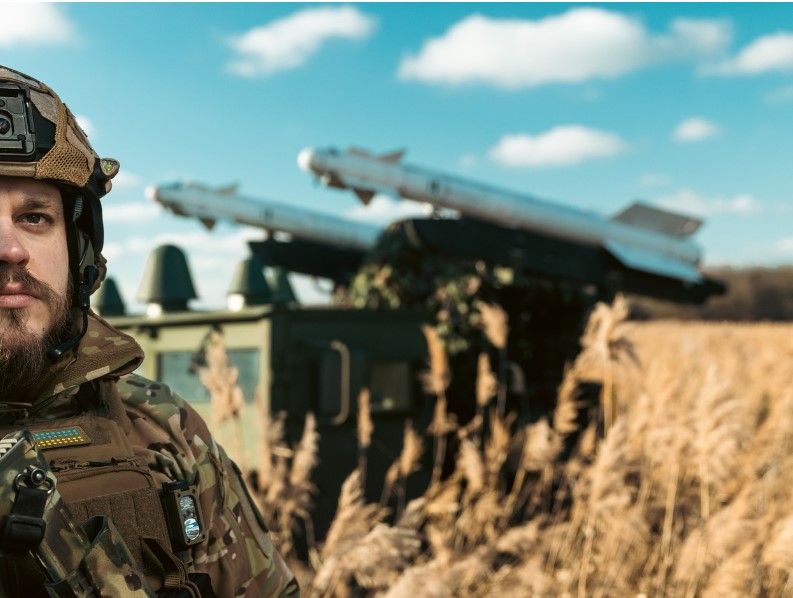
Russia wants to build 14,000 of a new cruise missile next year, enough to fire them at Ukrainian cities by the thousand. The weapon, the Dan-T, is a cheap air-launched jet missile that flies hundreds of kilometers on its own, RBC-Ukraine reported.
The danger is volume, not finesse. Russia aims to produce up to 2,000 Dan-T missiles by the end of this year and scale it drastically, RBC-Ukraine's sources say. Fired in large numbers, it would add a fresh layer to the Gerans and the cruise and ballistic missiles that already saturate Ukraine's skies on the worst nights.
Numbers make the threat
The experts are less worried about any single Dan-T than about the swarm. High speed, long range, and the ability to launch the missiles by the thousand would stretch Ukraine's air defense further with every strike, forcing crews to spend scarce interceptors on yet another cheap target.
The missile flies to its objective autonomously, and Russia claims a special flight profile designed to make it harder for air defense to spot and shoot down.
A target drone becomes a weapon
The Dan-T has an unusual pedigree. It began as the Dan-M, a jet-powered target drone Russia's Sokol bureau built in the early 1990s and imitated US Tomahawk cruise missiles for air-defense practice, now planned to be stripped of its recovery parachute, fitted with a warhead, and fired at Ukrainian cities. Like Russia's other new cruise weapons, it carries no operator link, steering itself by satellite and inertial navigation.
The Banderol joins the list
The Dan-T is not the only new weapon unsettling Ukraine's military. The experts named it alongside the S8000 Banderol, a separate cheap cruise missile that Russia already builds at up to 80 a month and has used in some of its heaviest strikes on Kyiv. The Dan-T closely resembles the Banderol and, being cheaper, may end up replacing it.
Russia is working methodically to modernize its attack drones on every possible front. This month, its drones are expected to carry 20-element anti-jam antennas in place of the 16-element ones, harder for Ukrainian electronic warfare to defeat, Serhii "Flash" Beskrestnov, President Volodymyr Zelenskyy's defense-technology adviser, said.
Russia's knack for scaling and upgrading its weapons is something Ukrainian experts keep flagging. Serhii Bratchuk, spokesperson for the Ukrainian Volunteer Army, recently put it bluntly, "Credit to the Russians. They know how to scale." Meanwhile, military analyst Oleksandr Kovalenko of the Information Resistance group has argued that Russia plans its terror campaigns years out and adapts almost monthly, a foresight Ukraine has struggled to match.
The antenna work is another example, and it will not stop at 20 elements: the main supplier, VNIIR "Progress", plans 24-element arrays in 2027, and Chinese firms are mounting similar efforts, shipping multi-element antennas to Russia disguised as farm equipment.
Autonomous drones need GPS jamming
Not every jet drone that reaches Kyiv is flown by a live operator, Beskrestnov said. A large share runs on ordinary satellite navigation, and a few weeks ago, Russia upgraded the drones' inertial navigation, the backup that holds a course when the satellite signal drops.
The distinction changes how Ukraine fights back. A drone under live control can be stopped by jamming its communication link, the mobile or satellite internet the operator uses, which cuts the operator off. A drone flying on its own has no such link to jam. There, Ukraine has to jam the GPS or GLONASS signals the drone relies on.
Cruise missiles share the weakness
The same logic applies to Russia's newer cruise weapons. The Banderol and the Dan-T, which Russia is betting on, carry no operator link at all, only satellite and inertial navigation, Beskrestnov said.
The Dan-T is a strange case: it began as the Dan-M, a jet-powered target drone that Russia's Sokol bureau built in the early 1990s to mimic US Tomahawk cruise missiles for air-defense practice, now fitted with a warhead and fired at Ukrainian cities.
Because these weapons navigate rather than being flown, Ukrainian electronic warfare is one of the few tools that can throw them off course, even as Russia races to harden the navigation they depend on.
Russia attacked Ukraine from 18:00 on 5 September and through the night into 6 September with 108 strike drones and S8000 Banderol cruise missiles, Ukraine's Air Force reported. The assault ran while US envoys Steve Witkoff and Jared Kushner were finishing three hours of talks with Russian President Vladimir Putin in Moscow. They left the Russian capital after midnight and were expected in Kyiv on 6 September, again carrying a US proposal to end the war. Ukraine's own offer of a four-day pause in the fighting went unmatched by Russia.
Russia has kept up daily air attacks on Ukrainian cities and towns throughout the ongoing war, killing civilians in apartment blocks, hospitals, and shelters. No round of diplomacy or declared truce has interrupted it — Russia's own Easter ceasefire drew thousands of violations within hours.
The attack was still running in the morning
By 09:30 air defenses had downed or suppressed 82 Shahed-type, Gerbera, and other drones, along with six Banderol missiles. The military logged impacts at 11 locations and falling debris at seven more, and warned that Russian drones were still in Ukraine's airspace.
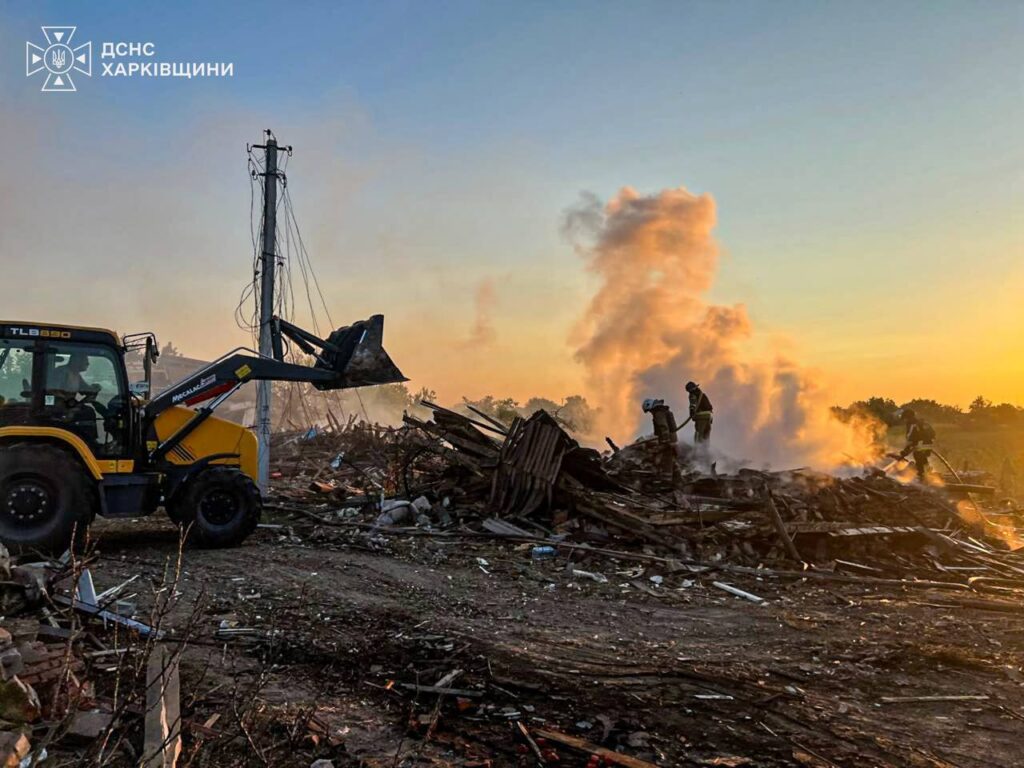
Over the previous day, Russian strikes killed seven people and injured 57 across Kharkiv, Kherson, Zaporizhzhia, Dnipropetrovsk, and Donetsk oblasts, according to oblast administration figures published on the morning of 6 September. Kharkiv Oblast lost four people, three of them one family in Chuhuiv. Zaporizhzhia Oblast reported one death, 25 injured, and 886 strikes on 54 settlements.
A children's playground in the center of Chuhuiv, the morning after a Russian drone hit the town
Russia killed three members of one family in the strike on the evening of 5 September: an 11-year-old boy, his 19-year-old sister, and their 45-year-old father. The children's mother… pic.twitter.com/OHDSJg2Qdj
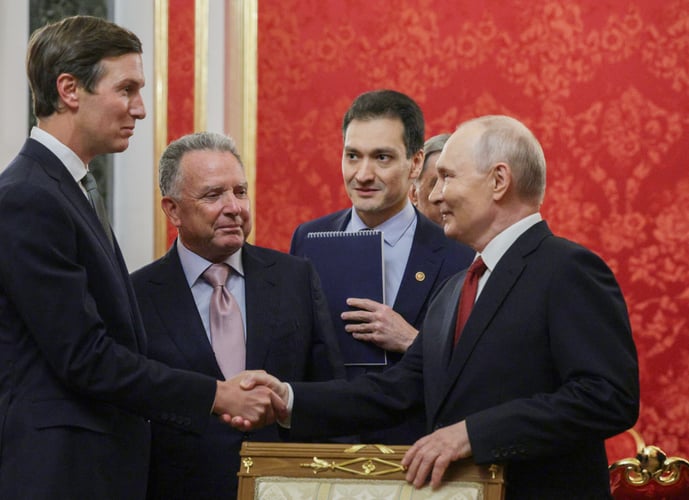
Witkoff and Kushner met Putin on 5 September and left the Kremlin close to midnight. Putin opened by telling them he had "full trust" in the US side, Axios reported, and Washington's goal is to restart direct Russian-Ukrainian talks that stopped six months ago. Putin's aide Yuri Ushakov called the discussion "substantive, constructive, exceptionally candid," ABC News reported, and stated the envoys had promised to carry Putin's own assessments into their meetings in Kyiv. Ushakov also repeated that Russia will achieve its goals and that the war's "root causes" must be removed — the Kremlin's shorthand for barring Ukraine from NATO and cutting down its army.
Jared Kushner shakes hands with Russian President Vladimir Putin, with US special envoy Steve Witkoff beside him, at the Kremlin in Moscow, Russia, 5 September 2026. Photo: Gavriil Grigorov/Sputnik
A White House official told RFE/RL that the sides discussed "concrete plans" for next steps, to be announced in the coming weeks. Kremlin envoy Kirill Dmitriev, who sat in on the talks, called the Moscow trip an important peacemaking visit, Al Jazeera reported. The Kyiv leg would be the envoys' first trip to Ukraine since taking over the US effort; it was set for August and postponed as Russian strikes intensified.
Russia is launching more jet-propelled Geran drones and Banderol missiles
Speeding along as fast as 700 km/hr, these munitions are hard to intercept
Ukraine's fighters are up to the task—but they are reaching for missiles designed in the 1970s
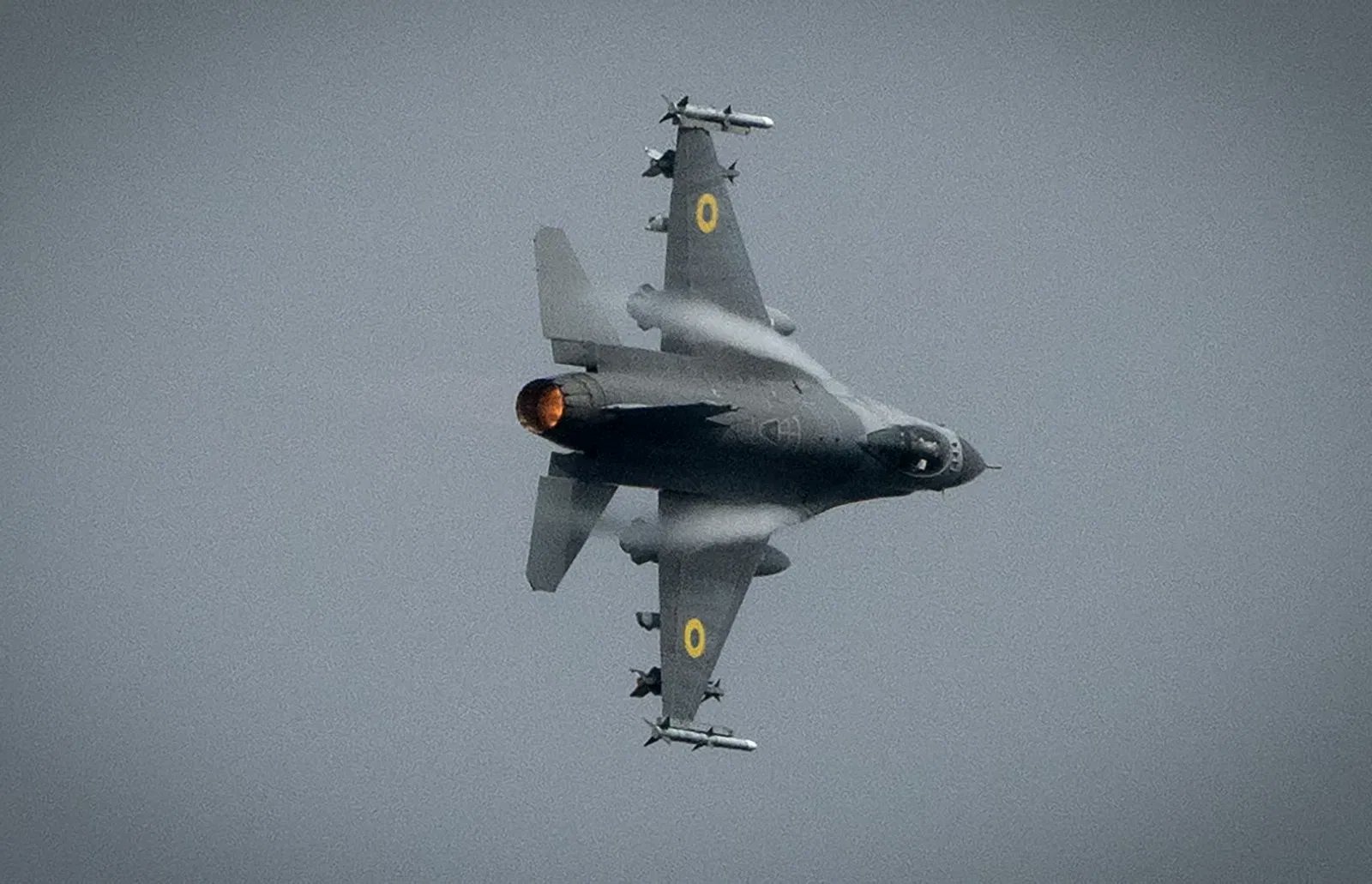
Russia is launching more of its best jet-propelled attack drones and miniature cruise missiles at Ukrainian ports, cities, warehouses, and power plants. The speedy Geran-3, Geran-4, and Geran-5 drones and Banderol missiles can zoom right past Ukraine's ground-based guns and slower interceptor drones, so the Ukrainian air force is deploying more supersonic fighters to chase down the Russian munitions.
But there's a problem. The Ukrainian jets are running short of the missiles that work best against them.
A deepening shortage of infrared-guided AIM-9 missiles and radar-guided AIM-120 missiles for the Ukrainian air force's ex-European Lockheed Martin F-16 fighters has been reported elsewhere. Less well known is what has been happening to the Soviet-era missiles carried by Ukraine's older Mikoyan MiG-29 fighters.
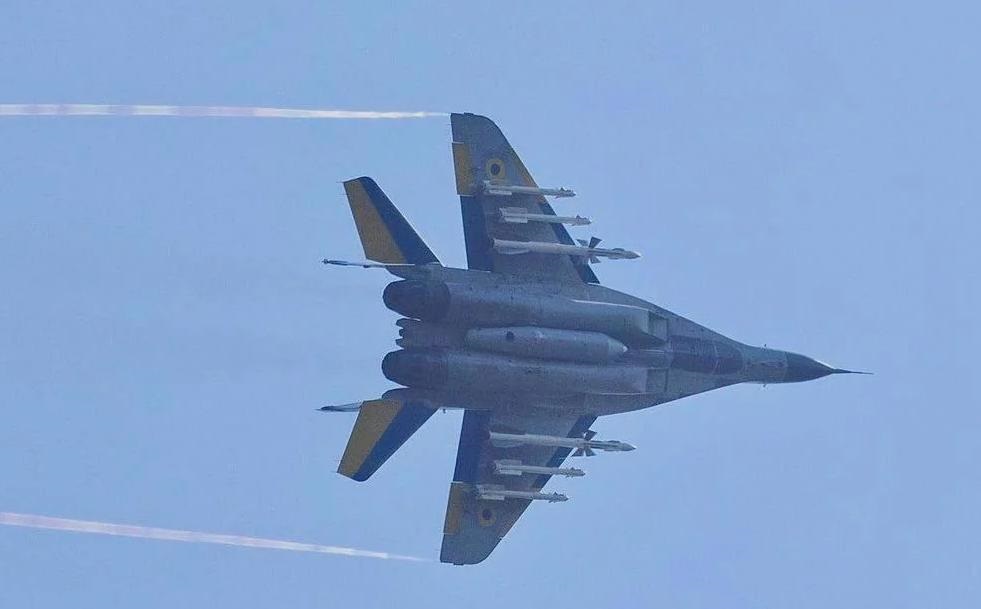
The F-16 is probably the most numerous Ukrainian fighter type, with around 50 in service. But the MiG-29 is a close second. Despite steep losses of MiG-29s in the 55 months since Russia widened its war on Ukraine, Ukrainian aviation brigades may still fly dozens of the classic Soviet-made fighters. MiG-29s are daily sights in the sky over the port of Odesa in southern Ukraine as the twin-engine fighters chase down Russian missiles and drones.
The missile shortage spreading to F-16s really concerns me. Because at the same time out of nowhere we are seeing Ukrainian MiGs flying combat sorties with older R-60 missiles and not R-73s.
Here’s a recent video of an R-60 being used against a banderol cruise missile : pic.twitter.com/UMhtXW2o2p
The MiG-29 can carry the full array of Soviet-style air-to-air missiles in the Ukrainian inventory including the infrared-guided R-60 and R-73 and the radar-guided R-27. But the missile of choice for intercepting the 500 km/hr Gerans and 700 km/hr Banderols is the more modern R-73. The $300,000 heat-seeking missile is maneuverable and accurate at the close ranges that are typical of fighter-on-drone engagements. Its one known weakness is cloud: a Ukrainian pilot said in 2022 that the R-73 tracks poorly through it, which is part of why pilots sometimes fall back on the cannon.
Ukraine went to war in 2022 with substantial stocks of R-73s and surely received additional copies from allies. While Ukrainian industry built some components for the 1980s-vintage missiles, they were and still are assembled in Russia—so the supply is finite. And the rate of expenditure rose sharply as Ukraine pushed the R-73 into roles it was never built for: onto ground-based launchers, after the 9M33 missiles for its Soviet Osa air defense systems ran short, and even onto some of its robotic boats.
Mobile air defense system with R-73 missiles from the 3rd Separate Assault Brigade, March 2025. Photo: Maksym Zaichenko
Down to the 1970s stock
The sign of that pressure is the return of the R-60—a missile designed in the 1970s and considered obsolete when Russia widened the war. Last month an R-60 was visible in the wreckage following the crash of a Ukrainian MiG-29. And this week, video circulated of a MiG-29 downing a Banderol with one at extremely low altitude.
Ukraine's air force had enough R-73s in 2022 that nobody expected to see R-60s again. Continuous interception of Russian cruise missiles and Shahed-type drones changed that, Militarnyi reported. Nor is this improvisation: since November 2025 Ukraine has been running a program to modernize the R-60, replacing analog seeker components with digital ones to sharpen its infrared sensitivity, and adapting it for ground launch. Ihor Fedirko of the Ukrainian Council of Defense Industry called it a temporary way to put otherwise unusable missiles to work.
It's not that the R-60 isn't suitable for downing a Geran or Banderol. It's that it's less suitable than an R-73. "I don't think Ukraine would be using R-60 missiles unless it had nothing else left," one close observer of the Ukrainian air force noted.
Explore further
Ukraine’s F-16s are so short of Western missiles that pilots fall back on jet’s built-in M61A1 Vulcan cannon, which risks killing civilians below
The only other alternative is for a fighter to use its gun. But that's risky, as the pilot must fly dangerously close to a drone or missile before opening fire; the resulting explosion could take out both the interceptee and the interceptor.
In the same way Russia is exhausting Ukraine's long-range surface-to-air missile batteries by firing more ballistic missiles than Ukrainian forces can intercept with their dwindling supply of Patriot missiles, Russia may also be exhausting Ukraine's fighters and their limited stocks of short-range air-to-air missiles.
As the Ukrainian missiles run out, more of the Russian missiles and drones get through—and strike their targets.
I’m not a missile expert but the missile on the left looks like an R-60. Perhaps Ukraine was trying to burn through some old R-60s it had and one malfunctioned. It could also just be An R-27 but I don’t know. The missile on the right looks to be an R-73 pic.twitter.com/yyZ0tSmaf4
The problem is going to get worse before it gets better. Russian industry is ramping up production of both the jet-propelled Geran models and the Banderol, and jet output overtook piston output in August. The Russians launched a reported 1,500 jet Gerans in July and 2,500 in August. Interception rates for the fast drones specifically ran as low as 50% in July, though they may have ticked up to 60% or even 70%.
But that's still too low considering that Ukrainian air defenders usually shoot down 90% of slower propeller-driven Geran-1s and Geran-2s. "Nobody wants interception rates in the 60s/70s," explained Michael Bohnert, an analyst for the RAND think tank in California.
New models of faster interceptor drones, which several Ukrainian manufacturers are scrambling to deliver to front-line forces, may help restore the 90% kill rate for even the fastest Gerans. But "jet-interceptor output has been behind jet-drone output," Bohnert noted. So it's likely that, for a few months at least, the Russians will have the numerical edge, and the Ukrainians will have no choice but to continue sortieing F-16s and MiG-29s to reinforce ground-launched air defenses.
But what happens when the fighters run out of even their oldest missiles?

 Connexion