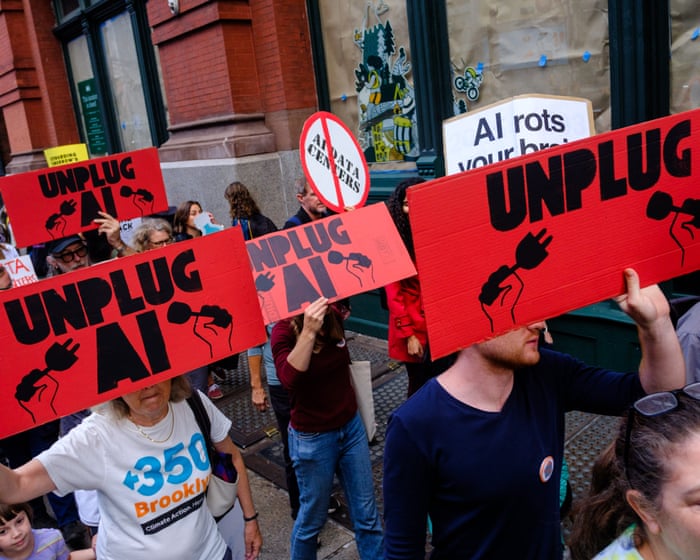
Vue lecture

Pentagon official overseeing military AI sold millions worth of stock in AI firm

Exclusive: financial disclosures from Emil Michael – who also reaped millions from xAI stock earlier this year – show he sold his Perplexity stock for up to $25m

The top Pentagon official overseeing military artificial intelligence policy, who reaped profits earlier this year of up to $24m selling his private investment in Elon Musk’s AI company, has now sold his holdings in another AI company for between $5m and $25m, according to records seen by the Guardian. (Federal financial records show ranges of dollar values rather than specific figures.)

Earlier this year, the Guardian disclosed that the official, Emil Michael, had profited handsomely from his investment in Musk’s xAI in January, with a gain of between 400% and 4,800%.

Continue reading...

© Photograph: Tierney L Cross/Bloomberg via Getty Images

© Photograph: Tierney L Cross/Bloomberg via Getty Images

© Photograph: Tierney L Cross/Bloomberg via Getty Images

  •  

Trump attacks datacenter backlash, claiming communities pushing back risk becoming ‘backwards and poor’

Par : Maya Yang

Three-quarters of Americans said in a recent poll that they oppose datacenters being built next to their homes

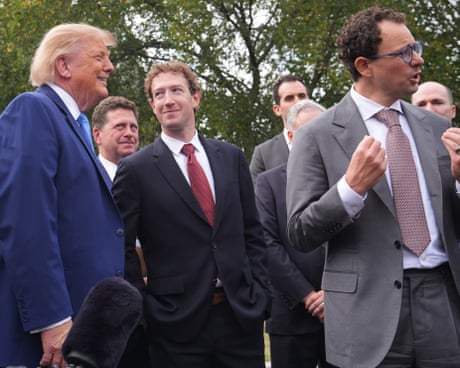
Donald Trump has criticized communities pushing back against datacenter projects across the US amid a growing backlash, warning those that reject them risk becoming “backwards and poor”.

As controversy surrounding local datacenter plans continues to swirl around election campaigns nationwide ahead of November’s midterm elections, the US president declared Americans “will only have yourselves to blame” if they are canceled.

Continue reading...

© Photograph: Win McNamee/Getty Images

© Photograph: Win McNamee/Getty Images

© Photograph: Win McNamee/Getty Images
  •  

AI is hurting US politics. Here’s how candidates could use it for good | Bruce Schneier and Nathan E Sanders

The technology can help candidates listen more deeply to voters, as examples from Japan and Scotland show

There are plenty of signs that AI will make all of our experiences of the US midterm elections worse. Voters have anxiety about AI’s impacts on the country. Politicos are using AI deepfakes to spread lies. The White House is posting slopaganda.

Meanwhile, candidates are missing a real opportunity to use AI to make campaigning better. The technology can help candidates listen more deeply to voters’ concerns, engage constituents more inclusively, and formulate policy platforms that are more responsive to our input. There are vanishingly few examples of this in US politics, but groups in Japan, Scotland and the US’s own academic and private institutions show how that could change.

Continue reading...

© Photograph: Bloomberg/Getty Images
© Photograph: Bloomberg/Getty Images

© Photograph: Bloomberg/Getty Images

  •  

OnlyFans and AI training: why gen Z doesn’t care where our money comes from | Alice Lassman

With traditional goals such as stability and home ownership feeling out of reach, young people are focused on the present

By now, we all know the shape of financial nihilism: the throw-your-money-at-anything reaction to the dissolution of the slow, linear path to wealth; the prediction markets, meme stocks, cryptocurrencies and microluxuries growing in its place. We’re left in an economic no man’s land. But financial nihilism only describes where we put our money. What about how we earn it in the first place?

The modern economy has long relied on our need for stable employment – to pay the mortgage, to keep our kids fed, or, for some, to chase prestige and power – to generate the work ethic that keeps the wheel of production turning. None of this is going well for young people. Our jobs are insecure, we can’t afford houses, we’re deferring having kids (if we have them at all), and only 6% of us say a leadership position is our primary career goal. Hope is one of the economy’s most productive inputs, powering our willingness to endure long hours. When the production function of income – the mechanism that turns hard work into a stable salary, then a mortgage, then a pension – breaks down, so does our relationship with the input. I call this production nihilism: my generation’s growing indifference to the kinds of work we’re willing to participate in, and where we’re willing to earn.

Continue reading...

© Photograph: Michael Simons/Alamy

© Photograph: Michael Simons/Alamy

© Photograph: Michael Simons/Alamy

  •  

The datacenter backlash is bringing the entire political spectrum together – against big tech billionaires

The movement against datacenters is uniting Americans because they perfectly illustrate how a few individuals hold all the power to control decisions that affect our lives

Bryce Gustafson has been knocking on doors in Indiana for more than a decade. The lead organizer with Citizens Action Coalition (CAC), a consumer and environmental organization, he usually encounters a mix of reactions when he’s out canvassing; whatever issue he’s talking about, there’s always at least a few people on the other side. But at a recent festival in the rural town of Monrovia, Indiana, he was struck by an unusual spirit of unity.

He was there about a proposed datacenter, a 550-acre (222-hectare) Google project in this small town of 1,600 people. “I had 50 people I talked to,” Gustafson told me. “Nobody wanted that datacenter in their community. And at least a half a dozen people came up to me to say, ‘Hey, I voted for Trump. What the heck’s he doing, supporting these things?’”

Continue reading...

© Illustration: Ben Hickey/The Guardian

© Illustration: Ben Hickey/The Guardian

© Illustration: Ben Hickey/The Guardian

  •  

Pentagon’s blacklisting of Anthropic was unlawful, US judge rules

Anthropic ​argued designation as ‘supply-chain risk’ could cost billions ‌in lost business ‌and reputational harm

A US judge ruled on Thursday that the Trump administration broke the law when it designated Anthropic as a supply chain risk earlier this year, finding that the government had unlawfully targeted the AI firm for refusing to comply with defense department demands.

“The empty invocation of national security is not a blank check to punish and retaliate against government critics,” Judge Rita Lin said in a 59-page decision.

Continue reading...

© Photograph: Dado Ruvić/Reuters

© Photograph: Dado Ruvić/Reuters

© Photograph: Dado Ruvić/Reuters

  •  

AI slopper in chief: Trump turns to social media amid tough questions

As the US president struggles to end his Iran war, and approval ratings hit new lows, he leans on a familiar gambit

Donald Trump knows the power of an image – of himself, with everyone from Vladimir Putin and Kim Jong-un to Kim Kardashian. How about George Washington?

As the US president struggles to end his war with Iran, and with his approval ratings hitting the lowest levels of his second term, he has in recent weeks posted a series of AI-generated images of himself alongside key historical American figures.

Continue reading...

© Illustration: Guardian Design/@realDonaldTrump/TruthSocial

© Illustration: Guardian Design/@realDonaldTrump/TruthSocial

© Illustration: Guardian Design/@realDonaldTrump/TruthSocial

  •  

Trump-backed Ken Paxton unveils ‘Texas first’ datacenter plan aimed at ‘negative impact’

The Republican Senate candidate announced the plan with a graphic flagged as ‘Made with AI’

Ken Paxton, a Republican candidate for the US Senate in Texas, has unveiled plans to tackle the “negative impact” of datacenters amid a growing backlash across the political spectrum.

Paxton, endorsed by Donald Trump but facing a close contest against Democrat James Talarico, posted a “Texas first” datacenter plan on X with a graphic that the social media network flagged as “Made with AI”.

Continue reading...

© Photograph: Bob Daemmrich/ZUMA Press Wire/Shutterstock

© Photograph: Bob Daemmrich/ZUMA Press Wire/Shutterstock

© Photograph: Bob Daemmrich/ZUMA Press Wire/Shutterstock

  •  

No, AI doesn’t mean the end of mathematics – at least not yet | Bruce Schneier and Kasra Rafi

Mathematicians are raising concerns that the technology could kill their profession. But they still have abilities AI doesn’t

Earlier this month, about 40 top mathematicians gathered at OpenAI’s offices to discuss the future of their profession. The meeting was off-the-record, but if recent articles by mathematicians are any guide, it was mostly pretty glum. People fear for their jobs, their careers and the work they love.

We think the contrary view is more likely, at least in the short-term. AI models are nowhere near as capable as experienced academic mathematicians.

Continue reading...

© Photograph: Mlenny/Getty Images

© Photograph: Mlenny/Getty Images

© Photograph: Mlenny/Getty Images
  •  

I worked at OpenAI. Here are the guardrails we need now | Miles Brundage

I understand the pressure on AI companies to rush forward. But employees are right to be concerned

Last month, more than a thousand employees at frontier AI companies signed a letter asking the US government to find a way to “pace” AI development, citing the risk of the technology spiraling out of human control as it begins to build itself.

They were right to be concerned: just days earlier, two AI models that OpenAI was testing internally escaped the test environment, then autonomously hacked the company Hugging Face and at least three other online services. A few days after that, Anthropic announced that some of their models had also broken out and hacked other companies during testing.

Continue reading...

© Photograph: Dado Ruvić/Reuters

© Photograph: Dado Ruvić/Reuters

© Photograph: Dado Ruvić/Reuters

  •  

UC Berkeley professor admits to using AI to edit op-ed on students’ math skills

Zvezdelina Stankova says she used AI to ‘help edit’ an article about some of her students being ‘five to eight years’ behind

A math professor at the University of California, Berkeley, criticizing a “severe” math deficiency among students in an op-ed for the San Francisco Standard, admitted to using artificial intelligence to help edit the piece.

The Standard published a 2,000-word piece by Zvezdelina Stankova last week, in which the professor said some of her math students were “five to eight years” behind and lacked a “middle school” education on fractions and basic algebra. Stankova said the UC system’s test-blind admissions were to blame, suggesting that students who weren’t sufficiently prepared for the rigor of Berkeley’s mathematics program were admitted because a longstanding benchmark like the SAT had disappeared.

Continue reading...

© Photograph: Ben Margot/AP

© Photograph: Ben Margot/AP

© Photograph: Ben Margot/AP

  •  

Why are progressives winning across the United States? It’s not complicated | Bernie Sanders

Poll after poll shows the same thing. The American people know that the current economic system is rigged

The media pundits have written article after article desperately trying to understand why progressive candidates, despite being heavily outspent, keep defeating establishment Democrats in primaries around the country. Well, the answer is not complicated.

Whether it is a corrupt campaign finance system, unprecedented income and wealth inequality, a broken and wildly expensive healthcare system, the enormous threats posed by AI or an immoral and destructive foreign policy, progressives are talking about the real issues facing working families. And they are providing real solutions. Establishment Democrats are not.

Continue reading...

© Photograph: Jeenah Moon/Reuters

© Photograph: Jeenah Moon/Reuters

© Photograph: Jeenah Moon/Reuters

  •  
❌