Russia keeps upgrading its jet-powered drones, and Ukraine's electronic warfare is racing to keep up. Kyiv has set extra tasks for its military and manufacturers to scale up the most effective electronic warfare approaches, President Volodymyr Zelenskyy said after a meeting of the Supreme Commander-in-Chief's Staff on electronic warfare and infrastructure protection.
Russia keeps modifying its jet-powered Shaheds to beat each new Ukrainian defense, and Ukraine's answers have to keep pac
Russia keeps upgrading its jet-powered drones, and Ukraine's electronic warfare is racing to keep up. Kyiv has set extra tasks for its military and manufacturers to scale up the most effective electronic warfare approaches, President Volodymyr Zelenskyy said after a meeting of the Supreme Commander-in-Chief's Staff on electronic warfare and infrastructure protection.
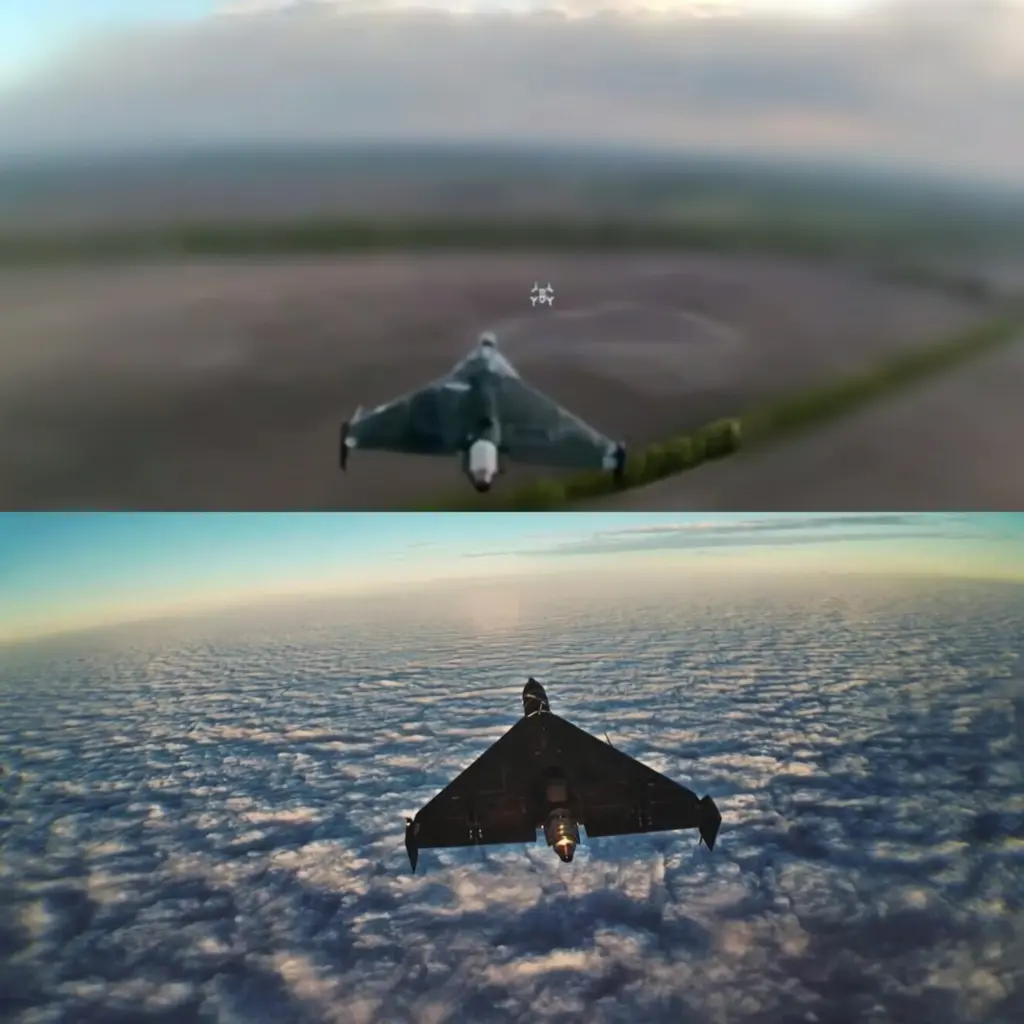
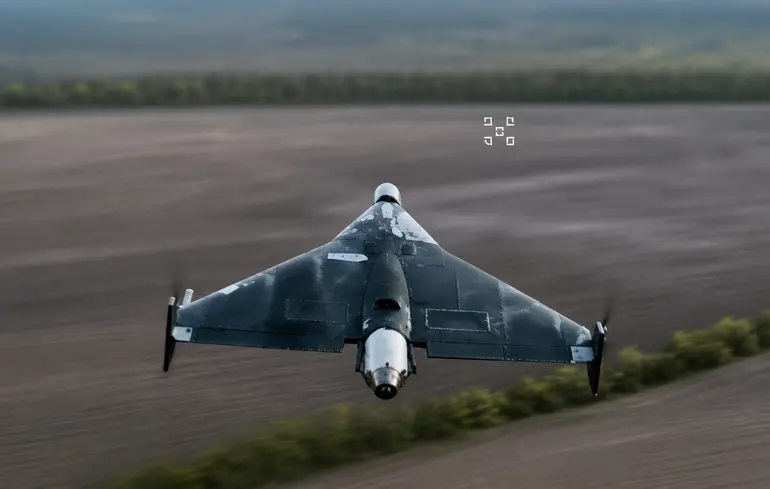
Russia keeps modifying its jet-powered Shaheds to beat each new Ukrainian defense, and Ukraine's answers have to keep pace. The race is tight: from 1 to 26 September, air defenses downed only 55 percent of the 2,730 new jet-powered drones, against 90% of the slower ones.
Hidden relays blunt Kyiv's jammers
Jamming has to improve because Russia keeps finding new ways around it. On 3 October, presidential adviser Serhii "Flash" Beskrestnov said someone had installed Russian MESH radio repeaters in Kyiv, a short control channel that guides Shahed drones onto their targets. As long as they are there, he said, closing the city with electronic warfare will not be effective.
"As long as online control of drones exists, not only the bridges but the air defense assets will be under threat," Flash stressed.
Sanctions aim at the supply chain
Beyond the jamming task, the Staff turned to where Russia gets the parts for those drones. Defense Intelligence reported on Russia's technological priorities for this year and next, and on supplies of critical components and equipment for its weapons production, Zelenskyy said.
New sanctions packages will follow, with Defense Intelligence due to send proposals to the Ukrainian government and the National Security and Defense Council, and Ukraine is working to align its sanctions with partners' jurisdictions.
The Staff also set the main tasks for supplying Ukrainian forces with long-range drones next year.
"The main criterion is that we must be able to respond in kind to Russian strikes," Zelenskyy emphasized.
Those parts, and the drones built from them, keep changing
In August, Intelligence Deputy Chief Vadym Skibitskyi said Russia remained fully dependent on Chinese turbojets for the Geran-4 and Geran-5, each costing about $35,000 to $40,000.
However, two months later, Ukraine reported the Geran-4 had received a locally built engine and a new optical navigation system. Kyiv has to stay attuned to changes to keep pace with the technology race, and so far, it is still trying to catch up rather than get ahead.
Germany is expanding drone detection at its airports with a new system operated by German air traffic control provider Deutsche Flugsicherung (DFS), the German Federal Ministry for Transport (BMV) announced on 5 October.
Germany has accused Russia of attempting a hybrid attack at Germany’s Leipzig/Halle Airport near a Ukrainian An-124 aircraft using a drone carrying explosives. Earlier, Finnish President Alexander Stubb said Europe must be prepared for “continued hybrid and sabotage att
Germany is expanding drone detection at its airports with a new system operated by German air traffic control provider Deutsche Flugsicherung (DFS), the German Federal Ministry for Transport (BMV) announced on 5 October.
Germany has accused Russia of attempting a hybrid attack at Germany’s Leipzig/Halle Airport near a Ukrainian An-124 aircraft using a drone carrying explosives. Earlier, Finnish President Alexander Stubb said Europe must be prepared for “continued hybrid and sabotage attacks” by Russia, adding that Russia seeks to sow panic through such actions.
On Monday, two more sites were added—Stuttgart and Hamburg. As of Monday, seven of Germany’s eight largest airports were equipped with the new drone detection system in their approach and departure areas.
Germany seeks responses to new hybrid threats
The Federal Ministry cited the reason for the new measure: drones near airports can affect air traffic very quickly.
Federal Transport Minister Steffen Bilger and Baden-Württemberg Transport Minister Nicole Razavi were briefed on the new system at Stuttgart Airport, where it is being put into operation, the ministry said. The system creates “an important technical basis for detecting potential threats at an early stage and quickly informing the competent authorities,” Bilger said.
“With today’s commissioning of the drone detection system at Stuttgart Airport, the federal government is fulfilling a key promise: it is not only talking about the dangers posed by unmanned aircraft, but is also following through with very concrete action. Protecting critical infrastructure and ensuring the safety of passengers at Stuttgart Airport require continuous adaptation to a changing security situation,” Razavi said, according to the ministry.
The new DFS system allows drones near airports to be detected at an early stage and information about possible threats to air traffic to be passed more quickly to the relevant authorities. This helps them assess risks and respond to them more quickly, the statement said.
DFS is responsible for detecting drones in approach and departure areas, while the Federal Police and other security services are responsible for preventing threats and defending against drones. The BMV, Federal Ministry of the Interior, DFS, Federal Police and airports coordinate their work to exchange information quickly and maintain a shared picture of the situation.
No further details about how the system operates have been disclosed.
The first stage of the expansion at Germany’s eight major commercial airports will be fully implemented this week, with the systems in Stuttgart and Hamburg being put into operation, the statement said.
Explore further
A drone came down beside a Bundeswehr air base, weeks after Berlin blamed Moscow for the Leipzig airport attack
The system will also be installed at the airport where a bomb-laden drone was found
The system will also be put into operation at Leipzig/Halle Airport this week, meaning that the first stage will be fully implemented at all eight of Germany’s largest commercial airports, according to the press release.
A quadcopter drone carrying a Semtex explosive flew directly toward a parked Ukrainian An-124 Ruslan cargo aircraft and struck its wing at Leipzig/Halle Airport in Germany on the evening of 4 August, Die Zeit reported on 10 August. The drone hit the aircraft at around 19:30 local time, bounced off the wing, and fell to the ground without detonating, according to the media outlet.
Ukrainian An-124 at Leipzig/Halle Airport in Germany, 5 August 2026. Photo: screenshot from Bild video
Germany has accused Russia of attempting the drone attack and announced further sanctions against Russian citizens and institutions, Tagesschau reported on 1 September.
At the crime scene, investigators found the drone configuration, explosives and detonation technology that had already appeared in other Russian hybrid operations and in Russia’s war against Ukraine, Federal Interior Minister Alexander Dobrindt said during a joint press conference with Federal Foreign Minister Johann Wadephul, the media outlet reported.
The German government assumes that Germany has been and will be a target of further such Russian attacks. Germany is not at war with Russia but is a “target of war,” Foreign Minister Wadephul said, according to the outlet.
Russian troops were taking selfies beside a jet-powered Shahed launcher when a Ukrainian drone hit them. A Ukrainian drone attacked a pickup truck converted to launch Russian Shahed drones in the Donetsk airport area while its crew prepared to fire a jet-powered Geran-4, according to video from the Cursed Empire drone unit of the 100th Separate Mechanized Brigade that volunteer Serhii Sternenko published on 6 October.
Three Russian soldiers struck a pose by their drone launcher near Do
Russian troops were taking selfies beside a jet-powered Shahed launcher when a Ukrainian drone hit them. A Ukrainian drone attacked a pickup truck converted to launch Russian Shahed drones in the Donetsk airport area while its crew prepared to fire a jet-powered Geran-4, according to video from the Cursed Empire drone unit of the 100th Separate Mechanized Brigade that volunteer Serhii Sternenko published on 6 October.
Three Russian soldiers struck a pose by their drone launcher near Donetsk airport
It was their last selfie. Ukrainian drones hit the crew moments later as they prepared to fire a jet-powered Geran-4 Serhii Sternenko pic.twitter.com/ri9bNztW5y
Russia launches Shahed drones, including jet-powered ones, from pickup trucks and fixed launchers, and the ruined Donetsk airport, about 50 kilometers from the front line, is one of its drone bases. In September, Oboronka outlet counted that in general, Russia has at least 63 launchers at its drone bases, which are built to survive strikes.
The video shows three carefree Russian soldiers next to a pickup fitted with a launch frame.
"That was their last photo shoot," Sternenko noted, commenting on the hit on the soldiers.
The primary target
Earlier, an officer of the 1st Separate Center of the Unmanned Systems Forces, call sign “Falco,” explained that the primary goal of strikes on drone bases is to disrupt Russia's ability to launch drones.
This is done by destroying launchers and storage facilities, as well as creating an aerial threat over the drone base. Such attacks can delay drone launches indefinitely, while the destruction of infrastructure can reduce the overall number of drones launched.
But the "jewel" of anti-drone port operations is the military staff
Although these facilities are important targets, the Unmanned Systems Forces have another priority: drone operators.
“The most difficult and, at the same time, the most valuable target is the operator. They don’t stay near the launchers for long,” Falco said.
By taking out drone operators, Ukraine inflicts losses on a scarce resource. There are already relatively few of them, and Russia will have to spend additional money and time training new crews.
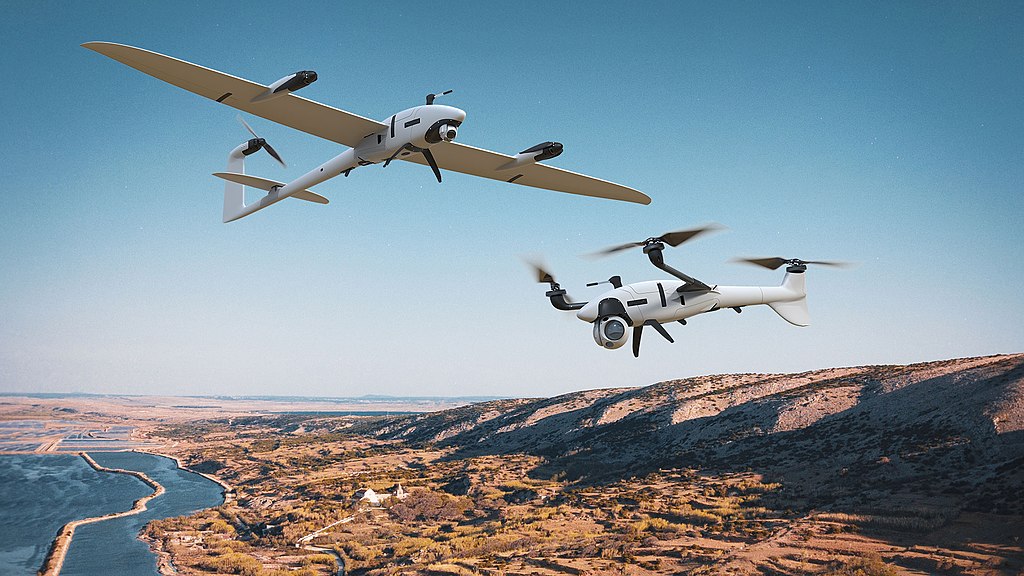
National Guard commander Major General Oleksandr Pivnenko signed a follow-on contract with Quantum Frontline Industries managing director Matthias Lehna and Frontline Robotics chief technology officer and co-founder Pavlo Kosolapkin to build two Ukrainian drones in Germany, Quantum Systems said on 5 October. The deal covers the Linza strike drone and the Zoom reconnaissance drone, exceeds the volume of the 2026 agreement, and schedules delivery for 2027.
The order scales up a line that
National Guard commander Major General Oleksandr Pivnenko signed a follow-on contract with Quantum Frontline Industries managing director Matthias Lehna and Frontline Robotics chief technology officer and co-founder Pavlo Kosolapkin to build two Ukrainian drones in Germany, Quantum Systems said on 5 October. The deal covers the Linza strike drone and the Zoom reconnaissance drone, exceeds the volume of the 2026 agreement, and schedules delivery for 2027.
The order scales up a line that is already running. Quantum Frontline Industries' first production year remains on track for completion in 2026, it has already delivered its first drones to Ukraine's Defense Forces, and it is now preparing to increase production capacity fivefold for next year, Quantum Systems said.
German plants, Ukrainian designs
Quantum Frontline Industries is a German-Ukrainian joint venture of Frontline Robotics and Quantum Systems. Both the Linza and the Zoom come from Frontline Robotics, and the systems are manufactured in Germany for Ukraine.
Explore further
German defense firm has made Ukraine its second-largest international base
Linza 3.0 carries up to 4 kg of payload out to 15 km and stays aloft up to 60 minutes, and it is already in service with more than 60 Ukrainian units, Frontline Robotics has said. Zoom 3.0 detects targets, fixes their coordinates, and corrects fire under active Russian jamming, the company told Militarnyi. It loiters for up to an hour and works at a tactical radius of up to 20 km. AI-driven navigation and autonomous operation over the target keep its data flowing even when standard radio links break down.
From ramp-up to serial production
Quantum Frontline Industries said the contract moves it from initial production ramp-up toward sustained, high-volume manufacturing. Kosolapkin told Militarnyi the firm keeps refining Linza and Zoom on feedback from Ukrainian troops, whose needs drive how the systems evolve, and that producing in Germany gives it extra capacity to scale Ukraine-proven designs and deliver them in larger volumes.
The Netherlands will help Ukraine with maintenance, spare parts, and ammunition for F-16 fighter jets, Dutch Prime Minister Rob Jetten promised in a statement on 5 October. He made this and other statements following a phone call with Ukrainian President Volodymyr Zelenskyy.
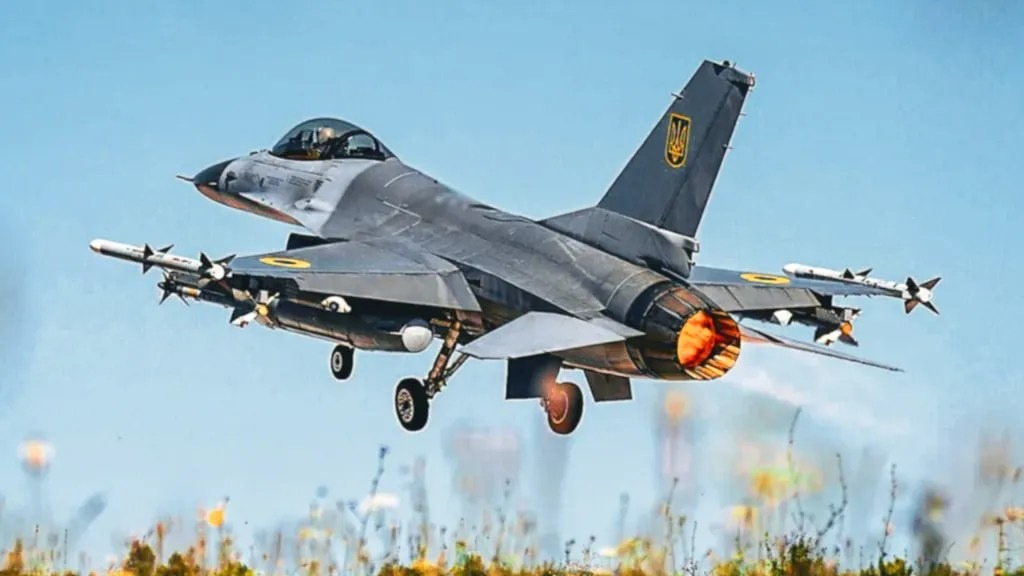
Russia attacks Ukrainian cities with drones every day, increasingly with jet-powered ones. F-16 fighter jets are one of the effective options for shooting down these UAVs, but Ukraine has far too few of them. The F-
The Netherlands will help Ukraine with maintenance, spare parts, and ammunition for F-16 fighter jets, Dutch Prime Minister Rob Jetten promised in a statement on 5 October. He made this and other statements following a phone call with Ukrainian President Volodymyr Zelenskyy.
Russia attacks Ukrainian cities with drones every day, increasingly with jet-powered ones. F-16 fighter jets are one of the effective options for shooting down these UAVs, but Ukraine has far too few of them. The F-16s are used very frequently and therefore require maintenance. About half of the aircraft spend extended periods abroad undergoing repairs and maintenance, Ukrainian President Volodymyr Zelenskyy told the Financial Times this month. The process of returning the aircraft has taken too long, and Ukraine has lost time when the jets were most needed to protect Ukrainian airspace, he said.
“A further strengthening of Ukraine’s air defense is literally vital,” the prime minister said.
Russia’s aggression continues to escalate, and F-16 fighter jets can help stop it
Russia is deliberately attacking civilian facilities and energy infrastructure and wants to make Ukrainian cities uninhabitable, Jetten said, adding that “we must not allow this to happen.”
One effective solution is the use of F-16 fighter jets, while Ukraine faces shortages of both these aircraft and the missiles for them.
Ukrainian F-16 pilots lack air-to-air missiles and take off with only the aircraft’s cannon during some daytime missions, the War Zone reported on 2 September. The M61A1 Vulcan 20mm rotary cannon can pose a danger to civilians on the ground, the outlet noted.
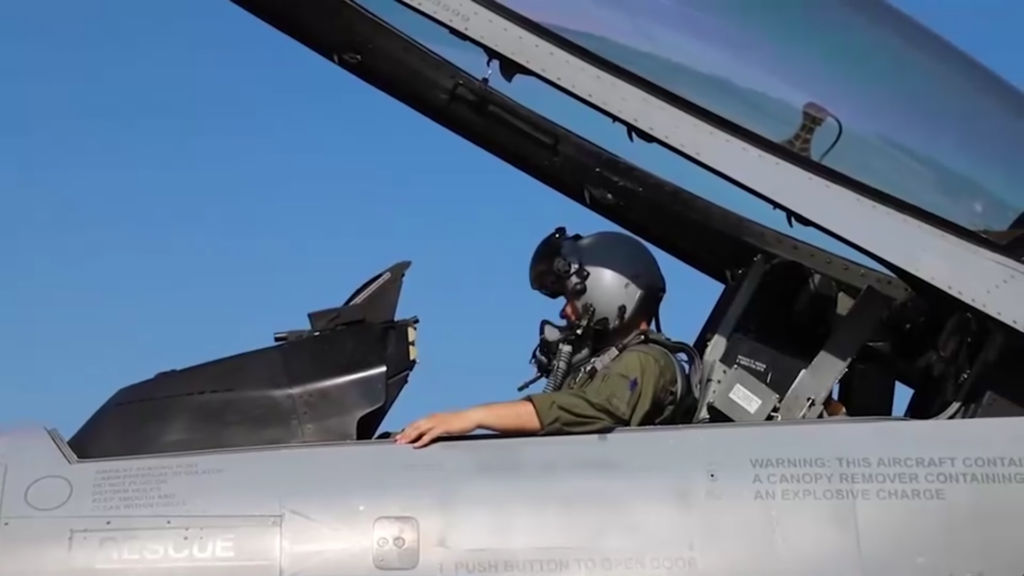
A pilot in an F-16 fighter in Ukraine. Screenshot from the video of President Volodymyr Zelenskyy's speech on Ukraine's Air Force Day
Poland promised to provide Ukraine with F-16 missiles back in September, and several partners, including Poland, have already begun the process of transferring ammunition this month. Other partners include Spain and Belgium, which Foreign Minister Andrii Sybiha mentioned during a meeting with journalists, Hromadske reported on 1 October.
Ukraine critically needs this ammunition, especially as Russia prepares new strikes, Sybiha said.
“Against the backdrop of the fact that we have not yet built up the capability to repel jet-powered drones, against the backdrop of preparations for new strikes, it was critically important to help our military shoot down these drones. The most effective right now—apart from air defense systems, which are very expensive to use constantly against drones—are F-16 fighter jets,” the minister said.
Zelenskyy held talks with the president of France and the prime ministers of Poland and the Netherlands about means of protecting against Russian strikes, he said in his address on 5 October. In particular, he thanked the Dutch prime minister for his prompt response.
Whether Belgian maintenance delays are the reason for the low number of operational F-16s in Ukraine remains disputed
Fewer than 50% of the F-16s delivered to Ukraine may be operational, Defense Express reports, citing a Wall Street Journal (WSJ) editorial published on 29 September.
The Belgian company that services F-16s for Ukraine takes as long as 40 weeks to complete the work, retired US Navy Rear Admiral Mark Montgomery told the WSJ.
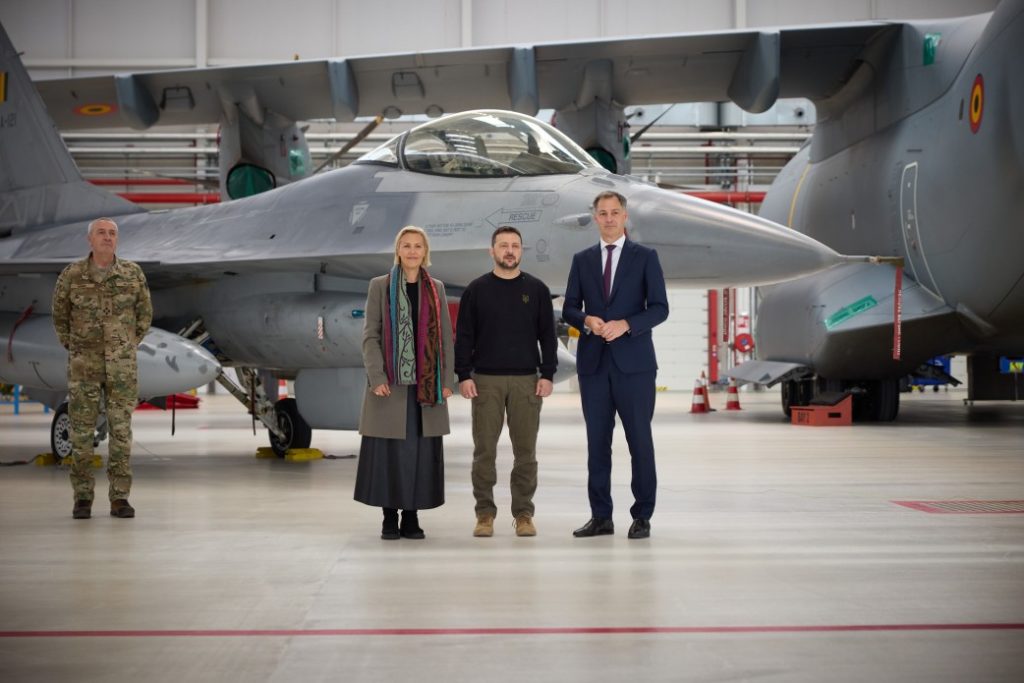
Belgian Defense Minister Ludivine Dedonder, Ukrainian President Volodymyr Zelenskyy, and Belgian Prime Minister Alexander De Croo visiting the Melsbroek Air Base, where Ukrainian personnel have been undergoing F-16 training, 28 May 2024. Photo: president.gov.ua
That day, Zelenskyy had already announced that Belgium would send three of its fighter jets to Ukraine this year. Ukraine will receive them under an accelerated procedure, he said.
Meanwhile, Ukraine’s Ministry of Foreign Affairs refutes claims that Ukrainian fighter jets have a catastrophically low operational availability rate and excessively long maintenance times.
“Contrary to these claims, our industrial sustainment partners are not only continuing to deliver overhauled aircraft, but are doing so at an increasing pace. Turnaround times are decreasing, not increasing,” Ukrainian Foreign Ministry spokesperson Heorhii Tykhyi said on 2 October.
Reports about the condition of Ukraine’s F-16s should not undermine confidence in international funding supporting F-16 maintenance or cast doubt on the need for additional F-16s from the stockpiles of partner countries, Tykhyi warned.
Ukraine has acquired new Korkut air defense guns from Türkiye
The Korkut is a pair of fast-firing guns on a tracked or wheeled chassis
Ground-based guns are effective defenses against drones
But the Russians are launching faster drones, and more of them are getting through
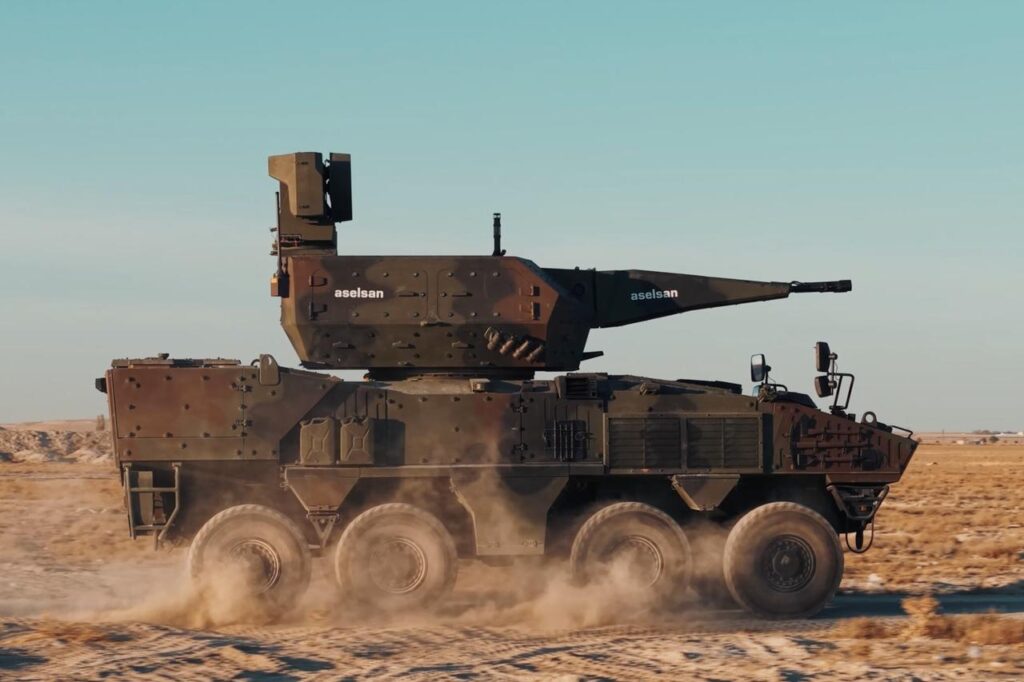
Ukraine has reportedly purchased Korkut self-propelled anti-aircraft guns (SPAAGs) from Türkiye. Effectively a Turkish take on the classic German-made Gepard SPAAG, a mainstay of Ukraine's defense against
Ukraine has acquired new Korkut air defense guns from Türkiye
The Korkut is a pair of fast-firing guns on a tracked or wheeled chassis
Ground-based guns are effective defenses against drones
But the Russians are launching faster drones, and more of them are getting through
Ukraine has reportedly purchased Korkut self-propelled anti-aircraft guns (SPAAGs) from Türkiye. Effectively a Turkish take on the classic German-made Gepard SPAAG, a mainstay of Ukraine's defense against Russian one-way attack (OWA) drones, the Korkuts could help stiffen Ukrainian air defenses as winter looms and Russia intensifies its terror attacks on Ukrainian cities and power plants.
The problem for Ukrainian air defenders is that the latest jet-propelled Russian drones, the Geran-4 and Geran-5, are getting through. They fly at around 500 km/h, nearly three times as fast as an older, propeller-driven Geran-2, and in September Ukraine shot down just 55% of them, by Zelenskyy's count, against at least 90% of the slow ones, one analyst calculated. The Korkuts arrive in that gap. Ground-based guns are arguably Ukraine's most cost-effective anti-drone weapons, but they may not work so well against the fastest drones.
That means more Russian munitions are getting through. More Ukrainian homes are burning. More power plants are going dark. It's a crisis now. It'll be an even greater crisis when winter arrives and the temperature drops.
All that is to say, the handful of Korkut systems Ukraine has received from Turkish firm Aselsan are welcome, but they're not silver bullets against Russian drones.
A Korkut battery includes a command vehicle plus three tracked or wheeled vehicles armed with pairs of fast-firing, radar-cued 35-mm autocannons. The exact variant Ukraine received hasn't been disclosed; Middle East Eye's mention of 25-mm ammunition suggests it may be the smaller Korkut 100/25, built mainly to stop frontline drones. The Ukrainian Korkuts join a sizeable fleet of SPAAGs in Ukrainian service, most notably including potentially 90 or more 1960s-vintage Gepards with twin radar-cued 35-mm guns.
Explore further
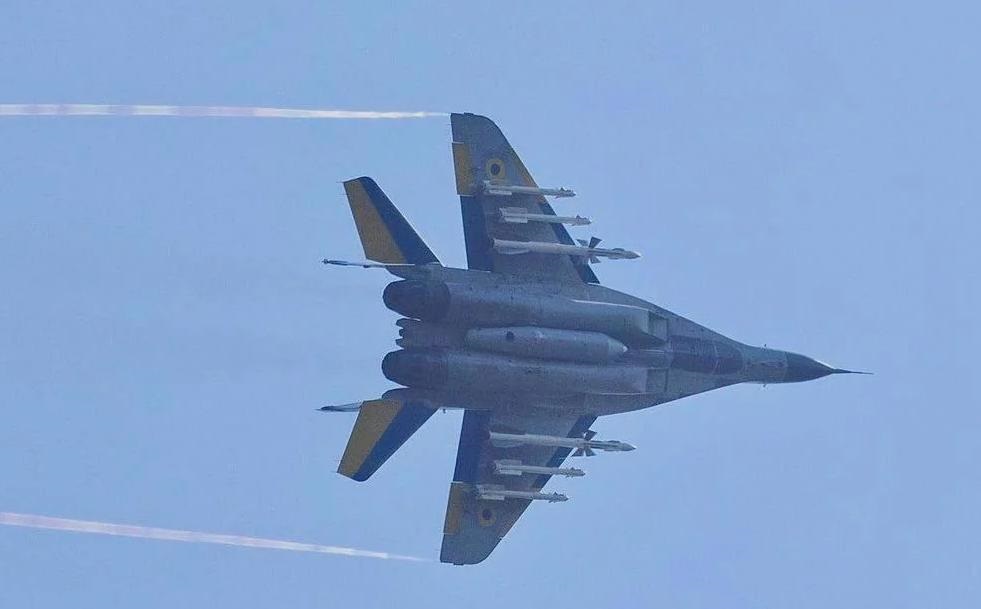
Ukraine is running short of its best missiles for hunting Russia’s jet drones. Now MiG-29s are firing 1970s weapons
The tracked Gepards are old but effective. They, like all SPAAGs, can only engage incoming drones and other targets at fairly short range: just a few kilometers. But they're cheap. A SPAAG might fire a few hundred dollars' worth of shells to bring down a $50,000 Geran. A surface-to-air missile can hit a Geran from much farther away, but even the cheapest missiles cost tens of thousands of dollars apiece—and the supply is limited.
Gepards and other gun-based air defenses, along with wide-area strategic radio jamming, were the twin keys to Ukraine's temporary victory over Russian Gerans as recently as late last year. That's when the Russians were still mostly launching propeller-driven Gerans, and the Ukrainians were shooting down most of them.
Slipping interception rates
Vanquishing the slow Gerans didn't solve a separate air defense problem—how to shoot down supersonic ballistic missiles—but it did minimize Ukrainian casualties and mitigate the overall damage to Ukrainian infrastructure. Only the best, priciest, and rarest Ukrainian air defenses such as the Patriot and SAMP/T can hit incoming ballistic missiles. As missiles have run out for those batteries, more Russian ballistic missiles have gotten through.
But now more Gerans are getting through, too. On 26 September, President Volodymyr Zelenskyy said Russia had launched more than 2,730 jet-powered Gerans at Ukraine that month and that Ukrainian air defenses were shooting down 55% of them. Analyst and mapper Clément Molin set that against Air Force totals: of 5,437 drones launched between 1 and 26 September, the remaining 2,707 were slow Geran-2s and Gerbera decoys, and at least 90% of those were downed. The overall interception rate, he calculated, has fallen to close to 70%, from 86% to 90% earlier this year.
Ukrainian forces are scrambling to acquire more inexpensive surface-to-air missiles as well as faster interceptor drones. But they're racing against time and the growing preponderance of jet-propelled OWA drones. The Ukrainians' air defense problem may get worse before it gets better.
This statement from V. Zelensky is very interesting
Based on UA air-force numbers, Russia already launched 5 437 drones this month, including 2 730 Geran-4/5 based on Zelensky's claim, 50%. Based on UA air-force numbers, 4 524 drones were downed this month, while Zelensky… https://t.co/F2JhDm7qEVpic.twitter.com/vVtpQQH5wz
"Ballistic missile defense is a serious problem, but the increasing production of Geran-4, Geran-5, Banderol, and Filin jet-powered OWA drones/cheap cruise missiles will also be a growing challenge this fall and winter," Rob Lee, an analyst with the Foreign Policy Research Institute in Philadelphia, warned in August.
Winter weather reduces the effectiveness of interceptor drones and helicopters, Lee noted, and Ukraine will need more high-speed interceptors to counter the jet drones. "The interception rate for OWA drones will likely decrease."
But that doesn't mean the Korkut isn't helping forestall an even worse dip in the overall interception rate for incoming Russian drones. Ukrainian officials are reportedly pleased with the Turkish gun. "Korkut has been pretty much successful in countering the Russian attacks," a Ukrainian official toldMiddle East Eye. "There were of course some problems but nothing that couldn't be overcome through some small adjustments."
According to Middle East Eye, the Ukrainians are considering acquiring more Korkuts.

 Connexion


 Serhii Sternenko
 is very interesting
 Based on UA air-force numbers, Russia already launched 5 437 drones this month, including 2 730 Geran-4/5 based on Zelensky's claim, 50%.