❌

Vue normale

  • ✇Euromaidan Press
  • Russia fabricates Dobropillia encirclement to strengthen its case for Kyiv’s capitulation at UN – ISW
    Russia’s Defense Ministry claimed on 22 September 2026 that it had surrounded Dobropillia, but the Institute for the Study of War (ISW) found no evidence to support the announcement. Dobropillia is a small town in Donetsk Oblast, known as the "pearl of the Donbas" for its coal industry, which has helped make Ukraine's Fortress Belt cities, holding the region from Russians since 2014, per RBC Ukraine. Ukraine’s Vivaldi counteroffensive in Donetsk Oblast broke the northern arm of Russia’s
     

Russia fabricates Dobropillia encirclement to strengthen its case for Kyiv’s capitulation at UN – ISW

23 septembre 2026 à 14:13

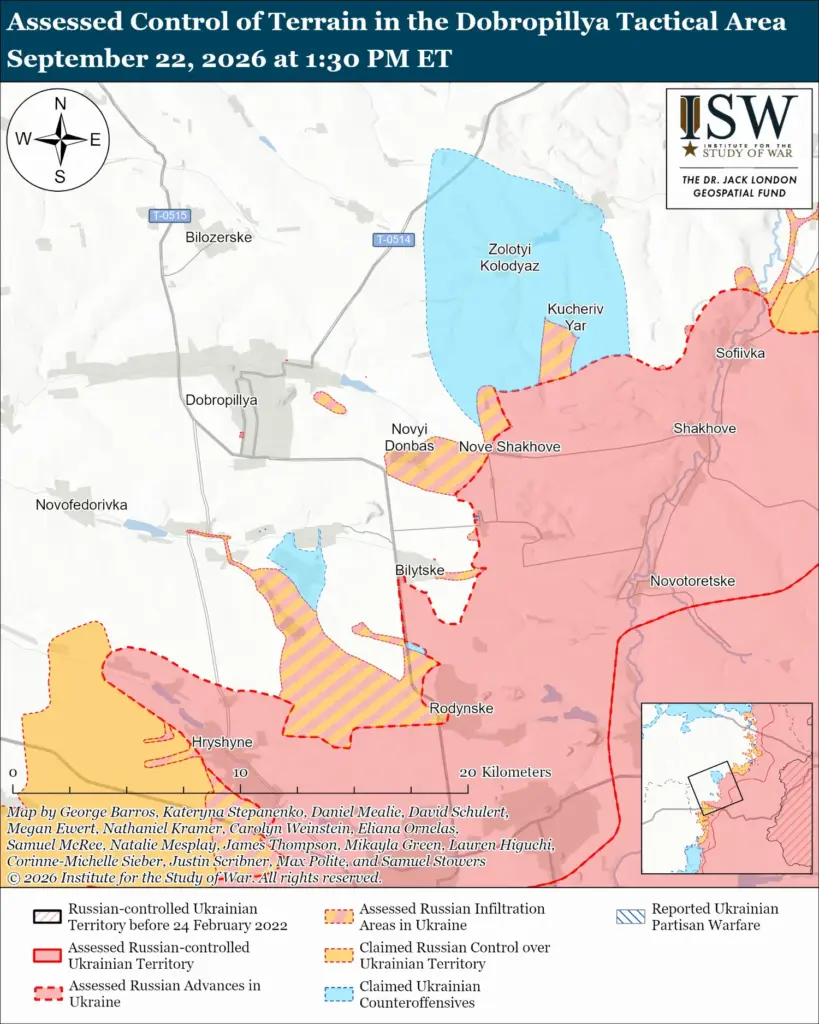
Map of Dobropillia and nearby towns, with Russian-controlled territory shaded pink mainly to the east and south, striped areas marking Russian infiltration, and blue areas marking claimed Ukrainian counteroffensives. Dobropillia is not shown as encircled.

Russia’s Defense Ministry claimed on 22 September 2026 that it had surrounded Dobropillia, but the Institute for the Study of War (ISW) found no evidence to support the announcement. Dobropillia is a small town in Donetsk Oblast, known as the "pearl of the Donbas" for its coal industry, which has helped make Ukraine's Fortress Belt cities, holding the region from Russians since 2014, per RBC Ukraine.

Ukraine’s Vivaldi counteroffensive in Donetsk Oblast broke the northern arm of Russia’s plan to surround the fortified cities. ISW says Moscow’s Dobropillia claim diverts attention from that setback and portrays Ukrainian defenses as collapsing during the 81st session of the UN General Assembly, held on 21-28 September. The institute says Russia is likely spreading such claims to support its push for Ukraine’s capitulation.

Meanwhile, Ukrainian officers say Russian assault groups are still trying to break through toward Dobropillia, but have made no major gains.

Russia’s encirclement claim clashes with Ukrainian battlefield reports

Russia’s Ministry of Defense has claimed its troops were advancing toward Oleksandrivka, a village northwest of Dobropillia, but published no map to support its account.

At the same time, Ukrainian military observer Kostyantyn Mashovets said Ukrainian troops still held positions south and northeast of the city, which the experts said was inconsistent with the claimed encirclement.

ISW reported that a Ukrainian artillery reconnaissance battalion chief of staff said on 22 September that Russia had made no major advances near Dobropillia. He said Russian commanders kept postponing deadlines because of heavy losses and a gap between their plans and battlefield conditions.

A Ukrainian battalion officer said Russian troops were still trying to slip through Ukrainian lines in small groups.

How Dobropillia fits Russia’s plan to surround the fortress belt

Dobropillia is a transport hub on the southwestern approach to Ukraine’s “fortress belt,” which includes Kostiantynivka, Druzhkivka, Kramatorsk, and Sloviansk. These cities have anchored Ukraine’s defense in Donetsk Oblast since 2022.

Ukraine’s Third Army Corps commander, Andrii Biletskyi, whose corps is conducting the Vivaldi counteroffensive north of Lyman, explained that Russian forces advancing through Dobropillia were meant to join another force coming from north of Lyman, behind the fortified cities, encircling them rather than attacking them head-on.

Andrii Biletskyi, commander of Ukraine’s Third Army Corps, stands outdoors in camouflage beside an orange “Operation Vivaldi” graphic.
Ukraine’s Third Army Corps commander, Brigadier General Andrii Biletskyi, announced “Operation Vivaldi” on 15 September 2026. Source: screenshot from Ukraine’s Third Army Corps announcement of Vivaldi

ISW had already assessed on 16 September that Vivaldi had made the two-sided plan infeasible. In its 22 September report, ISW said Russia’s false claim about Dobropillia partly aims to divert attention from those Ukrainian gains.

Russian assaults toward Dobropillia continue

The setback north of Lyman has not stopped Russia’s push toward Dobropillia. Ukrainian staff sergeant Dmytro Davydenko reported on 14 September a sharp increase in assault groups moving toward the city, sometimes more than his unit could engage. He said Ukrainian troops had mined, blocked, or destroyed the main approaches.

ISW reported that Russia was preparing armor and drone support for possible assaults using armored vehicles this fall. A Ukrainian battalion officer said fog might help Russia move that equipment, although Ukrainian reconnaissance and drones would make it difficult. He said Russian glide bombs continued to strike infrastructure in the area.

  • ✇Euromaidan Press
  • Old American armor, new Ukrainian brain: Skelya regiment nears completion of M1117 unmanned conversion
    Ukraine's 425th Separate Assault Regiment Skelya is converting American-made armored vehicles into remotely operated platforms as part of its "remote infantry" concept, head of the regiment's innovation support group Edhar Vinnik wrote in an exclusive column for 24 Kanal. The approach rests on a simple principle: if a machine can do the job, no soldier should risk their life doing it, Vinnik argued. The regiment established an Innovation Center to develop unmanned systems and robotic platf
     

Old American armor, new Ukrainian brain: Skelya regiment nears completion of M1117 unmanned conversion

23 septembre 2026 à 09:33

M1117 in service with Ukraine’s 425th Assault Battalion “Skala,” 2024

Ukraine's 425th Separate Assault Regiment Skelya is converting American-made armored vehicles into remotely operated platforms as part of its "remote infantry" concept, head of the regiment's innovation support group Edhar Vinnik wrote in an exclusive column for 24 Kanal. The approach rests on a simple principle: if a machine can do the job, no soldier should risk their life doing it, Vinnik argued. The regiment established an Innovation Center to develop unmanned systems and robotic platforms, Militarnyi reported.

The M1117 is the second vehicle Skelya has converted to unmanned control—after completing the Novator armored car in June—and the regiment's approach won a Defense Ministry DELTA innovation competition on 31 August 2026, earning approximately $33,700. The pattern suggests Ukraine's cheapest path to unmanned ground capability may not run through purpose-built robots but through vehicles already in service, upgraded with off-the-shelf hardware.

M1117 conversion nears completion

The regiment is in the final stages of converting the American M1117 Guardian into a remotely controlled platform. The 4x4 vehicle has been in Ukrainian service since 2023.

"The project of remote control of the American armored wheeled vehicle M1117 is in the final stage," Vinnik said.

This is Skelya's second such conversion. In June, the regiment completed a similar project with the Novator armored car. The Novator received multiple communication channels: Starlink, LTE, and Silvus radio systems. Vinnik argued the conversions prove that remote control can scale to any vehicle in service, if the hardware supports it.

Software ties the system together

Without adequate software, all unmanned platforms would remain isolated machines, Vinnik noted. The regiment's IT Innovation Department develops proprietary software for coordinating unmanned systems. One solution replicates functionality similar to R2D2—a network data-relay infrastructure that enables remote equipment operation. Using off-the-shelf routers cut the cost roughly fourfold.

"Without adequate software, all these drones and ground systems would remain just separate machines," Vinnik said.

The cost reduction matters for scalability, Vinnik argued. A technology that exists in one copy is a demo—one cheap and reliable enough for hundreds of crews is a capability. The regiment measures its progress by one number, he wrote: how many soldiers were not sent where they could be killed or wounded.

Why old armor gets a second life

The M1117 Guardian—built on the Cadillac Gage Commando chassis from the Vietnam War era—exemplifies the trend. The regiment's Innovation Center, established in autumn 2025, won a Defense Ministry DELTA innovation competition on 31 August 2026. Skelya's approach reflects a broader Ukrainian trend of converting existing vehicles into unmanned platforms rather than building robots from scratch. The National Guard's Khartiia Corps earlier converted a 12-ton US-made M113 armored personnel carrier into an unmanned platform for remote demining and logistics, fitting it with anti-drone armor and a mine flail. Ukraine is also rebuilding Soviet BRDM-2 armored scouts into remotely operated robotic platforms, and three units recently received Kaban—a bolt-on kit that turns ordinary vehicles into uncrewed ones.

Vivaldi’s secret weapon was the targeting, not the robots: Third Corps reconnaissance mapped Russian command nodes, then hit them to cause panic

23 septembre 2026 à 05:24

vivaldi's secret weapon targeting robots third corps reconnaissance mapped russian command nodes hit cause panic · post graphic ukraine's army / telegram під час операції вівальді нрк десантували щоб порушити

Ukraine's Third Army Corps dropped kamikaze ground robots on Russian command nodes identified by reconnaissance during Operation Vivaldi, a corps intelligence officer told Radio NV. The strikes aimed to break command coordination and force Russia to divert combat troops to guard its own headquarters, while a parallel campaign destroyed a diesel pipeline that fed about half the daily fuel needs of Russia's entire West grouping.

Russia's full-scale war against Ukraine is now in its fifth year, with Moscow pushing simultaneously along the front and striking cities behind it with drones, cruise and ballistic missiles, and glide bombs. The Vivaldi operation is the first time Ukraine has publicly shown how a reconnaissance-to-robot strike chain works against command nodes without risking infantry, a method that could be replicated across other sectors where Russia's coordination depends on forward headquarters within drone range.

Reconnaissance identified command nodes, robots hit them

One of the tasks set by corps commander Brigadier General Andrii Biletskyi was to disrupt command and communications in the Russian chain of command, the officer said. Brigade and corps reconnaissance identified areas where a strike could break Russian control.

"Reconnaissance of the brigades and the corps identified such areas that could affect the disruption of enemy command. It was into these areas that robots were dropped to create panic, disrupt command, and prevent the enemy from being effective," the officer told Radio NV.

To protect their command posts from the robots, Russian forces had to pull in additional personnel—troops that could not then be used to resist the Third Corps' ground assault.

Map: ISW

The Third Corps announced on 20 September that heavy bomber drones delivered kamikaze ground robots more than 10 km behind Russian lines, calling it a world first.

The same intel operation identified a frontline diesel pipeline

The same intelligence operation uncovered a pipeline running from Voronezh Oblast to temporarily occupied Luhansk Oblast. The pipeline carried finished diesel, not crude oil, and supplied about 50% of the daily fuel needs of Russia's forces on the direction, the officer said.

The corps struck both the intake point where fuel entered the pipeline and the output point where it was loaded onto tankers. The strikes forced Russia to dismantle the pipeline entirely. Russian forces now truck fuel from Voronezh Oblast, a 400 km supply run.

The pipeline's destruction affected not just the Lyman direction but the entire West grouping, including the Kupiansk and Borova directions, the officer said. The logistical disruption left frontline Russian drone units unable to refuel generators to charge batteries, and electronic warfare systems had to operate in a reduced mode.

Repair bases struck, 250 km logistics detour

Third Corps intelligence also located the repair base of Russia's 20th Army and its 144th Division. Ukrainian strikes during the preparatory phase forced Russia to relocate the base to Voronezh Oblast, increasing the repair route to 250 km.

Russia's 20th Army and its 144th Division, reinforced by assault detachments from the First Tank Army, remain the main strike force on the Oskil-Sviatohirsk direction, the officer said. The First Tank Army has been sending additional assault units to stabilize the Russian defensive line after Vivaldi, but these reinforcements are taking critical losses on logistics routes before reaching the combat zone.

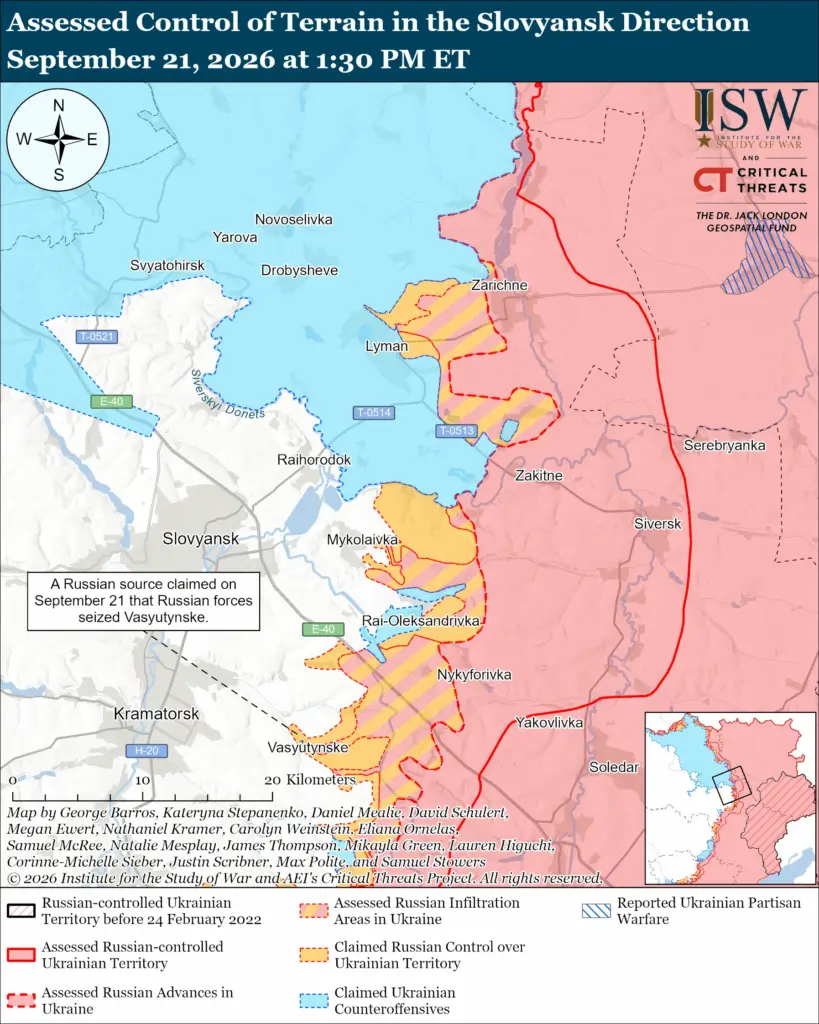
vivaldi's secret weapon targeting robots third corps reconnaissance mapped russian command nodes hit cause panic · post isw slovyansk-direction-september-21-2026 ukraine news ukrainian reports

Rubikon pulled out, Russian drone units at 70–90% strength

The officer said the corps headquarters specifically targeted Russia's most effective drone formations. During the preparatory phase, the elite Russian drone unit Rubikon was identified as a critical threat that could isolate the area of operations and obstruct Ukrainian maneuver.

Ukrainian reconnaissance located and passed targeting data to strike assets. Rubikon suffered heavy losses in equipment and personnel, and a senior Russian commander—misjudging the Third Corps' offensive potential—pulled the unit to rear areas for recovery at what turned out to be the worst possible moment, just as Ukraine's assault began.

Russian drone units on the direction are now staffed at 70–90%, the officer said. The corps is working to degrade their capability through targeted strikes on launch sites, pilot positions, and logistics in the second and third echelons.

Four seasons, two public

The officer said Russia's current task is to stabilize its defensive line, restore its observation network, and bring in additional reserves for counterattacks. Russia does not have enough personnel and will have to pull troops from training grounds before they finish their courses, shortening training cycles.

Operation Vivaldi has at least four "seasons," of which only the first two have been made public. The operation's name refers to Italian baroque composer Antonio Vivaldi, and The Four Seasons is his best-known set of four violin concerti.

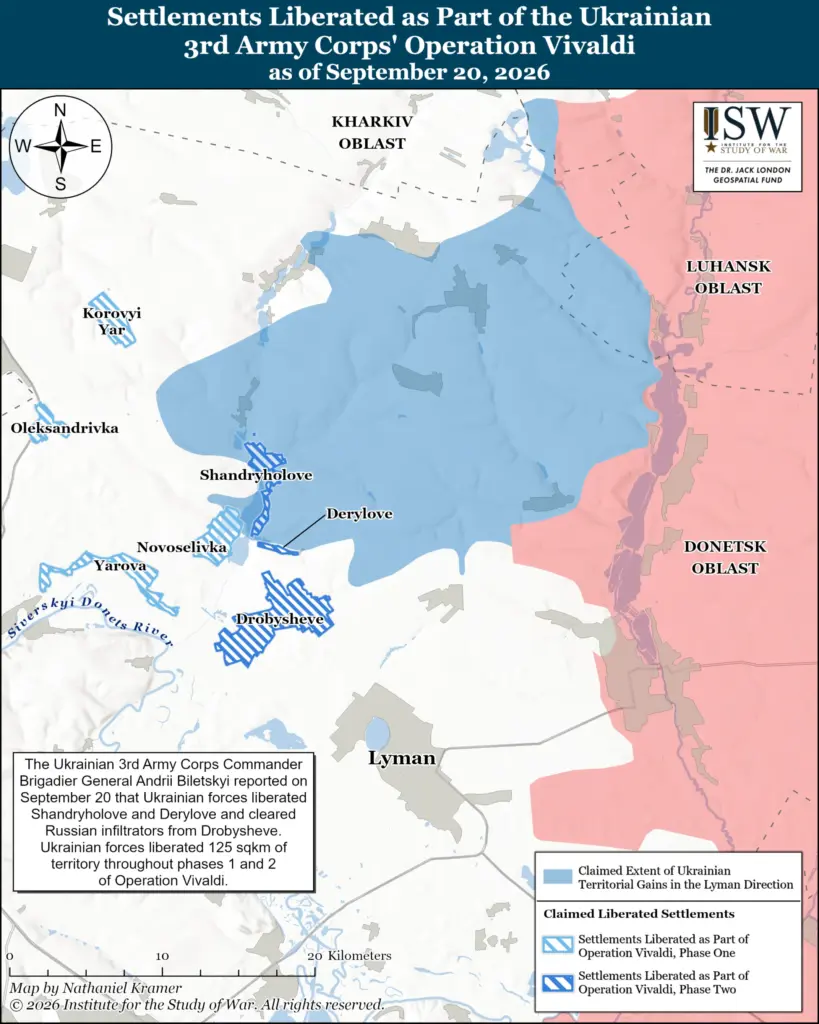
Biletskyi confirmed the liberation of Shandryholove, Derylove, and full control over Drobysheve on 20 September, bringing the total to 40 km² of freed territory in the second season alone. Russian losses have reached an estimated 3,000 personnel overall, over 12,000 drones in the first season, and hundreds of vehicles, according to the Third Corps. ISW assessed that the operation disrupted Russia's plan to encircle the fortress belt of Donetsk cities—Sloviansk, Kramatorsk, Druzhkivka, and Kostiantynivka.

❌