The EU locked in its sanctions on Russia for an unprecedented three years this week, and paid for it by letting two of the country's richest men off the list. Alisher Usmanov and Mikhail Fridman were delisted at the insistence of Slovakia, France, and Luxembourg, DW reported.
France pushed to remove Usmanov, a Kremlin-linked metals and telecoms magnate, as part of a secret deal to free prisoners held in Azerbaijan, and Luxembourg pushed to remove Fridman, who is pursuing the country
The EU locked in its sanctions on Russia for an unprecedented three years this week, and paid for it by letting two of the country's richest men off the list. Alisher Usmanov and Mikhail Fridman were delisted at the insistence of Slovakia, France, and Luxembourg, DW reported.
France pushed to remove Usmanov, a Kremlin-linked metals and telecoms magnate, as part of a secret deal to free prisoners held in Azerbaijan, and Luxembourg pushed to remove Fridman, who is pursuing the country for about $16 billion in arbitration over the losses his sanctions caused, the Financial Times reported.
Kyiv's reaction was immediate and furious
Foreign Minister Andrii Sybiha called the decision shameful and unjustified and urged EU states to impose their own national sanctions on the pair.
"In Moscow, they celebrate, because they got what they wanted: a sense of impunity, humiliation of the European Union, and division among Europeans," he wrote on X.
President Volodymyr Zelenskyy, who raised the issue with European Commission chief Ursula von der Leyen in New York, called the delisting "suicidal and counterproductive."
"Wars end with resolve and strength, not concessions to the aggressor's cronies," he said, thanking von der Leyen for agreeing to work on adding more Russian names to the lists.
At the same time, he stated that he "is grateful to Ursula for her willingness to work on adding more Russian individuals to the EU sanctions lists."
The step was a bargain of durability for names. Rather than roll the sanctions over for the usual six months, the EU previously extended them to 22 September 2029, keeping some 2,600 Russians and companies, including President Vladimir Putin, frozen out for three years, after weeks of deadlock that at one point nearly let the whole regime lapse.
The deal came only after the bloc pushed its deadline back a week to buy time, and its Irish presidency called the result a difficult compromise.
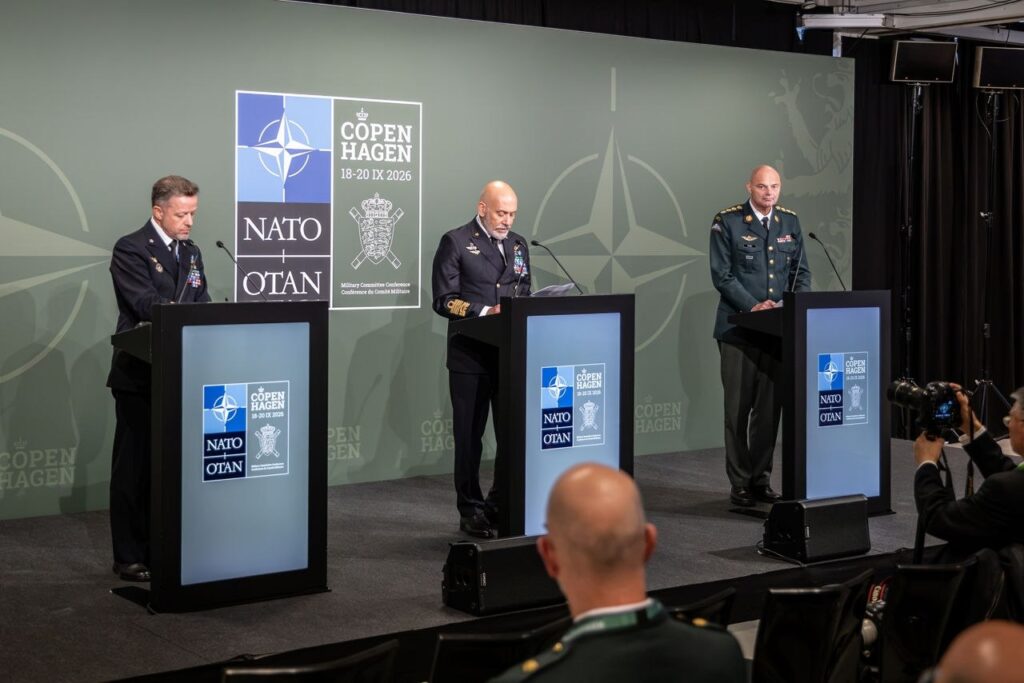
NATO's top generals gathered in Copenhagen, and Ukraine was at the center of the table. The Alliance's Military Committee, its 32 chiefs of defense and two strategic commanders, met to reaffirm support for Ukraine, accelerate its readiness, and appoint a new chairman, Ukraine's General Staff said.
The meeting comes as intelligence services and Western leaders warn that Russia may be preparing to move against NATO itself, not only Ukraine. Polish Prime Minister Donald Tusk has recently t
NATO's top generals gathered in Copenhagen, and Ukraine was at the center of the table. The Alliance's Military Committee, its 32 chiefs of defense and two strategic commanders, met to reaffirm support for Ukraine, accelerate its readiness, and appoint a new chairman, Ukraine's General Staff said.
The meeting comes as intelligence services and Western leaders warn that Russia may be preparing to move against NATO itself, not only Ukraine. Polish Prime Minister Donald Tusk has recently told his parliament that intelligence points to Russian plans for drone and missile strikes on NATO countries.
Ukraine anchors the agenda
The annual conference, held in Copenhagen and chaired by Admiral Giuseppe Cavo Dragone alongside the Alliance's two strategic commanders, followed up on decisions from the recent NATO summit in Ankara and centered on deterrence, defense, and new technology, with Ukraine running through it all, according to the NATO Representation in Ukraine.
Cavo Dragone said the Alliance maintains its unwavering support for Ukraine, and that allies continue to send equipment, conduct training, and provide aid while absorbing the hard lessons of Ukraine's defense.
The chair calls out Russia
Cavo Dragone framed the moment bluntly. The Alliance had again seen "the reckless behavior of Russia, including airspace violations, drone incidents, hybrid activities," he said at a joint press conference. He credited allied forces for their swift responses to those incidents and vowed the Alliance would defend every inch of its territory.
Germany's Breuer takes the helm
The chiefs have also elected General Carsten Breuer, Germany's chief of defense, as the next chair of the Military Committee, NATO's highest military body. He will take over in the summer of 2027 for a three-year term, succeeding Cavo Dragone.
Breuer, Germany's chief of defense since 2023, was the front-runner, and his selection, backed by Washington, hands the role to Europe's largest military spender and signals Germany's growing weight in the Alliance's command.
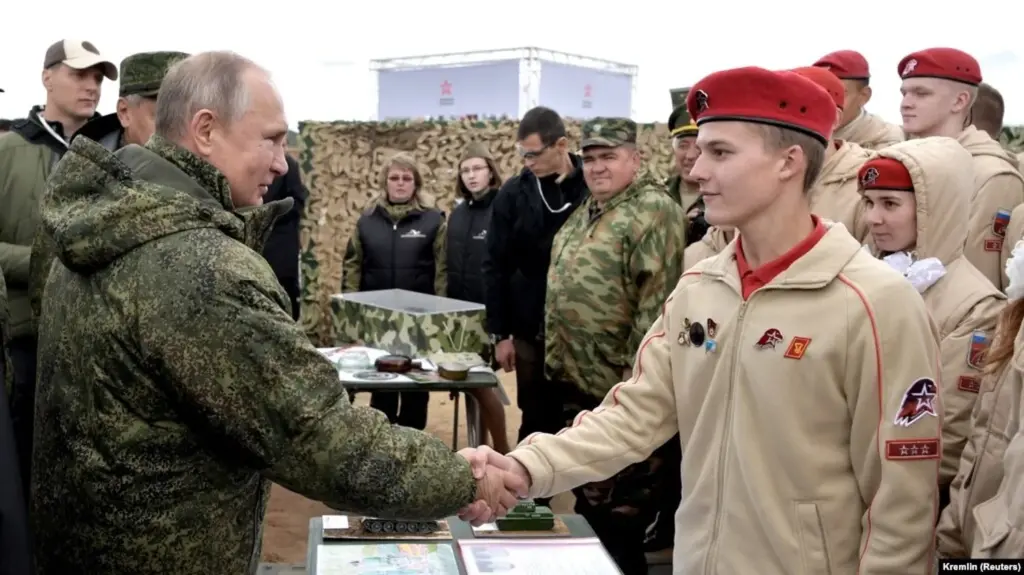
A Kremlin-backed program aimed at primary-school children claims 10,154 participants in occupied Zaporizhzhia, nearly 30 times Yunarmia's 355 members—Russia's uniformed military youth organization—Petro Andryushchenko, head of the Center for the Study of Occupation, said. Cadet classes in the same region account for another 387, according to Andryushchenko.
Yunarmia may represent only a fraction of Moscow’s system for militarizing Ukrainian children under occupation. Movement of the Fir
A Kremlin-backed program aimed at primary-school children claims 10,154 participants in occupied Zaporizhzhia, nearly 30 times Yunarmia's 355 members—Russia's uniformed military youth organization—Petro Andryushchenko, head of the Center for the Study of Occupation, said. Cadet classes in the same region account for another 387, according to Andryushchenko.
Yunarmia may represent only a fraction of Moscow’s system for militarizing Ukrainian children under occupation. Movement of the First, a Kremlin-backed mass youth group covering ages 6 to 18, claims about 65 times Yunarmia's membership in occupied Zaporizhzhia—over 23,000 by the end of 2025, up from about 14,000 a year earlier, according to Andryushchenko's breakdown of the series. A separate infographic in the same series puts the figure at over 19,000. Moscow has sustained the broader campaign throughout the full-scale invasion, combining classroom indoctrination, Kremlin youth movements, military games, and weapons training.
Andryushchenko explains why: Movement of the First is not a military organization, and that is precisely its function—a mass base that enrolls children without their joining any military-patriotic structure, then moves some into specialized programs. Through it, Zarnitsa stopped being a school game and became part of Russia's military-patriotic system. The movement functions as a gateway, not an endpoint.
In Kherson Oblast, the pattern repeated: over 2,700 children and young people passed through Movement of the First events in 2024, and by spring 2025, the registered count had reached 6,200, with primary cells growing from about 70 to 114–115.
From Eaglets to Zarnitsa: programs across occupied Zaporizhzhia
Andryushchenko said Eaglets of Russia, a program aimed at primary-school children aged 6 to 10, claims 10,154 participants across 97 schools and 626 class-teams in occupied Zaporizhzhia, while more than 2,000 children aged 11 to 17 have passed through the Zarnitsa 2.0 military game. In May 2026, children from all four occupied oblasts appeared at a federal Eaglets session alongside children from Russian regions—a sign the occupied territories are already integrated into the system.
He said military-applied instruction now fills about half of the OBZR course, Russia’s “Fundamentals of Security and Defense of the Motherland” subject, in occupation schools. He described a broader system stretching from kindergarten and mass children's organizations through military games and cadet structures to practical training in drones, tactics, weapons, and military medicine.
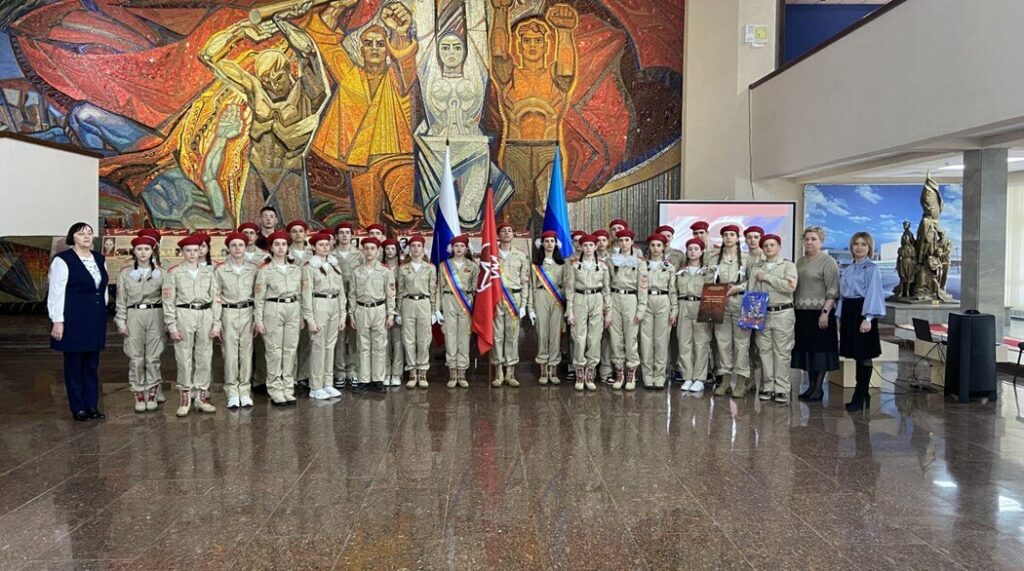
So-called "dedication ceremony for students of Milove secondary school to become members" of Russia's paramilitary organization Yunarmia. Occupied Sorokyne (ex-Krasnodon), Luhansk Oblast, April 2023. Image: lug-info.ru.
Military training center claims thousands across four occupied territories
Beyond Zaporizhzhia, Andryushchenko said the Russian military-sports training center VOIN claims 14,450 trained cadets across four occupied Ukrainian territories in his overview post. A later infographic in the series gives 10,381 for the same four territories, suggesting the figures may count differently.
That cannot be read as a count of children because VOIN programs accept participants aged 14 to 35, according to the Center's own website, and no age breakdown was provided. VOIN says it has trained more than 100,000 cadets across 21 Russian regions overall.
Andryushchenko's post opened a six-part series tracing the system "from first grade to cadet"—though the series itself showed the pipeline actually begins in kindergarten, with "Conversations about Important Things" starting at age 5. Part two, published on 22 September, broke down Movement of the First's role as a gateway, with Zarnitsa 2.0 next. The participation totals cited in his post are claims by Russian-run organizations relayed by the Center. They may overlap, have not been independently verified, and do not show how many individual children participated or whether children move from one program to another.
Luhansk school students wearing the uniform of the so-called "Young Army." 2022. Photo: lug-info
Militarization has continued throughout the full-scale invasion
These latest participation claims are the newest snapshot of a campaign that has expanded steadily throughout Russia’s full-scale invasion. In 2023, occupation schools were already teaching children to use assault rifles and provide battlefield first aid.
By late 2024, Putin had ordered the expansion of military-sports camps and youth indoctrination programs.
Reports published in 2025 and 2026 described mandatory “patriotism” lessons from first grade and documented Ukrainian orphans who entered cadet schools and later appeared in Russian military uniforms.
A man who volunteered to fight for Ukraine has landed in a Russian prison—seized not on the battlefield but on another continent, according to an investigation by Finnish daily Helsingin Sanomat (HS). He had gone to West Africa for civilian work when a Russia-aligned junta grabbed him and handed him to Moscow.
Russia has turned the Sahel's coup governments into clients, trading security for mining access. Its grip now reaches far enough that in what Yle calls the first such case, a man
A man who volunteered to fight for Ukraine has landed in a Russian prison—seized not on the battlefield but on another continent, according to an investigation by Finnish daily Helsingin Sanomat (HS). He had gone to West Africa for civilian work when a Russia-aligned junta grabbed him and handed him to Moscow.
Russia has turned the Sahel's coup governments into clients, trading security for mining access. Its grip now reaches far enough that in what Yle calls the first such case, a man who once fought against Moscow was picked up on another continent and delivered to its courts—the war's reach no longer stops at Ukraine's borders.
From Ukraine's army to an African gold mine
The 50-year-old, identified in the reporting only as Mikael, joined a Ukrainian army unit soon after Russia's full-scale invasion in 2022. Fluent in Finnish and Russian, he later worked as a liaison between foreign fighters and Ukrainian troops. His return to Finland at the end of winter 2025 was abrupt: Ukrainian authorities had opened an investigation into his handling of funds and imported cars.
HS's investigation also found he had given false information about himself to both his family and Finnish authorities, and that his Finnish criminal record includes embezzlement and fraud. By spring, he joined about ten men bound for Sierra Leone to guard a gold mine, HS reported, as Yle relayed. They wanted work that wasn't the war.
Handcuffed hours after arrival
When most of the group moved on, Mikael and an Italian named Paolo—another Ukraine volunteer—continued to Burkina Faso for the same mining firm. Within hours of reaching their hotel in Ouagadougou in June 2025, men blindfolded and handcuffed the two and drove them off, according to the same HS investigation, carried by NV. Burkina Faso's Russia-backed junta found Mikael's Ukrainian military passport and identified both as men who had fought in Ukraine. Italy's embassy freed Paolo after three months. Mikael stayed behind.
Stateless on paper—but maybe not
In autumn 2025, Burkina Faso secretely handed Mikael to Russia, which charged him with "mercenarism"—the statute carrying seven to 15 years that Moscow uses against foreigners who fought for Ukraine. His trial lasted about two months. Moscow's Basmanny District Court, which handles cases the state treats as sensitive, ruled in November 2025 and classified its decision. The sentence and its finality stay unknown, and he now sits in a prison in Samara. Mikael holds no Finnish passport: born in the Soviet Union, he lived in Finland on a residence permit and traveled on documents marking him "stateless"—a status HS's investigation calls into question.
HS's investigation, though, found he likely holds a Russian passport—a status Russia has not confirmed, and one that may explain why Helsinki never treated him as its own to rescue. His relatives pressed Finland's Foreign Ministry to help while he was still in Burkina Faso, but it never demanded his return. Russia tried him, it seems, as a foreigner—a citizen would have faced treason charges. Finnish police, the security service, and the Foreign Ministry are now investigating, with National Bureau of Investigation commissioner Sami Liimatainen saying they aim to locate a missing man and suspect no crime.

 Connexion