Vue normale

Ukraine keeps hitting the fuel that Russia’s war runs on. Its latest target is the Slavyansk-EKO refinery, with an annual processing capacity of at least 3 million tonnes
14 septembre 2026 à 15:15

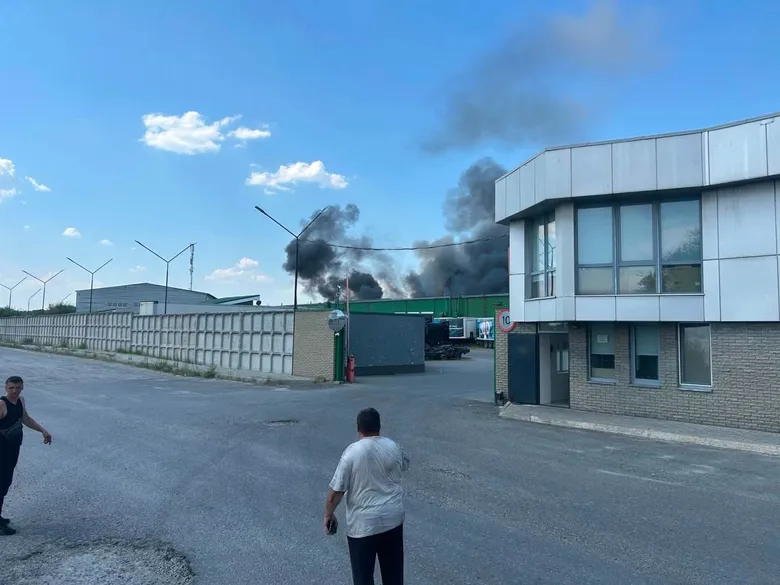
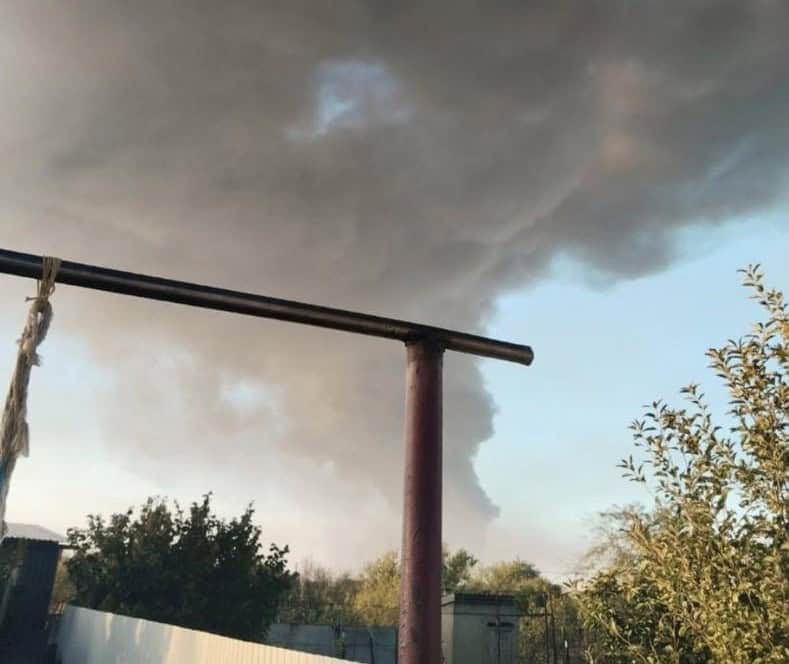
Smoke from a fire at the oil refinery in Slavyansk-on-Kuban. 13 September, 2026. Photo: Exilenova+

An oil refinery in Slavyansk-on-Kuban in southern Russia was attacked overnight on 13 September, Astra reported. By morning, residents began posting videos showing smoke over the refinery and nearby areas. That same morning, Ukraine’s Defense Intelligence (HUR) reported that Ukrainian drones had struck the Slavyansk-EKO refinery.

Ukrainian strikes on Russian oil refineries have become systematic, aimed in part at reducing the Russian military’s access to fuel, which is critical for waging the war. Ukrainian forces have been striking strategic facilities located hundreds of kilometers from the front line.

The design capacity of Slavyansk-EKO is approximately 5.2 million tonnes per year, though actual volumes are lower by about one to two million tonnes, Militarnyi reports.

Thick smoke visible for dozens of kilometers

The Ukrainian strike hit a key oil-processing unit and the facility’s oil storage tank farm, which “fuels the criminal war against Ukraine,” HUR reported.

Two oil storage tanks were destroyed in the strike, according to photos published by Dnipro Osint. Militarnyi noted that the photos also show damage to neighboring tanks.
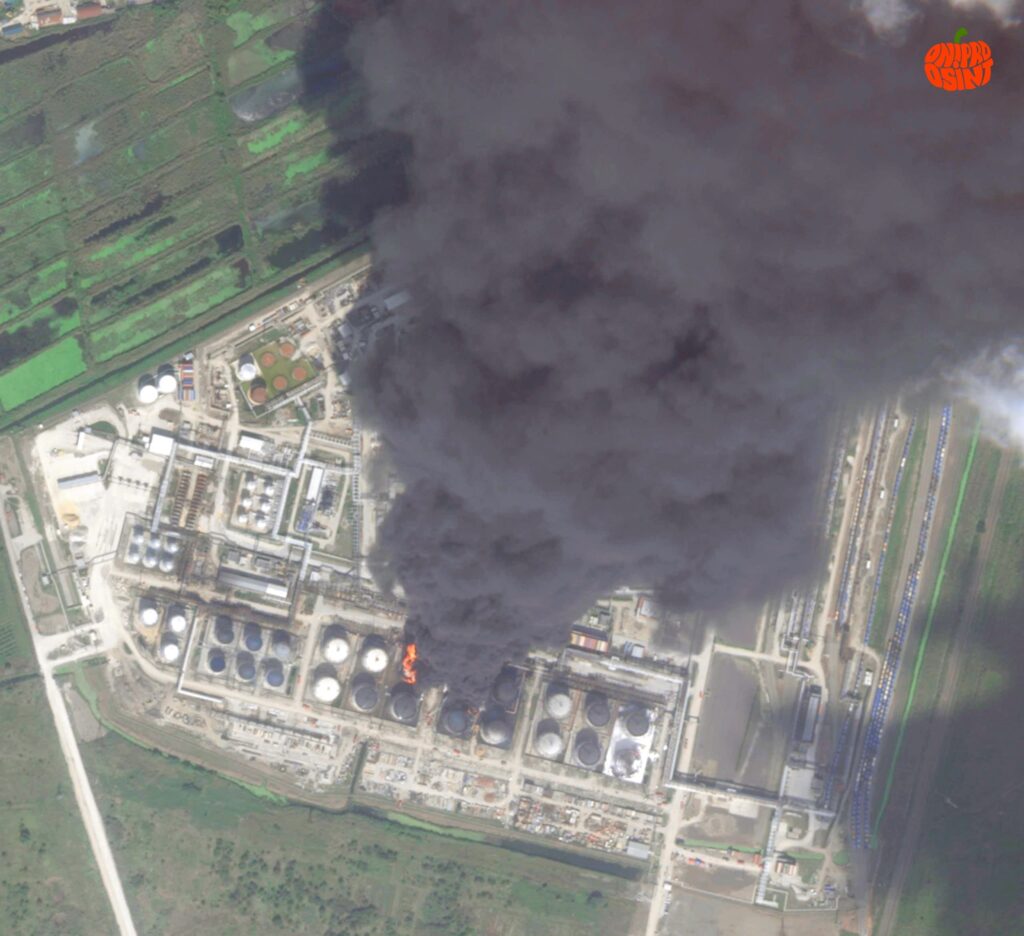
Satellite imagery of the Slavyansk oil refinery after a nighttime UAV attack on 13 September. Part of the refinery is obscured by thick smoke from a fire in the tank farm, Krasnodar Krai, Russia. Photo: Dnipro Osint


The strike reportedly hit the area containing the facility’s largest storage tanks. The refinery operates using purchased or tolling crude oil because it does not have its own crude oil production base.
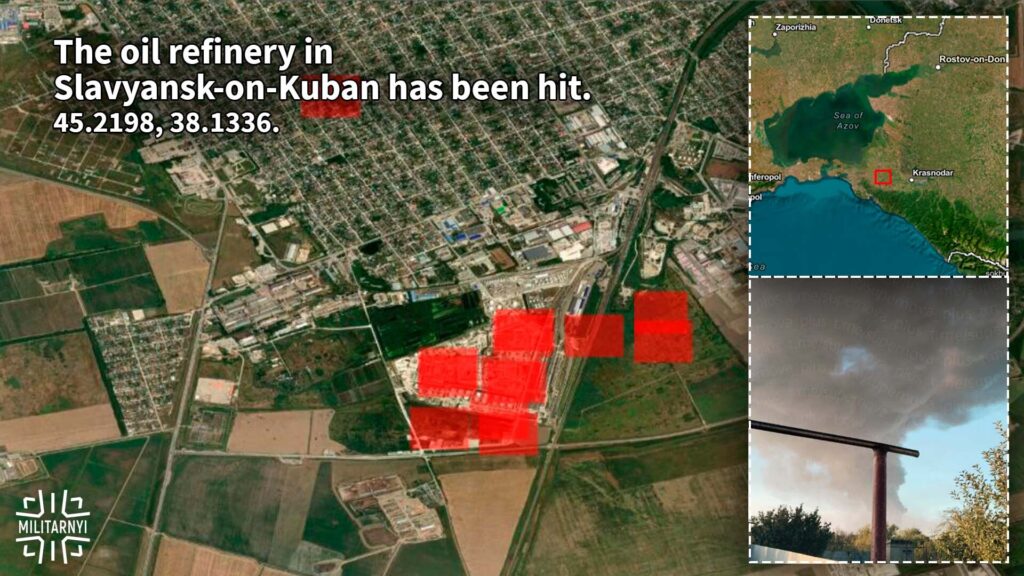
Fire broke out at the oil refinery in Slavyansk-on-Kuban following an attack by Ukrainian drones on September 13, 2026. Analysis by Militarnyi, with an Esri map and NASA FIRMS data

The refinery has been targeted before

Slavyansk-EKO is one of the largest independent oil refineries in southern Russia. The facility is located in Slavyansk-on-Kuban, about 69 kilometers northwest of Krasnodar.

Ukraine’s General Staff said that the refinery is “part of the energy rear of the Russian Federation and involved in supplying the armed forces of the aggressor.”

Before the 13 September strike, Ukrainian drones had struck the refinery at least four times, starting in 2024:

  • 27 April 2024 — a Ukrainian drone attack damaged the Slavyansk refinery, after which a fire broke out at the facility.
  • 19 May 2024 — SBU drones attacked the Slavyansk refinery, after which the facility suspended operations.
  • 26 January 2026 — Ukrainian Defense Forces struck infrastructure at the Slavyansk-EKO refinery. According to preliminary data, elements of the primary oil refining unit were damaged.
  • Five months later, on 28 June, Ukraine struck the Slavyansk refinery again, causing a large fire at the facility. EP noted that the refinery supplies fuel, including to occupied Crimea.
  • ✇Euromaidan Press
  • Ukraine hit the radar that guards Sochi, the Russian resort city it struck ten days ago
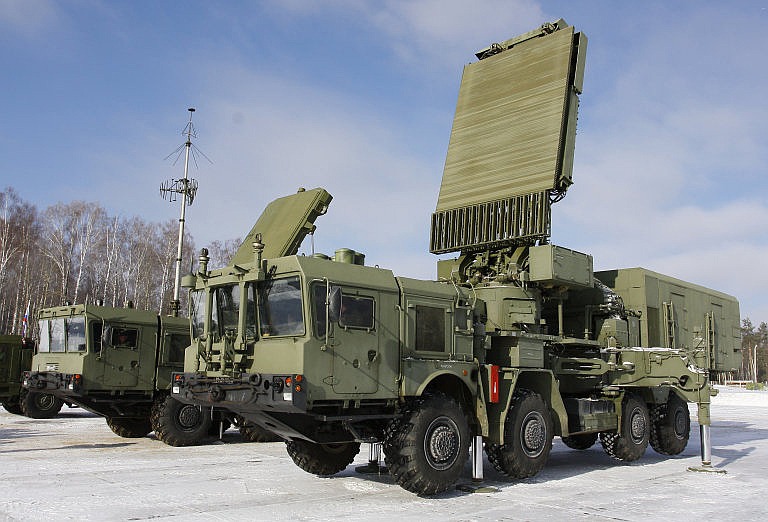
    Ukraine's Defense Forces struck the 92N6 multifunction radar of a Russian S-400 Triumf air defense system in Sochi, the General Staff said on 14 September. The S-400 is Russia's longest-range air defense system.  The radar tracks aerial targets and guides the system's missiles onto them, which makes it the part of an S-400 that decides whether the launchers can fire at anything. The strike came on 13 September and overnight into 14 September, alongside hits on drone launch sites, radars
     

Ukraine hit the radar that guards Sochi, the Russian resort city it struck ten days ago

14 septembre 2026 à 14:11

ukraine hit radar guards sochi russian resort city has been striking all month · post drone explodes air over russia after defense 14 2026 explosion fire groups sept news ukrainian

Ukraine's Defense Forces struck the 92N6 multifunction radar of a Russian S-400 Triumf air defense system in Sochi, the General Staff said on 14 September. The S-400 is Russia's longest-range air defense system.  The radar tracks aerial targets and guides the system's missiles onto them, which makes it the part of an S-400 that decides whether the launchers can fire at anything. The strike came on 13 September and overnight into 14 September, alongside hits on drone launch sites, radars, and relays elsewhere in Russia and occupied Crimea, according to the military.

Russia's full-scale war against Ukraine is in its fifth year, and Ukraine now carries it into Russia's rear, where the radars it keeps hitting are what widens the corridor for the next deep strike.

What was hit in Sochi

Ukrainian monitoring channels reported the explosions hours before the military did. Ukrainian Telegram channel Exilenova+ published night footage from Sochi at 3:29 with the sound of small arms fire, drone engines, and an explosion in the air, then a second clip in which the blast came on the ground. At 4:25 the channel posted a clip of distant explosions in Dagomys, a suburb of Sochi.

Sochi's regional operational headquarters claimed that falling drone debris injured five people in the city, including a child, and that one adult went to hospital and three private houses took damage. Russia's Defense Ministry claimed its air defenses intercepted and destroyed 399 Ukrainian drones overnight.

By 11:34, Exilenova+ reported that a new-generation medium-range air defense system and the infrastructure of a military unit near Dagomys had preliminarily been hit overnight.

Sochi is a Russian resort city on the eastern Black Sea coast, about 600 km from the front line in southern Ukraine. Drones hit two fuel depots there and an air defense position near the Abkhazia border on 4 September, and satellite imagery later showed nine destroyed storage tanks and impact marks at the air defense position, which Russian officials had never acknowledged.

💥 This night, Russians reported explosions and drone attacks in the Krasnodar region, - OSINT channels.

There were reports of loud noises in Sochi and Dagomys, at the very least. However, there is currently no information about the consequences of the attack. pic.twitter.com/IhOYlN9JPv

— Gianl1974 (@Gianl1974) September 14, 2026

The rest of the target list

Near Kursk and the occupied city of Donetsk, Ukrainian forces hit sites where Russia stores, prepares, and launches attack drones, the General Staff said. A drone control point of a Russian unit was struck in Novohrodivka, Donetsk Oblast.

ukraine says struck russia’s prized s-400 radar crimea — drones system meant detect russia's 92n6e station russian defense ministry militarnyi 92n6e96l6e-missilesru-3s ukraine’s special operations forces (sof) said 30 2025 triumf
Russia's 92N6E radar station. Illustrative photo: Russian Defense Ministry, via Militarnyi

Radar stations were hit in Litizh, Trostenchik, and Lipovka in Bryansk Oblast, and three signal relays in Rokhmanovo, Krasny Styag, and Kamen in the same oblast. At Saky airfield in occupied Crimea, Ukrainian forces struck a short-range radio navigation system.

The extent of the damage is being assessed, the General Staff said, adding that work against key Russian military targets continues.

“We expect specifics from our partners”: Zelenskyy says Ukraine will accept energy truce with Russia only if West guarantees Moscow won’t break it after its elections

14 septembre 2026 à 14:06

President of Ukraine Volodymyr Zelenskyy and the US President Donald Trump after talks in Florida on 29 December 2025. Credit: Facebook / Volodymyr Zelenskyy

US President Donald Trump said that Ukraine has agreed not to strike Russian energy facilities. According to him, Russia has agreed to do the same. Trump wrote about this on his social media platform, Truth Social. He also claimed that the global diesel fuel price rise is "mostly caused by the Russia/Ukraine War, not Iran.”

Leading international media and think tanks are directly pointing out that the US president is trying to mask his own miscalculations in the war with Iran ahead of the Congressional elections. For example, Politico writes that Trump is trying to find a "scapegoat" in Ukraine, blaming Kyiv's strikes for the fuel price rise, not the Strait of Hormuz closure.

The energy crisis and the spike in diesel prices to over $6.20 per gallon in the US began right after the military conflict between the US and Israel, and Iran erupted in February 2026, Fox News reports.

Diesel is the fuel used by Russian tanks that attack Ukrainian cities.

Guarantors of the agreements

At the same time, President Volodymyr Zelensky stated that Ukraine is ready to ensure an "energy truce" with Russia, provided there are no strikes from the aggressor country. To this end, Ukraine is proposing that partners serve as guarantors of the agreements with Moscow for such a truce.

"Food, energy, and other elements of basic life support must be protected, and Russian strikes are aimed primarily at this," Zelensky said.

Every day, targets include Ukrainian energy facilities, port infrastructure, logistics, and even food and pharmaceutical warehouses, he added.

Such a deal should hold after the elections in Russia

Zelensky also added that such an agreement must hold after the Russian elections.

"For this to be reliable, long-term, and have a real effect on people's lives — and not fall apart after the Russians hold their 'elections' and get exactly the easing of tension on gasoline and diesel they need for that period," he said.

Zelensky added that the war must be brought to an end, and de-escalation around strikes on critical infrastructure could be a first step toward peace.

"We expect specifics from our partners," he added.

Ukraine’s FLYCAT strike drone is built to fly without satellite signals. Its bigger new sibling is designed to reach 200 km behind the front

14 septembre 2026 à 07:45

Updated FLYCAT strike UAV at MSPO 2026.

A Ukrainian company has unveiled a homegrown strike drone built to fly deep behind Russian lines, Militarnyi reported on 13 September. Octava Defence showed the new long-range aircraft—a bigger version of a drone already used in combat—at the MSPO 2026 defense expo in Kielce, Poland. The company says the smaller drone is built to keep working in electronic warfare conditions without a reliable satellite signal.

Russian jamming is one of the biggest obstacles to Ukrainian strikes deep in the rear, which is why Ukrainian makers keep building guidance that does not depend on satellite signals.

The workhorse is already in the fight

The base FLYCAT, presented in January 2026 by another Ukrainian firm, Venator Technologies, is a strike drone Ukrainian forces have used in combat since March. An improved model went into action in July and August and is now undergoing codification—entry into Ukraine's official weapons register.

Ukraine is approaching to the Project 1100M "Sargan" patrol boat in Kerch. Source: Ukraine's Defense Intelligence
Explore further

Watch first naval battle in history fought entirely by drones: Ukrainian uncrewed boat spots, fires on, and sinks Russian one in Black Sea

The company says the updated drone can fly more than 80 km, stay in the air for an hour, and carry a warhead weighing up to 3.7 kg. It is built to hunt armored vehicles, artillery, radars, and air-defense systems, as well as lighter shelters and communications gear. It can pair with a scout drone that finds the target and passes the coordinates. Several FLYCATs can also strike a single target together or hit multiple targets at once.

Nearly everything on it is built in Ukraine—the communications, navigation, guidance, and warhead. Only the engines come from abroad. Its two cameras—day-only or day-and-night—feed a terminal-guidance module that picks out the target from 2,000 m as it closes in.

The one that reaches deeper

The FLYCAT SL is a bigger, longer-range version, and it is still in testing. The company says it is built to fly more than 200 km, stay airborne for over two and a half hours, and carry a heavier load of up to 7 kg.

One of the warhead variants of the FLYCAT strike UAV.
One of the warhead variants of the FLYCAT strike drone, shown at MSPO 2026 in Kielce, Poland. Photo: Militarnyi

That range is meant to let it go after command posts, armored vehicles, artillery, and air defenses far behind the front line.

  • ✇Euromaidan Press
  • A fourth Ukrainian pharmaceutical warehouse has burned in a Russian strike since the start of the month
    Russia struck a fourth Ukrainian pharmaceutical warehouse in two weeks on 14 September, setting fire to the Odesa depot of medicine distributor BaDM, Ekonomichna Pravda reported. Russian forces hit it during an attack they ran across the country through the night.  Russia fights a ground war on the front and bombs the country behind it with drones, cruise and ballistic missiles, and glide bombs, and in recent months it has aimed much of that at the civilian supply system, taking out the
     

A fourth Ukrainian pharmaceutical warehouse has burned in a Russian strike since the start of the month

14 septembre 2026 à 05:41

fourth ukrainian pharmaceutical warehouse has burned russian strike since start month · post fire damage medicine distributor badm after odesa ukraine 14 2026 росіяни зруйнували вже четвертий склад ліків за

Russia struck a fourth Ukrainian pharmaceutical warehouse in two weeks on 14 September, setting fire to the Odesa depot of medicine distributor BaDM, Ekonomichna Pravda reported. Russian forces hit it during an attack they ran across the country through the night. 

Russia fights a ground war on the front and bombs the country behind it with drones, cruise and ballistic missiles, and glide bombs, and in recent months it has aimed much of that at the civilian supply system, taking out the depots of retailers and carriers along with the rail that moves them. Burning stored goods does not move the front line, but it changes how a country at war feeds, supplies, and treats itself.

The fourth depot, and what Russia did to it

The BaDM complex stands on the edge of Odesa. The strike started a fire on the grounds, and the State Emergency Service worked at the site. It left significant damage to the storage buildings.

Preliminarily, nobody was hurt, sources on the pharmaceutical market told Ekonomichna Pravda. BaDM is one of the biggest wholesalers moving medicines to Ukrainian pharmacies.

The three depots Russia hit before it

  • Russia opened the run on 3 September, when it damaged the Biokon logistics complex in Boryspil raion, Kyiv Oblast. That site counts as the country's largest specialized pharmaceutical warehouse.
  • Overnight on 8 September, Russian forces attacked the Kyiv warehouse of Optima-Pharm with two ballistic missiles. They had already destroyed that site, which belongs to one of the largest distributors, in 2025.
  • On 13 September, Russian forces struck Universal Logistic, the second-largest medicine warehouse in Ukraine. Four specialized sites in two weeks is a pattern, and Russia now hits medicine storage as it has hit food, construction materials, and parcels.
Dnipro WHO Humanitarian Warehouse,
Explore further

WHO humanitarian warehouse in Dnipro destroyed in strike, Director-General says

The attack the Odesa strike came in

Russia launched 108 strike drones from 18:00 on 13 September, Ukraine's Air Force said. The wave carried Shahed-type drones, among them jet-powered ones, Gerbera drones, and Parodiya decoys. Air defense downed or suppressed 85 of them by 08:00. Ukrainian forces recorded hits at seven locations, and the Air Force said the attack was still running when it published that count.

Medicine is not the only category on Russia's list. Its strikes have wrecked so much large-format storage that Ukrainian retailers are now building small sites everywhere instead of a few big ones. In August, a strike destroyed a World Health Organization humanitarian warehouse in Dnipro, which held medical supplies for frontline facilities, and the WHO did not name who fired it.
❌