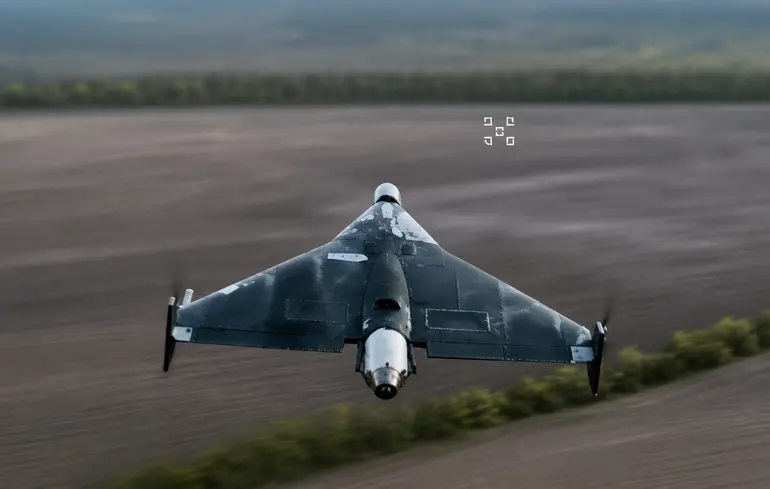
Ukraine's drone interceptors work until the weather turns. On 28 July, Presidential advisor Serhii "Flash" Beskrestnov wrote that fog and cloud in fall, winter, and spring can leave an interceptor pilot unable to see more than a dozen meters, and that success rates fall as soon as winter begins, a problem that is especially severe over the sea.
Cheap interceptor drones have become one of Ukraine's main answers to Shahed saturation. But nearly every system shares the fla
Ukraine's drone interceptors work until the weather turns. On 28 July, Presidential advisor Serhii "Flash" Beskrestnov wrote that fog and cloud in fall, winter, and spring can leave an interceptor pilot unable to see more than a dozen meters, and that success rates fall as soon as winter begins, a problem that is especially severe over the sea.
Cheap interceptor drones have become one of Ukraine's main answers to Shahed saturation. But nearly every system shares the flaw Beskrestnov names: it depends on a pilot or camera seeing the target. Ukrainian and foreign teams are all racing toward the same fix, an onboard seeker head.
The method started simple
The earliest approach was primitive but cheap and effective, Beskrestnov said. A pilot flies the interceptor to the right point using the radar network, then finds the target by eye, chases it, and attacks.
Russia answered not only with jet Shaheds but with onboard electronic warfare, evasion systems, in-flight maneuvers, and rear-facing cameras to watch the sky behind, he explained. Ukraine replied with machine-vision target capture and guidance.
Bad weather remains unsolved
None of that fixes visibility, Beskrestnov wrote, and the problem hits both ordinary and jet interceptors. The way out, he argued, is an autonomous seeker head, acoustic, thermal, or radar, mounted on the interceptor itself.
A radar seeker is the ideal, in his view, because it opens the door to a fully autonomous system with no human in the loop: the network sees the target, launches the nearest interceptor, guides it by tactical radar, and the seeker locks on for the kill.
A US firm has put a price on it
Building a radar small enough for an interceptor has proven hard, and teams in Ukraine and abroad are working on it, Beskrestnov said, adding that he would not discuss the Ukrainian efforts because the subject is sensitive.
He pointed to the American company Archimedes, which he said announced a radar days ago, operating at 24 gigahertz with a 25-by-14-degree field of view and a one-kilometer lock-on range, shown in a promotional video mounted on several Ukrainian interceptors, at about $4,000 per unit. Whether it works remains to be seen, he added, given how hard the problem is.
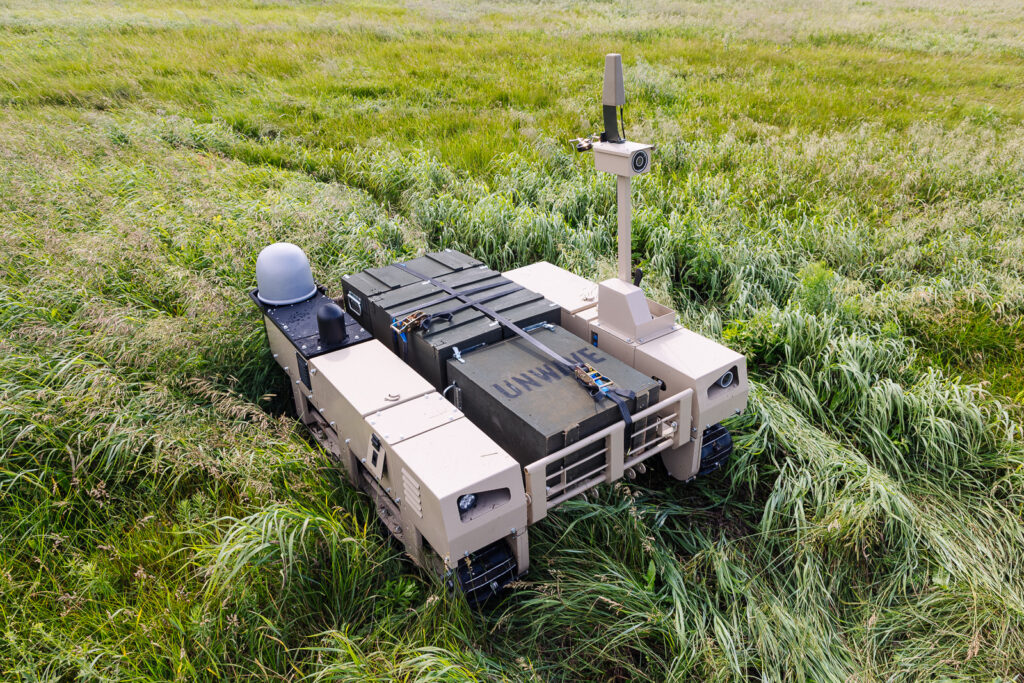
A Ukrainian ground robot used to run 12-15 missions. Near Kupiansk, it now survives three or four. The lifespan is collapsing under the denser Russian FPV drone and mining fire, Andrii Kopach, call sign "Matematyk", who commands a ground-robot unit in the "Lava" unmanned regiment of the "Khartia" corps, told Oboronka.
Ground robots have become a daily part of the front in Ukraine. Ukrainian units ran 16,676 logistics, strike, and evacuation missions with them in June, u
A Ukrainian ground robot used to run 12-15 missions. Near Kupiansk, it now survives three or four. The lifespan is collapsing under the denser Russian FPV drone and mining fire, Andrii Kopach, call sign "Matematyk", who commands a ground-robot unit in the "Lava" unmanned regiment of the "Khartia" corps, told Oboronka.
Ground robots have become a daily part of the front in Ukraine. Ukrainian units ran 16,676 logistics, strike, and evacuation missions with them in June, up 122 percent since January, and the military has contracted more than 22,000 for 2026, nearly double the 2025 total. That scale runs into a wall at the front, where Russia now assigns FPV crews, including fiber-optic drones, specifically to kill the robots.
The lifespan keeps shrinking
The pace of technological change is the core problem, Matematyk said. Ukrainian makers keep improving the platforms, but cannot always keep pace with how quickly the fighting evolves.
A machine may last only three or four missions now, as in Kharkiv Oblast, where it was eight or nine before and 12 to 15 earlier still, he said. Mining, Russian fiber-optic activity, FPV activity, and a targeted focus on countering robots all drive the decline.
Speed is the missing requirement
Most robots at the front are technologically outdated in speed and suspension, Matematyk said. Current figures of 10 to 15 kilometers per hour no longer allow a machine to cross logistics routes safely.
He put the problem in an image. Gun-armed combat robots, he said, are "Persian elephants", fearsome but so slow to reach the objective that "a couple of centuries" pass first. What the army needs are "Arabian steeds" that gallop in, do the job, and gallop back.
AI defense is in development
Ukrainian troops are working with Brave1 and the Digital Transformation Ministry on AI-based active-protection systems that could autonomously detect and neutralize enemy FPVs, Matematyk said. The approaches vary, from a camera to a mini-radar to a camera paired with sound.
The countermeasures could be net launchers, or for fast machines, shotgun blasts and shrapnel, he said. The detection and response are trained on models built from the data his unit has logged over previous years. Ukraine still holds a quality edge over Russian robots through better Starlink-based communications and decentralized robot groups in its units, he added.
A NATO country's defense minister wanted Mykhailo Fedorov the day after Ukraine dismissed him. Fedorov, Ukraine's former defense minister, has agreed to advise Italian Defense Minister Guido Crosetto on defense innovation, he wrote on Telegram.
As deputy prime minister and digital transformation minister, Fedorov created the Brave1 defense-tech cluster, then ran the Defense Ministry from 14 January 2026 until his dismissal in July. The removal triggered nationwide prote
A NATO country's defense minister wanted Mykhailo Fedorov the day after Ukraine dismissed him. Fedorov, Ukraine's former defense minister, has agreed to advise Italian Defense Minister Guido Crosetto on defense innovation, he wrote on Telegram.
As deputy prime minister and digital transformation minister, Fedorov created the Brave1 defense-tech cluster, then ran the Defense Ministry from 14 January 2026 until his dismissal in July. The removal triggered nationwide protests through July, with demonstrators calling for his reinstatement.
Earlier, Fedorov refused every other post Zelenskyy offered, saying only the defense minister, the president, and the commander-in-chief truly shape the war.
"I thanked Guido for his personal support and for offering me the opportunity to serve as his adviser on defense innovation. In this role, I will help Italy develop modern warfare technologies," he said.
Crozetto moved within a day
The Italian minister said he called Fedorov the day after the dismissal and asked when he would come to Rome to work as an advisor.
Fedorov met Crosetto on the first stop of an international trip focused on digitalization and defense technology.
The focus stays on his own projects
Fedorov said his main focus is unchanged and that he continues working in Ukraine on his own projects to strengthen its defense and attract international resources. In the advisory role, he will help Italy develop technologies of modern war and adapt to new security challenges, he wrote.
The two discussed drones, autonomous systems, air defense, and the development of a defense-tech ecosystem. The future of defense belongs to countries that can quickly test and scale new solutions, Fedorov said, and Ukraine's experience could serve as the basis for a new defense model for Europe.
Earlier, the Ukrainian parliament approved Yevhenii Khmara as the new defense minister. During his first speech, Khmara made it clear that he would continue his predecessor's course — the technologization of the army.
He added that there "would be more Ukrainian weapons, and strikes would be more precise.
Russia has spent the past two days repeatedly attacking Kyiv and Kyiv Oblast with jet-powered drones, hitting commercial and logistics infrastructure and disrupting businesses and supply chains around the capital.
The attacks have struck civilian enterprises, food warehouses, hypermarkets, postal terminals, and warehouses storing books, according to Ukraine’s Interior Minister Ivan Vyhivskyi. Fires have broken out at multiple warehouse sites, while repeated strikes have
Russia has spent the past two days repeatedly attacking Kyiv and Kyiv Oblast with jet-powered drones, hitting commercial and logistics infrastructure and disrupting businesses and supply chains around the capital.
The attacks have struck civilian enterprises, food warehouses, hypermarkets, postal terminals, and warehouses storing books, according to Ukraine’s Interior Minister Ivan Vyhivskyi. Fires have broken out at multiple warehouse sites, while repeated strikes have forced emergency crews to repeatedly stop their work and seek shelter.
The attacks are also affecting the movement and storage of essential goods around Kyiv, with damage to food warehouses and other logistics facilities contributing to supply disruptions and shortages.
Russia expands its aerial campaign against Kyiv
The latest wave comes after Russia dramatically ramped up its use of ballistic missiles against Kyiv and other Ukrainian cities in recent months. Now, improved Russian jet-powered drones are being used to sustain repeated attacks on the capital and surrounding oblast.
Russian forces have been launching the jet-powered drones at Ukrainian regions almost continuously for the previous two days.
The pattern has left Kyiv and Kyiv Oblast under prolonged air raid alerts while putting emergency crews under the threat of repeated strikes.
In Kyiv alone, air raid alerts were issued 13 times on 27 August and lasted for more than 14 hours in total.
Across Ukraine, Russian attacks killed 16 people and injured another 50 during the day, Vyhivskyi said.
Kyiv Oblast has been among the hardest-hit areas. Ukraine’s State Emergency Service (DSNS) said on Friday morning the oblast had come under 38 Russian attacks since the first strike overnight on 27 August.
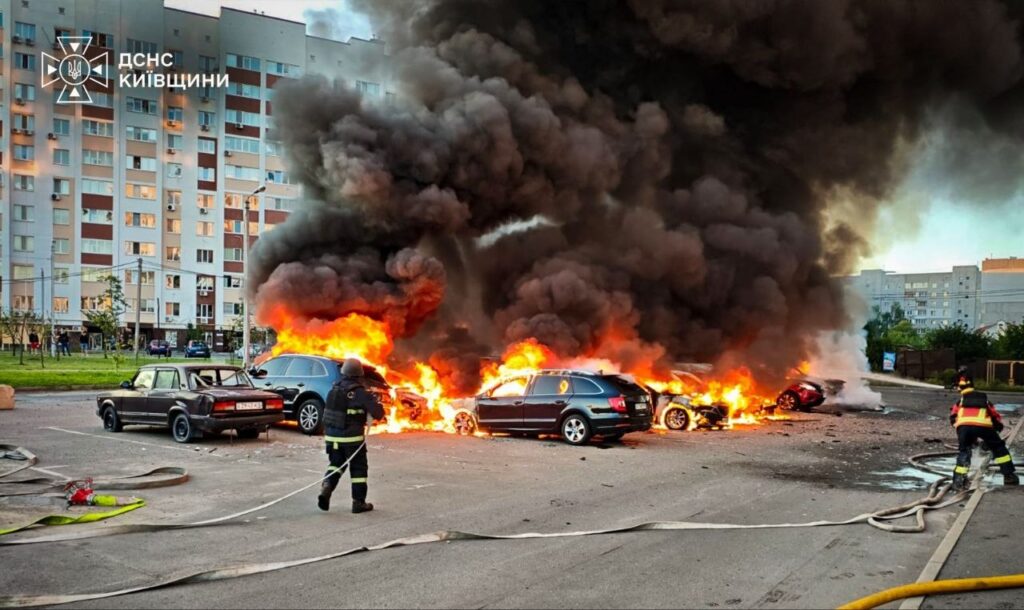
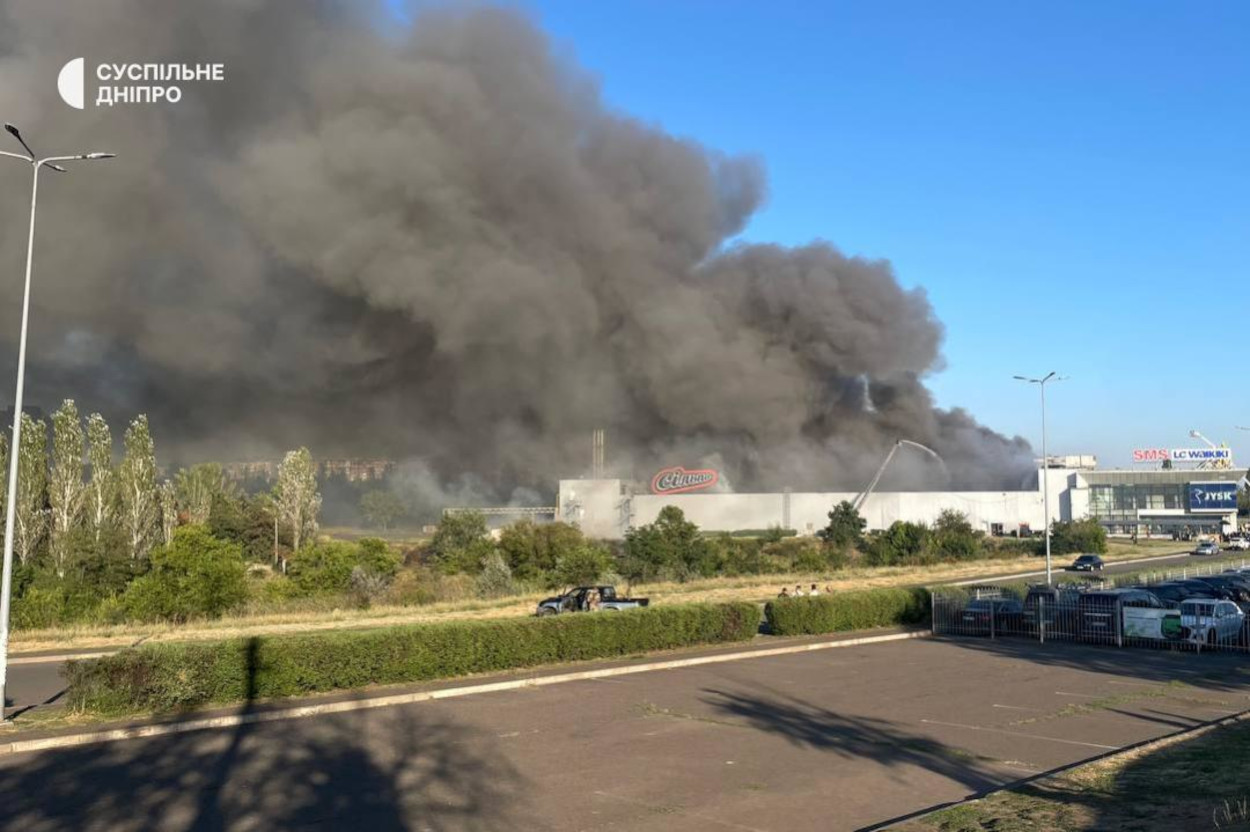
In Bucha district, firefighters worked at several locations where Russian drone strikes caused fires at warehouses and damaged vehicles.
At one site, a drone struck again while rescuers were working. After checking the area, emergency crews returned to the site and continued fighting the fire.
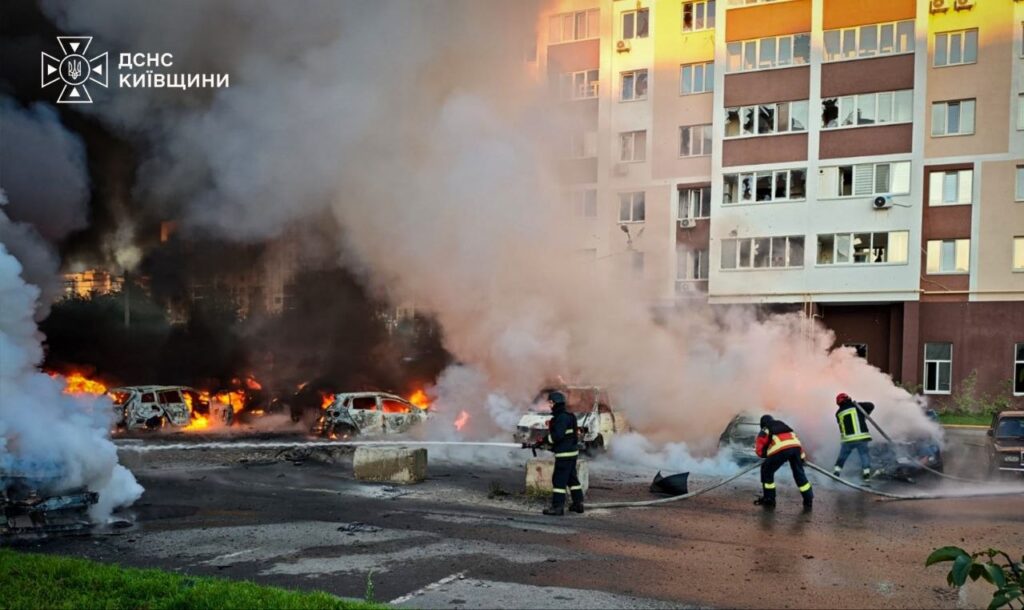
Firefighters also extinguished a fire involving 13 passenger cars. A nearby apartment building was damaged by the blast wave, which shattered windows.
At three locations, crews were still working to extinguish fires at warehouse buildings caused by the repeated attacks.
Aftermath of a Russian strike on Kyiv Oblast, 28 August 2026. Photo: Ukraine's State Emergency Service
Repeat strikes put rescuers at risk
The repeated attacks have made emergency operations particularly dangerous. Since rescuers began working, air raid alerts in the oblast had sounded 20 times as of Friday morning, according to the DSNS.
Firefighters have repeatedly been forced to stop their work and move to shelters or safe distances because of the threat of another strike, before returning to the fires once the danger passes.
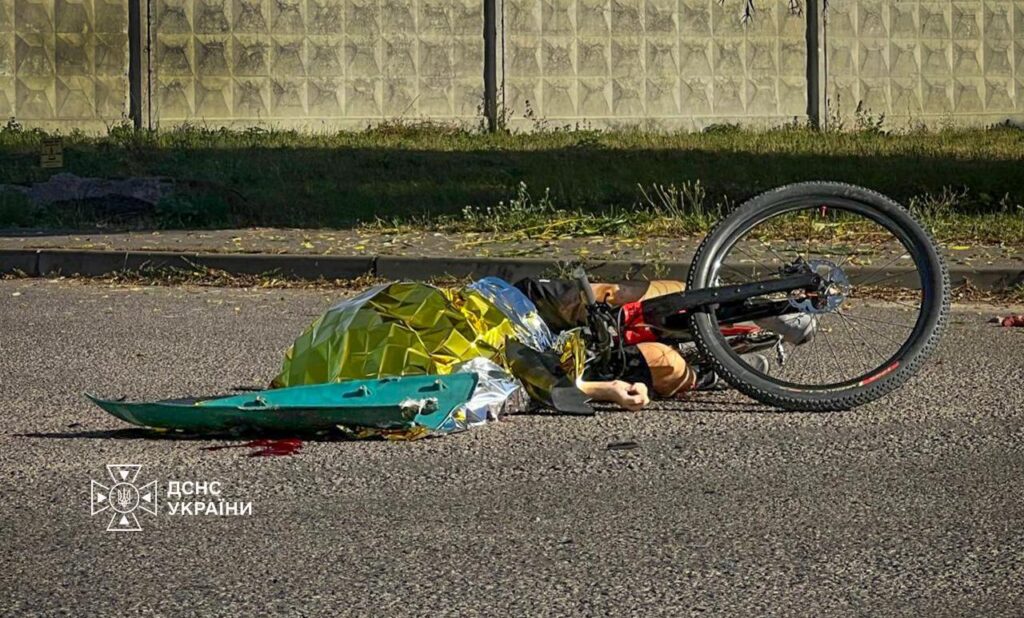
Vyhivskyi said one person was killed and others injured in Kyiv Oblast on the morning of 28 August after civilians remained near a site where crews were clearing the aftermath of an earlier strike despite the threat of another attack.
Russia’s latest attacks on Kyiv Oblast have repeatedly put emergency crews in danger, with firefighters forced to halt their work and move to safety as follow-up strikes hit the area.
Ukraine's State Emergency Service said that on 27 August, the oblast came under 28 additional… pic.twitter.com/cPdkj6Wxwa
The attacks on Kyiv and Kyiv Oblast are part of a broader recent pattern of Russian strikes on commercial infrastructure across Ukraine. In recent weeks, Russian drones have hit shopping centers, hypermarkets, warehouses, postal terminals and other civilian businesses.
In Kharkiv, a Russian jet-powered drone struck a closed shopping center in the city’s Kyivskyi district on 28 August, partially damaging the building and starting a fire among equipment and furniture. Firefighters extinguished the blaze despite the threat of repeat strikes. No casualties were reported.
Russia has struck another shopping center in Kharkiv with a jet-powered drone, hitting a closed commercial facility in the city’s Kyivskyi district.
The strike comes amid Russia’s intensified campaign against commercial sites across Ukraine, including shopping centers,… pic.twitter.com/KSj719sSKz
In Zaporizhzhia, another Russian drone strike injured five people and set a shopping center on fire. The blaze covered about 14,000 square meters, and firefighters had to repeatedly take shelter because of the threat of follow-up attacks.
A Russian drone strike on Zaporizhzhia injured five people and sparked a massive fire at a shopping center, with the blaze spreading across about 14,000 square meters.
The attack comes amid Russia’s intensified targeting of commercial and logistics sites across Ukraine,… pic.twitter.com/Iu5OyoGCGx
The strikes are adding pressure to Ukraine’s civilian supply and logistics networks, particularly around major population centers. Damage to food warehouses, retail facilities and logistics sites can disrupt the storage and movement of goods, contributing to shortages and delays for businesses and consumers.
Explore further
Russian drone strike on Kryvyi Rih shopping center kills 15, injures 130. Second attack targeted rescue workers 30 minutes later
Authorities warn civilians to stay away
Ukrainian authorities have urged residents to remain in shelters or other safe locations during air raid alerts and avoid areas where emergency crews are working.
The DSNS warned people not to approach sites where the aftermath of Russian strikes is being cleared, citing the continuing threat of repeat attacks.
Vyhivskyi also urged residents to treat every air raid alert as a signal to move to a shelter or other safe location, warning that no urgent task is worth risking a life.
Victim of a Russian strike on Kyiv Oblast, 28 August 2026. Photo: Ukraine's State Emergency Service
A Russian drone company is developing an interceptor drone—the cheap counter-drone weapon Ukraine has fielded at scale against Russian attack drones—internal documents published by the Russian resistance group Black Spark describe, the defense outlet Militarnyi reported. The documents describe two designs under consideration, and Black Spark alleges the company cooperated with Boeing before the full-scale invasion and spied on European companies.
Interceptor drones—unma
A Russian drone company is developing an interceptor drone—the cheap counter-drone weapon Ukraine has fielded at scale against Russian attack drones—internal documents published by the Russian resistance group Black Spark describe, the defense outlet Militarnyi reported. The documents describe two designs under consideration, and Black Spark alleges the company cooperated with Boeing before the full-scale invasion and spied on European companies.
Interceptor drones—unmanned aircraft that hunt other drones—scaled up out of Ukraine's need to shoot down Russia's mass Shahed attacks without spending million-dollar missiles on them. Ukraine now fields them from dozens of licensed makers, and their spread has pushed Russia toward faster jet-powered attack drones. Russia already flies anti-drone interceptors of its own—Ukrainian troops downed one in July—and the leaked designs would fly far faster than that machine.
Mortar-launched drone-killer
NIK is considering two interceptor designs. The first modifies the company's existing UBB-M, a folding-wing loitering munition that launches from a 160 mm container by mortar-style ejection. For the interceptor role, designers changed the wing from straight to swept, shrank the wingspan, installed a larger battery, and fitted a more powerful motor.
Explore further
Russia’s attack drones now jam the cheap interceptors sent to kill them
The modified drone weighs 15-16 kg, carries a 3 kg payload—likely a warhead—and flies at 250-300 km/h with a 20 km operating radius and up to 10 minutes of flight time, operating between 20 meters and 4.5 km altitude. NIK's second design has a cone-shaped fuselage with four electric motors. Its specifications remain unknown.
Espionage claim comes with no documents
Black Spark says the documents came from someone inside the company, not a break-in, and that it holds evidence the firm spied on European companies. It gave no details on the Boeing cooperation beyond dating it before the invasion.
The leak is Black Spark's latest operation against Russia's defense industry. The group, which operates inside Russia, says it infiltrated the Alabuga factory where Russia assembles Shahed-derived Geran drones and copied personnel databases. Ukraine's Special Operations Forces have acknowledged joint missions with Black Spark, including attacks on Russian oil infrastructure.

 Connexion