Vue normale

The Fedorov protesters lost. But they backed a man for what he built, not what he promised—and that may be new in Ukraine.

20 août 2026 à 15:14

A column of protesters demanding reinstatement of Mykhailo Fedorov as Defense MInister walks in vul. Khreschatyk in Kyiv, 1 August 2026. Photo: Serge Kostezh/Kyivpost

On 19 August, veteran and civic activist Dmytro Koziatynskyi thanked everyone who had taken part in the month-long protests to bring back Mykhailo Fedorov, and said it was all worth it. Koziatynskyi was one of the organizers of rallies across Ukrainian cities demanding the reinstatement of Fedorov, the defense minister widely credited with driving Ukraine's military-tech overhaul, after he was abruptly dismissed on 14 July.

His firing detonated a month of protests because Fedorov was no ordinary minister: the 35-year-old reformer had exposed billions in defense overspending and built the drone programs many Ukrainians saw as their best chance in the war, so his removal read, to those in the streets, as the old system protecting itself.

Koziatynskyi's decision to end his protest came after Parliament voted 312 that same day to appoint Yevhenii Khmara as defense minister. Ukrainian President Zelenskyy did not meet the protesters' main demand: the return of Fedorov.

"It is a pity that we were never able to establish a dialogue between the authorities and society. I hope this issue will be resolved over time because, in my view, the lack of communication was the root cause of these protests," Koziatynskyi writes.
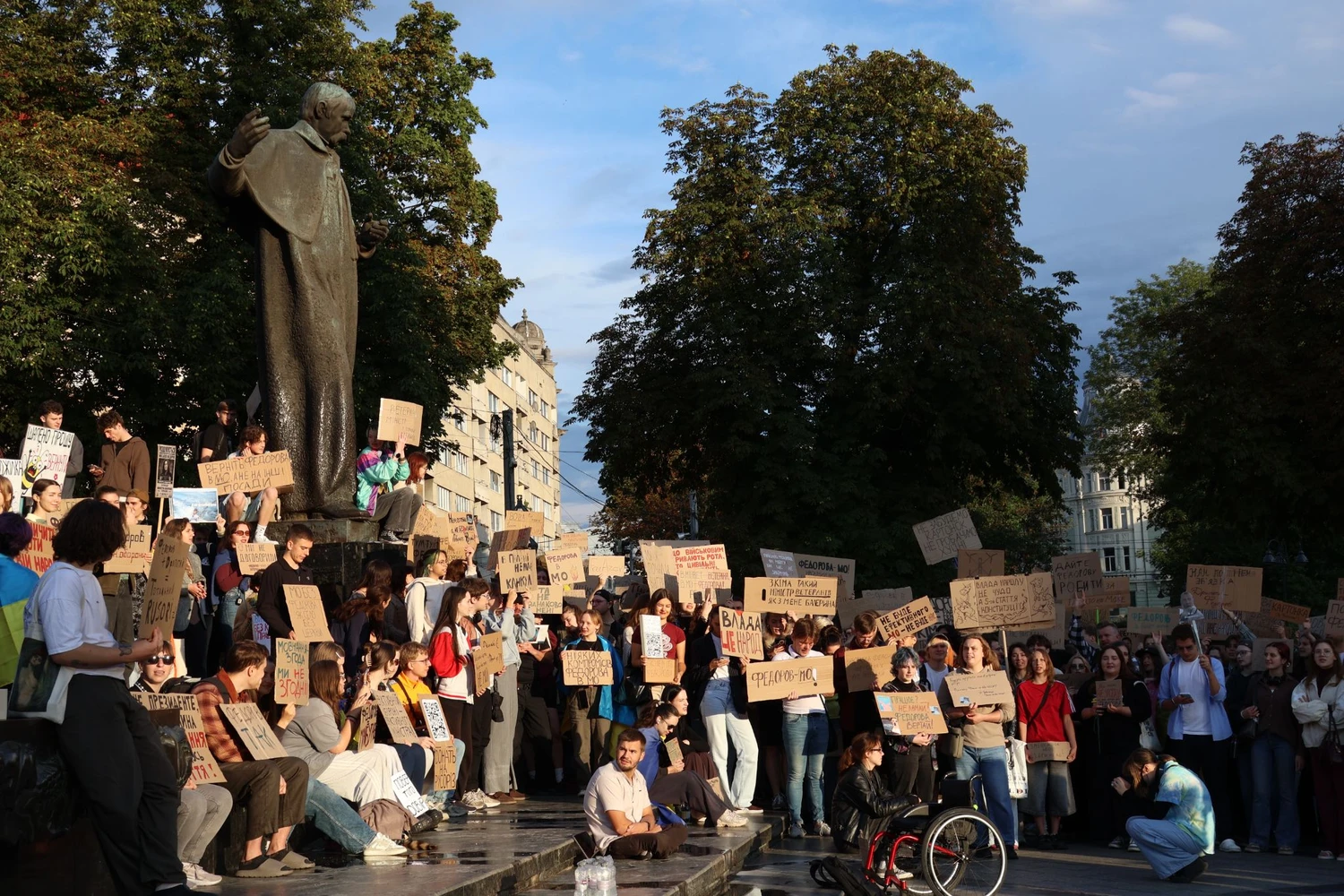
Demonstrators beneath the Taras Shevchenko monument in Lviv hold handwritten cardboard signs during an open-ended protest calling for Mykhailo Fedorov's reinstatement as Ukraine's Minister of Defence. Photo: Solomiia Stanovych/Euromaidan Press.
Explore further

Ukraine’s cardboard protests look like democracy working. In a war, that’s also the risk.

But the rallies may leave Ukrainian society with something that outlasts the outcome of one personnel decision, Anatolii Romaniuk, a political scientist at Ivan Franko National University in Lviv, told Euromaidan Press. The protesters lost: Parliament appointed Yevhenii Khmara as defense minister, not Mykhailo Fedorov. Yet the "cardboard Maidan," as the protests were termed for their abundance of handmade signs, may have revealed the beginnings of a broader shift in Ukrainian society. Romaniuk believes its significance lies in why people took to the streets: to support a politician not because of what he promised them, but because of what he had already done.
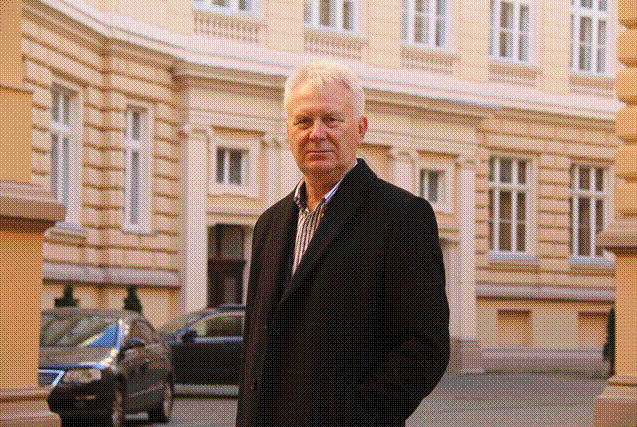
Anatolii Romaniuk. Photo: Ivan Franko National University of Lviv

Actions, not words

Romaniuk believes Ukrainian society has long lived under what he calls a "political curse": large numbers of Ukrainians repeatedly bought into populist promises from politicians offering things that were simply unrealistic.

He points to every Ukrainian election from 2004 through 2019, arguing that the share of populist promises only increased. Experts could see that many of them were impossible to fulfill, he says, yet voters continued to support politicians who made them. Romaniuk points to a promise from the 2019 election campaign that Ukrainian wages would overtake Poland's—at a time when the average salary in Ukraine was around $400 a month, and Poland's was roughly three times that.

The 2026 protests may represent a change in perspective, he argues: people backed a politician not for what he said he would do, but for what he had already done.

Fedorov's signature result was an audit—in his first months, his ministry exposed roughly $7.2 billion (300 billion hryvnia) in defense overspending, and that figure became the movement's rallying cry. "The audit showed 300 billion in theft. They removed the auditor, not the thieves," read one cardboard sign in Lviv.
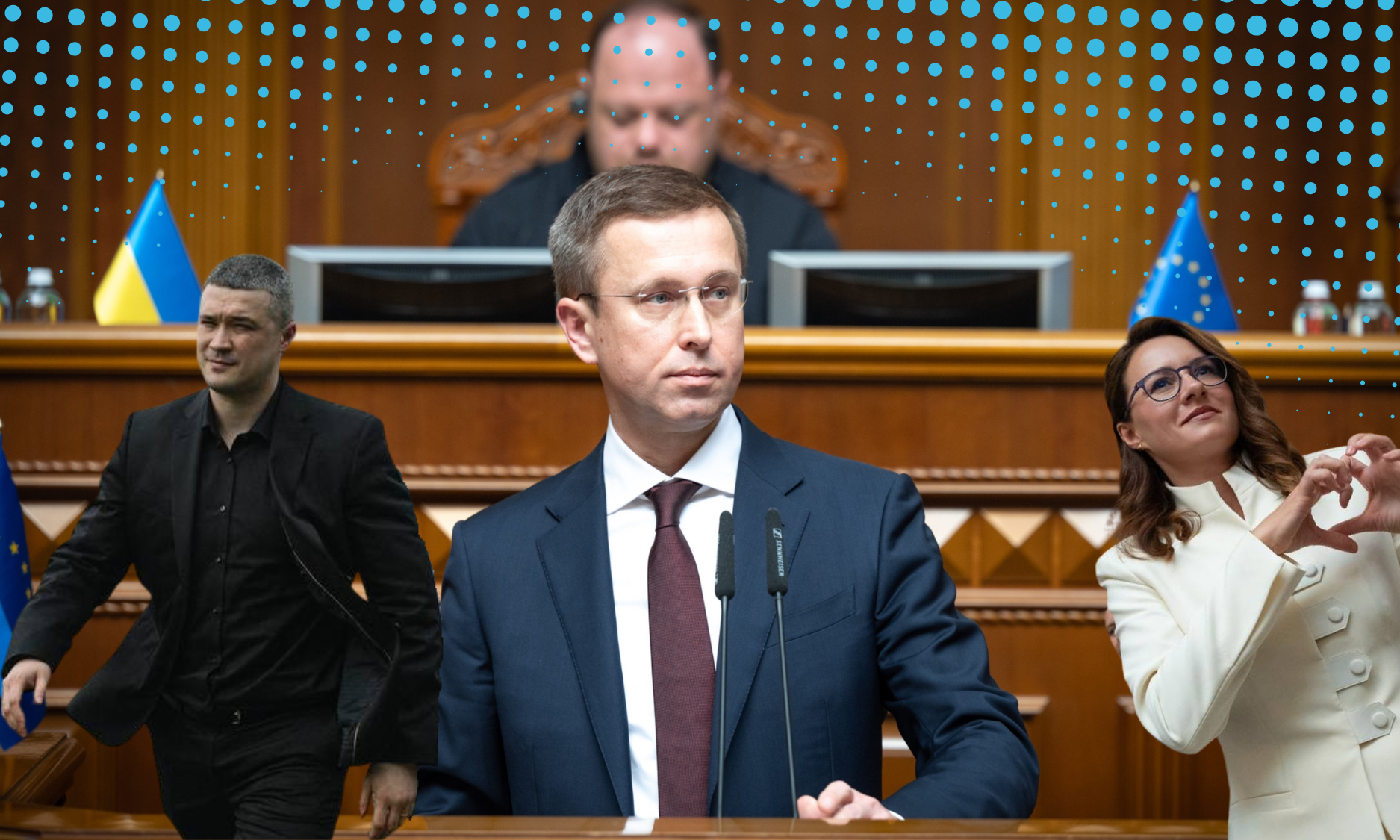
fedorov, koretskyi, svyrydenko collage
Explore further

“They removed the auditor, not the thieves”: why Ukrainians are protesting Zelenskyy’s reshuffle

The protesters were defending a record: open procurement built on the Brave1 marketplace, where frontline units order drones directly from certified manufacturers; a first competitive tender that cut 155mm shell prices by 16%; and, above all, Fedorov's bet on robotization—technology instead of manpower—that many Ukrainians saw as their best chance against a larger Russian army, a way to spend drones rather than lives. Fedorov was removed while he was implementing the reform, amid a conflict with then Commander-in-Chief Oleksandr Syrskyi.

"If this change in perspective continues, we will get out of the situation where we have become hostages to a growing wave of populism that would otherwise simply overwhelm us in the next elections. Because the degree, or the level, of populism in the 2019 elections was already very high. It was unrealistic," Romaniuk says of the protests' possible longer-term effect.
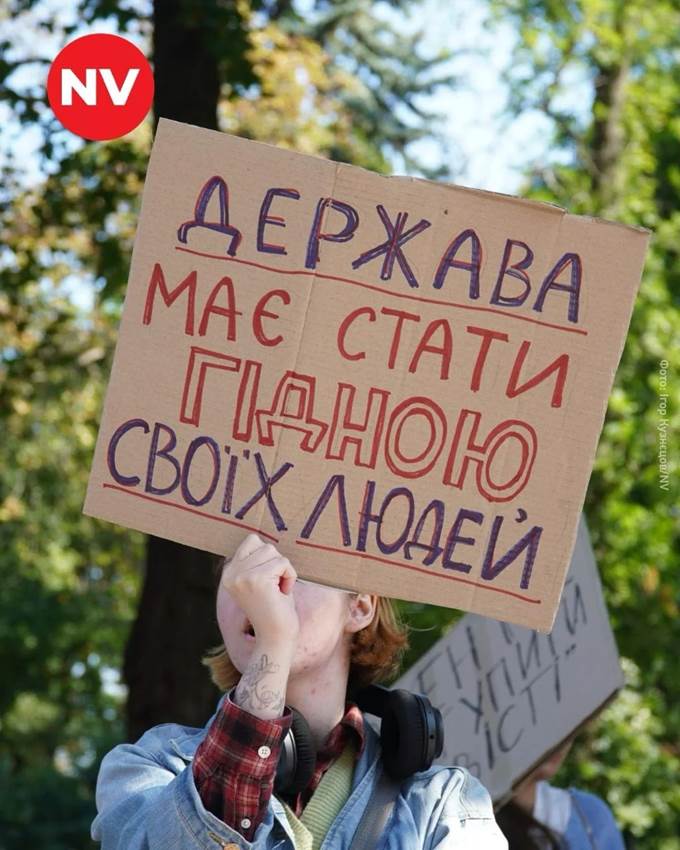
"The state must be worthy of its people." A protester stands with a cardboard sign outside the Verkhovna Rada during the session on Khmara's appointment. Kyiv, 19 August 2026. Photo: Ihor Kuznietsov/NV

The protesters were "for," not "against"

Romaniuk sees another distinction between these demonstrations and earlier protests in Ukraine's modern history: previous movements were built around being "against" something. This time, the demand was explicitly "for" something.

"If we recall the events of the 2014 Euromaidan Revolution, and even last year's protests, they were 'against.' That is, they were against Yanukovych signing an agreement with Russia and refusing to sign the Association Agreement. They were against a decision made at the highest level in Ukraine to restrict the anti-corruption bodies," Romaniuk says, referring to former President Viktor Yanukovych, whose 2013 pivot away from the European Union set off the Euromaidan Revolution.

He argues that Ukraine has never before seen protests explicitly organized in support of a government official, making the Fedorov rallies a first.

At the same time, Romaniuk acknowledges the paradox: even protests framed as being "against" something almost always implied support for an alternative. In 2004, for example, Ukrainians protested the results of the second round of a falsified presidential election that had declared pro-Russian Viktor Yanukovych the winner over his pro-European rival, Viktor Yushchenko. But by opposing those results, Romaniuk says, they were also supporting democratic elections.
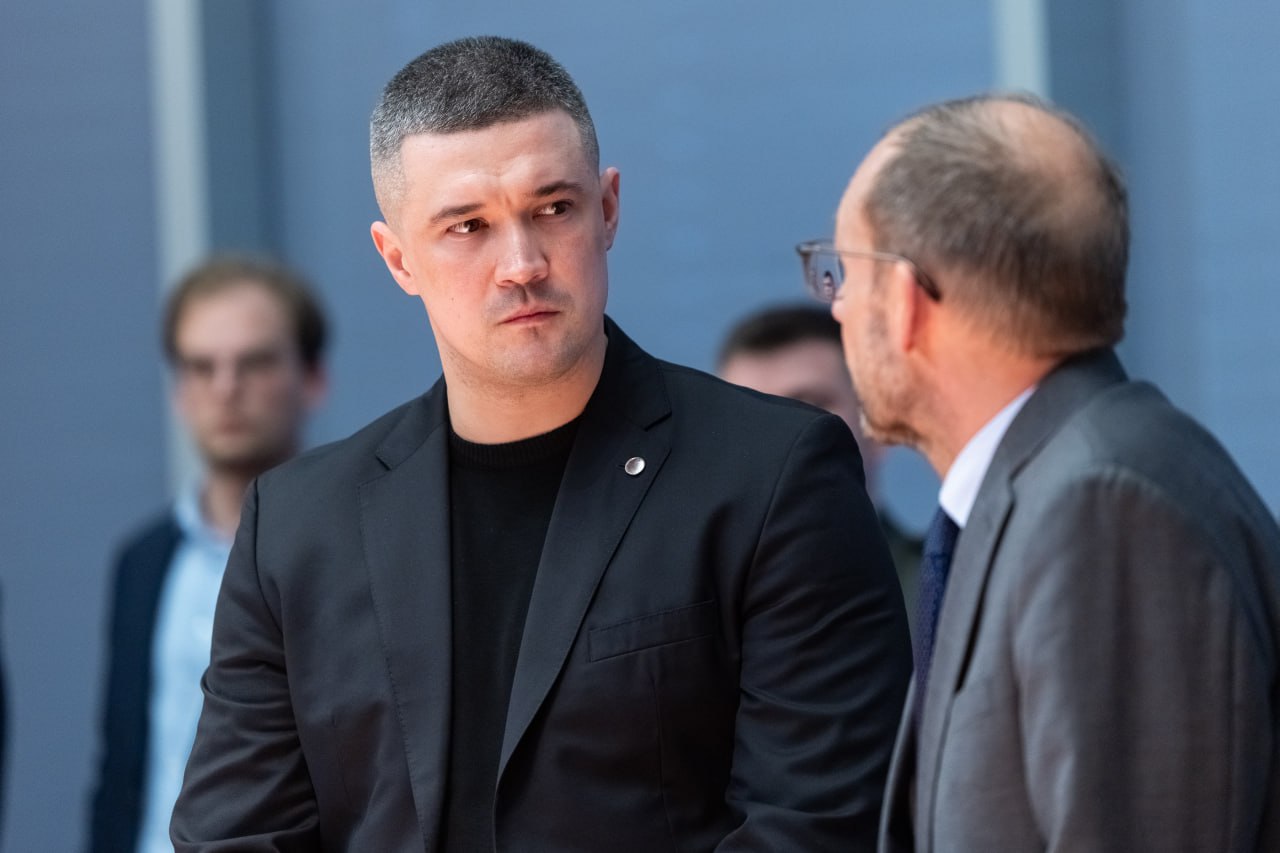
Ukrainian Defense Minister Mykhailo Fedorov in Germany, on 15 April 2026. Source: Fedorov
Explore further

Ukraine’s ousted defense minister took drone contracts away from the generals. Now they may take them back

The difference this time is that the "for" was clearly articulated. Protesters demanding Fedorov's return had an idea of the kind of Ukraine they wanted to see.

"In these protests, we have a situation where people are supporting the course pursued by Defense Minister Fedorov—the modernization of the army, changing approaches to warfare, and changing what the Ukrainian state should look like," Romaniuk says.
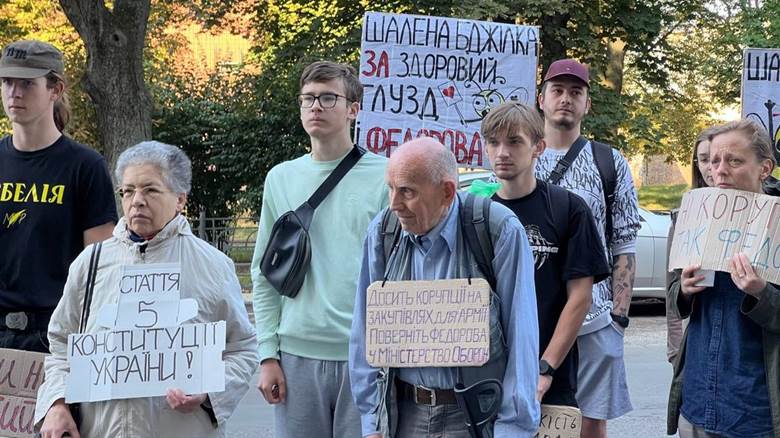
Participants in a protest calling for Mykhailo Fedorov to be reinstated as defense minister. Lviv, 19 August 2026. Photo: Snizhana Dobromylska/Suspilne Lviv.

Dariia, a 22-year-old who attended the protests in Lviv, describes her reasons for joining them in similar terms.

"My motivation is to see changes in the country, to see justice, to see that young, progressive people who put technology ahead of human losses are leading us toward victory."

She says Fedorov was one of the people introducing reforms "from the very top of government all the way to the battlefield."

"And we really saw those changes," Dariia told Euromaidan Press. She credits Fedorov with the long-range drone campaign that has struck Russian refineries, defense plants, and Wildberries depots as far as Bashkortostan, some 1,300 kilometers inside Russia: "Our enemy finds ways to attack, and we must also search for new ways to respond. Fedorov, as defense minister, was the person finding ways to respond to these attacks, how to carry out deep strikes."

mykhailo fedorov
Explore further

Ukraine’s defense minister explained how the country buys weapons—after he was sacked

This year's cardboard protests could be a good start

Romaniuk cautions that it is still too early to speak of a change in Ukrainians' political culture. But he says he would like to see this episode become the beginning of one.

"I would like other people in power to also be judged by their results, by what they have done," he says.

A genuine pattern, he adds, could only be established if similar cases repeated themselves. For now, this remains one specific episode rather than a proven trend.

Dariia connects the rallies to her own experience of protesting more than a decade earlier.

"I remember the rallies in Mykolaiv in 2014 against the occupation regime in the east. Back then, it was five people with cardboard signs standing in the rain. My family was one of them. Nobody came out, nobody understood that position… It is nice to see that people in the south and east understand now," Dariia says.
14 killed as Russia unleashes massive overnight barrage on unprotected Kyiv, striking homes, hospital, school and railway infrastructure

20 août 2026 à 04:47

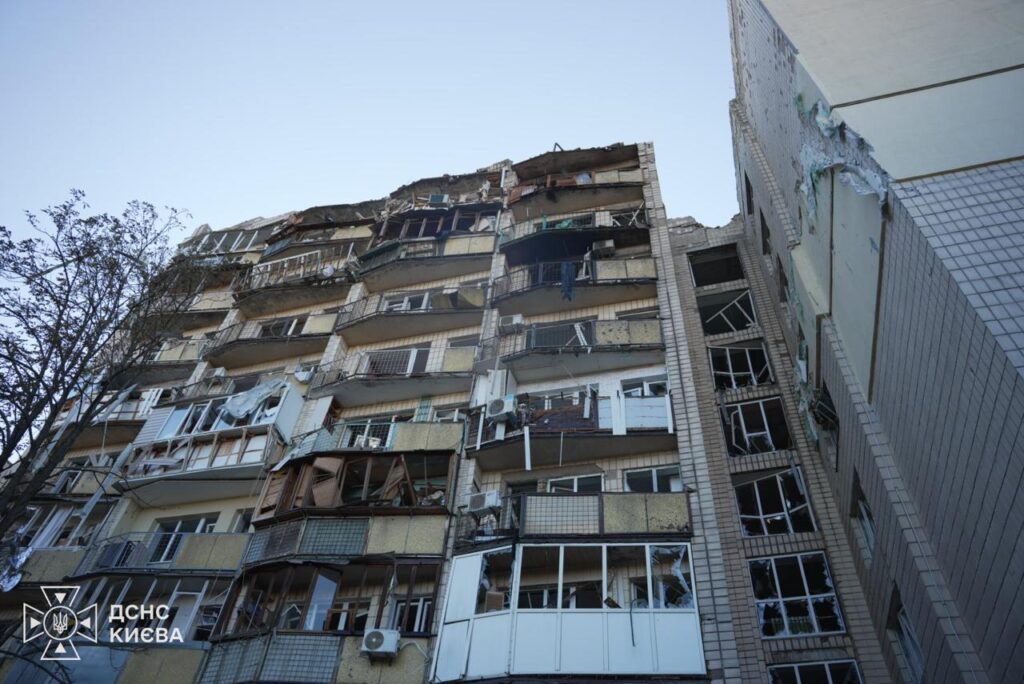
Apartment building damaged from a massive Russian aerial attack on Kyiv, Ukraine, 20 August 2026. Photo: Ukraine's State Emergency Service

Editor's note: This is a developing story.

Russia launched a massive overnight missile and drone attack targeting Kyiv and the surrounding region, killing 14 people and injuring more than 40, Ukrainian authorities said on 20 August.

The attack involved ballistic and cruise missiles alongside hundreds of drones. Ukraine’s Air Force said the main direction of the attack was Kyiv Oblast, with strikes and debris recorded at multiple locations. Several explosions were heard in the capital around midnight on 20 August, according to Euromaidan Press reporters in the city.

Residential building hit in Kyiv

In Kyiv, strikes, damage, and fires were reported in the Sviatoshynskyi, Darnytskyi, and Solomianskyi districts.

In Solomianskyi district, the upper two floors of a nine-story residential building were destroyed, with a fire breaking out across the seventh through ninth floors. 

People were trapped in two residential buildings and a school bomb shelter, prompting emergency crews to carry out rescue operations.

Thirteen people have now been confirmed killed in Kyiv, including a woman whose body was discovered by rescuers in Solomianskyi district, Interior Minister Ivan Vyhivskyi said.

Ukrainian President Volodymyr Zelenskyy said a children's hospital and a school were also damaged in the capital.

Kyiv Mayor Vitali Klitschko said the city would observe 21 August as a day of mourning, with entertainment events banned and flags lowered.

Death toll from Russia's missile attack on Kyiv city and Oblast climbs to 14

Ukraine's Interior Minister Ivan Vyhivskyi says another woman's body was found in Solomianskyi. More than 40 were wounded. The strikes damaged about 20 residential buildings, a school, a children's… pic.twitter.com/3wicnc5lni

— Euromaidan Press (@EuromaidanPress) August 20, 2026

Fires and damage across Kyiv

Around 20 residential buildings in Kyiv were significantly damaged, along with a school, children's hospital, and kindergarten, Vyhivskyi said.

In Sviatoshynskyi district, Russian strikes hit an industrial site and sparked fires at warehouses covering 500 and 1,000 square meters. Another warehouse also caught fire.

In Darnytskyi district, a non-residential site was hit, causing fires across warehouses and vehicles covering about 1,000 square meters. Rescuers saved one person and handed them over to medics.

Other locations saw damage to residential buildings, a medical facility, cars, garages, and stores.

More than 600 rescuers and police officers have been involved in clearing the aftermath since overnight. Emergency crews are currently working at two sites in Kyiv and three more in Boryspil and Brovary districts.

Rescuers are using specialized equipment and robotic systems to clear the rubble and check whether anyone remains trapped.

Police have set up assistance centers at the attack sites to register reports of damaged or destroyed property. More than 200 reports have already been processed in Kyiv, while psychologists are assisting people who lost relatives or their homes.

Russia's overnight missile attack killed at least 12 people in Kyiv and injured 34.

Russia pounded Kyiv and its surrounding region for hours into 20 August with dozens of ballistic missiles, Kalibr cruise missiles, and jet-powered Shahed drones.

The strikes killed at least 12… pic.twitter.com/UxPYdi6JY1

— Euromaidan Press (@EuromaidanPress) August 20, 2026

Kyiv Oblast casualties

The attack also hit Kyiv Oblast. One man was killed in Brovary district and another was injured.

In Boryspil district, six people were injured, four of whom were hospitalized. The attack damaged 14 private homes, four warehouses, a gas station, an apartment building, and eight vehicles.

Vyhivskyi said fires also engulfed warehouses storing household goods in Kyiv Oblast. Firefighters are working to contain the blaze, with aviation also deployed.

Russian attack leaves Kyiv and six oblasts with power outages

Ukrenergo says outages hit Kyiv and Kyiv, Donetsk, Odesa, Zaporizhzhia, Dnipropetrovsk, and Kharkiv oblasts. Ukrainians are asked to limit powerful appliances from 18:00–22:00.

The occupied Zaporizhzhia nuclear… pic.twitter.com/hlVz3CWyS5

— Euromaidan Press (@EuromaidanPress) August 20, 2026

Zelenskyy calls for stronger ballistic missile defenses

Zelenskyy said Russia’s growing investment in ballistic missiles requires a stronger international response and more air defense for Ukraine.

He said Ukraine is working daily on its FREYJA interceptor program, but stressed that Patriot interceptors remain irreplaceable and are needed every day to protect Ukrainian cities from Russian ballistic missile attacks.

“Every additional missile saves the lives of our people,” Zelenskyy said, thanking those working to provide Ukraine with additional air defense capabilities.

Russia spent months preparing its missiles. Zelenskyy says Ukraine still lacks enough interceptors to stop them

Russia combined different ballistic missiles, cruise missiles, and drones in its overnight attack to maximize damage to civilian infrastructure, President Volodymyr… pic.twitter.com/4iaRPs7dLC

— Euromaidan Press (@EuromaidanPress) August 20, 2026

Hundreds of aerial targets launched

Ukraine's Air Force said Russia launched 168 Shahed-type attack drones, Gerbera decoy drones, and other drones, along with 36 Kh-101, Iskander-K, and Kh-59 cruise missiles, eight Kalibr missiles, two Banderyl-type loitering munitions, and ballistic missiles including Oniks, Zircon, Iskander-M, and S-400 missiles.

As of 9:30 a.m., Ukrainian air defenses had shot down or suppressed 31 cruise missiles, all eight Kalibr missiles, both loitering munitions, and 145 drones, according to the Air Force.

The Air Force reported impacts at 28 locations and debris from intercepted targets at two others. 

The attack continued into the late morning, with air raid sirens still active and several Russian drones still in Ukrainian airspace.

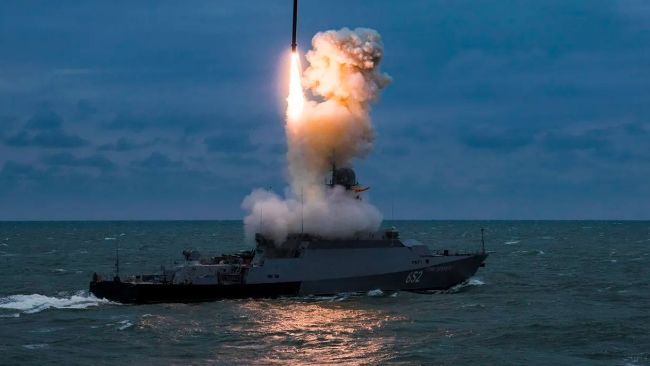
Ukraine is under a massive Russian attack right now: Russia's Kalibr missiles were launched from the Novorossiysk port

The warhead of the Kalibr family of cruise missiles typically weighs 450 kg
🎥Exilenova+ pic.twitter.com/DBgfRX7xhB

— Euromaidan Press (@EuromaidanPress) August 19, 2026
Kalibr missile launch black sea
Explore further

Russia hit Kyiv with ballistic and hypersonic missiles overnight, damaging a children’s hospital, with people trapped in a shelter

Rail traffic disrupted

Russia's strikes also disrupted rail traffic around Kyiv after railway infrastructure was damaged. Several suburban and regional trains between Kyiv and Nizhyn were rerouted or canceled.

Strikes reported in other regions

Zelenskyy said the attack also caused damage in Odesa and Chernihiv oblasts.

In Odesa Oblast, Russian drones targeted a border crossing with Moldova, while strikes in Chernihiv Oblast damaged gas infrastructure.

Russia strikes food trucks in Odesa Oblast

The attack ignited two trailers carrying food. Ukrainian firefighters extinguished the blaze, the State Emergency Service reported. No one was killed or injured.

📷 DSNS pic.twitter.com/pzt0PnKGsw

— Euromaidan Press (@EuromaidanPress) August 20, 2026
  • ✇Euromaidan Press
  • Belgium lines up a “drone deal” to tap Ukraine’s war-tested know-how
    Ukraine and Belgium are drawing up a bilateral agreement to deepen cooperation on drones, President Volodymyr Zelenskyy said after meeting Belgian Foreign Minister Maxime Prévot in Kyiv on 18 August. The two also discussed strengthening Ukraine's air power and shielding it from Russian attacks. Cheap drones now decide much of the fighting, and Kyiv has turned years of learning to fly and defeat them into leverage—trading that edge for weapons and money with a lengthenin
     

Belgium lines up a “drone deal” to tap Ukraine’s war-tested know-how

20 août 2026 à 03:19

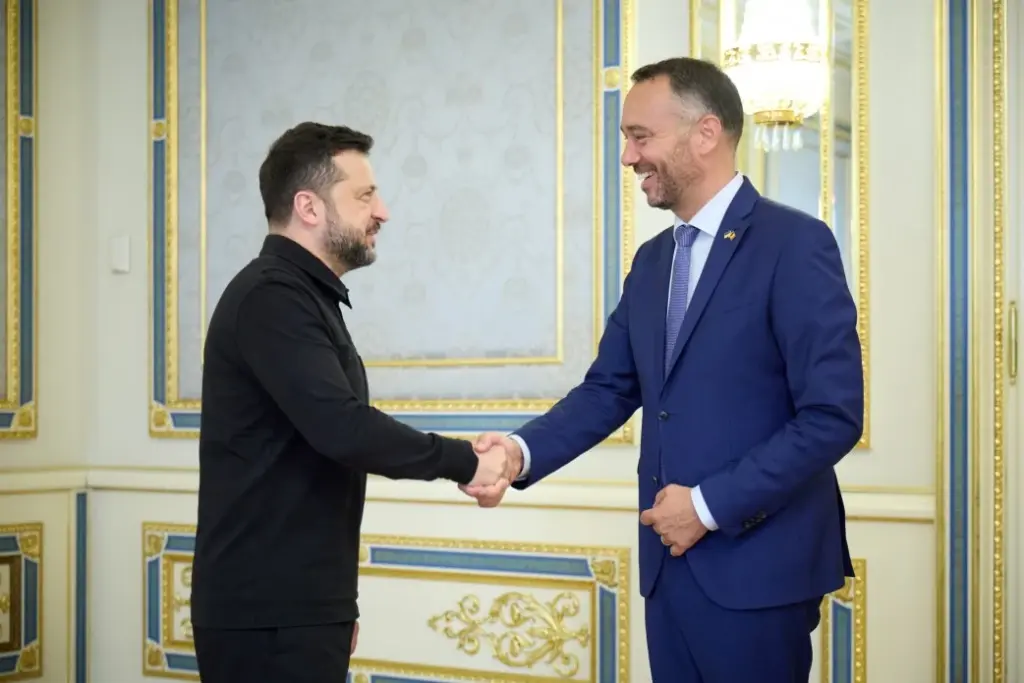
Volodymyr Zelenskyy, President of Ukraine, and Maxime Prévot, Belgium’s Deputy Prime Minister and Minister of Foreign Affairs, European Affairs, and Development Cooperation

Ukraine and Belgium are drawing up a bilateral agreement to deepen cooperation on drones, President Volodymyr Zelenskyy said after meeting Belgian Foreign Minister Maxime Prévot in Kyiv on 18 August. The two also discussed strengthening Ukraine's air power and shielding it from Russian attacks.

Cheap drones now decide much of the fighting, and Kyiv has turned years of learning to fly and defeat them into leverage—trading that edge for weapons and money with a lengthening line of Western partners.

A new deal takes shape

Teams on both sides are now writing the text of the Drone Deal and weighing possible dates to sign it, ArmyInform reported. Ukraine is ready to share its own expertise in unmanned systems with partners, Zelenskyy said.

Defense ran through the meeting, with both sides focused on strengthening Ukraine's combat aviation and defending its skies.

"I expect that we will be able to implement what we discussed, and there will be more protection from Russian strikes," Zelenskyy said.

Belgium has promised 30 F-16 fighter jets—the largest F-16 pledge from any single country—though none have reached Ukraine yet, with deliveries tied to Belgium's own switch to newer aircraft.

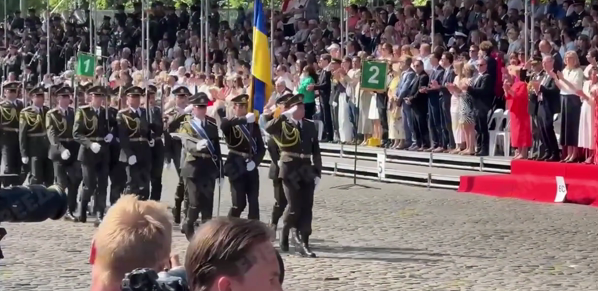
For the first time, Ukrainian soldiers marched among the foreign troops in Brussels on 21 July 2026. Source: Freedom
Explore further

“First time”: Ukrainian troops joined Belgium’s National Day parade in Brussels

Belgium's deeper backing

Zelenskyy thanked Belgium for more than $1.28 billion in support this year, covering defense and civilian needs alike, and for backing Ukraine's move toward the European Union. The military share flows from a standing pledge: since 2025, Belgium has committed to at least $1.16 billion in defense aid a year.

A 2024 security pact locked in that relationship, making a small Western European country one of Ukraine's steadier partners. Belgian firms also service the F-16s Ukraine already flies, the jets delivered by other partners in the coalition.

❌