
 Connexion
In Modi’s India, somebody is always watching
In May, William Tharien, a 19-year-old student, made his second attempt at passing NEET, India’s national entrance exam for would-be medical students. Passing the test was the only way William would be eligible to study to be a doctor, surgeon, dentist or vet and he was competing with about 2.2 million other students for one of about 130,000 places in medical schools around the country. What makes the test even more nerve-wracking is that only half of these places are available at heavily subsidized state-run colleges, rather than expensive private institutions.
It can take students up to two years to prepare for these exams, with parents going into debt to pay fees at tuition centers entirely devoted to cracking the test. Days after William, and millions of others, took the test on May 3, authorities discovered that the paper had likely been leaked and circulated on social media platforms like Telegram. The results were voided.
Around the same time, the Chief Justice of India’s Supreme Court compared young people “who don’t get any employment and don’t have any place in a profession” to cockroaches and parasites. In a country with the largest population of 15- to 29-year-olds in the world (nearly 370 million people) and high levels of youth unemployment, particularly amongst the educated, the judge’s remarks struck a raw nerve.
It led to the formation of the Cockroach Janta Party — a mocking reference to India’s governing Bharatiya Janata Party, led by prime minister Narendra Modi — initially as a satirical meme. But the cancellation of NEET gave the Cockroach Janta Party real-life relevance and made it an outlet to channel the extensive frustration and anger of India’s youth.
In neighboring Nepal, Bangladesh and Sri Lanka, so-called Gen Z protests between 2022 and 2025 had toppled governments.
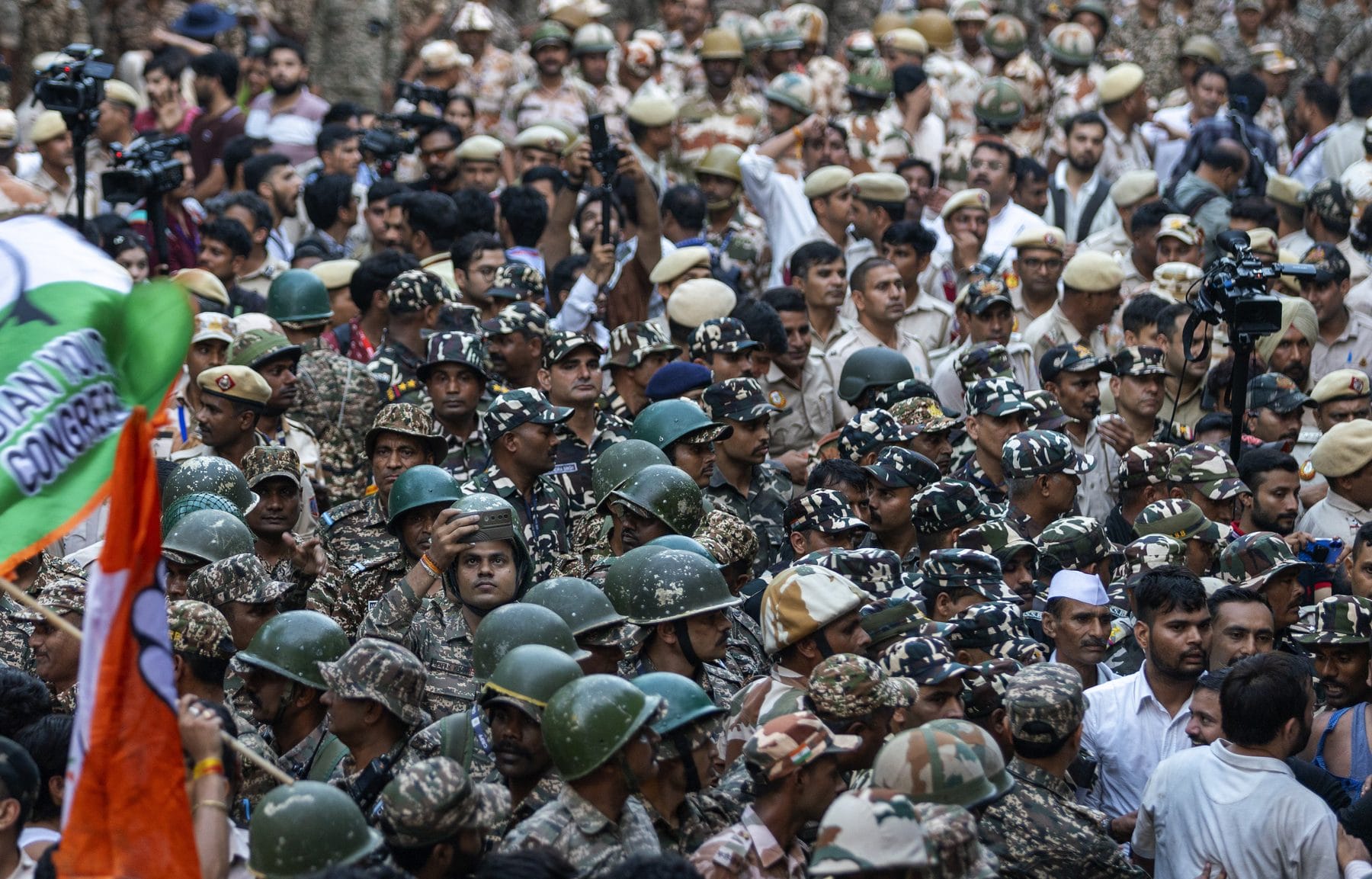
In June, William joined tens of thousands of students in Jantar Mantar, an iconic venue for public protest in the Indian capital Delhi, to call for the resignation of Minister of Education Dharmendra Pradhan over the NEET debacle. The demonstrations lasted for weeks, even as the Delhi Police resorted to tear gas, pellet guns, electric shock devices, and lathis (nearly six-foot-long bamboo sticks) to disperse the crowds. William was a regular.
“I always felt watched,” he told us. At metro stations, on his way to the protests, he said he repeatedly encountered the police. “They made sure that we saw them and that we should feel intimidated by their presence and their numbers.”
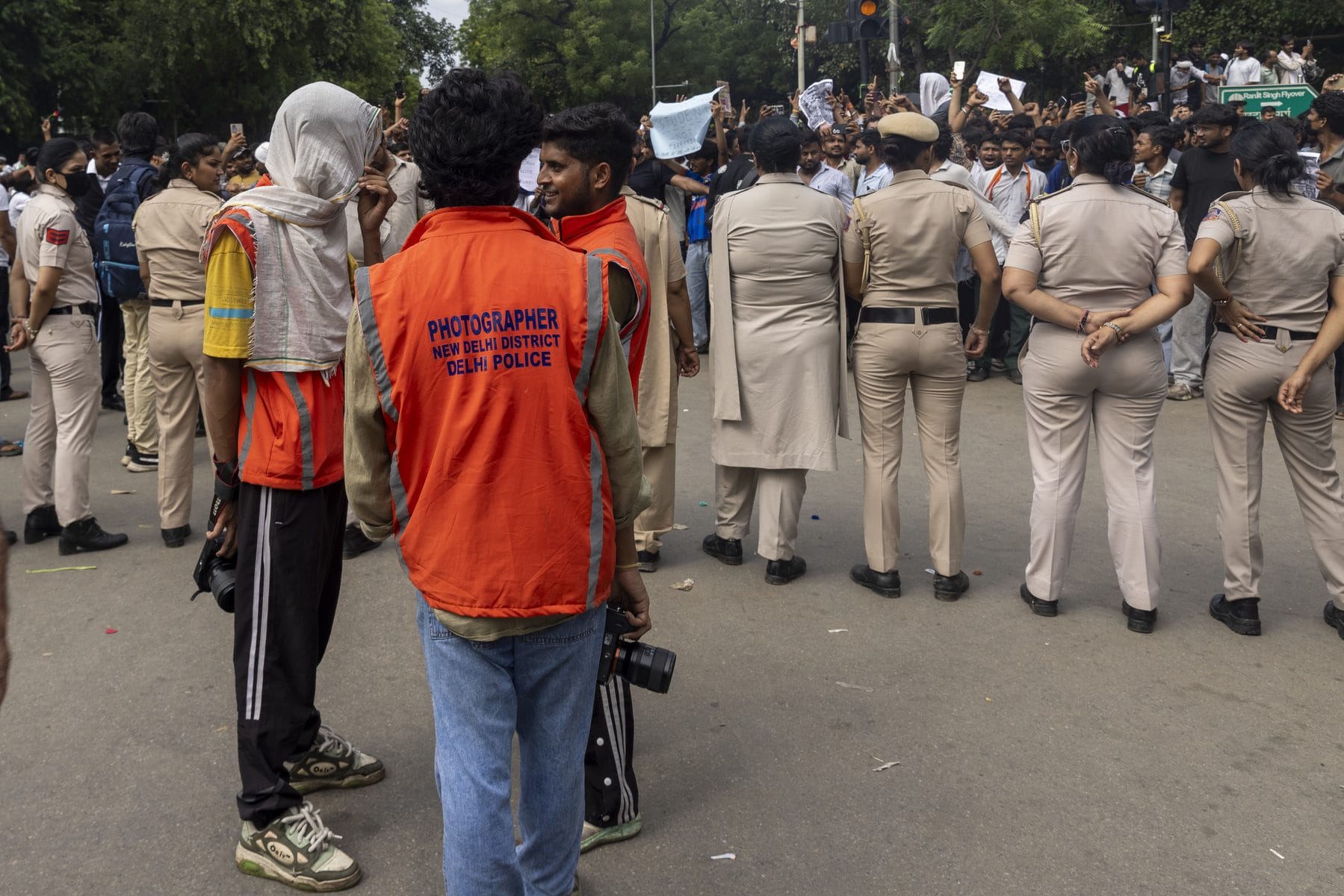
As journalists, we covered the June-July protests, including on July 20 when the police brutality reached an ugly peak as protesters marched towards the Indian parliament. Artificial intelligence-enabled CCTV cameras installed under Delhi’s “Safe City” project lined the streets in and around Jantar Mantar. A permanent surveillance tower stood at the center of the protest site, recording around the clock. Multiple drones circled overhead. Photographers hired by the police moved through the crowd. Some officers carried body cameras, and at least one police officer was seen wearing Ray-Ban Meta smart glasses.
Two police surveillance vehicles were parked just outside the entrance to Jantar Mantar. One was Ikshana (the Sanskrit for, literally, the act of seeing), an AI-powered police van with eight cameras that used facial recognition technology to match faces to police databases in real time. The other was a mobile command center.
According to William, the surveillance was not limited to the protest site. “I saw police detaining students at the metro station,” he said. “They were recognizing students from footage, identifying them by their bags, or style of mask or sunglasses.”
Even after the protests stopped, with the July 25 resignation of Pradhan, the education minister, William said the police paid visits to students in their neighborhoods. They were tracking down protesters. On August 3, he said, two police officers showed up at his lodgings. He was alone. “We have photos of you,” the police told him, “in colour. You’ve been seen going to the protest site on multiple days and also seen at the metro station.” Insisting that attending protests was a democratic right, William refused to let the police into his room without a warrant.
According to the Indian Express, the Delhi Police used surveillance footage accrued during the NEET protests in the summer to identify at least “2,800 people with a criminal background” who would be be prevented from protesting against Gyanesh Kumar.
Aishe Ghosh, a prominent student activist and national office holder at the left-wing Students’ Federation of India, has challenged the Indian government and the Delhi Police in court over the indiscriminate use of surveillance technology. Not only were the authorities documenting the protests, she alleges, they were using the footage to threaten protesters with public exposure.
Long an object of surveillance, Ghosh, who was a leader of the NEET protests, said the police entered the Communist Party of India (Marxist) headquarters in Delhi to arrest her in August on the basis of protests she had attended five years earlier in 2021. Describing the attempt to arrest Ghosh as a “continuing witch hunt against student protesters,” the CPI(M) added that it was evidence of “the Modi government’s escalating assault on democratic rights.”
Modi’s surveillance state
Hearing Ghosh’s litigation, the Delhi High Court appeared to suggest that the urgency to examine her specific allegations had dissipated since the NEET protests had concluded. The judges suggested that she file a more general petition.
The NEET protests proved only to be the start of the Cockroach Janta Party’s precipitous rise as serious, youth-led opposition to the Modi government, in power since 2014 and seemingly determined to use every arrow in its quiver, from opaque sources of funds to the takeover of independent institutions to the use of surveillance technology, to stifle dissent. In October, the “cockroaches” poured into Delhi’s streets again.
This time, they wanted the resignation of Gyanesh Kumar, India’s Chief Election Commissioner, a constitutional role meant to be entirely independent, apolitical and focused on maintaining the integrity of the Indian electoral process. An investigation by the Indian Express newspaper revealed that despite 14 objections in the last 10 months from the two other members of the election commission, Kumar had allegedly illegally taken unilateral decisions that resulted in voters being left off electoral rolls. India is currently undertaking an extensive revision of its voter lists that has controversially already disenfranchised 130 million people and potentially swayed state elections in favour of the governing BJP.
Kumar has not directly addressed the Indian Express’s findings. And while Modi too has remained typically silent — in his 12 years as prime minister, he has yet to call a single press conference — the Delhi Police has once again used violence and arbitrary arrests to crack down on still ongoing protests. Jantar Mantar, the de facto site of protests in Delhi since 1993, has been officially shut down. Prominent protesters, including Aishe Ghosh and the founders of the Cockroach Janta Party, have been detained. The opposition led by Congress Party scion Rahul Gandhi — the son, grandson and great-grandson of former Indian prime ministers — has been galvanized.
But India’s next general election is not until 2029 and the next major state legislative election is not until February 2027 at the earliest. Maintaining momentum is a task Gandhi has yet to show he can manage.
Meanwhile, the BJP continues to use friendly mainstream television media, alongside its heavy-handed policing, to argue that the protests are marginal, paid for by foreign sources and disliked by the large majority of Indians.
Fallible facial recognition tech
Technology researcher Srinivas Kodali told Coda that India’s efforts to modernise its policing system were stepped up after terrorist attacks in Mumbai in November 2008. Police stations across the country were connected, with access to criminal records and a tracking database. If someone attends a protest somewhere in India, Kodali explained, and has a police report filed against them, that information will be available to every police department in the country. He described the approach as “360-degree profiling,” pulling data together from facial recognition technology, surveillance towers, phone records, social media activity, and government databases including electoral records.
Delhi Police has said its use of technology and AI is meant to maintain law and order and identify people who already have a criminal record and not to randomly profile protesters. However, privacy researchers and lawyers warn that sophisticated surveillance systems can make participation in protests traceable long after the crowds have dispersed.
Much of the technology for this work is supplied by a growing group of private companies. Ikshana, the AI-powered police van used to monitor protesters in Jantar Mantar back in July, is one example. Rahul Bhardwaj, the Chief Growth Officer at analytics firm Intozi based in Gurugram, a tech hub on the outskirts of Delhi, said the company provides the software layer behind Ikshana’s system. Intozi processes video feeds through AI applications designed for tasks including crowd monitoring, detecting weapons and identifying people against police databases.
Intozi has previously deployed its facial-recognition technology for government security operations at high profile international summits in Delhi. Asked specifically whether its technology was used at Jantar Mantar this summer, though, Bhardwaj cited confidentiality obligations.
The company said that its role ends after its system is installed on police infrastructure, and that it does not retain the database or continue to access the system once it has been handed over to the police. “Images of people who are not in the police database,” Bhardwaj said, “are automatically blurred within seconds, while records associated with people already registered in police databases are retained by the police.”
That places responsibility for the technology and its subsequent use with the police.
Innefu Labs, whose AI Vision facial-recognition software has been used by Delhi Police in criminal investigations, declined to answer questions about data retention, legal safeguards or its operational relationship with police.
Another company, AjnaLens, confirmed its direct role in live policing. Kuldeep Pathak, Associate Director at AjnaLens said the company had supplied AI-enabled smart glasses to Delhi Police, first used in January 2026 in security operations during India’s Republic Day celebrations. The company confirmed that its glasses were used again during the NEET protests in Jantar Mantar. According to Pathak, their system was given access to a police database containing around 65,000 people with criminal records. He said 14 people were arrested after being recognized through the glasses.
Experts we spoke to questioned what authorises private vendors to access and process police databases, or whether an independent authority audits the system.
Surveillance without accountability
“What statutory regime operates in this context?” asked Menaka Guruswamy, a senior lawyer who is involved in litigation in the Supreme Court over the use of facial recognition technology at Jantar Mantar. “Where is this information hosted? Is it hosted by the private vendor, the state or the police? We know nothing.”
Guruswamy said tenders and contracts between the state and private companies should make it possible to establish what data each party is permitted to access and retain.
Disha Verma, AI researcher at Tech Global Institute and Ashoka University, claims these private vendors get access to police datasets that help them train their AI systems. “They (vendors) did not need to buy training datasets from anywhere,” she says. “They didn’t need to test their product anywhere else. They ended up with a curated, very accurate facial-recognition system.” The data provided by the police, she added, would help vendors sell their product for profit to other companies that want to make use of surveillance technology.
“What I am most concerned about is how much impunity and data and power this gives the private vendors,” Verma said, calling it a “parallel police state.”
And then there’s the accuracy of the technology, little of which has been subject to question or scrutiny.
In response to Right to Information requests made by the digital rights group Internet Freedom Foundation (IFF) in 2022, the police said it considered facial-recognition results with an accuracy score of 80 percent or above as a positive match. Only results below the 80 percent threshold were “subject to further verification using corroborative evidence.”
But the distinction between technical facial recognition matches and actual verified identifications became harder to ignore after the NEET protests in Jantar Mantar in the summer. Delhi Police said its facial recognition system identified 2,873 people with previous criminal records at the protest between July 20 and 26. But at least 25 of those people were actually in jail at the time they were supposed to be protesting.
Intozi’s own description shows why that distinction is not always straightforward. Bhardwaj told us that the company’s recognition threshold is “generally kept above 70 to 80%” and once that threshold is crossed, “it is a 100 percent match for us.” This is why, argues Guruswamy, the Supreme Court lawyer, a statutory framework is necessary. “There is no foolproof system,” she said. “That is why you need accountability, a legal regime, data protection and safeguards governing how these interactions take place.”
Nearly six years ago, Ahmed* (name changed on request) experienced the pitfalls of the Delhi Police’s then fledgling facial recognition technology and surveillance system. He was identified by AI-assisted video analysis as being present during deadly communal violence in northeast Delhi in 2020. Ahmed spent around 18 months in jail, accused of killing a police official during the riots. He insisted that the man seen in the footage used as clinching evidence was someone else.
“My hair was cropped short, and I had different shoes. Only the white shirt and dark trousers matched. But that does not make anyone wearing those clothes me,” Ahmed told us. He said he had shut his shop around noon on the day of the violence and gone home. Footage from one security camera showed him near the lane where he lived. But police later said it had used Amped FIVE, a video and image analysis tool, and AI Vision, facial recognition software made by Indian company Innefu Labs, to place Ahmed at the scene of the crime.
In September 2021, Ahmed was released on bail. The court noted that several people in the area wore similar clothes to those shown in the footage and that the video analysis identifying Ahmed across different recordings would have to be tested at trial.
By then, though, the damage to Ahmed’s life had already been done. Before his arrest, Ahmed ran a garments shop and employed a couple of workers. The shop did not survive his incarceration and, while on bail, he now works at a street stall, barely surviving on his meagre income.
Facial recognition systems turn facial features into numerical data and compare them with stored images, producing a similarity score or a list of possible matches. In a one-to-many search, a single face from a protest can be compared against an entire database.
“It's able to recognize a face the way an iPhone camera might,” Disha Verma, the Ashoka University researcher said. An iPhone's front camera works because everyone looks at it from roughly the same angle in consistent light, she added; but a police station is often dimly lit, angles vary, and the camera used to take the photo might be old and pixelated. "The system the police are using usually has a very large error rate, just inherently," Verma said.
Katie Kinsey, Chief of Staff and Tech Policy Counsel at the New York University School of Law’s Policing Project, told us that broad accuracy claims tell little about how a facial recognition system might work once it leaves controlled testing conditions. “A model tested on one dataset may behave differently when the cameras, lighting, image quality and population change,” she said.
Live video presents an additional difficulty because the images are less controlled and officers may be acting on alerts as events unfold. Kinsey said systems should be tested under the actual conditions in which police intend to use them.
Verma also raised concerns about biases affecting facial recognition systems. “If the police think a criminal looks like a dark-skinned bearded young man,” Verma said, “that is the data they will collect and that is what will train the AI.” It would, she added, create a feedback loop in which technology does not remove police prejudice but reproduce and legitimise it instead.
India has constitutional privacy protections and general data protection legislation, but no dedicated law for the use of facial recognition technology. Basically, “you won’t know you are on a watch list,” researcher Srinivas Kodali told us.
We reached out to the Delhi Police Cyber Cell with questions about the use of live facial recognition technology and other surveillance systems during protests, but did not receive a response.
Some jurisdictions have tried to place clearer limits on this type of power. For example, under the European Union’s AI Act, real-time remote biometric identification by law enforcement in public spaces is generally prohibited, with narrow exceptions. Even then, its exceptional use is subject to necessity and proportionality requirements and generally requires prior judicial or independent authorization.
Police in India have long maintained categories of people they consider suspects or potential troublemakers. For instance, in the south Indian state of Telangana, police have a category called “rowdy sheets” for people considered habitual offenders or threats to public order. With facial recognition technology, these categories have only widened.
Lawyer Menaka Guruswamy wondered what might happen when someone photographed at one protest is then seen at another protest. “Are we being criminalized simply for attending protests?”
Verma said that one of the significant shifts that she has witnessed over the years is how the technologies once associated with borders and the military have moved to civilian policing. The militarization of the Delhi Police has been evident as paramilitary personnel dressed in camouflage have been assaulting and detaining protesters.
Still, the protesters come.
William Tharien told us that despite being a known face to the Delhi police, despite his fears and struggles with his mental health, despite the monitoring of his social media, he is not going to stop protesting.
And with Delhi’s cockroaches still calling for the resignation of India’s chief election commissioner, still warning of the danger posed to Indian democracy by the Modi government’s authoritarian tendencies, how, William said, could he give up the fight now?
Related Articles
How Modi silenced Kashmir
Anuradha Bhasin
Modi does not want India to watch this documentary
Shougat Dasgupta
My mother tongues
Shougat Dasgupta
The post In Modi’s India, somebody is always watching appeared first on Coda Story.
