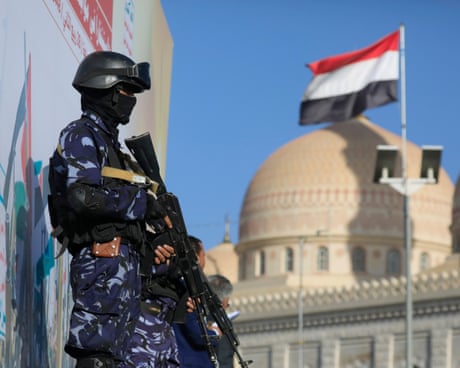
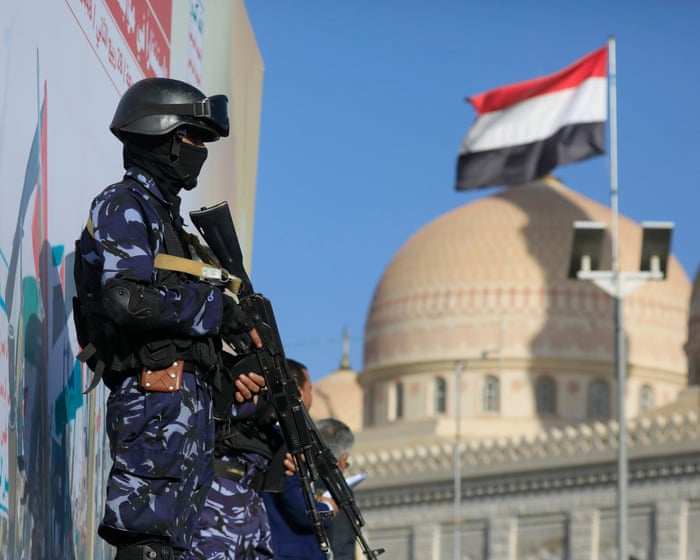
The Iran-backed group’s attacks have disrupted sports tournaments and threatened business events that the kingdom has long used to attract investment and raise its profile.
The Iran-backed group’s attacks have disrupted sports tournaments and threatened business events that the kingdom has long used to attract investment and raise its profile.
Saudi Arabia’s capital, Riyadh, has been rocked by Houthi attacks in recent weeks that have forced the authorities to close the city’s main international airport.
The move will force a vote on the agreement after the midterm elections, though it faces steep odds in the Republican-controlled Congress even amid bipartisan concern about the deal.
The move will force a vote on the agreement after the midterm elections, though it faces steep odds in the Republican-controlled Congress even amid bipartisan concern about the deal.
The employee, now fired, had said he advised government agencies in Saudi Arabia. He was also listed as a partner at a venture firm with a Saudi prince.
The employee, now fired, had said he advised government agencies in Saudi Arabia. He was also listed as a partner at a venture firm with a Saudi prince.
The San Francisco offices of OpenAI. According to a court filing, a thumb-size recording device wrapped in toilet paper was found plugged into the back of a television in an executive conference room.
Mourners carrying the body of Mahmoud Barqawi, 33, at his funeral in Amman, Jordan, on Monday. He was killed in a Houthi missile attack on King Khalid International Airport in Riyadh on Saturday.
The attack came after the Yemeni militia warned it would attack the headquarters of Aramco. The Saudi-led coalition said it was targeting Houthi capabilities.
The attack came after the Yemeni militia warned it would attack the headquarters of Aramco. The Saudi-led coalition said it was targeting Houthi capabilities.
The Saudi authorities said they were fending off drone and missile attacks after a weekend of confrontation with the Houthi militia in Yemen, whose patrons Iran offered to mediate.
The Saudi authorities said they were fending off drone and missile attacks after a weekend of confrontation with the Houthi militia in Yemen, whose patrons Iran offered to mediate.
The Saudi authorities said they were fending off drone and missile attacks after a weekend of confrontation with the Houthi militia in Yemen, whose patrons Iran offered to mediate.
The Saudi authorities said they were fending off drone and missile attacks after a weekend of confrontation with the Houthi militia in Yemen, whose patrons Iran offered to mediate.
The latest attack by Houthi rebels on Saudi Arabia may prove to be more calamitous for the region than the world imaginesOn Saturday, Houthi rebels launched a shocking and deadly attack on Saudi Arabia’s capital city, Riyadh. At the time of writing, the missile strike on King Khalid international airport has killed at least 13 people and left 300 injured, marking a significant turn in a regional conflagration that is only getting more intense. It was the single most deadly attack on any Gulf cou
The latest attack by Houthi rebels on Saudi Arabia may prove to be more calamitous for the region than the world imagines
On Saturday, Houthi rebels launched a shocking and deadly attack on Saudi Arabia’s capital city, Riyadh. At the time of writing, the missile strike on King Khalid international airport has killed at least 13 people and left 300 injured, marking a significant turn in a regional conflagration that is only getting more intense. It was the single most deadly attack on any Gulf country since the US and Israel launched their war on Iran in February. In Saudi Arabia, a country that is unaccustomed to such fatalities, the death toll is bewilderingly high and likely to prompt a bloody response.
Over the past year, the Gulf has entered a new era of instability that is not temporary and cannot be reversed. This may feel like an overstatement – casualties have been relatively low, after all, compared with Gaza and Iran – but the gradual erosion of peace and security in places such as Saudi Arabia, Qatar and the UAE has changed the region more dramatically than its leaders would like to acknowledge.
At least one person was killed in the Saudi capital, Riyadh, kingdom authorities said. The Houthis said Saudi aircraft hit the Yemeni capital’s airport.
At least one person was killed in the Saudi capital, Riyadh, kingdom authorities said. The Houthis said Saudi aircraft hit the Yemeni capital’s airport.
A fuel deal with Vladimir Putin, and sanctions against the legal institution, ram home the president’s belief that might is rightOn Friday, Donald Trump drove home his belief that might is right and the rule of law is an obstacle rather than an essential foundation stone of international order. First came the escalated assault on the international criminal court (ICC), sanctioning the body itself. Then he announced a deal with Russia to buy diesel.The US has long chafed at the notion of being bo
A fuel deal with Vladimir Putin, and sanctions against the legal institution, ram home the president’s belief that might is right
On Friday, Donald Trump drove home his belief that might is right and the rule of law is an obstacle rather than an essential foundation stone of international order. First came the escalated assault on the international criminal court (ICC), sanctioning the body itself. Then he announced a deal with Russia to buy diesel.
The US has long chafed at the notion of being bound by the rule of law that it espoused publicly. That hypocrisy now appears as a lesser vice. The president has declared that “my own morality” is all that constrains him. His brazen flouting of the law, embrace of dictators and rhetorical attacks all undermine global standards.
Do you have an opinion on the issues raised in this article? If you would like to submit a response of up to 300 words by email to be considered for publication in our letters section, please click here.
Three deadly attacks by the Iran-backed Houthis in Yemen on an airport in the Saudi capital underscored the asymmetrical nature of their conflict with the kingdom.
Three deadly attacks by the Iran-backed Houthis in Yemen on an airport in the Saudi capital underscored the asymmetrical nature of their conflict with the kingdom.
Crown Prince Mohammed bin Salman of Saudi Arabia in Paris in August. Houthi strikes on the Saudi capital, Riyadh, have cast a shadow on his efforts to transform the kingdom into a global hub for business and tourism.
The strike on Saturday was the deadliest attack in a Gulf Arab country since the U.S.-Israeli war with Iran began in February, and forced the airport to temporarily suspend operations.
The strike on Saturday was the deadliest attack in a Gulf Arab country since the U.S.-Israeli war with Iran began in February, and forced the airport to temporarily suspend operations.
The escalating violence has brought the conflict in Yemen to the doorstep of the Saudi capital, and the kingdom has no easy options to curtail the increasingly sophisticated and targeted strikes.
The escalating violence has brought the conflict in Yemen to the doorstep of the Saudi capital, and the kingdom has no easy options to curtail the increasingly sophisticated and targeted strikes.
A still from a video obtained from social media and verified by The New York Times showing a blast at King Khalid Airport in Riyadh, Saudi Arabia, on Thursday.
The Saudi authorities said they intercepted two missiles targeting Riyadh, a day after they said Houthi strikes on airports in the kingdom killed three people.
The Saudi authorities said they intercepted two missiles targeting Riyadh, a day after they said Houthi strikes on airports in the kingdom killed three people.
Residents of Saudi Arabia’s capital reported hearing booms on Thursday, a day after the Saudi government said two women and a Sudanese man died in strikes on two airports.
Residents of Saudi Arabia’s capital reported hearing booms on Thursday, a day after the Saudi government said two women and a Sudanese man died in strikes on two airports.
A Saudi-led coalition launched a military campaign this week against the Iran-backed Houthi militia in the country, reviving memories of its previous effort.
A Saudi-led coalition launched a military campaign this week against the Iran-backed Houthi militia in the country, reviving memories of its previous effort.
Smoke billowing from the fuel storage area at King Khalid International Airport in Riyadh, Saudi Arabia, last month after the Houthis claimed to have attacked the facility.
More than 200 U.S. intelligence and military analysts are in Saudi Arabia helping it provide assistance to its Yemeni allies, current and former U.S. officials say.
More than 200 U.S. intelligence and military analysts are in Saudi Arabia helping it provide assistance to its Yemeni allies, current and former U.S. officials say.
After the co-pilot stabbed the captain, two pilots who were seated in the cabin intervened alongside passengers and safely landed the Boeing 737 in Saudi Arabia.
After the co-pilot stabbed the captain, two pilots who were seated in the cabin intervened alongside passengers and safely landed the Boeing 737 in Saudi Arabia.
A FlyDubai plane carried passengers to Tel Aviv on Wednesday after a midair cockpit attack on their earlier flight. Two other pilots who were seated in the cabin safely landed that plane.
Yemen’s capital, Sanaa, was bombarded overnight, after government forces reported some of the most intense clashes in years around Taiz, the country’s third largest city.
Yemen’s capital, Sanaa, was bombarded overnight, after government forces reported some of the most intense clashes in years around Taiz, the country’s third largest city.
The United Arab Emirates has said it is leading the investigation into the episode, and FlyDubai’s service between Dubai and Tel Aviv has been suspended.
The United Arab Emirates has said it is leading the investigation into the episode, and FlyDubai’s service between Dubai and Tel Aviv has been suspended.
A passenger raises his arms in relief as he walks through the domestic arrivals doors with his dog and luggage at Ben Gurion Airport near Tel Aviv on Wednesday.
Capt. Smit Machchhar suffered stab wounds while fending off an attack from his co-pilot, saving the lives of around 170 people on board, officials said.
Capt. Smit Machchhar suffered stab wounds while fending off an attack from his co-pilot, saving the lives of around 170 people on board, officials said.
“I don’t deserve to die like this,” said one passenger on Flight 1073 from Dubai to Tel Aviv. The motive of the cockpit stabbing remains unknown, officials said.
“I don’t deserve to die like this,” said one passenger on Flight 1073 from Dubai to Tel Aviv. The motive of the cockpit stabbing remains unknown, officials said.
A routine flight turned terrifying when a violent altercation broke out inside the cockpit and the aircraft dropped 17,000 feet in two minutes. Passengers subdued a knife-wielding attacker.
A routine flight turned terrifying when a violent altercation broke out inside the cockpit and the aircraft dropped 17,000 feet in two minutes. Passengers subdued a knife-wielding attacker.
Passengers of a FlyDubai aircraft that made an emergency landing in Saudi Arabia were welcomed at Ben-Gurion International Airport in Israel on Wednesday.
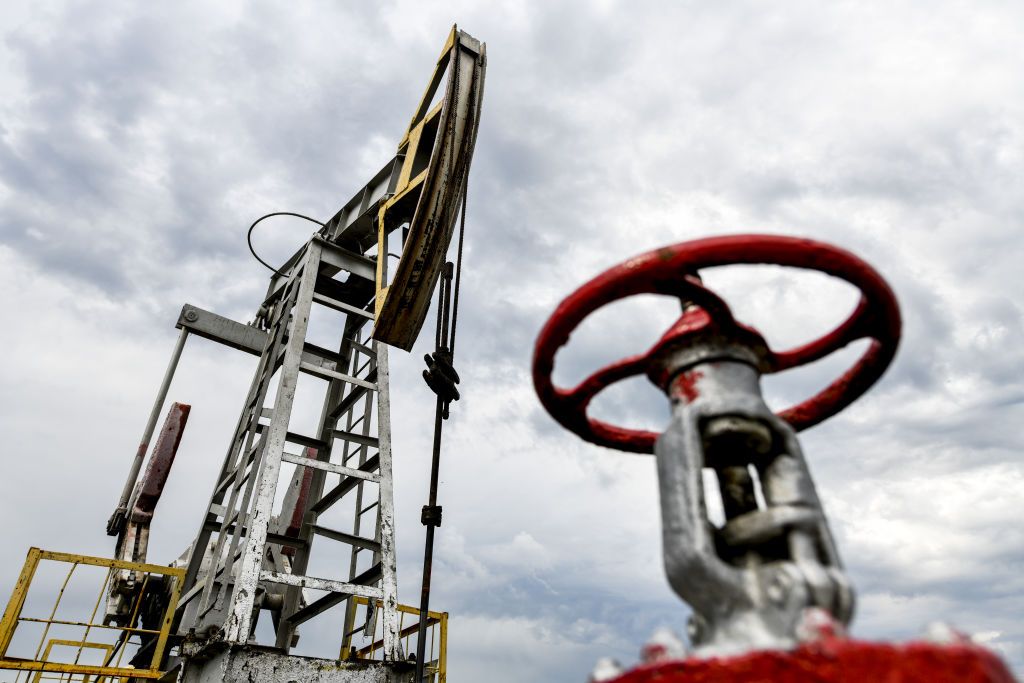
Russia's crude oil production in June fell below its agreed-upon OPEC+ target, according to individuals familiar with the data interviwed by Bloomberg. Russian producers reportedly pumped 9.022 million barrels per day last month, a figure 28,000 barrels per day below the required level, including compensation cuts. This marks the largest gap between Russia's output and its monthly quota this year, based on Bloomberg's calculations.Historically, Russia, which co-leads the OPEC+ alliance with Saud
Russia's crude oil production in June fell below its agreed-upon OPEC+ target, according to individuals familiar with the data interviwed by Bloomberg.
Russian producers reportedly pumped 9.022 million barrels per day last month, a figure 28,000 barrels per day below the required level, including compensation cuts. This marks the largest gap between Russia's output and its monthly quota this year, based on Bloomberg's calculations.
Historically, Russia, which co-leads the OPEC+ alliance with Saudi Arabia, has faced criticism for poor compliance with production quotas. However, the nation has shown improved adherence for most of 2025, often pumping below its required levels, according to analysis of Russian data. This increased focus on production discipline follows earlier critiques from Riyadh.
Under the terms of the OPEC+ agreement, Russia's daily production quota for June had increased by 78,000 barrels to 9.161 million barrels. However, Moscow had also committed to a 111,000 barrel-a-day compensation cut for the month, bringing its actual output target to 9.050 million barrels per day.
On July 5, eight OPEC+ nations collectively agreed to raise production by 548,000 barrels per day in August, aiming to capitalize on strong summer consumption. Analysts suggest these additional barrels may be quickly absorbed but could contribute to a crude surplus later in the year.
Independent verification of Russia's oil output data has become challenging since Moscow classified official figures after Western sanctions targeting the nation's energy industry following its full-scale invasion of Ukraine. Consequently, market watchers now largely rely on indicators such as seaborne exports and domestic refinery runs to track trends in Russia's oil production.

 Connexion