Vue normale

Russia’s thermobaric launchers used to just drive up and fire. Now they move one at a time, in steel boxes built to stop Ukrainian drones
Par : David Axe
23 août 2026 à 12:53

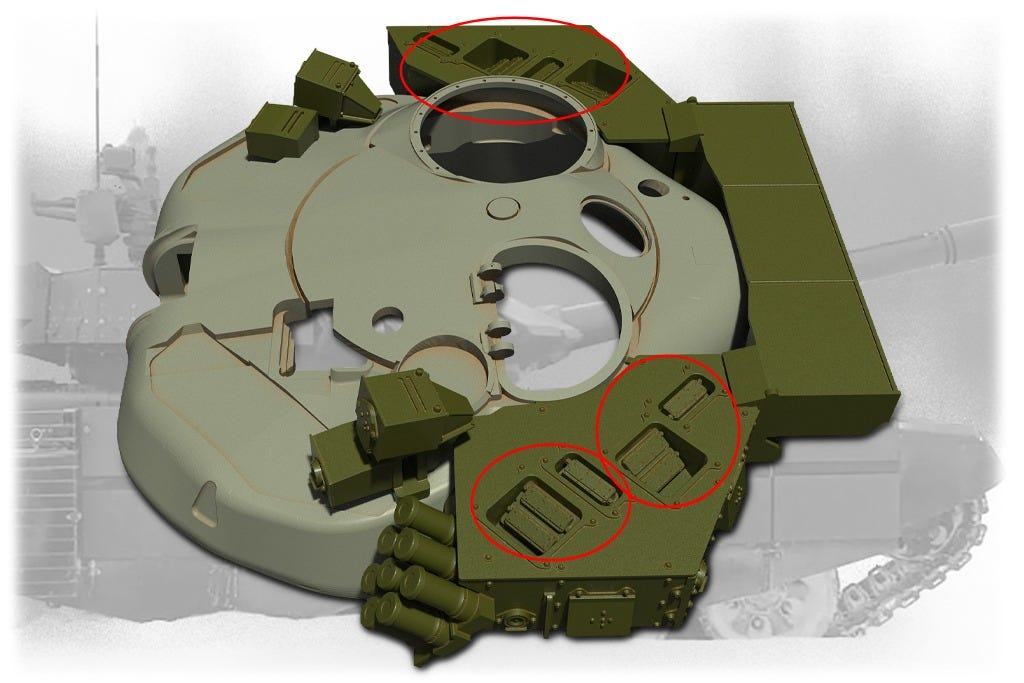
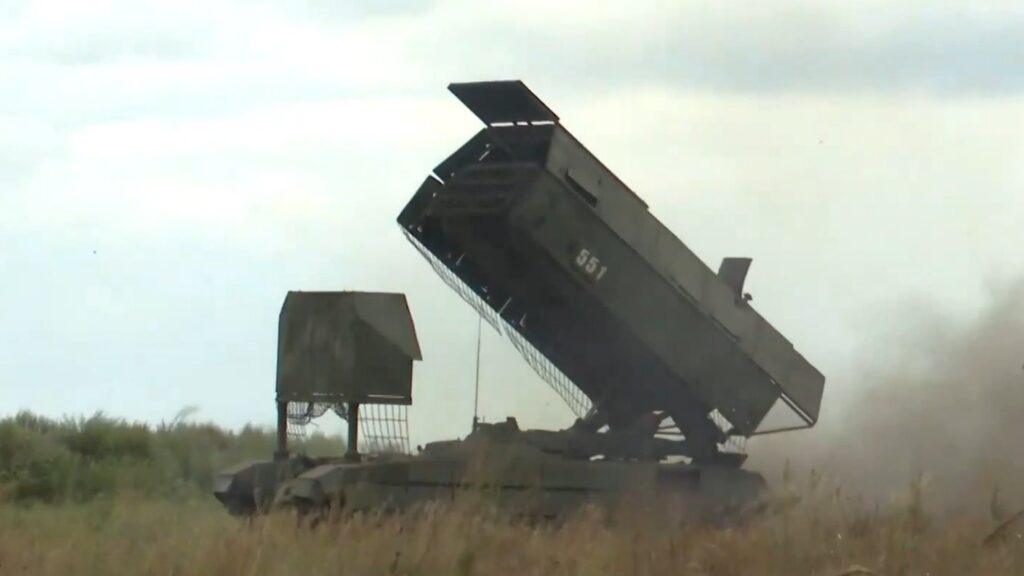
A new up-armored TOS-1A.

  • Russia's TOS-1A thermobaric rocket launcher is uniquely devastating, but also uniquely vulnerable
  • Its flame-spreading rockets reach just 6,000 m, which puts a launcher inside the reach of Ukraine's tiny explosive drones
  • Ukrainian forces have destroyed, damaged or captured 36 TOS-1As—and Russia is now building them with factory anti-drone armor

Russia is now building its TOS-1A thermobaric rocket launchers with factory armor wrapped around the rocket tubes. The tracked TOS-1A and its flame-producing 220-mm rockets are a powerful and terrifying weapon. But the launcher is also extremely vulnerable to Ukraine's drones and artillery. The add-on armor may be the only way the launchers can survive.

The TOS-1A is a T-72 with the turret swapped out for 24 thermobaric rockets, and the newest ones arrive inside a welded steel shell that lifts open when the tubes elevate. Russia is armoring the launcher the way it armors the tanks it's built from. What happens when the armor fails is not the same.

The TOS-1A adds a 24-round launcher onto the hull of a T-72 tank. The system's MO.1.01.04M rocket travels as far as 6,000 m with a payload of fuel that, once ignited, burns as hot as 3,000 degrees Celsius. The fuel can spread across the ground and into buildings and bunkers, allowing even a single TOS-1A to scorch a wide area.

It's not for no reason that the TOS-1A is one of Russia's preferred siege weapons. TOS-1As rolled into action early in Russia's wider war on Ukraine. In one of their first actions, in May 2022, TOS-1As staged on hilltops overlooking the city of Lyman, in eastern Ukraine's Donetsk Oblast, rained fire down on the front-line city. A few days later, Russian troops temporarily occupied Lyman.

Thinking back to May 2022. Watching Russian TOS-1 heavy thermobaric artillery devastate Lyman from the hill across the Siversky Donets. May 23 - the full assault would be launched a day or two later. pic.twitter.com/PPEyMukZGO

— Neil Hauer (@NeilPHauer) July 3, 2026

The best day the TOS-1A ever had came at Bakhmut. In early April 2023, Russian crews fired across the Bakhmutka River at entrenched Ukrainian positions and opened a 300-m gap in the line, US Army analysts later reconstructed. Wagner mercenaries poured through and covered 1.25 km in a single day. At Pavlivka, thermobaric fire breached the Ukrainian line and the settlement eventually fell—though it took five months and cost Russia two wrecked naval infantry brigades.

With its origins firmly in the 1970s, the TOS-1A was designed for a different era, however. An era where rocket launchers could, with a little support, safely approach to within a few kilometers of the enemy. Artillery is an ever-present danger, of course. But artillery can be suppressed—usually by other artillery.

The era of relative safety for the TOS-1A ended as tiny explosive drones began filling the sky over Ukraine in 2023. Even the tiniest of these tiny drones has the range to hit a TOS-1A before the TOS-1A can get into position to fire its rockets. Worse, the TOS-1A's thermobaric rockets are extremely volatile—and tend to explode in massive fireballs when struck.

"Nasty weapons—and also great targets" for anti-tank missiles and other munitions, is how Czech analyst Jakub Janovsky described the TOS-1A in the war's opening days, before the drones even arrived.

The launcher has a weather problem, too. Its rockets carry an oxidizer premix, which means crews can't fire them in the rain or from high ground.

A Russian TOS-1 thermobaric rocket launcher was completely destroyed by the Unmanned Systems Forces today. After getting hit, the TOS-1 cooked off and burnt down. pic.twitter.com/zQievlm5Vx

— Woofers (@NotWoofers) April 18, 2026

Deep losses

The Russians started losing TOS-1As almost immediately. Retreating from Kyiv Oblast on 1 April 2022, they left behind at least three launchers—two of them knocked out by Ukrainian Stugna-P missiles, one captured intact. Then the losses began piling up.

Today, 54 months into the wider war, the Ukrainians have destroyed, damaged or captured no fewer than 36 TOS-1As. 27 of them burned. Ukrainian crews turned at least one captured launcher on its former operators, firing it near Kreminna during the 2023 counteroffensive.

The losses are a problem for the Russians. US Army analysts estimated Russia's prewar TOS-1A fleet at 48 launchers, only a portion of which ever went to Ukraine. Documented losses now stand at 36, and Oryx counts only what it can see in a photograph. How much of that gap Russian factories have refilled isn't public.

What the losses did not do was change the war. For all its ferocity, the TOS-1A has had little to no effect on the conflict's outcome, US Army analysts concluded—and they name the short reach as the reason. A weapon that has to park within 6,000 m of the enemy is a weapon the enemy can find.

Armor, not range

The Russians got to work improving the TOS-1A and building more copies. The Omsk transport machinery plant, Omsktransmash, has turned out fresh batches for the defense ministry in September 2022, November 2022, November 2024 and again in November 2025, its parent concern Uralvagonzavod announcing each handover. It's unclear just how many replacement launchers the Russians acquired, but it's safe to assume they number in the dozens.

They also changed how they use the thing. Russian units now move single launchers up to the line under covering artillery fire rather than travelling in groups, reducing the likelihood of detection, the same US Army analysts reported. And the latest copies are up-armored against drones, with a shell of additional armor protecting the 24 launch tubes and their highly flammable rockets.

That isn't a brand-new idea. An earlier drone-protection variant was showcased in April 2024, and a different, serially produced kit went onto the batch shipped in November 2025. What circulated this month is fresh footage of the up-armored TOS-1As working out at a training range in Russia's Saratov Oblast.

Footage of Multiple Russian TOS-1A Obr.2022 at a Training Ground in the Saratov Region - Summer 2026 pic.twitter.com/LAOAVraai1

— Wilson (@WillKnowler) August 9, 2026

The add-on armor is apparently factory-standard at this point, and it's a purpose-built enclosure rather than the improvised slat and mesh Russian regiments tend to weld onto their tanks before sending them across the drone-patrolled gray zone. The function is the same: put something between the drone and the thing that matters.

The best up-armored "turtle tanks" have been known to absorb dozens or even scores of drone impacts. A TOS-1A crew should hope the launcher's new armor is equally tough. After all, the consequence of a turtle tank losing its shell and taking a direct drone hit is often immobilization: the tank throws a wheel or a track or loses power and simply can't move anymore.

An Arena-M tank right before a drone strike.
Explore further

Russia has thousands of tanks it can’t risk. One drone shield decides whether they roll

Armor is the cheap answer, and it isn't the real one. The real one is a launcher that doesn't have to park 6,000 m from a Ukrainian drone operator.

Uralvagonzavod says a modernized TOS-1A on a T-80 chassis is nearing the end of trials, with better accuracy, more automation and a longer reach. How much longer, the company hasn't said. Analyst Alexey Tarasov expects a new launch module able to take longer-range rockets, perhaps carrying the system to roughly the 15 to 20 km of the wheeled TOS-2. Until then, the crews get a steel box.

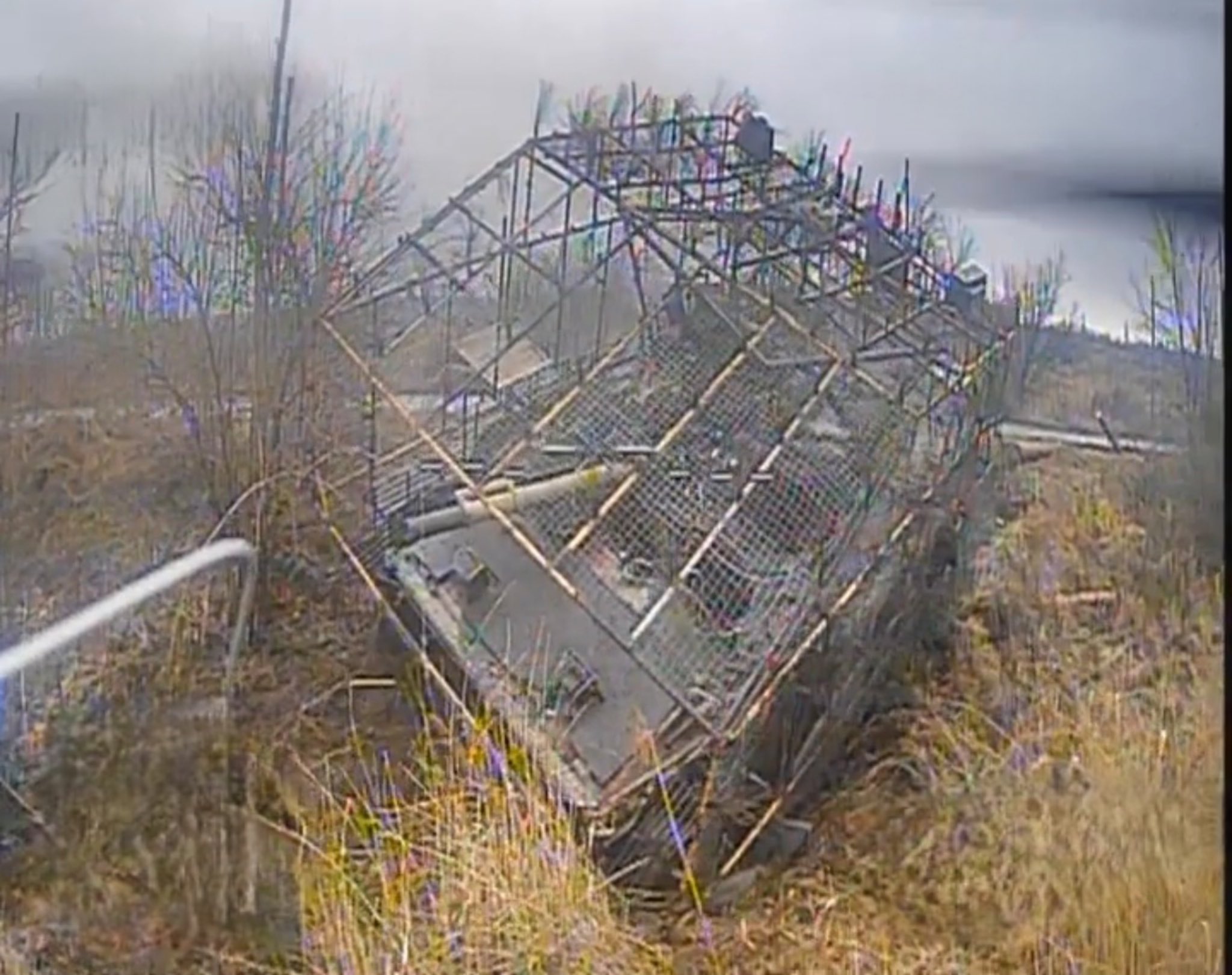
It had better hold. The earlier, cruder answer didn't: a TOS-1A wearing a field-built metal cage burned anyway when a Ukrainian FPV drone found it. And if a TOS-1A's armor fails, the next drone hit could trigger 24 rockets each weighing 217 kg and packed with concentrated fuel that's primed to explode.

⚡The 🇺🇦Ukrainian military from the 92nd separate assault brigade destroyed the 🇷🇺Russian 220-mm heavy flamethrower system TOS-1A "Solntsepek" using an FPV kamikaze drone pic.twitter.com/wEBz2H1T5y

🪖MilitaryNewsUA🇺🇦 (@front_ukrainian) September 2, 2023

Ukrainian top volunteer from outgoing minister’s own team, whose drones downed 12,954 Russian targets, is offering to help his successor

19 août 2026 à 15:29

Serhii Sternenko assassination

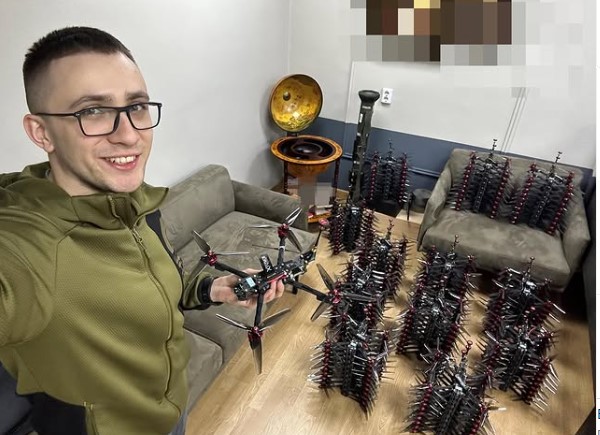
One of Ukraine's most prominent drone volunteers has given his comments on the new defense minister. Serhii Sternenko, a civic activist and former adviser to ousted Defense Minister Mykhailo Fedorov, has congratulated Yevhenii Khmara on his appointment to lead the Defense Ministry, Sternenko wrote on his Telegram channel.

Ukraine's parliament confirmed Khmara as defense minister after removing Fedorov, and figures from his circle, rather than boycotting his replacement, are lining up to work with the new minister for Ukraine's sake.

Sternenko owns a charity foundation that has purchased 291,502 FPV drones, which have helped the Ukrainian military shoot down 12,954+ aerial targets.

Sternenko offered help and wished the minister endurance

Sternenko has framed his congratulations in terms of Ukraine's benefit.

"I wish Defense Minister Khmara success and resilience. He will need them. This is in Ukraine's interest," he wrote.

He offered his fund's expertise. Together with his team, he is ready to help the new minister with matters concerning FPV drones, because that, too, is in Ukraine's interest, Sternenko said, extending the cooperation of one of the country's largest drone-supply operations to the incoming minister.

He paired the welcome with a warning about dialogue

Sternenko's support came with a pointed caveat. He said the country "finally has a defense minister," but that many unresolved issues remain regarding "government-society" interaction.

Solving them requires engagement from the top, he argued. Their resolution requires the active involvement of the president and the emergence of agency in parliament, Sternenko said, expressing hope that, under extremely difficult conditions for Ukraine, "there will still be room for reasonable dialogue and cooperation for the sake of victory."

Earlier, Mstyslav Banik, who served as a deputy to Fedorov, said he would stay on under the newly appointed Defense Minister. He is responsible for carrying out the defense-procurement reform and became a deputy defense minister under Fedorov on 25 March 2026, having previously led the ministry's digital products. Batnik led the development of "Army+" and "Reserve+", the apps that digitized military service and mobilization.

  • ✇Euromaidan Press
  • 1.2 million weapons in a year: Inside Ukraine’s Amazon-for-arms that ships to the frontline in 24 hours
    Ukraine's weapons marketplace DOT-Chain Defense has compressed delivery times from months to weeks after one year of operation, the country's Defense Ministry reported. For the fastest product categories—electronic warfare gear, ground robots, interceptor drones—orders now reach units within 24 hours. Ukraine's war against Russia's invasion has pushed Kyiv to rebuild military procurement from the ground up, trading slow bureaucratic pipelines for digital platforms where
     

1.2 million weapons in a year: Inside Ukraine’s Amazon-for-arms that ships to the frontline in 24 hours

18 août 2026 à 15:46

A Ukrainian drone operator.

Ukraine's weapons marketplace DOT-Chain Defense has compressed delivery times from months to weeks after one year of operation, the country's Defense Ministry reported. For the fastest product categories—electronic warfare gear, ground robots, interceptor drones—orders now reach units within 24 hours.

Ukraine's war against Russia's invasion has pushed Kyiv to rebuild military procurement from the ground up, trading slow bureaucratic pipelines for digital platforms where frontline units pick and receive their own weapons faster than Western militaries have managed. Domestic manufacturers now make 90% of newly authorized systems.

Fastest deliveries measured in hours

The Defense Ministry and the Defense Procurement Agency DOT have jointly driven the acceleration, according to the ministry's statement.

"Delivery times for drones and other systems have shrunk from months to a matter of weeks, and often to days," the ministry said.

Beyond that general compression, several categories saw delivery within a single day. Electronic warfare systems, ground robotic platforms, reconnaissance and bomber drones, interceptor drones, and FPV drones on both fiber-optic and radio control all reached units within 24 hours. Ammunition for unmanned systems arrived within six days.

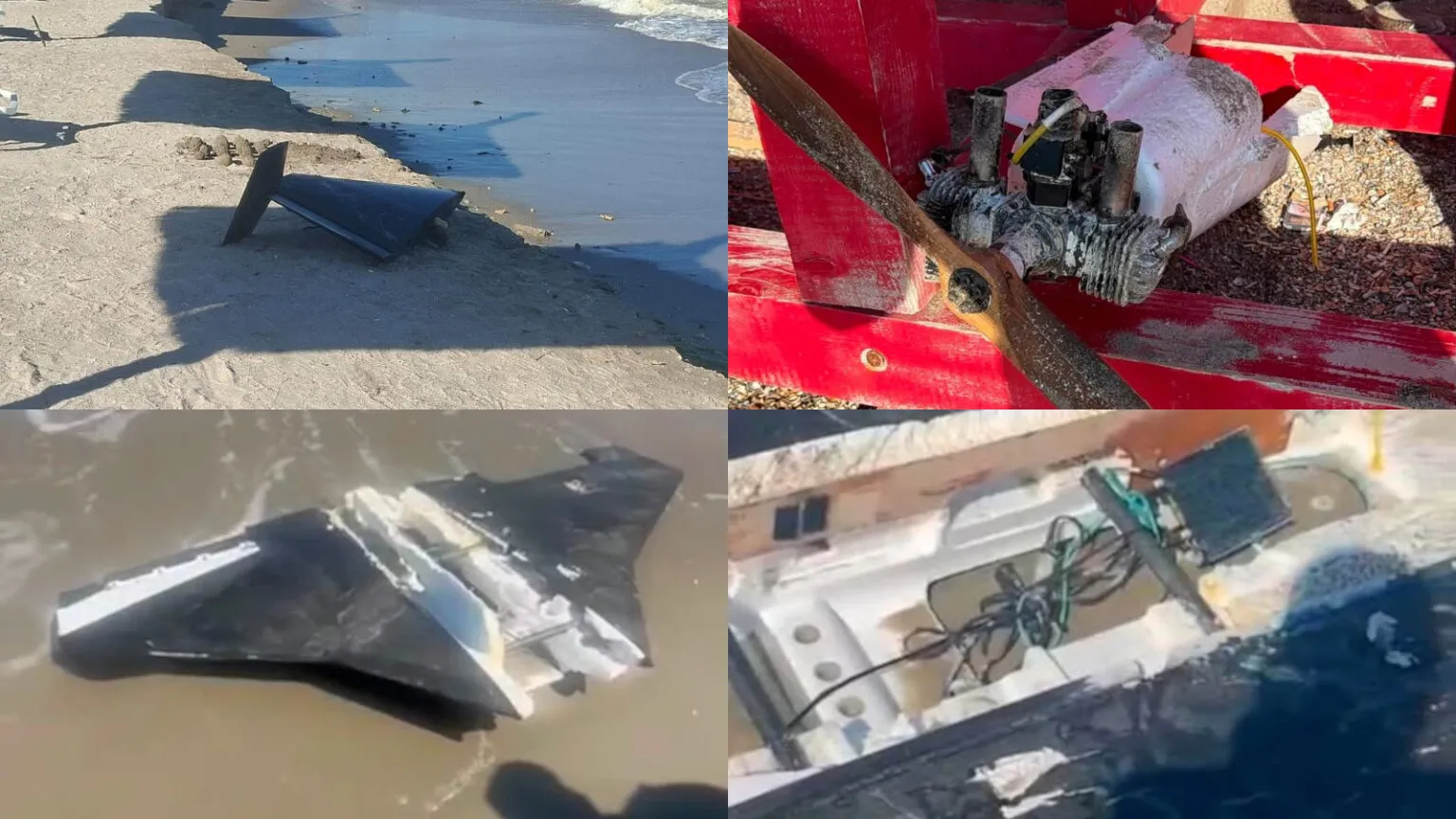
Four-image collage showing drone wreckage found on Romania’s coast and in nearby waters, including wing fragments, an engine and propeller, and exposed electronics.
Explore further

Russian drone attacks on Ukraine’s Danube ports hit recent high, Romania says

Over the first year, the platform shipped more than 1.2 million drones and other systems. Units now choose from 1,181 products made by 300 domestic manufacturers.

How the marketplace works

DOT-Chain Defense supplements centralized state supply rather than replacing it, the ministry noted. Combat units use allocated funds to browse and order the equipment they need for their section of the front. The marketplace handles contracts, payments, and delivery.

The platform's drone constructor tool lets units customize drone configurations before ordering. A dedicated training course on using the marketplace recently launched inside the Army+ mobile app.

ukraine timed its huliaipole operation around weather — worked here's why won't happen again soon · post ukrainian soldier 92nd assault battalion machine gun 2026 armed forces infantry frontline operations
Explore further

US copies Ukraine: Washington launches Amazon-backed UAVs marketplace, inspired by Kyiv’s Brave1 Market and DOT-Chain Defense

Broader procurement picture

The one-year milestone caps a period of rapid scaling across Ukraine's defense procurement. The country contracted about $8 billion worth of drones in the first half of 2026—double the same period last year, according to the Defense Ministry.

More than 400 combat units now shop for weapons through the marketplace's companion Brave1 Market program using points earned for confirmed battlefield activity. Washington modeled its own Unmanned Aircraft Systems Marketplace on the Ukrainian original earlier this year.

  • ✇Euromaidan Press
  • Russia has thousands of tanks it can’t risk. One drone shield decides whether they roll
    Russia's new Arena-M anti-drone shield can shoot down FPVs—but tanks still burn One fielded Arena-M reportedly carried 12 charges. Ukrainian crews used 15 to 20 drones per tank in one assault More rounds could help—if ammunition is really the binding constraint Russian forces may have finally found a way to protect their tanks from Ukrainian first-person-view drones. And it's not the usual add-on armor applications that have defined mechanized combat in Ukrain
     

Russia has thousands of tanks it can’t risk. One drone shield decides whether they roll

Par : David Axe
17 août 2026 à 14:15

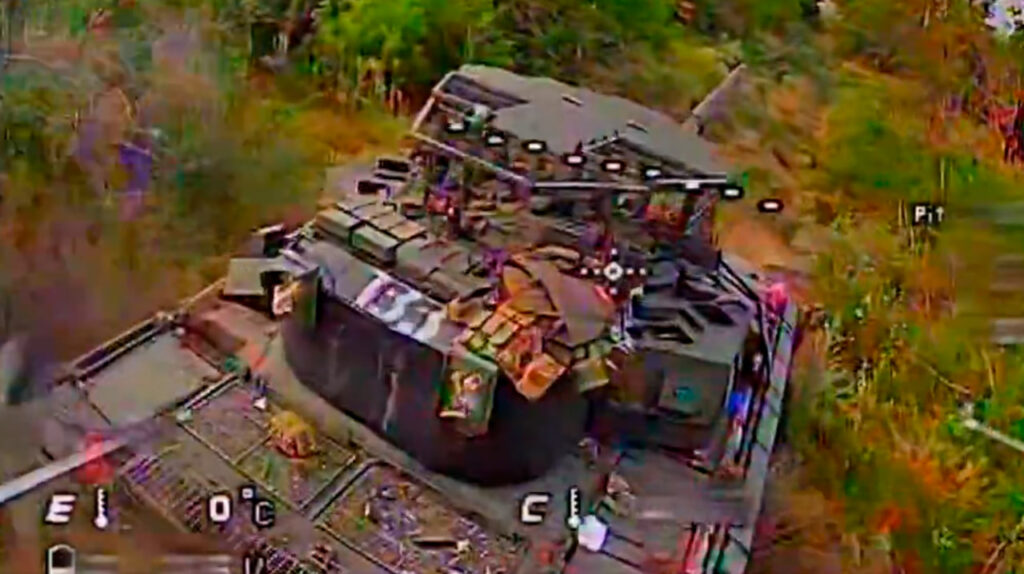
An Arena-M tank right before a drone strike.

  • Russia's new Arena-M anti-drone shield can shoot down FPVs—but tanks still burn
  • One fielded Arena-M reportedly carried 12 charges. Ukrainian crews used 15 to 20 drones per tank in one assault
  • More rounds could help—if ammunition is really the binding constraint

Russian forces may have finally found a way to protect their tanks from Ukrainian first-person-view drones. And it's not the usual add-on armor applications that have defined mechanized combat in Ukraine since the early months of Russia's wider war.

No, the Russians have begun deploying tanks fitted with the Arena-M active protection system (APS), which detects incoming FPVs and automatically fires a small projectile at them. The first few assaults by Arena-M-equipped tanks ended in defeat for the Russians, but limited combat footage shows the system can destroy incoming FPVs.

At least one Arena-M did work against FPVs—it just did not work long enough to save the tank. Observer Andrei_bt stressed that a reported 12-round loadout "does not match modern realities." Footage published on 7 August showed Ukrainian FPVs attacking an Arena-M-equipped T-72B3M near occupied Volodymyrivka, though the Institute for the Study of War assessed that it likely showed the late-July mechanized assault. Ukrainian drone operator Dmytro Putiata reported that one Arena-M shot down seven FPVs before Ukrainian forces destroyed the tank.

That is a smaller problem than the one the Russians had a month ago, and it is why the burned-out tanks along the road in Donetsk Oblast are not the whole story. Russia has spent three years accumulating tanks it cannot safely send anywhere—thousands of them, rebuilt and parked for want of a defense against $500 drones. An Arena-M that does not run dry halfway to the objective is the thing that would let those tanks out of the yard.

The good news for Russian mechanized forces is that developers now know Arena-M needs a bigger ammo loadout. The bad news is that packing more projectiles into the system could prove extremely difficult. The main problem: adding any further bulk to the turret-mounted projectile launchers could block a tank's engine compartment, preventing access for maintenance.

A Ukrainian drone targets a Russian vehicle during a 19 March clash around Lyman.
Explore further

Russia’s tanks are back after a year in hiding. Thursday was a massacre.

If there's a workaround, it may involve redesigning the Arena-M to fire smaller but more numerous projectiles.

Ammunition may not even be the binding constraint. Ukrainian aviation expert Anatolii Khrapchynskyi put the Arena-M's engagement range at 20 to 30 meters and its detection range at around 50—numbers that leave very little time against a drone diving from above, however many charges are in the launchers.

The Institute for the Study of War, for its part, assesses that the Arena-M alone is currently insufficient to protect Russian mechanized assaults from Ukrainian drones because the system can be saturated, though it raises the cost and effort required of Ukrainian forces.

An Arena-M with more rounds could be the development Russian commanders were waiting for as they continue stockpiling new and refurbished tanks and fighting vehicles. Doubling down on production of T-90 and T-72 tanks, the Kremlin has more than made good its combat losses in the first 54 months of the wider war.

Tank-led assaults have been rare in the last year of fighting as Russian forces have pivoted to infantry-led infiltration tactics. That may change as infantry losses deepen and commanders gain confidence in the Arena-M to protect tanks from drone attack.

Diagram of the Russian Arena-M active protection system showing the projectile launchers ringed around a tank turret
The Arena-M design, with projectile launchers circled. Kolomna Engineering Design Bureau art

Combat debut

The Arena-M, designed by the Kolomna Engineering Design Bureau, uses Doppler radar to spot incoming rockets, missiles, and drones, and counter-munitions meant to shred a threat shortly before impact. The concept is old: the Soviets fitted the Drozd system to modernized T-55ADs in the 1980s, and Russian designers have been chasing active protection since their tanks were mauled in Chechnya.

Three decades on, the Russian government daily Rossiyskaya Gazeta conceded on 7 August that there is still no generalized battlefield data on how the Arena-M performs, and that its potential against threats attacking from above needs further study.

Anti-Drone Armor Evolution
Evolution of Russia's anti-drone protection of tanks
From crude cages to shooting back—four years of trial and error
Russian tank with cope cage anti-drone armor, 2022
2022
Cope cage
Metal slats or mesh bolted over turrets to block incoming FPV drones
Russian turtle tank wrapped in metal shell, 2023
Spring 2023
Turtle tank
Entire vehicles wrapped in drone-blocking metal shells
Russian porcupine tank with rebar spines welded on armor, 2025
Spring 2025
Porcupine
Hundreds of thick rebar spines welded to cope cages and shells
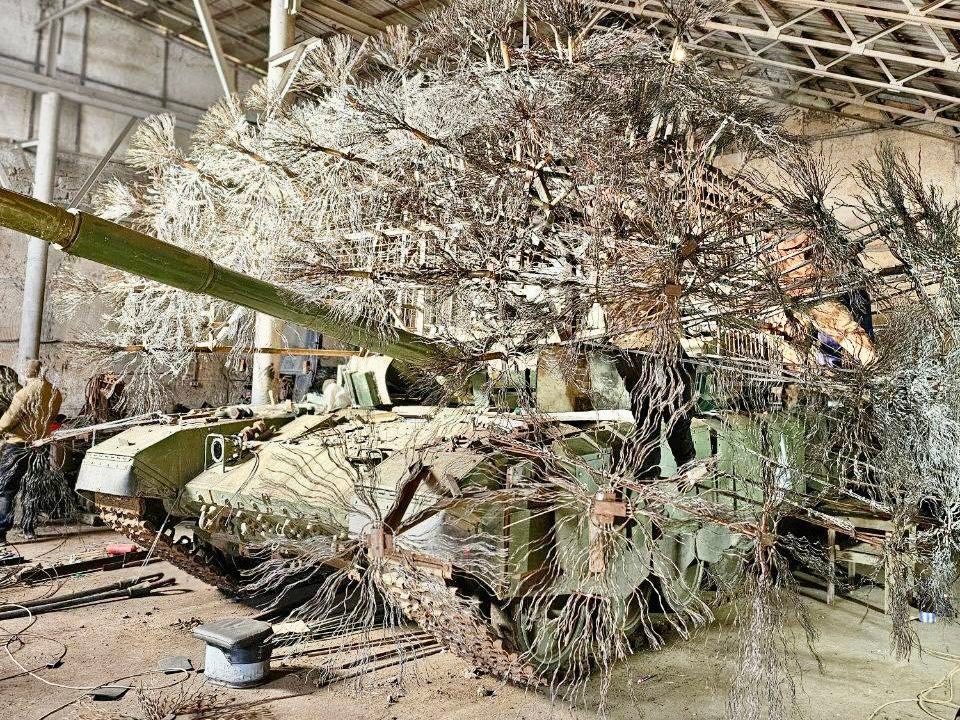
Russian dandelion tank with branching aluminum hairs and Kevlar mesh, 2025
Autumn 2025
Hedgehog & dandelion
Thousands of thin aluminum hairs; branching stalks with Kevlar mesh
Russian T-72B3A fitted with the Arena-M active protection system
July 2026
Arena-M
Radar-cued charges shoot drones down instead of blocking them—reported fielded loadout: 12 rounds
Chart: Euromaidan Press

The system had its major combat debut in Ukraine on and around 23 July, over several days of Russian mechanized attacks in the Dobropillia sector of eastern Ukraine's Donetsk Oblast. The Russian Center Group of Forces rolled a large mechanized assault group along the road through the village of Pankivka, roughly 36 km southwest of Kramatorsk and its twin free city of Sloviansk.

Ukrainian drones spotted the tanks coming, and attacked. When the smoke and dust cleared, the Russians had lost at least nine tanks. Reportedly seven of them were T-72B3A models with Arena-M installations.

The losses belie the Arena-M's effectiveness. The protection systems shot down drone after drone, and only stopped shooting down drones when they ran out of projectiles. "In general, it took from 15 to 20 FPV drones to destroy a tank," Ukrainian drone operator Dmytro Putiata reported.

While some of the best-protected turtle, porcupine, and hedgehog tanks have been able to withstand more than 20 FPVs before being immobilized, the add-on metal plates and bars that comprise turtle, porcupine, and hedgehog installations are extremely heavy—and tend to ruin a tank's transmission, weigh on its mobility, and prevent it from rotating its turret and aiming its main gun.

A T-72B3A the moment before a Ukrainian drone strikes.
Explore further

Russia took the cages off its newest tanks. The new Arena-M shield bought them a few minutes.

In other words, the add-on armor prevents tanks from fighting like tanks—using their speed and firepower to close with and destroy the enemy.

The Arena-M installation is bulky but it's not heavy. With Arena-M, a tank can defend itself from drones without sacrificing its mobility. If an Arena-M had, say, 24 rounds instead of just 12, an attacking tank might be able to fend off drones long enough to reach its objective across the disputed gray zone.

But only barely. "15 to 20 FPV drones to destroy a tank is a perfectly viable rate," Czech analyst Jakub Janovsky noted in a comment on Putiata's social media. "At those numbers, Russia could throw its entire [armored fighting vehicle] fleet at the Ukrainian front line over a few months without achieving much more than creating a future low-grade iron ore deposit."

What if the Russians could fit 36 rounds in an upgraded Arena-M installation? Would that be enough?

No one knows for sure until they try. What we do know is that "the Russian military is learning and is experimenting in how to employ armor on a drone-saturated battlefield," explained Rob Lee, an analyst with the Foreign Policy Research Institute in Philadelphia. "The Arena-M APS demonstrated effectiveness and will likely be improved."

And those improvements could unlock those thousands of tanks the Russians have parked for want of drone defenses.

A Russian T-90 dandelion tank.
Explore further

Russia mastered drone-proofing its tanks—Ukraine is copying its tricks

Ukraine’s ground robots ran nearly 17,000 missions in June. Every one depended on holding signal, problem this new antenna targets

16 août 2026 à 12:14

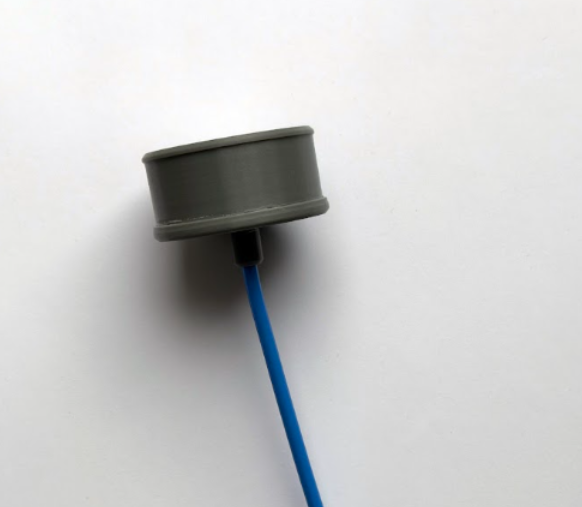
Ukraine's BlueBird Tech unveiled the CLOVER 5.8 GHz antenna. Source: RBC-Ukraine

A Ukrainian company has built a tiny antenna to solve one of the drone war's hardest problems: staying connected. Ukraine's BlueBird Tech has unveiled the CLOVER 5.8 GHz antenna, a 25-gram device for transmitting and receiving radio signals, according to RBC-Ukraine.

The antenna addresses the connectivity problem at the center of Ukraine's drone war. Keeping drones linked to their operators under heavy jamming is one of the war's persistent technical challenges, and the CLOVER is one Ukrainian company's answer.

Previously, Serhii “Flash” Beskrestnov, an adviser to the Ukrainian president, confirmed that the main problem for Ukrainian forces operating some 25,000 combat robots is not hardware limitations but connectivity restrictions.

The design is built to hold a link in motion

The antenna's shape is engineered for stability. Due to its clover design, circular polarization, and omnidirectional radiation pattern, the antenna works even in dynamic conditions.

Weight is decisive for a drone. At 25 grams, the CLOVER adds almost nothing to a small aircraft, leaving weight for payload, battery, or range, which matters for the small FPV drones that do much of the fighting, where a reliable signal and low weight are both at a premium.

It works on drones and ground robots

The antenna is not only for flying drones. It can be installed and used on ground robotic systems as well as FPV drones, and extended to the uncrewed ground vehicles that Ukraine increasingly uses for logistics and evacuation, which face the same connectivity challenge.

In June, Ukrainian ground robots ran nearly 17,000 supply and evacuation missions. Every one of those runs depends on the robot holding a signal, the problem the CLOVER is built to address.

It is built for quick integration. Despite its compact size, the CLOVER covers a wide 4.9-6.1 GHz range and comes with an SMA male connector and an RG402 cable, allowing it to integrate quickly into drone-detection tools, radio-monitoring complexes, and measurement equipment. It is compatible with the main systems on the market.

  • ✇Euromaidan Press
  • Stranded beside a frontline road, a dog found rescuers in Ukrainian soldiers
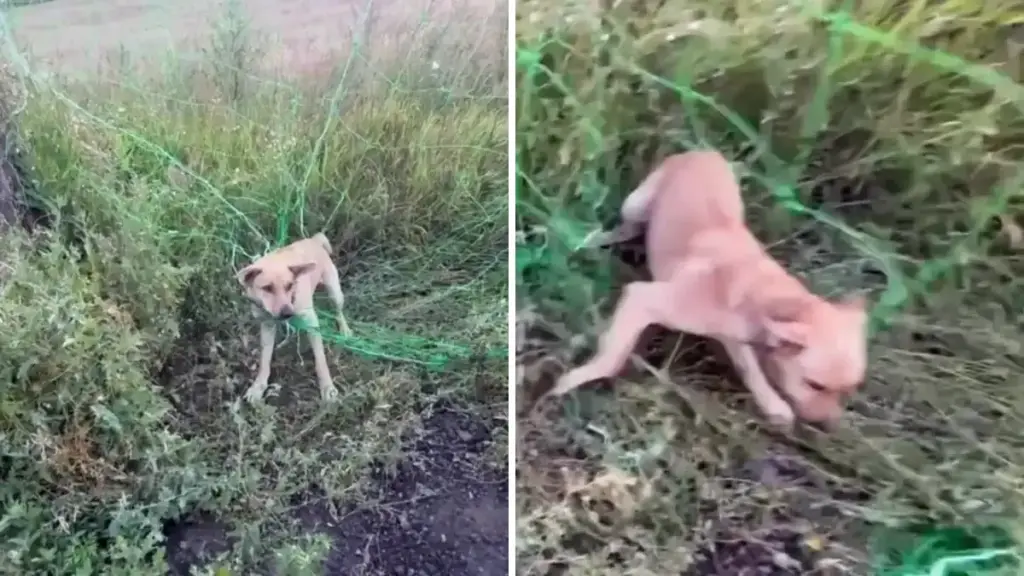
    A dog was caught in mesh beside a frontline road and could not free itself. Ukrainian soldiers stopped their vehicle, cut away the netting, and released it, as footage Ukrainian serviceman Denys Lysak posted on 10 August 2026 shows. The netting is meant to shield traffic from Russian FPV drones, but it can also trap animals left in the combat zone. The roadside rescue reflects how Russia's war against Ukraine has adversely impacted animals throughout Ukraine, while also
     

Stranded beside a frontline road, a dog found rescuers in Ukrainian soldiers

16 août 2026 à 09:44

Side-by-side screenshots show a tan dog trapped in green anti-drone netting and moving free after Ukrainian soldiers cut it loose.

A dog was caught in mesh beside a frontline road and could not free itself. Ukrainian soldiers stopped their vehicle, cut away the netting, and released it, as footage Ukrainian serviceman Denys Lysak posted on 10 August 2026 shows.

The netting is meant to shield traffic from Russian FPV drones, but it can also trap animals left in the combat zone. The roadside rescue reflects how Russia's war against Ukraine has adversely impacted animals throughout Ukraine, while also highlighting a familiar relationship along Ukraine’s front, where soldiers feed, shelter, and sometimes take in the animals they encounter.

Lysak wrote that animals left without owners suffer greatly in areas affected by fighting. Ukrainian troops try to feed, evacuate, or shelter them, he said. Many units have taken in several rescued cats and dogs.

“Unfortunately, you can’t help all of them, but we try,” Lysak said.

The animals Ukrainian troops find at the front

Across Ukraine, animals are caught in the crossfire—injured, stranded, or driven from their habitats. Sometimes Ukrainian troops reach them in time, as they did during the Special Operations Forces' (SSO) “Operation Bambi.”

Rangers from the 6th Separate Special Operations Regiment found a frightened fawn while clearing a Russian position, according to footage the SSO released on 15 August. The video shows the animal nestled against one soldier as the unit moved out.

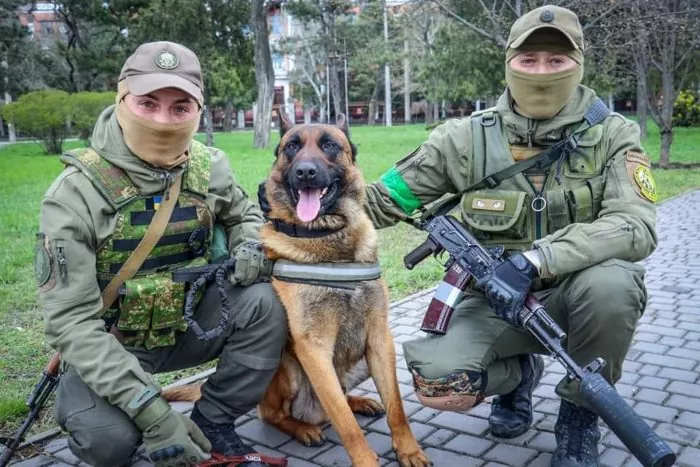
Some animals remain with the units that find them. Euromaidan Press reported in 2022 on Max, a Belgian shepherd abandoned by a Russian National Guard unit in Mykolaiv Oblast. A villager sheltered him before handing him to Ukraine’s National Guard, where handlers began teaching the former Russian service dog to follow commands in Ukrainian.

Photo of Max. Source: 19th Regiment of the National Guard of Ukraine

The fawn’s destination remains unknown. The SSO said only that it had been evacuated from the danger zone. Kharkiv volunteers had evacuated 18,800 animals by October 2024, but only around one-fifth had been reunited with their owners.

Russia's assault on Ukraine's ecosystem

Russia’s war has also affected wildlife beyond the trenches. Marine biologist Ivan Rusev estimated that more than 100,000 Black Sea dolphins have died since 2022, with sonar, underwater blasts, mines, and pollution among the suspected causes.

Russia’s destruction of the Kakhovka Dam dealt another blow. The floodwaters swept through areas holding 70% of the world’s Nordmann’s birch mice and half its sandy blind mole-rats, while killing tens of thousands of nesting birds.

Russia covered its Pantsir-S1 in camouflage. Ukraine’s naval platforms delivered the drones that burned it

7 août 2026 à 06:29

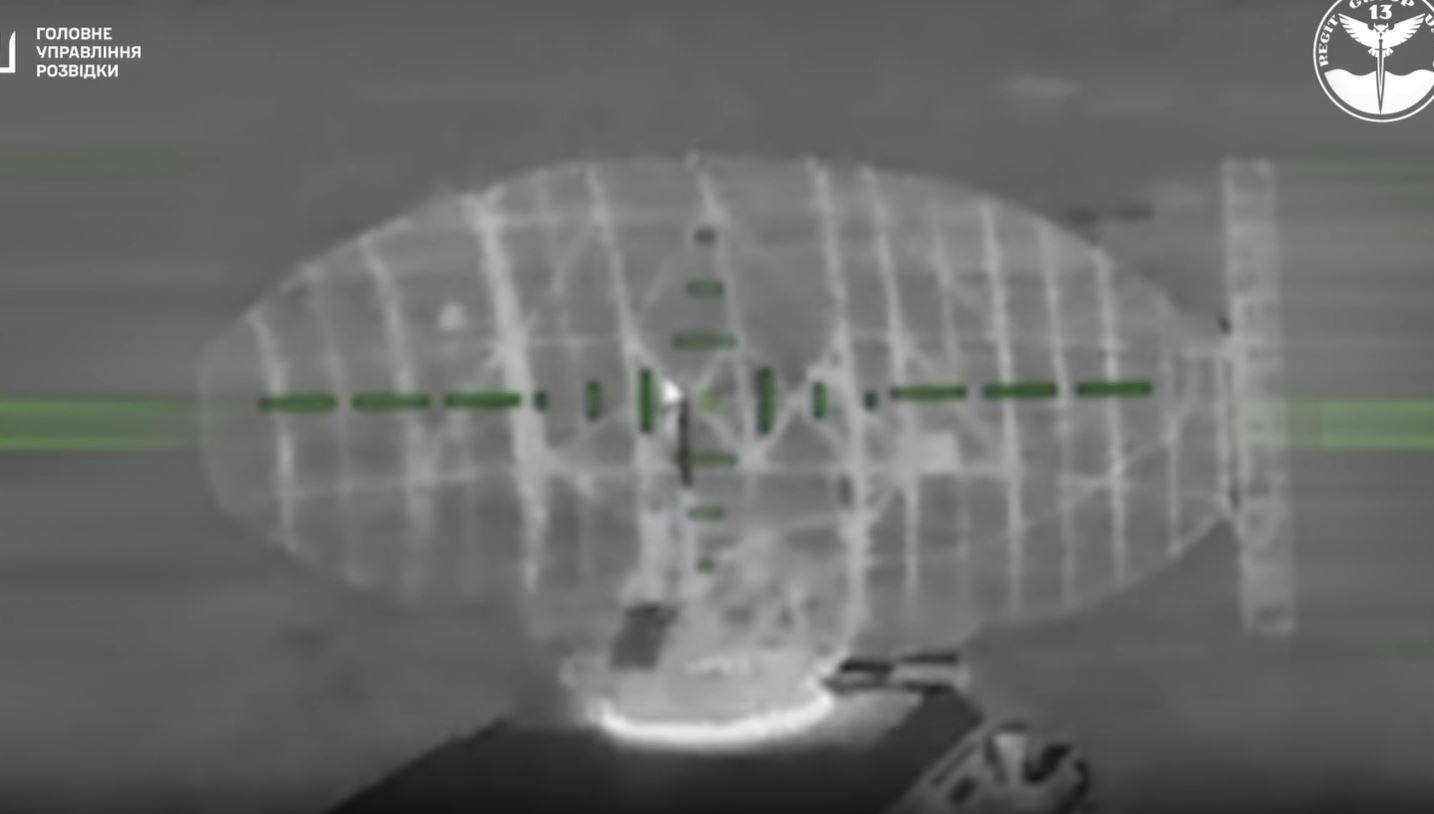
russia hid its pantsir under camouflage nets crimea · post russian pantsir-s1 air defense system covered occupied seen through drone targeting crosshairs moments before strike hur's group 13 early 2026

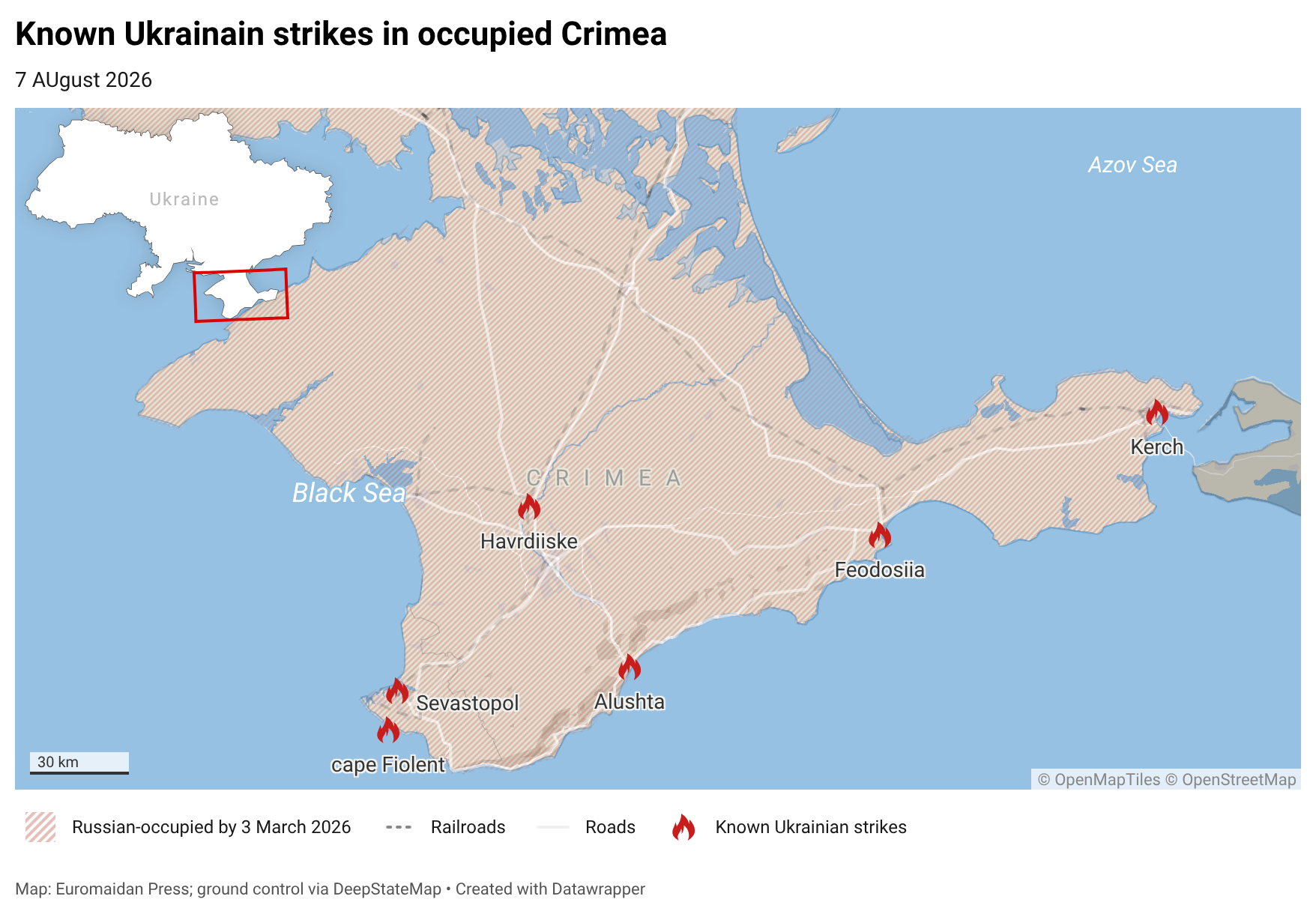
Ukraine's Main Directorate of Intelligence (HUR) destroyed a Pantsir-S1 air defense system worth an estimated $15 million and a military crane in occupied Crimea, HUR reported. The agency's Group 13 used maritime drones as drone carriers to deliver the strikes on ground targets. Separately, monitoring channels reported explosions across the peninsula from Kerch to Sevastopol overnight on 7 August, hitting the airfield Russia uses to launch Shaheds at Ukrainian cities.

The strikes on air defense run alongside a broader isolation campaign. Ukraine's drones have hit 201 shadow fleet vessels in three weeks, the Kerch Strait supply route is blocked indefinitely, and Ukraine's defense minister said the drone campaign is turning Crimea into an island. Earlier this week, the SBU damaged two FSB coast guard ships in Kerch that had been guarding the Crimean Bridge.

FPV drones launched from Magura platforms destroy air defense

HUR's Group 13 used Magura naval platforms as floating carriers for FPV drones. The drones flew from the platforms to strike a camouflaged Pantsir-S1 and a military crane on land, the agency's video shows. HUR estimated the destroyed air defense system at $15 million.

HUR did not specify the exact location but said the operation took place in early August 2026. The Pantsir-S1 is a short-range gun-and-missile system Russia deploys to protect higher-value assets such as S-400 batteries and command posts. Each one destroyed leaves a gap in the layered coverage Russia relies on over the peninsula.

The agency noted that Group 13 operators recently struck a Podlyot radar control vehicle and a Parol-4 radar interrogator in Crimea as well.

The Pantsir kill adds to a months-long campaign that has destroyed nearly 200 Russian air defense assets in the first half of 2026 alone by the Unmanned Systems Forces.

Overnight strikes sweep peninsula from Kerch to Sevastopol

Separately, overnight on 7 August, Ukraine struck at least six locations across occupied Crimea.

Monitoring Telegram channel Krymsky Veter reported explosions and gunfire in Kerch at 02:38. Near Alushta, four strong explosions were heard in the village of Malorichenske close to a large power substation. In Sevastopol, mobile fire groups engaged targets without an air-raid alert, and residents reported a powerful explosion near Cape Fiolent.

two russian radars destroyed crimea one ukrainian sea drone never touched shore · post parol-4 radar interrogator part friend-or-foe identification system seen fpv moments before strike occupied late 2026 video
Explore further

Ukraine’s sea drone that never touched the shore struck two Russian radars in occupied Crimea

The heaviest strikes hit the Hvardiiske military airfield, which Russia uses to launch Shahed attack drones against Ukrainian cities. Hits landed in two waves, from 03:30 to 03:39 and from 04:34 to 04:47. A fuel and lubricants depot caught fire, and small-arms ammunition began detonating, Krymsky Veter reported. Residents described two fire sites visible for kilometers. The Crimean Bridge was temporarily closed during the strikes.

In Feodosia, initial reports of a strike on the oil depot were corrected: the hit likely landed on a concentration of Russian military equipment at the former 13th military compound on the Kerch Highway. Krymsky Veter noted the same compound was struck on 22 June. A vessel also burned at sea off Gelendzhik overnight.

No official confirmation of the strikes' results has been issued. 

  • ✇Euromaidan Press
  • How Russia built a jam-proof drone force—and the Chinese supply chain that could still break it
    Ukrainian jamming worked too well: it compelled Russian drone developers to innovate Now many Russian drones communicate via unjammable optical fiber or jam-resistant mesh radio But the Russians can't make all the hardware themselves Instead, they rely on Chinese imports Frustrated by Ukrainian electronic warfare, Russia transformed its drone arsenal to be harder—or impossible—to jam. Most of Russia's tiny first-person-view drones now send and receive s
     

How Russia built a jam-proof drone force—and the Chinese supply chain that could still break it

Par : David Axe
6 août 2026 à 15:51

ukraine develops fiber-optic module fitting all drones integrates inertial navigation silkworm fiber optic drone unmanned systems forces shovkopryad ukraine’s testing universal designed types while firm installs its optical technology have

  • Ukrainian jamming worked too well: it compelled Russian drone developers to innovate
  • Now many Russian drones communicate via unjammable optical fiber or jam-resistant mesh radio
  • But the Russians can't make all the hardware themselves
  • Instead, they rely on Chinese imports

Frustrated by Ukrainian electronic warfare, Russia transformed its drone arsenal to be harder—or impossible—to jam.

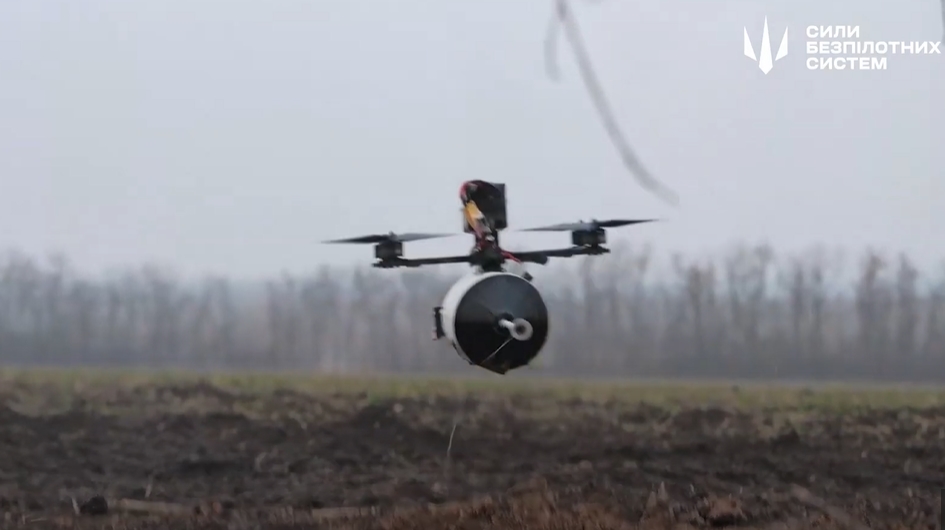
Most of Russia's tiny first-person-view drones now send and receive signals via jam-proof fiber optic cable instead of wireless radio. For heavier one-way attack drones that travel too far for fiber optics, the Russians have mostly switched to jam-resistant mesh radio networks made up of many interconnected senders and receivers.

In both cases, China is key. Chinese companies sell Russian companies the optical fibers and mesh modems that the Russians install in their drones. In other words, Beijing is the critical enabler in Moscow's ongoing aerial aggression.

That's the unsurprising yet sobering conclusion that Tatarigami, the founder of the Ukrainian Frontelligence Insight analysis group, reached in a recent investigation.

It's not enough for Ukrainian forces to shoot down or otherwise defend against Russian drones, or to fight back with their own drones. To win the drone war, Ukraine and its allies must "step up pressure on Chinese manufacturers," Tatarigami wrote.

Russia's response to electronic warfare wasn't a single solution. It evolved along two major paths: fiber-optic drones and mesh networks. This thread summarizes Frontelligence Insight analysis based on OSINT data and a report by the Center for Defense Reforms. Thread🧵 pic.twitter.com/k0v0ZeWKYB

— Tatarigami_UA (@Tatarigami_UA) July 30, 2026

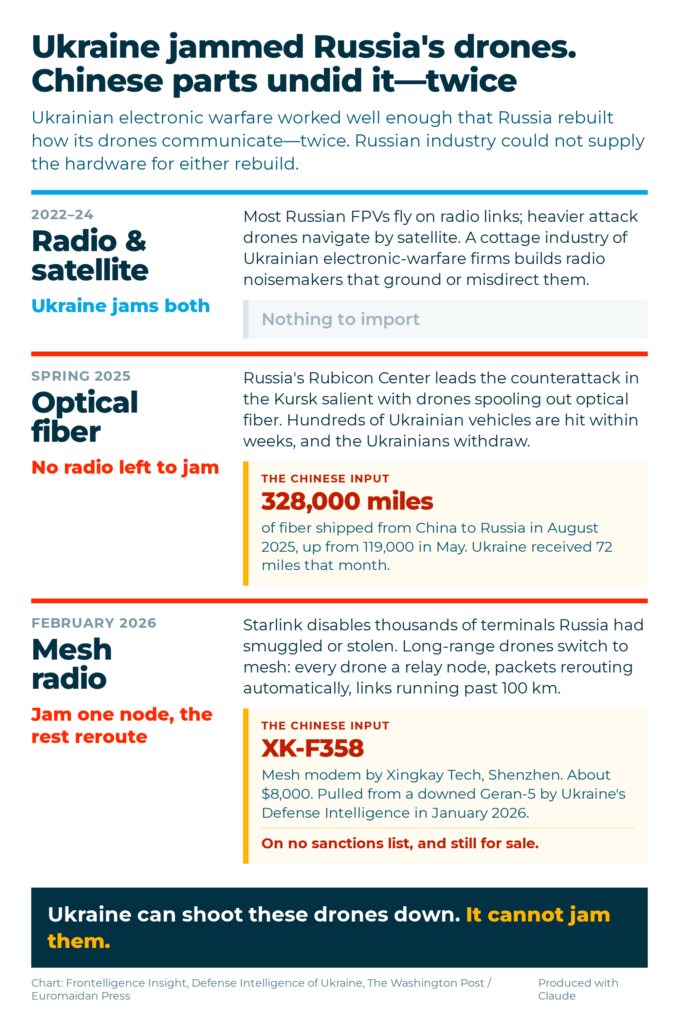
As the drone war over Ukraine ramped up in 2022 and 2023, most Russian FPVs were wireless models. And most heavier one-way attack drones navigated via satellite. Both classes of drone could be jammed. A cottage industry of Ukrainian electronic warfare producers sprung up. Each firm offered some variation of a radio noisemaker that can ground or misdirect wireless and satellite-guided drones.

The jamming worked. Combined with kinetic defenses—guns and missiles—and add-on protections such as mesh, cages and netting, the jamming blunted the impact of Russia's drone arsenal. But the Russians adapted. The turning point came in the spring of 2025, when Russia's elite Rubicon Center drone group led the counterattack against Ukrainian troops occupying parts of Kursk Oblast in western Russia.

Rubicon's fiber optic FPVs wreaked havoc on Ukrainian forces in the Kursk salient, damaging or destroying hundreds of trucks and other vehicles in the span of a few weeks. Starving for supplies and in danger of being cut off, the Ukrainians retreated.

But the Russian adaptation was just beginning. The Russians are now launching 10,000 FPVs a day. And in certain key sectors, 60% of the FPVs were fiber optic models, according to Tatarigami. The Ukrainians can shoot down these drones and block them with armor, nets and earthworks. They can also strike at the Russian FPV teams before the Russians can launch their FPVs.

But there's one thing the Ukrainians can't do: they can't jam the drones.

Over the past six months, SBS has been able to narrow the drone usage gap. They started at 1 for every 3 Russian drones in February, after russia spiked to 9K strikes and are running at 1 for every 2 by August. pic.twitter.com/9GWrU0fx4W

— Vitaly (@M0nstas) August 4, 2026

Unjammable drones

Jamming continued to work against many one-way attack drones that must travel hundreds or even thousands of kilometers—too far for optical fiber. Another turning point came in February, when Elon Musk's Starlink bricked Russia's thousands of smuggled and stolen satellite terminals, some of which Russian forces used to control the approximately 5,000 Geran attack drones they launch every month.

The Starlink shutdown compelled Russian developers to accelerate the transformation of the one-way attack drone force. "Russia's second adaptation was mesh networking, routing data through mesh modems to keep communications alive across both short and long-range drones," Tatarigami explained.

It's possible to jam a mesh radio network, but it's hard. Every drone in a given network is a node. It's not enough to jam a few of them; you have to jam all of them.

Chart tracking how Russian drones became resistant to Ukrainian jamming in three stages. From 2022 to 2024, Russian FPVs flew on radio links and heavier attack drones navigated by satellite, and Ukrainian electronic warfare could jam both. In spring 2025, Russia's Rubicon Center attacked the Kursk salient with fiber-optic drones that carry no radio signal to jam; China shipped Russia 328,000 miles of optical fiber in August 2025 against 72 miles to Ukraine. In February 2026, after Starlink disabled Russia's smuggled terminals, long-range drones switched to Chinese XK-F358 mesh modems, which carry no sanctions and remain on sale.
Chart: Euromaidan Press

If there's a constraint on Russia's switch to fiber optics and mesh networks, it's that Russian industry can't produce all the necessary hardware. "Unable to meet domestic demand, Russia turned to China," Tatarigami wrote.

The Washington Post reported Chinese optical fiber shipments to Russia growing from 119,000 miles in May 2025 to 328,000 miles that August. China sent Ukraine 72 miles the same month. For mesh networking, the Russians came to depend on XK-F358 modems from China's Shenzhen Xingkai Technology.

Ukraine's overstretched air defenses can't shoot down every Russian attack drone. Ukrainian troops and vehicle crews can't hide from 10,000 Russian FPVs a day. To defeat Russia's jam-proof drones, Ukraine and its allies must cut off the supply of Chinese parts, Tatarigami stressed.

They should extend export controls to modem-makers and producers of optical fiber, reels for the fiber and equipment associated with fiber production. "The recommendation is to expand sanctions beyond individual firms to the entire supply chain," Tatarigami advised.

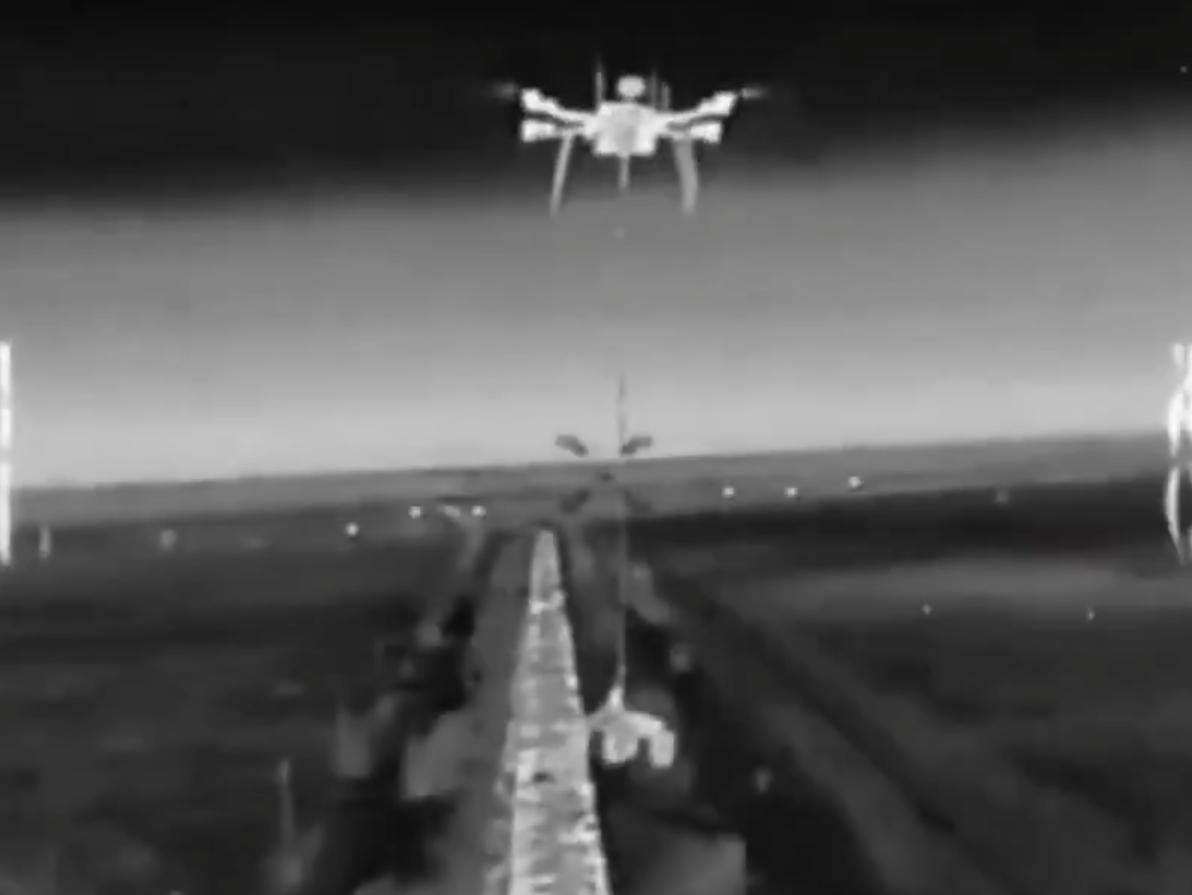
All-robot air assault.
Explore further

Some Ukrainian bomber drones aren’t carrying bombs anymore. They’re carrying robots.

❌